

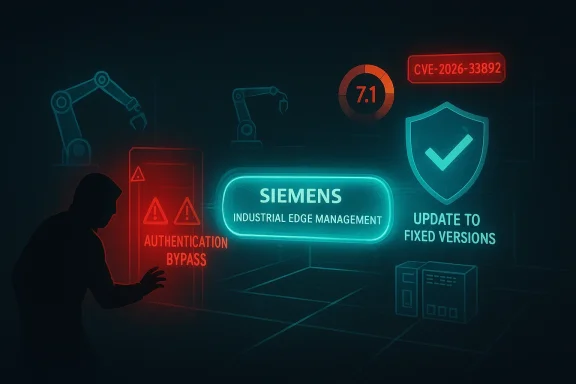
Industrial Edge Management is under fresh scrutiny after Siemens disclosed an authorization bypass flaw that could let an unauthenticated remote attacker tunnel into connected Industrial Edge devices through the platform’s remote connection feature. The issue is tracked as CVE-2026-33892, carries a CVSS 3.1 score of 7.1, and affects multiple branches of Industrial Edge Management Pro V1, Pro V2, and Industrial Edge Management Virtual. Siemens has already published fixed versions, and the message to operators is blunt: update now, or assume your remote access path may be exposing more than you intended.
Siemens Industrial Edge sits at the intersection of OT and IT, giving manufacturers a centralized way to manage edge devices, deploy apps, and maintain distributed infrastructure across plants and sites. Siemens describes the platform as a Docker-based and centrally managed architecture designed to simplify software rollout, lifecycle management, and secure data handling across industrial environments. That design is exactly why a management-plane flaw matters: if the control layer is compromised, the attacker may not need to attack the devices one by one.
The new advisory is a classic example of how industrial security problems increasingly live in the remote administration layer, not only in the device firmware itself. According to Siemens, the vulnerability allows bypass of user authentication on remote connections to devices, but only when the attacker has identified the header and port used for those connections and when remote access is enabled for the device. In practice, that means the flaw is conditional, but still serious, because the attacker’s end goal is access to the device tunnel itself.
The timing also matters. Siemens published the advisory on April 14, 2026, and CISA republished it on April 21, 2026, which is a normal but important cadence for industrial vulnerability coordination. For defenders, that means this is not an abstract future issue; it is a current patching and exposure-reduction task with a clear remediation path.
The affected version ranges are also narrow enough to be actionable. Siemens lists Industrial Edge Management Pro V1 from 1.7.6 through 1.15.16, Pro V2 from 2.0.0 through 2.1.0, and Virtual from 2.2.0 through 2.7.9 as affected. Siemens recommends updating to V1.15.17, V2.1.1, or V2.8.0 respectively. That specificity is useful, because industrial estates rarely run a single software branch. They run several.
A small but important point: Siemens says the flaw affects the remote connection feature, not the security features of the device itself, such as app-specific authentication. That distinction matters because it suggests the problem lives in the management path, not in the endpoint’s internal access controls. In other words, the attack may not “break” the device directly; it may simply circumvent the gatekeeper that gets you to it.
That combination makes the issue more nuanced than a simple open-door authentication bypass. It is not enough to spray packets blindly. But once an attacker has identified the connection path, the flaw appears to let them tunnel to the device without proper authentication checks. For industrial operators, that is the dangerous part: tunneling is often the step that turns “network reachability” into “operational reachability.”
Siemens classifies the issue as CWE-305: Authentication Bypass by Primary Weakness. That designation suggests a core trust failure in the product’s access-control logic, not a one-off configuration mistake. In security terms, this is the kind of bug that can survive normal hardening if the underlying code path remains exposed.
The score also reflects the likely operational impact. Siemens says successful exploitation allows an attacker to reach connected Industrial Edge devices through the remote connection feature, which creates a pathway to confidentiality, integrity, and availability effects. In the industrial world, even partial impact can be enough to disrupt maintenance, diagnostics, or fleet operations.
A CVSS score is not a prediction of a breach, but it is a useful indicator of how quickly defenders should move. In this case, the combination of network exposure, no required prior access, and management-plane reach should be enough to push the issue into the same urgency bucket as other critical access-path bugs. Not because the world ends with one advisory, but because these are the exact defects attackers look for first.
This is why management-plane flaws often feel worse than individual device bugs. A problem at the device level is typically local. A problem in the orchestration layer can scale across entire fleets, sites, or business units. That amplification effect is what makes a “mere” authentication issue relevant to manufacturing, logistics, and any organization that treats edge compute as a strategic platform rather than a point product.
For Pro V1, the affected range is 1.7.6 through 1.15.16. For Pro V2, it is 2.0.0 through 2.1.0. For Virtual, it is 2.2.0 through 2.7.9. Siemens says the fixed releases are 1.15.17, 2.1.1, and 2.8.0 or later, respectively.
Those version bands matter because they imply that many operators may already have some mitigation maturity in place, but not necessarily the right patch level. Industrial fleets often lag by one or two releases because of validation cycles, test windows, and downtime constraints. That is exactly why advisory writers include explicit version gates.
The vendor also points operators to its industrial security operational guidelines and product manuals. That is more than boilerplate. In a platform whose purpose is to mediate remote access to industrial devices, deployment topology, firewall placement, and trust boundaries are part of the security model. A patch on its own does not remove an overexposed management plane.
If there is a practical lesson here, it is that the fix is not only about software currency. It is also about verifying whether the remote connection feature is enabled where it should not be, whether the management interface is visible to too many networks, and whether the headers and ports associated with the tunnel are discoverable beyond the intended trust boundary. The patch closes the flaw; the architecture closes the opportunity.
The practical significance is that edge management now sits between enterprise systems and production systems. If that layer is bypassed, an attacker may gain not just a foothold but a trusted route into industrial devices. This is especially sensitive in environments that rely on centralized remote support, third-party maintenance, or distributed app orchestration.
That is why the issue is more than an isolated software defect. It is a reminder that the control plane has become a target in its own right. Once a platform is trusted to open tunnels into devices, authenticate sessions, and mediate remote operations, any bypass in that layer becomes a force multiplier.
CISA’s general guidance for control-system security has long emphasized network segmentation, minimized exposure, and careful use of VPNs or other secure remote-access methods. Those recommendations are especially relevant here because the flaw is only dangerous when the management path is reachable in the first place. The best exploit reduction is often not clever detection; it is shrinking the attack surface.
The remote-access angle is also a reminder that OT security and enterprise identity hygiene are now inseparable. A misconfigured management path, a too-broad administrative segment, or a forgotten maintenance rule can turn a high-severity vulnerability into an immediate operational risk. That is the pattern defenders have been relearning for years, and it has not become less true.
The likely enterprise concern is not only device access, but policy integrity. If an attacker can tunnel into devices by bypassing authentication, they may be able to view network structure, operational metadata, or maintenance workflows. Even if the device’s internal features remain intact, the attacker may still gain the context needed for later movement or reconnaissance.
This is where Industrial Edge Management behaves like other high-value control-plane software. A compromise at the top can cascade downward into apps, device groups, and operational permissions. The broader the fleet, the more valuable the management layer becomes to an attacker looking for leverage rather than noise.
Remote connection features are often used for troubleshooting, vendor support, and emergency workarounds. Those operational conveniences can age badly if they remain enabled permanently. In that sense, the vulnerability is a technical issue that exposes a governance issue: who still needs remote access, from where, and under what conditions?
That matters because industrial systems are built around reliability. Operators want predictable paths, stable credentials, and minimal surprises. The problem is that those same traits can make them slow to evolve when security assumptions change. If remote access is already normalized, a flaw in its enforcement can go unnoticed until after the patch window has passed.
Siemens also stresses that local device security features are not affected. That should not lull anyone into complacency. A secure app on the device is only one layer. If the management path is abused, the attacker may still learn enough about the environment to prepare more targeted attacks later.
That is why industrial advisories so often carry both a software fix and a network recommendation. The software patch removes the defect, while segmentation reduces the likelihood that a forgotten tunnel or exposed port turns the defect into an incident. In the plant environment, that dual control is not redundant. It is the difference between theoretical and practical exposure.
One more subtle issue is auditability. If remote access is used widely, it can be hard to tell normal maintenance from suspicious tunneling. A bypass in the management layer can muddy logs and complicate incident response, especially if multiple teams rely on the same control plane. That is exactly the kind of ambiguity attackers love.
The company’s Industrial Edge messaging also emphasizes security-by-design, centralized administration, and flexible deployment models, including on-premises, Kubernetes-based, and cloud-hosted options. Those deployment choices are useful, but they also mean defenders must think carefully about where trust ends and where management begins.
What makes advisories like this noteworthy is that they expose the friction between the promise of remote manageability and the reality of secure remote control. The more broadly a platform can reach devices, the more dangerous a mistake in its authentication path becomes.
This does not mean Siemens’ platform is uniquely weak. It means that modern industrial platforms, by their nature, concentrate trust and therefore attract bugs around identity, tunneling, and role enforcement. The lesson for defenders is that “centrally managed” should always be translated into “centrally sensitive.”
It also means procurement and architecture teams should ask harder questions about remote device access, especially when vendors market convenience features as productivity enablers. Convenience is a feature. It is also a cost.
The third concern is patch timing. Industrial environments often patch slowly, and for understandable reasons. But in this case the security benefit is immediate and the workarounds are mostly exposure-based rather than functional. That means organizations delaying remediation are essentially choosing to keep a risky trust path open while knowing there is a fix available. That is a hard choice to defend after the fact.
A second thing to watch is whether defenders use this as a trigger to audit their remote-access architecture more broadly. If a management tunnel is enabled, discoverable, and reachable from more networks than intended, the vulnerability becomes a much bigger issue than the advisory headline suggests. This is where policy, segmentation, and patching must align.
Finally, it will be worth watching whether Siemens issues any follow-up hardening guidance beyond the current advisory. Industrial advisories often evolve as customers validate fixes in the field, and additional clarity on deployment patterns, logging, or exposure reduction can help operators make better decisions. In a control environment, the best outcome is not just a patched bug; it is a cleaner trust model.
Source: CISA Siemens Industrial Edge Management | CISA
 Overview
Siemens Industrial Edge sits at the intersection of OT and IT, giving manufacturers a centralized way to manage edge devices, deploy apps, and maintain distributed infrastructure across plants and sites. Siemens describes the platform as a Docker-based and centrally managed architecture designed to simplify software rollout, lifecycle management, and secure data handling across industrial environments. That design is exactly why a management-plane flaw matters: if the control layer is compromised, the attacker may not need to attack the devices one by one.The new advisory is a classic example of how industrial security problems increasingly live in the remote administration layer, not only in the device firmware itself. According to Siemens, the vulnerability allows bypass of user authentication on remote connections to devices, but only when the attacker has identified the header and port used for those connections and when remote access is enabled for the device. In practice, that means the flaw is conditional, but still serious, because the attacker’s end goal is access to the device tunnel itself.
The timing also matters. Siemens published the advisory on April 14, 2026, and CISA republished it on April 21, 2026, which is a normal but important cadence for industrial vulnerability coordination. For defenders, that means this is not an abstract future issue; it is a current patching and exposure-reduction task with a clear remediation path.
The affected version ranges are also narrow enough to be actionable. Siemens lists Industrial Edge Management Pro V1 from 1.7.6 through 1.15.16, Pro V2 from 2.0.0 through 2.1.0, and Virtual from 2.2.0 through 2.7.9 as affected. Siemens recommends updating to V1.15.17, V2.1.1, or V2.8.0 respectively. That specificity is useful, because industrial estates rarely run a single software branch. They run several.
A small but important point: Siemens says the flaw affects the remote connection feature, not the security features of the device itself, such as app-specific authentication. That distinction matters because it suggests the problem lives in the management path, not in the endpoint’s internal access controls. In other words, the attack may not “break” the device directly; it may simply circumvent the gatekeeper that gets you to it.
What Siemens Disclosed
The vulnerability in plain terms
Siemens’ language is unusually direct. The affected management systems do not properly enforce user authentication on remote device connections, which could allow an unauthenticated remote attacker to impersonate a legitimate user. The advisory also states that exploitation requires knowledge of the correct header and port, and that the remote connection function must already be enabled for the target device.That combination makes the issue more nuanced than a simple open-door authentication bypass. It is not enough to spray packets blindly. But once an attacker has identified the connection path, the flaw appears to let them tunnel to the device without proper authentication checks. For industrial operators, that is the dangerous part: tunneling is often the step that turns “network reachability” into “operational reachability.”
Siemens classifies the issue as CWE-305: Authentication Bypass by Primary Weakness. That designation suggests a core trust failure in the product’s access-control logic, not a one-off configuration mistake. In security terms, this is the kind of bug that can survive normal hardening if the underlying code path remains exposed.
Why the CVSS score matters
The vendor assigns a CVSS v3.1 base score of 7.1, which lands in the high-severity category. The vector — AV:N/AC:L/PR:N/UI:R/S:C/C:L/I:L/A:L — is a tell. The flaw is network-reachable, low complexity, and requires no prior privileges, but it does require user interaction. That combination is less dramatic than a fully unauthenticated wormable bug, yet still highly relevant in industrial remote-support workflows where users may regularly initiate management sessions.The score also reflects the likely operational impact. Siemens says successful exploitation allows an attacker to reach connected Industrial Edge devices through the remote connection feature, which creates a pathway to confidentiality, integrity, and availability effects. In the industrial world, even partial impact can be enough to disrupt maintenance, diagnostics, or fleet operations.
A CVSS score is not a prediction of a breach, but it is a useful indicator of how quickly defenders should move. In this case, the combination of network exposure, no required prior access, and management-plane reach should be enough to push the issue into the same urgency bucket as other critical access-path bugs. Not because the world ends with one advisory, but because these are the exact defects attackers look for first.
A management-plane problem, not a device-only problem
Industrial Edge Management is central to the platform’s promise. Siemens markets Industrial Edge as a way to centrally administer edge devices, manage app rollouts, and maintain secure connectivity across distributed environments. That makes the management console a high-value target by design. If the console fails closed, the whole stack is safer. If it fails open, the trust model collapses upward.This is why management-plane flaws often feel worse than individual device bugs. A problem at the device level is typically local. A problem in the orchestration layer can scale across entire fleets, sites, or business units. That amplification effect is what makes a “mere” authentication issue relevant to manufacturing, logistics, and any organization that treats edge compute as a strategic platform rather than a point product.
- The flaw affects the remote connection path.
- The attacker may not need prior authentication.
- The device itself still enforces its own local security features.
- The impact is broader when remote access is already enabled.
- The management layer is the real control point.
Affected Versions and Remediation
What is impacted
Siemens identifies three product families as affected: Industrial Edge Management Pro V1, Industrial Edge Management Pro V2, and Industrial Edge Management Virtual. The version windows are precise, which is helpful for operations teams that maintain formal asset inventories and build-specific maintenance records.For Pro V1, the affected range is 1.7.6 through 1.15.16. For Pro V2, it is 2.0.0 through 2.1.0. For Virtual, it is 2.2.0 through 2.7.9. Siemens says the fixed releases are 1.15.17, 2.1.1, and 2.8.0 or later, respectively.
Those version bands matter because they imply that many operators may already have some mitigation maturity in place, but not necessarily the right patch level. Industrial fleets often lag by one or two releases because of validation cycles, test windows, and downtime constraints. That is exactly why advisory writers include explicit version gates.
Siemens’ recommended action
Siemens’ primary remediation is straightforward: update to the latest versions. The company also recommends limiting network access to trusted parties only and following its broader industrial security guidance. That is consistent with standard OT defense practice, where patching and segmentation work best together rather than in isolation.The vendor also points operators to its industrial security operational guidelines and product manuals. That is more than boilerplate. In a platform whose purpose is to mediate remote access to industrial devices, deployment topology, firewall placement, and trust boundaries are part of the security model. A patch on its own does not remove an overexposed management plane.
If there is a practical lesson here, it is that the fix is not only about software currency. It is also about verifying whether the remote connection feature is enabled where it should not be, whether the management interface is visible to too many networks, and whether the headers and ports associated with the tunnel are discoverable beyond the intended trust boundary. The patch closes the flaw; the architecture closes the opportunity.
A simple action checklist
- Inventory every Industrial Edge Management deployment and confirm the exact branch.
- Verify whether any instance is running below the fixed version threshold.
- Check whether remote device connections are enabled where they are not needed.
- Restrict network exposure to trusted administrative segments only.
- Schedule and validate upgrades in a maintenance window.
Why This Matters for Critical Manufacturing
Industrial edge is now part of the control plane
CISA places the affected systems in the Critical Manufacturing sector, and Siemens notes that Industrial Edge is deployed worldwide. That combination is increasingly common in modern manufacturing, where edge platforms are no longer experimental add-ons but core infrastructure for telemetry, app delivery, and operations support.The practical significance is that edge management now sits between enterprise systems and production systems. If that layer is bypassed, an attacker may gain not just a foothold but a trusted route into industrial devices. This is especially sensitive in environments that rely on centralized remote support, third-party maintenance, or distributed app orchestration.
That is why the issue is more than an isolated software defect. It is a reminder that the control plane has become a target in its own right. Once a platform is trusted to open tunnels into devices, authenticate sessions, and mediate remote operations, any bypass in that layer becomes a force multiplier.
Remote access changes the risk picture
Siemens says exploitation requires the remote connection feature to be enabled. That should not be read as reassurance. In real deployments, remote access is often enabled because operators need diagnostics, vendor support, and maintenance flexibility. Security teams know this tension well: the more useful a remote path is, the more likely it is to remain permanently enabled.CISA’s general guidance for control-system security has long emphasized network segmentation, minimized exposure, and careful use of VPNs or other secure remote-access methods. Those recommendations are especially relevant here because the flaw is only dangerous when the management path is reachable in the first place. The best exploit reduction is often not clever detection; it is shrinking the attack surface.
The remote-access angle is also a reminder that OT security and enterprise identity hygiene are now inseparable. A misconfigured management path, a too-broad administrative segment, or a forgotten maintenance rule can turn a high-severity vulnerability into an immediate operational risk. That is the pattern defenders have been relearning for years, and it has not become less true.
- Remote access is a business requirement, but it is also a risk multiplier.
- Industrial edge platforms are now part of the enterprise trust chain.
- Management interfaces can be more valuable than the devices they manage.
- Segmentation matters as much as patching.
- Disabled exposure is safer than trusted exposure.
Enterprise Impact
Centralized administration cuts both ways
For enterprise teams, Industrial Edge Management is attractive because it centralizes deployment, monitoring, and lifecycle control. Siemens explicitly positions the platform as a scalable management system for distributed industrial environments, with centralized administration and role-based controls. That same centralization becomes a liability when the management path is compromised.The likely enterprise concern is not only device access, but policy integrity. If an attacker can tunnel into devices by bypassing authentication, they may be able to view network structure, operational metadata, or maintenance workflows. Even if the device’s internal features remain intact, the attacker may still gain the context needed for later movement or reconnaissance.
This is where Industrial Edge Management behaves like other high-value control-plane software. A compromise at the top can cascade downward into apps, device groups, and operational permissions. The broader the fleet, the more valuable the management layer becomes to an attacker looking for leverage rather than noise.
Integration and exposure
Enterprises are also more likely to integrate Industrial Edge with existing identity, monitoring, and network-security tooling. That is good, but it also creates more assumptions about trust boundaries and more places where a remote-access exception may have been quietly expanded over time. In mature environments, the big question is not whether the platform is patched. It is whether the platform was ever exposed only as narrowly as the policy intended.Remote connection features are often used for troubleshooting, vendor support, and emergency workarounds. Those operational conveniences can age badly if they remain enabled permanently. In that sense, the vulnerability is a technical issue that exposes a governance issue: who still needs remote access, from where, and under what conditions?
- Centralized management increases the blast radius of a flaw.
- Policy drift often matters more than the bug itself.
- Remote support exceptions can become permanent exposure.
- Inventory and trust-boundary reviews are essential.
- Compromise of the control plane can outlive the initial exploit.
Plant-Floor Impact
What operators need to worry about
For plant-floor teams, the immediate concern is not abstract cybersecurity language. It is whether the remote connection path can be used to reach devices that support production, maintenance, or diagnostics. If an attacker can access a device through the management tunnel, they may be able to observe, disrupt, or manipulate operations indirectly.That matters because industrial systems are built around reliability. Operators want predictable paths, stable credentials, and minimal surprises. The problem is that those same traits can make them slow to evolve when security assumptions change. If remote access is already normalized, a flaw in its enforcement can go unnoticed until after the patch window has passed.
Siemens also stresses that local device security features are not affected. That should not lull anyone into complacency. A secure app on the device is only one layer. If the management path is abused, the attacker may still learn enough about the environment to prepare more targeted attacks later.
Why this can become operationally messy
The operational challenge is that fixing a vulnerability like this is rarely just a package update. It can require coordination across OT, IT, network, and vendor-support teams. If the platform is embedded in a maintenance workflow, the organization has to validate that the new version works without breaking remote operations or engineering access.That is why industrial advisories so often carry both a software fix and a network recommendation. The software patch removes the defect, while segmentation reduces the likelihood that a forgotten tunnel or exposed port turns the defect into an incident. In the plant environment, that dual control is not redundant. It is the difference between theoretical and practical exposure.
One more subtle issue is auditability. If remote access is used widely, it can be hard to tell normal maintenance from suspicious tunneling. A bypass in the management layer can muddy logs and complicate incident response, especially if multiple teams rely on the same control plane. That is exactly the kind of ambiguity attackers love.
- Production environments rarely tolerate disruptive patching.
- Remote access is often shared across teams and vendors.
- Audit trails can become noisy or ambiguous.
- Device-local protections do not fully solve management-layer risk.
- Maintenance workflows need revalidation after any patch.
Siemens’ Broader Industrial Security Posture
A familiar advisory pattern
Siemens repeatedly advises customers to protect network access, isolate control-system devices behind firewalls, and follow operational guidelines for industrial security. That pattern appears in this advisory as well. The repetition is not accidental; it reflects the reality that industrial software often sits in environments where access paths are historically broader than they should be.The company’s Industrial Edge messaging also emphasizes security-by-design, centralized administration, and flexible deployment models, including on-premises, Kubernetes-based, and cloud-hosted options. Those deployment choices are useful, but they also mean defenders must think carefully about where trust ends and where management begins.
What makes advisories like this noteworthy is that they expose the friction between the promise of remote manageability and the reality of secure remote control. The more broadly a platform can reach devices, the more dangerous a mistake in its authentication path becomes.
Why this is a vendor-level signal
There is a tendency in industrial security to treat each advisory as a one-off. That is understandable, but incomplete. When management-plane bugs recur in a platform family, it suggests that the attack surface is not merely incidental. It is structural.This does not mean Siemens’ platform is uniquely weak. It means that modern industrial platforms, by their nature, concentrate trust and therefore attract bugs around identity, tunneling, and role enforcement. The lesson for defenders is that “centrally managed” should always be translated into “centrally sensitive.”
It also means procurement and architecture teams should ask harder questions about remote device access, especially when vendors market convenience features as productivity enablers. Convenience is a feature. It is also a cost.
Strengths and Opportunities
Siemens’ advisory is unusually actionable, and that is a strength. The affected ranges are clearly defined, the fixed versions are explicit, and the mitigation guidance is consistent with established industrial security practice. That gives defenders a clean path from triage to remediation.- The version ranges are specific and easy to inventory against.
- The remediation versions are clearly stated.
- The issue is constrained to the remote connection feature.
- Siemens provides a network access mitigation in addition to patching.
- The advisory is current and already republished by CISA.
- The bug is serious, but the fix path is relatively straightforward.
- Operators can use this as a catalyst to review remote-access governance.
Risks and Concerns
The biggest concern is that this is a management-plane authentication bypass, which means the attacker is not trying to break a device. They are trying to abuse the system that grants access to the device. That is often more dangerous because it can preserve the appearance of legitimate activity.- The flaw can enable unauthenticated remote access to device tunnels.
- Attackers may target management systems already exposed for remote support.
- The issue depends on the presence of a known header and port, which may be discoverable.
- Remote access may already be enabled in many deployments.
- Patching delays could leave exposure open across multiple sites.
- Broadly trusted management paths are attractive pivot points.
- Logs may not clearly distinguish abuse from normal admin behavior.
The third concern is patch timing. Industrial environments often patch slowly, and for understandable reasons. But in this case the security benefit is immediate and the workarounds are mostly exposure-based rather than functional. That means organizations delaying remediation are essentially choosing to keep a risky trust path open while knowing there is a fix available. That is a hard choice to defend after the fact.
Looking Ahead
The next thing to watch is how quickly affected operators move from advisory review to actual version upgrades. Siemens has already provided the fixed versions, so the bottleneck is likely to be change-control discipline, asset identification, and the operational willingness to touch systems that support production. In industrial security, those are often the real constraints.A second thing to watch is whether defenders use this as a trigger to audit their remote-access architecture more broadly. If a management tunnel is enabled, discoverable, and reachable from more networks than intended, the vulnerability becomes a much bigger issue than the advisory headline suggests. This is where policy, segmentation, and patching must align.
Finally, it will be worth watching whether Siemens issues any follow-up hardening guidance beyond the current advisory. Industrial advisories often evolve as customers validate fixes in the field, and additional clarity on deployment patterns, logging, or exposure reduction can help operators make better decisions. In a control environment, the best outcome is not just a patched bug; it is a cleaner trust model.
- Confirm whether any deployment is still below the fixed version threshold.
- Review whether remote device connections are enabled where they are not needed.
- Restrict access to trusted administrative networks only.
- Revalidate logging and audit trails after patching.
- Reassess broader Industrial Edge management exposure.
Source: CISA Siemens Industrial Edge Management | CISA
