

CISA’s June 23, 2026 Siemens advisory warns that a high-severity OpenSSL CMS parsing flaw, CVE-2025-15467, reaches deep into Siemens industrial software, networking gear, HMI systems, engineering tools, and edge products that rely on vulnerable OpenSSL 3.x branches. The bug is not a Windows flaw, but Windows shops should not look away. Siemens’ affected catalog includes products that sit beside Windows engineering workstations, Windows-based SCADA deployments, email workflows, OPC UA tooling, and plant-floor networks where “just update OpenSSL” is rarely a one-line fix. The real story is not merely a cryptographic library bug; it is the way a small parser mistake can ripple through industrial estates built from long-lived software, embedded appliances, and operational exceptions.
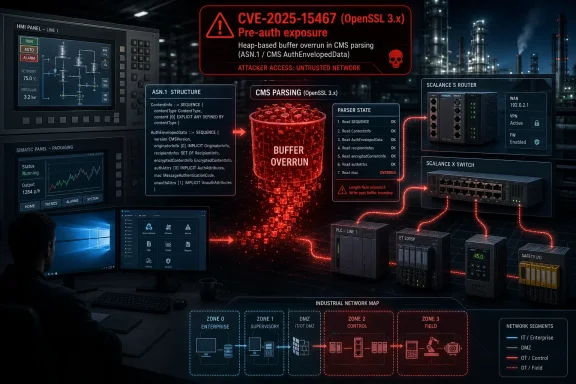
The vulnerability at the center of Siemens’ advisory is technically narrow and operationally broad. OpenSSL’s CMS handling can overflow a fixed-size stack buffer when parsing AuthEnvelopedData or EnvelopedData structures using AEAD ciphers such as AES-GCM. The attacker-controlled field is the initialization vector encoded inside ASN.1 parameters, and the failure is painfully familiar: data is copied before its length is proven safe.
That detail matters because the overflow occurs before authentication or tag verification. In other words, the malformed message does not need to be cryptographically valid to reach the dangerous code path. For defenders, that moves the bug from “maybe exploitable after keys or credentials are involved” toward the more uncomfortable category of pre-authentication parser exposure.
OpenSSL rates the issue as affecting the supported 3.x families listed in the advisory stream, including 3.0, 3.3, 3.4, 3.5, and 3.6. The old 1.1.1 and 1.0.2 lines are not affected by this specific defect, which creates the strange spectacle of legacy branches avoiding one modern bug while still remaining poor long-term security choices for other reasons. Siemens’ own product impact list shows why that nuance matters: industrial environments rarely have a single clean OpenSSL version to inventory.
The FIPS-module caveat is also important, and easy to overread. Siemens and OpenSSL note that the FIPS modules in affected 3.x families are not affected because the CMS implementation sits outside the FIPS module boundary. That does not mean an application using OpenSSL in a FIPS-oriented deployment is safe. It means the validated cryptographic module is not where this parser lives.
That is not a neat patch Tuesday blast radius. It is an industrial ecosystem, with cloud connectors on one side, field networking in the middle, and operator-facing visualization systems on the other. Some of these products live in server rooms; others live in cabinets, substations, production cells, mobile machinery, and segmented networks that are segmented precisely because nobody wants them changing too quickly.
This is why vulnerabilities in ubiquitous libraries create a special kind of risk in operational technology. The vulnerable code is not always exposed in the same way across products. One Siemens component might parse CMS content during certificate handling, another through secure messaging, another indirectly through bundled services, and another not at all in a default configuration. But asset owners still have to prove which case applies.
That proof is expensive. It requires version discovery, vendor matrix reading, maintenance window negotiation, backup validation, and sometimes a call to the line manager who remembers what happened the last time a “minor” firmware update touched a production gateway. The vulnerability is in software, but the remediation burden is social, procedural, and physical.
CMS and PKCS#7 are container formats used in security workflows, signed or encrypted data, certificate-related exchanges, and application-specific packaging. The dangerous pattern is not “a user opens a weird email” in isolation. The dangerous pattern is any service, gateway, application, or management component that accepts externally supplied CMS-like content and asks OpenSSL to parse it.
Siemens’ mitigations implicitly acknowledge this. The guidance includes reviewing whether affected systems are exposed to untrusted CMS or PKCS#7 content, refusing files from untrusted and unvalidated sources, securing connected email servers, restricting DeviceConnectionProxy destinations, and following product hardening instructions. Those are not generic platitudes; they identify the kinds of pathways through which a malformed cryptographic object might move from an attacker-controlled boundary into a trusted industrial application.
The pre-authentication nature of the flaw is what raises the stakes. If the malformed IV is copied into a stack buffer before authentication, then “the attacker cannot produce a valid tag” is not a defense. The parser trips before the cryptographic promise has a chance to do its work.
Remote code execution remains conditional. Stack protections, compiler hardening, address-space layout randomization, operating-system behavior, and the exact calling context all influence exploitability. But defenders should not translate “potentially remote code execution” into “probably just a crash.” Denial of service against a plant-floor management service is already serious, and the history of memory-corruption bugs teaches humility.
Engineering workstations run STEP 7, WinCC tooling, vendor utilities, device configuration software, email clients, certificate management scripts, and remote access tools. HMIs and SCADA nodes often sit on Windows Server or Windows client builds managed differently from corporate endpoints. Administrators may use Windows jump boxes to manage SCALANCE devices, SIMATIC systems, and SINEC software. A vulnerability in the software around those systems can alter the risk profile of the Windows machines that operate them.
The practical question for Windows admins is not “Is my Windows OpenSSL package vulnerable?” It is “Which Siemens components installed on or managed from Windows parse untrusted content, and which of those components bundle their own OpenSSL?” That distinction is crucial because updating OpenSSL at the operating-system level may do nothing for an application that ships its own library copy.
This is especially relevant for Windows-heavy industrial organizations that have become fluent in Microsoft patching but less disciplined with third-party runtime inventories. Windows Update, WSUS, Intune, Configuration Manager, and Defender for Endpoint can give a comforting sense of patch visibility. Siemens advisories like this puncture that comfort by reminding teams that critical parsing code can live inside vendor directories, appliance firmware, containers, edge packages, and private application bundles.
Where fixes exist, Siemens points to concrete target versions: AI Lightweight Inference Server V1.0 SP2 Update 5 or later, Connector for Azure V1.8.0 or later, SIMATIC WinCC Runtime Advanced V17 Update 9 or later, SIMATIC WinCC Unified-related V17.9 or later entries, SIMATIC PDM V21 or later, WinCC OA V3.19 P024, V3.20 P012, and V3.21 P02, among others. SIMOVE Fleetmanager has a V3.3.2-or-later fix path. SINEC NMS has a V5.7 SP4-or-later path. Some cases instead require contacting Siemens support.
Those version numbers are not trivia. They are the boundary between a vulnerability-management ticket that can close and one that becomes a risk acceptance record. In operational technology, the latter is common, but it should not be casual. If no fix is planned or none is available, the compensating controls must be treated as active security work, not as a note pasted into a spreadsheet.
The SCALANCE portion of the advisory is particularly significant because network infrastructure often becomes the assumed trust fabric. Routers, security appliances, managed switches, and wireless components are where segmentation policies become real. If the devices enforcing those boundaries carry vulnerable parsing paths or exposed management services, the defensive architecture has to be reviewed from the inside out.
This does not mean every named SCALANCE device is internet-exploitable or even remotely reachable in a default deployment. It means asset owners need to stop treating the product-name match as the end of the analysis. The next steps are exposure, role, firmware state, management-plane access, and whether CMS or PKCS#7 content can reach the vulnerable component.
In industrial settings, this can happen for many reasons. A product may be out of maintenance, may use a component only in a narrow path, may be architecturally difficult to update, or may be expected to be protected by deployment constraints. None of those explanations eliminates the vulnerability; they shift the burden onto system owners.
That shift is where many organizations struggle. IT vulnerability programs are built around finding CVEs, assigning owners, applying patches, and measuring closure. OT vulnerability programs often have to add another lane: document why the system cannot be fixed, restrict how it can be reached, monitor for abuse, and revisit the decision whenever the plant, network, or threat environment changes.
For Windows-oriented administrators pulled into OT security, this is one of the biggest culture gaps. In enterprise IT, unsupported software is usually a policy violation waiting for an upgrade project. In OT, unsupported or slowly patched components may be tied to machinery, validation regimes, safety cases, vendor contracts, or downtime costs that dwarf the price of a server refresh. The answer is not to ignore the risk, but to make the risk explicit enough that it can compete with production priorities honestly.
Encrypted SMTP protects data in transit between mail systems. It does not guarantee that an attached or encapsulated object is safe to parse once delivered. Strong authentication reduces the chance of arbitrary senders reaching a workflow, but it does not eliminate compromised trusted accounts. IP allowlists can limit exposure, but they do not sanitize files.
Still, these controls matter because industrial applications often integrate with mail, document flows, and notification systems in ways that are not obvious to central IT. A product that sends alerts may also receive configuration or certificate material. A service account that looks boring in Active Directory may have a pathway into a plant-floor application. A mailbox used by automation staff may be a bridge between corporate phishing risk and operational software.
The old advice “do not accept files from untrusted sources” is inadequate if nobody has mapped what the application accepts, from whom, and by which route. For this vulnerability, the sharper version is: identify every affected Siemens product that parses CMS, PKCS#7, S/MIME, encrypted package, certificate, or vendor-specific secure message content, then decide whether that content path is genuinely trusted.
A cloud connector does not need to be internet-facing in the old “open port on the public web” sense to introduce risk. It may consume messages from a broker, process certificates from a service, parse packages delivered by a management plane, or bridge local systems to remote APIs. Each of those workflows depends on parsers making safe decisions about data that originated somewhere else.
Windows administrators see the parallel in enterprise software every day. The danger is rarely a single exposed socket; it is an integration path that converts remote data into local trust. Industrial software adds longer lifecycles, lower tolerance for downtime, and more device-specific release notes.
This is why the advisory’s recommendation to restrict DeviceConnectionProxy destinations is more than a network hardening footnote. Destination restriction can shrink the set of systems able to feed dangerous content into a component. In a perfect world, vulnerable parsing code would be patched everywhere. In the real world, limiting who can talk to it is sometimes the fastest way to reduce risk before the maintenance window arrives.
This Siemens case is a textbook example of both sides. The underlying OpenSSL issue has a clear technical description and patched branches. But Siemens has to map the affected code into a sprawling product portfolio, determine exploitability or exposure by product, publish fixed versions where available, and provide mitigations where not.
For defenders, the lesson is not that OpenSSL is uniquely unsafe. The lesson is that library risk is product risk. If a product embeds a vulnerable OpenSSL build, the organization cannot manage the issue solely at the Linux distribution, Windows package, or container-base-image level. It must manage it at the application and appliance level as well.
This cuts against a lot of modern asset management comfort. Software bills of materials help, but only if they are accurate, current, and tied to actual deployed versions. Vulnerability scanners help, but embedded OpenSSL copies are often invisible unless authenticated checks, vendor inventories, or filesystem-level discovery are in place. Vendor advisories help, but only if organizations know they own the named products and can match model numbers precisely.
Security teams should build the triage around exposure, not alphabetized product names. Which affected products accept files from users? Which receive email or S/MIME content? Which parse CMS or PKCS#7 data from external partners, cloud services, or remote engineering workflows? Which are reachable from less-trusted network zones? Which sit on Windows systems where compromise would enable lateral movement into engineering projects?
The most uncomfortable cases are the systems that are both difficult to patch and positioned at trust boundaries. Industrial routers, security monitors, remote access components, and management services deserve early attention because they can turn a parser crash into an availability event or a foothold. HMI and engineering tools deserve attention because they often sit near privileged credentials and project files.
The lowest-risk cases should still be documented. If a product is named but not exposed to untrusted CMS-like content, that finding should be captured with the reasoning. Six months later, when an integration changes or a new workflow is added, the old assumption should be reviewed. Vulnerability management in OT is not a one-time query; it is configuration history with consequences.
The right response is prioritization, not panic. Products with available fixes and external content exposure should move first. Products with mitigations but no immediate patch should get network restrictions, input restrictions, and monitoring. Products with no fix planned should become candidates for isolation, replacement planning, or formal risk acceptance with a named business owner.
Windows teams can help here by bringing mature deployment mechanics into the OT conversation without pretending the environments are identical. They can inventory installed Siemens software on Windows endpoints, identify bundled OpenSSL DLLs where practical, correlate software versions with Siemens’ fixed releases, and validate whether email clients, file shares, or browser-accessible management tools form part of the ingestion path.
They can also help with logging and detection. A stack buffer overflow that only causes a crash may leave service restarts, application errors, Windows event logs, syslog entries, or device diagnostics. Those signals will not prove exploitation by themselves, but they can identify suspicious parsing failures after a mitigation is applied or during the period before a patch lands.
Industrial software magnifies that pattern. Products are designed to last, integrated into physical processes, and wrapped in operational procedures that resist frequent change. A memory-safety bug in a mainstream library becomes a coordination exercise among vendors, plant managers, network engineers, Windows admins, and security teams.
That coordination is where many defenses either succeed or fail. If the advisory becomes a spreadsheet of product names with no exposure analysis, the organization learns little. If it becomes a reason to map content flows, bundled libraries, email integrations, and management-plane access, then one OpenSSL bug can produce a better inventory than the last audit did.
The Siemens OpenSSL advisory should therefore be read as a warning about dependency depth as much as vulnerability severity. The immediate work is to patch what Siemens has fixed, isolate what cannot yet be fixed, and stop malformed CMS or PKCS#7 content from reaching systems that have no reason to parse it. The longer-term work is harder but more valuable: make industrial software inventories precise enough that the next library-level flaw is a managed event, not a scavenger hunt through the plant.
 A Crypto Parser Becomes an Industrial Inventory Problem
The vulnerability at the center of Siemens’ advisory is technically narrow and operationally broad. OpenSSL’s CMS handling can overflow a fixed-size stack buffer when parsing AuthEnvelopedData or EnvelopedData structures using AEAD ciphers such as AES-GCM. The attacker-controlled field is the initialization vector encoded inside ASN.1 parameters, and the failure is painfully familiar: data is copied before its length is proven safe.That detail matters because the overflow occurs before authentication or tag verification. In other words, the malformed message does not need to be cryptographically valid to reach the dangerous code path. For defenders, that moves the bug from “maybe exploitable after keys or credentials are involved” toward the more uncomfortable category of pre-authentication parser exposure.
OpenSSL rates the issue as affecting the supported 3.x families listed in the advisory stream, including 3.0, 3.3, 3.4, 3.5, and 3.6. The old 1.1.1 and 1.0.2 lines are not affected by this specific defect, which creates the strange spectacle of legacy branches avoiding one modern bug while still remaining poor long-term security choices for other reasons. Siemens’ own product impact list shows why that nuance matters: industrial environments rarely have a single clean OpenSSL version to inventory.
The FIPS-module caveat is also important, and easy to overread. Siemens and OpenSSL note that the FIPS modules in affected 3.x families are not affected because the CMS implementation sits outside the FIPS module boundary. That does not mean an application using OpenSSL in a FIPS-oriented deployment is safe. It means the validated cryptographic module is not where this parser lives.
Siemens’ List Reads Like a Map of the Modern Plant
The product list is striking less because of any one famous name than because of its breadth. Siemens names AI Lightweight Inference Server, Connector for Azure, Databus, HiMed Cockpit, Shopfloor IT Suite, SIDIS Prime, SiOME, SIMATIC panels, SIMATIC IPC products, SIMATIC PDM, SIMATIC STEP 7 V5, SIMATIC WinCC OA, SIMATIC WinCC Runtime Advanced, SIMATIC WinCC Unified Sequence, SIMATIC WinCC V7.5 through V8.1, SIMOTION, SIMOVE Fleetmanager, SINAMICS drives, SINEC network management and security tools, SINUMERIK OPC UA access, SIPLANT, SITRANS software, UMC, Visual Inspection Cockpit, and a long run of SCALANCE industrial routers, switches, wireless devices, and security appliances.That is not a neat patch Tuesday blast radius. It is an industrial ecosystem, with cloud connectors on one side, field networking in the middle, and operator-facing visualization systems on the other. Some of these products live in server rooms; others live in cabinets, substations, production cells, mobile machinery, and segmented networks that are segmented precisely because nobody wants them changing too quickly.
This is why vulnerabilities in ubiquitous libraries create a special kind of risk in operational technology. The vulnerable code is not always exposed in the same way across products. One Siemens component might parse CMS content during certificate handling, another through secure messaging, another indirectly through bundled services, and another not at all in a default configuration. But asset owners still have to prove which case applies.
That proof is expensive. It requires version discovery, vendor matrix reading, maintenance window negotiation, backup validation, and sometimes a call to the line manager who remembers what happened the last time a “minor” firmware update touched a production gateway. The vulnerability is in software, but the remediation burden is social, procedural, and physical.
The Pre-Authentication Detail Is the Part Security Teams Should Not Soften
There is a temptation to treat CMS and PKCS#7 parsing bugs as exotic. Many administrators do not knowingly traffic in CMS AuthEnvelopedData, and many Windows users will associate S/MIME with a dusty corporate email setting rather than a live exploit surface. That instinct is understandable, but it is not safe enough for industrial environments.CMS and PKCS#7 are container formats used in security workflows, signed or encrypted data, certificate-related exchanges, and application-specific packaging. The dangerous pattern is not “a user opens a weird email” in isolation. The dangerous pattern is any service, gateway, application, or management component that accepts externally supplied CMS-like content and asks OpenSSL to parse it.
Siemens’ mitigations implicitly acknowledge this. The guidance includes reviewing whether affected systems are exposed to untrusted CMS or PKCS#7 content, refusing files from untrusted and unvalidated sources, securing connected email servers, restricting DeviceConnectionProxy destinations, and following product hardening instructions. Those are not generic platitudes; they identify the kinds of pathways through which a malformed cryptographic object might move from an attacker-controlled boundary into a trusted industrial application.
The pre-authentication nature of the flaw is what raises the stakes. If the malformed IV is copied into a stack buffer before authentication, then “the attacker cannot produce a valid tag” is not a defense. The parser trips before the cryptographic promise has a chance to do its work.
Remote code execution remains conditional. Stack protections, compiler hardening, address-space layout randomization, operating-system behavior, and the exact calling context all influence exploitability. But defenders should not translate “potentially remote code execution” into “probably just a crash.” Denial of service against a plant-floor management service is already serious, and the history of memory-corruption bugs teaches humility.
Windows Is Not the Vulnerable Component, But Windows Estates Are in the Path
For WindowsForum readers, the obvious caveat is that this is not a Microsoft vulnerability. The vulnerable code is in OpenSSL’s CMS implementation, and many Siemens products affected here run on Linux-based appliances, embedded systems, or cross-platform application stacks. But Windows remains part of the impact story because industrial Windows deployments rarely exist alone.Engineering workstations run STEP 7, WinCC tooling, vendor utilities, device configuration software, email clients, certificate management scripts, and remote access tools. HMIs and SCADA nodes often sit on Windows Server or Windows client builds managed differently from corporate endpoints. Administrators may use Windows jump boxes to manage SCALANCE devices, SIMATIC systems, and SINEC software. A vulnerability in the software around those systems can alter the risk profile of the Windows machines that operate them.
The practical question for Windows admins is not “Is my Windows OpenSSL package vulnerable?” It is “Which Siemens components installed on or managed from Windows parse untrusted content, and which of those components bundle their own OpenSSL?” That distinction is crucial because updating OpenSSL at the operating-system level may do nothing for an application that ships its own library copy.
This is especially relevant for Windows-heavy industrial organizations that have become fluent in Microsoft patching but less disciplined with third-party runtime inventories. Windows Update, WSUS, Intune, Configuration Manager, and Defender for Endpoint can give a comforting sense of patch visibility. Siemens advisories like this puncture that comfort by reminding teams that critical parsing code can live inside vendor directories, appliance firmware, containers, edge packages, and private application bundles.
The Patch Matrix Is the Message
Siemens’ remediation language is uneven because the product estate is uneven. Some products have specific vendor fixes. Others have mitigations only. Some say no fix is currently available. Some say no fix is planned. That mix is not unusual in industrial advisories, but it is the part that should get management attention.Where fixes exist, Siemens points to concrete target versions: AI Lightweight Inference Server V1.0 SP2 Update 5 or later, Connector for Azure V1.8.0 or later, SIMATIC WinCC Runtime Advanced V17 Update 9 or later, SIMATIC WinCC Unified-related V17.9 or later entries, SIMATIC PDM V21 or later, WinCC OA V3.19 P024, V3.20 P012, and V3.21 P02, among others. SIMOVE Fleetmanager has a V3.3.2-or-later fix path. SINEC NMS has a V5.7 SP4-or-later path. Some cases instead require contacting Siemens support.
Those version numbers are not trivia. They are the boundary between a vulnerability-management ticket that can close and one that becomes a risk acceptance record. In operational technology, the latter is common, but it should not be casual. If no fix is planned or none is available, the compensating controls must be treated as active security work, not as a note pasted into a spreadsheet.
The SCALANCE portion of the advisory is particularly significant because network infrastructure often becomes the assumed trust fabric. Routers, security appliances, managed switches, and wireless components are where segmentation policies become real. If the devices enforcing those boundaries carry vulnerable parsing paths or exposed management services, the defensive architecture has to be reviewed from the inside out.
This does not mean every named SCALANCE device is internet-exploitable or even remotely reachable in a default deployment. It means asset owners need to stop treating the product-name match as the end of the analysis. The next steps are exposure, role, firmware state, management-plane access, and whether CMS or PKCS#7 content can reach the vulnerable component.
“No Fix Planned” Is a Governance Statement, Not Just a Patch Status
Security advisories often use terse remediation labels that look administrative but carry strategic meaning. “No fix planned” is one of them. It tells the defender that the vendor is not promising a future software correction for that product line, at least as currently described.In industrial settings, this can happen for many reasons. A product may be out of maintenance, may use a component only in a narrow path, may be architecturally difficult to update, or may be expected to be protected by deployment constraints. None of those explanations eliminates the vulnerability; they shift the burden onto system owners.
That shift is where many organizations struggle. IT vulnerability programs are built around finding CVEs, assigning owners, applying patches, and measuring closure. OT vulnerability programs often have to add another lane: document why the system cannot be fixed, restrict how it can be reached, monitor for abuse, and revisit the decision whenever the plant, network, or threat environment changes.
For Windows-oriented administrators pulled into OT security, this is one of the biggest culture gaps. In enterprise IT, unsupported software is usually a policy violation waiting for an upgrade project. In OT, unsupported or slowly patched components may be tied to machinery, validation regimes, safety cases, vendor contracts, or downtime costs that dwarf the price of a server refresh. The answer is not to ignore the risk, but to make the risk explicit enough that it can compete with production priorities honestly.
Email and File Handling Become Security Boundaries Again
Siemens’ mitigation guidance around email servers deserves more attention than it will probably receive. The advisory recommends enforcing TLS or SSL for SMTP connections, restricting email-server access to trusted systems, using strong authentication, and keeping the email server and operating system patched. That might sound like baseline hygiene, but in the context of a CMS parser flaw it is a reminder that content security and transport security are different layers.Encrypted SMTP protects data in transit between mail systems. It does not guarantee that an attached or encapsulated object is safe to parse once delivered. Strong authentication reduces the chance of arbitrary senders reaching a workflow, but it does not eliminate compromised trusted accounts. IP allowlists can limit exposure, but they do not sanitize files.
Still, these controls matter because industrial applications often integrate with mail, document flows, and notification systems in ways that are not obvious to central IT. A product that sends alerts may also receive configuration or certificate material. A service account that looks boring in Active Directory may have a pathway into a plant-floor application. A mailbox used by automation staff may be a bridge between corporate phishing risk and operational software.
The old advice “do not accept files from untrusted sources” is inadequate if nobody has mapped what the application accepts, from whom, and by which route. For this vulnerability, the sharper version is: identify every affected Siemens product that parses CMS, PKCS#7, S/MIME, encrypted package, certificate, or vendor-specific secure message content, then decide whether that content path is genuinely trusted.
The Cloud Connector Angle Complicates the Air-Gap Myth
The presence of Connector for Azure, Databus, AI Lightweight Inference Server, and edge-related Siemens components underlines how outdated the air-gap assumption has become. Modern industrial environments increasingly move telemetry, model outputs, maintenance data, and fleet status across cloud and enterprise boundaries. That connectivity can be valuable, but it turns parser exposure into a supply-chain and integration problem.A cloud connector does not need to be internet-facing in the old “open port on the public web” sense to introduce risk. It may consume messages from a broker, process certificates from a service, parse packages delivered by a management plane, or bridge local systems to remote APIs. Each of those workflows depends on parsers making safe decisions about data that originated somewhere else.
Windows administrators see the parallel in enterprise software every day. The danger is rarely a single exposed socket; it is an integration path that converts remote data into local trust. Industrial software adds longer lifecycles, lower tolerance for downtime, and more device-specific release notes.
This is why the advisory’s recommendation to restrict DeviceConnectionProxy destinations is more than a network hardening footnote. Destination restriction can shrink the set of systems able to feed dangerous content into a component. In a perfect world, vulnerable parsing code would be patched everywhere. In the real world, limiting who can talk to it is sometimes the fastest way to reduce risk before the maintenance window arrives.
OpenSSL’s Ubiquity Cuts Both Ways
OpenSSL remains one of the most important software dependencies in the world because it solved a hard problem well enough for almost everyone to depend on it. That ubiquity brings fast scrutiny and, usually, fast upstream fixes. It also means one bug report can turn into hundreds of vendor advisories.This Siemens case is a textbook example of both sides. The underlying OpenSSL issue has a clear technical description and patched branches. But Siemens has to map the affected code into a sprawling product portfolio, determine exploitability or exposure by product, publish fixed versions where available, and provide mitigations where not.
For defenders, the lesson is not that OpenSSL is uniquely unsafe. The lesson is that library risk is product risk. If a product embeds a vulnerable OpenSSL build, the organization cannot manage the issue solely at the Linux distribution, Windows package, or container-base-image level. It must manage it at the application and appliance level as well.
This cuts against a lot of modern asset management comfort. Software bills of materials help, but only if they are accurate, current, and tied to actual deployed versions. Vulnerability scanners help, but embedded OpenSSL copies are often invisible unless authenticated checks, vendor inventories, or filesystem-level discovery are in place. Vendor advisories help, but only if organizations know they own the named products and can match model numbers precisely.
Asset Names Are Not Enough; Exposure Is the Missing Column
Siemens’ advisory names a formidable number of products, but the name match is only the beginning. A vulnerable product sitting powered off in a lab is not the same risk as a vulnerable router managing remote access to a production line. A WinCC component parsing only locally generated data is not the same risk as a service ingesting signed or encrypted material from outside the trust boundary.Security teams should build the triage around exposure, not alphabetized product names. Which affected products accept files from users? Which receive email or S/MIME content? Which parse CMS or PKCS#7 data from external partners, cloud services, or remote engineering workflows? Which are reachable from less-trusted network zones? Which sit on Windows systems where compromise would enable lateral movement into engineering projects?
The most uncomfortable cases are the systems that are both difficult to patch and positioned at trust boundaries. Industrial routers, security monitors, remote access components, and management services deserve early attention because they can turn a parser crash into an availability event or a foothold. HMI and engineering tools deserve attention because they often sit near privileged credentials and project files.
The lowest-risk cases should still be documented. If a product is named but not exposed to untrusted CMS-like content, that finding should be captured with the reasoning. Six months later, when an integration changes or a new workflow is added, the old assumption should be reviewed. Vulnerability management in OT is not a one-time query; it is configuration history with consequences.
Patch Windows Must Compete With Attack Windows
Industrial operators often delay updates for good reasons. Patching a controller-adjacent system can require vendor approval, regression testing, backups, failover planning, and a production outage. The problem is that attackers do not wait for the next planned shutdown.The right response is prioritization, not panic. Products with available fixes and external content exposure should move first. Products with mitigations but no immediate patch should get network restrictions, input restrictions, and monitoring. Products with no fix planned should become candidates for isolation, replacement planning, or formal risk acceptance with a named business owner.
Windows teams can help here by bringing mature deployment mechanics into the OT conversation without pretending the environments are identical. They can inventory installed Siemens software on Windows endpoints, identify bundled OpenSSL DLLs where practical, correlate software versions with Siemens’ fixed releases, and validate whether email clients, file shares, or browser-accessible management tools form part of the ingestion path.
They can also help with logging and detection. A stack buffer overflow that only causes a crash may leave service restarts, application errors, Windows event logs, syslog entries, or device diagnostics. Those signals will not prove exploitation by themselves, but they can identify suspicious parsing failures after a mitigation is applied or during the period before a patch lands.
The Siemens Advisory Turns One OpenSSL Bug Into Five Practical Orders
The actionable reading of this advisory is narrower than “patch everything” and broader than “wait for Siemens.” The most useful response is a short, disciplined sequence that separates fixed software from exposed software and exposed software from theoretical matches.- Organizations should identify every deployed Siemens product named in the advisory, including Windows-installed engineering tools, SCALANCE network devices, SIMATIC HMI and WinCC components, SINEC tools, cloud connectors, and edge services.
- Teams should prioritize systems that accept untrusted CMS, PKCS#7, S/MIME, certificate, encrypted message, or vendor package content, especially when that content can arrive from email, remote access paths, cloud integrations, or less-trusted network zones.
- Where Siemens provides fixed versions, administrators should plan updates against the vendor’s named release targets rather than assuming an operating-system OpenSSL update remediates bundled application copies.
- Where no fix is available or no fix is planned, compensating controls should include strict source validation, network allowlisting, management-plane isolation, hardened email paths, and documented risk ownership.
- Windows administrators should treat affected Siemens applications and management workflows as part of their endpoint and identity risk model, even when the vulnerable OpenSSL code runs inside an appliance or embedded Linux component.
The Bigger Lesson Is That Parsers Sit on the Front Line
The deeper lesson is uncomfortable because it is not new. Parsers are often the first complex code to touch hostile data, and cryptographic wrappers do not magically make that data safe. Authentication and encryption can protect content once the implementation reaches the right stage, but a length bug in ASN.1 handling can turn the wrapper itself into the attack surface.Industrial software magnifies that pattern. Products are designed to last, integrated into physical processes, and wrapped in operational procedures that resist frequent change. A memory-safety bug in a mainstream library becomes a coordination exercise among vendors, plant managers, network engineers, Windows admins, and security teams.
That coordination is where many defenses either succeed or fail. If the advisory becomes a spreadsheet of product names with no exposure analysis, the organization learns little. If it becomes a reason to map content flows, bundled libraries, email integrations, and management-plane access, then one OpenSSL bug can produce a better inventory than the last audit did.
The Siemens OpenSSL advisory should therefore be read as a warning about dependency depth as much as vulnerability severity. The immediate work is to patch what Siemens has fixed, isolate what cannot yet be fixed, and stop malformed CMS or PKCS#7 content from reaching systems that have no reason to parse it. The longer-term work is harder but more valuable: make industrial software inventories precise enough that the next library-level flaw is a managed event, not a scavenger hunt through the plant.
References
- Primary source: CISA
Published: 2026-06-23T12:00:00+00:00

Siemens Products using OpenSSL | CISA
www.cisa.gov
- Related coverage: openssl-library.org
- Related coverage: mirror.openssl-library.org
- Related coverage: securitylabs.datadoghq.com
OpenSSL January 2026 Security Update: CMS and PKCS#12 Buffer Overflows | Datadog Security Labs
A deep dive into OpenSSL’s January 2026 CMS and PKCS#12 vulnerabilities, including a pre-auth stack overflow and a PKCS#12 parsing bug.securitylabs.datadoghq.com - Related coverage: stack.watch
OpenSSL Security Vulnerabilities in 2026
 stack.watch
- Related coverage: encyb.com
