

Microsoft’s Singapore findings for the 2026 Work Trend Index, released on June 16, say local workers are adopting AI faster than their organisations are redesigning work around it, with 88 percent of Singapore AI users saying they still own the thinking behind their output. That is the neat headline, and Microsoft would very much like it to be read as proof that AI is becoming a responsible co-worker rather than a reckless replacement engine. But the more interesting story is less flattering to management: Singapore’s employees appear to have crossed the psychological barrier to AI use, while many employers are still stuck treating it as a software rollout. The result is a workplace where the humans are ready, the tools are spreading, and the operating model is lagging behind both.
For the last two years, the corporate AI debate has often been framed as a question of adoption. Will employees use the tools? Will they trust them? Will they bring them into daily work, or will generative AI remain trapped in pilot projects, innovation labs, and keynote demos?
Microsoft’s Singapore numbers suggest that, at least among AI users, the adoption question is already stale. The company says 88 percent of AI users in Singapore believe they remain responsible for the thinking behind their work when using AI, slightly above the global figure of 86 percent. That is a small gap statistically, but an important one culturally: the dominant posture is not surrender to the machine, but delegation with ownership.
That matters because Singapore is not a loose, low-governance market where AI usage can be dismissed as shadow experimentation. It is a tightly organised economy with a highly digital public sector, mature enterprise IT environments, and a workforce accustomed to compliance-heavy industries such as finance, logistics, healthcare, and government-linked services. If AI is spreading there, it is not because workers have abandoned process; it is because they are finding ways to make AI fit inside process.
Microsoft’s preferred phrase is human agency. It is a useful phrase, though a slightly polished one. In plainer English, workers are saying: the tool can draft, search, summarise, compare, transform, and suggest, but I am still on the hook for whether the work is right.
That is the core distinction enterprise IT needs to preserve. AI that accelerates judgment is useful. AI that launders accountability is dangerous.
That figure cuts against some of the lazier rhetoric around workplace automation. If generative AI were simply a machine for replacing knowledge workers, critical thinking would become less central. Microsoft’s own framing points in the opposite direction: as AI handles more execution, the value of deciding what should be executed, why, and under what constraints rises.
This is the paradox of better automation. When low-level drafting and administrative synthesis get cheaper, the bottleneck moves upward. A worker who once spent half a day producing a first version of a document may now spend that time deciding whether the document should exist, what evidence it should include, how it should be challenged, and where the generated text may be wrong.
That is not a productivity story in the old spreadsheet sense. It is a management story, a training story, and increasingly a governance story. If the new work is more interpretive, then organisations need to know who is qualified to make the interpretation and how that judgment is reviewed.
The WindowsForum audience will recognise the pattern from every major platform shift. The first wave is tool excitement. The second wave is integration. The third, usually messier wave is controls, audit, identity, retention, security, and policy. AI has reached the third wave before many executives have finished celebrating the first.
This is the productivity promise in its most optimistic form. Workers are not merely doing the same things faster; they are doing things they previously could not do. That might mean a non-designer producing a credible first-pass visual brief, an analyst creating a quick model from messy inputs, a project manager turning scattered meeting notes into an action plan, or an engineer using AI to reason across unfamiliar documentation.
But the phrase “could not have created” deserves careful handling. It does not necessarily mean the output is excellent. It may mean the worker can now produce a rough draft, a prototype, a translation, a scenario plan, or a piece of analysis that would previously have required another specialist. In enterprise terms, that is still a big deal, but it is not the same as saying AI has collapsed entire professional boundaries.
This is where Microsoft’s marketing and the workplace reality start to diverge. Vendors understandably want to emphasise possibility. IT leaders have to ask a harsher question: which of these new outputs are good enough to use, which are good enough only to start a conversation, and which create new review burdens that cancel out the apparent productivity gain?
The answer will differ by job function. A draft internal memo is low risk. A generated financial recommendation, legal analysis, medical summary, security policy, or customer-facing promise is not. The same AI capability that feels magical in one workflow may be unacceptable in another unless governance is built in from the start.
That produces a familiar corporate absurdity. Employees are told to innovate with AI, but judged by legacy metrics. They are encouraged to experiment, but given unclear rules. They are asked to save time, but not told whether saved time should become more output, better output, new work, or simply invisible buffer in an already overloaded week.
Singapore’s numbers sharpen the point. Microsoft says 78 percent of AI users there recognise the need to adapt quickly, compared with a global average of 65 percent. Yet only 24 percent of Singapore respondents say their company’s leaders are clearly aligned on AI, slightly below the global figure of 26 percent. Even more telling, only 14 percent say their companies have strong incentives for redesigning work with AI.
That last number is the crack in the floor. If employees see the need to adapt, but the organisation does not reward redesign, then AI becomes a personal coping mechanism rather than an institutional capability. Workers use it to survive workload pressure, polish outputs, and move faster, while the company continues to pretend the old operating model still fits.
This is how shadow IT begins—not always with forbidden tools, but with forbidden realities. The work has changed, yet the official map has not.
Microsoft’s report plays directly into that narrative. A workforce that can use AI responsibly, productively, and with human judgment intact is attractive to employers trying to scale operations without surrendering quality. It also fits Singapore’s broader reputation for pragmatic technology adoption: move fast, but within a controlled system.
Yet there is a risk in celebrating worker readiness too quickly. If employees become more capable faster than organisations become more coherent, the reward may be unevenly distributed. High-agency workers will pull ahead. Managers who understand AI will gain leverage. Teams with permissive cultures and clear data access will accelerate. Others will be left with vague encouragement and a chatbot subscription.
That creates a new version of the digital divide inside white-collar work. It is no longer simply between people who can use a computer and people who cannot, or between coders and non-coders. It is between workers who know how to orchestrate AI across tasks and workers trapped using it as a better autocomplete box.
Microsoft’s “Frontier Professional” label is doing a lot of work here. It describes the advanced user, but it also quietly defines the next prestige category in the office. The person who can manage AI agents, evaluate their output, and redesign a workflow starts to look less like a power user and more like a new kind of operational architect.
That does not make the findings meaningless. It does mean readers should separate the diagnosis from the prescription. Microsoft is right that AI adoption without organisational redesign leaves value on the table. It is also commercially invested in the idea that its ecosystem is the place where that redesign should happen.
For Windows and Microsoft 365 administrators, this is where the discussion becomes practical. If employees are already using AI, the question is not whether the organisation has an AI strategy. The question is whether the actual strategy is being written by the IT department, the legal department, line managers, procurement, or employees pasting text into whichever tool gives the best answer.
The control plane matters. Identity, permissions, data boundaries, logging, retention, eDiscovery, endpoint management, and information protection are not glamorous, but they decide whether AI use is governable. An AI assistant connected to the wrong data can become a compliance problem at machine speed. An AI assistant connected to no useful data becomes an expensive toy.
Microsoft’s advantage is obvious: it already sits in the productivity stack for many of the organisations most likely to formalise AI use. But that advantage comes with a burden. If Copilot and related agents become embedded in daily work, administrators will need policy models that are understandable, auditable, and adjustable without requiring every company to become an AI research lab.
On one page, AI is a tool that keeps human judgment at the centre. On another, AI is a force that may automate large portions of knowledge work. Both can be true, depending on the task, the occupation, and the time horizon. The mistake is treating “augmentation” and “automation” as mutually exclusive camps.
Most workplace technologies do both. They augment some workers while automating parts of other workers’ jobs. They remove drudgery in one context and eliminate entry-level pathways in another. They make senior employees more productive while reducing the number of juniors needed to prepare drafts, gather facts, or perform routine analysis.
That is why Singapore’s emphasis on critical thinking is encouraging but not sufficient. Critical thinking does not automatically protect a role if the organisation decides it can buy enough judgment from fewer people. Nor does human oversight solve the problem if oversight becomes a thin ritual over outputs no one has time to properly inspect.
The serious version of the AI workforce debate is not “will AI replace everyone?” It is “which tasks become cheap, which skills become scarce, which roles get compressed, and who captures the savings?” Microsoft’s report answers the first half more clearly than the second.
Responsible AI at work has to be designed as a system. It needs clear rules about what data can be used, which outputs require human review, when AI involvement must be disclosed, how errors are escalated, and which tasks are off-limits. It also needs managers who understand enough about the tools to avoid both panic and magical thinking.
The incentive problem is especially dangerous. If a company rewards speed above accuracy, employees will use AI for speed. If it rewards volume above judgment, employees will produce more AI-assisted volume. If it praises innovation but punishes failed experiments, employees will hide their experiments.
This is the less comfortable meaning of human-led AI. Humans do not just remain responsible for the thinking behind a document. Leaders remain responsible for the conditions under which that thinking happens. A poorly governed AI workplace is not a machine failure; it is an organisational design failure with a machine attached.
Singapore’s numbers suggest that employees have accepted their side of the bargain. They know adaptation is necessary. They value critical thinking. They are producing new kinds of work. The unresolved question is whether employers will meet them with clarity or bury them under slogans.
This is where many AI programmes will succeed or fail. A manager who does not understand AI will either ban it informally, tolerate it blindly, or reduce it to a productivity quota. None of those outcomes produces durable transformation. The better manager asks where AI changes the sequence of work, where it introduces risk, and where it frees people to do higher-value analysis.
Microsoft’s Singapore data on leadership alignment should worry executives precisely because it points to weak managerial signalling. If only about a quarter of respondents see clear leadership alignment, employees are likely receiving mixed messages. One leader wants experimentation. Another wants compliance. A third wants cost reduction. A fourth wants the same headcount to deliver 30 percent more work without admitting that the job has changed.
That ambiguity is corrosive. Workers will adapt privately, but teams will not learn collectively. Good AI practices will remain local hacks rather than institutional knowledge. Mistakes will be repeated because no one wants to confess how the work is really being done.
The enterprise lesson is old but newly urgent: technology does not scale through enthusiasm alone. It scales through management systems.
A chatbot waits for prompts. An agent participates in a workflow. It may gather information, prepare a draft, update a system, schedule follow-ups, monitor changes, or coordinate other tools. Once that happens, AI is no longer a side panel. It becomes part of the work fabric.
For Windows environments, the implications are substantial. Endpoints, browsers, identity providers, productivity apps, and cloud services become surfaces for agentic action. Security teams will need to think about what an AI agent is allowed to read, what it is allowed to change, what actions require confirmation, and how to investigate what happened after the fact.
This is also where the phrase “human judgment at the centre” needs technical enforcement. A human cannot remain meaningfully in control if the system hides context, obscures provenance, or makes actions difficult to audit. The interface has to show not only the answer, but enough of the chain of reasoning, data sources, and action history for a person to challenge it.
The future Microsoft is selling is not just Copilot as helper. It is Microsoft 365 and Windows as an AI-mediated workspace. That may be powerful, but it raises the stakes for every admin console setting that used to feel routine.
That makes the “human-led” finding more credible. In a market where reputation, compliance, and operational reliability matter, workers are unlikely to openly celebrate reckless automation. The fact that many see AI as a way to expand what they can produce while retaining responsibility suggests a more mature adoption curve than the hype cycle usually allows.
But Singapore is also a warning. If a digitally advanced workforce with high AI readiness still shows weak leadership alignment and limited incentives for work redesign, less prepared markets should not expect an easier path. The hard part is not buying AI. The hard part is deciding what the organisation becomes after AI is normal.
That requires a level of managerial honesty many companies have avoided. If AI saves time, does the company reduce headcount, raise output targets, improve quality, shorten workweeks, invest in training, or redesign roles? If AI creates new capabilities, who owns them? If AI increases risk, who signs off?
These are not tool questions. They are power questions.
Right now, many organisations are probably in the heroics phase. A few workers learn the tools deeply. They build prompts, templates, shortcuts, and informal review habits. Their output improves. Their managers notice. Then the organisation assumes the AI strategy is working.
That is not transformation. It is uneven personal productivity. It may even increase burnout if the best AI users become the default fixers for everyone else’s broken workflows.
The next phase has to be more deliberate. Companies need to identify which processes are worth redesigning, which AI uses should become standard, which require guardrails, and which should be rejected. They also need to update performance management so employees are not punished for spending time improving the system rather than feeding the old one.
This is where the 14 percent incentive figure becomes so important. Without incentives, redesign is extra work. And in a high-pressure workplace, extra work loses to immediate deliverables almost every time.
 Singapore Has Already Moved Past the AI Permission Slip
For the last two years, the corporate AI debate has often been framed as a question of adoption. Will employees use the tools? Will they trust them? Will they bring them into daily work, or will generative AI remain trapped in pilot projects, innovation labs, and keynote demos?Microsoft’s Singapore numbers suggest that, at least among AI users, the adoption question is already stale. The company says 88 percent of AI users in Singapore believe they remain responsible for the thinking behind their work when using AI, slightly above the global figure of 86 percent. That is a small gap statistically, but an important one culturally: the dominant posture is not surrender to the machine, but delegation with ownership.
That matters because Singapore is not a loose, low-governance market where AI usage can be dismissed as shadow experimentation. It is a tightly organised economy with a highly digital public sector, mature enterprise IT environments, and a workforce accustomed to compliance-heavy industries such as finance, logistics, healthcare, and government-linked services. If AI is spreading there, it is not because workers have abandoned process; it is because they are finding ways to make AI fit inside process.
Microsoft’s preferred phrase is human agency. It is a useful phrase, though a slightly polished one. In plainer English, workers are saying: the tool can draft, search, summarise, compare, transform, and suggest, but I am still on the hook for whether the work is right.
That is the core distinction enterprise IT needs to preserve. AI that accelerates judgment is useful. AI that launders accountability is dangerous.
The Real Gap Is Not Between Humans and Machines
The strongest finding in the Singapore release is not that workers like AI. It is that they do not appear to be confusing AI use with intellectual outsourcing. More than half of Singapore respondents, 52 percent, identified critical thinking as the most important future skill.That figure cuts against some of the lazier rhetoric around workplace automation. If generative AI were simply a machine for replacing knowledge workers, critical thinking would become less central. Microsoft’s own framing points in the opposite direction: as AI handles more execution, the value of deciding what should be executed, why, and under what constraints rises.
This is the paradox of better automation. When low-level drafting and administrative synthesis get cheaper, the bottleneck moves upward. A worker who once spent half a day producing a first version of a document may now spend that time deciding whether the document should exist, what evidence it should include, how it should be challenged, and where the generated text may be wrong.
That is not a productivity story in the old spreadsheet sense. It is a management story, a training story, and increasingly a governance story. If the new work is more interpretive, then organisations need to know who is qualified to make the interpretation and how that judgment is reviewed.
The WindowsForum audience will recognise the pattern from every major platform shift. The first wave is tool excitement. The second wave is integration. The third, usually messier wave is controls, audit, identity, retention, security, and policy. AI has reached the third wave before many executives have finished celebrating the first.
Microsoft’s Numbers Make the Worker Look More Advanced Than the Workplace
The Singapore data contains a second, sharper claim: two-thirds of AI users in the city-state say they are producing work they could not have created a year earlier. Globally, Microsoft puts that figure at 58 percent. Among Singapore’s most advanced AI users, whom Microsoft calls Frontier Professionals, the figure rises to 82 percent.This is the productivity promise in its most optimistic form. Workers are not merely doing the same things faster; they are doing things they previously could not do. That might mean a non-designer producing a credible first-pass visual brief, an analyst creating a quick model from messy inputs, a project manager turning scattered meeting notes into an action plan, or an engineer using AI to reason across unfamiliar documentation.
But the phrase “could not have created” deserves careful handling. It does not necessarily mean the output is excellent. It may mean the worker can now produce a rough draft, a prototype, a translation, a scenario plan, or a piece of analysis that would previously have required another specialist. In enterprise terms, that is still a big deal, but it is not the same as saying AI has collapsed entire professional boundaries.
This is where Microsoft’s marketing and the workplace reality start to diverge. Vendors understandably want to emphasise possibility. IT leaders have to ask a harsher question: which of these new outputs are good enough to use, which are good enough only to start a conversation, and which create new review burdens that cancel out the apparent productivity gain?
The answer will differ by job function. A draft internal memo is low risk. A generated financial recommendation, legal analysis, medical summary, security policy, or customer-facing promise is not. The same AI capability that feels magical in one workflow may be unacceptable in another unless governance is built in from the start.
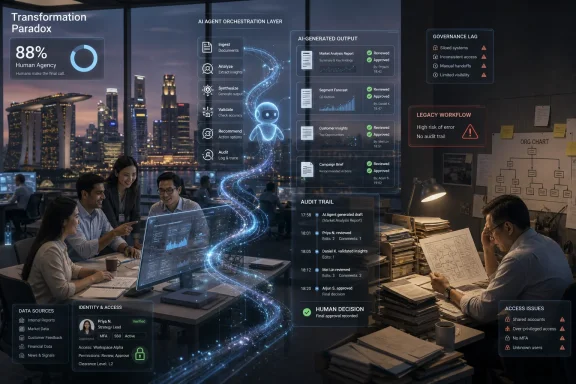
The Transformation Paradox Is Really a Management Failure
Microsoft describes Singapore as facing a “Transformation Paradox”: employees are adopting AI faster than organisations are adapting to it. The phrase is elegant, but it risks making the problem sound abstract. It is not abstract. It means workers are changing how tasks get done while job descriptions, approval chains, incentives, compliance models, and management expectations remain largely unchanged.That produces a familiar corporate absurdity. Employees are told to innovate with AI, but judged by legacy metrics. They are encouraged to experiment, but given unclear rules. They are asked to save time, but not told whether saved time should become more output, better output, new work, or simply invisible buffer in an already overloaded week.
Singapore’s numbers sharpen the point. Microsoft says 78 percent of AI users there recognise the need to adapt quickly, compared with a global average of 65 percent. Yet only 24 percent of Singapore respondents say their company’s leaders are clearly aligned on AI, slightly below the global figure of 26 percent. Even more telling, only 14 percent say their companies have strong incentives for redesigning work with AI.
That last number is the crack in the floor. If employees see the need to adapt, but the organisation does not reward redesign, then AI becomes a personal coping mechanism rather than an institutional capability. Workers use it to survive workload pressure, polish outputs, and move faster, while the company continues to pretend the old operating model still fits.
This is how shadow IT begins—not always with forbidden tools, but with forbidden realities. The work has changed, yet the official map has not.
AI Readiness Is Becoming a Labour-Market Signal
Singapore’s workforce has long been positioned as a high-skill node in the global economy. The country competes less on cheap labour than on coordination, infrastructure, legal predictability, logistics, finance, and technical competence. In that context, AI readiness is not just an HR metric. It is part of the national economic pitch.Microsoft’s report plays directly into that narrative. A workforce that can use AI responsibly, productively, and with human judgment intact is attractive to employers trying to scale operations without surrendering quality. It also fits Singapore’s broader reputation for pragmatic technology adoption: move fast, but within a controlled system.
Yet there is a risk in celebrating worker readiness too quickly. If employees become more capable faster than organisations become more coherent, the reward may be unevenly distributed. High-agency workers will pull ahead. Managers who understand AI will gain leverage. Teams with permissive cultures and clear data access will accelerate. Others will be left with vague encouragement and a chatbot subscription.
That creates a new version of the digital divide inside white-collar work. It is no longer simply between people who can use a computer and people who cannot, or between coders and non-coders. It is between workers who know how to orchestrate AI across tasks and workers trapped using it as a better autocomplete box.
Microsoft’s “Frontier Professional” label is doing a lot of work here. It describes the advanced user, but it also quietly defines the next prestige category in the office. The person who can manage AI agents, evaluate their output, and redesign a workflow starts to look less like a power user and more like a new kind of operational architect.
The Copilot Sales Pitch Meets the Enterprise Control Plane
No Microsoft workplace AI story can be separated from Copilot. The Work Trend Index is research, but it is also part of Microsoft’s broader argument that Microsoft 365, Windows, Teams, Outlook, SharePoint, security tooling, and Copilot can become the operating layer for AI-mediated work.That does not make the findings meaningless. It does mean readers should separate the diagnosis from the prescription. Microsoft is right that AI adoption without organisational redesign leaves value on the table. It is also commercially invested in the idea that its ecosystem is the place where that redesign should happen.
For Windows and Microsoft 365 administrators, this is where the discussion becomes practical. If employees are already using AI, the question is not whether the organisation has an AI strategy. The question is whether the actual strategy is being written by the IT department, the legal department, line managers, procurement, or employees pasting text into whichever tool gives the best answer.
The control plane matters. Identity, permissions, data boundaries, logging, retention, eDiscovery, endpoint management, and information protection are not glamorous, but they decide whether AI use is governable. An AI assistant connected to the wrong data can become a compliance problem at machine speed. An AI assistant connected to no useful data becomes an expensive toy.
Microsoft’s advantage is obvious: it already sits in the productivity stack for many of the organisations most likely to formalise AI use. But that advantage comes with a burden. If Copilot and related agents become embedded in daily work, administrators will need policy models that are understandable, auditable, and adjustable without requiring every company to become an AI research lab.
The White-Collar Automation Debate Is Not Going Away
The article that surfaced alongside the Singapore report also points readers to a separate controversy: Microsoft Copilot drew backlash after an AI executive suggested AI could automate white-collar jobs within 18 months. That tension is not incidental. It is the emotional background to every workplace AI study in 2026.On one page, AI is a tool that keeps human judgment at the centre. On another, AI is a force that may automate large portions of knowledge work. Both can be true, depending on the task, the occupation, and the time horizon. The mistake is treating “augmentation” and “automation” as mutually exclusive camps.
Most workplace technologies do both. They augment some workers while automating parts of other workers’ jobs. They remove drudgery in one context and eliminate entry-level pathways in another. They make senior employees more productive while reducing the number of juniors needed to prepare drafts, gather facts, or perform routine analysis.
That is why Singapore’s emphasis on critical thinking is encouraging but not sufficient. Critical thinking does not automatically protect a role if the organisation decides it can buy enough judgment from fewer people. Nor does human oversight solve the problem if oversight becomes a thin ritual over outputs no one has time to properly inspect.
The serious version of the AI workforce debate is not “will AI replace everyone?” It is “which tasks become cheap, which skills become scarce, which roles get compressed, and who captures the savings?” Microsoft’s report answers the first half more clearly than the second.
Responsible Use Requires More Than Responsible Workers
The Singapore findings repeatedly stress that workers are using AI responsibly. That is important, but enterprise risk is not solved by worker intent. Good employees can still mishandle sensitive data, trust plausible nonsense, fail to document AI assistance, or create outputs that are legally or commercially problematic.Responsible AI at work has to be designed as a system. It needs clear rules about what data can be used, which outputs require human review, when AI involvement must be disclosed, how errors are escalated, and which tasks are off-limits. It also needs managers who understand enough about the tools to avoid both panic and magical thinking.
The incentive problem is especially dangerous. If a company rewards speed above accuracy, employees will use AI for speed. If it rewards volume above judgment, employees will produce more AI-assisted volume. If it praises innovation but punishes failed experiments, employees will hide their experiments.
This is the less comfortable meaning of human-led AI. Humans do not just remain responsible for the thinking behind a document. Leaders remain responsible for the conditions under which that thinking happens. A poorly governed AI workplace is not a machine failure; it is an organisational design failure with a machine attached.
Singapore’s numbers suggest that employees have accepted their side of the bargain. They know adaptation is necessary. They value critical thinking. They are producing new kinds of work. The unresolved question is whether employers will meet them with clarity or bury them under slogans.
The Manager Becomes the Bottleneck
If AI adoption spreads from individual task assistance to workflow redesign, middle management becomes the decisive layer. Senior leaders can announce strategies, and IT can provision tools, but managers translate policy into daily permission. They decide whether a team actually changes how work is assigned, reviewed, measured, and improved.This is where many AI programmes will succeed or fail. A manager who does not understand AI will either ban it informally, tolerate it blindly, or reduce it to a productivity quota. None of those outcomes produces durable transformation. The better manager asks where AI changes the sequence of work, where it introduces risk, and where it frees people to do higher-value analysis.
Microsoft’s Singapore data on leadership alignment should worry executives precisely because it points to weak managerial signalling. If only about a quarter of respondents see clear leadership alignment, employees are likely receiving mixed messages. One leader wants experimentation. Another wants compliance. A third wants cost reduction. A fourth wants the same headcount to deliver 30 percent more work without admitting that the job has changed.
That ambiguity is corrosive. Workers will adapt privately, but teams will not learn collectively. Good AI practices will remain local hacks rather than institutional knowledge. Mistakes will be repeated because no one wants to confess how the work is really being done.
The enterprise lesson is old but newly urgent: technology does not scale through enthusiasm alone. It scales through management systems.
The Windows Workplace Is Turning Into an Agent Workplace
The 2026 Work Trend Index is not only about chatbots. Microsoft’s broader AI message this year has moved toward agents: systems that can take on multi-step tasks, interact with enterprise data, and operate across applications with varying degrees of autonomy. That shift matters more than another round of “AI can write emails” demos.A chatbot waits for prompts. An agent participates in a workflow. It may gather information, prepare a draft, update a system, schedule follow-ups, monitor changes, or coordinate other tools. Once that happens, AI is no longer a side panel. It becomes part of the work fabric.
For Windows environments, the implications are substantial. Endpoints, browsers, identity providers, productivity apps, and cloud services become surfaces for agentic action. Security teams will need to think about what an AI agent is allowed to read, what it is allowed to change, what actions require confirmation, and how to investigate what happened after the fact.
This is also where the phrase “human judgment at the centre” needs technical enforcement. A human cannot remain meaningfully in control if the system hides context, obscures provenance, or makes actions difficult to audit. The interface has to show not only the answer, but enough of the chain of reasoning, data sources, and action history for a person to challenge it.
The future Microsoft is selling is not just Copilot as helper. It is Microsoft 365 and Windows as an AI-mediated workspace. That may be powerful, but it raises the stakes for every admin console setting that used to feel routine.
Singapore Is a Useful Test Case Because It Is Not Silicon Valley
One reason the Singapore findings are worth attention is that they do not describe a startup enclave or a purely American tech workforce. Singapore is global, regulated, multilingual, service-heavy, and deeply connected to multinational business operations. It is exactly the kind of market where enterprise AI either becomes normal or runs into the hard wall of real-world constraints.That makes the “human-led” finding more credible. In a market where reputation, compliance, and operational reliability matter, workers are unlikely to openly celebrate reckless automation. The fact that many see AI as a way to expand what they can produce while retaining responsibility suggests a more mature adoption curve than the hype cycle usually allows.
But Singapore is also a warning. If a digitally advanced workforce with high AI readiness still shows weak leadership alignment and limited incentives for work redesign, less prepared markets should not expect an easier path. The hard part is not buying AI. The hard part is deciding what the organisation becomes after AI is normal.
That requires a level of managerial honesty many companies have avoided. If AI saves time, does the company reduce headcount, raise output targets, improve quality, shorten workweeks, invest in training, or redesign roles? If AI creates new capabilities, who owns them? If AI increases risk, who signs off?
These are not tool questions. They are power questions.
The Productivity Dividend Will Not Distribute Itself
The phrase “sustainable advantage” appears in Microsoft Singapore’s statement, and it is doing more than public-relations work. AI advantage is sustainable only if the gains are captured in repeatable systems rather than one-off heroics by motivated employees.Right now, many organisations are probably in the heroics phase. A few workers learn the tools deeply. They build prompts, templates, shortcuts, and informal review habits. Their output improves. Their managers notice. Then the organisation assumes the AI strategy is working.
That is not transformation. It is uneven personal productivity. It may even increase burnout if the best AI users become the default fixers for everyone else’s broken workflows.
The next phase has to be more deliberate. Companies need to identify which processes are worth redesigning, which AI uses should become standard, which require guardrails, and which should be rejected. They also need to update performance management so employees are not punished for spending time improving the system rather than feeding the old one.
This is where the 14 percent incentive figure becomes so important. Without incentives, redesign is extra work. And in a high-pressure workplace, extra work loses to immediate deliverables almost every time.
The Singapore AI Story Is Really About Who Gets to Redesign Work
Microsoft’s Singapore findings are optimistic, but not simple. They show a workforce ready to use AI with judgment, and they show organisations that have not yet built the leadership alignment or incentive structures to fully benefit from that readiness.- Singapore AI users are slightly more likely than the global average to say they remain responsible for the thinking behind AI-assisted work.
- Critical thinking is not being displaced by AI in the survey; it is being elevated as the skill workers believe will matter most.
- A large share of Singapore AI users say they are now producing work they could not have produced a year ago, suggesting a shift from efficiency to capability.
- The biggest organisational risk is no longer non-adoption, but unmanaged adoption inside old workflows.
- Leadership alignment, manager behaviour, incentives, governance, and auditability will determine whether AI becomes durable advantage or another layer of workplace confusion.
- For Windows and Microsoft 365 environments, the move from chatbot assistance to agentic workflows will make identity, permissions, security, and data governance central to everyday productivity.
References
- Primary source: The Independent Singapore News
Published: 2026-06-21T08:35:07.770794
Singapore workers embrace AI while keeping human judgment at the centre: Microsoft - Singapore News
Nearly nine in 10 AI users in Singapore said they remain responsible for the thinking behind their work. theindependent.sg
- Official source: news.microsoft.com
- Official source: microsoft.com
2026 Work Trend Index report: Agents, human agency, and opportunity
As AI and agents take on execution, our own agency expands. The question is whether organizations are built to capture it.www.microsoft.com - Official source: blogs.microsoft.com
How Frontier Firms are rebuilding the operating model for the age of AI - The Official Microsoft Blog
Updated May 11, 2026: The post was updated to reflect that third-party plugins will be available starting May 12, 2026. Spend time with any software engineering team right now and you’ll see something worth paying attention to. Over the last few years, the way software gets built has moved...blogs.microsoft.com - Related coverage: metaintro.com
Microsoft 2026 Work Trend Index: 67% Say... | Metaintro
Microsoft's 2026 Work Trend Index of 20,000 workers finds 67% rank organizational readiness — not tools — as the biggest factor in AI pilot success globally.www.metaintro.com - Official source: microsoftpartners.microsoft.com

- Related coverage: forbes.com
Microsoft Work Trend Index 2026 Shows AI Productivity Is Not Enough
The 2026 Work Trend Index shows that marginal AI productivity gains are outpacing organizational redesign that might harness AI for durable strategic advantage.www.forbes.com - Related coverage: techradar.com
'Every business leader knows the world is changing, but far fewer have a clear picture of what to do about it': Microsoft flags the changing world of AI at work, and why "Frontier Firms" are leading the way | TechRadar
Microsoft digs deep into how businesses are using AIwww.techradar.com - Related coverage: tomshardware.com
Microsoft says 'Transformation Paradox' holding back AI adoption in the workplace — 45% of respondents say it's safer to focus on current goals, rather than AI innovation | Tom's Hardware
“Employees are ready to reinvent how they work, but the system around them continues to reinforce the old way.”www.tomshardware.com - Related coverage: pcgamer.com
Using 'trillions of anonymised productivity signals', Microsoft thinks nearly half of people like AI in their work | PC Gamer
There's dozens of us who don't!www.pcgamer.com - Official source: cdn-dynmedia-1.microsoft.com
