

OpenAI Is No Longer Just the Tool in the Brief
For the first wave of generative AI adoption, agencies treated OpenAI as a production accelerator. It wrote first drafts, generated mood-board language, helped summarize consumer research, and gave social teams a way to squeeze more variations out of fewer hours. That phase was disruptive enough, but it still placed AI inside the agency’s existing workflow.
The newer shift is more structural. OpenAI has been moving toward advertising products of its own, with agency groups and marketing partners positioned around the buying, planning, creative, and measurement layers. Once ChatGPT becomes not just a place where users ask questions but a place where commercial intent can be surfaced, the agency’s relationship to the platform changes.
That is why the phrase “work with indies” deserves more attention than it might receive in a normal agency roundup. Independent agencies have often sold themselves on agility, taste, and senior attention. If OpenAI is now courting them directly, it suggests the company understands that advertising adoption cannot be won only through holding-company scale.
The ad platform that wins in AI will need trust from brands, but it will also need fluency from the people who turn brand strategy into campaigns. Independent agencies are useful test beds because they are close enough to clients to move quickly and small enough to change process without a year of steering committees.
The Indie Agency Suddenly Has Leverage Again
The last decade was not always kind to independent shops. Procurement favored scale, media buying consolidated, and large clients often treated agency rosters like vendor management puzzles. Creative boutiques could still break through, but the economics of full-service marketing tilted toward networks that could bundle media, data, production, commerce, and analytics.
AI complicates that hierarchy. If a smaller agency can use AI systems to compress research, prototyping, localization, performance analysis, and production, it can compete above its headcount. The old advantage of scale does not disappear, but it becomes less absolute.
That does not mean a three-person shop can suddenly replace a global network for a multinational advertiser. Brand safety, regulatory review, localization, procurement compliance, and data governance still matter. But AI narrows the execution gap in the messy middle of marketing, where many clients need speed more than organizational theater.
OpenAI’s interest in independents also gives those shops a new kind of platform relationship. In the old model, smaller agencies often got whatever access the major platforms allowed after the biggest buyers had negotiated their terms. If AI advertising is still early, independent agencies may be able to shape the workflows before they harden into another dashboard controlled by the largest spenders.
Fortnight’s Hire Points to the Same Anxiety
Fortnight Collective’s creative hire belongs in the same story because talent is the other half of the AI question. Agencies are not merely asking which tools to buy. They are asking what kind of creative leadership still matters when more execution can be automated.
The answer is not “prompt engineering,” at least not in the shallow sense that dominated LinkedIn discourse in 2023 and 2024. The more durable skill is judgment: knowing what a brand should say, what it should avoid, what will feel derivative, and when efficiency has started to sand off the interesting edges. AI can generate a hundred campaign territories. It cannot, by itself, know which one a brand has earned the right to occupy.
Creative hiring in this environment is therefore a signal. Agencies still need people who can make taste-based calls under commercial pressure. If anything, the volume of machine-generated options makes senior creative judgment more valuable, not less.
The danger is that agencies will confuse output with imagination. Faster storyboards, more headlines, cheaper social variants, and endless synthetic concepting can create the appearance of creative abundance. But a brand can still become invisible if every idea has the same polished, platform-optimized texture.
The Real Platform Fight Is Over Intent
Traditional digital advertising was built around signals that were either explicit, like a search query, or inferred, like browsing behavior and demographic models. Chat-based AI introduces a stranger kind of signal. A user may ask for help choosing software, planning a trip, comparing laptops, writing an RFP, or deciding how to fix a home network.
That kind of conversation can reveal commercial intent, but it also carries expectations that are different from a search results page or a social feed. Users do not experience a chatbot as an ad slot. They experience it as an assistant, adviser, tutor, or problem-solver.
That is where OpenAI’s advertising challenge becomes delicate. The company has said it wants ads to be distinct and not influence answers. That is the right positioning, but the practical line will be hard to police because recommendation, retrieval, shopping, and advertising can blur inside conversational interfaces.
For agencies, this means creative work may move closer to the informational layer. The winning campaign may not be the most cinematic video or the cleverest banner. It may be the brand asset, product data, comparison language, and trust signal that makes a company legible to an AI system at the moment a user is asking for help.
Windows Users Will Feel This Through the Browser, Not the Billboard
This story may sound like inside baseball for Madison Avenue, but the distribution layer is familiar to anyone who follows Windows. The PC is where productivity, search, browsing, messaging, identity, and enterprise policy collide. If AI assistants become commercial interfaces, the Windows desktop becomes one of the most important battlegrounds for how those interfaces are governed.
Microsoft has already spent years integrating Copilot across Windows, Edge, Microsoft 365, GitHub, security tooling, and Azure. OpenAI’s consumer and advertising ambitions run alongside that ecosystem, sometimes as partner, sometimes as gravitational force. The boundary between workplace assistant and commercial recommender will matter enormously to IT departments.
A sysadmin may not care which agency created a ChatGPT ad campaign. They will care whether employees are pasting sensitive data into AI systems, whether commercial results are clearly labeled, whether enterprise controls apply consistently, and whether browser-level policy can separate personal AI use from managed corporate workflows.
That is the practical bridge between agency news and WindowsForum’s world. Advertising is not just a marketing revenue model. It is also an interface design choice that shapes what users see when they ask machines for advice.
The One Club’s Student Challenge Shows the Pipeline Problem
The One Club’s challenge for undergraduate students adds a generational layer to the story. The industry is not simply retraining current staff; it is redefining what junior creative talent is supposed to be. Students entering advertising in 2026 are not learning AI as an optional specialty. They are entering a field where AI is already part of the default toolkit.
That creates both opportunity and risk. Young creatives may be more comfortable with AI-native ideation than their managers. They may also be entering a market that has fewer traditional junior production tasks, because the work once used to train them is exactly the work agencies are most eager to automate.
Advertising has always relied on apprenticeship. Juniors learned by making things, revising them, watching them get killed, and gradually understanding why the work that survived was stronger. If AI removes too many of those low-level repetitions, the industry may save money in the short term while weakening its own talent pipeline.
The better version is not to protect busywork for sentimental reasons. It is to redesign entry-level creative roles around sharper judgment, cultural research, live experimentation, and ethical fluency. The worst version is an agency floor where juniors become prompt operators and seniors become reviewers of synthetic mush.
The Holding Companies Still Have the Weight
It would be easy to overstate the indie-agency renaissance. The largest agency groups still bring global client relationships, media buying scale, enterprise-grade data operations, and legal infrastructure. Those advantages matter even more when AI systems touch privacy, targeting, brand safety, and measurement.
OpenAI’s major agency partnerships make that clear. The big networks are not being bypassed; they are being enlisted. They offer a route into large advertisers that cannot experiment with a new ad channel casually, especially when the channel sits inside a conversational AI product with heightened trust concerns.
But the existence of large partnerships does not cancel the significance of independent agencies. Instead, it creates a two-track adoption pattern. Holding companies will shape governance, measurement standards, and enterprise packaging, while independents may shape use cases, creative formats, and faster client experimentation.
That split is familiar from previous platform shifts. Search marketing, social advertising, programmatic buying, influencer marketing, and commerce media all developed through a mix of scale players and nimble specialists. AI advertising is likely to follow the same pattern, only faster and with more anxiety.
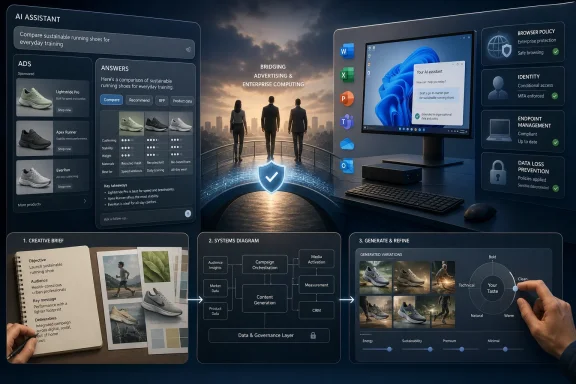
The Creative Brief Is Becoming a Systems Brief
The classic creative brief asked for audience, insight, proposition, tone, mandatories, and deliverables. The AI-era brief has to ask additional questions. What data can the model use? Which claims must be verified? Where should generated content be blocked? What constitutes disclosure? How will performance feedback change the next creative iteration?
That turns the brief into a systems document as much as a creative one. Agencies will need to understand not only brand strategy but also data provenance, model behavior, content rights, and platform policy. The people who can bridge those domains will become disproportionately valuable.
This is where many agencies will struggle. Advertising has long borrowed the language of technology while keeping its internal workflows surprisingly informal. AI punishes that gap. A loose process that once produced charming chaos can become a liability when machine-generated assets, automated targeting, and client data all move through the same pipeline.
The agencies that thrive will not be the ones that merely “use AI.” Everyone will use AI. The advantage will go to agencies that can explain where AI enters the process, where humans retain authority, and how the client can audit the result.
Trust Is the Scarce Inventory
OpenAI’s advertising push has to solve a problem Google never faced in quite the same way. Search advertising trained users to understand that sponsored results lived near organic results. Social advertising trained users to understand that the feed was commercialized by design. ChatGPT, however, became popular because users felt they were talking to something that helped them directly.
That trust is valuable, but it is also fragile. If users begin to suspect that commercial relationships are shaping answers, even subtly, the product’s utility suffers. Clear separation between ads and answers is therefore not just an ethical stance; it is a product requirement.
Agencies have their own version of the trust problem. Clients are excited by speed and efficiency, but they are also wary of generic output, copyright disputes, hallucinated claims, and brand safety failures. The agency that can say “we made this faster” will be less compelling than the agency that can say “we made this faster and can show you exactly how it was controlled.”
In that sense, AI may push advertising back toward craft after years of optimization theater. Not craft as nostalgia, but craft as accountable judgment. The work has to be distinctive, legally safe, contextually aware, measurable, and explainable.
Enterprise IT Will Be Dragged Into the Campaign Room
One of the underappreciated consequences of AI marketing is that it pulls IT departments into decisions they used to avoid. If an agency wants to connect client data to an AI platform, someone must decide what data is allowed, how it is anonymized, where it is stored, and whether it can be used for model improvement. Those are not purely marketing questions.
For Windows-heavy organizations, the controls may run through identity management, endpoint policy, browser configuration, data-loss prevention tools, and Microsoft 365 governance. The campaign may begin with a creative ambition, but it quickly becomes an enterprise architecture discussion.
This is especially true for regulated industries. A bank, insurer, healthcare company, or public-sector body cannot treat AI-generated advertising like a clever shortcut. Claims must be substantiated, customer data must be protected, and approval trails must survive scrutiny.
Agencies that ignore this will lose credibility with sophisticated clients. Agencies that learn to speak both brand and compliance will gain an edge. The future account team may need to understand the CMO’s growth target and the CISO’s threat model in the same meeting.
The Small Brief That Explains the Bigger Market
The June 5 Agency Brief is not, on its face, a dramatic industry earthquake. A creative hire, a student challenge, and OpenAI’s indie-agency work are the kind of items that usually pass quickly through a trade newsletter. But taken together, they show an industry trying to rebalance itself around AI without admitting how unsettled the ground has become.
The creative hire says human taste still matters. The student challenge says the next generation will inherit a field already altered by automation. OpenAI’s agency work says the platform layer is moving closer to the center of advertising economics.
That combination is the story. Agencies are not being replaced in a single clean wave. They are being re-sorted by how well they can combine creativity, data discipline, AI tooling, and trust.
The result will be uneven. Some shops will become sharper and more valuable. Others will wrap old services in AI language and hope clients do not look too closely. A few will disappear because the work they sold was never strategic enough to survive automation.
The Practical Read for WindowsForum’s Crowd
The most concrete lesson is that AI advertising is not just another media channel. It is a sign that conversational systems are becoming commercial infrastructure, and that has consequences for users, admins, developers, and security teams.
- OpenAI’s work with independent agencies suggests AI advertising is moving beyond closed experiments with the biggest holding companies.
- Creative hiring still matters because AI increases the need for judgment, taste, and brand discipline rather than eliminating it.
- Student competitions now sit inside a changed talent market where young creatives must learn both concepting and AI-mediated production.
- Enterprise IT will have to govern the data, identity, browser, and compliance layers that make AI-driven marketing possible.
- Users should expect more commercial experiences inside AI assistants, making transparency and separation between answers and ads essential.
- Agencies that can document their AI workflows will be more credible than agencies that treat automation as a magic trick.
The advertising business has always followed attention, and attention is now moving into interfaces that answer, summarize, recommend, and act. That makes OpenAI’s agency relationships more than a trade-news footnote. They are an early sign of a market in which the creative brief, the media buy, the enterprise policy stack, and the user’s everyday AI assistant all start to overlap—and the winners will be the companies that can make that overlap useful without making it feel compromised.
References
- Agency Brief—Fortnight Collective’s creative hire, OpenAI’s work with indies Ad Age · 2026-06-05T09:50:12.412228
- openai.com openai.com