

Singapore startups increased their paid use of artificial intelligence platforms in FY2026, with Aspire reporting on June 16 that subscriptions rose 42 percent year on year and that 704 startups were paying for three or more AI tools at once. The headline number is not simply that founders are buying more software. It is that the AI stack is fragmenting faster than the operating model around it. Singapore’s startup scene is becoming a live test of what happens when young companies treat generative AI less like a single productivity app and more like cloud infrastructure: always on, metered, redundant, and increasingly strategic.
For the first year or two of the generative AI boom, the corporate adoption story was often told as if there were one decision to make: use ChatGPT or do not use ChatGPT. That framing is now badly out of date. Aspire’s spending data suggests Singapore startups are moving from experimentation into portfolio management, paying for multiple AI services because no single model, interface, or vendor cleanly covers the work they want to automate.
The numbers are stark. The average startup in Aspire’s sample used 1.87 AI platforms, while the number using three or more platforms more than doubled from 339 to 704 between FY2025 and FY2026. This is not the behavior of companies dabbling with a shiny chatbot on the side. It is the behavior of firms building AI into customer support, coding, marketing, research, sales operations, finance workflows, and founder productivity at the same time.
That matters because the startup software budget has always been a map of managerial intent. A young company’s card transactions reveal what it thinks it must buy before it can scale. In this case, the map shows that AI is no longer one line item competing with SaaS tools; it is becoming the layer that cuts across them.
The practical implication is uncomfortable for vendors and buyers alike. If startups are already paying for several model providers at once, then the winner-takes-most narrative around consumer AI may not translate neatly into business adoption. In the enterprise, “best model” increasingly means “best model for this workflow, this risk profile, this integration path, and this budget cycle.”
But Claude’s trajectory is the more revealing part of the report. Aspire counted 1,537 unique paying clients for Claude in FY2026, a 258 percent increase from FY2024. More strikingly, Claude users spent about 1.4 times more per account annually than ChatGPT users: US$1,598 versus US$1,144.
That spending pattern implies Claude is not merely being sampled as a second opinion. It is being used seriously enough, and perhaps in sufficiently premium tiers or heavier workflows, to command a larger average wallet. Aspire said total spending on Claude grew 17 times in a single year, compared with a 79 percent increase for ChatGPT.
This is where the AI market starts to look less like the browser wars and more like the early cloud wars. Developers and operators do not choose a cloud provider only because of brand recognition. They choose services based on reliability, latency, data posture, tooling, price predictability, ecosystem fit, and the internal folklore of what breaks least often. AI models are starting to be judged the same way.
Claude’s share of startup AI spend in the report, at 37 percent, is already close to ChatGPT’s 41 percent. That does not mean Anthropic has overtaken OpenAI in Singapore startups, nor does it mean spending share equals strategic dependence. It does mean the market is becoming less psychologically dependent on one interface and one vendor.
The answer is that AI tools do not overlap as cleanly as they appear to. One model may be better for code review, another for long-context document analysis, another for quick ideation, another for data extraction, and another because it is bundled into an existing productivity suite. The user experience may be a chat window, but the business use case can vary wildly underneath.
Startups are also hedging against a market that changes by the month. Model rankings shift, prices move, context windows expand, rate limits tighten, integrations appear, and safety behavior changes after updates. A company that standardizes too early on one model risks tying its internal processes to a moving target.
There is also a subtle organizational factor. Employees bring preferences. Engineers may gravitate toward one model, marketers toward another, founders toward whichever tool gives them the cleanest board memo at midnight. In a five-person company, that can be tolerated as personal workflow. In a 50-person startup, it becomes shadow procurement. In a 200-person scale-up, it becomes governance.
Aspire’s data captures the phase before governance fully catches up. Singapore startups are clearly spending; they are not necessarily rationalizing that spend yet. The next wave of management work will be less glamorous than AI adoption itself: vendor registers, access controls, data handling rules, model evaluation, prompt libraries, cost allocation, and audit trails.
That helps explain why the Aspire report is more interesting than a simple ranking of software subscriptions. Singapore startups are not just using AI more; they are using AI while reconfiguring how work is sourced and distributed. The same report that shows rising AI adoption also shows growing payroll activity outside the Republic, especially in the Philippines, Indonesia, and India.
This pairing is not accidental. Generative AI makes distributed work more legible and more scalable, while distributed teams create more demand for tools that reduce coordination costs. A founder with engineers in India, support staff in the Philippines, sales development in Indonesia, and management in Singapore has a coordination problem before they have a model problem. AI tools promise to compress some of that distance.
But the promise cuts both ways. AI can help a distributed workforce move faster, but it can also conceal process fragility. A team that relies on chatbots to summarize meetings, draft customer replies, generate code, translate copy, and analyze contracts may move with impressive speed until a mistake crosses a compliance boundary or a customer-facing hallucination becomes a trust issue.
The frontier for Singapore startups, then, is not “AI adoption” in the abstract. It is whether AI can be integrated into a cross-border operating model without turning every workflow into an ungoverned experiment.
The report also found that 51 percent of Singapore startups were paying staff monthly, while 21 percent were paying on an ad hoc basis. That mix suggests a workforce architecture made of full-time employees, contractors, freelancers, agencies, and project-based specialists. In other words, the startup workforce is being modularized.
The median payroll transaction fell from US$3,535 in FY2025 to US$3,318 in FY2026. That decline should not be overread as a direct wage signal; transaction data can shift because of geography, contractor mix, currency, payment frequency, and company stage. But it does fit the broader picture of startups seeking flexibility in a tighter funding environment.
AI sits neatly inside that model. A founder can use AI to reduce the need for some junior work, increase the leverage of senior staff, and coordinate external contributors more cheaply. At the same time, startups can hire specialists across borders and use AI as a connective layer for documentation, onboarding, translation, and knowledge retrieval.
The risk is that flexibility becomes opacity. Contractors may have access to customer data, AI tools may retain prompts or outputs depending on plan settings, and distributed teams may route sensitive work through consumer-grade interfaces. For IT pros, this is the familiar shadow IT problem wearing a new jacket.
But the shape of office spending is changing. Fixed leases and utilities have contracted, while spending on co-working surged. Singapore startups almost doubled spending at IWG and WeWork in FY2026 compared with the prior year, with IWG leading by transaction volume, followed by WeWork and Regus.
That is not a return to the pre-pandemic office. It is the office being refactored as an option. Founders still want rooms for investor meetings, team rituals, hiring interviews, customer workshops, and the occasional all-hands burst of urgency. They are less eager to sign long leases that assume headcount growth will arrive on a tidy schedule.
This mirrors what is happening in software. Just as startups are buying multiple AI platforms instead of betting everything on one vendor, they are buying workspace flexibility instead of locking into a single physical footprint. The organizing principle is optionality.
Optionality, however, is not the same as efficiency. Flexible workspace can be more expensive per seat. Multiple AI tools can create duplicate spending. Distributed hiring can lower some costs while increasing management overhead. The modern startup is not simply becoming leaner; it is exchanging fixed commitments for variable complexity.
The US dollar is the native currency of much of the global startup ecosystem. Cloud infrastructure, AI subscriptions, developer tools, venture financing, and cross-border contractor rates are often quoted or mentally benchmarked in dollars. As Singapore startups hire beyond the Republic and sell beyond the region, a rising dollar share in payroll transactions fits the pattern.
For WindowsForum readers, this is a reminder that AI adoption is not just a software trend. It is part of a broader replatforming of business operations. The startup stack now includes global payroll, expense management, cloud services, AI tools, co-working subscriptions, and security controls that must operate across borders.
This is where small companies start to resemble miniature multinationals before they have multinational-grade IT departments. They may have employees in several countries, SaaS vendors in several jurisdictions, AI tools processing sensitive text, and financial flows in multiple currencies. The operational surface area expands faster than the headcount.
The result is a market that creates opportunity for fintech platforms like Aspire, but also for identity providers, endpoint management vendors, security brokers, compliance automation tools, and managed service providers. Startups that once needed only laptops, Google Workspace or Microsoft 365, Slack, GitHub, and a cloud account now need an operating model that can survive AI-accelerated sprawl.
The second wave will be sold on control. Once AI spend grows, once multiple tools enter the company, and once employees begin using them for work that touches customers or codebases, management has to ask dull but necessary questions. Who has access? What data is allowed? Which outputs need review? What gets logged? Which tool is approved for which task?
The answer cannot simply be a ban on unapproved tools. That tends to fail in startups, where velocity is a form of survival. It also misses the reality that employees may have good reasons for preferring different platforms. A heavy-handed single-vendor mandate could reduce both productivity and morale.
A better model is tiered governance. Low-risk brainstorming can happen broadly. Customer data, financial data, source code, legal text, and employment records require stricter controls. AI vendors should be evaluated not just on model quality but on admin controls, retention settings, enterprise terms, auditability, and integration with identity systems.
This is where IT leaders need to reclaim the conversation. The AI budget may have entered through founder credit cards and departmental enthusiasm, but it cannot stay there indefinitely. If AI is becoming infrastructure, it needs infrastructure discipline.
Microsoft has spent heavily to make Copilot the AI layer across Windows, Microsoft 365, GitHub, Azure, and business applications. For organizations already standardized on Microsoft identity, endpoint management, and productivity software, that bundling is powerful. It promises fewer procurement headaches and a cleaner administrative story.
But Aspire’s data is a warning against assuming that bundling ends the market. Workers and teams will still reach for ChatGPT, Claude, Gemini, Perplexity, specialized coding assistants, meeting bots, research tools, and vertical AI apps if those tools solve problems better than the approved suite. The enterprise AI estate will be multi-platform by default unless IT actively makes the sanctioned platform both safe and good enough.
That matters on Windows endpoints because the browser has become the universal AI client. A company can lock down desktop software and still have employees pasting sensitive text into web apps. It can deploy Copilot and still find engineering teams paying for another model because it handles code or long documents better. It can negotiate enterprise terms with one vendor while business units quietly expense another.
The lesson from Singapore’s startups is not that every organization should copy their tool mix. It is that actual users optimize for task completion, not procurement elegance. IT strategy that ignores that fact will produce beautiful policy documents and ugly reality.
General-purpose AI tools are stickier than they look, but less sticky than vendors would like. Users develop habits, save prompts, build custom assistants, and integrate APIs. Yet the core experience remains portable enough that a visibly better model can attract work quickly. If a rival handles long context better, writes better code, follows instructions more reliably, or prices aggressively, users can shift portions of work without migrating the whole company.
This is why Claude’s rise in Aspire’s data matters. It suggests that even in a market where ChatGPT has massive mindshare, startups are willing to allocate serious spend to a challenger. They are not waiting for a single corporate standard to bless the move. They are voting with transactions.
For AI vendors, that creates pressure to ship constantly and court developers, founders, and finance teams at the same time. For customers, it creates leverage but also fatigue. Every model update becomes a possible procurement event. Every new benchmark becomes a Slack argument. Every pricing change becomes a spreadsheet.
The likely outcome is not one model to rule them all. It is a layered market: bundled assistants for everyday office work, premium models for specialized reasoning, coding tools for software teams, embedded AI inside vertical SaaS, and internal governance systems trying to hold the whole thing together.
But startups also show where software usage goes when friction is low. They reveal demand before procurement departments domesticate it. If hundreds of Singapore startups are already paying for multiple AI platforms, larger companies should assume the same desire exists inside their walls, whether or not it appears in the official vendor list.
The Aspire data also reinforces that AI adoption is not replacing older infrastructure choices. It is accumulating on top of them. Startups still buy office space, cloud infrastructure, payroll services, contractor labor, and collaboration tools. AI does not simplify the operating model by magic; it adds a new layer that can either increase leverage or multiply confusion.
That is the central argument buried inside the transaction data. AI is not a discrete app category anymore. It is becoming a general-purpose capability that touches hiring, workspace, finance, product development, and security. When a technology becomes that horizontal, the main challenge shifts from access to architecture.
Singapore is a useful place to watch this because its startups operate under conditions many global companies recognize: high local labor costs, regional talent access, cross-border ambitions, sophisticated finance, and intense pressure to move quickly. The city-state is not an edge case. It is a preview.
Singapore’s startup economy is showing the next phase of business AI in miniature: multi-model, cross-border, flexible, expensive, and only partially governed. The companies that benefit most will not be the ones that merely buy the newest model fastest, but the ones that learn how to turn a messy bundle of tools, people, currencies, and workspaces into a coherent operating system before the complexity compounds.
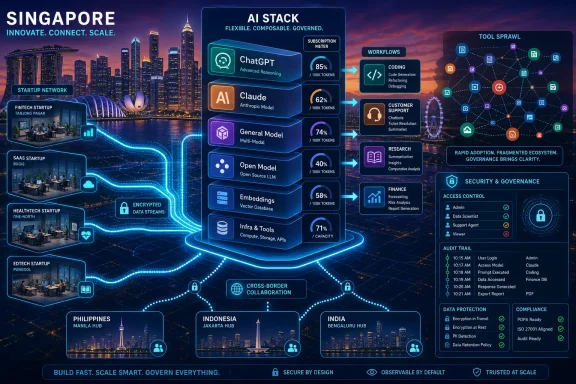 The AI Budget Has Become a Stack, Not a Subscription
For the first year or two of the generative AI boom, the corporate adoption story was often told as if there were one decision to make: use ChatGPT or do not use ChatGPT. That framing is now badly out of date. Aspire’s spending data suggests Singapore startups are moving from experimentation into portfolio management, paying for multiple AI services because no single model, interface, or vendor cleanly covers the work they want to automate.The numbers are stark. The average startup in Aspire’s sample used 1.87 AI platforms, while the number using three or more platforms more than doubled from 339 to 704 between FY2025 and FY2026. This is not the behavior of companies dabbling with a shiny chatbot on the side. It is the behavior of firms building AI into customer support, coding, marketing, research, sales operations, finance workflows, and founder productivity at the same time.
That matters because the startup software budget has always been a map of managerial intent. A young company’s card transactions reveal what it thinks it must buy before it can scale. In this case, the map shows that AI is no longer one line item competing with SaaS tools; it is becoming the layer that cuts across them.
The practical implication is uncomfortable for vendors and buyers alike. If startups are already paying for several model providers at once, then the winner-takes-most narrative around consumer AI may not translate neatly into business adoption. In the enterprise, “best model” increasingly means “best model for this workflow, this risk profile, this integration path, and this budget cycle.”
ChatGPT Still Leads, but Claude Is Now the Startup CFO’s Problem
ChatGPT remains the obvious giant in Aspire’s data. It had 2,377 unique paying startup clients in FY2026, up 31 percent from FY2024. For many founders and employees, ChatGPT is still the default front door to generative AI, the product name that has become shorthand for the category itself.But Claude’s trajectory is the more revealing part of the report. Aspire counted 1,537 unique paying clients for Claude in FY2026, a 258 percent increase from FY2024. More strikingly, Claude users spent about 1.4 times more per account annually than ChatGPT users: US$1,598 versus US$1,144.
That spending pattern implies Claude is not merely being sampled as a second opinion. It is being used seriously enough, and perhaps in sufficiently premium tiers or heavier workflows, to command a larger average wallet. Aspire said total spending on Claude grew 17 times in a single year, compared with a 79 percent increase for ChatGPT.
This is where the AI market starts to look less like the browser wars and more like the early cloud wars. Developers and operators do not choose a cloud provider only because of brand recognition. They choose services based on reliability, latency, data posture, tooling, price predictability, ecosystem fit, and the internal folklore of what breaks least often. AI models are starting to be judged the same way.
Claude’s share of startup AI spend in the report, at 37 percent, is already close to ChatGPT’s 41 percent. That does not mean Anthropic has overtaken OpenAI in Singapore startups, nor does it mean spending share equals strategic dependence. It does mean the market is becoming less psychologically dependent on one interface and one vendor.
The Multi-Model Startup Is a Rational Response to an Unsettled Market
Running three or more AI platforms can look wasteful from the outside. In a conventional SaaS procurement review, duplicate tools are the first things finance teams try to eliminate. Why pay for overlapping subscriptions when one vendor promises to do almost everything?The answer is that AI tools do not overlap as cleanly as they appear to. One model may be better for code review, another for long-context document analysis, another for quick ideation, another for data extraction, and another because it is bundled into an existing productivity suite. The user experience may be a chat window, but the business use case can vary wildly underneath.
Startups are also hedging against a market that changes by the month. Model rankings shift, prices move, context windows expand, rate limits tighten, integrations appear, and safety behavior changes after updates. A company that standardizes too early on one model risks tying its internal processes to a moving target.
There is also a subtle organizational factor. Employees bring preferences. Engineers may gravitate toward one model, marketers toward another, founders toward whichever tool gives them the cleanest board memo at midnight. In a five-person company, that can be tolerated as personal workflow. In a 50-person startup, it becomes shadow procurement. In a 200-person scale-up, it becomes governance.
Aspire’s data captures the phase before governance fully catches up. Singapore startups are clearly spending; they are not necessarily rationalizing that spend yet. The next wave of management work will be less glamorous than AI adoption itself: vendor registers, access controls, data handling rules, model evaluation, prompt libraries, cost allocation, and audit trails.
Singapore Is Becoming a Neutral Lab for AI-Native Business
Singapore has long sold itself as a headquarters location for companies that want access to South-east Asia without surrendering the legal predictability and financial infrastructure of a developed market. The AI boom has made that positioning more valuable. A startup can incorporate in Singapore, hire regionally, sell globally, and buy frontier AI services from American providers while operating in a multilingual, cross-border commercial environment.That helps explain why the Aspire report is more interesting than a simple ranking of software subscriptions. Singapore startups are not just using AI more; they are using AI while reconfiguring how work is sourced and distributed. The same report that shows rising AI adoption also shows growing payroll activity outside the Republic, especially in the Philippines, Indonesia, and India.
This pairing is not accidental. Generative AI makes distributed work more legible and more scalable, while distributed teams create more demand for tools that reduce coordination costs. A founder with engineers in India, support staff in the Philippines, sales development in Indonesia, and management in Singapore has a coordination problem before they have a model problem. AI tools promise to compress some of that distance.
But the promise cuts both ways. AI can help a distributed workforce move faster, but it can also conceal process fragility. A team that relies on chatbots to summarize meetings, draft customer replies, generate code, translate copy, and analyze contracts may move with impressive speed until a mistake crosses a compliance boundary or a customer-facing hallucination becomes a trust issue.
The frontier for Singapore startups, then, is not “AI adoption” in the abstract. It is whether AI can be integrated into a cross-border operating model without turning every workflow into an ungoverned experiment.
The Distributed Workforce Is the Other Half of the AI Story
Aspire’s payroll data points toward a startup labor market that is becoming more regional, more flexible, and less bound to the traditional office headcount model. The Philippines was the top payroll destination by transaction count for Singapore startups, followed by Indonesia and India. That ranking says as much about South-east Asia’s services talent pool as it does about Singapore’s cost structure.The report also found that 51 percent of Singapore startups were paying staff monthly, while 21 percent were paying on an ad hoc basis. That mix suggests a workforce architecture made of full-time employees, contractors, freelancers, agencies, and project-based specialists. In other words, the startup workforce is being modularized.
The median payroll transaction fell from US$3,535 in FY2025 to US$3,318 in FY2026. That decline should not be overread as a direct wage signal; transaction data can shift because of geography, contractor mix, currency, payment frequency, and company stage. But it does fit the broader picture of startups seeking flexibility in a tighter funding environment.
AI sits neatly inside that model. A founder can use AI to reduce the need for some junior work, increase the leverage of senior staff, and coordinate external contributors more cheaply. At the same time, startups can hire specialists across borders and use AI as a connective layer for documentation, onboarding, translation, and knowledge retrieval.
The risk is that flexibility becomes opacity. Contractors may have access to customer data, AI tools may retain prompts or outputs depending on plan settings, and distributed teams may route sensitive work through consumer-grade interfaces. For IT pros, this is the familiar shadow IT problem wearing a new jacket.
The Office Did Not Die; It Became a More Expensive Choice
One of the more counterintuitive findings in the Aspire report is that physical offices still matter. Office-related spending accounted for 44.3 percent of infrastructure spending among Singapore startups, ahead of cloud infrastructure at 32 percent. In a report full of AI and distributed payroll signals, the office remains stubbornly present.But the shape of office spending is changing. Fixed leases and utilities have contracted, while spending on co-working surged. Singapore startups almost doubled spending at IWG and WeWork in FY2026 compared with the prior year, with IWG leading by transaction volume, followed by WeWork and Regus.
That is not a return to the pre-pandemic office. It is the office being refactored as an option. Founders still want rooms for investor meetings, team rituals, hiring interviews, customer workshops, and the occasional all-hands burst of urgency. They are less eager to sign long leases that assume headcount growth will arrive on a tidy schedule.
This mirrors what is happening in software. Just as startups are buying multiple AI platforms instead of betting everything on one vendor, they are buying workspace flexibility instead of locking into a single physical footprint. The organizing principle is optionality.
Optionality, however, is not the same as efficiency. Flexible workspace can be more expensive per seat. Multiple AI tools can create duplicate spending. Distributed hiring can lower some costs while increasing management overhead. The modern startup is not simply becoming leaner; it is exchanging fixed commitments for variable complexity.
The Currency Shift Hints at a More Global Operating Model
Aspire noted that the Singapore dollar remains the dominant payroll currency, but the US dollar’s share rose to 9.1 percent from 7.1 percent two years ago. That may sound like a small movement, but in startup operations, currency choices are rarely random. They reflect who is being paid, where revenue is expected, how vendors price, and which investors shape expectations.The US dollar is the native currency of much of the global startup ecosystem. Cloud infrastructure, AI subscriptions, developer tools, venture financing, and cross-border contractor rates are often quoted or mentally benchmarked in dollars. As Singapore startups hire beyond the Republic and sell beyond the region, a rising dollar share in payroll transactions fits the pattern.
For WindowsForum readers, this is a reminder that AI adoption is not just a software trend. It is part of a broader replatforming of business operations. The startup stack now includes global payroll, expense management, cloud services, AI tools, co-working subscriptions, and security controls that must operate across borders.
This is where small companies start to resemble miniature multinationals before they have multinational-grade IT departments. They may have employees in several countries, SaaS vendors in several jurisdictions, AI tools processing sensitive text, and financial flows in multiple currencies. The operational surface area expands faster than the headcount.
The result is a market that creates opportunity for fintech platforms like Aspire, but also for identity providers, endpoint management vendors, security brokers, compliance automation tools, and managed service providers. Startups that once needed only laptops, Google Workspace or Microsoft 365, Slack, GitHub, and a cloud account now need an operating model that can survive AI-accelerated sprawl.
The Governance Bill Arrives After the Productivity High
The first wave of generative AI adoption was sold on speed: draft faster, code faster, research faster, respond faster. Startups, by temperament and necessity, were always going to be early buyers. They can tolerate mess if the mess produces momentum.The second wave will be sold on control. Once AI spend grows, once multiple tools enter the company, and once employees begin using them for work that touches customers or codebases, management has to ask dull but necessary questions. Who has access? What data is allowed? Which outputs need review? What gets logged? Which tool is approved for which task?
The answer cannot simply be a ban on unapproved tools. That tends to fail in startups, where velocity is a form of survival. It also misses the reality that employees may have good reasons for preferring different platforms. A heavy-handed single-vendor mandate could reduce both productivity and morale.
A better model is tiered governance. Low-risk brainstorming can happen broadly. Customer data, financial data, source code, legal text, and employment records require stricter controls. AI vendors should be evaluated not just on model quality but on admin controls, retention settings, enterprise terms, auditability, and integration with identity systems.
This is where IT leaders need to reclaim the conversation. The AI budget may have entered through founder credit cards and departmental enthusiasm, but it cannot stay there indefinitely. If AI is becoming infrastructure, it needs infrastructure discipline.
Windows Shops Should Read This as a Copilot Warning, Not a Foreign Startup Curiosity
At first glance, a Singapore fintech report about startup spending may seem far removed from the daily concerns of Windows administrators. It is not. The pattern Aspire describes is exactly the pattern that will appear inside larger Microsoft-centric organizations, only with more bureaucracy and higher stakes.Microsoft has spent heavily to make Copilot the AI layer across Windows, Microsoft 365, GitHub, Azure, and business applications. For organizations already standardized on Microsoft identity, endpoint management, and productivity software, that bundling is powerful. It promises fewer procurement headaches and a cleaner administrative story.
But Aspire’s data is a warning against assuming that bundling ends the market. Workers and teams will still reach for ChatGPT, Claude, Gemini, Perplexity, specialized coding assistants, meeting bots, research tools, and vertical AI apps if those tools solve problems better than the approved suite. The enterprise AI estate will be multi-platform by default unless IT actively makes the sanctioned platform both safe and good enough.
That matters on Windows endpoints because the browser has become the universal AI client. A company can lock down desktop software and still have employees pasting sensitive text into web apps. It can deploy Copilot and still find engineering teams paying for another model because it handles code or long documents better. It can negotiate enterprise terms with one vendor while business units quietly expense another.
The lesson from Singapore’s startups is not that every organization should copy their tool mix. It is that actual users optimize for task completion, not procurement elegance. IT strategy that ignores that fact will produce beautiful policy documents and ugly reality.
Vendor Loyalty Is Weak When Models Keep Leapfrogging
The Aspire report’s most commercially disruptive implication is that AI vendor loyalty may be weaker than traditional SaaS loyalty. Once a CRM or ERP system is embedded, switching costs become enormous. Data models, workflows, integrations, training, and reporting all conspire to keep customers in place.General-purpose AI tools are stickier than they look, but less sticky than vendors would like. Users develop habits, save prompts, build custom assistants, and integrate APIs. Yet the core experience remains portable enough that a visibly better model can attract work quickly. If a rival handles long context better, writes better code, follows instructions more reliably, or prices aggressively, users can shift portions of work without migrating the whole company.
This is why Claude’s rise in Aspire’s data matters. It suggests that even in a market where ChatGPT has massive mindshare, startups are willing to allocate serious spend to a challenger. They are not waiting for a single corporate standard to bless the move. They are voting with transactions.
For AI vendors, that creates pressure to ship constantly and court developers, founders, and finance teams at the same time. For customers, it creates leverage but also fatigue. Every model update becomes a possible procurement event. Every new benchmark becomes a Slack argument. Every pricing change becomes a spreadsheet.
The likely outcome is not one model to rule them all. It is a layered market: bundled assistants for everyday office work, premium models for specialized reasoning, coding tools for software teams, embedded AI inside vertical SaaS, and internal governance systems trying to hold the whole thing together.
The Startup Stack Is Telling Enterprises What Comes Next
The temptation is to dismiss startup behavior as chaotic, immature, or unrepresentative. In some ways, it is. Startups overspend on tools, chase trends, tolerate operational debt, and make decisions in days that enterprises would study for quarters.But startups also show where software usage goes when friction is low. They reveal demand before procurement departments domesticate it. If hundreds of Singapore startups are already paying for multiple AI platforms, larger companies should assume the same desire exists inside their walls, whether or not it appears in the official vendor list.
The Aspire data also reinforces that AI adoption is not replacing older infrastructure choices. It is accumulating on top of them. Startups still buy office space, cloud infrastructure, payroll services, contractor labor, and collaboration tools. AI does not simplify the operating model by magic; it adds a new layer that can either increase leverage or multiply confusion.
That is the central argument buried inside the transaction data. AI is not a discrete app category anymore. It is becoming a general-purpose capability that touches hiring, workspace, finance, product development, and security. When a technology becomes that horizontal, the main challenge shifts from access to architecture.
Singapore is a useful place to watch this because its startups operate under conditions many global companies recognize: high local labor costs, regional talent access, cross-border ambitions, sophisticated finance, and intense pressure to move quickly. The city-state is not an edge case. It is a preview.
The Signal Inside Aspire’s Numbers Is Hard to Ignore
Aspire’s report should be read less as a leaderboard and more as an operating manual written in payment data. The most important findings are not just which AI platform is ahead, but how quickly startup behavior is moving toward multi-platform adoption, distributed labor, and flexible infrastructure.- Singapore startups are no longer treating AI as a one-tool experiment; many are building a working stack across multiple paid platforms.
- ChatGPT remains the leading paid AI platform in Aspire’s data, but Claude is closing the gap in both client count and spending share.
- The rise of three-or-more-platform users suggests that model specialization, employee preference, and vendor hedging are becoming normal startup behavior.
- Distributed hiring across the Philippines, Indonesia, India, and other markets is reinforcing the need for AI-enabled coordination and stronger data controls.
- Flexible offices and co-working growth show that startups are not abandoning physical space, but they are avoiding long-term commitments where possible.
- IT teams should assume that AI sprawl will arrive through browsers, expense cards, contractors, and departmental workflows long before it appears in a formal architecture diagram.
Singapore’s startup economy is showing the next phase of business AI in miniature: multi-model, cross-border, flexible, expensive, and only partially governed. The companies that benefit most will not be the ones that merely buy the newest model fastest, but the ones that learn how to turn a messy bundle of tools, people, currencies, and workspaces into a coherent operating system before the complexity compounds.
References
- Primary source: The Business Times
Published: 2026-06-15T23:03:22.716802
Singapore startups double down on AI usage, running multiple platforms: Aspire report - The Business Times
Such companies are also building a distributed workforce, with hiring from outside of the Republic growing Read more at The Business Times.www.businesstimes.com.sg
- Related coverage: bloomberg.com
- Related coverage: aitoolsbee.com
- Related coverage: channelnewsasia.com
AI ‘no longer optional’: GIC, Anthropic woo tech leaders at first Singapore event after recent funding
GIC first invested in the AI startup in September 2025 and most recently led the Series G funding round.www.channelnewsasia.com - Related coverage: techxplore.com
