

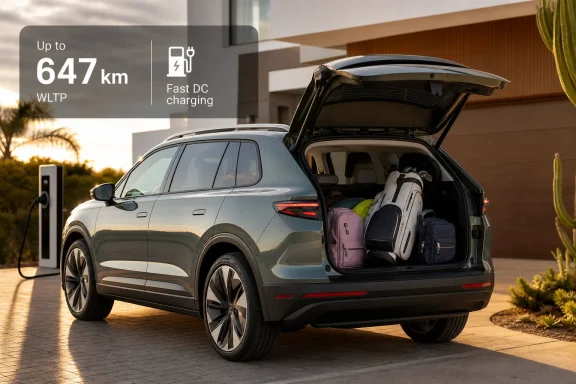
Škoda has announced the Peaq, a seven-seat electric family SUV due for a European launch after its 2026 debut and expected in Australia in 2027, with up to 647 kilometres of WLTP range from a 91kWh battery and pricing below €50,000 in Europe. The headline sounds like another big-battery SUV story, but the more interesting shift is strategic: Škoda is trying to turn the electric three-row family car from a premium indulgence into something closer to a rational household purchase. If it succeeds, the Peaq will not just pressure Hyundai and Kia; it will test whether Volkswagen Group’s mass-market EV architecture can finally scale upward without losing the value argument.
The Peaq arrives in a part of the EV market that has been oddly thin. Electric hatchbacks, compact crossovers, and luxury SUVs are everywhere; true three-row electric family vehicles remain comparatively rare, expensive, or compromised. That gap matters because the buyers who need seven seats are often the same buyers least willing to gamble on range, charging time, boot space, or resale value.
Škoda’s pitch is familiar but well aimed. The brand has spent years cultivating a reputation for practical packaging, lower-friction ergonomics, and sensible pricing inside the Volkswagen Group. The Peaq applies that formula to a segment where “sensible” has been in short supply.
The European starting price of under €50,000 is the number doing the most work here. It does not mean Australians should expect an $80,000 driveway bargain, especially once exchange rates, shipping, taxes, local specification, and dealer realities enter the picture. But it does mean Škoda is trying to undercut the psychological premium attached to large electric SUVs.
That matters in Australia because the likely comparison set is not a cheap one. The Kia EV9 and Hyundai Ioniq 9 have established the three-row EV as desirable, spacious, and expensive. A Peaq that lands below them, even modestly, would give family buyers a reason to treat the segment as competitive rather than aspirational.
The smaller 63kWh battery, with around 459km of WLTP range, is the more revealing option. It suggests Škoda is not building the Peaq as a single high-spec halo product. It wants a lower entry point, even if that version will be less compelling for buyers who regularly load the car with passengers and luggage.
This is the classic EV trade-off in its family-hauler form. A 91kWh pack buys reassurance, but it adds cost and weight. A 63kWh pack makes the sticker price easier to advertise, but it may feel like a compromise in the exact use case that makes seven seats appealing: road trips, school-holiday travel, and regional driving.
Charging figures are solid rather than revolutionary. The smaller battery is said to charge from 10 to 80 percent in 27 minutes at up to 160kW, while the larger pack can do the same in 28 minutes at up to 199kW. In the real world, the bigger determinant will be charging-curve consistency, battery preconditioning, charger reliability, and whether owners can arrive at a working high-power DC charger when the kids are hungry and the third row has gone feral.
For Australian buyers, that last point cannot be hand-waved away. A long WLTP number is comforting, but Australia’s distances, heat, towing habits, and patchy regional charging infrastructure can expose the difference between laboratory range and practical usability. The Peaq’s range gives it a strong starting position; the ownership experience will decide whether the promise survives contact with the Hume, Bruce, or Eyre highways.
But large three-row SUVs punish compromise. They need cabin space, battery capacity, thermal performance, crash structure, and charging reliability, all while carrying the mass and aerodynamic burden of a big body. The Peaq’s 4874mm length makes it shorter than the Kia EV9 and Hyundai Ioniq 9, so Škoda’s packaging will have to be clever rather than merely expansive.
The brand’s history suggests it understands that assignment. Škoda has often made cars feel larger inside than their exterior dimensions imply. If the Peaq can deliver adult-usable rear seating, a practical boot with all seats in use, and the expected Simply Clever storage touches, it could make a shorter footprint feel like a virtue rather than a limitation.
The powertrain layout is conventional for a modern EV SUV. A single rear motor produces 150kW and 350Nm in the lower output version, while all-wheel drive lifts output to 220kW and 545Nm. Those are not performance-SUV numbers in the theatrical sense, but they should be more than adequate for a family vehicle whose credibility depends on refinement, traction, and predictability.
The Sportline variant adds the now-obligatory sharper appearance package, and optional two-tone paint gives the Peaq a bit of visual theatre. But the more important design detail may be the flush door handles, a first for Škoda. That sounds minor until you remember that EV design is increasingly a battle of aerodynamic fractions, perceived modernity, and whether a brand can look futuristic without becoming irritating.
The old infotainment model treated the car as a sealed appliance. The new model treats it as a rolling software endpoint, with app ecosystems, cloud services, voice control, mapping intelligence, and over-the-air updates shaping the ownership experience. That shift can be good for users, but it also imports the usual problems of connected platforms: account dependencies, update regressions, privacy questions, and long-term support uncertainty.
Škoda’s challenge is not merely to install a big screen. It has to make the screen feel like an aid rather than a tollbooth. Family SUVs are used by multiple drivers, in bad weather, under time pressure, often with children demanding attention from the back seats. Controls that look elegant in a press photo can become a daily annoyance if climate settings, seat controls, and navigation tasks require too much tapping.
The vertical screen is interesting because it may suit mapping and route planning, especially in an EV where charging stops are part of the journey. But it also raises the same question every modern cabin raises: how much of the interface belongs on glass, and how much should remain physical? Škoda’s reputation for usability gives it some benefit of the doubt, but that reputation also raises the bar.
The audio system and panoramic roof point toward a more premium atmosphere, which is sensible for a flagship. Still, the Peaq cannot become too precious. The brand’s magic has never been about pretending to be Audi; it has been about making practical choices feel quietly upscale. If the Peaq forgets that, it risks becoming just another expensive electric SUV with a Czech badge.
That ladder matters because Australian EV adoption is no longer just about early adopters buying Teslas. The next phase depends on whether mainstream households can find electric replacements for the cars they already use. For many families, that means SUVs with space, range, roof capacity, towing capability, and enough seating flexibility to handle daily chaos.
The Peaq’s biggest weapon may be comparative pricing. If it arrives meaningfully below the Kia EV9 and Hyundai Ioniq 9, it will force buyers to ask whether they are paying for size, badge confidence, battery technology, or simply being early to a constrained segment. If it arrives too close to those rivals, the value argument gets harder.
European pricing below €50,000 does not translate cleanly into Australian dollars. Imported European cars often carry a premium once local market realities are applied. A starting point above $80,000 would not be surprising, and higher-spec long-range versions could climb substantially.
Even so, there is a difference between expensive and out of reach. A seven-seat EV starting somewhere in the lower-to-mid premium SUV band could still alter the market if it offers enough range and space. The Peaq does not need to be cheap to matter; it needs to make the existing alternatives look less inevitable.
That makes route planning, battery thermal management, charging reliability, and software support central to the product. A Peaq owner heading away for a long weekend will not judge the car only by its WLTP number. They will judge it by whether the navigation system chooses sensible chargers, whether the battery is ready to accept high-speed charging, and whether the interface can explain delays without burying the driver in ambiguity.
This is where traditional carmakers are still learning. Mechanical competence is necessary but no longer sufficient. The best EVs feel coherent because the battery, drivetrain, navigation, charging data, mobile app, and cabin interface behave like parts of one system.
Škoda’s use of Google Android software may help here, depending on implementation. Google’s mapping strength is a major asset in EV route planning, but automakers still control integration, update cadence, permissions, and the boundary between native car functions and cloud-dependent services. For IT-minded buyers, the question is not whether the screen looks modern on launch day; it is whether the platform feels maintained five, seven, or ten years later.
There is also a security angle that deserves more attention than it usually gets in car coverage. Connected vehicles collect location data, driver profiles, contact information, charging behavior, and payment details. A family SUV is not just transportation; it is a data-rich household device with wheels, microphones, cameras, and persistent connectivity.
The Peaq’s strongest claim is that it appears to understand this. Its numbers are competitive, but its real appeal is the possibility of an electric family SUV that does not require buyers to become brand evangelists, charging theorists, or software beta testers. It wants to be the car that happens to be electric, not the electric object that happens to carry seven people.
That is a subtle but important difference. The Kia EV9 has already shown that families will consider a big electric SUV if the package is convincing. Hyundai’s Ioniq 9 pushes the same idea with a different design language. The Peaq’s job is to make that idea feel less premium-experimental and more mainstream-European.
Škoda also benefits from arriving after the first wave. It can study rival packaging, charging expectations, cabin interfaces, and pricing mistakes. It can let Hyundai and Kia normalize the shape of the segment, then attack with a more value-conscious proposition.
The risk is that waiting also means expectations rise. By 2027, Australian buyers will not be comparing the Peaq only with today’s EV9. They will compare it with new Chinese rivals, updated Korean models, discounted premium EVs, and possibly more flexible plug-in hybrids. The Peaq’s window is real, but it is not unlimited.
Towing capacity will be crucial. Large SUVs in Australia are often expected to tow trailers, small boats, bikes, or camper gear. EV towing can slash range, and a seven-seat SUV with family luggage already starts with a demanding load case.
Servicing and dealer readiness matter too. Škoda’s Australian footprint is smaller than those of Hyundai and Kia, and that may influence buyers who live outside major metropolitan areas. An EV family car needs not just warranty confidence but practical support when something goes wrong far from home.
Then there is supply. European brands have repeatedly faced allocation challenges in right-hand-drive markets. A competitive price means little if the long-range versions arrive slowly, in limited numbers, or with option packs that distort the value equation.
None of these caveats undermines the Peaq’s significance. They simply shift the conversation from announcement to execution. In the EV market, execution is where credibility is earned.
 Škoda Brings the Family Bus Into the EV Mainstream
The Peaq arrives in a part of the EV market that has been oddly thin. Electric hatchbacks, compact crossovers, and luxury SUVs are everywhere; true three-row electric family vehicles remain comparatively rare, expensive, or compromised. That gap matters because the buyers who need seven seats are often the same buyers least willing to gamble on range, charging time, boot space, or resale value.Škoda’s pitch is familiar but well aimed. The brand has spent years cultivating a reputation for practical packaging, lower-friction ergonomics, and sensible pricing inside the Volkswagen Group. The Peaq applies that formula to a segment where “sensible” has been in short supply.
The European starting price of under €50,000 is the number doing the most work here. It does not mean Australians should expect an $80,000 driveway bargain, especially once exchange rates, shipping, taxes, local specification, and dealer realities enter the picture. But it does mean Škoda is trying to undercut the psychological premium attached to large electric SUVs.
That matters in Australia because the likely comparison set is not a cheap one. The Kia EV9 and Hyundai Ioniq 9 have established the three-row EV as desirable, spacious, and expensive. A Peaq that lands below them, even modestly, would give family buyers a reason to treat the segment as competitive rather than aspirational.
The 647km Claim Is Impressive, but the Battery Tells the Real Story
The range figure will dominate the brochures. Up to 647km on the WLTP cycle from the rear-drive 91kWh version puts the Peaq comfortably in long-distance family-car territory, at least on paper. The all-wheel-drive version reportedly drops that figure to around 613km, which is still strong for a large seven-seat SUV.The smaller 63kWh battery, with around 459km of WLTP range, is the more revealing option. It suggests Škoda is not building the Peaq as a single high-spec halo product. It wants a lower entry point, even if that version will be less compelling for buyers who regularly load the car with passengers and luggage.
This is the classic EV trade-off in its family-hauler form. A 91kWh pack buys reassurance, but it adds cost and weight. A 63kWh pack makes the sticker price easier to advertise, but it may feel like a compromise in the exact use case that makes seven seats appealing: road trips, school-holiday travel, and regional driving.
Charging figures are solid rather than revolutionary. The smaller battery is said to charge from 10 to 80 percent in 27 minutes at up to 160kW, while the larger pack can do the same in 28 minutes at up to 199kW. In the real world, the bigger determinant will be charging-curve consistency, battery preconditioning, charger reliability, and whether owners can arrive at a working high-power DC charger when the kids are hungry and the third row has gone feral.
For Australian buyers, that last point cannot be hand-waved away. A long WLTP number is comforting, but Australia’s distances, heat, towing habits, and patchy regional charging infrastructure can expose the difference between laboratory range and practical usability. The Peaq’s range gives it a strong starting position; the ownership experience will decide whether the promise survives contact with the Hume, Bruce, or Eyre highways.
Volkswagen Group’s MEB Platform Gets Its Biggest Family Test
The Peaq is another attempt to stretch Volkswagen Group’s electric platform strategy across a broader set of body styles. That is both an advantage and a risk. Shared architecture can lower development cost, simplify parts supply, and bring familiar software and powertrain components into a new class of vehicle.But large three-row SUVs punish compromise. They need cabin space, battery capacity, thermal performance, crash structure, and charging reliability, all while carrying the mass and aerodynamic burden of a big body. The Peaq’s 4874mm length makes it shorter than the Kia EV9 and Hyundai Ioniq 9, so Škoda’s packaging will have to be clever rather than merely expansive.
The brand’s history suggests it understands that assignment. Škoda has often made cars feel larger inside than their exterior dimensions imply. If the Peaq can deliver adult-usable rear seating, a practical boot with all seats in use, and the expected Simply Clever storage touches, it could make a shorter footprint feel like a virtue rather than a limitation.
The powertrain layout is conventional for a modern EV SUV. A single rear motor produces 150kW and 350Nm in the lower output version, while all-wheel drive lifts output to 220kW and 545Nm. Those are not performance-SUV numbers in the theatrical sense, but they should be more than adequate for a family vehicle whose credibility depends on refinement, traction, and predictability.
The Sportline variant adds the now-obligatory sharper appearance package, and optional two-tone paint gives the Peaq a bit of visual theatre. But the more important design detail may be the flush door handles, a first for Škoda. That sounds minor until you remember that EV design is increasingly a battle of aerodynamic fractions, perceived modernity, and whether a brand can look futuristic without becoming irritating.
The Interior Is Where Škoda Has the Most to Prove
The cabin appears to be a deliberate step up. A 13.6-inch vertical central touchscreen, a digital driver display, a panoramic roof, and a 16-speaker 755W audio system put the Peaq into the same technology-and-ambience conversation as pricier rivals. The use of a Google Android-based software system is especially notable for WindowsForum readers because it reflects the car industry’s slow surrender to consumer-tech expectations.The old infotainment model treated the car as a sealed appliance. The new model treats it as a rolling software endpoint, with app ecosystems, cloud services, voice control, mapping intelligence, and over-the-air updates shaping the ownership experience. That shift can be good for users, but it also imports the usual problems of connected platforms: account dependencies, update regressions, privacy questions, and long-term support uncertainty.
Škoda’s challenge is not merely to install a big screen. It has to make the screen feel like an aid rather than a tollbooth. Family SUVs are used by multiple drivers, in bad weather, under time pressure, often with children demanding attention from the back seats. Controls that look elegant in a press photo can become a daily annoyance if climate settings, seat controls, and navigation tasks require too much tapping.
The vertical screen is interesting because it may suit mapping and route planning, especially in an EV where charging stops are part of the journey. But it also raises the same question every modern cabin raises: how much of the interface belongs on glass, and how much should remain physical? Škoda’s reputation for usability gives it some benefit of the doubt, but that reputation also raises the bar.
The audio system and panoramic roof point toward a more premium atmosphere, which is sensible for a flagship. Still, the Peaq cannot become too precious. The brand’s magic has never been about pretending to be Audi; it has been about making practical choices feel quietly upscale. If the Peaq forgets that, it risks becoming just another expensive electric SUV with a Czech badge.
Australia Turns the Peaq From Product News Into a Price Fight
The Australian angle is where the story becomes sharper. The Peaq is expected to arrive in 2027, slotting above the Enyaq and Elroq in Škoda’s local EV range. That would give the brand a three-SUV electric ladder: compact, mid-size, and large family hauler.That ladder matters because Australian EV adoption is no longer just about early adopters buying Teslas. The next phase depends on whether mainstream households can find electric replacements for the cars they already use. For many families, that means SUVs with space, range, roof capacity, towing capability, and enough seating flexibility to handle daily chaos.
The Peaq’s biggest weapon may be comparative pricing. If it arrives meaningfully below the Kia EV9 and Hyundai Ioniq 9, it will force buyers to ask whether they are paying for size, badge confidence, battery technology, or simply being early to a constrained segment. If it arrives too close to those rivals, the value argument gets harder.
European pricing below €50,000 does not translate cleanly into Australian dollars. Imported European cars often carry a premium once local market realities are applied. A starting point above $80,000 would not be surprising, and higher-spec long-range versions could climb substantially.
Even so, there is a difference between expensive and out of reach. A seven-seat EV starting somewhere in the lower-to-mid premium SUV band could still alter the market if it offers enough range and space. The Peaq does not need to be cheap to matter; it needs to make the existing alternatives look less inevitable.
The Three-Row EV Is Becoming a Software-and-Infrastructure Product
Large EVs expose the hidden complexity of electrification. A city EV can get by on home charging, predictable commutes, and modest expectations. A seven-seat family SUV is expected to replace the one car in the household that must work when everything else is complicated.That makes route planning, battery thermal management, charging reliability, and software support central to the product. A Peaq owner heading away for a long weekend will not judge the car only by its WLTP number. They will judge it by whether the navigation system chooses sensible chargers, whether the battery is ready to accept high-speed charging, and whether the interface can explain delays without burying the driver in ambiguity.
This is where traditional carmakers are still learning. Mechanical competence is necessary but no longer sufficient. The best EVs feel coherent because the battery, drivetrain, navigation, charging data, mobile app, and cabin interface behave like parts of one system.
Škoda’s use of Google Android software may help here, depending on implementation. Google’s mapping strength is a major asset in EV route planning, but automakers still control integration, update cadence, permissions, and the boundary between native car functions and cloud-dependent services. For IT-minded buyers, the question is not whether the screen looks modern on launch day; it is whether the platform feels maintained five, seven, or ten years later.
There is also a security angle that deserves more attention than it usually gets in car coverage. Connected vehicles collect location data, driver profiles, contact information, charging behavior, and payment details. A family SUV is not just transportation; it is a data-rich household device with wheels, microphones, cameras, and persistent connectivity.
The Peaq’s Best Argument Is Not Luxury, It Is Normality
The EV market has spent years selling novelty. Instant torque, huge screens, futuristic lighting, and dramatic acceleration made sense when the buyer pool was early adopters. The next buyers are different. They want EVs to be boring in the best possible way.The Peaq’s strongest claim is that it appears to understand this. Its numbers are competitive, but its real appeal is the possibility of an electric family SUV that does not require buyers to become brand evangelists, charging theorists, or software beta testers. It wants to be the car that happens to be electric, not the electric object that happens to carry seven people.
That is a subtle but important difference. The Kia EV9 has already shown that families will consider a big electric SUV if the package is convincing. Hyundai’s Ioniq 9 pushes the same idea with a different design language. The Peaq’s job is to make that idea feel less premium-experimental and more mainstream-European.
Škoda also benefits from arriving after the first wave. It can study rival packaging, charging expectations, cabin interfaces, and pricing mistakes. It can let Hyundai and Kia normalize the shape of the segment, then attack with a more value-conscious proposition.
The risk is that waiting also means expectations rise. By 2027, Australian buyers will not be comparing the Peaq only with today’s EV9. They will compare it with new Chinese rivals, updated Korean models, discounted premium EVs, and possibly more flexible plug-in hybrids. The Peaq’s window is real, but it is not unlimited.
The Fine Print Will Decide Whether the Peaq Is a Bargain or a Brochure Star
Several questions remain unanswered, and they are the questions that usually determine whether an EV works in Australia. Local pricing is the obvious one, but specification matters just as much. If the sub-€50,000 European version corresponds to a lightly equipped short-range model, Australian buyers may find the desirable Peaq costs far more than the headline suggests.Towing capacity will be crucial. Large SUVs in Australia are often expected to tow trailers, small boats, bikes, or camper gear. EV towing can slash range, and a seven-seat SUV with family luggage already starts with a demanding load case.
Servicing and dealer readiness matter too. Škoda’s Australian footprint is smaller than those of Hyundai and Kia, and that may influence buyers who live outside major metropolitan areas. An EV family car needs not just warranty confidence but practical support when something goes wrong far from home.
Then there is supply. European brands have repeatedly faced allocation challenges in right-hand-drive markets. A competitive price means little if the long-range versions arrive slowly, in limited numbers, or with option packs that distort the value equation.
None of these caveats undermines the Peaq’s significance. They simply shift the conversation from announcement to execution. In the EV market, execution is where credibility is earned.
The Numbers That Make Škoda’s Big EV Worth Watching
The Peaq is not revolutionary in the way the first wave of high-profile EVs tried to be. Its importance is more pragmatic: it brings range, seating, and a potentially sharper price into a segment that badly needs more competition. That is exactly the kind of product that can move EV adoption from enthusiasm to normal purchasing logic.- The Peaq is a seven-seat electric SUV expected to reach Australia in 2027 as Škoda’s flagship EV.
- The longest-range version uses a 91kWh battery and is claimed to deliver up to 647km on the WLTP cycle.
- The model range is expected to include rear-wheel-drive and all-wheel-drive versions, with outputs from 150kW to 220kW.
- DC fast charging is claimed to take about 27 to 28 minutes from 10 to 80 percent, depending on battery size.
- European pricing is expected to start below €50,000, but Australian pricing will almost certainly sit above a direct currency conversion.
- The Peaq’s real test will be whether it can combine Škoda’s usual practicality with software, charging, and support that feel mature enough for family use.
References
- Primary source: The Standard | Warrnambool, VIC
Published: 2026-06-24T02:50:33.675043
New seven-seat, 647km range EV incoming | The Standard | Warrnambool, VIC
The Skoda Peaq has just been announced as Europe's latest electric family SUV rival.www.standard.net.au - Related coverage: theevreport.com
Škoda Names Electric Seven-Seater Flagship Peaq - The EV Report
Discover Škoda's upcoming Peaq, an all-electric seven-seater debuting in summer 2026, designed for families and professionals.theevreport.com - Related coverage: cartoq.com
Skoda Peaq Revealed As The Brand’s Flagship Electric SUV
Skoda unveils the Peaq,its most advanced flagship electric SUV with three powertrain options,up to 647km range,and potential India launch as a CBU import.www.cartoq.com - Related coverage: notebookcheck.net
Skoda Peaq revealed: Large 7-seater electric SUV with over 600 km range - Notebookcheck News
Skoda is entering the large family SUV market with its largest EV to date, the Peaq. This new flagship model towers above the Kodiaq, offering optional space for seven people and boasting an enormous 1,010 litres of trunk space. Thanks to the new 91 kWh battery, the extra long-range model... www.notebookcheck.net
- Related coverage: drivespark.com
Bigger Than Kodiaq! Skoda Reveals Flagship Peaq EV With 647 KM Range - DriveSpark News
Skoda has unveiled its flagship electric SUV, the Peaq, globally with class-leading space and technology.www.drivespark.com - Related coverage: electrive.com
Škoda Peaq achieves over 600 kilometres of range - electrive.com
Škoda has provided a first glimpse of its upcoming large electric SUV, the Peaq, and revealed some key details. The Czech VW brand's flagship electric modelwww.electrive.com
