

General Motors’ Chevrolet Silverado EV is drawing fresh scrutiny after TechCrunch reported on July 3, 2026, that the long-range electric pickup sold only about 14,000 units in the United States and Canada last year despite offering more than 400 miles of driving range. The puzzle is not whether GM can engineer an impressive electric truck; by most accounts, it already has. The harder question is why the company’s most American EV proposition — big, quiet, powerful, domestically branded, and truck-shaped — has not translated into pickup-scale demand. The answer says less about range anxiety in the abstract than about the limits of solving a cultural and economic problem with a bigger battery.
The Silverado EV looks, on paper, like the rebuttal to years of complaints about electric pickups. It is not a compact lifestyle experiment, not a compliance car with a bed, and not a fragile city runabout pretending to understand rural America. It is a full-size Chevrolet pickup with serious range, serious mass, serious cabin space, and enough electric torque to make the old small-block mythology feel suddenly quaint.
TechCrunch’s Tim De Chant came away from a Detroit-area drive impressed by the truck’s polish. He described a quiet cabin, massive frunk, expansive rear seat, carlike ride quality, and the kind of effortless acceleration EV owners already know but truck buyers may still experience as a novelty. The Silverado EV also brings the usual GM truck-party tricks into the electric era: towing capability, a large bed, available hands-free highway driving, and the ability to serve as a backup power source.
That is why the weak sales number matters. If the Silverado EV were a half-hearted product, the market’s rejection would be easy to explain. Instead, GM appears to have built something much closer to the electric truck that enthusiasts and policy planners imagined would unlock the heart of the American vehicle market.
But the pickup market is not merely a category of vehicles. It is a bundle of identity, utility, habit, financing math, dealer behavior, and worst-case-scenario thinking. A 450-mile range rating can answer one objection and still leave the purchase decision untouched.
Yet the truck’s pricing puts it in a strange place. TechCrunch noted that the LT Extended Range version sits near the premium end of the full-size pickup market, while the Max Range version adds thousands more for extra miles. The same report pointed out that full-size pickup buyers already pay high average transaction prices, which complicates the easy claim that the Silverado EV is simply too expensive.
Still, sticker price is not the whole price. Buyers compare monthly payments, trade-in values, incentives, charging installation, resale risk, insurance, and the emotional cost of being the person who “went electric” before everyone around them. A gas Silverado may be expensive, but it is expensive in a familiar way. The Silverado EV is expensive in a way that asks buyers to believe several new things at once.
That is where the range achievement becomes less decisive. A 400-mile EV truck can still feel risky if the buyer imagines towing in winter, charging at a rural job site, or trying to resell a first-generation electric pickup after battery technology improves. The number on the window sticker solves the EPA test-cycle problem; it does not solve the kitchen-table finance problem.
This is where EV pickups run into a uniquely American contradiction. Many full-size truck owners rarely tow, rarely haul near payload limits, and rarely drive hundreds of miles in a day. But the purchase is often justified by the edge case: the boat, the camper, the storm cleanup, the move, the future project, the imagined emergency.
TechCrunch cited Strategic Vision data indicating that many full-size truck owners tow at most once a year. That should, in theory, make an EV truck an easy sell. In practice, it may make the problem worse, because the rare towing trip becomes symbolically huge. If a buyer’s truck identity rests on the one weekend a year when the machine must be unquestioned, any uncertainty about charging and towing range becomes disproportionately powerful.
Gasoline trucks benefit from an infrastructure that feels invisible because it is everywhere. EVs still ask drivers to plan, and planning is culturally coded as compromise. For a sedan commuter, that compromise may be trivial. For a pickup buyer who sees the truck as a guarantee against inconvenience, it can feel like a category error.
That future has real advantages. TechCrunch praised the responsiveness of the infotainment system and noted how the navigation system can account for Super Cruise availability along a route. GM’s hands-free highway system remains one of the more credible Level 2 driver-assistance offerings on the market, and in a vehicle this large, reducing fatigue is not a gimmick.
But software cuts both ways. De Chant also described moments where Super Cruise was caught out by traffic behavior and a dirty trailer, a reminder that advanced driver assistance is still assistance, not autonomy. The bigger the vehicle, the less forgiving those edge cases feel.
GM’s decision to remove Apple CarPlay from its newer EVs adds another layer of friction. The company argues that deeper integration improves the experience, especially around charging, routing, and vehicle systems. Many buyers hear something else: a manufacturer taking away a familiar interface in favor of a vendor-controlled stack.
For tech people, this is a recognizable platform fight. GM wants the dashboard to become a strategic layer. Customers, especially those spending luxury-car money on a truck, may simply want their phone to work the way it worked in the last vehicle. The Silverado EV may be advanced, but every removed affordance becomes another reason for a hesitant buyer to wait.
TechCrunch previously reported that GM is targeting LMR batteries for later this decade, with company executives arguing that the chemistry can reduce reliance on costly nickel and cobalt while keeping electric trucks above the 400-mile mark. GM has framed the work as both a cost breakthrough and a supply-chain strategy, with domestic manufacturing and fewer critical-mineral constraints.
That sounds like a product solution, but it is also a margin solution. The Silverado EV needs a very large battery to deliver the kind of range that pickup buyers expect. Large batteries are expensive, heavy, and material-intensive. If GM can take thousands of dollars out of the pack without making the truck feel like a downgrade, it changes the business case.
The catch is timing. A 2028-ish battery improvement does not help a 2026 shopper who is staring at a high payment today. Worse, the promise of cheaper batteries can freeze demand by telling buyers that the better version is coming later.
This is the Osborne effect in work boots. GM needs buyers now to validate the platform, but it also needs to reassure investors and customers that today’s cost structure is not permanent. Every hint of a better battery tomorrow risks making today’s truck look like an early-adopter tax.
Fleet buyers can make more disciplined calculations about fuel, maintenance, depot charging, tax treatment, and duty cycles. Retail pickup buyers are messier. They bring brand loyalty, political identity, spouse approval, garage dimensions, towing mythology, and dealership relationships into the decision.
The truck’s sheer size also works against it. De Chant noted that the Silverado EV is nearly 20 feet long, and that even with rear-wheel steering, parking and garage fit remain real constraints. That is not unique to the EV version, but electrification does not make a giant pickup easier to live with.
In a way, GM may have built the right EV for the wrong first audience. The Silverado EV is a strong answer for people who already want an electric truck. The mass pickup market is full of people who may need to be converted one household, one job site, and one dealer conversation at a time.
GM has had genuine EV wins. The Equinox EV has given Chevrolet a more approachable electric model, and the company’s broader EV sales have improved as more Ultium-based vehicles reached showrooms. But electric pickups remain a harder sell because they ask buyers to electrify one of the most emotionally loaded vehicle segments in North America.
Ford’s F-150 Lightning ran into similar headwinds after its early hype cycle. Rivian found a loyal but narrower adventure-lifestyle audience. Tesla’s Cybertruck turned the pickup into a rolling culture war. GM’s Silverado EV is arguably the least weird of the bunch, which should help — but normality alone does not overcome the economics.
The lesson is not that electric trucks are doomed. It is that the transition will not be won by range ratings alone. Automakers have to make the ownership story feel boring, cheap, and inevitable. Right now, the Silverado EV feels impressive, expensive, and early.
Chevrolet has an advantage Tesla never had: generations of pickup credibility. But that credibility comes with expectations. A Silverado buyer does not grade on an EV curve. The truck must be a Silverado first and an EV second, and it must survive comparison not with abstract climate goals but with discounted gasoline trucks sitting on the same dealer lots.
That dealer-lot comparison is brutal. A gas Silverado can be financed, serviced, modified, resold, and understood through existing habits. The EV version may be smoother, quieter, quicker, and cheaper to fuel, but the buyer has to internalize those benefits before the purchase. Most consumers do not learn by reading spec sheets; they learn by seeing neighbors take the risk first.
GM’s challenge is therefore social as much as technical. It needs more visible owners, more confident dealers, clearer charging stories, and lower entry prices. It needs the Silverado EV to stop being a fascinating article subject and start being a normal truck choice.
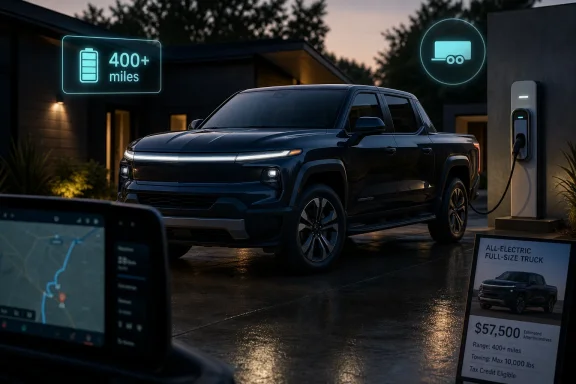 GM Built the Truck EV Skeptics Said They Wanted
The Silverado EV looks, on paper, like the rebuttal to years of complaints about electric pickups. It is not a compact lifestyle experiment, not a compliance car with a bed, and not a fragile city runabout pretending to understand rural America. It is a full-size Chevrolet pickup with serious range, serious mass, serious cabin space, and enough electric torque to make the old small-block mythology feel suddenly quaint.TechCrunch’s Tim De Chant came away from a Detroit-area drive impressed by the truck’s polish. He described a quiet cabin, massive frunk, expansive rear seat, carlike ride quality, and the kind of effortless acceleration EV owners already know but truck buyers may still experience as a novelty. The Silverado EV also brings the usual GM truck-party tricks into the electric era: towing capability, a large bed, available hands-free highway driving, and the ability to serve as a backup power source.
That is why the weak sales number matters. If the Silverado EV were a half-hearted product, the market’s rejection would be easy to explain. Instead, GM appears to have built something much closer to the electric truck that enthusiasts and policy planners imagined would unlock the heart of the American vehicle market.
But the pickup market is not merely a category of vehicles. It is a bundle of identity, utility, habit, financing math, dealer behavior, and worst-case-scenario thinking. A 450-mile range rating can answer one objection and still leave the purchase decision untouched.
Range Was the Headline, but Price Is the Sentence
The Silverado EV’s range numbers are legitimately impressive. Depending on trim and configuration, Chevrolet has advertised versions above 400 miles, with some variants pushing well beyond the psychological threshold that once separated “real vehicle” from “EV experiment.” For many commuters, contractors, and suburban truck owners, that is more range than they use in several days.Yet the truck’s pricing puts it in a strange place. TechCrunch noted that the LT Extended Range version sits near the premium end of the full-size pickup market, while the Max Range version adds thousands more for extra miles. The same report pointed out that full-size pickup buyers already pay high average transaction prices, which complicates the easy claim that the Silverado EV is simply too expensive.
Still, sticker price is not the whole price. Buyers compare monthly payments, trade-in values, incentives, charging installation, resale risk, insurance, and the emotional cost of being the person who “went electric” before everyone around them. A gas Silverado may be expensive, but it is expensive in a familiar way. The Silverado EV is expensive in a way that asks buyers to believe several new things at once.
That is where the range achievement becomes less decisive. A 400-mile EV truck can still feel risky if the buyer imagines towing in winter, charging at a rural job site, or trying to resell a first-generation electric pickup after battery technology improves. The number on the window sticker solves the EPA test-cycle problem; it does not solve the kitchen-table finance problem.
The Pickup Buyer Is Not Waiting for a Better Spec Sheet
Automakers have long treated the pickup buyer as a rational utility maximizer who will switch when the capability chart looks good enough. That was always too tidy. Trucks are bought for what they do, but also for what they promise the owner could do if called upon.This is where EV pickups run into a uniquely American contradiction. Many full-size truck owners rarely tow, rarely haul near payload limits, and rarely drive hundreds of miles in a day. But the purchase is often justified by the edge case: the boat, the camper, the storm cleanup, the move, the future project, the imagined emergency.
TechCrunch cited Strategic Vision data indicating that many full-size truck owners tow at most once a year. That should, in theory, make an EV truck an easy sell. In practice, it may make the problem worse, because the rare towing trip becomes symbolically huge. If a buyer’s truck identity rests on the one weekend a year when the machine must be unquestioned, any uncertainty about charging and towing range becomes disproportionately powerful.
Gasoline trucks benefit from an infrastructure that feels invisible because it is everywhere. EVs still ask drivers to plan, and planning is culturally coded as compromise. For a sedan commuter, that compromise may be trivial. For a pickup buyer who sees the truck as a guarantee against inconvenience, it can feel like a category error.
Super Cruise Shows the Silverado EV’s Strengths — and Its Trust Problem
The Silverado EV is also a software-defined vehicle in ways that matter to WindowsForum readers. Its Google-powered infotainment system, route planning, and Super Cruise integration point toward a future where the truck is less a mechanical tool than a rolling compute platform with a cargo bed.That future has real advantages. TechCrunch praised the responsiveness of the infotainment system and noted how the navigation system can account for Super Cruise availability along a route. GM’s hands-free highway system remains one of the more credible Level 2 driver-assistance offerings on the market, and in a vehicle this large, reducing fatigue is not a gimmick.
But software cuts both ways. De Chant also described moments where Super Cruise was caught out by traffic behavior and a dirty trailer, a reminder that advanced driver assistance is still assistance, not autonomy. The bigger the vehicle, the less forgiving those edge cases feel.
GM’s decision to remove Apple CarPlay from its newer EVs adds another layer of friction. The company argues that deeper integration improves the experience, especially around charging, routing, and vehicle systems. Many buyers hear something else: a manufacturer taking away a familiar interface in favor of a vendor-controlled stack.
For tech people, this is a recognizable platform fight. GM wants the dashboard to become a strategic layer. Customers, especially those spending luxury-car money on a truck, may simply want their phone to work the way it worked in the last vehicle. The Silverado EV may be advanced, but every removed affordance becomes another reason for a hesitant buyer to wait.
GM’s Battery Fix Is Really a Margin Fix
The most important line in the latest Silverado EV coverage may not be the sales figure. It may be GM’s hint that lithium-manganese-rich battery chemistry could cut costs by about $6,000 while preserving much of the truck’s long range.TechCrunch previously reported that GM is targeting LMR batteries for later this decade, with company executives arguing that the chemistry can reduce reliance on costly nickel and cobalt while keeping electric trucks above the 400-mile mark. GM has framed the work as both a cost breakthrough and a supply-chain strategy, with domestic manufacturing and fewer critical-mineral constraints.
That sounds like a product solution, but it is also a margin solution. The Silverado EV needs a very large battery to deliver the kind of range that pickup buyers expect. Large batteries are expensive, heavy, and material-intensive. If GM can take thousands of dollars out of the pack without making the truck feel like a downgrade, it changes the business case.
The catch is timing. A 2028-ish battery improvement does not help a 2026 shopper who is staring at a high payment today. Worse, the promise of cheaper batteries can freeze demand by telling buyers that the better version is coming later.
This is the Osborne effect in work boots. GM needs buyers now to validate the platform, but it also needs to reassure investors and customers that today’s cost structure is not permanent. Every hint of a better battery tomorrow risks making today’s truck look like an early-adopter tax.
The Silverado EV Is Too Good to Be a Niche Product and Too Expensive to Be a Mass One
The Silverado EV’s predicament is that it lives between markets. It is too capable to dismiss as a toy, but too expensive and unfamiliar to become the default work truck. It is practical enough to challenge assumptions, but not cheap enough to bulldoze them.Fleet buyers can make more disciplined calculations about fuel, maintenance, depot charging, tax treatment, and duty cycles. Retail pickup buyers are messier. They bring brand loyalty, political identity, spouse approval, garage dimensions, towing mythology, and dealership relationships into the decision.
The truck’s sheer size also works against it. De Chant noted that the Silverado EV is nearly 20 feet long, and that even with rear-wheel steering, parking and garage fit remain real constraints. That is not unique to the EV version, but electrification does not make a giant pickup easier to live with.
In a way, GM may have built the right EV for the wrong first audience. The Silverado EV is a strong answer for people who already want an electric truck. The mass pickup market is full of people who may need to be converted one household, one job site, and one dealer conversation at a time.
Detroit Is Learning That EV Adoption Is Not Linear
The Silverado EV’s slow momentum fits a broader industry pattern. Automakers assumed that once battery range improved and vehicle categories filled out, EV adoption would march steadily from early adopters into the mainstream. Instead, the market has become segmented, uneven, and heavily dependent on price, charging access, incentives, and brand trust.GM has had genuine EV wins. The Equinox EV has given Chevrolet a more approachable electric model, and the company’s broader EV sales have improved as more Ultium-based vehicles reached showrooms. But electric pickups remain a harder sell because they ask buyers to electrify one of the most emotionally loaded vehicle segments in North America.
Ford’s F-150 Lightning ran into similar headwinds after its early hype cycle. Rivian found a loyal but narrower adventure-lifestyle audience. Tesla’s Cybertruck turned the pickup into a rolling culture war. GM’s Silverado EV is arguably the least weird of the bunch, which should help — but normality alone does not overcome the economics.
The lesson is not that electric trucks are doomed. It is that the transition will not be won by range ratings alone. Automakers have to make the ownership story feel boring, cheap, and inevitable. Right now, the Silverado EV feels impressive, expensive, and early.
The Truck That Proves Engineering Was Only Half the Battle
For GM, the Silverado EV is not just another model launch. It is a referendum on whether legacy automakers can translate their strongest brands into the electric era without losing the customers who made those brands powerful.Chevrolet has an advantage Tesla never had: generations of pickup credibility. But that credibility comes with expectations. A Silverado buyer does not grade on an EV curve. The truck must be a Silverado first and an EV second, and it must survive comparison not with abstract climate goals but with discounted gasoline trucks sitting on the same dealer lots.
That dealer-lot comparison is brutal. A gas Silverado can be financed, serviced, modified, resold, and understood through existing habits. The EV version may be smoother, quieter, quicker, and cheaper to fuel, but the buyer has to internalize those benefits before the purchase. Most consumers do not learn by reading spec sheets; they learn by seeing neighbors take the risk first.
GM’s challenge is therefore social as much as technical. It needs more visible owners, more confident dealers, clearer charging stories, and lower entry prices. It needs the Silverado EV to stop being a fascinating article subject and start being a normal truck choice.
The Silverado EV’s Numbers Tell Detroit Where the Resistance Lives
The cleanest reading of the Silverado EV story is not that GM failed. It is that GM has discovered the remaining wall between EV capability and EV inevitability.- GM has built a genuinely capable electric pickup, but capability has not been enough to move mainstream truck buyers at gasoline-Silverado scale.
- The Silverado EV’s long range reduces one major objection, but towing, charging, resale value, and household finances still dominate the buying decision.
- GM’s software strategy strengthens the integrated EV experience while risking backlash from buyers who see the loss of Apple CarPlay as unnecessary control.
- LMR battery chemistry could materially improve the cost equation, but its later-decade timing may also encourage some shoppers to wait.
- The electric pickup market will likely grow through price normalization and owner familiarity, not through one dramatic range breakthrough.
References
- Primary source: NewsCord
Published: 2026-07-03T22:20:19.258663
GM Struggles To Sell Chevrolet Silverado EV Despite 450-Mile Range: 13 Sources (Local Western: 5) | NewsCord | NewsCord
13 sources compared: Local Western (5), Western Mainstream (2). Chevrolet’s Silverado EV has arrived with specifications that include an EPA-estimated 450-mile range on a full charge, ...newscord.org - Related coverage: ev.com
GM Says Silverado EV and Sierra EV Are Not Going Anywhere | EV.com
While the U.S. EV pickup segment remains relatively small, GM executives and analysts point to the company’s shared platform strategy as a key reason its batterev.com - Related coverage: thenextweb.com
The Chevy Silverado EV is one of the best electric trucks ever built, so why is nobody buying it
GM sold roughly 14,000 Silverado EVs last year while the gas version moves ten times that per quarter, and a cheaper battery is still two years away.thenextweb.com - Related coverage: techcrunch.com
GM to build an electric Chevrolet Silverado pickup truck with more than 400 miles of range | TechCrunch
GM is adding an electric Chevrolet Silverado pickup truck to its lineup, as the automaker pushes to deliver more than 1 million electric vehicles globallytechcrunch.com - Related coverage: news.gm.ca
2025 Chevrolet Silverado EV Offers up to 792 km of Range and New Trim Levels
The 2025 Chevrolet Silverado EV launches later this year in three distinct trims with more range and content, for retail and commercial customers.news.gm.ca - Related coverage: chevrolet.com
2025 Chevy Silverado EV | Electric Truck | Chevrolet
Get there with confidence in the 2025 Chevy Silverado EV. This electric truck leads the charge with 440 miles of estimated range and innovative technology.www.chevrolet.com
- Related coverage: gmupfitter.com
- Related coverage: news.chevrolet.com
1400928172
Low angle view of hands of multiracial group of people working with ideas and brainstorming together to make decisions with documents on table in creative office teamworknews.chevrolet.com
- Related coverage: media.chevrolet.com
