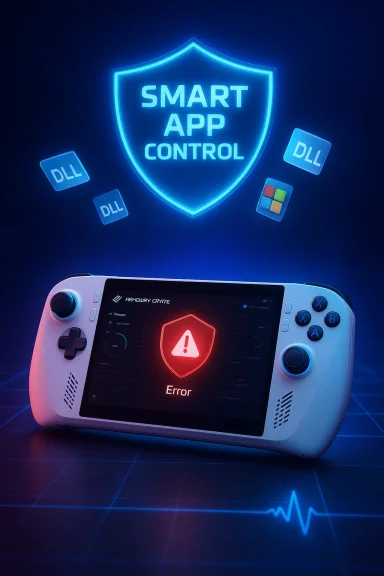
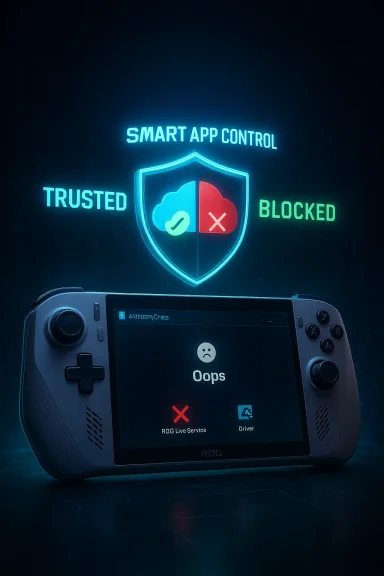
Windows 11’s new Smart App Control has just collided with the fragile integration that makes the Xbox Ally and ROG Ally feel like polished handhelds: users report Armoury Crate SE refusing to launch, background services being blocked, and firmware/update flows interrupted — and the immediate workaround being to turn off the security feature that’s doing the blocking. The problem is real, reproducible across multiple community reports, and highlights a larger tension between AI-driven protection features and vendor-supplied device tooling that depends on a permissive trust model.
Armoury Crate SE is ASUS’s device-management companion for the ROG/ROG Xbox Ally line. On Ally devices it’s the centralized hub for performance profiles, thermal and power tuning, controller mappings, and firmware or software updates — effectively the user-facing control plane for everyday handheld operation. ASUS documents Armoury Crate SE as the canonical way to configure and update Ally devices.
Smart App Control (SAC) is a Windows 11 security feature that uses Microsoft’s cloud app intelligence and on-device heuristics — including AI-driven models — to decide whether an app or binary should be allowed to run. SAC operates in three states: Evaluation, On (enforcement), and Off. When SAC is in enforcement mode it will block binaries that do not meet Microsoft’s trust criteria (unknown reputation, unsigned, or flagged by heuristics). Microsoft’s public documentation explains that SAC can block executables or modules before they run and that some apps not signed by a trusted CA or lacking cloud reputation can be prevented from executing.
Why this matters: handhelds like the Ally rely on vendor-signed helpers and background services that must be allowed to run for features (controller remapping, thermal tuning, firmware updates) to work. When SAC decides a vendor binary is “untrusted,” the end result is a crippled user experience rather than a security win.
Community posts report the same pattern across multiple devices in the Ally family (original ROG Ally, ROG Ally X, and Xbox-branded Ally models), suggesting the issue is driven by Windows’ app-control evaluation rather than a single corrupted installer or one-off OEM error. Some users manage temporary success by disabling SAC; othersr repeatedly rebooting lets the update path continue long enough for Armoury Crate to recover. The problem has impacted not just profile tuning but firmware installation in at least some reports.
Community-sourced evidence (forum threads, Reddit posts) combined with reporting from outlets covering Windows and handheld gaming makes the case that this is not an isolated, single-user issue — it’s a reproducible compatibility problem between SAC and Armoury Crate on current Windows 11 installs.
For Windows-on-handheld devices — especially those that intentionally ship with vendor utilities that touch low-level device behavior — the tolerance for false positives is low. When a protection layer blocks essential helpers, the result is degraded device function and worse user outcomes than the theoretical attacks prevented. This is not an argument against SAC’s intent; it’s a call for better coordination, clearer vendor whitelisting channels, and reversible controls that do not force device owners into permanent security tradeoffs. Community reports and vendor documentation together paint a clear picture: this broke a meaningful portion of the handheld user experience, and practical fixes exist but are imperfect.
Smart App Control is a valuable defensive layer — but when a security control interrupts vendor tooling that the device needs to function, the solution must be collaborative, not binary. Until Microsoft and ASUS coordinate a durable fix — whether that’s a signed Armoury Crate release, a targeted Microsoft whitelist, or an improved SAC toggling experience — Ally owners must choose between a fully functional handheld and a stricter security posture. The right long-term outcome is clear: protections that work quietly without denying users essential device features, plus reversible admin controls that avoid forcing a reinstall to restore functionality.
Conclusion
The Armoury Crate blockage on Xbox Ally and ROG Ally devices is a defensible safety mechanism colliding with practical device management. The community and press coverage show the problem is real and reproducible; the current practical fix is to disable Smart App Control or reinstall Armoury Crate after disabling it, and ASUS’s support pages back up the reinstall flow. Microsoft’s documentation explains why SAC could take this action and also signals that the company is iterating on SAC’s controls in preview builds. Until an official patch or vendor-signed update eliminates the false positives, Ally owners should apply the measured workarounds above, understand the security tradeoffs, and monitor official channels for a coordinated remediation.
Source: Windows Central Windows 11 AI security feature breaks Armory Crate on Xbox Ally
 Background: what Armoury Crate and Smart App Control do — and why they interact
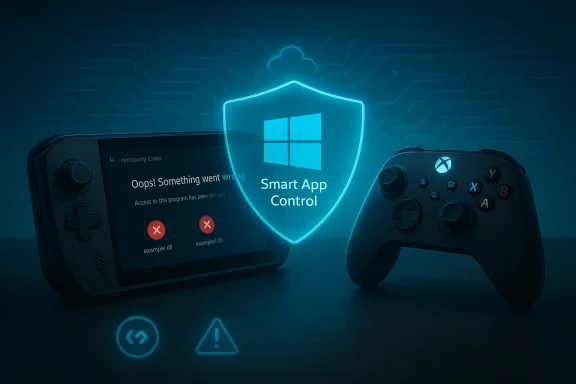
Armoury Crate SE is ASUS’s device-management companion for the ROG/ROG Xbox Ally line. On Ally devices it’s the centralized hub for performance profiles, thermal and power tuning, controller mappings, and firmware or software updates — effectively the user-facing control plane for everyday handheld operation. ASUS documents Armoury Crate SE as the canonical way to configure and update Ally devices. Smart App Control (SAC) is a Windows 11 security feature that uses Microsoft’s cloud app intelligence and on-device heuristics — including AI-driven models — to decide whether an app or binary should be allowed to run. SAC operates in three states: Evaluation, On (enforcement), and Off. When SAC is in enforcement mode it will block binaries that do not meet Microsoft’s trust criteria (unknown reputation, unsigned, or flagged by heuristics). Microsoft’s public documentation explains that SAC can block executables or modules before they run and that some apps not signed by a trusted CA or lacking cloud reputation can be prevented from executing.
Why this matters: handhelds like the Ally rely on vendor-signed helpers and background services that must be allowed to run for features (controller remapping, thermal tuning, firmware updates) to work. When SAC decides a vendor binary is “untrusted,” the end result is a crippled user experience rather than a security win.
What’s happening in the field: symptoms, error text, and scope
Multiple users across Ally community forums and device subreddits began reporting the same behavior: Armoury Crate SE showing an “Oops!” error that reads, “There was an issue with the connections to Armoury Crate SE. Please open Armoury Crate SE for repairs and try again,” followed by Windows Security / Smart App Control notifications flagging parts of the app (including ROG Live Service or specific DLLs) as blocked. Affected owners can be unable to open, update, uninstall, or reinstall Armoury Crate because the blocked components are integral to the app’s operation.Community posts report the same pattern across multiple devices in the Ally family (original ROG Ally, ROG Ally X, and Xbox-branded Ally models), suggesting the issue is driven by Windows’ app-control evaluation rather than a single corrupted installer or one-off OEM error. Some users manage temporary success by disabling SAC; othersr repeatedly rebooting lets the update path continue long enough for Armoury Crate to recover. The problem has impacted not just profile tuning but firmware installation in at least some reports.
Community-sourced evidence (forum threads, Reddit posts) combined with reporting from outlets covering Windows and handheld gaming makes the case that this is not an isolated, single-user issue — it’s a reproducible compatibility problem between SAC and Armoury Crate on current Windows 11 installs.
Technical analysis: why Smart App Control may flag Armoury Crate
Smart App Control uses a conservative allowlist-first model informed by cloud reputation, code signatures, and heuristics. The concrete mechanisms that can lead to false-positive blocking include:- The binary or installer component is signed with a certificate that SAC’s cloud service does not recognize or that has changed recently (certificate renewal/chain differences can create transient reputation gaps).
- A helper DLL or service is dynamically unsigned, or is loaded by the main executable in a way the heuristic flags as suspicious.
- SAC’s machine-learning model identifies patterns in the app’s behavior (driver/helper installs, low-level hardware access, unsigned driver loading) that resemble malicious toolkits and preemptively blocks execution.
- Cloud reputation lookups or certificate chain checks collide with store entitlement or local install states, producing an enforcement decision before an app can repair itself.
Verified responses and fixes (what actually works right now)
At time of writing the two consistently reported, field-tested remediation paths are:- Temporarily disable Smart App Control in Windows Security (App & browser control → Smart App Control settings → Off), then reboot. Many affected users report Armoury Crate opens and updates normally afterward. Windows Central reproduced and published these steps as the current practical fix.
- If disabling SAC is insufficient, fully uninstall Armoury Crate using ASUS’s official uninstall flow (ASUS provides an uninstall tool and step-by-step guidance for Armoury Crate SE), reboot, then reinstall the latest Armoury Crate SE build from ASUS and allow it to update while SAC remains off. ASUS’s Armoury Crate SE FAQ documents the supported versions and the install/uninstall guidance for Ally devices.
- Some users report turning off Wi‑Fi temporarily allowed Armoury Crate to update without being blocked, then re-enabling networking. This suggests SAC’s cloud checks sometimes create race conditions with background update flows.
- Attempts to add blocked files to local allowlists sometimes fail on reboot when enforcement is driven by code-integrity rules (WDAC-style), demonstrating that local "allow this file" actions are not guaranteed to persist with SAC-style enforcement.
Step-by-step remediation: safe, repeatable actions for Ally owners
Follow these ordered steps; test after each to avoid unnecessary changes.- Try simple recovery first:
- Reboot the Ally. If Armoury Crate was in a transient blocked state, a restart sometimes clears the condition.
- If you have a functioning Armoury Crate shortcut, try to open Armoury Crate SE’s Repair dialog if offered.
- If reboots don’t help, disable Smart App Control (temporary):
- Switch to Desktop Mode.
- Open Start → type Windows Security → Open Windows Security.
- Click App & browser control → Smart App Control settings.
- Set Smart App Control to Off. Restart your device.
- Verify Armoury Crate opens and that updates/installers can run.
Note: Disabling SAC carries security tradeoffs; read the Risks section below before proceeding. - If disabled SAC still leaves Armoury Crate broken, fully remove and reinstall Armoury Crate:
- Use ASUS’s official Armoury Crate uninstall tool or follow the official uninstall instructions for your Ally model (ASUS documents this flow for Armoury Crate SE).
- Reboot the device.
- Download and install the latest Armoury Crate SE installer for your model (ROG Ally, Xbox Ally variant) from ASUS support.
- Open Armoury Crate SE and allow it to run its repair/update cycle.
- Test firmware update paths if needed.
- If you must re-enable Smart App Control later:
- Historically, turning SAC back on required a reinstall of Windows unless you are on a preview build where Microsoft enabled toggling. If you disabled SAC temporarily, plan to re-evaluate your security posture and monitor Microsoft preview channel notes for the toggle change rollout. Do not rely on community registry hacks to re-enable SAC without a reinstall; those are unsupported and risky.
Security tradeoffs and practical risk assessment
Turning off Smart App Control will likely restore Armoury Crate, but it reduces a layer of proactive protection on your device. Key points to weigh:- What you lose: SAC’s proactive blocks against unknown or newly distributed malware. If SAC is off, the device still has Microsoft Defender Antivirus (or third-party AV) but lacks the pre-execution allowlist heuristics that stop risky installers before they run. That increases attack surface for drive-by installers or trojans disguised as helpers.
- What you gain: Restored device manageability, ability to install firmware and driver updates, and the return of performance/tuning features that make an Ally usable.
- Return cost: Historically SAC could not be reenabled without a clean reinstall; Microsoft has previewed a change to toggle SAC but that may not be broadly available on every consumer channel today. Consequently, turning SAC off can be a semi-permanent choice for many owners unless they accept the cost of an OS reinstall later.
- Maintain a robust endpoint AV solution and enable other mitigations such as Controlled Folder Access, Secure Boot, and BitLocker where appropriate.
- Only download Armoury Crate and updates from official ASUS support for your model; avoid third-party repackaging sites.
Who’s responsible — and what should OEMs and Microsoft do next?
This is a classic ecosystem problem where responsibility is shared:- Microsoft should refine SAC’s model and cloud reputation handling for OEM-supplied system helpers, and provide clearer remediation guidance inside Windows Security (for example, a per-app “allow once” or a vendor whitelisting channel). Their public docs confirm the model but leave practical debugging guidance thin; a clearer KB or advisory for OEM helpers would reduce user risk.
- ASUS should confirm the integrity and certificate state of Armoury Crate components and coordinate with Microsoft to ensure vendor helpers (especially those shipping on OEM images) are appropriately recognized by SAC’s reputation service. ASUS’s official support pages already provide uninstall/reinstall instructions; they should add guidance tailored to this SAC-interaction and, if necessary, publish a signed update that avoids triggering SAC heuristics.
- Both vendors should fix the UX gap: users should be able to temporarily allow a vendor-signed helper without turning off a systemwide security feature permanently. The lack of a safe, reversible override is the core usability failure here.
What to watch for next (how to know when the issue is fully resolved)
- Microsoft patch notes or an updated Smart App Control guidance page announcing improved toggling behavior or whitelisting flows for OEM helpers.
- ASUS service bulletins or an Armoury Crate SE update that explicitly states compatibility with SAC or that reinstates an appropriately signed executable chain for Ally devices.
- Community confirmations from multiple users that Armoury Crate no longer triggers SAC on updated Windows builds — look for threads where users re-enable SAC after vendor patches and report success (evidence of true fix, not a one-off workaround).
Bottom line: broader implications for Windows-on-handheld and AI‑backed security
This incident is a microcosm of a larger design tradeoff in modern OS security: the tension between aggressive prevention and application compatibility. AI-driven protections like Smart App Control are effective at stopping many classes of modern malware, but they rely on signals (reputation, certificates, observed behaviors) that can be update packaging, rotate certificates, or ship complex helper stacks that interact deeply with the platform.For Windows-on-handheld devices — especially those that intentionally ship with vendor utilities that touch low-level device behavior — the tolerance for false positives is low. When a protection layer blocks essential helpers, the result is degraded device function and worse user outcomes than the theoretical attacks prevented. This is not an argument against SAC’s intent; it’s a call for better coordination, clearer vendor whitelisting channels, and reversible controls that do not force device owners into permanent security tradeoffs. Community reports and vendor documentation together paint a clear picture: this broke a meaningful portion of the handheld user experience, and practical fixes exist but are imperfect.
Quick-reference checklist (for Ally owners right now)
- Try rebooting first — sometimes the block is transient.
- If that fails, disable Smart App Control (Windows Security → App & browser control → Smart App Control → Off) and reboot; confirm Armoury Crate works.
- If Armoury Crate still misbehaves, use ASUS’s official uninstall tool and reinstall Armoury Crate SE for your model (ROG/ROG Xbox Ally series).
- After recovery, monitor Microsoft and ASUS channels before re-enabling SAC; be aware that re-enabling SAC may require a clean OS reinstall on some builds.
Smart App Control is a valuable defensive layer — but when a security control interrupts vendor tooling that the device needs to function, the solution must be collaborative, not binary. Until Microsoft and ASUS coordinate a durable fix — whether that’s a signed Armoury Crate release, a targeted Microsoft whitelist, or an improved SAC toggling experience — Ally owners must choose between a fully functional handheld and a stricter security posture. The right long-term outcome is clear: protections that work quietly without denying users essential device features, plus reversible admin controls that avoid forcing a reinstall to restore functionality.
Conclusion
The Armoury Crate blockage on Xbox Ally and ROG Ally devices is a defensible safety mechanism colliding with practical device management. The community and press coverage show the problem is real and reproducible; the current practical fix is to disable Smart App Control or reinstall Armoury Crate after disabling it, and ASUS’s support pages back up the reinstall flow. Microsoft’s documentation explains why SAC could take this action and also signals that the company is iterating on SAC’s controls in preview builds. Until an official patch or vendor-signed update eliminates the false positives, Ally owners should apply the measured workarounds above, understand the security tradeoffs, and monitor official channels for a coordinated remediation.
Source: Windows Central Windows 11 AI security feature breaks Armory Crate on Xbox Ally