

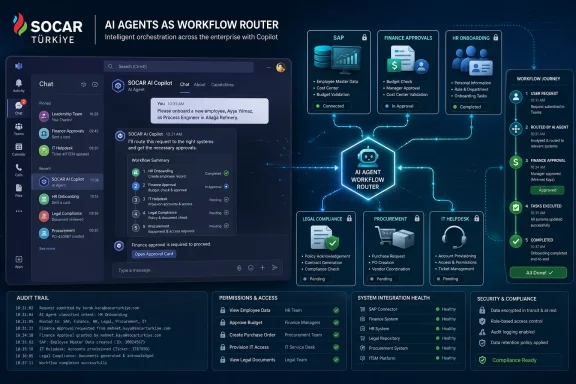
SOCAR Türkiye said on June 26, 2026, that it is saving more than 7,500 employee hours a year after building a Copilot-based internal chatbot and department-specific AI agents across finance, legal, HR, procurement, IT, and corporate services. The headline number is useful, but the more interesting story is architectural: this is not “AI as a writing assistant” so much as “AI as a conversational front end for enterprise plumbing.” Microsoft’s customer story is a marketing artifact, naturally, but it captures where corporate AI adoption is actually moving. The winner is not the flashiest model; it is the agent that knows where the SAP request lives, who can approve it, and how to close the loop inside Teams.
The public conversation around generative AI still tends to chase spectacular demos: code written from scratch, images generated from a sentence, or chatbots that can talk fluently about almost anything. Inside large companies, the more durable use case is much less glamorous. It is the reduction of small frictions that have accumulated over years of ticketing systems, email approvals, spreadsheet lookups, policy PDFs, and enterprise software screens no one enjoys navigating.
SOCAR Türkiye’s project sits squarely in that category. The company, an energy business operating in a sector where compliance, procurement, capital spending, and internal coordination are everyday realities, did not present its Copilot deployment as a moonshot. It presented it as a way to stop wasting professional time on repetitive queries and administrative handoffs.
That distinction matters. Many enterprises are still trying to separate AI theater from AI operations. SOCAR Türkiye’s s.e.d.a.+ chatbot appears to have been built less as a novelty assistant and more as a layer over existing business systems, including SAP, HR platforms, Teams, IT service management tools, and internal workflow software.
That is exactly where Microsoft wants Copilot Studio to sit. The company’s broader Copilot strategy depends on convincing customers that AI is not a separate destination but a new interface for the systems they already pay for. In that telling, the chatbot is not the product. The product is the ability to turn a sentence into a governed workflow.
That is the point at which “chatbot” becomes an inadequate word. A chatbot that answers an FAQ is useful, but limited. An agent that reaches into finance, legal, HR, procurement, and IT systems becomes a different class of tool — one that carries operational risk as well as operational upside.
For WindowsForum readers, the interesting part is the Microsoft stack pattern. Teams becomes the front door. Copilot Studio supplies the low-code agent-building surface. Microsoft 365 Copilot and Azure OpenAI provide the AI layer. Existing enterprise systems continue to hold the authoritative data and workflow state.
This is the model Microsoft has been pushing for more than a year: not one omniscient AI, but many specialized agents grounded in enterprise data and constrained by business processes. The SOCAR Türkiye case gives that model a concrete shape. Finance gets one set of capabilities, legal another, HR another, procurement another, and IT another.
That specialization is important because enterprise AI often fails when it tries to be too general. A model that can discuss company policy is not the same thing as a system that knows which policy applies, which workflow must be triggered, and which approval chain governs the request. SOCAR Türkiye’s example suggests the practical path is narrower, more departmental, and much more integrated.
SOCAR Türkiye says its finance teams saw a 30 percent reduction in time spent on manual tasks by automating repetitive queries such as invoice tracking and IBAN lookups. That is not a claim about replacing finance professionals. It is a claim about moving low-value work out of their queue.
Legal is more sensitive. Microsoft says s.e.d.a.+ provides scenario-based guidance on regulatory procedures, helps plan compliance workflows, and gives employees answers and document templates. The reported annual savings in legal work are 1,820 hours, which is substantial enough to matter but not so large that it implies legal judgment has been automated away.
That is the line enterprises will need to hold. Legal AI can help with retrieval, first drafts, standardization, and routing. It should not become an unreviewed authority on regulatory obligations, especially in industries where mistakes have real financial and operational consequences.
HR is the more culturally visible case. Onboarding, policy questions, training support, employee feedback, and internal development programs are classic high-volume, low-complexity support burdens. If an employee can get a reliable answer about benefits, training, or onboarding steps without waiting for a human reply, HR saves time and the employee experience improves.
But HR also shows the governance problem. Once an AI assistant becomes the front door for workplace policy, employees will assume its answers are official. That raises the bar for grounding, update discipline, escalation paths, and auditability. A stale policy document behind a pleasant chatbot is still a stale policy document.
For employees, the appeal is obvious. If approvals, support tickets, procurement checks, and HR questions can happen where work conversations already happen, fewer people need to context-switch into specialized systems. For Microsoft, that means Teams becomes more deeply embedded in the operational life of the company.
For IT administrators, this is both attractive and alarming. The attractive part is centralization. Agents built with Microsoft tooling can fit into familiar identity, access, compliance, and management frameworks more readily than a patchwork of third-party bots and shadow AI subscriptions.
The alarming part is also centralization. Once Teams becomes the command surface for backend actions, mistakes in permissions, connectors, workflow design, or prompt handling can have business consequences. A bad chatbot answer is one thing. A bad chatbot action is another.
That is why agent deployments need to be treated less like productivity add-ons and more like application rollouts. They require testing, access controls, logging, monitoring, change management, and a clear owner for every workflow they touch. The more successful they are, the more essential that discipline becomes.
Some savings are direct and measurable: fewer manual lookups, fewer repeated support replies, fewer routine ticket triage steps. Others are softer: faster response times, less frustration, fewer abandoned requests, fewer interruptions for specialist teams. The first category is easier to quantify; the second may be more important.
SOCAR Türkiye’s reported figures include 50 percent faster response times in internal helpdesk and HR workflows, 225 hours saved annually in procurement through AI-assisted validation and procedural guidance, and more than 1,300 IT and support requests handled annually. The company also reports nearly 2,300 active users and a satisfaction score of 4.8 out of 5.0.
Those numbers point to a broader truth: AI adoption spreads when employees find it less annoying than the old way. That sounds mundane, but it is the core test of enterprise software. If the agent adds another layer of ceremony, people will route around it. If it removes a step, remembers context, and gets the work moving, usage grows.
The reported growth in monthly sessions — more than 400 per month, according to Microsoft’s story — suggests the tool is being used, though the figure is modest relative to 2,300 active users. That is not necessarily a weakness. In internal enterprise automation, success often looks like targeted usage by the people who need a workflow, not universal daily engagement.
SOCAR Türkiye reportedly ran an eight-week “AI Marathon” with Microsoft Türkiye and partner Mindworks, involving around 30 digital champions from across business units. The company also used workshops, demos, brainstorming sessions, and a GEN-D digital capability program to build internal familiarity with AI.
This is the unglamorous part of AI rollout that vendors often understate. A chatbot that touches finance, HR, procurement, and legal cannot be designed solely by a central IT team. It needs the people who understand the exceptions, the legacy processes, the informal workarounds, and the failure modes.
Digital champions serve as translators. They can tell technical teams which workflows are worth automating and tell business teams where AI can help without promising magic. They also create a feedback channel after deployment, which is critical because agents improve only when their failures are visible.
The risk is that “champion” programs become unpaid enthusiasm campaigns. The better version gives champions actual authority, time, and accountability. If AI agents are becoming production systems, the people helping shape them should be treated as part of the operating model, not as volunteers in a morale initiative.
SOCAR Türkiye’s deployment shows why that hybrid model appeals to large organizations. Finance and HR teams know the pain points. IT knows the systems, identity boundaries, and support implications. Microsoft and partners bring the platform knowledge. The result is neither pure citizen development nor traditional enterprise application development.
That middle ground is where Microsoft has a real advantage. The company already owns much of the workplace surface area through Microsoft 365, Teams, Entra identity, Power Platform, and Azure. Copilot Studio becomes more compelling when it can sit on top of that stack and reach outward through connectors.
But this also creates a licensing and governance maze. Organizations need to understand which Copilot Studio capabilities are available under which plan, what requires standalone licensing, how agent interactions are metered, and how connectors affect cost and security. The business case can look simple at the headline level and complicated in the procurement spreadsheet.
For sysadmins, the lesson is straightforward: do not let the ease of building an agent obscure the complexity of running one. Every connector is a trust decision. Every workflow action is a permission decision. Every knowledge source is a data-quality decision. Low-code does not mean low-responsibility.
They are also organizations where reckless automation would be unacceptable. Legal and compliance guidance must be controlled. Procurement data must be accurate. Finance approvals must follow policy. IT requests must respect security boundaries.
That tension makes the SOCAR Türkiye story a useful proxy for the enterprise market. If AI agents can operate safely in narrow, high-friction internal workflows, they have a path to legitimacy. If they overreach, hallucinate, or obscure accountability, they will be pushed back into toy status.
The Microsoft customer story naturally emphasizes the upside. It does not dwell on failure handling, audit logs, exception rates, security reviews, or model evaluation. Those omissions are normal for a customer win story, but they are precisely the areas IT pros should ask about before copying the pattern.
In a mature deployment, an agent should be judged not only by how often it succeeds, but by how gracefully it fails. Does it escalate to a human? Does it show its source? Does it know when not to answer? Does it leave an audit trail? Does it preserve least-privilege access? Those questions determine whether a chatbot becomes infrastructure.
This is why the most successful early enterprise AI projects often target repetitive, bounded, well-understood tasks. Invoice tracking is a better first use case than open-ended financial advice. HR policy retrieval is safer than individualized employment guidance. IT password reset workflows are more practical than unconstrained troubleshooting.
SOCAR Türkiye’s department-specific approach reflects that logic. Rather than launch one universal assistant and hope it could handle everything, the company built agents around recurring pain points. That lets each function define what “good” looks like and reduces the blast radius of mistakes.
The prompt library detail is also significant. SOCAR Türkiye has reportedly built department-based prompt collections that curate effective prompts by function and scenario. That may sound small, but it is one of the ways enterprises turn AI from a novelty into repeatable practice.
Prompt libraries are not magic, either. They can become stale, overly prescriptive, or detached from real work. But when maintained properly, they capture organizational learning. They tell employees not merely that AI exists, but how to use it for the company’s actual workflows.
That shift changes the admin conversation. AI agents will need lifecycle management. They will need environment strategy, data-loss-prevention policies, role-based access, connector governance, and incident response playbooks. They will need owners who understand both the business process and the technical surface.
The old chatbot model could often be ignored by infrastructure teams. It lived on a website or in a support corner. The new agent model cannot be ignored because it can trigger workflows, touch business systems, and sit in the middle of collaboration tools employees use all day.
This is where Microsoft’s ecosystem lock-in becomes both a feature and a concern. A Microsoft-native agent strategy may be easier to govern than scattered AI tools. It may also deepen dependency on Microsoft’s licensing, roadmap, and administrative model. Enterprises will need to decide whether that trade is worth it.
For many, the answer will be yes, because the alternative is worse: unmanaged AI usage, copy-pasted company data into public tools, departmental bots with no security review, and duplicated automation efforts. The question is not whether employees will use AI. The question is whether IT can make the sanctioned path easier than the unsafe one.
 Microsoft’s AI Sales Pitch Gets Its Most Convincing Form: Boring Work
The public conversation around generative AI still tends to chase spectacular demos: code written from scratch, images generated from a sentence, or chatbots that can talk fluently about almost anything. Inside large companies, the more durable use case is much less glamorous. It is the reduction of small frictions that have accumulated over years of ticketing systems, email approvals, spreadsheet lookups, policy PDFs, and enterprise software screens no one enjoys navigating.SOCAR Türkiye’s project sits squarely in that category. The company, an energy business operating in a sector where compliance, procurement, capital spending, and internal coordination are everyday realities, did not present its Copilot deployment as a moonshot. It presented it as a way to stop wasting professional time on repetitive queries and administrative handoffs.
That distinction matters. Many enterprises are still trying to separate AI theater from AI operations. SOCAR Türkiye’s s.e.d.a.+ chatbot appears to have been built less as a novelty assistant and more as a layer over existing business systems, including SAP, HR platforms, Teams, IT service management tools, and internal workflow software.
That is exactly where Microsoft wants Copilot Studio to sit. The company’s broader Copilot strategy depends on convincing customers that AI is not a separate destination but a new interface for the systems they already pay for. In that telling, the chatbot is not the product. The product is the ability to turn a sentence into a governed workflow.
The Chatbot Is Really a Workflow Router
The name s.e.d.a.+ may read like a chatbot brand, but the deployment Microsoft describes is closer to a conversational operations console. Employees can ask for information in natural language, but they can also trigger actions: retrieving payment details, initiating finance requests, approving transactions, creating support tickets, guiding procurement decisions, and handling IT support tasks.That is the point at which “chatbot” becomes an inadequate word. A chatbot that answers an FAQ is useful, but limited. An agent that reaches into finance, legal, HR, procurement, and IT systems becomes a different class of tool — one that carries operational risk as well as operational upside.
For WindowsForum readers, the interesting part is the Microsoft stack pattern. Teams becomes the front door. Copilot Studio supplies the low-code agent-building surface. Microsoft 365 Copilot and Azure OpenAI provide the AI layer. Existing enterprise systems continue to hold the authoritative data and workflow state.
This is the model Microsoft has been pushing for more than a year: not one omniscient AI, but many specialized agents grounded in enterprise data and constrained by business processes. The SOCAR Türkiye case gives that model a concrete shape. Finance gets one set of capabilities, legal another, HR another, procurement another, and IT another.
That specialization is important because enterprise AI often fails when it tries to be too general. A model that can discuss company policy is not the same thing as a system that knows which policy applies, which workflow must be triggered, and which approval chain governs the request. SOCAR Türkiye’s example suggests the practical path is narrower, more departmental, and much more integrated.
Finance, Legal, and HR Show Why Generic Copilot Is Not Enough
The finance use case is the easiest to understand. Employees need payment status, IBAN details, invoice information, CapEx approvals, or purchase-order creation. In many companies, these requests generate email chains or manual lookups by specialists who would rather be doing analysis than clerical retrieval.SOCAR Türkiye says its finance teams saw a 30 percent reduction in time spent on manual tasks by automating repetitive queries such as invoice tracking and IBAN lookups. That is not a claim about replacing finance professionals. It is a claim about moving low-value work out of their queue.
Legal is more sensitive. Microsoft says s.e.d.a.+ provides scenario-based guidance on regulatory procedures, helps plan compliance workflows, and gives employees answers and document templates. The reported annual savings in legal work are 1,820 hours, which is substantial enough to matter but not so large that it implies legal judgment has been automated away.
That is the line enterprises will need to hold. Legal AI can help with retrieval, first drafts, standardization, and routing. It should not become an unreviewed authority on regulatory obligations, especially in industries where mistakes have real financial and operational consequences.
HR is the more culturally visible case. Onboarding, policy questions, training support, employee feedback, and internal development programs are classic high-volume, low-complexity support burdens. If an employee can get a reliable answer about benefits, training, or onboarding steps without waiting for a human reply, HR saves time and the employee experience improves.
But HR also shows the governance problem. Once an AI assistant becomes the front door for workplace policy, employees will assume its answers are official. That raises the bar for grounding, update discipline, escalation paths, and auditability. A stale policy document behind a pleasant chatbot is still a stale policy document.
Teams Becomes the Place Where Enterprise AI Either Works or Fails
The SOCAR Türkiye deployment is notable because s.e.d.a.+ is accessible through Teams, a web portal, and mobile. The Teams piece is the strategic center. Microsoft has spent years turning Teams from a meeting app into a work hub, and Copilot agents give that ambition a new reason to exist.For employees, the appeal is obvious. If approvals, support tickets, procurement checks, and HR questions can happen where work conversations already happen, fewer people need to context-switch into specialized systems. For Microsoft, that means Teams becomes more deeply embedded in the operational life of the company.
For IT administrators, this is both attractive and alarming. The attractive part is centralization. Agents built with Microsoft tooling can fit into familiar identity, access, compliance, and management frameworks more readily than a patchwork of third-party bots and shadow AI subscriptions.
The alarming part is also centralization. Once Teams becomes the command surface for backend actions, mistakes in permissions, connectors, workflow design, or prompt handling can have business consequences. A bad chatbot answer is one thing. A bad chatbot action is another.
That is why agent deployments need to be treated less like productivity add-ons and more like application rollouts. They require testing, access controls, logging, monitoring, change management, and a clear owner for every workflow they touch. The more successful they are, the more essential that discipline becomes.
The Real Metric Is Not Hours Saved, but Friction Removed
The 7,500-plus annual hours figure is the easy number to headline because it translates AI into something executives understand. It is also the number most likely to be repeated in sales decks. But saved hours can be a slippery metric.Some savings are direct and measurable: fewer manual lookups, fewer repeated support replies, fewer routine ticket triage steps. Others are softer: faster response times, less frustration, fewer abandoned requests, fewer interruptions for specialist teams. The first category is easier to quantify; the second may be more important.
SOCAR Türkiye’s reported figures include 50 percent faster response times in internal helpdesk and HR workflows, 225 hours saved annually in procurement through AI-assisted validation and procedural guidance, and more than 1,300 IT and support requests handled annually. The company also reports nearly 2,300 active users and a satisfaction score of 4.8 out of 5.0.
Those numbers point to a broader truth: AI adoption spreads when employees find it less annoying than the old way. That sounds mundane, but it is the core test of enterprise software. If the agent adds another layer of ceremony, people will route around it. If it removes a step, remembers context, and gets the work moving, usage grows.
The reported growth in monthly sessions — more than 400 per month, according to Microsoft’s story — suggests the tool is being used, though the figure is modest relative to 2,300 active users. That is not necessarily a weakness. In internal enterprise automation, success often looks like targeted usage by the people who need a workflow, not universal daily engagement.
Digital Champions Are the Human Middleware
Microsoft’s story emphasizes SOCAR Türkiye’s Centre of Excellence and its network of digital champions. That may sound like standard transformation language, but it is probably one of the more important details in the case. Enterprise AI projects do not fail only because the model is bad. They fail because no one owns adoption, feedback, governance, or iteration after the launch meeting.SOCAR Türkiye reportedly ran an eight-week “AI Marathon” with Microsoft Türkiye and partner Mindworks, involving around 30 digital champions from across business units. The company also used workshops, demos, brainstorming sessions, and a GEN-D digital capability program to build internal familiarity with AI.
This is the unglamorous part of AI rollout that vendors often understate. A chatbot that touches finance, HR, procurement, and legal cannot be designed solely by a central IT team. It needs the people who understand the exceptions, the legacy processes, the informal workarounds, and the failure modes.
Digital champions serve as translators. They can tell technical teams which workflows are worth automating and tell business teams where AI can help without promising magic. They also create a feedback channel after deployment, which is critical because agents improve only when their failures are visible.
The risk is that “champion” programs become unpaid enthusiasm campaigns. The better version gives champions actual authority, time, and accountability. If AI agents are becoming production systems, the people helping shape them should be treated as part of the operating model, not as volunteers in a morale initiative.
Copilot Studio’s Sweet Spot Is the Mess Between Low-Code and IT Control
Copilot Studio is designed to let organizations build agents without requiring every use case to become a custom software project. That is its commercial promise. Business users can describe scenarios, connect knowledge sources, and build conversational experiences; developers and IT can extend, govern, and integrate where needed.SOCAR Türkiye’s deployment shows why that hybrid model appeals to large organizations. Finance and HR teams know the pain points. IT knows the systems, identity boundaries, and support implications. Microsoft and partners bring the platform knowledge. The result is neither pure citizen development nor traditional enterprise application development.
That middle ground is where Microsoft has a real advantage. The company already owns much of the workplace surface area through Microsoft 365, Teams, Entra identity, Power Platform, and Azure. Copilot Studio becomes more compelling when it can sit on top of that stack and reach outward through connectors.
But this also creates a licensing and governance maze. Organizations need to understand which Copilot Studio capabilities are available under which plan, what requires standalone licensing, how agent interactions are metered, and how connectors affect cost and security. The business case can look simple at the headline level and complicated in the procurement spreadsheet.
For sysadmins, the lesson is straightforward: do not let the ease of building an agent obscure the complexity of running one. Every connector is a trust decision. Every workflow action is a permission decision. Every knowledge source is a data-quality decision. Low-code does not mean low-responsibility.
Energy Companies Are an Especially Useful Test Bed
SOCAR Türkiye is not a consumer startup experimenting with a chatbot on a landing page. It is an energy company, and that makes the case more interesting. Energy firms tend to have complex procurement chains, regulated operations, capital-intensive projects, and large internal service functions. They are exactly the kind of organizations where administrative friction can become expensive.They are also organizations where reckless automation would be unacceptable. Legal and compliance guidance must be controlled. Procurement data must be accurate. Finance approvals must follow policy. IT requests must respect security boundaries.
That tension makes the SOCAR Türkiye story a useful proxy for the enterprise market. If AI agents can operate safely in narrow, high-friction internal workflows, they have a path to legitimacy. If they overreach, hallucinate, or obscure accountability, they will be pushed back into toy status.
The Microsoft customer story naturally emphasizes the upside. It does not dwell on failure handling, audit logs, exception rates, security reviews, or model evaluation. Those omissions are normal for a customer win story, but they are precisely the areas IT pros should ask about before copying the pattern.
In a mature deployment, an agent should be judged not only by how often it succeeds, but by how gracefully it fails. Does it escalate to a human? Does it show its source? Does it know when not to answer? Does it leave an audit trail? Does it preserve least-privilege access? Those questions determine whether a chatbot becomes infrastructure.
The Agent Era Will Reward Companies That Already Know Their Processes
One quiet implication of the SOCAR Türkiye case is that AI agents are not a shortcut around process discipline. They amplify whatever process reality already exists. If workflows are documented, APIs are available, permissions are clean, and data owners are known, an agent can make the system feel simpler. If processes are chaotic, the agent becomes a conversational mask over chaos.This is why the most successful early enterprise AI projects often target repetitive, bounded, well-understood tasks. Invoice tracking is a better first use case than open-ended financial advice. HR policy retrieval is safer than individualized employment guidance. IT password reset workflows are more practical than unconstrained troubleshooting.
SOCAR Türkiye’s department-specific approach reflects that logic. Rather than launch one universal assistant and hope it could handle everything, the company built agents around recurring pain points. That lets each function define what “good” looks like and reduces the blast radius of mistakes.
The prompt library detail is also significant. SOCAR Türkiye has reportedly built department-based prompt collections that curate effective prompts by function and scenario. That may sound small, but it is one of the ways enterprises turn AI from a novelty into repeatable practice.
Prompt libraries are not magic, either. They can become stale, overly prescriptive, or detached from real work. But when maintained properly, they capture organizational learning. They tell employees not merely that AI exists, but how to use it for the company’s actual workflows.
The Windows Admin Angle Is Governance, Not Hype
For WindowsForum’s core audience, the SOCAR Türkiye story is not mainly about whether Copilot can write better emails. It is about how Microsoft’s AI stack is being woven into the operational fabric of enterprises that already depend on Windows, Microsoft 365, Teams, Azure, and Power Platform.That shift changes the admin conversation. AI agents will need lifecycle management. They will need environment strategy, data-loss-prevention policies, role-based access, connector governance, and incident response playbooks. They will need owners who understand both the business process and the technical surface.
The old chatbot model could often be ignored by infrastructure teams. It lived on a website or in a support corner. The new agent model cannot be ignored because it can trigger workflows, touch business systems, and sit in the middle of collaboration tools employees use all day.
This is where Microsoft’s ecosystem lock-in becomes both a feature and a concern. A Microsoft-native agent strategy may be easier to govern than scattered AI tools. It may also deepen dependency on Microsoft’s licensing, roadmap, and administrative model. Enterprises will need to decide whether that trade is worth it.
For many, the answer will be yes, because the alternative is worse: unmanaged AI usage, copy-pasted company data into public tools, departmental bots with no security review, and duplicated automation efforts. The question is not whether employees will use AI. The question is whether IT can make the sanctioned path easier than the unsafe one.
SOCAR Türkiye’s Numbers Point to the Agent Playbook Microsoft Wants Everyone to Copy
The SOCAR Türkiye case is most useful when read as a pattern rather than a miracle story. The claimed savings are meaningful, but the architecture and rollout model are the parts other organizations can actually learn from.- SOCAR Türkiye built s.e.d.a.+ as an integrated workflow assistant, not merely as a chatbot that answers static FAQs.
- The company targeted specific departmental pain points in finance, legal, HR, procurement, IT, and corporate services instead of trying to launch a universal AI assistant for every task.
- Teams served as a key employee-facing surface, which made the agents available inside the collaboration environment many workers already use.
- The reported benefits include more than 7,500 saved hours annually, 50 percent faster response times in some internal workflows, and a 4.8 out of 5.0 user satisfaction score.
- The deployment depended on change management, digital champions, workshops, and prompt libraries, which suggests the human rollout mattered as much as the AI tooling.
- The biggest lesson for IT is that agent governance must be treated like application governance, because these systems can retrieve data, trigger workflows, and affect business operations.
References
- Primary source: Microsoft
Published: 2026-06-26T11:30:08.591839
SOCAR Türkiye saves 7,500+ hours annually with Copilot-based chatbot and AI agents | Microsoft Customer Stories
SOCAR Türkiye builds a chatbot and custom agents with Copilot Studio and Microsoft Foundry, saving 7,500+ hours each year.www.microsoft.com
