

On May 29, 2026, Microsoft said Sonata Software, a publicly traded India-based IT services firm, saved about 200 hours a month after moving forecasting and reconciliation work onto Microsoft Fabric, OneLake, Copilot, and Fabric data agents across delivery, sales, finance, and operations. The case study is more than another “AI saves time” customer win. It is a useful snapshot of where Microsoft wants Fabric to sit in the enterprise stack: not beside the business, but underneath the decisions executives are judged on. For Sonata, the story is really about replacing spreadsheet-era trust with governed, near real-time control.
Microsoft Fabric has often been described in platform language: lakehouse, warehouse, pipelines, semantic models, governance, OneLake, Power BI, Copilot. That vocabulary is accurate, but it can also flatten the business problem into architecture. Sonata’s deployment makes the argument sharper because the pain was not “we need better dashboards.” The pain was that the company could not consistently trust the operational numbers behind revenue and margin forecasting until too late in the cycle.
That matters because IT services firms live and die by predictability. A manufacturer can point to supply shocks or inventory. A software company can point to subscription cohorts. A services company has to explain people, projects, utilization, billing, deal conversion, delivery slippage, and margin leakage across thousands of moving parts. The forecast is not an accounting artifact; it is an operating claim.
Sonata’s old model was familiar to anyone who has worked near enterprise finance. Sales, delivery, HR, timesheets, CRM, and finance systems had evolved independently, each with its own definitions and timing. Month-end reconciliation then became a human integration layer, with project managers and finance teams downloading data, comparing numbers, resolving gaps, and trying to determine which system represented reality.
Microsoft says Sonata cut reconciliation effort by 25 to 30 percent, increased speed to act on business data by 30 to 40 percent, and freed roughly 200 hours a month. Those are customer-story numbers, not an independent audit, and they should be read accordingly. But the interesting part is less the exact percentage than the direction of travel: Fabric is being sold as a way to move the enterprise from reporting what happened to controlling what is still happening.
Sonata’s issue, as described by Microsoft, was not simply manual work. It was that business logic had migrated into “people’s heads” and spreadsheets. That phrase should make every CIO uncomfortable. When calculations that determine revenue, billing, utilization, or margin are embedded in local workarounds, the company is no longer running on systems alone. It is running on memory.
Fabric’s role here was to pull those rules into semantic models and data products. That may sound less glamorous than Copilot answering questions in natural language, but it is the real foundation. AI cannot fix a disputed definition of billable utilization. It cannot make margin trustworthy if delivery hours, CRM stages, and invoice status are all on different clocks.
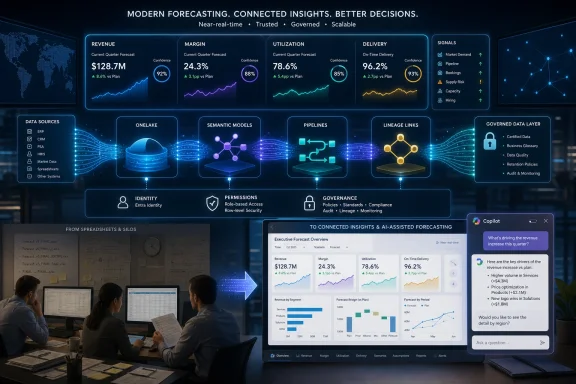
The move to OneLake is therefore central to the story. Sonata connected project delivery systems, timesheets, CRM, HR, and finance platforms into a governed data store. Automated ingestion pipelines continuously moved data from those systems into the lake. Full lineage then gave leaders a way to understand where numbers came from, not just what the numbers were.
That lineage point is crucial. Executives do not merely need charts; they need defensible charts. If a revenue forecast changes, the follow-up question is immediate: why? A platform that can show the path from source data to semantic calculation to executive view does not eliminate judgment, but it changes the quality of the argument inside the business.
That is the version of AI Microsoft wants buyers to imagine: conversational access to trusted business data, delivered inside the workstream. Publishing agents into Microsoft Teams lowers friction because Teams is already where many managers live during the workday. If the answer arrives in the same collaboration surface where action is assigned, the gap between insight and follow-up narrows.
But Sonata’s example also exposes the condition Microsoft sometimes underplays in its AI marketing. Copilot is only as impressive as the data estate beneath it. Natural language is not magic; it is an interface. If the underlying model is inconsistent, the agent simply gives bad answers more fluently.
That is why the phrase AI-ready foundation deserves more scrutiny than the average vendor slogan. In practice, it means the painful plumbing has been done: sources mapped, terms standardized, lineage exposed, permissions enforced, and calculations made repeatable. Only then does a conversational agent become more than a novelty layered over corporate confusion.
This is where Fabric’s bundling strategy becomes powerful. Microsoft is not asking enterprises to buy a chatbot alone. It is asking them to consolidate analytics, storage, business intelligence, data engineering, governance, and AI interaction into a single control plane. Sonata is precisely the kind of customer proof point Microsoft needs because the value comes from the whole chain, not from one isolated feature.
Near real-time forecasting changes the rhythm of management. In the old model, teams discover discrepancies at month-end, after invoices are in motion and corrective options are limited. In the new model, missing timesheet entries, billing gaps, delivery issues, and utilization problems can surface while there is still time to intervene.
That does not mean every forecast becomes accurate. Services businesses remain exposed to client delays, scope changes, staffing constraints, currency effects, and sales-cycle volatility. But a faster feedback loop reduces the amount of surprise buried inside the system. For public companies, fewer surprises can be worth more than prettier dashboards.
Sonata’s leadership view now reportedly includes revenue forecasting, pipeline by geography and business unit, people utilization, and delivery performance. That is the connective tissue of an IT services firm. If sales teams are spending time on deals that do not convert, capacity can be redirected. If delivery hours are missing or misclassified, revenue protection can happen before billing disputes harden.
The broader implication is that forecasting is no longer a periodic finance exercise. It is becoming an operational discipline that depends on telemetry. The closer finance gets to live delivery and sales behavior, the more the forecast resembles an instrument panel rather than a rearview mirror.
For WindowsForum’s IT pro audience, that should sound like the part of the iceberg below the waterline. Identity, permissions, source ownership, schema drift, data quality, and lifecycle management are where enterprise analytics projects either mature or decay. A natural-language interface may increase demand for answers, but it also increases the blast radius of bad governance.
Fabric’s OneLake architecture is designed to reduce duplicated data estates, but centralization brings its own politics. Different departments often prefer their own numbers because those numbers reflect their incentives. Sales may define pipeline quality one way; delivery may define project health another; finance may care about recognized revenue on a different cadence. A governed platform can host common definitions, but it cannot create organizational agreement by itself.
That is why Sonata’s decision to build domain-specific data products is notable. Rather than pretending the whole company has one monolithic information need, the deployment separated finance, operations, and delivery into distinct models and agents. That is likely the more realistic enterprise pattern: shared foundations, domain-aware semantics, and persona-specific interfaces.
The risk is that “single source of truth” becomes a slogan masking many curated truths. The opportunity is that those truths can finally be reconciled inside a governed system instead of across email threads and spreadsheet attachments. That is not glamorous transformation, but it is the kind that changes how a company runs.
That matters in the Windows and Microsoft ecosystem because the company already owns many of the surfaces where work happens. Teams is the meeting room, chat client, and workflow hub. Power BI is already entrenched in reporting. Microsoft 365 is where documents and collaboration live. Azure is the cloud foundation for many enterprise workloads. Fabric is the attempt to make the data layer feel native to that universe.
The Sonata story shows how Microsoft can turn that installed base into a platform argument. Data lands in OneLake. Business logic is expressed in semantic models. Users interact through Copilot and Fabric data agents. Answers can be surfaced in Teams. Future actions may be triggered through operational agents. The loop begins to look less like analytics and more like enterprise command-and-control.
That is also why competitors will not dismiss this as a simple customer win. Snowflake, Databricks, Salesforce, ServiceNow, Google, AWS, and specialist analytics vendors all want to own pieces of the same operating fabric. The prize is not just storage or dashboards. It is the layer that tells executives what is happening, recommends what to do, and increasingly initiates the workflow.
Microsoft’s advantage is integration. Its challenge is complexity. Fabric can feel like an umbrella over many product categories, and enterprises will need skilled architects to avoid turning platform consolidation into a new form of sprawl. Sonata, as a Microsoft Fabric launch partner and IT services firm, had expertise most customers will not have internally.
It is stronger because Sonata knows the domain. An IT services firm understands delivery economics, project billing, utilization, finance operations, and client reporting pressures. It also has the technical skill to build data pipelines, semantic layers, and AI agents with fewer outside dependencies than a less technical organization.
It is less typical because many companies attempting similar modernization will not have Sonata’s in-house data and AI practice. They may still be wrestling with source system quality, data ownership, or basic Power BI governance. For them, “go live in under six months” may be aspirational rather than predictive.
That does not invalidate the result. It does mean buyers should separate the product lesson from the timeline. The product lesson is that governed data plus domain-specific AI access can reduce reconciliation drag and improve forecast responsiveness. The timeline lesson is that execution speed depends heavily on organizational readiness.
There is also an obvious commercial flywheel. Sonata can use its own deployment as a reference architecture for clients. Microsoft gets a partner success story. Customers see a services firm applying Fabric to its own forecasting problem rather than merely reselling the platform. In enterprise technology, eating your own dog food remains one of the more persuasive sales motions.
An agent that answers a question is useful. An agent that detects a forecast risk, explains the drivers, identifies the responsible owner, and starts the remediation workflow is more consequential. It also raises harder questions about permission, accountability, auditability, and error handling.
If a system flags missing hours, who gets notified? If it detects a margin risk, can it open a task? If it identifies a low-probability sales pursuit, can it recommend reallocating effort? If the recommendation is wrong, who owns the decision? These are not abstract governance questions. They are the operating rules for AI inside the enterprise.
Ontology is Microsoft’s attempt to give business concepts more structure above the raw data layer. In plain terms, the company wants systems to understand relationships between customers, projects, people, invoices, forecasts, and risks in business language. That structure is essential if agents are expected to reason across domains rather than retrieve isolated metrics.
The promise is compelling: fewer manual handoffs, faster interventions, and business processes that respond to signals as they emerge. The danger is equally clear: organizations may automate around flawed assumptions if they do not maintain strict controls over definitions, approvals, and exceptions. The closer AI gets to action, the less tolerance there is for vague governance.
That hidden cost is everywhere in enterprise IT. Teams build reports to verify other reports. Managers hold meetings to reconcile conflicting dashboards. Finance delays decisions because delivery data is incomplete. Sales capacity is spent on opportunities that better data might have deprioritized sooner. None of that always appears in a neat savings calculation.
This is why the Sonata deployment should interest sysadmins and IT leaders beyond the data team. The business increasingly expects IT to deliver not just uptime and tooling, but operational truth. When systems disagree, IT becomes the referee. When data pipelines fail, the forecast suffers. When identity and permissions are wrong, AI access becomes a security concern.
Fabric’s success in these environments will depend on whether it can reduce that burden without hiding complexity behind branding. Enterprises do not need another black box. They need platforms that make data movement, transformation, security, and lineage observable enough for professionals to operate with confidence.
For Sonata, the reported savings are meaningful. For the wider market, the bigger message is that many companies are still paying a large tax for fragmented systems. Microsoft is arguing that Fabric can collect that tax and return some of it as speed.
That distinction matters because enterprises are becoming more skeptical of vague AI uplift. Boards and CFOs want hard links between AI investment and business outcomes. A deployment that reduces reconciliation effort, accelerates decision-making, protects revenue, and improves forecast confidence is easier to defend than a general promise of “smarter work.”
Still, the numbers should be interpreted carefully. Microsoft’s customer stories are marketing documents, not neutral benchmarks. They emphasize outcomes that support the platform narrative. They rarely dwell on implementation costs, change management difficulty, data quality failures, licensing complexity, or the internal politics of standardizing business definitions.
A serious reading therefore lands in the middle. Sonata’s results are plausible and strategically important, but they are not plug-and-play proof that every Fabric deployment will save 200 hours a month. The repeatable pattern is not the number. It is the sequence: unify the data, govern the definitions, expose lineage, build semantic models, then let AI become an interface to trusted business logic.
That sequence is less exciting than a chatbot demo, but it is far more likely to survive contact with enterprise reality. The companies that skip to the interface will get conversational confusion. The companies that invest in the foundation may get operational leverage.
Those questions are uncomfortable because they reveal that many digital transformations stopped at visibility. They made reports easier to consume without making the underlying data more trustworthy. Fabric’s pitch is that visibility, governance, AI, and action should be designed together.
That has implications for IT staffing. Data engineering, business analysis, finance operations, security, and collaboration administration can no longer operate as distant silos. A Teams-based AI agent that answers finance questions depends on Entra identity, data permissions, ingestion reliability, semantic modeling, and user training. The interface may be simple; the operating model is not.
It also has implications for procurement. Buying Fabric capacity or Copilot access is not the transformation. The transformation is deciding which business process is worth rebuilding around governed data. Sonata chose forecasting and reconciliation because the pain was material, recurring, and tied to public-market credibility. That is exactly the kind of use case where platform modernization can justify itself.
The weaker path is to deploy AI broadly and hope productivity appears. The stronger path is to pick a process where bad data is already expensive, then redesign the data foundation around it. Sonata’s example belongs to the second category.
 Microsoft’s Fabric Pitch Gets Its Finance Department Test
Microsoft Fabric has often been described in platform language: lakehouse, warehouse, pipelines, semantic models, governance, OneLake, Power BI, Copilot. That vocabulary is accurate, but it can also flatten the business problem into architecture. Sonata’s deployment makes the argument sharper because the pain was not “we need better dashboards.” The pain was that the company could not consistently trust the operational numbers behind revenue and margin forecasting until too late in the cycle.That matters because IT services firms live and die by predictability. A manufacturer can point to supply shocks or inventory. A software company can point to subscription cohorts. A services company has to explain people, projects, utilization, billing, deal conversion, delivery slippage, and margin leakage across thousands of moving parts. The forecast is not an accounting artifact; it is an operating claim.
Sonata’s old model was familiar to anyone who has worked near enterprise finance. Sales, delivery, HR, timesheets, CRM, and finance systems had evolved independently, each with its own definitions and timing. Month-end reconciliation then became a human integration layer, with project managers and finance teams downloading data, comparing numbers, resolving gaps, and trying to determine which system represented reality.
Microsoft says Sonata cut reconciliation effort by 25 to 30 percent, increased speed to act on business data by 30 to 40 percent, and freed roughly 200 hours a month. Those are customer-story numbers, not an independent audit, and they should be read accordingly. But the interesting part is less the exact percentage than the direction of travel: Fabric is being sold as a way to move the enterprise from reporting what happened to controlling what is still happening.
The Spreadsheet Was the Symptom, Not the Disease
Every company with a mature IT estate has shadow systems. Some are Excel files. Some are SQL extracts. Some are Power BI workspaces that began as a helpful team project and became a parallel source of truth. The problem is not that employees are careless; it is that businesses change faster than centrally governed systems can absorb.Sonata’s issue, as described by Microsoft, was not simply manual work. It was that business logic had migrated into “people’s heads” and spreadsheets. That phrase should make every CIO uncomfortable. When calculations that determine revenue, billing, utilization, or margin are embedded in local workarounds, the company is no longer running on systems alone. It is running on memory.
Fabric’s role here was to pull those rules into semantic models and data products. That may sound less glamorous than Copilot answering questions in natural language, but it is the real foundation. AI cannot fix a disputed definition of billable utilization. It cannot make margin trustworthy if delivery hours, CRM stages, and invoice status are all on different clocks.
The move to OneLake is therefore central to the story. Sonata connected project delivery systems, timesheets, CRM, HR, and finance platforms into a governed data store. Automated ingestion pipelines continuously moved data from those systems into the lake. Full lineage then gave leaders a way to understand where numbers came from, not just what the numbers were.
That lineage point is crucial. Executives do not merely need charts; they need defensible charts. If a revenue forecast changes, the follow-up question is immediate: why? A platform that can show the path from source data to semantic calculation to executive view does not eliminate judgment, but it changes the quality of the argument inside the business.
Copilot Becomes Useful Only After the Data Stops Arguing
The headline-friendly part of the Sonata deployment is that employees can ask questions through Copilot and Fabric data agents. A project manager can ask whether there are missing hours for the week and get an answer quickly. Finance and operations users can query delivery, billing, or resource allocation without waiting for an analyst to prepare another report.That is the version of AI Microsoft wants buyers to imagine: conversational access to trusted business data, delivered inside the workstream. Publishing agents into Microsoft Teams lowers friction because Teams is already where many managers live during the workday. If the answer arrives in the same collaboration surface where action is assigned, the gap between insight and follow-up narrows.
But Sonata’s example also exposes the condition Microsoft sometimes underplays in its AI marketing. Copilot is only as impressive as the data estate beneath it. Natural language is not magic; it is an interface. If the underlying model is inconsistent, the agent simply gives bad answers more fluently.
That is why the phrase AI-ready foundation deserves more scrutiny than the average vendor slogan. In practice, it means the painful plumbing has been done: sources mapped, terms standardized, lineage exposed, permissions enforced, and calculations made repeatable. Only then does a conversational agent become more than a novelty layered over corporate confusion.
This is where Fabric’s bundling strategy becomes powerful. Microsoft is not asking enterprises to buy a chatbot alone. It is asking them to consolidate analytics, storage, business intelligence, data engineering, governance, and AI interaction into a single control plane. Sonata is precisely the kind of customer proof point Microsoft needs because the value comes from the whole chain, not from one isolated feature.
Forecasting Is Becoming an Operational Discipline
The case study’s most important word may be “predictability.” Sonata’s CTO, Manu Swami, frames the issue around commitments to the market, especially revenue and margins. That places the deployment squarely in the CFO-CIO overlap, where technology projects are judged less by feature adoption and more by whether the company can make better promises.Near real-time forecasting changes the rhythm of management. In the old model, teams discover discrepancies at month-end, after invoices are in motion and corrective options are limited. In the new model, missing timesheet entries, billing gaps, delivery issues, and utilization problems can surface while there is still time to intervene.
That does not mean every forecast becomes accurate. Services businesses remain exposed to client delays, scope changes, staffing constraints, currency effects, and sales-cycle volatility. But a faster feedback loop reduces the amount of surprise buried inside the system. For public companies, fewer surprises can be worth more than prettier dashboards.
Sonata’s leadership view now reportedly includes revenue forecasting, pipeline by geography and business unit, people utilization, and delivery performance. That is the connective tissue of an IT services firm. If sales teams are spending time on deals that do not convert, capacity can be redirected. If delivery hours are missing or misclassified, revenue protection can happen before billing disputes harden.
The broader implication is that forecasting is no longer a periodic finance exercise. It is becoming an operational discipline that depends on telemetry. The closer finance gets to live delivery and sales behavior, the more the forecast resembles an instrument panel rather than a rearview mirror.
The Governance Story Is Less Flashy and More Important
Customer stories about AI often move too quickly from fragmented data to magical answers. Sonata’s case is more credible because the governance layer remains visible. Microsoft says semantic models codified business logic, automated pipelines kept data current, and lineage improved trust in how outputs were derived.For WindowsForum’s IT pro audience, that should sound like the part of the iceberg below the waterline. Identity, permissions, source ownership, schema drift, data quality, and lifecycle management are where enterprise analytics projects either mature or decay. A natural-language interface may increase demand for answers, but it also increases the blast radius of bad governance.
Fabric’s OneLake architecture is designed to reduce duplicated data estates, but centralization brings its own politics. Different departments often prefer their own numbers because those numbers reflect their incentives. Sales may define pipeline quality one way; delivery may define project health another; finance may care about recognized revenue on a different cadence. A governed platform can host common definitions, but it cannot create organizational agreement by itself.
That is why Sonata’s decision to build domain-specific data products is notable. Rather than pretending the whole company has one monolithic information need, the deployment separated finance, operations, and delivery into distinct models and agents. That is likely the more realistic enterprise pattern: shared foundations, domain-aware semantics, and persona-specific interfaces.
The risk is that “single source of truth” becomes a slogan masking many curated truths. The opportunity is that those truths can finally be reconciled inside a governed system instead of across email threads and spreadsheet attachments. That is not glamorous transformation, but it is the kind that changes how a company runs.
Microsoft Is Selling Fabric as the Operating System for Business Data
Microsoft’s strategic interest is obvious. Fabric is not merely competing with data warehouses, BI tools, or AI assistants. It is an attempt to make Microsoft the default fabric — in the ordinary-language sense — connecting enterprise data, analytics, collaboration, and automation.That matters in the Windows and Microsoft ecosystem because the company already owns many of the surfaces where work happens. Teams is the meeting room, chat client, and workflow hub. Power BI is already entrenched in reporting. Microsoft 365 is where documents and collaboration live. Azure is the cloud foundation for many enterprise workloads. Fabric is the attempt to make the data layer feel native to that universe.
The Sonata story shows how Microsoft can turn that installed base into a platform argument. Data lands in OneLake. Business logic is expressed in semantic models. Users interact through Copilot and Fabric data agents. Answers can be surfaced in Teams. Future actions may be triggered through operational agents. The loop begins to look less like analytics and more like enterprise command-and-control.
That is also why competitors will not dismiss this as a simple customer win. Snowflake, Databricks, Salesforce, ServiceNow, Google, AWS, and specialist analytics vendors all want to own pieces of the same operating fabric. The prize is not just storage or dashboards. It is the layer that tells executives what is happening, recommends what to do, and increasingly initiates the workflow.
Microsoft’s advantage is integration. Its challenge is complexity. Fabric can feel like an umbrella over many product categories, and enterprises will need skilled architects to avoid turning platform consolidation into a new form of sprawl. Sonata, as a Microsoft Fabric launch partner and IT services firm, had expertise most customers will not have internally.
The Partner Angle Cuts Both Ways
Sonata is not a random enterprise buyer discovering Fabric from scratch. Microsoft says Sonata was one of six Fabric launch partners globally and had early access to the platform. That makes the case study both stronger and less typical.It is stronger because Sonata knows the domain. An IT services firm understands delivery economics, project billing, utilization, finance operations, and client reporting pressures. It also has the technical skill to build data pipelines, semantic layers, and AI agents with fewer outside dependencies than a less technical organization.
It is less typical because many companies attempting similar modernization will not have Sonata’s in-house data and AI practice. They may still be wrestling with source system quality, data ownership, or basic Power BI governance. For them, “go live in under six months” may be aspirational rather than predictive.
That does not invalidate the result. It does mean buyers should separate the product lesson from the timeline. The product lesson is that governed data plus domain-specific AI access can reduce reconciliation drag and improve forecast responsiveness. The timeline lesson is that execution speed depends heavily on organizational readiness.
There is also an obvious commercial flywheel. Sonata can use its own deployment as a reference architecture for clients. Microsoft gets a partner success story. Customers see a services firm applying Fabric to its own forecasting problem rather than merely reselling the platform. In enterprise technology, eating your own dog food remains one of the more persuasive sales motions.
The Next Step Is Letting Agents Act, Not Just Answer
The most forward-looking part of the case study is Sonata’s pilot of ontology in Fabric and its plan for operational agents that can trigger actions directly in Teams. That is where the story moves from analytics modernization into the next contested phase of enterprise AI.An agent that answers a question is useful. An agent that detects a forecast risk, explains the drivers, identifies the responsible owner, and starts the remediation workflow is more consequential. It also raises harder questions about permission, accountability, auditability, and error handling.
If a system flags missing hours, who gets notified? If it detects a margin risk, can it open a task? If it identifies a low-probability sales pursuit, can it recommend reallocating effort? If the recommendation is wrong, who owns the decision? These are not abstract governance questions. They are the operating rules for AI inside the enterprise.
Ontology is Microsoft’s attempt to give business concepts more structure above the raw data layer. In plain terms, the company wants systems to understand relationships between customers, projects, people, invoices, forecasts, and risks in business language. That structure is essential if agents are expected to reason across domains rather than retrieve isolated metrics.
The promise is compelling: fewer manual handoffs, faster interventions, and business processes that respond to signals as they emerge. The danger is equally clear: organizations may automate around flawed assumptions if they do not maintain strict controls over definitions, approvals, and exceptions. The closer AI gets to action, the less tolerance there is for vague governance.
Sonata’s 200-Hour Claim Is Really a Warning About Hidden Labor
The 200 hours a month figure will attract attention because it is easy to understand. But it may understate the broader cost of manual reconciliation. The visible labor is the time spent checking spreadsheets and chasing discrepancies. The hidden labor is the delay, uncertainty, and managerial attention consumed by numbers nobody fully trusts.That hidden cost is everywhere in enterprise IT. Teams build reports to verify other reports. Managers hold meetings to reconcile conflicting dashboards. Finance delays decisions because delivery data is incomplete. Sales capacity is spent on opportunities that better data might have deprioritized sooner. None of that always appears in a neat savings calculation.
This is why the Sonata deployment should interest sysadmins and IT leaders beyond the data team. The business increasingly expects IT to deliver not just uptime and tooling, but operational truth. When systems disagree, IT becomes the referee. When data pipelines fail, the forecast suffers. When identity and permissions are wrong, AI access becomes a security concern.
Fabric’s success in these environments will depend on whether it can reduce that burden without hiding complexity behind branding. Enterprises do not need another black box. They need platforms that make data movement, transformation, security, and lineage observable enough for professionals to operate with confidence.
For Sonata, the reported savings are meaningful. For the wider market, the bigger message is that many companies are still paying a large tax for fragmented systems. Microsoft is arguing that Fabric can collect that tax and return some of it as speed.
The Numbers Point to a Different Kind of AI ROI
The first wave of generative AI ROI stories often focused on individual productivity: write faster, summarize faster, search faster, code faster. Sonata’s case belongs to a more durable category. The value is not merely that one employee saves a few minutes. The value is that a recurring business process becomes more reliable.That distinction matters because enterprises are becoming more skeptical of vague AI uplift. Boards and CFOs want hard links between AI investment and business outcomes. A deployment that reduces reconciliation effort, accelerates decision-making, protects revenue, and improves forecast confidence is easier to defend than a general promise of “smarter work.”
Still, the numbers should be interpreted carefully. Microsoft’s customer stories are marketing documents, not neutral benchmarks. They emphasize outcomes that support the platform narrative. They rarely dwell on implementation costs, change management difficulty, data quality failures, licensing complexity, or the internal politics of standardizing business definitions.
A serious reading therefore lands in the middle. Sonata’s results are plausible and strategically important, but they are not plug-and-play proof that every Fabric deployment will save 200 hours a month. The repeatable pattern is not the number. It is the sequence: unify the data, govern the definitions, expose lineage, build semantic models, then let AI become an interface to trusted business logic.
That sequence is less exciting than a chatbot demo, but it is far more likely to survive contact with enterprise reality. The companies that skip to the interface will get conversational confusion. The companies that invest in the foundation may get operational leverage.
The Real Lesson for Microsoft Shops Arrives Before the Demo
For organizations already deep in Microsoft’s stack, Sonata’s story should trigger a practical inventory. Where are the business-critical numbers still reconciled manually? Which teams maintain unofficial spreadsheets that executives quietly trust more than the system of record? Which Power BI dashboards disagree? Which forecast inputs arrive too late to change outcomes?Those questions are uncomfortable because they reveal that many digital transformations stopped at visibility. They made reports easier to consume without making the underlying data more trustworthy. Fabric’s pitch is that visibility, governance, AI, and action should be designed together.
That has implications for IT staffing. Data engineering, business analysis, finance operations, security, and collaboration administration can no longer operate as distant silos. A Teams-based AI agent that answers finance questions depends on Entra identity, data permissions, ingestion reliability, semantic modeling, and user training. The interface may be simple; the operating model is not.
It also has implications for procurement. Buying Fabric capacity or Copilot access is not the transformation. The transformation is deciding which business process is worth rebuilding around governed data. Sonata chose forecasting and reconciliation because the pain was material, recurring, and tied to public-market credibility. That is exactly the kind of use case where platform modernization can justify itself.
The weaker path is to deploy AI broadly and hope productivity appears. The stronger path is to pick a process where bad data is already expensive, then redesign the data foundation around it. Sonata’s example belongs to the second category.
The Forecast Factory Finally Gets a Control Panel
Sonata’s deployment offers a compact set of lessons for Microsoft-centric enterprises weighing Fabric, Copilot, and data agents. The lesson is not that AI magically fixed forecasting. The lesson is that AI became useful after the company treated forecasting as a governed data product rather than a month-end scramble.- Sonata reportedly saved about 200 hours a month by reducing manual reconciliation across finance, delivery, sales, and operations workflows.
- The company cut reconciliation effort by an estimated 25 to 30 percent after consolidating business data into OneLake and standardizing logic through semantic models.
- Teams were able to act on business data 30 to 40 percent faster because automated pipelines reduced dependence on stale snapshots and month-end cleanup.
- Copilot and Fabric data agents became valuable because they queried governed, domain-specific data products rather than disconnected operational systems.
- The next phase will be riskier and more powerful, as Sonata pilots ontology in Fabric and explores operational agents that can trigger actions inside Teams.
- The broader lesson for IT leaders is that trustworthy AI begins with unglamorous data work: definitions, lineage, permissions, ingestion, and ownership.
References
- Primary source: Microsoft
Published: 2026-05-30T07:50:15.973398
Sonata saves 200 hours each month with near real-time forecast control in Fabric | Microsoft Customer Stories
Sonata built an AI-ready data foundation on Microsoft Fabric, cutting reconciliation effort by 25–30% and acting on financial data 30–40% faster.www.microsoft.com
