

Nvidia is the world’s most valuable company as of mid-June 2026, while SpaceX’s June 12 Nasdaq debut reportedly made Elon Musk’s rocket-and-satellite business the seventh-largest public company by market value after a record $75 billion initial public offering. The list is not just a scoreboard for investors; it is a map of where the modern technology stack is concentrating power. Chips, cloud infrastructure, AI platforms, smartphones, e-commerce, satellites, and oil now sit in the same valuation conversation. That should make Windows users and IT administrators pay attention, because the market is putting a premium on the companies that increasingly define the hardware, software, compute, and connectivity beneath daily work.
SpaceX’s reported IPO was historic in the narrow Wall Street sense: a $75 billion raise, shares priced at $135, an opening trade around $150, and a first-day close near $160.95. Those numbers would make it the largest IPO ever, far beyond Saudi Aramco’s 2019 offering, and would place SpaceX in the company of the global mega-caps almost immediately.
But the more interesting story is not the IPO pop. The more interesting story is that investors are treating SpaceX less like a speculative aerospace company and more like an infrastructure platform. Rockets are the visible product, but the valuation case is really about launch cadence, Starlink broadband, national-security contracts, orbital logistics, and whatever future market emerges when compute, sensors, and communications move further off the planet.
That is why the ranking matters. A company once described in terms of Mars ambitions is now being valued beside Nvidia, Alphabet, Apple, Microsoft, Amazon, TSMC, Broadcom, Saudi Aramco, and Meta. The market is saying that the next layer of strategic technology may not be only in the data center or the phone, but also in orbit.
For WindowsForum readers, this sounds distant until it does not. Enterprise IT already lives in a world where cloud regions, edge devices, satellite failover, sovereign data rules, and AI compute availability shape architecture decisions. SpaceX’s arrival in the top tier puts another private infrastructure layer into the same conversation as Azure, AWS, Google Cloud, and the silicon supply chain.
The company’s GPUs and AI accelerators have become the default substrate for training and running large models. Hyperscalers, frontier AI labs, research institutions, and enterprises have spent the past several years trying to secure enough capacity to keep up with demand. That demand is why Nvidia’s valuation has pushed into territory that once belonged only to the most dominant platform companies.
This is not merely an investor enthusiasm cycle. The Windows ecosystem is already being reshaped around AI PCs, Copilot integrations, local inference, GPU acceleration, and cloud-backed productivity features. Even when Microsoft is the name on the user-facing tool, Nvidia is often part of the invisible supply chain that makes the feature plausible at scale.
The risk is that the market may be pricing Nvidia not as a cyclical chip company but as a semi-permanent tax on the AI economy. That assumption can be dangerous. Competition from custom accelerators, export controls, energy constraints, and model-efficiency gains could all change the slope of Nvidia’s growth. But for now, the valuation says the bottleneck is compute, and the company closest to that bottleneck gets the crown.
That is not a trivial bet. The classic Google model depended on users asking questions, scanning links, and clicking ads. AI answer engines compress that journey. Alphabet’s challenge is to preserve the economics of search while pushing Gemini, cloud AI services, and Android into a world where the interface to the internet may become less browser-shaped.
Apple, meanwhile, remains the great hardware-and-services compounder. Its valuation reflects the durability of the iPhone, the App Store, wearables, services revenue, and a user base that continues to spend. Investors may debate whether Apple is leading in AI, but they are not yet abandoning the belief that Apple controls one of the most valuable consumer endpoints in the world.
For Windows users, Apple’s position remains a reminder that Microsoft’s desktop dominance no longer defines personal computing by itself. The center of gravity is split across phones, tablets, PCs, browsers, app stores, cloud accounts, and AI assistants. The operating system still matters, but it is now part of a larger identity-and-services mesh.
Windows, Microsoft 365, Azure, GitHub, Teams, LinkedIn, Xbox, security products, and Copilot form a portfolio that touches nearly every layer of business computing. Microsoft’s AI strategy is not confined to one product. It is being injected into documents, code editors, operating systems, cloud services, endpoint management, identity, and security workflows.
The company’s OpenAI relationship has been one of the defining alliances of the AI era, even as the exact economics and governance of that relationship remain a subject of close scrutiny. Microsoft does not need to own every model outright if it can become the default enterprise distribution channel for AI. That is the same playbook it has used for decades: own the productivity surface, own the developer surface, own the admin surface.
For IT administrators, Microsoft’s ranking is less important than its direction. Copilot features are arriving across Windows and Microsoft 365 whether organizations are culturally ready or not. The budget conversation is shifting from “Do we need AI?” to “Which licenses, data controls, audit trails, and endpoint policies make AI safe enough to deploy?”
TSMC’s role is especially strategic. It manufactures the most advanced chips for many of the companies above and around it in the ranking. Apple, Nvidia, AMD, and others depend on TSMC’s ability to turn designs into leading-edge silicon at massive scale.
That concentration is both a triumph and a vulnerability. The global economy has discovered that one island’s semiconductor capacity can become a central dependency for cloud computing, smartphones, military systems, and AI infrastructure. For CIOs and policymakers, that makes chip supply chains a board-level issue rather than an engineering footnote.
Broadcom’s rise fits the same pattern. It is not usually the consumer brand in the headline, but it sits inside the networking, custom silicon, enterprise software, and connectivity layers that make modern infrastructure work. In an AI data center, moving data efficiently can matter almost as much as raw compute.
In the AI era, AWS faces the same challenge as Microsoft Azure and Google Cloud: customers want access to powerful models, specialized chips, managed data platforms, and predictable costs. The cloud no longer sells only virtual machines and storage. It sells acceleration, governance, observability, and increasingly the promise that a customer can build AI without rebuilding the whole company.
Meta’s tenth-place ranking shows the durability of social platforms even after years of regulatory pressure, metaverse skepticism, and privacy battles. Facebook, Instagram, WhatsApp, and Threads give Meta enormous distribution. Its AI ambitions are also increasingly tied to open-weight models, advertising automation, recommendation systems, and consumer assistants.
The lesson is that the platform giants did not disappear when the AI cycle began. They adapted their stories. Some now talk about GPUs, some about agents, some about creator tools, some about cloud infrastructure, but the underlying contest is still about who controls attention, identity, compute, data, and distribution.
Data centers consume electricity, advanced manufacturing consumes energy, and satellite launches consume fuel. The world’s most valuable technology companies increasingly depend on energy availability, grid expansion, cooling systems, and geopolitical stability. Aramco’s valuation is not a relic; it is a statement about the unfinished transition from hydrocarbons to electrified infrastructure.
This matters because the AI industry often talks as if scaling is mostly a matter of chips and capital expenditure. It is not. Scaling also requires power purchase agreements, transmission lines, water, land, permits, and public tolerance for vast new infrastructure.
SpaceX fits awkwardly but revealingly into this picture. It is a space company, a telecom company, a defense contractor, and now a public-market mega-cap. Like Aramco, it reminds investors that infrastructure is never purely digital, no matter how software-defined the product appears.
That web of dependency complicates the usual fanboy narrative. No single company “owns the future” in isolation. Each is powerful because it controls a scarce layer, and each is exposed because another company controls a different scarce layer.
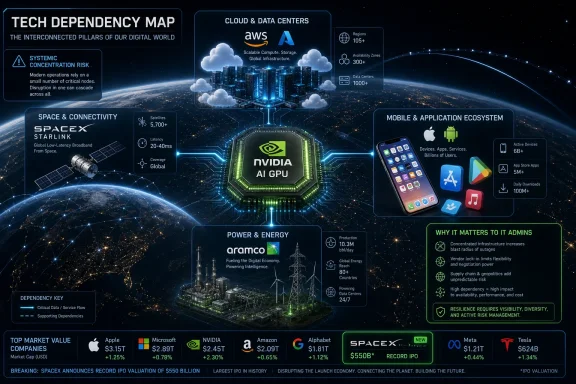
For Windows administrators, the practical takeaway is that enterprise technology risk is becoming more systemic. A procurement decision about AI features may depend on GPU supply. A cloud architecture decision may depend on regional energy capacity. A remote-site connectivity plan may one day include satellite broadband as a normal option rather than an emergency workaround.
The valuation table, in other words, is not just financial trivia. It is a warning about concentration. When a small group of companies controls the critical layers of compute, cloud, chips, operating systems, advertising, connectivity, and energy, outages and policy shifts can ripple faster than procurement teams can react.
That scrutiny may be uncomfortable. SpaceX has benefited from the mystique of being private: selective disclosures, ambitious timelines, and a founder whose public image can move markets. Public shareholders tend to love visionary narratives until margins, dilution, regulatory risk, or missed targets intrude.
There is also the question of governance. Dual-class structures, founder control, national-security entanglements, and the sheer strategic importance of satellite networks will make SpaceX a different kind of public company. It will be analyzed like a tech stock, regulated like a telecom and aerospace contractor, and watched like a geopolitical asset.
If the company performs, its IPO may become the template for the next generation of mega-listings. If it stumbles, it may become a cautionary tale about public markets accepting private-market mythology at trillion-dollar scale. Either way, the debut has already changed the conversation.
 SpaceX Did Not Just Go Public; It Entered the Infrastructure Club
SpaceX’s reported IPO was historic in the narrow Wall Street sense: a $75 billion raise, shares priced at $135, an opening trade around $150, and a first-day close near $160.95. Those numbers would make it the largest IPO ever, far beyond Saudi Aramco’s 2019 offering, and would place SpaceX in the company of the global mega-caps almost immediately.But the more interesting story is not the IPO pop. The more interesting story is that investors are treating SpaceX less like a speculative aerospace company and more like an infrastructure platform. Rockets are the visible product, but the valuation case is really about launch cadence, Starlink broadband, national-security contracts, orbital logistics, and whatever future market emerges when compute, sensors, and communications move further off the planet.
That is why the ranking matters. A company once described in terms of Mars ambitions is now being valued beside Nvidia, Alphabet, Apple, Microsoft, Amazon, TSMC, Broadcom, Saudi Aramco, and Meta. The market is saying that the next layer of strategic technology may not be only in the data center or the phone, but also in orbit.
For WindowsForum readers, this sounds distant until it does not. Enterprise IT already lives in a world where cloud regions, edge devices, satellite failover, sovereign data rules, and AI compute availability shape architecture decisions. SpaceX’s arrival in the top tier puts another private infrastructure layer into the same conversation as Azure, AWS, Google Cloud, and the silicon supply chain.
Nvidia’s Number One Ranking Is the Market’s AI Verdict
Nvidia’s place at the top is the least surprising and most consequential fact in the list. The company’s rise reflects a simple reality: AI is not primarily a chatbot business in capital-market terms. It is a compute business, and Nvidia sells the picks, shovels, roads, and toll booths.The company’s GPUs and AI accelerators have become the default substrate for training and running large models. Hyperscalers, frontier AI labs, research institutions, and enterprises have spent the past several years trying to secure enough capacity to keep up with demand. That demand is why Nvidia’s valuation has pushed into territory that once belonged only to the most dominant platform companies.
This is not merely an investor enthusiasm cycle. The Windows ecosystem is already being reshaped around AI PCs, Copilot integrations, local inference, GPU acceleration, and cloud-backed productivity features. Even when Microsoft is the name on the user-facing tool, Nvidia is often part of the invisible supply chain that makes the feature plausible at scale.
The risk is that the market may be pricing Nvidia not as a cyclical chip company but as a semi-permanent tax on the AI economy. That assumption can be dangerous. Competition from custom accelerators, export controls, energy constraints, and model-efficiency gains could all change the slope of Nvidia’s growth. But for now, the valuation says the bottleneck is compute, and the company closest to that bottleneck gets the crown.
Alphabet and Apple Show the Two Surviving Consumer Empires
Alphabet’s reported second-place position reflects a different kind of power. Google owns search, YouTube, Android, a massive advertising engine, and a cloud business that has become strategically important in the AI race. Its valuation is a bet that generative AI will not destroy the search business faster than Alphabet can rewire it.That is not a trivial bet. The classic Google model depended on users asking questions, scanning links, and clicking ads. AI answer engines compress that journey. Alphabet’s challenge is to preserve the economics of search while pushing Gemini, cloud AI services, and Android into a world where the interface to the internet may become less browser-shaped.
Apple, meanwhile, remains the great hardware-and-services compounder. Its valuation reflects the durability of the iPhone, the App Store, wearables, services revenue, and a user base that continues to spend. Investors may debate whether Apple is leading in AI, but they are not yet abandoning the belief that Apple controls one of the most valuable consumer endpoints in the world.
For Windows users, Apple’s position remains a reminder that Microsoft’s desktop dominance no longer defines personal computing by itself. The center of gravity is split across phones, tablets, PCs, browsers, app stores, cloud accounts, and AI assistants. The operating system still matters, but it is now part of a larger identity-and-services mesh.
Microsoft’s Fourth Place Is Strength, Not Weakness
Microsoft appearing behind Nvidia, Alphabet, and Apple does not mean the company has lost its centrality. It means the market is currently paying a higher premium for AI compute scarcity and consumer-platform scale than for Microsoft’s broad enterprise machine. That enterprise machine, however, remains one of the most formidable in technology.Windows, Microsoft 365, Azure, GitHub, Teams, LinkedIn, Xbox, security products, and Copilot form a portfolio that touches nearly every layer of business computing. Microsoft’s AI strategy is not confined to one product. It is being injected into documents, code editors, operating systems, cloud services, endpoint management, identity, and security workflows.
The company’s OpenAI relationship has been one of the defining alliances of the AI era, even as the exact economics and governance of that relationship remain a subject of close scrutiny. Microsoft does not need to own every model outright if it can become the default enterprise distribution channel for AI. That is the same playbook it has used for decades: own the productivity surface, own the developer surface, own the admin surface.
For IT administrators, Microsoft’s ranking is less important than its direction. Copilot features are arriving across Windows and Microsoft 365 whether organizations are culturally ready or not. The budget conversation is shifting from “Do we need AI?” to “Which licenses, data controls, audit trails, and endpoint policies make AI safe enough to deploy?”
TSMC and Broadcom Reveal the Supply Chain Behind the Spotlight
The presence of TSMC and Broadcom in the top 10 is the antidote to any simplistic story about software eating the world. Software may define the user experience, but advanced semiconductors define the ceiling. Without fabs, packaging, networking chips, accelerators, and custom silicon, the AI boom becomes a PowerPoint deck waiting for hardware.TSMC’s role is especially strategic. It manufactures the most advanced chips for many of the companies above and around it in the ranking. Apple, Nvidia, AMD, and others depend on TSMC’s ability to turn designs into leading-edge silicon at massive scale.
That concentration is both a triumph and a vulnerability. The global economy has discovered that one island’s semiconductor capacity can become a central dependency for cloud computing, smartphones, military systems, and AI infrastructure. For CIOs and policymakers, that makes chip supply chains a board-level issue rather than an engineering footnote.
Broadcom’s rise fits the same pattern. It is not usually the consumer brand in the headline, but it sits inside the networking, custom silicon, enterprise software, and connectivity layers that make modern infrastructure work. In an AI data center, moving data efficiently can matter almost as much as raw compute.
Amazon and Meta Are Still Platform Companies, Even When the Narrative Moves On
Amazon’s fifth-place ranking is easy to misread if one thinks only of retail. The company’s valuation is inseparable from AWS, which remains one of the foundational platforms for cloud computing. Retail provides scale and logistics muscle, but AWS provides the enterprise-margin engine and strategic relevance.In the AI era, AWS faces the same challenge as Microsoft Azure and Google Cloud: customers want access to powerful models, specialized chips, managed data platforms, and predictable costs. The cloud no longer sells only virtual machines and storage. It sells acceleration, governance, observability, and increasingly the promise that a customer can build AI without rebuilding the whole company.
Meta’s tenth-place ranking shows the durability of social platforms even after years of regulatory pressure, metaverse skepticism, and privacy battles. Facebook, Instagram, WhatsApp, and Threads give Meta enormous distribution. Its AI ambitions are also increasingly tied to open-weight models, advertising automation, recommendation systems, and consumer assistants.
The lesson is that the platform giants did not disappear when the AI cycle began. They adapted their stories. Some now talk about GPUs, some about agents, some about creator tools, some about cloud infrastructure, but the underlying contest is still about who controls attention, identity, compute, data, and distribution.
Saudi Aramco’s Place Is the Reality Check Silicon Valley Needs
Saudi Aramco’s presence in the top 10 is a reminder that the physical economy never left. Oil still powers transportation, industry, chemicals, and parts of the global energy system that the digital sector prefers not to discuss. Even the AI boom has an energy shadow.Data centers consume electricity, advanced manufacturing consumes energy, and satellite launches consume fuel. The world’s most valuable technology companies increasingly depend on energy availability, grid expansion, cooling systems, and geopolitical stability. Aramco’s valuation is not a relic; it is a statement about the unfinished transition from hydrocarbons to electrified infrastructure.
This matters because the AI industry often talks as if scaling is mostly a matter of chips and capital expenditure. It is not. Scaling also requires power purchase agreements, transmission lines, water, land, permits, and public tolerance for vast new infrastructure.
SpaceX fits awkwardly but revealingly into this picture. It is a space company, a telecom company, a defense contractor, and now a public-market mega-cap. Like Aramco, it reminds investors that infrastructure is never purely digital, no matter how software-defined the product appears.
The Ranking Is Really a Map of Dependency
The top 10 list is less interesting as a horse race than as a dependency chart. Nvidia depends on TSMC. Microsoft, Alphabet, Amazon, and Meta depend on Nvidia-class accelerators and data-center buildouts. Apple depends on TSMC, global manufacturing, and premium consumer demand. SpaceX depends on launch economics, satellite deployment, spectrum rights, and government contracts.That web of dependency complicates the usual fanboy narrative. No single company “owns the future” in isolation. Each is powerful because it controls a scarce layer, and each is exposed because another company controls a different scarce layer.
For Windows administrators, the practical takeaway is that enterprise technology risk is becoming more systemic. A procurement decision about AI features may depend on GPU supply. A cloud architecture decision may depend on regional energy capacity. A remote-site connectivity plan may one day include satellite broadband as a normal option rather than an emergency workaround.
The valuation table, in other words, is not just financial trivia. It is a warning about concentration. When a small group of companies controls the critical layers of compute, cloud, chips, operating systems, advertising, connectivity, and energy, outages and policy shifts can ripple faster than procurement teams can react.
SpaceX’s Public Market Test Has Only Started
The first day of trading is theater. The real test begins when SpaceX has to report like a public company, guide like a public company, and withstand public-market scrutiny quarter after quarter. Investors will want to understand how launch services, Starlink, defense contracts, capital spending, debt, and future projects fit together in a coherent financial model.That scrutiny may be uncomfortable. SpaceX has benefited from the mystique of being private: selective disclosures, ambitious timelines, and a founder whose public image can move markets. Public shareholders tend to love visionary narratives until margins, dilution, regulatory risk, or missed targets intrude.
There is also the question of governance. Dual-class structures, founder control, national-security entanglements, and the sheer strategic importance of satellite networks will make SpaceX a different kind of public company. It will be analyzed like a tech stock, regulated like a telecom and aerospace contractor, and watched like a geopolitical asset.
If the company performs, its IPO may become the template for the next generation of mega-listings. If it stumbles, it may become a cautionary tale about public markets accepting private-market mythology at trillion-dollar scale. Either way, the debut has already changed the conversation.
The Numbers That Matter After the Rocket Smoke Clears
The cleanest way to read the new top 10 is not to memorize the order, because that will change with every trading session. The better approach is to understand what each valuation is rewarding. The market is paying for control points, not merely revenue lines.- Nvidia’s lead shows that AI compute remains the most prized scarcity in global technology.
- SpaceX’s reported seventh-place ranking shows that orbital infrastructure is now being valued alongside cloud, chips, and consumer platforms.
- Microsoft’s position confirms that enterprise software remains enormously powerful, even when the market’s hottest premium is attached to AI hardware.
- TSMC and Broadcom prove that the companies behind the hardware stack can be as strategically important as the brands users see.
- Saudi Aramco’s continued presence shows that energy remains inseparable from the digital economy’s ambitions.
- The top 10 list should be read as a concentration-risk dashboard for IT leaders, not just as a leaderboard for investors.
References
- Primary source: india.com
Published: 2026-06-15T13:50:08.145721
Elon Musk's SpaceX is world's 7th most valuable company; check out who is at number one in top 10 list
SpaceX secured the record for the largest IPO in history, shattering the previous record of $25.6 billion set by Saudi Aramco in 2019 by a wide margin. www.india.com
- Related coverage: axios.com
How SpaceX's arrival impacts the stock market
Stocks are now starting the week in their trillion-dollar IPO era.www.axios.com
- Related coverage: kiplinger.com
Should You Buy SPCX Stock? | Kiplinger
The massive SpaceX IPO has come and gone, with SPCX stock now trading on the Nasdaq.www.kiplinger.com - Related coverage: moneyweek.com
SpaceX IPO blasts off: shares gain 20% on first day | MoneyWeek
SpaceX set the record for the largest IPO in history on Friday, ending its first day on the public markets with a $2 trillion market cap.moneyweek.com - Related coverage: companiesmarketcap.com
NVIDIA (NVDA) - Market capitalization
As of June 2026 NVIDIA has a market cap of $5.143 Trillion USD. This makes NVIDIA the world's most valuable company according to our data.companiesmarketcap.com
- Related coverage: nasdaq.com
SpaceX (SPCX): Rocket Company Launches Historic IPO | Nasdaq
SpaceX (SPCX) rang the opening bell at the Nasdaq Stock Market on Friday June 12 to celebrate its highly anticipated and largest initial public offering in Wall Street history.www.nasdaq.com
- Related coverage: ir.spacex.com
SpaceX - Space Exploration Technologies Corp. Announces Pricing of Initial Public Offering
STARBASE, Texas, June 11, 2026 – Space Exploration Technologies Corp.(“SpaceX”) today confirmedthe pricing of its initial public offering of 555,555,555shares of its Class A common stock, at a public offering price of $135.00per share. The shares are expected to begin trading on the Nasdaq...ir.spacex.com
- Related coverage: techcrunch.com
SpaceX IPO closes up 19% and delivers the world's first trillionaire | TechCrunch
The company made its heavily anticipated debut on Friday, trading higher than its initial $135 IPO price.techcrunch.com - Related coverage: investing.com
15 Largest Companies By Market Cap (May 2025) - Investing.com
Amazon, Meta and Tesla are all members of the top 15 largest companies in the world (by market cap), but who else made the list this month?www.investing.com - Related coverage: visualcapitalist.com
Ranked: The World’s 50 Most Valuable Companies in 2026
AI has propelled semiconductor companies to the top in 2026. See how Nvidia, TSMC, and other chipmakers rank among the world’s most valuable firms. www.visualcapitalist.com
- Related coverage: basenor.com
SpaceX IPO: $75B Raise at $135/Share Targets June 12
📌 UPDATE — June 11, 2026 SpaceX has officially confirmed its IPO price at $135 per share ahead of tomorrow's Nasdaq debut, with the company's valuation now pegged at a historic $1.77 trillion — making it one of the most valuable public companies at listing. Early employees are reportedly... www.basenor.com
- Related coverage: capital.com
NVIDIA Market Cap (NVDA) – June 2026 Update | Capital.com
Explore NVIDIA Corp market capitalization (NVDA) with real-time data. Track valuation, stock performance, and financial insights.capital.com - Related coverage: content.spacex.com
- Related coverage: tomshardware.com
ASML becomes Europe's most valuable company ever as analysts bet on higher EUV output — its market cap hit $674 billion this week | Tom's Hardware
Passing the $650 billion record Novo Nordisk set in June 2024.www.tomshardware.com - Related coverage: elpais.com
SpaceX se estrena en Bolsa con una subida del 19% y 2,1 billones de valoración
La acción repunta tras marcar su primer cambio en 150 dólares. “SpaceX trata de sacar la ficción de la ciencia ficción y crear un futuro emocionante”, asegura Elon Musk, que se convierte en el primer billonarioelpais.com
- Related coverage: lemonde.fr
'The SpaceX stock market debut reads more like science fiction than a realistic business plan'
COLUMN. Elon Musk is basing the market valuation of his aerospace company, which is set to go public on the Nasdaq on Friday, on the promise of dominating technologies and markets that do not yet exist. In the space sector, however, the line between achievement and disaster is razor-thin...www.lemonde.fr
