

SpaceX’s planned Starmind constellation would place AI-processing satellites in orbit, potentially scaling to 1 million spacecraft—roughly 100 times Starlink’s current fleet—but it is far more likely to become a specialized layer of cloud infrastructure than to make Amazon Web Services, Microsoft Azure, or Google Cloud obsolete. The distinction matters because Starmind attacks the physical constraints beneath AI computing, not the full collection of services enterprises mean when they say “cloud.” Its real target is the terrestrial data center’s growing dependence on scarce electricity, difficult cooling, available land, and slow construction. If SpaceX can turn inexpensive, repeatable launches into inexpensive, repeatable compute deployment, the hyperscalers will face a formidable new supplier, partner, and competitor—but not an overnight replacement.
Elon Musk recently confirmed on X, formerly Twitter, that Space Exploration Technologies’ proposed AI satellite constellation will be called Starmind. According to the July 12, 2026, report from The Motley Fool, the plan calls for up to 1 million satellites capable of running AI workloads in orbit, processing data above Earth and transmitting the results back to users or systems on the ground.
The scale is deliberately difficult to comprehend. The planned Starmind fleet would contain roughly 100 times as many satellites as Starlink currently operates and several times the total number of satellites launched across human history, according to the original report. That does not make 1 million a near-term deployment schedule; it makes the number a statement about what Musk believes the underlying industrial system could eventually become.
The immediate pitch is straightforward. AI data centers require enormous electrical capacity, and increasingly dense processors generate heat that must be removed continuously. On Earth, that means power contracts, substations, transmission infrastructure, cooling equipment, water or closed-loop liquid systems, backup power, land acquisition, permits, and years of construction.
Starmind proposes to move part of that equation to a location where solar energy is abundant and zoning boards do not exist. Musk summarizes the sales pitch with characteristic compression: “It’s always sunny in space.”
That line captures both Starmind’s appeal and its most important oversimplification. Solar power in orbit may reduce dependence on terrestrial grids, but computing hardware still converts electricity into heat. Space does not remove thermodynamics; it replaces familiar cooling systems with a different and, in some respects, harder engineering problem.
Even so, the strategic logic is stronger than the slogan. The AI industry is no longer constrained only by chip availability or model design. It is constrained by the rate at which physical infrastructure can be financed, approved, energized, cooled, connected, and brought online.
SpaceX is effectively arguing that the fastest way around those constraints is not to improve the data center but to change its address.
Spacecraft have historically been expensive, customized assets expected to operate for years with limited opportunities for repair. AI infrastructure moves in the opposite direction. Accelerators age quickly, networking standards change, model architectures evolve, and yesterday’s premium processor can become economically unattractive long before it physically stops functioning.
That mismatch creates one of Starmind’s defining design questions. If SpaceX launches valuable compute hardware that remains functional but becomes commercially outdated, can the company replace it cheaply enough to preserve the economics of the constellation? A terrestrial cloud operator can remove servers, upgrade networking, change storage, alter cooling equipment, and reuse the building; an orbital operator cannot send technicians down the aisle with a cart of replacement components.
Starmind therefore needs more than low launch prices. It needs a production model in which satellites can be launched, operated, retired, and replaced as routinely as hyperscalers rotate through server generations. The constellation would function less like one enormous data center and more like an ever-changing fleet of disposable or semi-disposable compute nodes.
That may explain why SpaceX, rather than an established cloud provider, is positioned to make the most aggressive version of the proposal. The essential capabilities are not limited to cloud software or chip procurement. They include spacecraft production, launch scheduling, orbital operations, communications, collision avoidance, fleet management, ground stations, and the ability to absorb failures without treating every failed satellite as a bespoke crisis.
Starlink has already given SpaceX experience operating a large distributed network in low Earth orbit. Starmind would attempt to turn that operating model inward: instead of using satellites primarily to move customers’ internet traffic, the satellites themselves would perform the computation.
The jump remains vast. A communications satellite relays data, while an AI compute satellite must supply sustained power to dense processors, move data between nodes, manage memory and storage, reject heat, tolerate radiation, maintain accurate timing, and provide predictable service despite continuous orbital movement.
The proposed satellite count is therefore not merely evidence of ambition. It is an admission that orbital AI may depend on overwhelming scale, redundancy, and replacement capacity to compensate for an environment in which individual nodes are less accessible and potentially less durable than servers on Earth.
Terrestrial data centers use conduction, convection, evaporation, refrigeration, and liquid circulation to move heat from chips to somewhere else. In space, a satellite ultimately has to reject heat through radiation. That can work, but it generally requires significant radiator area, careful orientation, thermal control, and hardware capable of surviving repeated temperature cycles.
The U.S. Government Accountability Office, in its assessment of space-based data centers, identifies power, cooling, communication, radiation, collision risks, and interference with astronomy among the major issues. IEEE Spectrum’s technical coverage has likewise emphasized that removing heat from high-density computing equipment may be one of the most difficult parts of the orbital-data-center proposition.
The difference between producing electricity and using electricity continuously is crucial. Large solar arrays can generate power, but the processors consuming that power produce corresponding heat. Batteries or another storage mechanism may also be needed when a spacecraft’s orbit places it outside direct sunlight, adding weight, complexity, degradation, and another thermal-management problem.
Solar panels and radiators compete for mass, surface area, orientation, and structural support. Communications equipment, shielding, propulsion, batteries, processors, and inter-satellite links all draw from the same limited spacecraft budget. A system optimized solely for collecting sunlight will not automatically be optimized for shedding processor heat or maintaining low-latency communications.
Radiation adds a second layer of difficulty. Terrestrial AI accelerators are designed for performance, power efficiency, and deployment in controlled facilities—not for long-term exposure to the orbital environment. Radiation can corrupt computations, damage components, reduce hardware life, and force operators to choose among shielding, redundancy, error correction, specialized components, and more frequent replacements.
None of these problems makes Starmind physically impossible. They do mean that the phrase “less cooling will be needed” is an incomplete description of the trade. Starmind may need less water and less conventional mechanical cooling, but it will need an extensive thermal system engineered around radiative heat rejection.
The orbital environment exchanges one expensive infrastructure stack for another. The question is not whether space provides free electricity and cooling; it is whether solar collection, thermal radiation, launch, replacement, and communications together can become cheaper or more scalable than grids, cooling plants, buildings, and terrestrial networking.
Some workloads are naturally suited to orbital processing. Satellites already collect imagery, weather observations, communications signals, and other sensor data in space. Processing that information near its source could reduce how much raw data must be transmitted to Earth, allowing the system to return classifications, alerts, compressed results, or other smaller outputs.
That is the strongest early case for Starmind: compute where the data already exists. If a satellite captures a large volume of information but only a small fraction is valuable, running inference in orbit may be more efficient than transmitting everything to a terrestrial facility before deciding what matters.
The economics become less obvious when the original data is on Earth. Training a large model can require enormous datasets distributed across storage systems and repeatedly exchanged among tightly connected accelerators. Uploading that data to orbit, synchronizing computation across moving satellites, and returning checkpoints or results could erase part of the energy advantage.
Latency is not the only concern. Modern AI clusters rely on extremely high-bandwidth, predictable connections among accelerators. A distributed orbital constellation would need powerful inter-satellite links, resilient routing, precise orchestration, and software capable of handling nodes that move relative to users and may not always have the same power or thermal capacity.
That does not mean Starmind must reproduce a terrestrial supercomputer in the sky. A more plausible architecture would divide workloads according to their tolerance for latency, interruption, and data movement. Orbital nodes could perform inference, preprocessing, simulation, batch processing, or jobs associated with space-generated information, while tightly coupled model training and sensitive enterprise workloads remain closer to terrestrial storage and users.
In that scenario, Starmind is not a replacement for AWS, Azure, or Google Cloud. It is a new compute tier—one that could sit beside central cloud regions, edge facilities, on-premises systems, consumer devices, and existing satellites.
The commercial winner may be the company that makes those tiers feel like one system. Customers do not want to manually calculate satellite visibility, route jobs between spacecraft, or decide when thermal limits require a workload to migrate. They want an API, a service-level agreement, an identity policy, a bill, and a support number.
That is precisely where the established hyperscalers are strongest.
Customers buy more than processor time from a hyperscaler. They buy databases, object storage, identity systems, encryption, monitoring, logging, deployment platforms, private networking, analytics, backup, disaster recovery, security tooling, developer services, billing controls, marketplace integrations, and contractual commitments.
They also buy geographic and legal placement. Governments, healthcare organizations, financial institutions, and multinational businesses routinely care where data is stored, where it is processed, which employees can access it, and which jurisdiction applies. Orbit does not automatically provide a sovereignty exemption.
AWS, Microsoft, and Google are already responding to AI’s infrastructure pressure through more efficient facilities, custom silicon, high-density networking, and advanced cooling. AWS describes flexible systems combining air and liquid cooling for increasingly powerful AI hardware. Microsoft has promoted closed-loop, direct-to-chip cooling and data-center designs intended to reduce or eliminate operational water consumption for cooling. Google has developed rack-level liquid-cooling systems that can be installed in existing air-cooled facilities.
Those efforts undermine the simplest version of the Starmind pitch. The competitive baseline is not today’s least efficient data center frozen in time. It is a rapidly evolving terrestrial industry spending heavily to reduce energy, water, deployment time, and cooling overhead while preserving accessibility and maintainability.
The table reveals why “obsolete” is the wrong competitive frame. Starmind’s proposition begins at the physical infrastructure layer, while the hyperscalers compete across the complete service stack. SpaceX could conceivably offer cheaper computation for specific jobs without replacing the platforms customers use to manage those jobs.
The three cloud providers could also become Starmind’s largest customers. AWS could expose orbital compute through its existing consoles and APIs. Azure could treat Starmind as another specialized capacity pool in a hybrid architecture. Google Cloud could schedule suitable workloads across terrestrial and orbital resources while keeping storage, identity, and application services on the ground.
In that outcome, SpaceX supplies a new kind of data-center capacity while the hyperscalers preserve the customer relationship. It would resemble the way cloud providers combine their own silicon, third-party processors, carrier networks, leased facilities, and partner services behind a unified consumption model.
Starmind would still be disruptive. But it might disrupt the construction and energy economics of data centers more directly than it disrupts the cloud platforms built above them.
Leo is not described in the supplied material as an orbital AI data-center system. It should not be treated as one. But it gives Amazon direct organizational experience with satellite manufacturing, launch procurement, ground infrastructure, network operations, and the regulatory environment surrounding a large constellation.
That experience could become strategically valuable if orbital compute moves from concept to viable product. Amazon could develop its own computing satellites, partner with another operator, use Leo as a communications layer, or integrate third-party orbital resources into AWS.
The important advantage is not simply ownership of satellites. Amazon could connect any future orbital capacity to an enormous installed base of AWS customers. It could make space-based processing appear as another instance type, accelerator option, edge location, or managed service rather than asking enterprises to adopt an entirely separate operational environment.
Blue Origin provides another possible piece of the puzzle by giving the broader Bezos ecosystem a connection to launch capabilities. That does not guarantee a coordinated Amazon orbital-compute strategy, and the companies should not be treated as interchangeable. It does mean that Amazon is less likely than a conventional software company to view launch capacity as an alien dependency.
Microsoft and Google would not need to build rockets to compete. Cloud providers routinely abstract infrastructure they do not manufacture, and either company could purchase orbital capacity from SpaceX or another operator. The critical asset would be the software and commercial layer that decides which jobs should run in space and makes that decision invisible to customers.
This is why Starmind may create an unusual balance of dependence. SpaceX could need hyperscalers to supply customers, developer ecosystems, and enterprise-grade service management. The hyperscalers could need SpaceX to supply launch economics and orbital operations they cannot quickly reproduce.
The rivalry could therefore look less like one side destroying the other and more like a negotiation over who owns the profitable layer. SpaceX will want Starmind to become a platform, not merely wholesale capacity. AWS, Azure, and Google Cloud will want orbital compute to become a replaceable infrastructure component behind their platforms.
For Starmind, reusability is not simply a way to lower the initial construction bill. It is the foundation of the proposed hardware-refresh model. AI satellites may need to be launched in large batches, replaced after failures, rotated as processors become obsolete, and replenished as radiation and orbital conditions degrade components.
If Starship cannot deliver the required combination of price, payload capacity, frequency, and reliability, Starmind becomes much harder to justify. The constellation could still serve niche workloads, but its ability to compete with terrestrial data centers at hyperscale would weaken.
Launch price alone is not enough. A rocket with a low theoretical cost per unit of payload does not help if launches are too infrequent, integration is slow, insurance is costly, or failures interrupt deployment. A million-satellite architecture depends on an industrial cadence, not a handful of spectacular missions.
The comparison with terrestrial cloud expansion is revealing. Data centers are difficult to build, but their construction uses large, mature supply chains. Servers can be delivered by truck, repaired by technicians, connected to existing fiber, and replaced without crossing the atmosphere.
Starmind must compensate for all of those terrestrial advantages with cheaper energy, faster scaling, or access to workloads that are uniquely valuable in orbit. The more expensive the satellite and launch system becomes, the narrower that useful workload set will be.
Conversely, if SpaceX can launch large quantities of standardized compute satellites at high frequency, the economics of orbit could change rapidly. The company would possess something the hyperscalers cannot purchase from an ordinary construction contractor: the ability to add computing capacity without waiting for a local grid, water system, land-use approval, or building project.
That would make Starship the equivalent of Starmind’s construction industry, freight network, and maintenance pipeline combined. The rocket is not a supporting detail in the proposal. It is the entire economic hinge.
But “no permitting or zoning obstacles” should not be mistaken for “no regulation.” Launches, radio-frequency use, satellite operations, orbital positions, reentry, debris mitigation, and interference all exist inside regulatory frameworks. A constellation measured in hundreds of thousands of spacecraft would invite scrutiny far beyond that applied to an individual data center.
The GAO has warned that more orbital data-center satellites could increase collision risks and interfere with astronomical research. Those concerns become especially significant when the proposed constellation is several times larger than the total number of satellites previously launched in human history.
SpaceX would need to demonstrate that Starmind satellites can maneuver reliably, communicate their positions, avoid other spacecraft, and leave orbit safely at the end of their useful lives. The company would also need systems capable of managing failures at a scale where even a tiny percentage can translate into a large absolute number of uncontrolled or degraded satellites.
The computing hardware itself introduces policy questions. If Starmind processes commercial, government, or personal information, regulators and customers will ask which country’s rules apply, how data is encrypted, how it is deleted, whether it crosses borders while being transmitted, and how investigators or auditors verify compliance.
Cloud providers have spent years building region-specific services and contractual structures around those questions. An orbital platform cannot dismiss them by pointing upward. It must translate terrestrial legal obligations into a system whose components continually move around the planet.
Security will also be inseparable from fleet management. A compromised server in a terrestrial facility can be isolated and physically accessed. A compromised compute satellite may remain overhead, connected to other nodes and impossible to repair directly.
Starmind’s enormous scale could provide redundancy, but it could also expand the attack surface. Secure boot, hardware roots of trust, encrypted inter-satellite links, software updates, key management, workload isolation, and graceful decommissioning would all have to operate remotely and repeatedly.
The absence of local zoning may make orbital deployment politically attractive. It does not make it institutionally simple.
The inline company badge displayed SPCX with a 4.51% change, while the expanded market panel explicitly showed a negative 4.51% daily move. That presentation discrepancy is worth recognizing because it illustrates how quickly the market narrative can overwhelm the underlying detail.
Starmind lends itself to spectacular valuation arguments. SpaceX would no longer be viewed only as a launch provider and satellite broadband operator; it could be valued as an AI infrastructure company with access to solar energy, proprietary transportation, and a potentially unprecedented deployment footprint.
Yet the difference between an addressable market and a functioning service is especially large here. Before Starmind can threaten hyperscaler revenue, SpaceX has to prove sustained AI computation in orbit, useful workload performance, manageable thermal behavior, reliable communications, acceptable hardware life, safe fleet operations, and competitive total costs.
The proposal also inherits the uncertainty attached to Musk’s most aggressive forecasts. The source material notes that he has made grand predictions that did not come true. Starmind should therefore be evaluated through demonstrated milestones rather than the maximum proposed satellite count.
Investors should watch for evidence of an architecture, not just evidence of ambition. The meaningful questions concern what processors the satellites can operate, how much sustained compute they provide, how they reject heat, how data reaches them, how workloads move between nodes, how often the hardware must be replaced, and what customers will pay.
A small orbital-compute service could be commercially important without approaching 1 million satellites. It could process data for Earth-observation operators, governments, communications networks, research organizations, or AI systems that benefit from global coverage.
That would not justify every claim attached to Starmind, but it would establish a market from which the company could expand. The first proof point is not cloud extinction. It is a customer choosing orbital compute because it performs a specific job better or more cheaply than a terrestrial alternative.
The practical model is likely to be hybrid. Data could be generated in space, filtered by Starmind, enriched in a cloud region, stored under a customer’s jurisdictional requirements, and delivered through an application running at the edge. Alternatively, a terrestrial cloud service might send delay-tolerant jobs to orbital capacity during periods when the energy economics are favorable.
That possibility affects how organizations should design applications now. Workloads built around portable containers, well-defined data interfaces, resumable jobs, strong encryption, and location-independent orchestration will be easier to move between infrastructure layers than tightly coupled applications dependent on one provider’s proprietary hardware assumptions.
The most useful preparation is to remove unnecessary assumptions about where computation must occur. That work provides benefits even if Starmind never reaches commercial scale because it also improves portability across cloud regions, edge devices, on-premises systems, and competing accelerators.
A hyperscaler does not need to lose all of its customers for Starmind to change its strategy. The credible possibility of orbital compute could influence how AWS, Microsoft, and Google negotiate energy contracts, design accelerators, invest in cooling, structure satellite partnerships, and decide whether to build or purchase future capacity.
Starmind could also put pressure on cloud margins. If SpaceX eventually offers inexpensive batch inference or orbital-data processing, hyperscalers may have to resell that capacity, match its price for comparable workloads, or differentiate through software and managed services.
The result could resemble the broader history of cloud infrastructure. Commodity hardware did not eliminate enterprise computing; it shifted value toward orchestration, software, reliability, and scale. Orbital compute could similarly commoditize part of the physical AI layer while increasing the value of the platforms that decide where and how workloads run.
SpaceX may attempt to own both layers. Starlink already places the company between users and terrestrial networks, and Starmind could place it between AI applications and physical compute. Combining connectivity, launch, satellite production, and processing would give SpaceX a vertically integrated position unlike that of a conventional data-center operator.
But vertical integration produces its own burdens. SpaceX would have to support developers, negotiate enterprise contracts, provide transparent billing, resolve outages, meet performance guarantees, and build trust with customers that may be uncomfortable placing sensitive computation aboard inaccessible moving hardware.
The hyperscalers have spent years making complicated infrastructure appear ordinary. Starmind’s long-term success will depend on whether SpaceX can do the same for orbit.
If it can, customers may eventually submit a job without knowing or caring whether it ran in Virginia, on their premises, at a network edge, or hundreds of kilometers above Earth. That invisibility—not the sight of a million satellites—is what mature orbital cloud computing would look like.
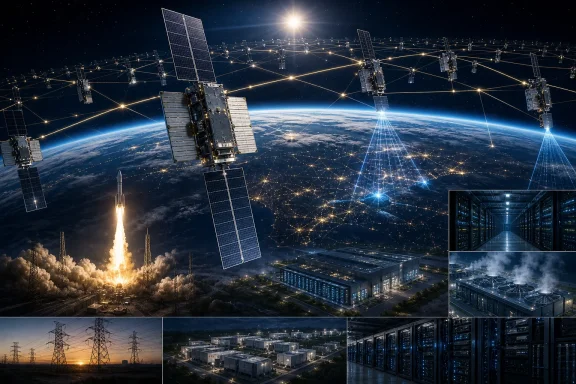 Starmind Is an Attack on the Data Center’s Weakest Point
Elon Musk recently confirmed on X, formerly Twitter, that Space Exploration Technologies’ proposed AI satellite constellation will be called Starmind. According to the July 12, 2026, report from The Motley Fool, the plan calls for up to 1 million satellites capable of running AI workloads in orbit, processing data above Earth and transmitting the results back to users or systems on the ground.The scale is deliberately difficult to comprehend. The planned Starmind fleet would contain roughly 100 times as many satellites as Starlink currently operates and several times the total number of satellites launched across human history, according to the original report. That does not make 1 million a near-term deployment schedule; it makes the number a statement about what Musk believes the underlying industrial system could eventually become.
The immediate pitch is straightforward. AI data centers require enormous electrical capacity, and increasingly dense processors generate heat that must be removed continuously. On Earth, that means power contracts, substations, transmission infrastructure, cooling equipment, water or closed-loop liquid systems, backup power, land acquisition, permits, and years of construction.
Starmind proposes to move part of that equation to a location where solar energy is abundant and zoning boards do not exist. Musk summarizes the sales pitch with characteristic compression: “It’s always sunny in space.”
That line captures both Starmind’s appeal and its most important oversimplification. Solar power in orbit may reduce dependence on terrestrial grids, but computing hardware still converts electricity into heat. Space does not remove thermodynamics; it replaces familiar cooling systems with a different and, in some respects, harder engineering problem.
Even so, the strategic logic is stronger than the slogan. The AI industry is no longer constrained only by chip availability or model design. It is constrained by the rate at which physical infrastructure can be financed, approved, energized, cooled, connected, and brought online.
SpaceX is effectively arguing that the fastest way around those constraints is not to improve the data center but to change its address.
One Million Satellites Is a Manufacturing Thesis, Not a Deployment Schedule
It would be a mistake to read the proposed 1 million satellites as if SpaceX had announced a conventional product rollout with a fixed completion date. No such timetable appears in the supplied reporting. The number is better understood as a declaration that Starmind would have to be manufactured and operated as a mass-produced computing system rather than as a traditional satellite program.Spacecraft have historically been expensive, customized assets expected to operate for years with limited opportunities for repair. AI infrastructure moves in the opposite direction. Accelerators age quickly, networking standards change, model architectures evolve, and yesterday’s premium processor can become economically unattractive long before it physically stops functioning.
That mismatch creates one of Starmind’s defining design questions. If SpaceX launches valuable compute hardware that remains functional but becomes commercially outdated, can the company replace it cheaply enough to preserve the economics of the constellation? A terrestrial cloud operator can remove servers, upgrade networking, change storage, alter cooling equipment, and reuse the building; an orbital operator cannot send technicians down the aisle with a cart of replacement components.
Starmind therefore needs more than low launch prices. It needs a production model in which satellites can be launched, operated, retired, and replaced as routinely as hyperscalers rotate through server generations. The constellation would function less like one enormous data center and more like an ever-changing fleet of disposable or semi-disposable compute nodes.
That may explain why SpaceX, rather than an established cloud provider, is positioned to make the most aggressive version of the proposal. The essential capabilities are not limited to cloud software or chip procurement. They include spacecraft production, launch scheduling, orbital operations, communications, collision avoidance, fleet management, ground stations, and the ability to absorb failures without treating every failed satellite as a bespoke crisis.
Starlink has already given SpaceX experience operating a large distributed network in low Earth orbit. Starmind would attempt to turn that operating model inward: instead of using satellites primarily to move customers’ internet traffic, the satellites themselves would perform the computation.
The jump remains vast. A communications satellite relays data, while an AI compute satellite must supply sustained power to dense processors, move data between nodes, manage memory and storage, reject heat, tolerate radiation, maintain accurate timing, and provide predictable service despite continuous orbital movement.
The proposed satellite count is therefore not merely evidence of ambition. It is an admission that orbital AI may depend on overwhelming scale, redundancy, and replacement capacity to compensate for an environment in which individual nodes are less accessible and potentially less durable than servers on Earth.
Space Is Not a Free Cooling Loop
The most seductive argument for orbital computing is also the one that requires the most careful qualification. Space is cold in the colloquial sense, but it is a vacuum, and a vacuum prevents heat from being carried away by air or liquid flowing into the surrounding environment.Terrestrial data centers use conduction, convection, evaporation, refrigeration, and liquid circulation to move heat from chips to somewhere else. In space, a satellite ultimately has to reject heat through radiation. That can work, but it generally requires significant radiator area, careful orientation, thermal control, and hardware capable of surviving repeated temperature cycles.
The U.S. Government Accountability Office, in its assessment of space-based data centers, identifies power, cooling, communication, radiation, collision risks, and interference with astronomy among the major issues. IEEE Spectrum’s technical coverage has likewise emphasized that removing heat from high-density computing equipment may be one of the most difficult parts of the orbital-data-center proposition.
The difference between producing electricity and using electricity continuously is crucial. Large solar arrays can generate power, but the processors consuming that power produce corresponding heat. Batteries or another storage mechanism may also be needed when a spacecraft’s orbit places it outside direct sunlight, adding weight, complexity, degradation, and another thermal-management problem.
Solar panels and radiators compete for mass, surface area, orientation, and structural support. Communications equipment, shielding, propulsion, batteries, processors, and inter-satellite links all draw from the same limited spacecraft budget. A system optimized solely for collecting sunlight will not automatically be optimized for shedding processor heat or maintaining low-latency communications.
Radiation adds a second layer of difficulty. Terrestrial AI accelerators are designed for performance, power efficiency, and deployment in controlled facilities—not for long-term exposure to the orbital environment. Radiation can corrupt computations, damage components, reduce hardware life, and force operators to choose among shielding, redundancy, error correction, specialized components, and more frequent replacements.
None of these problems makes Starmind physically impossible. They do mean that the phrase “less cooling will be needed” is an incomplete description of the trade. Starmind may need less water and less conventional mechanical cooling, but it will need an extensive thermal system engineered around radiative heat rejection.
The orbital environment exchanges one expensive infrastructure stack for another. The question is not whether space provides free electricity and cooling; it is whether solar collection, thermal radiation, launch, replacement, and communications together can become cheaper or more scalable than grids, cooling plants, buildings, and terrestrial networking.
The Network Decides Which AI Workloads Can Leave Earth
Even if SpaceX solves power and heat, Starmind does not become a useful cloud merely by placing processors in orbit. AI workloads depend on moving data, and the cost of moving that data can be just as important as the cost of the computation itself.Some workloads are naturally suited to orbital processing. Satellites already collect imagery, weather observations, communications signals, and other sensor data in space. Processing that information near its source could reduce how much raw data must be transmitted to Earth, allowing the system to return classifications, alerts, compressed results, or other smaller outputs.
That is the strongest early case for Starmind: compute where the data already exists. If a satellite captures a large volume of information but only a small fraction is valuable, running inference in orbit may be more efficient than transmitting everything to a terrestrial facility before deciding what matters.
The economics become less obvious when the original data is on Earth. Training a large model can require enormous datasets distributed across storage systems and repeatedly exchanged among tightly connected accelerators. Uploading that data to orbit, synchronizing computation across moving satellites, and returning checkpoints or results could erase part of the energy advantage.
Latency is not the only concern. Modern AI clusters rely on extremely high-bandwidth, predictable connections among accelerators. A distributed orbital constellation would need powerful inter-satellite links, resilient routing, precise orchestration, and software capable of handling nodes that move relative to users and may not always have the same power or thermal capacity.
That does not mean Starmind must reproduce a terrestrial supercomputer in the sky. A more plausible architecture would divide workloads according to their tolerance for latency, interruption, and data movement. Orbital nodes could perform inference, preprocessing, simulation, batch processing, or jobs associated with space-generated information, while tightly coupled model training and sensitive enterprise workloads remain closer to terrestrial storage and users.
In that scenario, Starmind is not a replacement for AWS, Azure, or Google Cloud. It is a new compute tier—one that could sit beside central cloud regions, edge facilities, on-premises systems, consumer devices, and existing satellites.
The commercial winner may be the company that makes those tiers feel like one system. Customers do not want to manually calculate satellite visibility, route jobs between spacecraft, or decide when thermal limits require a workload to migrate. They want an API, a service-level agreement, an identity policy, a bill, and a support number.
That is precisely where the established hyperscalers are strongest.
Hyperscalers Sell an Operating Model, Not a Warehouse of Servers
The Motley Fool frames the investor question in appropriately dramatic terms: Could Starmind make AWS, Azure, and Google Cloud obsolete? The short answer is no—not unless SpaceX reproduces decades of cloud services, enterprise relationships, developer tooling, compliance programs, and operational discipline in addition to building the orbital hardware.Customers buy more than processor time from a hyperscaler. They buy databases, object storage, identity systems, encryption, monitoring, logging, deployment platforms, private networking, analytics, backup, disaster recovery, security tooling, developer services, billing controls, marketplace integrations, and contractual commitments.
They also buy geographic and legal placement. Governments, healthcare organizations, financial institutions, and multinational businesses routinely care where data is stored, where it is processed, which employees can access it, and which jurisdiction applies. Orbit does not automatically provide a sovereignty exemption.
AWS, Microsoft, and Google are already responding to AI’s infrastructure pressure through more efficient facilities, custom silicon, high-density networking, and advanced cooling. AWS describes flexible systems combining air and liquid cooling for increasingly powerful AI hardware. Microsoft has promoted closed-loop, direct-to-chip cooling and data-center designs intended to reduce or eliminate operational water consumption for cooling. Google has developed rack-level liquid-cooling systems that can be installed in existing air-cooled facilities.
Those efforts undermine the simplest version of the Starmind pitch. The competitive baseline is not today’s least efficient data center frozen in time. It is a rapidly evolving terrestrial industry spending heavily to reduce energy, water, deployment time, and cooling overhead while preserving accessibility and maintainability.
| Infrastructure | Primary model | Power and cooling approach | Strongest initial fit | Central constraint |
|---|---|---|---|---|
| Starmind | Up to 1 million AI-processing satellites | Solar power with radiative heat rejection | Orbital data processing and selected AI workloads | Launch, thermal management, radiation, networking, and replacement |
| Amazon Web Services | Terrestrial and customer-site cloud infrastructure | Grid-connected facilities with air and liquid cooling | Broad enterprise cloud, AI training, inference, storage, and managed services | Power availability and data-center construction |
| Microsoft Azure | Terrestrial hyperscale cloud | High-density liquid cooling and closed-loop designs | Enterprise, government, hybrid cloud, and large AI systems | Power, facility capacity, and regional expansion |
| Google Cloud | Terrestrial hyperscale cloud | Advanced facility and rack-level liquid cooling | AI infrastructure, data platforms, and tightly connected computing | Power, cooling retrofits, and deployment capacity |
The three cloud providers could also become Starmind’s largest customers. AWS could expose orbital compute through its existing consoles and APIs. Azure could treat Starmind as another specialized capacity pool in a hybrid architecture. Google Cloud could schedule suitable workloads across terrestrial and orbital resources while keeping storage, identity, and application services on the ground.
In that outcome, SpaceX supplies a new kind of data-center capacity while the hyperscalers preserve the customer relationship. It would resemble the way cloud providers combine their own silicon, third-party processors, carrier networks, leased facilities, and partner services behind a unified consumption model.
Starmind would still be disruptive. But it might disrupt the construction and energy economics of data centers more directly than it disrupts the cloud platforms built above them.
Amazon Has the Most Obvious Orbital Countermove
Among the three hyperscalers, Amazon has the clearest existing path toward an orbital response. Its Leo satellite business is designed around broadband connectivity, and Amazon’s founder, Jeff Bezos, is also associated with launch company Blue Origin.Leo is not described in the supplied material as an orbital AI data-center system. It should not be treated as one. But it gives Amazon direct organizational experience with satellite manufacturing, launch procurement, ground infrastructure, network operations, and the regulatory environment surrounding a large constellation.
That experience could become strategically valuable if orbital compute moves from concept to viable product. Amazon could develop its own computing satellites, partner with another operator, use Leo as a communications layer, or integrate third-party orbital resources into AWS.
The important advantage is not simply ownership of satellites. Amazon could connect any future orbital capacity to an enormous installed base of AWS customers. It could make space-based processing appear as another instance type, accelerator option, edge location, or managed service rather than asking enterprises to adopt an entirely separate operational environment.
Blue Origin provides another possible piece of the puzzle by giving the broader Bezos ecosystem a connection to launch capabilities. That does not guarantee a coordinated Amazon orbital-compute strategy, and the companies should not be treated as interchangeable. It does mean that Amazon is less likely than a conventional software company to view launch capacity as an alien dependency.
Microsoft and Google would not need to build rockets to compete. Cloud providers routinely abstract infrastructure they do not manufacture, and either company could purchase orbital capacity from SpaceX or another operator. The critical asset would be the software and commercial layer that decides which jobs should run in space and makes that decision invisible to customers.
This is why Starmind may create an unusual balance of dependence. SpaceX could need hyperscalers to supply customers, developer ecosystems, and enterprise-grade service management. The hyperscalers could need SpaceX to supply launch economics and orbital operations they cannot quickly reproduce.
The rivalry could therefore look less like one side destroying the other and more like a negotiation over who owns the profitable layer. SpaceX will want Starmind to become a platform, not merely wholesale capacity. AWS, Azure, and Google Cloud will want orbital compute to become a replaceable infrastructure component behind their platforms.
Starship Is the Economic Hinge
The source material identifies launch cost as Starmind’s principal drawback and Starship as the mechanism intended to reduce it. SpaceX describes Starship and its Super Heavy booster as a fully reusable transportation system for carrying crew and cargo to Earth orbit and beyond.For Starmind, reusability is not simply a way to lower the initial construction bill. It is the foundation of the proposed hardware-refresh model. AI satellites may need to be launched in large batches, replaced after failures, rotated as processors become obsolete, and replenished as radiation and orbital conditions degrade components.
If Starship cannot deliver the required combination of price, payload capacity, frequency, and reliability, Starmind becomes much harder to justify. The constellation could still serve niche workloads, but its ability to compete with terrestrial data centers at hyperscale would weaken.
Launch price alone is not enough. A rocket with a low theoretical cost per unit of payload does not help if launches are too infrequent, integration is slow, insurance is costly, or failures interrupt deployment. A million-satellite architecture depends on an industrial cadence, not a handful of spectacular missions.
The comparison with terrestrial cloud expansion is revealing. Data centers are difficult to build, but their construction uses large, mature supply chains. Servers can be delivered by truck, repaired by technicians, connected to existing fiber, and replaced without crossing the atmosphere.
Starmind must compensate for all of those terrestrial advantages with cheaper energy, faster scaling, or access to workloads that are uniquely valuable in orbit. The more expensive the satellite and launch system becomes, the narrower that useful workload set will be.
Conversely, if SpaceX can launch large quantities of standardized compute satellites at high frequency, the economics of orbit could change rapidly. The company would possess something the hyperscalers cannot purchase from an ordinary construction contractor: the ability to add computing capacity without waiting for a local grid, water system, land-use approval, or building project.
That would make Starship the equivalent of Starmind’s construction industry, freight network, and maintenance pipeline combined. The rocket is not a supporting detail in the proposal. It is the entire economic hinge.
Regulation Does Not Vanish at the Edge of the Atmosphere
The absence of zoning hearings is one of Starmind’s advertised attractions. Space-based infrastructure does avoid some of the local disputes that surround large data-center developments, including land use, noise, water consumption, transmission lines, and competition for electricity.But “no permitting or zoning obstacles” should not be mistaken for “no regulation.” Launches, radio-frequency use, satellite operations, orbital positions, reentry, debris mitigation, and interference all exist inside regulatory frameworks. A constellation measured in hundreds of thousands of spacecraft would invite scrutiny far beyond that applied to an individual data center.
The GAO has warned that more orbital data-center satellites could increase collision risks and interfere with astronomical research. Those concerns become especially significant when the proposed constellation is several times larger than the total number of satellites previously launched in human history.
SpaceX would need to demonstrate that Starmind satellites can maneuver reliably, communicate their positions, avoid other spacecraft, and leave orbit safely at the end of their useful lives. The company would also need systems capable of managing failures at a scale where even a tiny percentage can translate into a large absolute number of uncontrolled or degraded satellites.
The computing hardware itself introduces policy questions. If Starmind processes commercial, government, or personal information, regulators and customers will ask which country’s rules apply, how data is encrypted, how it is deleted, whether it crosses borders while being transmitted, and how investigators or auditors verify compliance.
Cloud providers have spent years building region-specific services and contractual structures around those questions. An orbital platform cannot dismiss them by pointing upward. It must translate terrestrial legal obligations into a system whose components continually move around the planet.
Security will also be inseparable from fleet management. A compromised server in a terrestrial facility can be isolated and physically accessed. A compromised compute satellite may remain overhead, connected to other nodes and impossible to repair directly.
Starmind’s enormous scale could provide redundancy, but it could also expand the attack surface. Secure boot, hardware roots of trust, encrypted inter-satellite links, software updates, key management, workload isolation, and graceful decommissioning would all have to operate remotely and repeatedly.
The absence of local zoning may make orbital deployment politically attractive. It does not make it institutionally simple.
The Investor Story Is Running Ahead of the Architecture
The Motley Fool’s article is framed for investors, and its market-data panel displayed Space Exploration Technologies at $145.29, down $6.87 or 4.51%, with a displayed market capitalization of $1.9 trillion. The panel listed a day’s range of $145.25 to $150.45, a 52-week range of $145.07 to $225.64, volume of 1.5 million, and average volume of 154 million.The inline company badge displayed SPCX with a 4.51% change, while the expanded market panel explicitly showed a negative 4.51% daily move. That presentation discrepancy is worth recognizing because it illustrates how quickly the market narrative can overwhelm the underlying detail.
Starmind lends itself to spectacular valuation arguments. SpaceX would no longer be viewed only as a launch provider and satellite broadband operator; it could be valued as an AI infrastructure company with access to solar energy, proprietary transportation, and a potentially unprecedented deployment footprint.
Yet the difference between an addressable market and a functioning service is especially large here. Before Starmind can threaten hyperscaler revenue, SpaceX has to prove sustained AI computation in orbit, useful workload performance, manageable thermal behavior, reliable communications, acceptable hardware life, safe fleet operations, and competitive total costs.
The proposal also inherits the uncertainty attached to Musk’s most aggressive forecasts. The source material notes that he has made grand predictions that did not come true. Starmind should therefore be evaluated through demonstrated milestones rather than the maximum proposed satellite count.
Investors should watch for evidence of an architecture, not just evidence of ambition. The meaningful questions concern what processors the satellites can operate, how much sustained compute they provide, how they reject heat, how data reaches them, how workloads move between nodes, how often the hardware must be replaced, and what customers will pay.
A small orbital-compute service could be commercially important without approaching 1 million satellites. It could process data for Earth-observation operators, governments, communications networks, research organizations, or AI systems that benefit from global coverage.
That would not justify every claim attached to Starmind, but it would establish a market from which the company could expand. The first proof point is not cloud extinction. It is a customer choosing orbital compute because it performs a specific job better or more cheaply than a terrestrial alternative.
CIOs Should Plan for an Orbital Tier, Not a Cloud Funeral
Enterprise IT departments do not need to redesign their architectures around Starmind today. They should, however, begin treating the location of AI computation as a variable rather than assuming that every meaningful workload will run in a conventional terrestrial region.The practical model is likely to be hybrid. Data could be generated in space, filtered by Starmind, enriched in a cloud region, stored under a customer’s jurisdictional requirements, and delivered through an application running at the edge. Alternatively, a terrestrial cloud service might send delay-tolerant jobs to orbital capacity during periods when the energy economics are favorable.
That possibility affects how organizations should design applications now. Workloads built around portable containers, well-defined data interfaces, resumable jobs, strong encryption, and location-independent orchestration will be easier to move between infrastructure layers than tightly coupled applications dependent on one provider’s proprietary hardware assumptions.
Action checklist for admins
- Classify AI workloads by latency sensitivity, data volume, sovereignty requirements, interruption tolerance, and the amount of communication required between processors.
- Separate large source datasets from smaller inference inputs and outputs so orbital processing can be evaluated without moving unnecessary data.
- Require prospective orbital-compute providers to document encryption, identity, isolation, software-update, hardware-retirement, and incident-response controls.
- Model the complete cost of moving data to and from orbit rather than comparing only processor or electricity prices.
- Preserve workload portability through containers, open interfaces, infrastructure-as-code, and exportable model formats where practical.
- Add orbital processing to future vendor-risk exercises, but do not treat an announced constellation size as available production capacity.
The most useful preparation is to remove unnecessary assumptions about where computation must occur. That work provides benefits even if Starmind never reaches commercial scale because it also improves portability across cloud regions, edge devices, on-premises systems, and competing accelerators.
Starmind Could Change the Cloud Without Replacing It
The strongest argument for Starmind is not that space will become universally cheaper than Earth. It is that the AI industry is encountering enough physical constraints that a radically different source of capacity may become valuable even if it is suitable for only part of the workload mix.A hyperscaler does not need to lose all of its customers for Starmind to change its strategy. The credible possibility of orbital compute could influence how AWS, Microsoft, and Google negotiate energy contracts, design accelerators, invest in cooling, structure satellite partnerships, and decide whether to build or purchase future capacity.
Starmind could also put pressure on cloud margins. If SpaceX eventually offers inexpensive batch inference or orbital-data processing, hyperscalers may have to resell that capacity, match its price for comparable workloads, or differentiate through software and managed services.
The result could resemble the broader history of cloud infrastructure. Commodity hardware did not eliminate enterprise computing; it shifted value toward orchestration, software, reliability, and scale. Orbital compute could similarly commoditize part of the physical AI layer while increasing the value of the platforms that decide where and how workloads run.
SpaceX may attempt to own both layers. Starlink already places the company between users and terrestrial networks, and Starmind could place it between AI applications and physical compute. Combining connectivity, launch, satellite production, and processing would give SpaceX a vertically integrated position unlike that of a conventional data-center operator.
But vertical integration produces its own burdens. SpaceX would have to support developers, negotiate enterprise contracts, provide transparent billing, resolve outages, meet performance guarantees, and build trust with customers that may be uncomfortable placing sensitive computation aboard inaccessible moving hardware.
The hyperscalers have spent years making complicated infrastructure appear ordinary. Starmind’s long-term success will depend on whether SpaceX can do the same for orbit.
If it can, customers may eventually submit a job without knowing or caring whether it ran in Virginia, on their premises, at a network edge, or hundreds of kilometers above Earth. That invisibility—not the sight of a million satellites—is what mature orbital cloud computing would look like.
The Signals That Matter More Than the Million-Satellite Headline
Starmind deserves attention because it joins reusable launch systems, mass-produced satellites, and AI’s infrastructure crisis in one strategy. The proposal should be judged through concrete technical and commercial evidence, not solely through its maximum scale or its potential contribution to SpaceX’s valuation.- Starmind is planned as an AI-processing constellation of up to 1 million satellites, roughly 100 times Starlink’s current satellite count.
- Its core proposition is to use solar power and orbital deployment to bypass terrestrial electricity, cooling, land, and construction constraints.
- Radiative cooling, radiation exposure, networking, hardware replacement, orbital safety, and regulation remain fundamental obstacles.
- AWS, Azure, and Google Cloud are unlikely to become obsolete because their value extends far beyond physical computing capacity.
- Amazon’s Leo satellite business and Jeff Bezos’ connection to Blue Origin give Amazon the most visible foundation for an orbital response.
- Starship’s launch cost, cadence, payload capacity, and reusability will determine whether Starmind can become infrastructure rather than spectacle.
References
- Primary source: The Motley Fool
Published: 2026-07-12T09:10:09.168438
Loading…
www.fool.com - Related coverage: leo.amazon.com
Loading…
leo.amazon.com - Related coverage: space.com
Loading…
www.space.com - Related coverage: aboutamazon.com
Loading…
www.aboutamazon.com - Related coverage: press.aboutamazon.com
Loading…
press.aboutamazon.com - Related coverage: cincodias.elpais.com
Amazon Leo arranca 2026 por todo lo alto: lanza 32 satélites en el cohete Ariane 64 | Lifestyle | SmartLife | Cinco Días
Este es un claro ejemplo de que SpaceX ya no está sola y que tiene rivales de una entidad que se debe tener en cuenta.cincodias.elpais.com
- Related coverage: aws.amazon.com
Loading…
aws.amazon.com - Official source: azure.microsoft.com
Loading…
azure.microsoft.com - Official source: cloud.google.com
Loading…
cloud.google.com - Related coverage: spacex.com
Loading…
www.spacex.com - Official source: microsoft.com
Sustainable by design: Next-generation datacenters consume zero water for cooling | The Microsoft Cloud Blog
Learn more about our Datacenter Community Pledge, detailing our commitment to the local economies and communities in which we operate our datacenters.www.microsoft.com - Official source: blogs.microsoft.com
Inside Microsoft’s two-decade push to cut water intensity while scaling for growth - The Official Microsoft Blog
Microsoft on advancing water stewardship in datacenters, while scaling AI and progressing toward a 2030 water positive goal.blogs.microsoft.com - Official source: datacenters.microsoft.com
Loading…
datacenters.microsoft.com - Related coverage: content.spacex.com
