

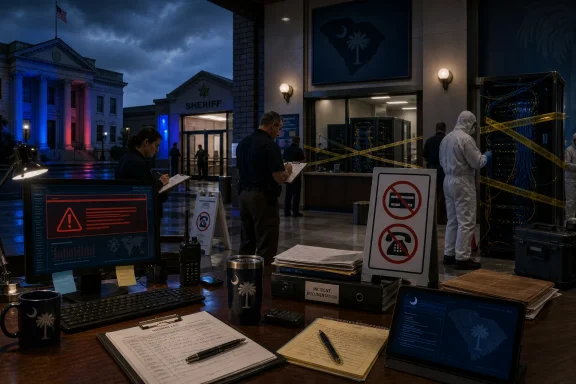
Spartanburg County, South Carolina, began isolating parts of its computer infrastructure on Wednesday, June 10, 2026, after officials identified “questionable activity,” leaving many county services disrupted for nearly two weeks while SLED’s cybersecurity team investigates. The county says offices remain open, but the phrase “normal operations” is doing heroic work. When deputies are handwriting reports, deed searches are stalled, card payments fail, and court staff turn to personal devices, the outage has already moved beyond IT inconvenience. It has become a test of whether local government can still function when the network becomes the crime scene.
The most important detail in Spartanburg County’s statement is not the careful language around “questionable activity.” It is the county’s admission that many services were made unavailable because officials chose to isolate and protect networks while consultants verified security.
That is often the right move during a suspected cyber incident. Containment can stop lateral movement, preserve evidence, and prevent one compromised system from becoming an organization-wide disaster. But containment also exposes a harsh truth: if the digital network is the only practical way to conduct public business, then the security response becomes indistinguishable from a service shutdown.
County offices remaining open is therefore only half the story. Doors can be unlocked while the government behind them is partially frozen. A clerk can accept a request she cannot process, a sheriff’s office can keep taking reports while investigators lose routine lookup capability, and a real estate transaction can technically proceed while the documents that make it possible are out of reach.
That gap between open buildings and usable services is where public trust erodes. Residents do not experience “network isolation protocols.” They experience delayed deeds, cash-only counters, missing phone access, and employees improvising with pens, paper, and personal assets.
That caution is normal in the early phase of an investigation. Officials do not want to overstate what they know, tip off attackers, or create legal exposure by speculating before forensics are complete. SLED’s South Carolina Critical Infrastructure Cybersecurity team entering the picture, however, signals that the incident is being treated as more than a routine help-desk outage.
For the public, the problem is that careful language rarely answers the practical question: Is my government still capable of delivering the service I need today? Cybersecurity investigations move on forensic timelines. Marriage licenses, deeds, court filings, police reports, and payments move on civic timelines.
The county’s statement says systems are being restored as confirmations are completed. That is a sensible security posture, but it also means restoration is gated by confidence, not merely by whether a server can be powered back on. In a well-run incident response, coming back online too quickly can be worse than staying offline, because a premature recovery may reintroduce compromised credentials, persistence mechanisms, or unverified machines.
Still, the public has a right to expect more than a binary message of patience. The county does not need to disclose sensitive technical details to publish meaningful service status, realistic workarounds, and plain-language expectations. Silence becomes its own operational failure.
There is a temptation to romanticize this as resilience. The government did not stop; people adapted. In reality, those adaptations are evidence that the formal continuity plan either was not sufficient, was not accessible, or was not designed around the services residents actually use.
A clipboard is useful during a short outage. It is not a substitute for tested offline workflows, hardened backups, alternate communications, preauthorized manual procedures, and a clear chain of command for degraded operations. The longer an outage lasts, the more “temporary workaround” becomes an unmanaged parallel system.
That parallel system creates risks of its own. Handwritten reports must later be transcribed, increasing error rates. Requests held for later processing can be lost, duplicated, or handled out of order. Personal devices used for public business may create records-retention, privacy, authentication, and evidence-handling problems that outlast the cyber incident itself.
The line from Clerk of Court Amy Cox about personal assets cuts directly to the governance issue. Many public agencies rightly forbid employees from mixing personal and official systems because it creates security and compliance risk. If an outage forces staff into exactly that behavior, the organization has effectively outsourced continuity to employee improvisation.
Past incidents do not prove that the current outage is ransomware. They do, however, change the standard by which the county should be judged. After one serious cyber incident, leaders can plausibly argue they were surprised by a threat landscape that evolved faster than local budgets. After repeated disruptions, the question becomes whether lessons were converted into architecture, funding, drills, and accountability.
That is why the demand for compartmentalization matters. In cybersecurity jargon, the concept is segmentation: networks, identities, systems, and privileges are divided so that a compromise in one area does not automatically collapse the entire organization. In plain government terms, the deed office, sheriff’s office, court systems, tax systems, and public website should not all become hostage to the same failure mode.
Segmentation is not glamorous. It does not photograph well at ribbon cuttings. But it is precisely the kind of unglamorous infrastructure that determines whether a county suffers a painful disruption or a civic paralysis event.
The county’s statement says isolation was used to protect other networks. That suggests some defensive segmentation or containment capability existed. But the service impact described by employees and residents raises a harder question: was the segmentation designed around technical boundaries, or around the public’s need to keep essential services moving?
That mismatch is exactly what attackers exploit. Local governments hold valuable data, run essential services, depend on legacy systems, and often lack the staffing depth of private-sector enterprises. They also cannot simply shut the doors and tell customers to come back next quarter.
The ransomware economy has professionalized around that imbalance. Attackers do not need to defeat a Fortune 100 security team to cause real harm. They can target a county where a small IT staff is responsible for identity systems, endpoints, servers, public portals, backups, phones, and vendor integrations spread across multiple elected offices and departments.
The civic blast radius is larger than the technical blast radius. A network outage can delay property closings, court activity, investigations, permits, public records, and routine payments. That means cyber resilience is no longer just an IT budget line. It is part of public safety, economic development, records integrity, and access to justice.
This is where counties often get trapped. Residents rarely reward preventive spending because the best outcome is nothing happening. But when the incident arrives, the absence of investment becomes visible all at once: missing workarounds, brittle dependencies, unclear communications, and employees absorbing institutional failure at the counter.
The more durable question is whether Spartanburg County built an environment that could absorb hostile activity without forcing broad service disruption. Modern security assumes compromise. The measure of maturity is not whether suspicious activity ever appears, but whether the organization can detect it early, contain it narrowly, recover cleanly, and keep critical services available.
That requires more than endpoint software and outside consultants. It requires asset inventories that are current, identity controls that are enforced, multifactor authentication that is universal where it matters, backups that are offline and tested, and recovery procedures that are rehearsed under realistic conditions. It also requires leadership willing to decide which services must remain available even when the main network is not.
The public-facing version of that work is service continuity. Can the sheriff’s office write reports offline and sync them securely later? Can the clerk’s office access a clean, read-only backup of essential indexes? Can residents pay fees through an alternate channel that does not compromise auditability? Can phones be rerouted? Can departments communicate without resorting to personal accounts?
If the answer is no, then the county’s risk is not just cyber risk. It is operational fragility wearing a cyber label.
For residents, the difference is obvious. A counter that cannot accept card payments is not operating normally. A department that cannot provide licensing or deed documents is not operating normally. A court office relying on personal assets to fill professional requests is not operating normally, even if staff are doing everything they can.
This distinction is not semantic. Public agencies often measure continuity by whether departments are open, whether phones are answered, and whether life-safety systems remain intact. Residents measure it by whether the thing they came to do can actually be done.
Both perspectives matter, but only one captures lived reality. A resident trying to close on a home, file a record, resolve a court matter, or obtain a document does not care that a server is being “confirmed” unless someone can explain what alternative exists and when service will return.
The county’s alert banner and departmental disruption list are useful steps. They should be treated as the minimum viable communication layer, not the whole public-information strategy. In a prolonged outage, updates should become more granular, more frequent, and more explicit about what is restored, what remains unavailable, and what residents should not waste a trip attempting.
Personal devices may lack county-managed encryption, logging, retention policies, endpoint monitoring, and secure deletion practices. Personal email or storage can blur the boundary between public records and private accounts. If sensitive documents move through unmanaged devices, the county may later face hard questions about chain of custody, privacy, discovery, and compliance.
This is not a criticism of employees caught in a bad situation. It is a criticism of institutions that leave employees choosing between serving the public and following policy. A serious continuity plan should give staff approved tools for degraded operations before a crisis forces improvisation.
That might mean preconfigured clean laptops stored offline, secure mobile hotspots, alternate identity workflows, emergency printing procedures, read-only data extracts, or vendor-hosted continuity portals. The details vary by department. The principle does not: the workaround must be as governed as the system it replaces.
If county leaders take only one lesson from this outage, it should be that unofficial workarounds are not free. They borrow time during the crisis and repay it later in audit findings, data cleanup, legal ambiguity, and public doubt.
Law enforcement work depends on timely access to records, communications, case-management tools, and external information. When investigators cannot look up information outside their own system, operational tempo changes. Leads may take longer to verify, reports may take longer to circulate, and coordination becomes more manual.
Not every delay is catastrophic. But cyber incidents in public agencies rarely fail in cinematic ways. They fail through friction: an officer waits for a record, a clerk cannot retrieve a file, a prosecutor lacks timely paperwork, a resident makes a second trip, a manual entry is mistyped.
Those small frictions accumulate. They are the real-world cost of brittle systems, and they are why public-sector cyber resilience must be judged by service outcomes rather than by whether 911 stayed online. Emergency communications are crucial, but they are not the only public-safety function county networks support.
The same logic applies to courts and property records. These are not optional conveniences. They are the administrative machinery that lets people buy homes, resolve disputes, enforce rights, and interact with the state in orderly ways.
But consultants cannot own the county’s long-term accountability. They can tell leaders what happened, what to contain, what to rebuild, and what controls are missing. They cannot decide whether the county funds architecture changes, hires enough staff, modernizes legacy systems, or conducts public after-action reporting.
This is a recurring weakness in local government cyber incidents. The outside experts arrive during the emergency, the worst systems are restored, a carefully worded statement is issued, and then the organization drifts back toward normal until the next disruption. The consultant invoice becomes the visible cost of the breach, while the deeper repair remains politically inconvenient.
A credible response should include an after-action process that distinguishes between sensitive technical details and public governance lessons. Residents do not need exploit chains or firewall rules. They do need to know whether backups worked, whether continuity plans were followed, what services failed hardest, and what measurable changes will be made before the next incident.
Transparency after recovery is not a favor to the public. It is part of recovery.
Microsoft’s modern security story is built around identity, conditional access, endpoint detection, Defender tooling, Intune management, and cloud-based recovery options. Those tools can help, but only when deployed coherently. A license is not a control, and a dashboard is not a recovery plan.
The hard part is not buying the newest product. It is enforcing least privilege when departments complain, segmenting networks when old applications assume flat access, requiring multifactor authentication when elected offices want exceptions, and testing backups when everyone is busy. Cyber resilience is mostly a campaign against organizational entropy.
The same is true for hybrid environments. Counties often run a mix of on-premises Active Directory, cloud services, vendor portals, file shares, records systems, and specialized applications with uneven support lifecycles. Attackers thrive in the seams between them.
That is why “questionable activity” can lead to a broad outage. Once trust in identity, endpoints, or network integrity is uncertain, administrators have to assume that ordinary connectivity may be dangerous. The cure is not merely faster restoration; it is building an environment where trust can be re-established by segment, service, and identity boundary rather than by shutting down the civic nervous system.
Those are not merely complaints. They are the right questions for elected officials, county administrators, auditors, and IT leadership. Backups are not just files copied somewhere else; they are a promise that the organization can restore useful service within a tolerable time. Compartmentalization is not just network design; it is a governance decision about how much failure the public must absorb.
Core services must be defined before the incident. Which services must be restored in hours, which in days, and which can wait? Which records need offline read-only access? Which departments require alternate payment methods? Which functions have legal deadlines that cannot simply be paused by a network outage?
If leaders cannot answer those questions in public terms, then the technology plan is not aligned with the mission. The county may have cybersecurity tools, but it does not yet have cybersecurity governance that residents can see.
This is where public frustration becomes constructive. The goal should not be to demand impossible immunity from attack. The goal should be to demand demonstrable resilience when attacks or suspicious activity occur.
 The Network Outage Is Now the Government Story
The most important detail in Spartanburg County’s statement is not the careful language around “questionable activity.” It is the county’s admission that many services were made unavailable because officials chose to isolate and protect networks while consultants verified security.That is often the right move during a suspected cyber incident. Containment can stop lateral movement, preserve evidence, and prevent one compromised system from becoming an organization-wide disaster. But containment also exposes a harsh truth: if the digital network is the only practical way to conduct public business, then the security response becomes indistinguishable from a service shutdown.
County offices remaining open is therefore only half the story. Doors can be unlocked while the government behind them is partially frozen. A clerk can accept a request she cannot process, a sheriff’s office can keep taking reports while investigators lose routine lookup capability, and a real estate transaction can technically proceed while the documents that make it possible are out of reach.
That gap between open buildings and usable services is where public trust erodes. Residents do not experience “network isolation protocols.” They experience delayed deeds, cash-only counters, missing phone access, and employees improvising with pens, paper, and personal assets.
“Questionable Activity” Is a Careful Phrase With Big Implications
Spartanburg County has not publicly confirmed a ransomware attack in this latest incident, and that distinction matters. “Questionable activity” could cover a range of events, from suspicious authentication attempts to malware, unauthorized access, data staging, or behavior that triggered defensive shutdowns before damage could be assessed.That caution is normal in the early phase of an investigation. Officials do not want to overstate what they know, tip off attackers, or create legal exposure by speculating before forensics are complete. SLED’s South Carolina Critical Infrastructure Cybersecurity team entering the picture, however, signals that the incident is being treated as more than a routine help-desk outage.
For the public, the problem is that careful language rarely answers the practical question: Is my government still capable of delivering the service I need today? Cybersecurity investigations move on forensic timelines. Marriage licenses, deeds, court filings, police reports, and payments move on civic timelines.
The county’s statement says systems are being restored as confirmations are completed. That is a sensible security posture, but it also means restoration is gated by confidence, not merely by whether a server can be powered back on. In a well-run incident response, coming back online too quickly can be worse than staying offline, because a premature recovery may reintroduce compromised credentials, persistence mechanisms, or unverified machines.
Still, the public has a right to expect more than a binary message of patience. The county does not need to disclose sensitive technical details to publish meaningful service status, realistic workarounds, and plain-language expectations. Silence becomes its own operational failure.
Paper Forms Are Not a Continuity Plan
The most vivid reports from the outage are not technical. They are physical: warning signs on doors and windows, handwritten sheriff’s reports, employees unable to retrieve documents, and county workers accepting requests they cannot immediately fulfill.There is a temptation to romanticize this as resilience. The government did not stop; people adapted. In reality, those adaptations are evidence that the formal continuity plan either was not sufficient, was not accessible, or was not designed around the services residents actually use.
A clipboard is useful during a short outage. It is not a substitute for tested offline workflows, hardened backups, alternate communications, preauthorized manual procedures, and a clear chain of command for degraded operations. The longer an outage lasts, the more “temporary workaround” becomes an unmanaged parallel system.
That parallel system creates risks of its own. Handwritten reports must later be transcribed, increasing error rates. Requests held for later processing can be lost, duplicated, or handled out of order. Personal devices used for public business may create records-retention, privacy, authentication, and evidence-handling problems that outlast the cyber incident itself.
The line from Clerk of Court Amy Cox about personal assets cuts directly to the governance issue. Many public agencies rightly forbid employees from mixing personal and official systems because it creates security and compliance risk. If an outage forces staff into exactly that behavior, the organization has effectively outsourced continuity to employee improvisation.
The County’s History Makes This Harder to Treat as Bad Luck
Spartanburg County’s current disruption lands in a context that officials cannot easily wave away. The county was hit by a ransomware attack in April 2023, and it disclosed another data breach in 2025. WYFF’s reporting also notes public frustration from employees and residents who see this not as a freak occurrence, but as the latest chapter in a pattern.Past incidents do not prove that the current outage is ransomware. They do, however, change the standard by which the county should be judged. After one serious cyber incident, leaders can plausibly argue they were surprised by a threat landscape that evolved faster than local budgets. After repeated disruptions, the question becomes whether lessons were converted into architecture, funding, drills, and accountability.
That is why the demand for compartmentalization matters. In cybersecurity jargon, the concept is segmentation: networks, identities, systems, and privileges are divided so that a compromise in one area does not automatically collapse the entire organization. In plain government terms, the deed office, sheriff’s office, court systems, tax systems, and public website should not all become hostage to the same failure mode.
Segmentation is not glamorous. It does not photograph well at ribbon cuttings. But it is precisely the kind of unglamorous infrastructure that determines whether a county suffers a painful disruption or a civic paralysis event.
The county’s statement says isolation was used to protect other networks. That suggests some defensive segmentation or containment capability existed. But the service impact described by employees and residents raises a harder question: was the segmentation designed around technical boundaries, or around the public’s need to keep essential services moving?
Local Government Has Become a Soft Target With Hard Consequences
The Spartanburg outage fits a larger pattern that every sysadmin already knows but many elected officials still treat as background noise. Counties, cities, school districts, libraries, courts, and utilities now run on complex digital stacks, but many of them are funded and staffed as if IT were still an internal convenience.That mismatch is exactly what attackers exploit. Local governments hold valuable data, run essential services, depend on legacy systems, and often lack the staffing depth of private-sector enterprises. They also cannot simply shut the doors and tell customers to come back next quarter.
The ransomware economy has professionalized around that imbalance. Attackers do not need to defeat a Fortune 100 security team to cause real harm. They can target a county where a small IT staff is responsible for identity systems, endpoints, servers, public portals, backups, phones, and vendor integrations spread across multiple elected offices and departments.
The civic blast radius is larger than the technical blast radius. A network outage can delay property closings, court activity, investigations, permits, public records, and routine payments. That means cyber resilience is no longer just an IT budget line. It is part of public safety, economic development, records integrity, and access to justice.
This is where counties often get trapped. Residents rarely reward preventive spending because the best outcome is nothing happening. But when the incident arrives, the absence of investment becomes visible all at once: missing workarounds, brittle dependencies, unclear communications, and employees absorbing institutional failure at the counter.
The Real Test Is Not Whether the County Was Attacked
Public attention naturally gravitates toward the attacker. Was it ransomware? Was data stolen? Was a known gang involved? Did someone click a phishing email? Those are important questions, but they are not the only ones that matter.The more durable question is whether Spartanburg County built an environment that could absorb hostile activity without forcing broad service disruption. Modern security assumes compromise. The measure of maturity is not whether suspicious activity ever appears, but whether the organization can detect it early, contain it narrowly, recover cleanly, and keep critical services available.
That requires more than endpoint software and outside consultants. It requires asset inventories that are current, identity controls that are enforced, multifactor authentication that is universal where it matters, backups that are offline and tested, and recovery procedures that are rehearsed under realistic conditions. It also requires leadership willing to decide which services must remain available even when the main network is not.
The public-facing version of that work is service continuity. Can the sheriff’s office write reports offline and sync them securely later? Can the clerk’s office access a clean, read-only backup of essential indexes? Can residents pay fees through an alternate channel that does not compromise auditability? Can phones be rerouted? Can departments communicate without resorting to personal accounts?
If the answer is no, then the county’s risk is not just cyber risk. It is operational fragility wearing a cyber label.
“Normal Hours” Is Not the Same as Normal Service
Spartanburg County’s offices remained open during the disruption, and that matters. Governments have an obligation to preserve presence, answer questions, and maintain as much service as possible during emergencies. But “open for normal hours” can also become a shield that obscures degraded capability.For residents, the difference is obvious. A counter that cannot accept card payments is not operating normally. A department that cannot provide licensing or deed documents is not operating normally. A court office relying on personal assets to fill professional requests is not operating normally, even if staff are doing everything they can.
This distinction is not semantic. Public agencies often measure continuity by whether departments are open, whether phones are answered, and whether life-safety systems remain intact. Residents measure it by whether the thing they came to do can actually be done.
Both perspectives matter, but only one captures lived reality. A resident trying to close on a home, file a record, resolve a court matter, or obtain a document does not care that a server is being “confirmed” unless someone can explain what alternative exists and when service will return.
The county’s alert banner and departmental disruption list are useful steps. They should be treated as the minimum viable communication layer, not the whole public-information strategy. In a prolonged outage, updates should become more granular, more frequent, and more explicit about what is restored, what remains unavailable, and what residents should not waste a trip attempting.
The Personal Device Problem Should Alarm Every Records Officer
The report that some staff used personal assets to fulfill professional requests deserves more attention than it may receive. In an outage, it is easy to praise initiative. In government, initiative that bypasses controls can create new liabilities.Personal devices may lack county-managed encryption, logging, retention policies, endpoint monitoring, and secure deletion practices. Personal email or storage can blur the boundary between public records and private accounts. If sensitive documents move through unmanaged devices, the county may later face hard questions about chain of custody, privacy, discovery, and compliance.
This is not a criticism of employees caught in a bad situation. It is a criticism of institutions that leave employees choosing between serving the public and following policy. A serious continuity plan should give staff approved tools for degraded operations before a crisis forces improvisation.
That might mean preconfigured clean laptops stored offline, secure mobile hotspots, alternate identity workflows, emergency printing procedures, read-only data extracts, or vendor-hosted continuity portals. The details vary by department. The principle does not: the workaround must be as governed as the system it replaces.
If county leaders take only one lesson from this outage, it should be that unofficial workarounds are not free. They borrow time during the crisis and repay it later in audit findings, data cleanup, legal ambiguity, and public doubt.
The Sheriff’s Office Shows Why Cybersecurity Is Public Safety
The sheriff’s office reportedly relied on handwritten reports to keep investigations moving, with delays but not a complete stop. That is better than paralysis, but it should still unsettle anyone who treats cybersecurity as a back-office matter.Law enforcement work depends on timely access to records, communications, case-management tools, and external information. When investigators cannot look up information outside their own system, operational tempo changes. Leads may take longer to verify, reports may take longer to circulate, and coordination becomes more manual.
Not every delay is catastrophic. But cyber incidents in public agencies rarely fail in cinematic ways. They fail through friction: an officer waits for a record, a clerk cannot retrieve a file, a prosecutor lacks timely paperwork, a resident makes a second trip, a manual entry is mistyped.
Those small frictions accumulate. They are the real-world cost of brittle systems, and they are why public-sector cyber resilience must be judged by service outcomes rather than by whether 911 stayed online. Emergency communications are crucial, but they are not the only public-safety function county networks support.
The same logic applies to courts and property records. These are not optional conveniences. They are the administrative machinery that lets people buy homes, resolve disputes, enforce rights, and interact with the state in orderly ways.
Vendor Consultants Cannot Substitute for Public Accountability
Spartanburg County says consultants are helping confirm and enhance security measures. That is normal and often necessary. Incident response firms bring forensic expertise, surge capacity, and specialized tooling that most counties cannot maintain in-house.But consultants cannot own the county’s long-term accountability. They can tell leaders what happened, what to contain, what to rebuild, and what controls are missing. They cannot decide whether the county funds architecture changes, hires enough staff, modernizes legacy systems, or conducts public after-action reporting.
This is a recurring weakness in local government cyber incidents. The outside experts arrive during the emergency, the worst systems are restored, a carefully worded statement is issued, and then the organization drifts back toward normal until the next disruption. The consultant invoice becomes the visible cost of the breach, while the deeper repair remains politically inconvenient.
A credible response should include an after-action process that distinguishes between sensitive technical details and public governance lessons. Residents do not need exploit chains or firewall rules. They do need to know whether backups worked, whether continuity plans were followed, what services failed hardest, and what measurable changes will be made before the next incident.
Transparency after recovery is not a favor to the public. It is part of recovery.
The Windows Angle Is Identity, Endpoints, and Boring Discipline
For WindowsForum readers, the Spartanburg incident will sound familiar not because we know the county’s exact stack, but because the failure modes are common across Windows-heavy organizations. Identity sprawl, shared administrative privileges, legacy line-of-business apps, underpatched servers, exposed remote access, and inconsistent endpoint management remain the everyday terrain of public-sector IT.Microsoft’s modern security story is built around identity, conditional access, endpoint detection, Defender tooling, Intune management, and cloud-based recovery options. Those tools can help, but only when deployed coherently. A license is not a control, and a dashboard is not a recovery plan.
The hard part is not buying the newest product. It is enforcing least privilege when departments complain, segmenting networks when old applications assume flat access, requiring multifactor authentication when elected offices want exceptions, and testing backups when everyone is busy. Cyber resilience is mostly a campaign against organizational entropy.
The same is true for hybrid environments. Counties often run a mix of on-premises Active Directory, cloud services, vendor portals, file shares, records systems, and specialized applications with uneven support lifecycles. Attackers thrive in the seams between them.
That is why “questionable activity” can lead to a broad outage. Once trust in identity, endpoints, or network integrity is uncertain, administrators have to assume that ordinary connectivity may be dangerous. The cure is not merely faster restoration; it is building an environment where trust can be re-established by segment, service, and identity boundary rather than by shutting down the civic nervous system.
Residents Are Asking the Right Governance Question
The quotes from residents and staff cut through the fog. Do we not have backup data somewhere? How do we keep one problem from shutting everything down? What does it mean to provide core government services?Those are not merely complaints. They are the right questions for elected officials, county administrators, auditors, and IT leadership. Backups are not just files copied somewhere else; they are a promise that the organization can restore useful service within a tolerable time. Compartmentalization is not just network design; it is a governance decision about how much failure the public must absorb.
Core services must be defined before the incident. Which services must be restored in hours, which in days, and which can wait? Which records need offline read-only access? Which departments require alternate payment methods? Which functions have legal deadlines that cannot simply be paused by a network outage?
If leaders cannot answer those questions in public terms, then the technology plan is not aligned with the mission. The county may have cybersecurity tools, but it does not yet have cybersecurity governance that residents can see.
This is where public frustration becomes constructive. The goal should not be to demand impossible immunity from attack. The goal should be to demand demonstrable resilience when attacks or suspicious activity occur.
The Spartanburg Lesson Is Written in Deeds, Reports, and Cash-Only Counters
The immediate facts are still developing, and it would be irresponsible to label the June 2026 incident as ransomware without official confirmation. But enough is already visible to draw practical conclusions about the county’s operational posture.- Spartanburg County began isolating networks on June 10, 2026, after identifying questionable activity on its computer infrastructure.
- SLED’s South Carolina Critical Infrastructure Cybersecurity team is investigating, which places the outage squarely in the cyber-response category even without a confirmed ransomware label.
- County offices remaining open has not prevented meaningful service degradation, including problems with internet-dependent records, payments, phone access, and law enforcement reporting workflows.
- The county’s previous ransomware and breach history raises the bar for public explanation, because repeated incidents demand evidence of architectural and governance change.
- Personal-device workarounds may keep service moving in the moment, but they also introduce records, privacy, and compliance risks that a mature continuity plan should avoid.
- The most important recovery metric is not when every system comes back online, but whether the county can prove that essential services will be less fragile next time.
References
- Primary source: WYFF News 4
Published: Mon, 22 Jun 2026 22:28:00 GMT
- Related coverage: hendryadrian.com
Spartanburg County Cyber Outage Sparks SLED Response
Spartanburg County in South Carolina has been dealing with a multi-day network and internet outage since June 10, 2026, with the South Carolina Law Enforcement Division assisting the county amid a suspected cyber incident. Several public services and internal communications, including at the...www.hendryadrian.com - Related coverage: fitsnews.com
Spartanburg County Employees Warn Of Escalating Cyberattacks - FITSNews
Back-to-back incidents disrupt county systems amid ongoing phishing attempts.www.fitsnews.com - Related coverage: scpress.org
- Related coverage: callmepower.com
Spartanburg, SC power outage: live map & who to call (2026)
Live Spartanburg (South Carolina) power outage map. Report a blackout in seconds and call Duke Energy Carolinas at 1-800-769-3766. callmepower.com
- Related coverage: dbdigest.com
Spartanburg County: US County Government Suffers Ransomware Attack Resulting In IT Systems And Telephone Systems Disruption
Daily Digest of Global Data Breaches and Cyber Security News and Advicewww.dbdigest.com
- Related coverage: comparitech.com
Ransomware gang says it hacked Spartanburg County, SC - Comparitech
Ransomware gang Qilin took credit for breaching the local government of Spartanburg County, South Carolina that disrupted city services.www.comparitech.com - Related coverage: usoutage.com
Spartanburg Power Outages - Live Outage Map & Current Status
Check power outage data in Spartanburg County, North Carolina. Live updates and providers information.usoutage.com
