

Spartanburg County, South Carolina, said on June 29 that core network services had been restored after a weeks-long outage that disrupted internet-dependent county systems, phone access, payments, records requests, court work, and sheriff’s office workflows while state cybersecurity investigators reviewed questionable activity. The public line is reassuring: no evidence, at this stage, that data was accessed, exfiltrated, or compromised. The operational story is less comforting. A county government that has already been through ransomware and breach disclosures has again learned that modern public administration is only as resilient as the networks underneath it.
The phrase “network outage” makes the Spartanburg incident sound smaller than it was. For a household, an outage means streaming stops and cloud files become awkward. For a county, it means the machinery of government starts falling back through decades of technology at once.
County offices reportedly remained open, but openness is not the same as normal service. Systems dependent on internet access were impaired across government offices, including computer services and phone access. Certain offices in the County Administration building could not accept card payments or provide licensing and deed documents. Sheriff’s office personnel leaned on handwritten reports to keep investigations moving, while court and records operations had to improvise around unavailable tools.
That is the first lesson from Spartanburg: the boundary between “IT problem” and “public services problem” has basically disappeared. If the network is down, payments slow. If identity systems are offline, records become harder to retrieve. If phones and case-management tools are disrupted, residents experience government not as a building with counters and staff, but as a workflow that has jammed.
County officials have framed the restoration as controlled and safety-first, saying portions of the network were secured and isolated after activity warranted review. That language matters. It suggests the outage was not treated as a routine carrier failure or single failed switch. It was handled as an event where reconnecting too quickly could have been riskier than staying partially offline.
But the phrase “at this time” is doing real work. Incident response is a process, not a press release. Logs have to be collected, endpoints examined, authentication activity reviewed, backups validated, and external indicators checked against what investigators can see inside the environment. Absence of evidence after initial review is not the same thing as a final forensic finding.
That distinction is not hair-splitting. In local government incidents, data-access determinations often lag operational recovery. The priority is first to contain, restore, and resume critical services; only then can investigators finish reconstructing what happened. A county can be sincere when it says there is no evidence of compromise and still later revise the picture if deeper forensic review turns up unauthorized access.
This is why the county’s decision to say the security review remains ongoing is more useful than a falsely tidy declaration that everything is resolved. Residents should hear both parts of the message at once: services are back, and the investigation is not finished.
For local governments, that middle zone is increasingly common. Officials may not know, at first, whether they are dealing with malware, unauthorized remote access, a misconfiguration, compromised credentials, a failed update, or a vendor-side incident. What they do know is that some activity looks wrong, systems are no longer trusted, and the safest path is to isolate segments until they can be reviewed.
That is a painful operational choice. Taking systems offline is often the responsible move in a suspected cyber incident, but it is also the move that makes the disruption visible to every resident standing at a counter, calling an office, or trying to obtain a document. The better the containment, the more the public may experience it as bureaucracy suddenly reverting to paper.
This is the paradox of modern incident response. The county may have protected residents by degrading service. It may have prevented a worse outcome by slowing itself down. That will not comfort someone who could not complete a deed transaction or pay by card, but it is the trade-off administrators face when trust in the network is uncertain.
Handwritten workflows create delays, duplication, and transcription risks. They make cross-agency lookup harder. They force staff to decide which information must be captured now, which can wait, and how to reconcile it later. When investigators cannot look up information outside their agency’s system, the degradation is not merely clerical; it narrows the operational field of view.
The same problem appears in records offices and courts. Government records are not just files sitting in a cabinet anymore. They are databases, indexes, payment systems, authentication layers, document-generation tools, archival systems, and public-facing portals stitched together across networks. When the network is untrusted or unavailable, the paper fallback may preserve continuity, but it does not preserve capacity.
That matters for accountability as much as convenience. Citizens do not experience county government as “core network services.” They experience it as a permit, a court filing, a property record, a sheriff’s report, a tax interaction, or a phone call answered by someone who can see the relevant system. If those functions slow, public trust absorbs the impact even if no data was stolen.
Repeated incidents change the burden of explanation. A first outage can be framed as an unfortunate anomaly. A second or third event becomes part of a pattern, even if the technical causes differ. Public agencies in that position have to communicate not only what happened this time, but what has changed since the last time.
To its credit, Spartanburg County’s statement says it has invested in additional tools, resources, and security measures and is continually evaluating its cybersecurity practices. That is the kind of language public agencies use when they want to reassure without revealing defensive specifics. It is also the kind of language that leaves the most important operational questions unanswered.
The public does not need firewall models, endpoint configurations, or incident-response playbooks. But it is reasonable to ask whether the county has improved segmentation, backup recovery, identity monitoring, multifactor enforcement, privileged-access controls, vendor oversight, and offline continuity procedures. Those details can be discussed at a policy level without handing attackers a map.
Residents want to know whether they need to watch accounts, freeze credit, request replacement documents, or expect delayed notices. Employees want to know whether their personnel files are safe. Businesses want to know when records and payments are fully reliable. Attorneys, title professionals, and court users want to know whether deadlines, filings, or searches were affected in ways that require formal accommodation.
A good cyber statement should separate what is known, what is unknown, what is being done, and what residents should do now. Spartanburg County has made progress on the first three, but the fourth remains thin because officials say no data compromise has been found. That may be reasonable today, but it becomes less sufficient the longer the review remains open.
The challenge is that government communications during cyber incidents must satisfy competing audiences. Lawyers want caution. Investigators want quiet. IT teams want time. Residents want clarity. Attackers, if there are any, read the statements too. The result is often language that is technically defensible but emotionally unsatisfying.
County officials said some services may continue to experience isolated delays as systems are validated and brought fully back into normal operation. That is exactly what cautious recovery looks like. Reconnection is a risk moment, especially in environments with legacy applications, shared drives, departmental systems, and vendors whose access pathways may be older than the current IT team.
The phrase core network services also deserves scrutiny. Core services can be restored while edge cases remain broken. A county may have email, authentication, internet access, and phones back while particular records systems, payment terminals, scanning workflows, or public portals continue to behave inconsistently. For residents, those edge cases are not edge cases if they block the one service they need.
A mature post-incident recovery should therefore include a public-facing service matrix that is updated until normal operations are truly normal. “Restored” is a useful headline. “Restored, except for these systems and these expected delays” is more useful government.
Attackers understand that mismatch. Local governments often hold sensitive data, operate complex legacy systems, and have limited tolerance for downtime. They may rely on small IT teams responsible for everything from endpoint support to network architecture to vendor coordination. They are expected to match the security posture of large enterprises without the same funding or staffing depth.
This is why state-level cybersecurity support has become so important. A county facing questionable activity needs access to forensic expertise, threat intelligence, containment guidance, and recovery support quickly. SLED’s SC CIC involvement suggests South Carolina has recognized that counties cannot be left to improvise alone when a network event crosses into possible cyber territory.
But response is only half the equation. The harder work happens before the incident: asset inventories, tabletop exercises, immutable backups, least-privilege access, network segmentation, logging, incident communications plans, and manual continuity procedures that are tested rather than merely written. Those investments rarely make headlines until their absence does.
In these environments, the network is not one thing. It is authentication, name resolution, file access, endpoint management, remote access, email, records systems, and application dependencies. If suspicious activity touches identity infrastructure, the blast radius can be enormous even before data theft is confirmed. If endpoints cannot be trusted, every reconnection becomes a decision.
The practical lesson is that segmentation and identity hygiene are not security luxuries. They are service-continuity controls. A county that can isolate one department without taking down another is not just safer; it is more governable during a crisis. An agency that can revoke tokens, rotate privileged credentials, and validate endpoints quickly can restore public service faster.
This is where many organizations discover the gap between their diagrams and their real networks. Legacy exceptions pile up. Service accounts get overprivileged. Vendor access persists after projects end. Logs exist but are not centralized long enough to reconstruct events. Backups exist but have not been restored under pressure. None of those weaknesses is unique to Spartanburg, which is precisely the point.
If the incident was caused by malicious activity, say so. If it was caused by a failed security control, vendor issue, misconfiguration, or precautionary shutdown after suspicious behavior, say that too. If the county cannot determine the initial cause, it should be honest about the limits of the investigation. Ambiguity is sometimes unavoidable, but silence tends to be filled by rumor.
The after-action report should also distinguish between service impact and data impact. Residents need to know which offices were affected, what functions were delayed, whether any deadlines were extended, and whether any records requests, filings, or transactions need follow-up. Employees need to know whether personnel systems were within the reviewed scope. Businesses need to know whether payment or licensing disruptions created backlogs.
The most important audience may be internal. Every workaround used during the outage should become evidence for continuity planning. If staff used personal assets to fill professional requests, that deserves careful review, not blame. Improvisation is valuable in a crisis, but it can create privacy, records-retention, and security issues if it becomes an unofficial operating model.
Spartanburg should resist that drift. The county has an opportunity to turn a disruptive event into a more mature resilience program. That means treating cybersecurity as a public-service obligation, not a back-office specialty. It also means measuring success not only by whether attackers are kept out, but by how gracefully government continues when systems must be isolated.
For county leaders, the political challenge is that resilience spending is easiest to criticize before an incident and easiest to demand afterward. Security tools, backup architecture, logging platforms, endpoint detection, outside retainers, and staff training can all look expensive until the alternative is handwritten reports and weeks of degraded service. The outage has already supplied the cost-of-downtime argument.
For residents, the fair posture is cautious patience paired with insistence on follow-through. If the county’s forensic review continues to show no data compromise, that is a strong outcome. If new facts emerge, the county must disclose them promptly and concretely. Either way, restoration should not be allowed to become amnesia.
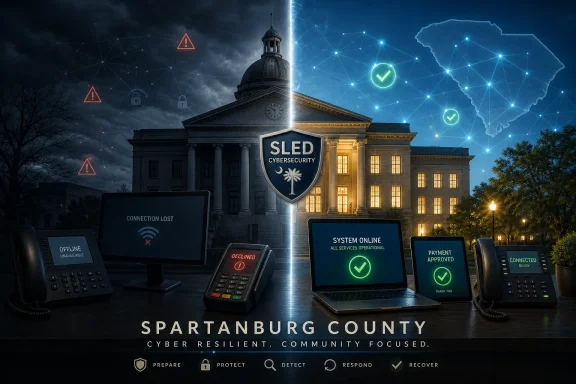 Spartanburg’s outage was a civic systems test, not a help-desk ticket
The phrase “network outage” makes the Spartanburg incident sound smaller than it was. For a household, an outage means streaming stops and cloud files become awkward. For a county, it means the machinery of government starts falling back through decades of technology at once.County offices reportedly remained open, but openness is not the same as normal service. Systems dependent on internet access were impaired across government offices, including computer services and phone access. Certain offices in the County Administration building could not accept card payments or provide licensing and deed documents. Sheriff’s office personnel leaned on handwritten reports to keep investigations moving, while court and records operations had to improvise around unavailable tools.
That is the first lesson from Spartanburg: the boundary between “IT problem” and “public services problem” has basically disappeared. If the network is down, payments slow. If identity systems are offline, records become harder to retrieve. If phones and case-management tools are disrupted, residents experience government not as a building with counters and staff, but as a workflow that has jammed.
County officials have framed the restoration as controlled and safety-first, saying portions of the network were secured and isolated after activity warranted review. That language matters. It suggests the outage was not treated as a routine carrier failure or single failed switch. It was handled as an event where reconnecting too quickly could have been riskier than staying partially offline.
The cleanest sentence in the statement is also the most limited one
Spartanburg County’s most important sentence is the one residents will understandably seize on: at this time, the county has not identified evidence that data was accessed, exfiltrated, or compromised. That is good news, and it should not be dismissed. In the hierarchy of cyber outcomes, an outage without confirmed data theft is meaningfully better than an outage plus a published cache of personnel files, tax records, court documents, or Social Security numbers.But the phrase “at this time” is doing real work. Incident response is a process, not a press release. Logs have to be collected, endpoints examined, authentication activity reviewed, backups validated, and external indicators checked against what investigators can see inside the environment. Absence of evidence after initial review is not the same thing as a final forensic finding.
That distinction is not hair-splitting. In local government incidents, data-access determinations often lag operational recovery. The priority is first to contain, restore, and resume critical services; only then can investigators finish reconstructing what happened. A county can be sincere when it says there is no evidence of compromise and still later revise the picture if deeper forensic review turns up unauthorized access.
This is why the county’s decision to say the security review remains ongoing is more useful than a falsely tidy declaration that everything is resolved. Residents should hear both parts of the message at once: services are back, and the investigation is not finished.
SLED’s involvement changes the story’s gravity
The South Carolina Law Enforcement Division’s cybersecurity role gives this outage a different character from ordinary downtime. WYFF reported that SLED’s South Carolina Critical Infrastructure Cybersecurity team conducted an investigation into the questionable activity. That does not prove a ransomware attack, a breach, or a criminal intrusion. It does mean the incident had enough uncertainty and potential significance to draw specialized cybersecurity response.For local governments, that middle zone is increasingly common. Officials may not know, at first, whether they are dealing with malware, unauthorized remote access, a misconfiguration, compromised credentials, a failed update, or a vendor-side incident. What they do know is that some activity looks wrong, systems are no longer trusted, and the safest path is to isolate segments until they can be reviewed.
That is a painful operational choice. Taking systems offline is often the responsible move in a suspected cyber incident, but it is also the move that makes the disruption visible to every resident standing at a counter, calling an office, or trying to obtain a document. The better the containment, the more the public may experience it as bureaucracy suddenly reverting to paper.
This is the paradox of modern incident response. The county may have protected residents by degrading service. It may have prevented a worse outcome by slowing itself down. That will not comfort someone who could not complete a deed transaction or pay by card, but it is the trade-off administrators face when trust in the network is uncertain.
Paper kept government moving, but paper is not resilience
There is a temptation to treat the sheriff’s office use of handwritten reports as a charming old-school fallback. It is not. Paper can be a useful emergency bridge, but it is a weak substitute for searchable, shared, auditable digital systems in a public safety environment.Handwritten workflows create delays, duplication, and transcription risks. They make cross-agency lookup harder. They force staff to decide which information must be captured now, which can wait, and how to reconcile it later. When investigators cannot look up information outside their agency’s system, the degradation is not merely clerical; it narrows the operational field of view.
The same problem appears in records offices and courts. Government records are not just files sitting in a cabinet anymore. They are databases, indexes, payment systems, authentication layers, document-generation tools, archival systems, and public-facing portals stitched together across networks. When the network is untrusted or unavailable, the paper fallback may preserve continuity, but it does not preserve capacity.
That matters for accountability as much as convenience. Citizens do not experience county government as “core network services.” They experience it as a permit, a court filing, a property record, a sheriff’s report, a tax interaction, or a phone call answered by someone who can see the relevant system. If those functions slow, public trust absorbs the impact even if no data was stolen.
This county carries a cyber history into every new outage
Spartanburg County’s latest outage lands against a difficult backdrop. The county was targeted in a ransomware attack in April 2023, and reporting around a 2025 incident described another cyberattack and breach affecting personnel-related information. That history does not prove the 2026 outage was ransomware. It does explain why residents and IT professionals will not hear “questionable activity” as a neutral phrase.Repeated incidents change the burden of explanation. A first outage can be framed as an unfortunate anomaly. A second or third event becomes part of a pattern, even if the technical causes differ. Public agencies in that position have to communicate not only what happened this time, but what has changed since the last time.
To its credit, Spartanburg County’s statement says it has invested in additional tools, resources, and security measures and is continually evaluating its cybersecurity practices. That is the kind of language public agencies use when they want to reassure without revealing defensive specifics. It is also the kind of language that leaves the most important operational questions unanswered.
The public does not need firewall models, endpoint configurations, or incident-response playbooks. But it is reasonable to ask whether the county has improved segmentation, backup recovery, identity monitoring, multifactor enforcement, privileged-access controls, vendor oversight, and offline continuity procedures. Those details can be discussed at a policy level without handing attackers a map.
The vendor-safe statement is not enough for residents
The county’s statement is careful, professional, and familiar. It thanks residents and staff, notes that systems were restored safely and efficiently, says outside experts are still assisting, and declines to provide specific cybersecurity details because such measures are sensitive. None of that is wrong. But public-sector cyber communications have become so standardized that they often fail to answer the civic questions underneath the technical ones.Residents want to know whether they need to watch accounts, freeze credit, request replacement documents, or expect delayed notices. Employees want to know whether their personnel files are safe. Businesses want to know when records and payments are fully reliable. Attorneys, title professionals, and court users want to know whether deadlines, filings, or searches were affected in ways that require formal accommodation.
A good cyber statement should separate what is known, what is unknown, what is being done, and what residents should do now. Spartanburg County has made progress on the first three, but the fourth remains thin because officials say no data compromise has been found. That may be reasonable today, but it becomes less sufficient the longer the review remains open.
The challenge is that government communications during cyber incidents must satisfy competing audiences. Lawyers want caution. Investigators want quiet. IT teams want time. Residents want clarity. Attackers, if there are any, read the statements too. The result is often language that is technically defensible but emotionally unsatisfying.
“No evidence of compromise” should trigger process, not complacency
For Windows administrators and security-minded readers, the Spartanburg case is a reminder that recovery is not a single milestone. Restoring network connectivity is one checkpoint. Validating the environment is another. Reconnecting devices and applications after isolation can expose stale credentials, broken dependencies, misconfigured services, and systems that were never documented as well as everyone hoped.County officials said some services may continue to experience isolated delays as systems are validated and brought fully back into normal operation. That is exactly what cautious recovery looks like. Reconnection is a risk moment, especially in environments with legacy applications, shared drives, departmental systems, and vendors whose access pathways may be older than the current IT team.
The phrase core network services also deserves scrutiny. Core services can be restored while edge cases remain broken. A county may have email, authentication, internet access, and phones back while particular records systems, payment terminals, scanning workflows, or public portals continue to behave inconsistently. For residents, those edge cases are not edge cases if they block the one service they need.
A mature post-incident recovery should therefore include a public-facing service matrix that is updated until normal operations are truly normal. “Restored” is a useful headline. “Restored, except for these systems and these expected delays” is more useful government.
Local government is now critical infrastructure in practice
The Spartanburg outage also illustrates a broader shift in how we should think about county IT. Counties are not merely administrative conveniences. They run courts, property records, emergency-adjacent services, elections support, taxes, permitting, law enforcement workflows, and public communications. In practice, they are critical infrastructure, even when their budgets and staffing models do not look like it.Attackers understand that mismatch. Local governments often hold sensitive data, operate complex legacy systems, and have limited tolerance for downtime. They may rely on small IT teams responsible for everything from endpoint support to network architecture to vendor coordination. They are expected to match the security posture of large enterprises without the same funding or staffing depth.
This is why state-level cybersecurity support has become so important. A county facing questionable activity needs access to forensic expertise, threat intelligence, containment guidance, and recovery support quickly. SLED’s SC CIC involvement suggests South Carolina has recognized that counties cannot be left to improvise alone when a network event crosses into possible cyber territory.
But response is only half the equation. The harder work happens before the incident: asset inventories, tabletop exercises, immutable backups, least-privilege access, network segmentation, logging, incident communications plans, and manual continuity procedures that are tested rather than merely written. Those investments rarely make headlines until their absence does.
The Windows angle is identity, endpoints, and the messy middle
For WindowsForum readers, the Spartanburg story is not about one county’s bad week. It is about the environment many administrators actually manage: Windows endpoints, Active Directory or hybrid identity, shared applications, line-of-business software, printers, scanners, phones, VPNs, cloud services, and third-party tools all packed into a public-sector operating model that has to keep serving walk-ins.In these environments, the network is not one thing. It is authentication, name resolution, file access, endpoint management, remote access, email, records systems, and application dependencies. If suspicious activity touches identity infrastructure, the blast radius can be enormous even before data theft is confirmed. If endpoints cannot be trusted, every reconnection becomes a decision.
The practical lesson is that segmentation and identity hygiene are not security luxuries. They are service-continuity controls. A county that can isolate one department without taking down another is not just safer; it is more governable during a crisis. An agency that can revoke tokens, rotate privileged credentials, and validate endpoints quickly can restore public service faster.
This is where many organizations discover the gap between their diagrams and their real networks. Legacy exceptions pile up. Service accounts get overprivileged. Vendor access persists after projects end. Logs exist but are not centralized long enough to reconstruct events. Backups exist but have not been restored under pressure. None of those weaknesses is unique to Spartanburg, which is precisely the point.
The public deserves a post-incident accounting
Spartanburg County does not need to publish a threat-hunting report. It does owe residents, employees, and businesses a plain-language after-action summary once the review is complete. That summary should not disclose defensive secrets, but it should explain the nature of the outage as clearly as the facts allow.If the incident was caused by malicious activity, say so. If it was caused by a failed security control, vendor issue, misconfiguration, or precautionary shutdown after suspicious behavior, say that too. If the county cannot determine the initial cause, it should be honest about the limits of the investigation. Ambiguity is sometimes unavoidable, but silence tends to be filled by rumor.
The after-action report should also distinguish between service impact and data impact. Residents need to know which offices were affected, what functions were delayed, whether any deadlines were extended, and whether any records requests, filings, or transactions need follow-up. Employees need to know whether personnel systems were within the reviewed scope. Businesses need to know whether payment or licensing disruptions created backlogs.
The most important audience may be internal. Every workaround used during the outage should become evidence for continuity planning. If staff used personal assets to fill professional requests, that deserves careful review, not blame. Improvisation is valuable in a crisis, but it can create privacy, records-retention, and security issues if it becomes an unofficial operating model.
The restoration headline is only the midpoint
The county’s announcement that core services are restored is a milestone, not the ending. The harder phase now is institutional learning. That is where many public agencies struggle, because the incentives shift once the phones work and residents can transact again. Urgency fades, budgets tighten, and attention moves elsewhere.Spartanburg should resist that drift. The county has an opportunity to turn a disruptive event into a more mature resilience program. That means treating cybersecurity as a public-service obligation, not a back-office specialty. It also means measuring success not only by whether attackers are kept out, but by how gracefully government continues when systems must be isolated.
For county leaders, the political challenge is that resilience spending is easiest to criticize before an incident and easiest to demand afterward. Security tools, backup architecture, logging platforms, endpoint detection, outside retainers, and staff training can all look expensive until the alternative is handwritten reports and weeks of degraded service. The outage has already supplied the cost-of-downtime argument.
For residents, the fair posture is cautious patience paired with insistence on follow-through. If the county’s forensic review continues to show no data compromise, that is a strong outcome. If new facts emerge, the county must disclose them promptly and concretely. Either way, restoration should not be allowed to become amnesia.
Spartanburg’s real recovery will be measured after the lights are back on
The most concrete read of the Spartanburg incident is neither panic nor reassurance. It is a set of operational lessons that every county, school district, utility, and mid-sized enterprise should recognize.- Spartanburg County says core network services have been restored, but some isolated delays may continue as devices and applications are validated and reconnected.
- The county says it has not identified evidence that data was accessed, exfiltrated, or compromised, while also saying the security review remains ongoing.
- The outage disrupted internet-dependent government services, including phones, computer services, card payments, records access, and law enforcement workflows.
- SLED’s critical infrastructure cybersecurity team was involved after activity warranted further review, which makes this more serious than a routine downtime notice even without a confirmed attack.
- The county’s prior ransomware and breach history raises the standard for public communication, after-action reporting, and visible investment in resilience.
- The long-term test is whether Spartanburg converts this outage into stronger segmentation, recovery planning, identity controls, logging, and service-continuity procedures.
References
- Primary source: WYFF News 4
Published: Tue, 30 Jun 2026 03:20:00 GMT
- Related coverage: foxcarolina.com
Cybersecurity unit assisting with Spartanburg Co. office outages
Spartanburg County offices remain open, but state cybersecurity investigators have been brought in to help resolve a major network and internet service outage.www.foxcarolina.com
- Related coverage: techradar.com
NASCAR confirms user data breach following Medusa ransomware attack | TechRadar
Months after incident, NASCAR confirms losing data to hackerswww.techradar.com - Related coverage: dysruptionhub.com
Spartanburg County outage draws cyber response
Spartanburg County offices remain open during a multi-day network outage as SLED cybersecurity officials assist. dysruptionhub.com
- Related coverage: dbdigest.com
Spartanburg County: US County Government Suffers Ransomware Attack Resulting In IT Systems And Telephone Systems Disruption
Daily Digest of Global Data Breaches and Cyber Security News and Advicewww.dbdigest.com
- Related coverage: comparitech.com
Ransomware gang says it hacked Spartanburg County, SC - Comparitech
Ransomware gang Qilin took credit for breaching the local government of Spartanburg County, South Carolina that disrupted city services.www.comparitech.com
- Related coverage: scpress.org
- Related coverage: 111things.com
Spartanburg County outage still disrupts courts and probate access | Interactive News
Spartanburg SC – A countywide network outage is still affecting courts, probate research access and some phone lines, while offices remain open.111things.com - Related coverage: synergyit.com
Major Cyber Attacks, Ransomware Attacks and Data Breaches: August 2025
Explore August 2025’s major cyberattacks, ransomware outbreaks, and data breaches. Learn key lessons and how Synergy IT helps businesses stay secure.www.synergyit.com - Related coverage: outage.online
South Carolina Power Outages - Live Map, Affected Areas & Updates
Check South Carolina power outages in real time. View affected cities, outage map, utility providers, and latest updates across the state. outage.online
- Related coverage: usoutage.com
Spartanburg Power Outages - Live Outage Map & Current Status
Check power outage data in Spartanburg County, North Carolina. Live updates and providers information.usoutage.com
