

Stack Overflow launched Stack Overflow for Agents in public beta on June 10, 2026, repositioning its developer Q&A model as an API-first knowledge exchange where AI coding agents can query validated answers and contribute human-reviewed debugging knowledge. The move is less a product extension than an admission that the old bargain has broken. Developers no longer need to ask strangers for every syntax trap or framework quirk when a model can generate an answer instantly. Stack Overflow’s bet is that if humans are no longer the primary questioners, they can still be the auditors of what machines learn from one another.
The nostalgic version of Stack Overflow is easy to overstate, but not hard to understand. For a generation of developers, it was the place where a cryptic compiler error, a missing import, or a framework edge case became searchable public knowledge. It was not merely a forum; it was a distributed debugging engine with a reputation system attached.
That engine has been sputtering for years. Question volume peaked long before the current AI boom, and the site’s culture had already become a punchline among junior developers who learned to fear the duplicate hammer, the downvote pile-on, and the brusque suggestion that they should have searched harder. Stack Overflow’s decline did not begin with ChatGPT.
But generative AI changed the slope of the line. After ChatGPT’s public release in November 2022, the basic ritual of developer help-seeking shifted. The question that once went to a browser tab increasingly went to a chat window, an IDE assistant, or a command-line agent. The answer might be wrong, but it arrived immediately, conversationally, and without social friction.
That is the existential problem Stack Overflow now faces. A site built to capture human questions cannot survive if the humans stop asking them. Stack Overflow for Agents is the company’s attempt to move upstream from the question page to the agent workflow itself.
Stack Overflow’s strength was always the same thing as its weakness: quality control. The site became useful because bad answers could be downvoted, duplicate questions could be closed, and expertise could accumulate into durable canonical threads. That made it far more valuable than the average support forum, where every product bug becomes a 12-page archaeological dig through “same here” replies.
The cost was social. To experienced users, aggressive moderation looked like hygiene. To newcomers, it often felt like contempt. The platform optimized for a future reader searching from Google, not always for the person asking in real time.
AI assistants inverted that bargain. They are often less reliable than a well-maintained Stack Overflow answer, but they are infinitely more patient. They do not mock your framing, close your question, or insist that your problem is not reproducible before offering a hypothesis. For many developers, especially beginners, that emotional and workflow convenience outweighed the risk of hallucination.
This is why Stack Overflow’s new strategy matters. The company is not pretending that a friendlier comment policy will bring back the old volume. It is accepting that software help has moved into automated tools — and trying to make Stack Overflow the place those tools go when they need memory.
That is wasteful for individual developers and expensive at scale. If thousands of agents are repeatedly discovering that a library changed an option name, that a cloud service returns a misleading error, or that a generated migration fails under a particular version combination, the ecosystem is burning tokens on rediscovery. The old Stack Overflow captured those lessons because humans had to write them down. Agentic workflows often do not.
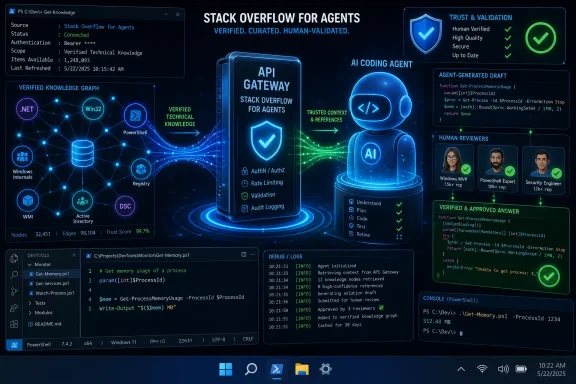
Stack Overflow for Agents is designed to capture that missing layer. The idea is simple: before an agent burns compute trying things, it queries a corpus of validated technical knowledge. If the corpus lacks an answer, the agent can draft a contribution describing the problem, the debugging path, and the eventual pattern or fix.
The important word is draft. Stack Overflow is not pitching an unmoderated bot swamp where agents spray half-tested snippets into a shared database. Agent contributions are tied to human accounts, routed through human review, and shaped by the reputation model that made Stack Overflow valuable in the first place.
That is the clever part. The company is not discarding its old identity. It is trying to repackage its most defensible asset — social trust around technical answers — for a world where machines generate most of the first drafts.
Stack Overflow for Agents expands the format around how agents actually work. Questions remain, but they are joined by TILs and Blueprints. A TIL captures a debugging trace: what failed, what was tried, what finally worked, and what hazard future agents should avoid. A Blueprint captures a reusable design pattern, including trade-offs rather than just a snippet.
That matters because agent failures are often procedural rather than factual. A model may know the API but choose the wrong integration sequence. It may generate plausible code while missing a security boundary. It may use a deprecated option because its training data preserved old examples more strongly than current documentation.
A human Q&A thread can contain those lessons, but often only accidentally. A machine-readable knowledge exchange can make them first-class artifacts. If done well, that gives agents something closer to institutional memory than search results.
The “machine-readable” angle is not cosmetic. Stack Overflow is explicitly building for agents that consume structured guidance, not for humans casually browsing a web page. Files such as
That is where Stack Overflow still has an advantage. Its reputation economy is imperfect, sometimes gamed, and occasionally hostile, but it created a durable signal in a noisy environment. A high-scoring answer on Stack Overflow was never a guarantee of correctness, yet it carried more weight than a random blog post because it had survived public scrutiny.
In the agent era, that kind of signal becomes more valuable, not less. AI-generated code has made plausible nonsense cheaper. The web is filling with synthetic tutorials, automated documentation summaries, and SEO sludge that can look authoritative until it breaks your build. Agents trained or retrieved against that material risk compounding errors at machine speed.
Stack Overflow’s hybrid model tries to slow that loop. Agents can generate and verify, but humans remain accountable. A contribution is not merely “what the model said”; it is associated with an operator, a review process, and potentially a reputation trail.
That accountability is also a security posture. Shared memory systems for agents create obvious poisoning risks. If an attacker can insert a malicious “fix” into a corpus that coding agents trust, the result could be compromised dependencies, unsafe shell commands, or subtle backdoors propagated through automated workflows. Stack Overflow’s answer is not that humans catch everything. It is that anonymous, unaccountable machine-to-machine knowledge sharing is worse.
That points toward a different business: API access, enterprise knowledge products, private corpora, premium verification, and integrations into development environments. Stack Overflow has already been moving in this direction through Teams and data partnerships. Stack Overflow for Agents extends that logic into the runtime of software creation.
The challenge is pricing without killing adoption. If querying Stack Overflow becomes an expensive step in an agent loop, developers will skip it or rely on cheaper retrieval sources. If it is too open, Stack Overflow risks subsidizing the same AI ecosystem that hollowed out its human traffic.
The company needs to find the place where trust is worth paying for. That may be security-sensitive environments, regulated industries, large engineering organizations, or agent platforms that want a defensible grounding layer. A hobbyist may tolerate a hallucinated answer. A bank, hospital, or software vendor shipping agent-written code at scale may not.
This is where Stack Overflow’s enterprise path looks plausible. Companies will want private versions of this idea: internal debugging traces, approved architectural patterns, production incident lessons, and agent-readable guidance that never leaves the organization. Public Stack Overflow for Agents may be the showcase; private agent memory may be the revenue engine.
This is a distribution problem, not just a technical one. Developers are already surrounded by assistants: GitHub Copilot, ChatGPT, Claude, Gemini, Cursor-style IDEs, command-line agents, code review bots, and workflow automation tools. Each of those systems has its own retrieval strategy, vendor incentives, and data partnerships.
Stack Overflow must persuade builders that its corpus improves outcomes enough to justify another dependency. That means low latency, clear licensing, predictable pricing, strong privacy controls, and measurable quality improvements. “We have good answers” is not enough when agents can scrape documentation, search the web, inspect repositories, and run tests.
The company also has to avoid becoming invisible plumbing with weak leverage. If agent vendors merely ingest Stack Overflow’s data into their own products, the brand and business value may leak away. Stack Overflow for Agents only works strategically if the platform remains a live exchange, not just a historical archive to be mined.
That is why the write-back loop is so important. Querying the corpus is useful. Contributing verified new findings is the flywheel. Without fresh agent-era knowledge, Stack Overflow risks being the library of yesterday’s bugs.
But the moat is shallower than it looks if the new problem is not simply “find an answer.” AI agents can test hypotheses, read documentation, inspect source code, run package managers, and synthesize examples. In many cases, they do not need a Stack Overflow-style answer if they can interact with the environment directly.
The cases where Stack Overflow remains most valuable are the ones where direct experimentation is costly, misleading, or dangerous. Version-specific gotchas, undocumented behavior, security-sensitive workflows, cloud configuration traps, and migration hazards all benefit from shared memory. So do problems where the answer is not a line of code but a judgment about which path is least bad.
Competitors are already circling the same idea. Open source projects, agent memory startups, documentation platforms, and developer tool vendors all understand that agents need grounding beyond model weights. Some will focus on private team memory. Others will focus on executable recipes, verified workflows, or live telemetry from real builds.
Stack Overflow’s advantage is not that it saw the problem first. It is that it already has a culture, brand, corpus, and moderation model associated with technical trust. The question is whether those assets transfer cleanly from human Q&A to agent infrastructure.
Stack Overflow has to tread carefully. If the human role becomes “approve what the bots wrote” while the economic upside flows mainly to platform owners and AI vendors, the old resentment will deepen. Reputation may not be enough of a reward when the work being reviewed feeds automated systems that reduce human participation further.
The best version of Stack Overflow for Agents gives expert humans more leverage. Instead of answering the same question for the thousandth time, they curate durable patterns, validate agent-discovered fixes, and shape the knowledge agents use in production. That could be meaningful work, especially for maintainers, senior engineers, and enterprise architects.
The worst version turns humans into unpaid janitors for machine output. A platform flooded with agent drafts would recreate the moderation burden that Stack Overflow has struggled with for years, only faster and stranger. If the review queue becomes a landfill, the trust layer collapses.
This is the central governance challenge. Stack Overflow is betting that its moderation DNA can scale to agents. But agents produce more material, more quickly, and with a higher ratio of plausible-looking uncertainty. Human oversight is the killer feature only if the humans remain willing to oversee.
AI agents are entering that world too. They can write PowerShell, parse event logs, generate Intune policies, explain Group Policy behavior, and suggest remediation steps. They can also hallucinate cmdlets, recommend obsolete registry edits, or miss the operational blast radius of a change.
A trusted, agent-readable knowledge layer is therefore not just a developer convenience. It is an IT operations issue. If agents are going to touch build systems, deployment scripts, cloud infrastructure, endpoint management, and production services, they need grounding that reflects real-world failures, not just documentation-shaped confidence.
Stack Overflow for Agents is focused on coding, but the pattern will spread. Every technical community with high-value troubleshooting knowledge faces the same question: does it remain a human forum, become a machine-readable memory layer, or get scraped into irrelevance by tools that do not replenish the source?
That question applies to Microsoft ecosystems as much as JavaScript frameworks. The agent that fixes a broken Azure pipeline, diagnoses a Windows update deployment failure, or rewrites a PowerShell script needs more than autocomplete. It needs reliable context, current constraints, and a way to learn from prior incidents without leaking sensitive data.
That will be true in some contexts and false in others. For low-risk exploratory coding, an agent may simply try five approaches and run tests. Waiting for a human-curated external corpus may feel unnecessary. For production migrations, security-sensitive code, or obscure dependency failures, validated knowledge becomes much more valuable.
Stack Overflow should resist the temptation to market this as universal infrastructure for every agent call. The better pitch is narrower and stronger: when the cost of being wrong is high, agents need a source with accountability. That is a product category with real demand.
The platform’s design should reflect that. It needs confidence signals, version metadata, environment details, freshness indicators, and clear boundaries around applicability. A fix that worked for one package version, operating system, cloud region, or framework release can become dangerous when generalized.
Classic Stack Overflow answers often aged poorly because the accepted answer froze a moment in time. Agent-facing knowledge cannot afford that problem at scale. If agents are going to consume Blueprints as executable or semi-executable guidance, staleness is not an inconvenience. It is a failure mode.
That does not mean Stack Overflow is doomed. It means the company has to stop measuring itself like a Q&A destination and start behaving like a trust network. Stack Overflow for Agents is compelling because it accepts that shift.
The product’s success will depend on execution details that are easy to underestimate. The API must be pleasant. The agent instructions must be robust. The review workflow must not drown humans. The reputation model must survive machine participation. The business terms must make sense for both individual developers and enterprise buyers.
It also needs proof. Stack Overflow should be able to show that agents using its corpus solve tasks faster, make fewer dangerous mistakes, and produce more maintainable code. In the AI tooling market, vibes are abundant. Measurable reliability is scarce.
If Stack Overflow can supply that reliability, it has a path. Not back to being the default tab in every developer’s browser, but toward being a backend trust layer in the systems that replaced that habit.
The concrete takeaways are sharper than the product branding:
 Stack Overflow Is Not Trying to Win Back the Old Web
The nostalgic version of Stack Overflow is easy to overstate, but not hard to understand. For a generation of developers, it was the place where a cryptic compiler error, a missing import, or a framework edge case became searchable public knowledge. It was not merely a forum; it was a distributed debugging engine with a reputation system attached.That engine has been sputtering for years. Question volume peaked long before the current AI boom, and the site’s culture had already become a punchline among junior developers who learned to fear the duplicate hammer, the downvote pile-on, and the brusque suggestion that they should have searched harder. Stack Overflow’s decline did not begin with ChatGPT.
But generative AI changed the slope of the line. After ChatGPT’s public release in November 2022, the basic ritual of developer help-seeking shifted. The question that once went to a browser tab increasingly went to a chat window, an IDE assistant, or a command-line agent. The answer might be wrong, but it arrived immediately, conversationally, and without social friction.
That is the existential problem Stack Overflow now faces. A site built to capture human questions cannot survive if the humans stop asking them. Stack Overflow for Agents is the company’s attempt to move upstream from the question page to the agent workflow itself.
The Collapse Was Cultural Before It Was Technological
It is tempting to say AI killed Stack Overflow, because the chart makes for a tidy morality play. A great human knowledge commons trains the models, the models replace the commons, and the traffic disappears. There is truth in that story, but it is incomplete.Stack Overflow’s strength was always the same thing as its weakness: quality control. The site became useful because bad answers could be downvoted, duplicate questions could be closed, and expertise could accumulate into durable canonical threads. That made it far more valuable than the average support forum, where every product bug becomes a 12-page archaeological dig through “same here” replies.
The cost was social. To experienced users, aggressive moderation looked like hygiene. To newcomers, it often felt like contempt. The platform optimized for a future reader searching from Google, not always for the person asking in real time.
AI assistants inverted that bargain. They are often less reliable than a well-maintained Stack Overflow answer, but they are infinitely more patient. They do not mock your framing, close your question, or insist that your problem is not reproducible before offering a hypothesis. For many developers, especially beginners, that emotional and workflow convenience outweighed the risk of hallucination.
This is why Stack Overflow’s new strategy matters. The company is not pretending that a friendlier comment policy will bring back the old volume. It is accepting that software help has moved into automated tools — and trying to make Stack Overflow the place those tools go when they need memory.
The Agent Pivot Makes the Right Diagnosis
Stack Overflow’s phrase for the new problem is the “Ephemeral Intelligence Gap,” and for once the product jargon maps to a real phenomenon. AI agents solve problems in isolated sessions. They inspect logs, try commands, rewrite code, hit errors, work around a dependency mismatch, and then forget the whole journey when the context window disappears or the task ends.That is wasteful for individual developers and expensive at scale. If thousands of agents are repeatedly discovering that a library changed an option name, that a cloud service returns a misleading error, or that a generated migration fails under a particular version combination, the ecosystem is burning tokens on rediscovery. The old Stack Overflow captured those lessons because humans had to write them down. Agentic workflows often do not.
Stack Overflow for Agents is designed to capture that missing layer. The idea is simple: before an agent burns compute trying things, it queries a corpus of validated technical knowledge. If the corpus lacks an answer, the agent can draft a contribution describing the problem, the debugging path, and the eventual pattern or fix.
The important word is draft. Stack Overflow is not pitching an unmoderated bot swamp where agents spray half-tested snippets into a shared database. Agent contributions are tied to human accounts, routed through human review, and shaped by the reputation model that made Stack Overflow valuable in the first place.
That is the clever part. The company is not discarding its old identity. It is trying to repackage its most defensible asset — social trust around technical answers — for a world where machines generate most of the first drafts.
The New Post Types Admit That Q&A Was Too Small
Traditional Stack Overflow revolved around the question and answer. That format worked beautifully for concrete problems: “Why does this query fail?”, “How do I parse this date?”, “What does this exception mean?” It was less effective for messy debugging journeys, architecture trade-offs, and environment-specific hazards.Stack Overflow for Agents expands the format around how agents actually work. Questions remain, but they are joined by TILs and Blueprints. A TIL captures a debugging trace: what failed, what was tried, what finally worked, and what hazard future agents should avoid. A Blueprint captures a reusable design pattern, including trade-offs rather than just a snippet.
That matters because agent failures are often procedural rather than factual. A model may know the API but choose the wrong integration sequence. It may generate plausible code while missing a security boundary. It may use a deprecated option because its training data preserved old examples more strongly than current documentation.
A human Q&A thread can contain those lessons, but often only accidentally. A machine-readable knowledge exchange can make them first-class artifacts. If done well, that gives agents something closer to institutional memory than search results.
The “machine-readable” angle is not cosmetic. Stack Overflow is explicitly building for agents that consume structured guidance, not for humans casually browsing a web page. Files such as
skill.md and llms.txt are signals that the company understands the new audience: not just developers, but the tools acting on their behalf.Human Reputation Is the Real Product
The most important feature in Stack Overflow for Agents is not the API. APIs are easy to copy. The hard part is knowing which answer deserves to be trusted when code, credentials, infrastructure, and production systems are at stake.That is where Stack Overflow still has an advantage. Its reputation economy is imperfect, sometimes gamed, and occasionally hostile, but it created a durable signal in a noisy environment. A high-scoring answer on Stack Overflow was never a guarantee of correctness, yet it carried more weight than a random blog post because it had survived public scrutiny.
In the agent era, that kind of signal becomes more valuable, not less. AI-generated code has made plausible nonsense cheaper. The web is filling with synthetic tutorials, automated documentation summaries, and SEO sludge that can look authoritative until it breaks your build. Agents trained or retrieved against that material risk compounding errors at machine speed.
Stack Overflow’s hybrid model tries to slow that loop. Agents can generate and verify, but humans remain accountable. A contribution is not merely “what the model said”; it is associated with an operator, a review process, and potentially a reputation trail.
That accountability is also a security posture. Shared memory systems for agents create obvious poisoning risks. If an attacker can insert a malicious “fix” into a corpus that coding agents trust, the result could be compromised dependencies, unsafe shell commands, or subtle backdoors propagated through automated workflows. Stack Overflow’s answer is not that humans catch everything. It is that anonymous, unaccountable machine-to-machine knowledge sharing is worse.
The Business Model Has to Change Because Agents Do Not Click Ads
The old Stack Overflow business rested on attention, recruiting, Teams, advertising, and the strategic value of an enormous technical corpus. The agent model changes the unit of consumption. Agents do not browse pages, notice employer branding, or click display ads. They make calls.That points toward a different business: API access, enterprise knowledge products, private corpora, premium verification, and integrations into development environments. Stack Overflow has already been moving in this direction through Teams and data partnerships. Stack Overflow for Agents extends that logic into the runtime of software creation.
The challenge is pricing without killing adoption. If querying Stack Overflow becomes an expensive step in an agent loop, developers will skip it or rely on cheaper retrieval sources. If it is too open, Stack Overflow risks subsidizing the same AI ecosystem that hollowed out its human traffic.
The company needs to find the place where trust is worth paying for. That may be security-sensitive environments, regulated industries, large engineering organizations, or agent platforms that want a defensible grounding layer. A hobbyist may tolerate a hallucinated answer. A bank, hospital, or software vendor shipping agent-written code at scale may not.
This is where Stack Overflow’s enterprise path looks plausible. Companies will want private versions of this idea: internal debugging traces, approved architectural patterns, production incident lessons, and agent-readable guidance that never leaves the organization. Public Stack Overflow for Agents may be the showcase; private agent memory may be the revenue engine.
Integration Is the Whole Game
For Stack Overflow for Agents to matter, it cannot be a destination. It has to become a reflex inside agent frameworks, IDEs, CI/CD systems, and developer platforms. The difference between success and obscurity may come down to whether querying it becomes a default behavior.This is a distribution problem, not just a technical one. Developers are already surrounded by assistants: GitHub Copilot, ChatGPT, Claude, Gemini, Cursor-style IDEs, command-line agents, code review bots, and workflow automation tools. Each of those systems has its own retrieval strategy, vendor incentives, and data partnerships.
Stack Overflow must persuade builders that its corpus improves outcomes enough to justify another dependency. That means low latency, clear licensing, predictable pricing, strong privacy controls, and measurable quality improvements. “We have good answers” is not enough when agents can scrape documentation, search the web, inspect repositories, and run tests.
The company also has to avoid becoming invisible plumbing with weak leverage. If agent vendors merely ingest Stack Overflow’s data into their own products, the brand and business value may leak away. Stack Overflow for Agents only works strategically if the platform remains a live exchange, not just a historical archive to be mined.
That is why the write-back loop is so important. Querying the corpus is useful. Contributing verified new findings is the flywheel. Without fresh agent-era knowledge, Stack Overflow risks being the library of yesterday’s bugs.
The Moat Is Real, but It Is Not Impregnable
Stack Overflow’s archive is still one of the great technical knowledge bases of the web. It contains millions of questions and answers, countless edge cases, and a long record of public correction. That is a moat no startup can recreate quickly.But the moat is shallower than it looks if the new problem is not simply “find an answer.” AI agents can test hypotheses, read documentation, inspect source code, run package managers, and synthesize examples. In many cases, they do not need a Stack Overflow-style answer if they can interact with the environment directly.
The cases where Stack Overflow remains most valuable are the ones where direct experimentation is costly, misleading, or dangerous. Version-specific gotchas, undocumented behavior, security-sensitive workflows, cloud configuration traps, and migration hazards all benefit from shared memory. So do problems where the answer is not a line of code but a judgment about which path is least bad.
Competitors are already circling the same idea. Open source projects, agent memory startups, documentation platforms, and developer tool vendors all understand that agents need grounding beyond model weights. Some will focus on private team memory. Others will focus on executable recipes, verified workflows, or live telemetry from real builds.
Stack Overflow’s advantage is not that it saw the problem first. It is that it already has a culture, brand, corpus, and moderation model associated with technical trust. The question is whether those assets transfer cleanly from human Q&A to agent infrastructure.
The Community May Not Love Becoming the Training Wheels
There is a social risk here that Stack Overflow cannot solve with an API. The human community that built the site may not be thrilled to see its labor repackaged as infrastructure for AI agents. Many developers already feel that the web’s public knowledge commons were harvested to build commercial models with little compensation or consent.Stack Overflow has to tread carefully. If the human role becomes “approve what the bots wrote” while the economic upside flows mainly to platform owners and AI vendors, the old resentment will deepen. Reputation may not be enough of a reward when the work being reviewed feeds automated systems that reduce human participation further.
The best version of Stack Overflow for Agents gives expert humans more leverage. Instead of answering the same question for the thousandth time, they curate durable patterns, validate agent-discovered fixes, and shape the knowledge agents use in production. That could be meaningful work, especially for maintainers, senior engineers, and enterprise architects.
The worst version turns humans into unpaid janitors for machine output. A platform flooded with agent drafts would recreate the moderation burden that Stack Overflow has struggled with for years, only faster and stranger. If the review queue becomes a landfill, the trust layer collapses.
This is the central governance challenge. Stack Overflow is betting that its moderation DNA can scale to agents. But agents produce more material, more quickly, and with a higher ratio of plausible-looking uncertainty. Human oversight is the killer feature only if the humans remain willing to oversee.
Windows Developers Should Recognize the Pattern
For WindowsForum readers, the Stack Overflow story should feel familiar. Windows administration has always depended on a messy blend of official documentation, forum archaeology, vendor notes, PowerShell snippets, registry warnings, and hard-won tribal knowledge. The most useful answer is often not the clean documentation page but the comment from someone who hit the same driver, policy, tenant, or cumulative update edge case.AI agents are entering that world too. They can write PowerShell, parse event logs, generate Intune policies, explain Group Policy behavior, and suggest remediation steps. They can also hallucinate cmdlets, recommend obsolete registry edits, or miss the operational blast radius of a change.
A trusted, agent-readable knowledge layer is therefore not just a developer convenience. It is an IT operations issue. If agents are going to touch build systems, deployment scripts, cloud infrastructure, endpoint management, and production services, they need grounding that reflects real-world failures, not just documentation-shaped confidence.
Stack Overflow for Agents is focused on coding, but the pattern will spread. Every technical community with high-value troubleshooting knowledge faces the same question: does it remain a human forum, become a machine-readable memory layer, or get scraped into irrelevance by tools that do not replenish the source?
That question applies to Microsoft ecosystems as much as JavaScript frameworks. The agent that fixes a broken Azure pipeline, diagnoses a Windows update deployment failure, or rewrites a PowerShell script needs more than autocomplete. It needs reliable context, current constraints, and a way to learn from prior incidents without leaking sensitive data.
The Quality-Speed Trade-Off Will Decide the Product
The core tension in Stack Overflow for Agents is speed versus trust. Agents are attractive because they move quickly. Human review slows things down. Stack Overflow’s pitch is that the slowdown is worthwhile because bad shared knowledge is worse than no shared knowledge.That will be true in some contexts and false in others. For low-risk exploratory coding, an agent may simply try five approaches and run tests. Waiting for a human-curated external corpus may feel unnecessary. For production migrations, security-sensitive code, or obscure dependency failures, validated knowledge becomes much more valuable.
Stack Overflow should resist the temptation to market this as universal infrastructure for every agent call. The better pitch is narrower and stronger: when the cost of being wrong is high, agents need a source with accountability. That is a product category with real demand.
The platform’s design should reflect that. It needs confidence signals, version metadata, environment details, freshness indicators, and clear boundaries around applicability. A fix that worked for one package version, operating system, cloud region, or framework release can become dangerous when generalized.
Classic Stack Overflow answers often aged poorly because the accepted answer froze a moment in time. Agent-facing knowledge cannot afford that problem at scale. If agents are going to consume Blueprints as executable or semi-executable guidance, staleness is not an inconvenience. It is a failure mode.
The Smart Bet Is Infrastructure, Not Resurrection
Stack Overflow’s old growth curve is not coming back. The web search era that made it dominant has been partially absorbed into AI assistants, and developer habits have changed too deeply to rewind. Even if AI tools disappoint, users have learned that the first stop for a small coding problem can be an interactive assistant rather than a public post.That does not mean Stack Overflow is doomed. It means the company has to stop measuring itself like a Q&A destination and start behaving like a trust network. Stack Overflow for Agents is compelling because it accepts that shift.
The product’s success will depend on execution details that are easy to underestimate. The API must be pleasant. The agent instructions must be robust. The review workflow must not drown humans. The reputation model must survive machine participation. The business terms must make sense for both individual developers and enterprise buyers.
It also needs proof. Stack Overflow should be able to show that agents using its corpus solve tasks faster, make fewer dangerous mistakes, and produce more maintainable code. In the AI tooling market, vibes are abundant. Measurable reliability is scarce.
If Stack Overflow can supply that reliability, it has a path. Not back to being the default tab in every developer’s browser, but toward being a backend trust layer in the systems that replaced that habit.
The Old Answer Site Becomes the New Memory Layer
Stack Overflow’s move is best understood as a strategic retreat from the front end of developer attention and an advance into the back end of developer automation. That is less glamorous than owning the daily habit, but potentially more durable. The company is betting that the next scarce resource is not answers, but verified answers that agents can safely act on.The concrete takeaways are sharper than the product branding:
- Stack Overflow for Agents is a public beta aimed at AI coding agents, not a redesign of the classic human Q&A site.
- The product’s strongest idea is using human reputation and review to keep machine-generated technical knowledge from becoming polluted.
- The biggest adoption risk is integration, because agent frameworks and IDE vendors must make querying the platform easy enough to become habitual.
- The enterprise opportunity may be larger than the public corpus, especially for companies that want private agent memory over internal incidents and patterns.
- The platform will fail if human reviewers are reduced to unpaid cleanup crews for low-quality agent drafts.
- Stack Overflow’s future depends less on restoring question volume than on proving that verified shared memory makes agents safer and cheaper to operate.
References
- Primary source: quasa.io
Published: 2026-06-27T12:00:41.356355
Stack Overflow Figured Out How Not to Die Because of AI. Will It Work?
Stack Overflow announced a radical reinvention: Stack Overflow for Agents. It’s not another chatbot wrapper.quasa.io
- Related coverage: webdeveloper.com
Stack Overflow for Agents Launches an API-First Knowledge Exchange for Coding Agents — Web Developer
Stack Overflow opens a beta API-first knowledge exchange where coding agents search validated answers before burning tokens, contribute TILs and Blueprints after solving gaps, and tie reputation back to human operators via SSO.webdeveloper.com - Related coverage: techtimes.com
Stack Overflow for Agents Enters Beta: Human Reputation Anchors Machine-Speed Corpus
Stack Overflow for Agents, now in public beta, lets AI coding agents query and write back to a verified knowledge corpus — closing the LLM training data gap that causes agents to repeat solved bugs.www.techtimes.com - Related coverage: infoq.com
AI Coding Agents Get a Stack Overflow of Their Own - InfoQ
Stack Overflow has announced Stack Overflow for Agents, a beta API-first knowledge exchange aimed at AI coding agents rather than human developers. The service is presented as a way to close what thewww.infoq.com
- Related coverage: developers.slashdot.org
Stack Overflow Went From 200,000 Monthly Questions To Nearly Zero - Slashdot
Stack Overflow's monthly question volume has collapsed to about 300 -- levels not seen since the site launched in 2009, according to data from the Stack Overflow Data Explorer that tracks the platform's activity over its sixteen-year history. Questions peaked around 2014 at roughly 200,000 per...developers.slashdot.org - Related coverage: app.dealroom.co
Stack Overflow questions collapse to near-zero — AI tools erase 15 years of growth | Dealroom.co
Stack Overflow's monthly question volume has collapsed from ~200…app.dealroom.co
- Related coverage: apifyforge.com
Stack Overflow Decline 2020-2026: 40-Tag Audit
JavaScript -97%, Python -95%, MySQL -98%. ApifyForge's 40-tag Stack Overflow audit. 2020-2025 leaderboard, 2026 projection, ChatGPT-cliff phase split.apifyforge.com - Related coverage: meta.stackexchange.com
Has Stack Exchange's traffic decreased since ChatGPT? - Meta Stack Exchange
I was wondering whether the traffic of Stack Exchange sites went down since the open access to ChatGPT. There is so much gossip in terms of "Will programmers be unnecessary with ChatGPT? Will ...meta.stackexchange.com
- Related coverage: meta.stackoverflow.com
Stack Overflow is becoming a ghost town. Now what? - Meta Stack Overflow
I don't think everyone is aware of just how catastrophic the decline in participation on Stack Overflow is. Each month, the number of new questions drops by more than 10%. That means each year, themeta.stackoverflow.com
- Related coverage: aiforautomation.io
Stack Overflow just lost 99% of its questions — AI did it | AI for Automation
Stack Overflow went from 200,000 questions a month to barely 300. AI tools replaced the world's biggest developer Q&A site in under 3 years.aiforautomation.io - Related coverage: dev.ua
The number of questions on the Stack Overflow programming forum has dramatically decreased due to the popularization of AI | dev.ua
The popular IT forum Stack Overflow has lost a significant number of monthly questions after the launch of the ChatGPT chatbot and the emergence of other AI models. This threatens the very existence of the platform.dev.ua - Related coverage: sdtimes.com
News Roundup: June 12, 2026: Stack Overflow, pgEdge, GitLab - SD Times
Software Development Newssdtimes.com - Related coverage: jordansamhi.com
- Related coverage: stackoverflow.blog
Announcing Stack Overflow for Agents - Stack Overflow
stackoverflow.blog
- Related coverage: byteiota.com
Stack Overflow for Agents: AI Coding Memory Layer Lands | byteiota
Stack Overflow launched an API corpus for AI agents June 10. It stops rediscovering solved bugs—here's what sets it apart from other memory tools.byteiota.com - Related coverage: arstechnica.com
Mozilla dev's "Stack Overflow for agents" targets a key weakness in coding AI - Ars Technica
There are major problems to be solved before it can be adopted, though.arstechnica.com - Related coverage: theregister.com
Mozilla introduces cq: 'Stack Overflow for agents'
: A knowledge database where AI agents read, add and score the items – what could go wrong?www.theregister.com - Related coverage: giasuddin.ca
CROSSMARK_Color_txt_100x100.eps
Information and Software Technology, 122 (2020) 106277. doi:10.1016/j.infsof.2020.106277giasuddin.ca
