

Star Wars Zero Company will launch on August 27, 2026 for Windows PC, PlayStation 5, and Xbox Series X|S, with EA listing PC requirements that target 1080p at 30 FPS on low settings and 1440p at 60 FPS on high settings. The numbers are less shocking than revealing: this is not a game trying to sell ray-tracing spectacle as its central promise. It is a tactics game asking for enough CPU, memory, and GPU headroom to make a dense battlefield feel readable, cinematic, and stable. For PC players, the real story is not whether the game will run, but what kind of machine EA now considers the floor for a premium Star Wars release.
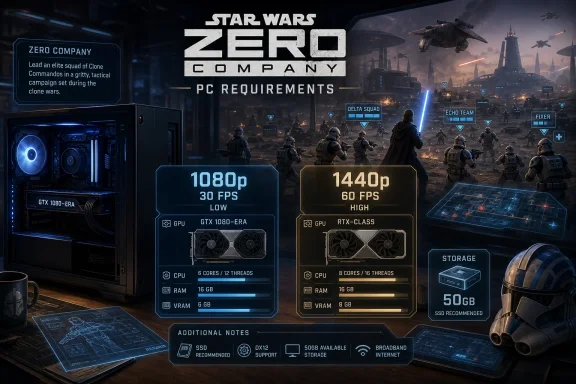
The minimum spec for Star Wars Zero Company is straightforward but not lightweight. EA asks for a 64-bit version of Windows 10 or Windows 11, with Windows 11 recommended, an Intel Core i5-8400 or Ryzen 5 2600X, 16GB of RAM, and a GeForce GTX 1080, Radeon RX 5600 XT, or Intel Arc B580. That configuration is meant for 1920x1080, native 30 FPS, and the low graphics preset.
The recommended spec moves the target to 2560x1440 at native 60 FPS on high settings. For that, EA lists an Intel Core i7-10700K or Ryzen 7 3700X, 32GB of RAM, and either an Nvidia GeForce RTX 3080 or AMD Radeon RX 7800 XT. Storage is mercifully modest by modern AAA standards at 50GB.
That split matters because EA is not hiding behind vague labels like “minimum” and “recommended” without context. The company is attaching each tier to a resolution, frame-rate target, and graphics preset. In 2026, that specificity should be the norm, but it still feels refreshing because PC requirements too often leave players guessing whether “recommended” means 1080p medium, 1440p high, or 4K with upscaling magic doing half the work.
For WindowsForum readers, the important practical takeaway is that Zero Company’s baseline is old enough to include mature hardware but high enough to rule out many casual gaming PCs and older laptops. A GTX 1080 is a veteran card, but it was a high-end veteran. The game’s minimum is not “anything with a GPU.” It is “a once-serious gaming PC that has aged well.”
The Radeon RX 5600 XT is roughly in the same conceptual lane: a capable 1080p card from the previous generation of mainstream gaming hardware. Intel’s Arc B580 inclusion is more interesting because it reflects a newer GPU family and implies EA expects driver support and Intel’s current discrete graphics stack to be relevant by launch. That is good news for Intel GPU owners, but it also means early adopters should watch launch-day driver notes carefully.
The CPU floor is similarly reasonable. Intel’s Core i5-8400 and AMD’s Ryzen 5 2600X are six-core chips from the era when mainstream gaming systems finally moved beyond four cores as the comfortable default. A turn-based tactics game does not need to simulate a 128-player shooter, but it may still lean on the CPU for AI planning, line-of-sight calculations, destructible or interactive environments, animation systems, and background campaign logic.
The minimum 16GB RAM requirement is the least surprising part of the list. In 2026, 16GB is the functional entry point for serious PC gaming on Windows, especially once launchers, overlays, browser tabs, capture tools, and background services are added to the equation. Players still clinging to 8GB systems should treat Zero Company as another sign that the old budget standard has finally slipped below the waterline.
That makes sense given the way EA and Lucasfilm have positioned the game. Zero Company is described as a single-player, cinematic, turn-based tactics game set in the twilight of the Clone Wars, with a customizable leader named Hawks and a squad drawn from archetypes including clone troopers, astromechs, scoundrels, and even a Jedi. It wants the visual language of modern Star Wars — close-ups, animated character work, bespoke environments, and dramatic battlefield moments — without abandoning the board-game clarity of tactics combat.
That combination can be harder to scale than it looks. A tactics game can often tolerate a lower frame rate better than a twitch shooter, but it cannot tolerate unreadable environments, muddy unit silhouettes, or animation stutter during key combat sequences. The genre is built on trust: when a player moves a unit, commits an action, or exposes a flank, the screen has to communicate consequences cleanly.
The recommended 32GB RAM target is also worth taking seriously. Some players will look at it and assume it is excessive for a turn-based game. But modern engines, high-resolution textures, shader caches, heavy UI layers, and large campaign maps can all eat memory quickly, especially at 1440p with high presets. If Zero Company is doing the usual modern combination of cinematic storytelling, hub management, and tactical battlefields, 32GB may be less about extravagance and more about avoiding hitching.
For gamers, Windows 11 recommendation usually means more than marketing alignment. It can reflect QA prioritization, scheduler behavior on newer CPUs, graphics driver assumptions, DirectStorage-adjacent expectations, HDR handling, security defaults, or simply where the developer expects most active support to land during the game’s post-launch window. None of that means Windows 10 players are second-class citizens on day one, but it does mean they should be more cautious about edge cases.
The timing is also important. Zero Company launches in late August 2026, well after Windows 10’s mainstream consumer support story has become a live operational concern for many households and small offices. By then, a Windows 10 gaming rig will increasingly be a deliberate choice rather than just an old default.
For sysadmins and power users who maintain shared gaming PCs, lab machines, or family systems, the safe read is simple: if this is the game that triggers a rebuild or upgrade, build around Windows 11 unless you have a specific reason not to. EA has given Windows 10 enough room to run, but not enough rhetorical confidence to make it the preferred target.
But Zero Company is not being positioned as a tiny genre exercise. It is an EA-published Star Wars game developed by Bit Reactor in collaboration with Respawn Entertainment and Lucasfilm Games. Bit Reactor includes veterans of strategy development, and the game’s pitch leans heavily into cinematic presentation, character customization, squad synergies, and a campaign structure that stretches beyond isolated battles.
That means the PC requirements should be read in context. The camera may pull in close. Combat animations may be elaborate. Environments may be dense with Star Wars visual detail. Characters may have custom appearances, armor, voices, abilities, and progression hooks that need to persist across a campaign. The tactical layer may be turn-based, but the production layer is clearly modern.
This is the broader trend PC players keep running into: genre no longer tells the whole performance story. A modern strategy game can be heavier than an older action game. A single-player tactics game can demand more memory than a competitive shooter. Visual fidelity, engine design, shader complexity, texture budgets, and asset streaming now matter at least as much as the genre label on the storefront.
The bad news is that the 1440p high preset lands in a much more expensive neighborhood. An RTX 3080 remains a serious GPU, and the RX 7800 XT is not bargain-bin hardware. Players who bought midrange cards expecting 1440p to be the new default may find that “native 60 FPS high” is becoming the line where publishers increasingly ask for upper-midrange or former high-end equipment.
This is where the word native does some quiet work. EA’s notes specify native FPS targets rather than leaning on upscaling in the published requirements. That does not necessarily mean the game will lack upscaling options, but it does mean the stated performance targets are not framed around DLSS, FSR, or XeSS doing the heavy lifting.
That is good for clarity. It also means players with weaker GPUs may still have options if upscaling is included, but they should not assume a 1440p high experience just because their card can technically output 2560x1440. Resolution is cheap on a settings menu; stable native frame delivery is not.
The more important question is not capacity but drive type. EA’s listed requirements mention available space, not an SSD mandate. Still, players should assume an SSD will be the sensible choice unless the developer explicitly proves otherwise. Modern Windows games increasingly rely on fast storage not only for loading screens but for asset streaming, shader cache behavior, and general responsiveness.
A tactics game can hide some loading pressure better than an open-world title, but it cannot make a slow drive feel modern forever. Campaign hubs, mission transitions, cinematic sequences, and large battlefields all benefit from fast storage. If the rest of your PC meets the recommended spec and the game is installed on an aging hard drive, that drive will be the part of the system most out of step with the experience EA is describing.
For IT-minded players, this is the boring but useful upgrade path. If your CPU and GPU are close enough, memory and storage may deliver the most immediate quality-of-life improvement. A move from 16GB to 32GB and from an old SATA hard drive to a modern SSD can make a system feel less brittle even when average frame rates do not change dramatically.
The story setup helps explain the hardware posture. Players control Hawks, a former Republic officer, and assemble a squad operating in the shadows of the Clone Wars. EA and Lucasfilm have emphasized choice, customization, squad bonds, a base of operations, and tactical missions across the galaxy. That is not a simple skirmish generator; it is a campaign-driven tactics RPG wearing Star Wars armor.
The game’s lineage also matters. Bit Reactor’s team has roots in strategy development, and Respawn’s involvement brings with it the expectation of polished character action and strong moment-to-moment presentation, even when the underlying genre is slower and more deliberate. That combination raises expectations for animation, camera work, interface responsiveness, and mission drama.
Seen that way, the requirements look less like bloat and more like a warning against underestimating the game’s ambitions. Zero Company may not ask for a top-end 2026 GPU, but it does ask for a PC that can handle more than static grids and blaster icons. It wants to make turn-based tactics feel like Star Wars, and that has a hardware cost.
That matters because many players read requirements emotionally. A listed GPU becomes a personal insult, a CPU line becomes a referendum on optimization, and a RAM figure becomes proof that developers have forgotten restraint. Sometimes those complaints are justified. But the healthier way to read this sheet is as a performance map.
If you own an RTX 3060 Ti, RTX 4060, RX 6700 XT, RX 7600 XT, or similar card, you are likely somewhere between EA’s two targets, not magically covered by the recommended column. If you own a laptop GPU with a familiar desktop name, you need to be even more careful because mobile power limits can change the story dramatically. If your system has 16GB of RAM and a capable GPU, you may be able to play well, but 1440p high at a locked 60 FPS is not what EA is promising you.
This is especially important for a game launching on both PC and current consoles. Console versions give developers fixed hardware targets, while PC versions expose every weak link in a player’s machine. The requirements do not eliminate that variability, but they do make it harder for anyone to claim ignorance about what the developer considers the intended experience.
If your goal is 1080p and you already have a GTX 1080-class GPU, a six-core CPU, and 16GB of RAM, waiting for benchmarks is the rational move. You may need to lower settings, but the published minimum is explicitly built around that compromise. Spending hundreds of dollars before launch just to escape a low preset in a turn-based game may not be the best use of money.
If your goal is 1440p high at 60 FPS, the case changes. EA is telling you that an RTX 3080 or RX 7800 XT-class card is the comfort zone. Players below that tier should expect to tune settings, use upscaling if available, or accept lower frame rates. That is not failure; it is precisely why PC graphics menus exist.
Memory is the sleeper upgrade. Moving from 16GB to 32GB may not transform average FPS, but it can reduce hitching, improve multitasking, and make modern Windows gaming less fragile. For users who keep Discord, browsers, recording tools, RGB utilities, and storefront clients open while playing, 32GB increasingly feels less like luxury and more like breathing room.
That last point is important. Tactics and strategy games can benchmark deceptively well early on, then become more demanding as maps grow, units accumulate abilities, effects stack, and simulation layers get busier. A launch-day benchmark of the first mission may not tell the whole story for a 40-hour campaign.
There is also the usual PC launch variable: drivers. Nvidia, AMD, and Intel may all ship game-ready updates around release, and Intel Arc users in particular should pay attention because driver maturity can have an outsized impact on newer architectures. The fact that Arc appears in the minimum spec is encouraging, but it is not a substitute for real-world testing.
Still, the published list is better than the evasive alternative. EA has given players enough information to make informed decisions, and the targets are specific enough to be tested once review builds and retail code are available. The remaining uncertainty is not whether the game has requirements; it is whether launch performance will honor them.
 EA Draws a Clear Line Between “Playable” and “Comfortable”
The minimum spec for Star Wars Zero Company is straightforward but not lightweight. EA asks for a 64-bit version of Windows 10 or Windows 11, with Windows 11 recommended, an Intel Core i5-8400 or Ryzen 5 2600X, 16GB of RAM, and a GeForce GTX 1080, Radeon RX 5600 XT, or Intel Arc B580. That configuration is meant for 1920x1080, native 30 FPS, and the low graphics preset.The recommended spec moves the target to 2560x1440 at native 60 FPS on high settings. For that, EA lists an Intel Core i7-10700K or Ryzen 7 3700X, 32GB of RAM, and either an Nvidia GeForce RTX 3080 or AMD Radeon RX 7800 XT. Storage is mercifully modest by modern AAA standards at 50GB.
That split matters because EA is not hiding behind vague labels like “minimum” and “recommended” without context. The company is attaching each tier to a resolution, frame-rate target, and graphics preset. In 2026, that specificity should be the norm, but it still feels refreshing because PC requirements too often leave players guessing whether “recommended” means 1080p medium, 1440p high, or 4K with upscaling magic doing half the work.
For WindowsForum readers, the important practical takeaway is that Zero Company’s baseline is old enough to include mature hardware but high enough to rule out many casual gaming PCs and older laptops. A GTX 1080 is a veteran card, but it was a high-end veteran. The game’s minimum is not “anything with a GPU.” It is “a once-serious gaming PC that has aged well.”
The GTX 1080 Minimum Says More Than It First Appears
The presence of the GTX 1080 in the minimum column is a useful signal. This is a 2016-era card that still punches above the reputation of its age, particularly in rasterized games at 1080p. If Zero Company can hit native 1080p at 30 FPS on low settings there, Bit Reactor is clearly aiming for a wide PC audience without treating integrated graphics or entry-level mobile GPUs as part of the plan.The Radeon RX 5600 XT is roughly in the same conceptual lane: a capable 1080p card from the previous generation of mainstream gaming hardware. Intel’s Arc B580 inclusion is more interesting because it reflects a newer GPU family and implies EA expects driver support and Intel’s current discrete graphics stack to be relevant by launch. That is good news for Intel GPU owners, but it also means early adopters should watch launch-day driver notes carefully.
The CPU floor is similarly reasonable. Intel’s Core i5-8400 and AMD’s Ryzen 5 2600X are six-core chips from the era when mainstream gaming systems finally moved beyond four cores as the comfortable default. A turn-based tactics game does not need to simulate a 128-player shooter, but it may still lean on the CPU for AI planning, line-of-sight calculations, destructible or interactive environments, animation systems, and background campaign logic.
The minimum 16GB RAM requirement is the least surprising part of the list. In 2026, 16GB is the functional entry point for serious PC gaming on Windows, especially once launchers, overlays, browser tabs, capture tools, and background services are added to the equation. Players still clinging to 8GB systems should treat Zero Company as another sign that the old budget standard has finally slipped below the waterline.
The 1440p Spec Is Where the Real Hardware Tax Appears
The recommended GPU tier is where the requirements become more demanding. A GeForce RTX 3080 is not current flagship hardware anymore, but it remains a powerful card. AMD’s Radeon RX 7800 XT is a strong modern 1440p performer. Asking for that class of GPU for native 1440p, 60 FPS, and high settings suggests Zero Company is not simply an isometric tactics game with modest presentation layered on top.That makes sense given the way EA and Lucasfilm have positioned the game. Zero Company is described as a single-player, cinematic, turn-based tactics game set in the twilight of the Clone Wars, with a customizable leader named Hawks and a squad drawn from archetypes including clone troopers, astromechs, scoundrels, and even a Jedi. It wants the visual language of modern Star Wars — close-ups, animated character work, bespoke environments, and dramatic battlefield moments — without abandoning the board-game clarity of tactics combat.
That combination can be harder to scale than it looks. A tactics game can often tolerate a lower frame rate better than a twitch shooter, but it cannot tolerate unreadable environments, muddy unit silhouettes, or animation stutter during key combat sequences. The genre is built on trust: when a player moves a unit, commits an action, or exposes a flank, the screen has to communicate consequences cleanly.
The recommended 32GB RAM target is also worth taking seriously. Some players will look at it and assume it is excessive for a turn-based game. But modern engines, high-resolution textures, shader caches, heavy UI layers, and large campaign maps can all eat memory quickly, especially at 1440p with high presets. If Zero Company is doing the usual modern combination of cinematic storytelling, hub management, and tactical battlefields, 32GB may be less about extravagance and more about avoiding hitching.
Windows 11 Is Recommended, but Windows 10 Still Gets a Seat
EA’s operating system line is politically careful: 64-bit Windows 10 or Windows 11, with Windows 11 recommended. That phrasing is becoming increasingly common as developers prepare for a Windows gaming audience that has not fully moved forward at the same pace as Microsoft’s support calendar. It gives Windows 10 holdouts an answer while quietly nudging them toward the newer platform.For gamers, Windows 11 recommendation usually means more than marketing alignment. It can reflect QA prioritization, scheduler behavior on newer CPUs, graphics driver assumptions, DirectStorage-adjacent expectations, HDR handling, security defaults, or simply where the developer expects most active support to land during the game’s post-launch window. None of that means Windows 10 players are second-class citizens on day one, but it does mean they should be more cautious about edge cases.
The timing is also important. Zero Company launches in late August 2026, well after Windows 10’s mainstream consumer support story has become a live operational concern for many households and small offices. By then, a Windows 10 gaming rig will increasingly be a deliberate choice rather than just an old default.
For sysadmins and power users who maintain shared gaming PCs, lab machines, or family systems, the safe read is simple: if this is the game that triggers a rebuild or upgrade, build around Windows 11 unless you have a specific reason not to. EA has given Windows 10 enough room to run, but not enough rhetorical confidence to make it the preferred target.
A Tactics Game With AAA Expectations Is Still a AAA Game
There is a temptation to treat turn-based tactics as inherently lightweight. That was once a fair instinct. Compared with open-world action games, racing sims, or competitive shooters, a tactical strategy game should not need to render dozens of square miles at high speed or chase triple-digit frame rates to feel playable.But Zero Company is not being positioned as a tiny genre exercise. It is an EA-published Star Wars game developed by Bit Reactor in collaboration with Respawn Entertainment and Lucasfilm Games. Bit Reactor includes veterans of strategy development, and the game’s pitch leans heavily into cinematic presentation, character customization, squad synergies, and a campaign structure that stretches beyond isolated battles.
That means the PC requirements should be read in context. The camera may pull in close. Combat animations may be elaborate. Environments may be dense with Star Wars visual detail. Characters may have custom appearances, armor, voices, abilities, and progression hooks that need to persist across a campaign. The tactical layer may be turn-based, but the production layer is clearly modern.
This is the broader trend PC players keep running into: genre no longer tells the whole performance story. A modern strategy game can be heavier than an older action game. A single-player tactics game can demand more memory than a competitive shooter. Visual fidelity, engine design, shader complexity, texture budgets, and asset streaming now matter at least as much as the genre label on the storefront.
1080p Players Get the Wider Door, 1440p Players Get the Bill
The good news is that Zero Company’s 1080p target is accessible to a large number of existing gaming desktops. Anyone with a GTX 1080-class card, 16GB of RAM, and a six-core CPU from the last several years should be in the conversation. That does not guarantee flawless launch performance, but it suggests the game is not designed only for the latest enthusiast hardware.The bad news is that the 1440p high preset lands in a much more expensive neighborhood. An RTX 3080 remains a serious GPU, and the RX 7800 XT is not bargain-bin hardware. Players who bought midrange cards expecting 1440p to be the new default may find that “native 60 FPS high” is becoming the line where publishers increasingly ask for upper-midrange or former high-end equipment.
This is where the word native does some quiet work. EA’s notes specify native FPS targets rather than leaning on upscaling in the published requirements. That does not necessarily mean the game will lack upscaling options, but it does mean the stated performance targets are not framed around DLSS, FSR, or XeSS doing the heavy lifting.
That is good for clarity. It also means players with weaker GPUs may still have options if upscaling is included, but they should not assume a 1440p high experience just because their card can technically output 2560x1440. Resolution is cheap on a settings menu; stable native frame delivery is not.
Storage Is the One Place Zero Company Looks Restrained
The 50GB storage requirement is almost modest in the modern PC gaming landscape. It will still matter for users juggling small SSDs, but it is not the 100GB-plus monster that now defines many prestige releases. For a game with cinematic ambitions and licensed art assets, that restraint is notable.The more important question is not capacity but drive type. EA’s listed requirements mention available space, not an SSD mandate. Still, players should assume an SSD will be the sensible choice unless the developer explicitly proves otherwise. Modern Windows games increasingly rely on fast storage not only for loading screens but for asset streaming, shader cache behavior, and general responsiveness.
A tactics game can hide some loading pressure better than an open-world title, but it cannot make a slow drive feel modern forever. Campaign hubs, mission transitions, cinematic sequences, and large battlefields all benefit from fast storage. If the rest of your PC meets the recommended spec and the game is installed on an aging hard drive, that drive will be the part of the system most out of step with the experience EA is describing.
For IT-minded players, this is the boring but useful upgrade path. If your CPU and GPU are close enough, memory and storage may deliver the most immediate quality-of-life improvement. A move from 16GB to 32GB and from an old SATA hard drive to a modern SSD can make a system feel less brittle even when average frame rates do not change dramatically.
The Requirements Fit the Game EA Wants Zero Company to Be
Zero Company is arriving at a moment when Star Wars games are being asked to do several jobs at once. They must satisfy franchise fans who want recognizable lore, game players who want mechanical depth, and PC users who increasingly expect transparent performance targets before they preorder. The requirements reveal a game trying to sit between accessibility and premium presentation.The story setup helps explain the hardware posture. Players control Hawks, a former Republic officer, and assemble a squad operating in the shadows of the Clone Wars. EA and Lucasfilm have emphasized choice, customization, squad bonds, a base of operations, and tactical missions across the galaxy. That is not a simple skirmish generator; it is a campaign-driven tactics RPG wearing Star Wars armor.
The game’s lineage also matters. Bit Reactor’s team has roots in strategy development, and Respawn’s involvement brings with it the expectation of polished character action and strong moment-to-moment presentation, even when the underlying genre is slower and more deliberate. That combination raises expectations for animation, camera work, interface responsiveness, and mission drama.
Seen that way, the requirements look less like bloat and more like a warning against underestimating the game’s ambitions. Zero Company may not ask for a top-end 2026 GPU, but it does ask for a PC that can handle more than static grids and blaster icons. It wants to make turn-based tactics feel like Star Wars, and that has a hardware cost.
PC Buyers Should Read the Spec Sheet Like a Contract
The most useful thing about EA’s published requirements is that they establish two concrete contracts. If your PC is near the minimum, the promise is 1080p, 30 FPS, low settings. If your PC is near the recommended tier, the promise is 1440p, 60 FPS, high settings. Everything else is negotiation.That matters because many players read requirements emotionally. A listed GPU becomes a personal insult, a CPU line becomes a referendum on optimization, and a RAM figure becomes proof that developers have forgotten restraint. Sometimes those complaints are justified. But the healthier way to read this sheet is as a performance map.
If you own an RTX 3060 Ti, RTX 4060, RX 6700 XT, RX 7600 XT, or similar card, you are likely somewhere between EA’s two targets, not magically covered by the recommended column. If you own a laptop GPU with a familiar desktop name, you need to be even more careful because mobile power limits can change the story dramatically. If your system has 16GB of RAM and a capable GPU, you may be able to play well, but 1440p high at a locked 60 FPS is not what EA is promising you.
This is especially important for a game launching on both PC and current consoles. Console versions give developers fixed hardware targets, while PC versions expose every weak link in a player’s machine. The requirements do not eliminate that variability, but they do make it harder for anyone to claim ignorance about what the developer considers the intended experience.
The Upgrade Case Is Narrower Than the Hype Cycle Wants
The easiest bad advice would be to tell everyone to upgrade. That is what the PC hardware ecosystem always wants, and it is rarely the most useful answer. Zero Company’s requirements suggest a more measured approach.If your goal is 1080p and you already have a GTX 1080-class GPU, a six-core CPU, and 16GB of RAM, waiting for benchmarks is the rational move. You may need to lower settings, but the published minimum is explicitly built around that compromise. Spending hundreds of dollars before launch just to escape a low preset in a turn-based game may not be the best use of money.
If your goal is 1440p high at 60 FPS, the case changes. EA is telling you that an RTX 3080 or RX 7800 XT-class card is the comfort zone. Players below that tier should expect to tune settings, use upscaling if available, or accept lower frame rates. That is not failure; it is precisely why PC graphics menus exist.
Memory is the sleeper upgrade. Moving from 16GB to 32GB may not transform average FPS, but it can reduce hitching, improve multitasking, and make modern Windows gaming less fragile. For users who keep Discord, browsers, recording tools, RGB utilities, and storefront clients open while playing, 32GB increasingly feels less like luxury and more like breathing room.
The Spec Sheet Makes One Promise and Leaves Several Unanswered
For all its clarity, EA’s requirement list still leaves open questions. We do not yet have official targets for 4K. We do not have detailed guidance on ultrawide support, upscaling technologies, ray tracing, frame generation, HDR behavior, Steam Deck compatibility, or handheld PC performance. We also do not know how the game behaves in late-campaign scenarios, where strategy games often become heavier than their opening hours suggest.That last point is important. Tactics and strategy games can benchmark deceptively well early on, then become more demanding as maps grow, units accumulate abilities, effects stack, and simulation layers get busier. A launch-day benchmark of the first mission may not tell the whole story for a 40-hour campaign.
There is also the usual PC launch variable: drivers. Nvidia, AMD, and Intel may all ship game-ready updates around release, and Intel Arc users in particular should pay attention because driver maturity can have an outsized impact on newer architectures. The fact that Arc appears in the minimum spec is encouraging, but it is not a substitute for real-world testing.
Still, the published list is better than the evasive alternative. EA has given players enough information to make informed decisions, and the targets are specific enough to be tested once review builds and retail code are available. The remaining uncertainty is not whether the game has requirements; it is whether launch performance will honor them.
The Clone Wars Come With a PC Checklist
Zero Company’s hardware story is ultimately more practical than dramatic. It sets a real floor, a serious but attainable recommended tier, and a fairly modest storage demand. Before August 27, PC players should measure their systems against the experience they actually want, not the one they hope marketing language will imply.- A PC meeting the minimum spec should be treated as a 1080p, 30 FPS, low-settings machine for this game.
- A PC meeting the recommended spec is aimed at 1440p, 60 FPS, and high settings without relying on vague performance assumptions.
- Six-core CPUs remain viable here, but older quad-core systems and 8GB RAM builds are effectively outside the intended audience.
- The 32GB RAM recommendation is a sign that modern campaign-driven strategy games are no longer automatically light on memory.
- Windows 10 is supported, but Windows 11 is the safer long-term target for anyone building or refreshing a gaming PC in 2026.
- Players below the RTX 3080 or RX 7800 XT class should wait for benchmarks before assuming a polished 1440p high experience.
References
- Primary source: GameGPU
Published: 2026-06-06T15:20:48.898895
STAR WARS Zero Company system requirements for playing in Full HD and 2K
Electronic Arts has released the full system requirements for the tactical strategy game STAR WARS Zero Company, which is set to be released in August 2026.en.gamegpu.com
- Related coverage: gamesradar.com
Star Wars Zero Company release date leaks one day before Summer Game Fest, as XCOM veterans' new strategy game joins the crowd avoiding GTA 6 | GamesRadar+
Scary, that Grand Theft Auto iswww.gamesradar.com - Related coverage: gamespot.com
Star Wars Zero Company - GameSpot
Recruit an unconventional team of operatives and deploy them on missions unlike any other in the galaxy far, far away in Star Wars Zero Company!www.gamespot.com - Related coverage: gematsu.com
Star Wars Zero Company launches in 2026, debut trailer and screenshots - Gematsu
Single-player turn-based tactics game Star Wars Zero Company will launch for PlayStation 5, Xbox Series, and PC via Steam and Epic Games Store in 2026…www.gematsu.com - Related coverage: store.steampowered.com
Pre-purchase STAR WARS Zero Company™ on Steam
Command an elite squad through a gritty and authentic story in STAR WARS Zero Company™, a single-player turn-based tactics game set in the twilight of the Clone Wars™.store.steampowered.com
- Related coverage: news.ea.com
Electronic Arts - EA & Lucasfilm Games Announce Star Wars Zero Company™, a Turn-Based Tactics Game Set in the Clone Wars
Developed by Bit Reactor, in Collaboration with Respawn Entertainment and Lucasfilm Games, Star Wars Zero Company is Set to Launch in 2026 Watch the Official Announce Trailer which Premiered at Star Wars Celebration Japan At Star Wars ™ Celebration Japan, Electronic Arts Inc. (NASDAQ: EA)...news.ea.com
- Related coverage: marketscreener.com
Electronic Arts Inc. and Bit Reactor Collaborate with Lucasfilm Games to Launch Star Wars Zero Company
Electronic Arts Inc. announced that Star Wars Zero Company, a single-player turn-based tactics game, developed by Bit Reactor in collaboration with Lucasfilm Games, will be available on PC,...www.marketscreener.com
- Related coverage: starwars.com
Star Wars Zero Company - Game Announce | StarWars.com
Learn more about Star Wars Zero Company, the new turn-based tactics game set during the Clone Wars, developed by Bit Reactor, Respawn Entertainment and Lucasfilm Games. www.starwars.com
- Related coverage: pcgamer.com
Star Wars Zero Company: Trailers and gameplay details, summarised by humans | PC Gamer
Here's everything we know about Star Wars Zero Company, the turn-based tactics game from a bunch of former XCOM developers.www.pcgamer.com - Related coverage: pcmrace.com
Star Wars Zero Company confirmado para el 27 de Agosto - Requisitos Oficiales, Screenshots y Trailer de Gameplay | PC Master Race Latinoamérica
Electronic Arts anunció hoy que Star Wars Zero Company, un juego táctico por turnos para un solo jugador, desarrollado por Bit Reactor en colaboración conwww.pcmrace.com - Related coverage: download.intel.com
Intel and Ubisoft Announce Collaboration for 2024’s Star Wars Outlaws
PDF documentdownload.intel.com
