

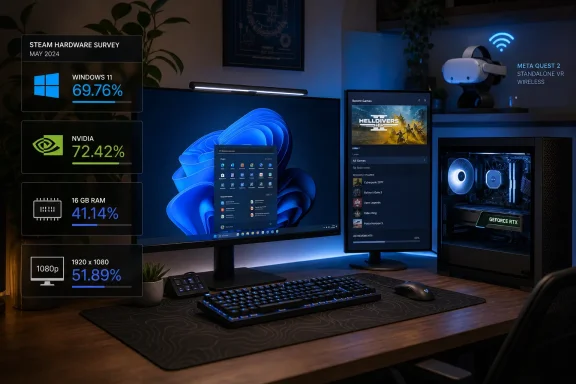
Valve’s latest Steam Hardware & Software Survey shows Windows 11 64-bit at 69.76 percent of surveyed Steam systems, Nvidia at 72.42 percent of GPUs, 16GB RAM as the most common memory configuration, and Meta’s Quest headsets leading VR usage. The numbers are not a census, and Steam’s opt-in methodology can wobble from month to month, but the direction is hard to miss. PC gaming is modernizing, yet it is not becoming the ultra-premium, 4K-first, flagship-GPU market that hardware marketing often imagines. The center of gravity remains practical, midrange, Windows-based, Nvidia-powered, and stubbornly 1080p.
The Steam survey has always been useful because it punctures the fantasy version of the PC market. Enthusiast discussion tends to orbit the newest GPU launch, the biggest OLED monitor, and the most expensive processor with a cache stack tall enough to need its own skyline. Steam’s data points somewhere more ordinary and more commercially important: the machine most people actually use.
That machine is not a museum piece. A Windows 11 share approaching 70 percent among surveyed Steam users tells us that the Windows gaming base has largely crossed the psychological upgrade line. Windows 10 is no longer the default assumption for developers aiming at the Steam audience, even if it remains significant enough that nobody sane can ignore it yet.
But this is not a clean leap into the bleeding edge. The most common memory tier is still 16GB, the dominant display resolution is still 1920x1080, and the most visible GPUs are not halo cards. They are parts with names like RTX 3060 and RTX 4060, the kind of hardware that ships in volume, appears in laptops, and survives because it hits a price-performance zone ordinary buyers can justify.
That is the central tension of the current PC gaming market. Gamers are moving forward, but not in the way platform vendors would prefer. They are adopting the new operating system, buying newer graphics cards, and using multi-core CPUs, while still clinging to the settings and resolutions that keep games smooth on affordable hardware.
That does not mean Windows 11’s success is purely passive. Modern CPU scheduling, security defaults, DirectStorage positioning, HDR improvements, and the general assumption that new gaming features will be validated first on Windows 11 all matter at the margins. The more important factor, however, is attrition. Old systems age out; new systems arrive with Windows 11; Steam records the result.
The 2.02 percentage-point increase cited in the latest figures is notable because it suggests momentum rather than mere stability. In consumer Windows adoption, Steam users have often behaved like an early-warning system. Gamers tend to upgrade hardware faster than office fleets, and they are less constrained by enterprise compatibility testing. When Windows 11 becomes the default on Steam, it signals where the broader enthusiast desktop is headed.
For developers, this changes the baseline. Windows 10 compatibility remains commercially necessary, but Windows 11 can increasingly be treated as the primary Windows environment rather than the awkward new target. The practical result is subtle: more testing time goes to Windows 11 quirks, more troubleshooting assumes Windows 11 settings, and more performance commentary starts from Windows 11 rather than explaining it as the alternative.
The irony is that Microsoft’s victory here is not necessarily a triumph of affection. Windows 11 still carries complaints about interface regressions, account prompts, hardware requirements, advertising surfaces, and the general sense that the operating system is more managed than owned. Steam’s numbers do not say gamers love Windows 11. They say gamers are now using it anyway.
This does not mean AMD is irrelevant. At 19.13 percent, Radeon remains a serious second platform, especially because consoles use AMD graphics architectures and because AMD’s CPU presence gives it an enormous role in the gaming ecosystem. Intel’s 8.05 percent GPU share is also not trivial, particularly when integrated graphics and newer Arc products are counted. But Steam’s GPU split explains why Nvidia features so heavily in PC game launch messaging.
The more interesting story is not simply that Nvidia leads. It is that Nvidia leads through the middle of the stack. The RTX 3060 desktop card remaining the single largest named GPU at 4.02 percent is a reminder that older midrange cards have long tails. The RTX 4060 laptop GPU at 3.99 percent and desktop RTX 4060 at 3.74 percent reinforce the same point: the market’s center is defined by mainstream parts, not flagship boards.
That matters for ray tracing, upscaling, frame generation, and VRAM pressure. The existence of expensive GPUs does not automatically make their capabilities a safe baseline for game design. A developer who builds around high-end assumptions risks colliding with the real Steam audience, where many users have capable but constrained hardware and expect games to scale.
The reported 3.09 percent share for the RTX 5070 is striking because it suggests rapid adoption of a newer generation part. But it should be read with caution. Steam survey results can fluctuate, and past months have produced odd jumps that looked less like clean market movement than sampling noise, regional effects, or cybercafé distortions. The direction may be real, but the exact tempo should not be mistaken for a quarterly shipment report.
That makes it a more meaningful design anchor than a flagship GPU. If a game is smooth and visually convincing on an RTX 3060-class machine, it has a fighting chance across a wide Steam audience. If it only becomes acceptable after leaning on top-end hardware, aggressive upscaling, or frame-generation tricks, it is heading for a bad launch conversation.
The laptop presence in the top GPU rankings is equally important. PC gaming is not just desktops under desks with 750-watt power supplies. It is also laptops plugged into external monitors, dorm-room machines, thin gaming notebooks, and portable systems with thermal ceilings that make “same GPU name” comparisons misleading. A laptop RTX 4060 is not simply a desktop RTX 4060 in a smaller shell; power limits and cooling matter.
This is where the hardware survey becomes a warning to game studios. The PC audience is diverse not only across brands, but across form factors and power envelopes. A GPU name alone does not guarantee a performance profile. The market is full of machines that support modern features but cannot brute-force poor optimization.
That is why “minimum requirements” increasingly feel divorced from user experience. A spec sheet can say a game runs on a certain GPU, but Steam’s data shows why the real question is whether it runs well on the cards people actually own. The difference between launch success and a review-bombed mess often lives in that gap.
For years, game developers had to be careful about assuming more than four strong cores. That caution is fading. Six cores now look like the safe mainstream target, while eight cores increasingly define the comfort zone for demanding games. The move is gradual, but it changes how engines schedule work and how reviewers should think about stutter, frame pacing, and minimum frame rates.
The Intel-versus-AMD split complicates the picture. On Windows, Intel reportedly sits at 55.02 percent of the Steam CPU user base, which keeps it in front overall. On Linux, AMD’s 67.03 percent share flips the story completely, reflecting the overlap between Linux gaming, enthusiast buyers, and AMD-friendly handheld or desktop configurations.
That Linux split matters more than its absolute market share might suggest. Linux gaming remains small compared with Windows, but it is strategically influential because of Steam Deck, Proton, and Valve’s ongoing effort to make Windows games less dependent on Windows. AMD’s strength in that subset reinforces the sense that the alternative gaming platform stack is being built around different hardware assumptions than the traditional Windows desktop.
Still, Windows remains the commercial center of gravity. For most PC game developers, the dominant test matrix remains Windows plus Nvidia plus a mainstream six- or eight-core CPU. That is not glamorous, but it is the practical shape of the market.
That number should make developers nervous when memory budgets creep upward. Modern games increasingly compete with launchers, overlays, browsers, chat clients, RGB utilities, capture software, and operating system services. A 16GB PC can still be perfectly capable, but it is not a blank canvas. Wasteful memory behavior becomes visible quickly.
The situation is even sharper for open-world games and engines that stream large assets. High-resolution textures, shader caches, geometry data, and background decompression can turn “16GB supported” into “16GB technically launches.” Players know the difference. Stutter, long loads, hitching, and aggressive texture pop-in all become part of the perceived quality of the game, not footnotes in a technical post.
At the same time, 16GB’s dominance should not be read as stagnation. It is the current mode, not the ceiling. As DDR5 platforms mature and newer systems ship with 32GB more often, the balance will continue to shift. But the transition period matters, and we are living in it.
For Windows users, this is also where operating system bloat becomes more than a complaint. Every background feature, widget surface, update service, security component, and resident app eats into the same memory pool games need. Microsoft can argue, correctly, that modern PCs have more RAM than they used to. Steam’s data replies: yes, but the largest group still has 16GB.
The more revealing detail is available space. If many users have only 100GB to 249GB free, developers and publishers should take that as a warning. A 150GB install may be survivable on paper, but it competes against a player’s existing library. When a game demands a huge install, it is not just asking for disk space; it is asking the user to delete something else.
This has commercial consequences. A bloated game becomes easier to postpone, uninstall, or avoid on a whim. The friction is not theoretical. Players with slower connections, data caps, or shared household networks feel every giant patch as a tax on their time.
The move to SSDs has softened some pain but created new expectations. Fast storage enables better streaming and shorter loads, but it also encourages developers to assume the drive can rescue asset-heavy designs. That assumption works until it meets a budget system with limited SSD capacity or a secondary hard drive still holding part of the library.
Steam’s storage figures suggest that capacity has caught up with modern gaming only partially. Users have bigger drives because games forced the issue, not because storage pressure disappeared. If anything, the survey shows how normalized the pressure has become.
That is not a failure of imagination by players. It is a rational trade-off. Competitive games benefit from frame rate and latency more than from pixel density, and many popular titles are designed to run well on modest systems. For a huge slice of the Steam audience, 1080p is not a compromise. It is the correct setting.
The multi-monitor data adds nuance. A 3840x1080 configuration leading among multi-display setups suggests many users are pairing two 1080p displays rather than moving wholesale into high-resolution single-panel territory. That fits the broader desktop reality: one screen for the game, one for Discord, browsers, streaming tools, guides, or monitoring software.
This matters for UI design. PC games increasingly need to behave well in multitasking environments. Borderless windowed modes, alt-tab stability, HDR handling, multi-monitor focus behavior, and sensible cursor capture are not luxuries. They are part of the everyday experience of a Steam user whose machine is both gaming rig and general-purpose computer.
The persistence of 1080p also complicates the visual arms race. Texture packs and ray-traced modes sell screenshots, but the most common display resolution rewards clarity, performance, and responsiveness. Developers who treat 1080p as an afterthought misunderstand the audience.
That does not mean PC VR is dead. High-end sims, modded experiences, racing rigs, flight setups, and enthusiast spaces still benefit from powerful desktops. But the mainstream VR buyer has voted for convenience. Wireless, self-contained devices have reduced the setup penalty that made earlier PC VR feel impressive but fragile.
Meta’s dominance also shows how platform control can matter more than raw fidelity. A standalone headset with a strong content library, a clear upgrade path, and optional PC connectivity is easier to recommend than a technically superior system with a narrower audience. The best headset for market share is not always the best headset in a lab.
For Windows gamers, this creates a split identity. The PC remains a performance source for VR, but not necessarily the center of the VR platform. A Quest headset may be used as a standalone console one day and a PC display the next. That hybrid behavior is harder to capture in traditional PC hardware narratives.
It also leaves Microsoft looking curiously absent. Windows remains the dominant PC gaming OS, but the VR market visible through Steam is being shaped by Meta’s hardware, not by a Microsoft-controlled mixed-reality strategy. The old Windows Mixed Reality era now looks less like a missed feature and more like a missed platform moment.
The RTX 5070’s recent volatility in past reports is a good reminder. When a GPU appears to surge or collapse in implausible ways, the responsible interpretation is not instant market revolution. It is caution. The Steam survey is most useful when read as a trend instrument over time, not as a precision accounting system.
That said, dismissing the survey because it is imperfect would be even more foolish. No public data source gives the same recurring, broad, platform-specific look at what active PC gamers are using. Developers, journalists, and hardware vendors all pay attention because the survey captures something real, even when individual months are noisy.
The right way to read the latest figures is as a portrait of constraints. The constraints are Windows 11’s growing dominance, Nvidia’s overwhelming GPU presence, 16GB RAM’s continued relevance, 1080p’s stubborn majority, and standalone VR’s practical victory. Those are not tiny artifacts. They are structural signals.
The survey does not tell us what enthusiasts want to buy next. It tells us what millions of players are likely to run tonight. For anyone making, optimizing, supporting, or buying PC games, that distinction matters.
That combination should shape how we evaluate the next year of PC releases.
The next turn of the cycle will bring more Windows 11 systems, more 32GB builds, more RTX 50-series cards, and more pressure for games to exploit faster storage and newer GPUs. But the Steam survey’s enduring value is its refusal to flatter the industry. It says the dominant gaming PC is not a showroom fantasy; it is a practical machine built from compromises, and the winners in the Windows gaming ecosystem will be the ones who optimize for that reality before the support forums have to explain it for them.
 The Typical Gaming PC Is Newer Than It Looks, But Less Exotic Than Advertised
The Steam survey has always been useful because it punctures the fantasy version of the PC market. Enthusiast discussion tends to orbit the newest GPU launch, the biggest OLED monitor, and the most expensive processor with a cache stack tall enough to need its own skyline. Steam’s data points somewhere more ordinary and more commercially important: the machine most people actually use.That machine is not a museum piece. A Windows 11 share approaching 70 percent among surveyed Steam users tells us that the Windows gaming base has largely crossed the psychological upgrade line. Windows 10 is no longer the default assumption for developers aiming at the Steam audience, even if it remains significant enough that nobody sane can ignore it yet.
But this is not a clean leap into the bleeding edge. The most common memory tier is still 16GB, the dominant display resolution is still 1920x1080, and the most visible GPUs are not halo cards. They are parts with names like RTX 3060 and RTX 4060, the kind of hardware that ships in volume, appears in laptops, and survives because it hits a price-performance zone ordinary buyers can justify.
That is the central tension of the current PC gaming market. Gamers are moving forward, but not in the way platform vendors would prefer. They are adopting the new operating system, buying newer graphics cards, and using multi-core CPUs, while still clinging to the settings and resolutions that keep games smooth on affordable hardware.
Windows 11 Has Won the Gaming Desktop, Mostly by Running Out the Clock
The rise of Windows 11 on Steam is not a mystery. Microsoft’s newest consumer operating system has had years to preinstall itself into the market through new PCs, and Windows 10’s support deadline has turned the upgrade path from a preference into a calendar problem. For gamers, the decision is rarely philosophical. If a new laptop or desktop came with Windows 11 and Steam works, the operating system battle is over.That does not mean Windows 11’s success is purely passive. Modern CPU scheduling, security defaults, DirectStorage positioning, HDR improvements, and the general assumption that new gaming features will be validated first on Windows 11 all matter at the margins. The more important factor, however, is attrition. Old systems age out; new systems arrive with Windows 11; Steam records the result.
The 2.02 percentage-point increase cited in the latest figures is notable because it suggests momentum rather than mere stability. In consumer Windows adoption, Steam users have often behaved like an early-warning system. Gamers tend to upgrade hardware faster than office fleets, and they are less constrained by enterprise compatibility testing. When Windows 11 becomes the default on Steam, it signals where the broader enthusiast desktop is headed.
For developers, this changes the baseline. Windows 10 compatibility remains commercially necessary, but Windows 11 can increasingly be treated as the primary Windows environment rather than the awkward new target. The practical result is subtle: more testing time goes to Windows 11 quirks, more troubleshooting assumes Windows 11 settings, and more performance commentary starts from Windows 11 rather than explaining it as the alternative.
The irony is that Microsoft’s victory here is not necessarily a triumph of affection. Windows 11 still carries complaints about interface regressions, account prompts, hardware requirements, advertising surfaces, and the general sense that the operating system is more managed than owned. Steam’s numbers do not say gamers love Windows 11. They say gamers are now using it anyway.
Nvidia’s Lead Is Not Just Market Share, It Is Developer Gravity
Nvidia’s 72.42 percent share of surveyed Steam GPUs is the kind of number that reshapes decisions before anyone opens a spreadsheet. When one graphics vendor accounts for nearly three quarters of the visible PC gaming base, developers optimize for that reality. Game engines, driver testing, support scripts, performance presets, and marketing partnerships all bend toward the installed base.This does not mean AMD is irrelevant. At 19.13 percent, Radeon remains a serious second platform, especially because consoles use AMD graphics architectures and because AMD’s CPU presence gives it an enormous role in the gaming ecosystem. Intel’s 8.05 percent GPU share is also not trivial, particularly when integrated graphics and newer Arc products are counted. But Steam’s GPU split explains why Nvidia features so heavily in PC game launch messaging.
The more interesting story is not simply that Nvidia leads. It is that Nvidia leads through the middle of the stack. The RTX 3060 desktop card remaining the single largest named GPU at 4.02 percent is a reminder that older midrange cards have long tails. The RTX 4060 laptop GPU at 3.99 percent and desktop RTX 4060 at 3.74 percent reinforce the same point: the market’s center is defined by mainstream parts, not flagship boards.
That matters for ray tracing, upscaling, frame generation, and VRAM pressure. The existence of expensive GPUs does not automatically make their capabilities a safe baseline for game design. A developer who builds around high-end assumptions risks colliding with the real Steam audience, where many users have capable but constrained hardware and expect games to scale.
The reported 3.09 percent share for the RTX 5070 is striking because it suggests rapid adoption of a newer generation part. But it should be read with caution. Steam survey results can fluctuate, and past months have produced odd jumps that looked less like clean market movement than sampling noise, regional effects, or cybercafé distortions. The direction may be real, but the exact tempo should not be mistaken for a quarterly shipment report.
The RTX 3060 Still Explains More About PC Gaming Than the RTX 5090 Ever Will
Hardware companies sell aspiration, but developers ship to medians. The continuing visibility of the RTX 3060 is important precisely because it is boring. It is a widely owned card with enough performance to remain viable, enough VRAM in many configurations to avoid immediate obsolescence, and enough feature support to run modern engines without being treated as legacy hardware.That makes it a more meaningful design anchor than a flagship GPU. If a game is smooth and visually convincing on an RTX 3060-class machine, it has a fighting chance across a wide Steam audience. If it only becomes acceptable after leaning on top-end hardware, aggressive upscaling, or frame-generation tricks, it is heading for a bad launch conversation.
The laptop presence in the top GPU rankings is equally important. PC gaming is not just desktops under desks with 750-watt power supplies. It is also laptops plugged into external monitors, dorm-room machines, thin gaming notebooks, and portable systems with thermal ceilings that make “same GPU name” comparisons misleading. A laptop RTX 4060 is not simply a desktop RTX 4060 in a smaller shell; power limits and cooling matter.
This is where the hardware survey becomes a warning to game studios. The PC audience is diverse not only across brands, but across form factors and power envelopes. A GPU name alone does not guarantee a performance profile. The market is full of machines that support modern features but cannot brute-force poor optimization.
That is why “minimum requirements” increasingly feel divorced from user experience. A spec sheet can say a game runs on a certain GPU, but Steam’s data shows why the real question is whether it runs well on the cards people actually own. The difference between launch success and a review-bombed mess often lives in that gap.
Six and Eight Cores Are the New Sensible Center
The CPU data tells a quieter but equally important story. Six-core processors at 28.94 percent and eight-core processors at 27.31 percent suggest that the old quad-core baseline has finally been displaced in the gaming mainstream. This is not just a victory for spec-sheet inflation. It reflects a real shift in how modern systems absorb background tasks, launcher overhead, shader compilation, voice chat, browser windows, anti-cheat services, and the game itself.For years, game developers had to be careful about assuming more than four strong cores. That caution is fading. Six cores now look like the safe mainstream target, while eight cores increasingly define the comfort zone for demanding games. The move is gradual, but it changes how engines schedule work and how reviewers should think about stutter, frame pacing, and minimum frame rates.
The Intel-versus-AMD split complicates the picture. On Windows, Intel reportedly sits at 55.02 percent of the Steam CPU user base, which keeps it in front overall. On Linux, AMD’s 67.03 percent share flips the story completely, reflecting the overlap between Linux gaming, enthusiast buyers, and AMD-friendly handheld or desktop configurations.
That Linux split matters more than its absolute market share might suggest. Linux gaming remains small compared with Windows, but it is strategically influential because of Steam Deck, Proton, and Valve’s ongoing effort to make Windows games less dependent on Windows. AMD’s strength in that subset reinforces the sense that the alternative gaming platform stack is being built around different hardware assumptions than the traditional Windows desktop.
Still, Windows remains the commercial center of gravity. For most PC game developers, the dominant test matrix remains Windows plus Nvidia plus a mainstream six- or eight-core CPU. That is not glamorous, but it is the practical shape of the market.
16GB RAM Is Still the Baseline, Not the Past
The persistence of 16GB RAM at 41.14 percent is one of the survey’s most important reality checks. In enthusiast circles, 32GB is often treated as the new normal, and for new builds it is increasingly the sensible recommendation. But installed bases move slowly. Steam’s current snapshot says the biggest single audience still has 16GB.That number should make developers nervous when memory budgets creep upward. Modern games increasingly compete with launchers, overlays, browsers, chat clients, RGB utilities, capture software, and operating system services. A 16GB PC can still be perfectly capable, but it is not a blank canvas. Wasteful memory behavior becomes visible quickly.
The situation is even sharper for open-world games and engines that stream large assets. High-resolution textures, shader caches, geometry data, and background decompression can turn “16GB supported” into “16GB technically launches.” Players know the difference. Stutter, long loads, hitching, and aggressive texture pop-in all become part of the perceived quality of the game, not footnotes in a technical post.
At the same time, 16GB’s dominance should not be read as stagnation. It is the current mode, not the ceiling. As DDR5 platforms mature and newer systems ship with 32GB more often, the balance will continue to shift. But the transition period matters, and we are living in it.
For Windows users, this is also where operating system bloat becomes more than a complaint. Every background feature, widget surface, update service, security component, and resident app eats into the same memory pool games need. Microsoft can argue, correctly, that modern PCs have more RAM than they used to. Steam’s data replies: yes, but the largest group still has 16GB.
Storage Capacity Has Grown Because Games Made It Non-Negotiable
The storage data is a monument to game size inflation. More than half of surveyed systems reportedly have over 1TB of total drive space, which would have seemed extravagant in an earlier era but now feels almost mandatory. Install a few blockbuster games, keep Windows updated, leave room for shader caches and downloads, and a smaller drive begins to feel cramped very quickly.The more revealing detail is available space. If many users have only 100GB to 249GB free, developers and publishers should take that as a warning. A 150GB install may be survivable on paper, but it competes against a player’s existing library. When a game demands a huge install, it is not just asking for disk space; it is asking the user to delete something else.
This has commercial consequences. A bloated game becomes easier to postpone, uninstall, or avoid on a whim. The friction is not theoretical. Players with slower connections, data caps, or shared household networks feel every giant patch as a tax on their time.
The move to SSDs has softened some pain but created new expectations. Fast storage enables better streaming and shorter loads, but it also encourages developers to assume the drive can rescue asset-heavy designs. That assumption works until it meets a budget system with limited SSD capacity or a secondary hard drive still holding part of the library.
Steam’s storage figures suggest that capacity has caught up with modern gaming only partially. Users have bigger drives because games forced the issue, not because storage pressure disappeared. If anything, the survey shows how normalized the pressure has become.
1080p Refuses to Die Because Performance Still Wins
The dominance of 1920x1080 at 51.89 percent is the survey’s bluntest message to monitor makers and GPU marketers. The PC gaming mainstream is not 4K. It is not even uniformly 1440p. It is still Full HD, because Full HD remains the easiest way to get high frame rates from affordable hardware.That is not a failure of imagination by players. It is a rational trade-off. Competitive games benefit from frame rate and latency more than from pixel density, and many popular titles are designed to run well on modest systems. For a huge slice of the Steam audience, 1080p is not a compromise. It is the correct setting.
The multi-monitor data adds nuance. A 3840x1080 configuration leading among multi-display setups suggests many users are pairing two 1080p displays rather than moving wholesale into high-resolution single-panel territory. That fits the broader desktop reality: one screen for the game, one for Discord, browsers, streaming tools, guides, or monitoring software.
This matters for UI design. PC games increasingly need to behave well in multitasking environments. Borderless windowed modes, alt-tab stability, HDR handling, multi-monitor focus behavior, and sensible cursor capture are not luxuries. They are part of the everyday experience of a Steam user whose machine is both gaming rig and general-purpose computer.
The persistence of 1080p also complicates the visual arms race. Texture packs and ray-traced modes sell screenshots, but the most common display resolution rewards clarity, performance, and responsiveness. Developers who treat 1080p as an afterthought misunderstand the audience.
VR Belongs to Meta Because the PC Cable Lost the Mainstream
The VR figures are perhaps the clearest sign that the old PC-tethered dream lost the mass market argument. Meta Quest 3 at 28.63 percent, Quest 2 at 22.88 percent, and Quest 3S at 13.23 percent point to a VR ecosystem dominated by standalone headsets that can connect to PCs but do not depend on them. The headset that wins is the one that works without turning the living room into a cable-management project.That does not mean PC VR is dead. High-end sims, modded experiences, racing rigs, flight setups, and enthusiast spaces still benefit from powerful desktops. But the mainstream VR buyer has voted for convenience. Wireless, self-contained devices have reduced the setup penalty that made earlier PC VR feel impressive but fragile.
Meta’s dominance also shows how platform control can matter more than raw fidelity. A standalone headset with a strong content library, a clear upgrade path, and optional PC connectivity is easier to recommend than a technically superior system with a narrower audience. The best headset for market share is not always the best headset in a lab.
For Windows gamers, this creates a split identity. The PC remains a performance source for VR, but not necessarily the center of the VR platform. A Quest headset may be used as a standalone console one day and a PC display the next. That hybrid behavior is harder to capture in traditional PC hardware narratives.
It also leaves Microsoft looking curiously absent. Windows remains the dominant PC gaming OS, but the VR market visible through Steam is being shaped by Meta’s hardware, not by a Microsoft-controlled mixed-reality strategy. The old Windows Mixed Reality era now looks less like a missed feature and more like a missed platform moment.
Steam’s Survey Is a Compass, Not a Court Transcript
The temptation with the Steam Hardware Survey is to treat every percentage point as a verdict. That is a mistake. Valve’s survey is optional, anonymous, and subject to sampling quirks. Regional usage patterns, cybercafés, hardware detection oddities, and short-term participation changes can all distort month-to-month comparisons.The RTX 5070’s recent volatility in past reports is a good reminder. When a GPU appears to surge or collapse in implausible ways, the responsible interpretation is not instant market revolution. It is caution. The Steam survey is most useful when read as a trend instrument over time, not as a precision accounting system.
That said, dismissing the survey because it is imperfect would be even more foolish. No public data source gives the same recurring, broad, platform-specific look at what active PC gamers are using. Developers, journalists, and hardware vendors all pay attention because the survey captures something real, even when individual months are noisy.
The right way to read the latest figures is as a portrait of constraints. The constraints are Windows 11’s growing dominance, Nvidia’s overwhelming GPU presence, 16GB RAM’s continued relevance, 1080p’s stubborn majority, and standalone VR’s practical victory. Those are not tiny artifacts. They are structural signals.
The survey does not tell us what enthusiasts want to buy next. It tells us what millions of players are likely to run tonight. For anyone making, optimizing, supporting, or buying PC games, that distinction matters.
The Market’s Real Spec Sheet Is Written in Compromise
The current Steam snapshot points to a PC gaming market that is modern but not maximalist. It has moved to Windows 11 faster than many desktop traditionalists expected, but it has not moved to 4K in the same way. It buys Nvidia in overwhelming numbers, but mostly through mainstream cards. It has embraced multi-core CPUs, but it still asks 16GB of RAM to do a lot of work.That combination should shape how we evaluate the next year of PC releases.
- Game developers should treat Windows 11 as the primary Windows target while keeping Windows 10 support realistic until the remaining audience shrinks further.
- Performance testing should prioritize mainstream Nvidia GPUs, especially RTX 3060- and RTX 4060-class systems, rather than treating flagship results as representative.
- Six-core and eight-core CPUs now look like the practical gaming mainstream, but poor shader compilation and background task handling can still punish otherwise capable machines.
- 16GB RAM remains too common for developers to behave as though 32GB is already universal.
- 1080p is still the default Steam resolution, so visual settings and user interfaces must be tuned for clarity and performance at Full HD.
- VR developers should assume Meta Quest headsets define the reachable audience, even when PC connectivity remains part of the experience.
The next turn of the cycle will bring more Windows 11 systems, more 32GB builds, more RTX 50-series cards, and more pressure for games to exploit faster storage and newer GPUs. But the Steam survey’s enduring value is its refusal to flatter the industry. It says the dominant gaming PC is not a showroom fantasy; it is a practical machine built from compromises, and the winners in the Windows gaming ecosystem will be the ones who optimize for that reality before the support forums have to explain it for them.
References
- Primary source: Technetbook
Published: 2026-06-06T16:35:23.177249
Steam Hardware Survey Analysis reveals Dominant PC Gaming Configurations | Technetbook
An analysis of the latest Steam hardware and software survey telemetry, detailing GPU market share, processor trends, and VR headset adoption.www.technetbooks.com
- Related coverage: pcgamesn.com
PC RAM prices are so high that gaming PCs with 32GB just dropped 20% on Steam - PCGamesN
According to the latest Steam Hardware Survey for March 2026, the proportion of PCs using Steam with 32GB of memory plummeted last month.www.pcgamesn.com - Related coverage: digitalcitizen.life
Steam’s April survey shows many PC gamers are still holding onto older hardware
Steam’s April 2026 Hardware and Software Survey shows a clear split in PC gaming. New hardware keeps arriving, but many players are still using older GPUs, 16GB RAM, and Windows 10. That matters because it affects what developers can realistically target when building modern PC games. Windows is...www.digitalcitizen.life
- Related coverage: techspot.com
Steam's hardware survey just flipped: new top GPU, Windows 11 crashes, Chinese takes the lead | TechSpot
Valve said last week that it fixed an issue where VRAM on some graphics cards was not reported correctly in the Steam survey.www.techspot.com - Related coverage: tech.news.am
The most popular gaming PC specs on Steam, August 2025 | NEWS.am TECH - Innovations and science
The most popular GPU is the NVIDIA GeForce RTX 4060, found in 4.85% of gaming systems...tech.news.am - Related coverage: windowsreport.com
Valve Steam Survey April 2026: Windows 11 Grows, Mid-Range PCs Still Dominate
Steam Survey April 2026 shows Windows 11 at 67.74%, RTX 3060 still leads, and 16GB RAM remains the standard windowsreport.com
- Related coverage: digitaltrends.com
Steam survey shows PC gamers are still mostly playing in 1080p and lower - Digital Trends
Valve Software’s latest hardware and software survey for July 2reveals that 63.72 percent of Steam’s registered members still play games with a 1080p resolution. Even more, only 1.14 percent are playing at a 4K resolution.www.digitaltrends.com - Related coverage: pcgamer.com
Valve says the Steam Machine is better than what 70% of PC gamers have at home, a convenient reminder that not all gaming PCs are monster rigs | PC Gamer
All well and good, if the price is right.www.pcgamer.com - Related coverage: pcpartsgeek.com
Gaming PC Statistics (2026) - PCPartsGeek
Gaming PC statistics are easiest to understand in two layers: (1) how many gaming PCs (and gaming monitors) ship, and (2) what “typical” gaming PC hardwarepcpartsgeek.com - Related coverage: tomshardware.com
AMD CPUs surpass the 40% threshold in latest Steam hardware survey — RTX 5070 emerges as the most preferred GPU within the Blackwell series | Tom's Hardware
Intel’s lead shrinks as gamers increasingly embrace AMD’s 3D V-Cache CPUswww.tomshardware.com - Related coverage: windowscentral.com
Windows 11 surges on Steam — Windows 10 won’t die | Windows Central
Windows 11’s momentum on Steam looks good on paper, but nearly a third of players are still clinging to Windows 10.www.windowscentral.com - Related coverage: principledtechnologies.com
- Related coverage: news.lenovo.com
