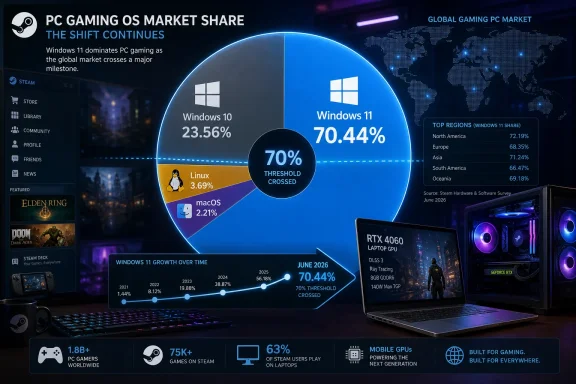
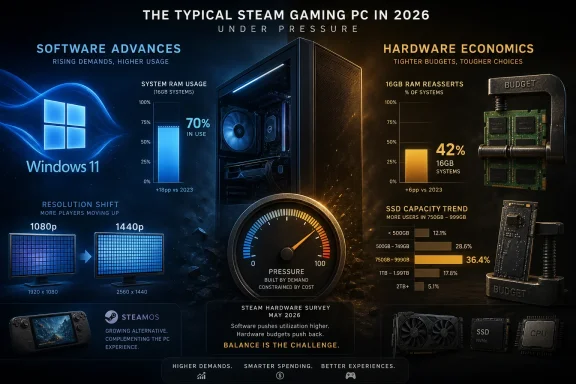
Valve’s June 2026 Steam Hardware and Software Survey shows Windows 11 passing 70 percent of surveyed Steam users, 1080p slipping toward 51 percent, 1440p-class displays gaining ground, and 16GB RAM reasserting itself as the most common gaming PC memory configuration. The headline is not that PC gaming suddenly changed direction. It is that the “average Steam PC” is being squeezed from two sides at once: software platforms are moving forward, while memory and storage economics are dragging hardware ambition back toward the middle.
That makes June’s survey more interesting than a routine month-to-month chart shuffle. Steam’s survey is not a census, and its randomized sampling can produce odd swings, but it remains one of the best public instruments for watching the consumer PC gaming market breathe. This month, the signal is clear enough: the Windows gaming base is modernizing, but the machine under the desk is becoming more cost-conscious.
Windows 11 crossing the 70 percent line among surveyed Steam users is a symbolic milestone, but not a surprising one. Gamers tend to move faster than office fleets, and Windows 10’s long glide path toward retirement has made the upgrade decision feel less optional with every passing month.
The more telling number is Windows 10’s reported slide to roughly 24 percent. That is still a large population, especially in Steam terms, but it no longer looks like a rival platform inside PC gaming. It looks like a residue: older systems, unsupported CPUs, cautious users, and machines whose owners see no reason to disturb a working setup until a game, driver, or security prompt forces the issue.
For Microsoft, this is the part of the Windows 11 transition that worked. The gaming ecosystem has largely accepted the new baseline, aided by DirectX 12-era assumptions, newer CPU scheduling behavior, TPM-era hardware requirements, and the fact that most new gaming laptops and prebuilt desktops simply arrive with Windows 11 installed. The operating system did not need to be loved. It needed to become normal.
That does not mean Windows 11’s gaming story is spotless. Enthusiasts still complain about interface churn, account pressure, telemetry, ads, and the strange feeling that Windows is sometimes a storefront wearing an operating-system costume. But Steam users have voted with installation share, and the vote says that Windows 11 is now the default Windows gaming environment.
That is why the arrival of new SteamOS hardware matters more than any single month’s Linux movement. A handheld creates Linux users by selling them a finished appliance. A living-room Steam Machine would try to do the same thing in a harder category, where buyers compare it against consoles, Windows desktops, and the old dream of a quiet PC under the television.
The problem is that SteamOS’s success is not just technical. Proton is good enough that many games feel boringly normal on Linux, which is the highest compliment compatibility software can earn. The harder question is whether Valve and its partners can sell enough devices at the right prices while component costs, especially memory and storage, are working against them.
That makes June’s Linux dip less a verdict than a warning. SteamOS can keep expanding, but not by moral victory. It needs hardware that ordinary buyers actually want, at prices that do not make a PlayStation, Xbox, or discounted Windows laptop look like the saner purchase.
Digital Foundry’s reading of the data puts 16GB at about 42 percent of surveyed users after a half-point rise, with 32GB second at roughly 37 percent and 64GB far behind at around four percent. In a healthier upgrade market, that would look like a transitional chart: 16GB slowly declining, 32GB rising, and 64GB growing from workstation luxury into high-end gaming indulgence. June instead looks like a market tapping the brakes.
That matters because RAM used to be the easy upgrade. Compared with a GPU, monitor, or platform overhaul, memory was a relatively painless way to extend a system’s life. If prices rise sharply, the cheapest “future-proofing” move disappears, and builders start making compromises they would have mocked a year earlier.
The consequences are not abstract. Modern games increasingly assume more memory headroom, especially when paired with browser tabs, launchers, capture software, chat clients, RGB utilities, anti-cheat services, and the other barnacles of a real gaming PC. A 16GB system is still viable, but the margin is thinner than it used to be.
PC gaming has lived through a decade in which storage expectations inflated with astonishing speed. A single blockbuster can eat more than 100GB. Live-service games sprawl through seasonal updates. Shader caches, mods, capture folders, and duplicated launchers turn free space into a resource that vanishes in chunks rather than drips.
For years, the answer was simple: buy another SSD. That answer is less simple when NAND pricing and broader component constraints make storage upgrades feel less like impulse buys. Users who might once have added a 2TB NVMe drive may now uninstall aggressively, defer purchases, or settle for smaller primary drives in new builds.
This changes the way people experience the PC as a platform. The PC’s great advantage has always been abundance: more games installed, more mods, more settings, more multitasking, more everything. When storage gets tight, the platform starts to feel more console-like, not because Windows has become simpler, but because users are forced into curation.
That is because 1440p occupies the sweet spot that 4K still struggles to own in PC gaming. It is visibly sharper than 1080p, works well on common 27-inch panels, and does not require the same brute-force GPU budget as high-refresh 4K. Add upscaling technologies, frame generation, better midrange GPUs, and increasingly affordable monitors, and 1440p becomes the place where many users can feel an upgrade without rebuilding the whole system.
The 2560×1600 number is also worth watching because it reflects the laptop side of the market. The 16:10 display has become one of the better trends in modern notebook design, giving users more vertical space without turning machines into oddball productivity slabs. Gaming laptops helped normalize that resolution class, and Steam’s survey is picking up the result.
Still, 1080p is not going away quickly. It remains cheap, fast, easy to drive, and perfectly adequate for competitive gaming. The point is not that 1080p is dead; it is that 1440p is increasingly the place where “normal” starts to move.
There is a quiet platform consequence here. As low-VRAM cards decline, developers get a little more room to raise texture expectations, cache more data, and build for modern rendering techniques. The installed base still contains plenty of modest hardware, but the worst constraints are slowly aging out.
The 16GB VRAM category reaching roughly a quarter of surveyed users is especially notable. That does not mean a quarter of Steam users own flagship-class GPUs; VRAM reporting, integrated graphics, mobile parts, and survey quirks can complicate clean interpretation. But it does indicate that large memory buffers are no longer rare in the gaming population.
This is where the PC market looks split. GPU capability is moving upward in the expected way, while system memory and storage are showing signs of economic resistance. The result is a strange machine: a PC that may be better at rendering 1440p frames than it is at keeping every modern game installed comfortably.
For games, six good cores are still enough more often than not. The persistence of six-core CPUs shows how long a competent platform can remain useful, especially when paired with a GPU upgrade. The desktop PC has always been good at this kind of asymmetry: users replace the graphics card and carry the CPU forward until the motherboard, memory standard, or operating-system requirements finally force a bigger move.
The rise of higher-core parts is nevertheless important. Modern gaming PCs are not just game boxes. They stream, encode, decompress, compile shaders, run voice chat, host browser tabs, and occasionally pretend to be workstations. Extra cores may not always raise the average frame rate, but they improve the odds that the system feels smooth while everything else is happening.
That matters for Windows 11 too. Microsoft’s current OS lives in a world of background services, security layers, widgets, sync engines, and update mechanisms. A higher-core CPU gives Windows more room to be Windows without immediately colliding with the game.
That matters because regional shifts can move hardware statistics even when individual users do not change anything. If a larger share of responses comes from a market with different café usage, laptop penetration, component pricing, display preferences, or upgrade timing, the global chart changes. The Steam survey is useful, but it is not a lab instrument sealed against demographic drift.
This is one reason to be cautious about overreading any single month. A half-point change in RAM or a one-point change in display resolution may reflect real buying behavior, sampling variation, regional mix, or all three. The survey is best treated as a weather map, not a land registry.
But weather maps are useful precisely because they reveal pressure systems. June’s pressure system is coherent: Windows 11 keeps advancing, 1440p keeps climbing, and component costs are steering users toward more conservative memory and storage configurations.
There is now a widening gap between the machine developers want to target, the machine enthusiasts discuss online, and the machine many users actually own. A developer may look at 16GB RAM and 8GB VRAM as an uncomfortable floor. An enthusiast may consider 32GB RAM and 12GB or 16GB VRAM the sensible middle. A budget buyer may be trying to stretch an older system through another year because RAM and SSD prices have made a planned upgrade less attractive.
Windows 11’s dominance does not erase that fragmentation. In some ways, it sharpens it. The OS may be modern, but the hardware beneath it spans everything from aging 1080p desktops to high-refresh 1440p rigs and premium laptops with dense 16:10 panels.
This is the paradox of the PC in 2026. The platform is technologically healthier than it has been in years, with better upscaling, better handheld compatibility, better driver maturity, and a broader range of form factors. Yet the economic foundation feels less stable, because the mundane parts of the build — RAM and storage — have become strategic constraints.
Minimum specs are not just a marketing line. They shape refund rates, review sentiment, support costs, and the first weekend reputation of a PC release. A game that technically launches on 16GB RAM but stutters under real-world background load will be judged by the experience, not the footnote.
Storage footprint is equally dangerous. PC players have become more tolerant of large installs, but tolerance is not infinite. When users are juggling fewer terabytes than expected, a 150GB download becomes a purchase objection, especially for a game they are not sure they will keep playing.
The smarter path is not to freeze ambition at 2018 levels. It is to scale intelligently: better texture options, clearer install-size choices, optional high-resolution packs, honest RAM guidance, and shader-compilation behavior that respects ordinary machines. The Steam survey is telling developers that the mainstream PC is improving, but not in every dimension at the same speed.
Valve, however, owns the map that lets everyone see the transition. The Steam survey remains powerful because it sits at the intersection of software, hardware, geography, and gamer behavior. Even with sampling caveats, it provides a public counterweight to vendor anecdotes and marketing decks.
That is also why the survey can be uncomfortable. It shows that the industry’s preferred narrative — more cores, more pixels, more memory, more storage — is only partly true. Users are upgrading where the value proposition is obvious and hesitating where pricing has turned ugly.
The companies that understand that split will have an advantage. A monitor maker selling 1440p panels into a maturing mainstream has a clean story. A memory vendor or SSD maker facing price-sensitive buyers has a harder one. Microsoft can celebrate Windows 11 adoption, but the PC ecosystem still has to sell users the hardware that makes the OS feel new.
That makes June’s survey more interesting than a routine month-to-month chart shuffle. Steam’s survey is not a census, and its randomized sampling can produce odd swings, but it remains one of the best public instruments for watching the consumer PC gaming market breathe. This month, the signal is clear enough: the Windows gaming base is modernizing, but the machine under the desk is becoming more cost-conscious.
 Windows 11 Has Won the Steam Argument Before Windows 10 Fully Leaves the Stage
Windows 11 crossing the 70 percent line among surveyed Steam users is a symbolic milestone, but not a surprising one. Gamers tend to move faster than office fleets, and Windows 10’s long glide path toward retirement has made the upgrade decision feel less optional with every passing month.The more telling number is Windows 10’s reported slide to roughly 24 percent. That is still a large population, especially in Steam terms, but it no longer looks like a rival platform inside PC gaming. It looks like a residue: older systems, unsupported CPUs, cautious users, and machines whose owners see no reason to disturb a working setup until a game, driver, or security prompt forces the issue.
For Microsoft, this is the part of the Windows 11 transition that worked. The gaming ecosystem has largely accepted the new baseline, aided by DirectX 12-era assumptions, newer CPU scheduling behavior, TPM-era hardware requirements, and the fact that most new gaming laptops and prebuilt desktops simply arrive with Windows 11 installed. The operating system did not need to be loved. It needed to become normal.
That does not mean Windows 11’s gaming story is spotless. Enthusiasts still complain about interface churn, account pressure, telemetry, ads, and the strange feeling that Windows is sometimes a storefront wearing an operating-system costume. But Steam users have voted with installation share, and the vote says that Windows 11 is now the default Windows gaming environment.
The Linux Dip Is a Reminder That SteamOS Is Still a Hardware Story
The reported Linux decline to around four percent deserves careful handling. Linux gaming is no longer a novelty, and Proton has permanently changed what is possible outside Windows. But Steam’s Linux share is still heavily tied to hardware distribution, especially the Steam Deck and whatever Valve chooses to ship next.That is why the arrival of new SteamOS hardware matters more than any single month’s Linux movement. A handheld creates Linux users by selling them a finished appliance. A living-room Steam Machine would try to do the same thing in a harder category, where buyers compare it against consoles, Windows desktops, and the old dream of a quiet PC under the television.
The problem is that SteamOS’s success is not just technical. Proton is good enough that many games feel boringly normal on Linux, which is the highest compliment compatibility software can earn. The harder question is whether Valve and its partners can sell enough devices at the right prices while component costs, especially memory and storage, are working against them.
That makes June’s Linux dip less a verdict than a warning. SteamOS can keep expanding, but not by moral victory. It needs hardware that ordinary buyers actually want, at prices that do not make a PlayStation, Xbox, or discounted Windows laptop look like the saner purchase.
The RAM Story Has Turned From Upgrade Path to Price Signal
The most striking hardware reading in June is not that 16GB remains the most common memory configuration. It is that 16GB appears to be re-establishing itself after years in which 32GB felt ready to become the enthusiast default.Digital Foundry’s reading of the data puts 16GB at about 42 percent of surveyed users after a half-point rise, with 32GB second at roughly 37 percent and 64GB far behind at around four percent. In a healthier upgrade market, that would look like a transitional chart: 16GB slowly declining, 32GB rising, and 64GB growing from workstation luxury into high-end gaming indulgence. June instead looks like a market tapping the brakes.
That matters because RAM used to be the easy upgrade. Compared with a GPU, monitor, or platform overhaul, memory was a relatively painless way to extend a system’s life. If prices rise sharply, the cheapest “future-proofing” move disappears, and builders start making compromises they would have mocked a year earlier.
The consequences are not abstract. Modern games increasingly assume more memory headroom, especially when paired with browser tabs, launchers, capture software, chat clients, RGB utilities, anti-cheat services, and the other barnacles of a real gaming PC. A 16GB system is still viable, but the margin is thinner than it used to be.
Storage Is Where the PC’s Comfort Zone Is Quietly Shrinking
The storage numbers tell a similar story with a different texture. Systems with more than 1TB of total storage reportedly slipped below the 50 percent mark, while the 750GB-to-999GB range grew toward a quarter of users. That category is awkward because it can include nominal 1TB drives once formatting and reporting quirks enter the picture, but the direction still matters.PC gaming has lived through a decade in which storage expectations inflated with astonishing speed. A single blockbuster can eat more than 100GB. Live-service games sprawl through seasonal updates. Shader caches, mods, capture folders, and duplicated launchers turn free space into a resource that vanishes in chunks rather than drips.
For years, the answer was simple: buy another SSD. That answer is less simple when NAND pricing and broader component constraints make storage upgrades feel less like impulse buys. Users who might once have added a 2TB NVMe drive may now uninstall aggressively, defer purchases, or settle for smaller primary drives in new builds.
This changes the way people experience the PC as a platform. The PC’s great advantage has always been abundance: more games installed, more mods, more settings, more multitasking, more everything. When storage gets tight, the platform starts to feel more console-like, not because Windows has become simpler, but because users are forced into curation.
1440p Is Becoming the Sensible Upgrade, Not the Luxury One
The monitor shift is the happiest part of the June data. 1080p remains dominant at roughly 51 percent, but its decline alongside gains for 2560×1440 and 2560×1600 suggests the long-predicted 1440p migration is no longer confined to spec-sheet enthusiasts. It is becoming the mainstream upgrade path.That is because 1440p occupies the sweet spot that 4K still struggles to own in PC gaming. It is visibly sharper than 1080p, works well on common 27-inch panels, and does not require the same brute-force GPU budget as high-refresh 4K. Add upscaling technologies, frame generation, better midrange GPUs, and increasingly affordable monitors, and 1440p becomes the place where many users can feel an upgrade without rebuilding the whole system.
The 2560×1600 number is also worth watching because it reflects the laptop side of the market. The 16:10 display has become one of the better trends in modern notebook design, giving users more vertical space without turning machines into oddball productivity slabs. Gaming laptops helped normalize that resolution class, and Steam’s survey is picking up the result.
Still, 1080p is not going away quickly. It remains cheap, fast, easy to drive, and perfectly adequate for competitive gaming. The point is not that 1080p is dead; it is that 1440p is increasingly the place where “normal” starts to move.
The GPU Market Looks Healthier Than the Memory Market
The GPU figures described in the June survey suggest a more ordinary upgrade cycle than the RAM and storage numbers. Older 2GB, 3GB, and 4GB VRAM cards lost share, while 6GB, 12GB, and 16GB classes gained. That is what progress looks like when it is not being interrupted by a pricing shock.There is a quiet platform consequence here. As low-VRAM cards decline, developers get a little more room to raise texture expectations, cache more data, and build for modern rendering techniques. The installed base still contains plenty of modest hardware, but the worst constraints are slowly aging out.
The 16GB VRAM category reaching roughly a quarter of surveyed users is especially notable. That does not mean a quarter of Steam users own flagship-class GPUs; VRAM reporting, integrated graphics, mobile parts, and survey quirks can complicate clean interpretation. But it does indicate that large memory buffers are no longer rare in the gaming population.
This is where the PC market looks split. GPU capability is moving upward in the expected way, while system memory and storage are showing signs of economic resistance. The result is a strange machine: a PC that may be better at rendering 1440p frames than it is at keeping every modern game installed comfortably.
CPU Core Counts Are Creeping Up While the Six-Core Era Refuses to Die
June’s CPU movement also fits the slow-upgrade story. Six-core CPUs remain a major category, but they reportedly gave up share while 14-core and 16-core chips gained. That reflects the replacement cycle rather than a sudden new requirement.For games, six good cores are still enough more often than not. The persistence of six-core CPUs shows how long a competent platform can remain useful, especially when paired with a GPU upgrade. The desktop PC has always been good at this kind of asymmetry: users replace the graphics card and carry the CPU forward until the motherboard, memory standard, or operating-system requirements finally force a bigger move.
The rise of higher-core parts is nevertheless important. Modern gaming PCs are not just game boxes. They stream, encode, decompress, compile shaders, run voice chat, host browser tabs, and occasionally pretend to be workstations. Extra cores may not always raise the average frame rate, but they improve the odds that the system feels smooth while everything else is happening.
That matters for Windows 11 too. Microsoft’s current OS lives in a world of background services, security layers, widgets, sync engines, and update mechanisms. A higher-core CPU gives Windows more room to be Windows without immediately colliding with the game.
Language Shifts Show Steam Is Not One Market
The reported language movement is a reminder that Steam’s hardware survey is not just a hardware story. Simplified Chinese gained strongly, reaching roughly 24 percent as the second-most common language behind English at about 38 percent. Traditional Chinese and Korean also rose slightly, while English, Spanish, and Russian declined.That matters because regional shifts can move hardware statistics even when individual users do not change anything. If a larger share of responses comes from a market with different café usage, laptop penetration, component pricing, display preferences, or upgrade timing, the global chart changes. The Steam survey is useful, but it is not a lab instrument sealed against demographic drift.
This is one reason to be cautious about overreading any single month. A half-point change in RAM or a one-point change in display resolution may reflect real buying behavior, sampling variation, regional mix, or all three. The survey is best treated as a weather map, not a land registry.
But weather maps are useful precisely because they reveal pressure systems. June’s pressure system is coherent: Windows 11 keeps advancing, 1440p keeps climbing, and component costs are steering users toward more conservative memory and storage configurations.
The “Average Gaming PC” Is Becoming Less Average
Every Steam survey tempts readers into imagining a single average PC: Windows 11, 16GB RAM, a midrange Nvidia GPU, 1080p or 1440p display, and somewhere around a terabyte of storage. That imaginary machine is useful, but it hides the fragmentation that defines PC gaming.There is now a widening gap between the machine developers want to target, the machine enthusiasts discuss online, and the machine many users actually own. A developer may look at 16GB RAM and 8GB VRAM as an uncomfortable floor. An enthusiast may consider 32GB RAM and 12GB or 16GB VRAM the sensible middle. A budget buyer may be trying to stretch an older system through another year because RAM and SSD prices have made a planned upgrade less attractive.
Windows 11’s dominance does not erase that fragmentation. In some ways, it sharpens it. The OS may be modern, but the hardware beneath it spans everything from aging 1080p desktops to high-refresh 1440p rigs and premium laptops with dense 16:10 panels.
This is the paradox of the PC in 2026. The platform is technologically healthier than it has been in years, with better upscaling, better handheld compatibility, better driver maturity, and a broader range of form factors. Yet the economic foundation feels less stable, because the mundane parts of the build — RAM and storage — have become strategic constraints.
Developers Should Read June’s Survey as a Warning Against Wishful Minimum Specs
For game developers and publishers, the June survey argues for discipline. The temptation in 2026 is to treat Windows 11 adoption and higher GPU memory as permission to raise the floor aggressively. That would be a mistake if system RAM and storage are simultaneously showing signs of stress.Minimum specs are not just a marketing line. They shape refund rates, review sentiment, support costs, and the first weekend reputation of a PC release. A game that technically launches on 16GB RAM but stutters under real-world background load will be judged by the experience, not the footnote.
Storage footprint is equally dangerous. PC players have become more tolerant of large installs, but tolerance is not infinite. When users are juggling fewer terabytes than expected, a 150GB download becomes a purchase objection, especially for a game they are not sure they will keep playing.
The smarter path is not to freeze ambition at 2018 levels. It is to scale intelligently: better texture options, clearer install-size choices, optional high-resolution packs, honest RAM guidance, and shader-compilation behavior that respects ordinary machines. The Steam survey is telling developers that the mainstream PC is improving, but not in every dimension at the same speed.
Microsoft Gets the Win, but Valve Owns the Map
Microsoft can fairly claim that Windows 11 has become the dominant Steam OS. That matters for DirectX, Game Pass, driver certification, anti-cheat vendors, hardware makers, and the broad assumption that Windows remains the home field for PC gaming. The Windows 10 holdout story is not over, but it is no longer the central plot.Valve, however, owns the map that lets everyone see the transition. The Steam survey remains powerful because it sits at the intersection of software, hardware, geography, and gamer behavior. Even with sampling caveats, it provides a public counterweight to vendor anecdotes and marketing decks.
That is also why the survey can be uncomfortable. It shows that the industry’s preferred narrative — more cores, more pixels, more memory, more storage — is only partly true. Users are upgrading where the value proposition is obvious and hesitating where pricing has turned ugly.
The companies that understand that split will have an advantage. A monitor maker selling 1440p panels into a maturing mainstream has a clean story. A memory vendor or SSD maker facing price-sensitive buyers has a harder one. Microsoft can celebrate Windows 11 adoption, but the PC ecosystem still has to sell users the hardware that makes the OS feel new.
The June Steam Snapshot Says the Future Arrived Unevenly
The most useful reading of June’s Steam Hardware and Software Survey is not a single triumphant number, but a set of tensions that define the next year of PC gaming.- Windows 11 has become the default Steam operating system, with Windows 10 now looking more like a shrinking legacy base than a peer competitor.
- The 16GB RAM configuration remains deeply entrenched, suggesting that price pressure has slowed the expected march toward 32GB as the mainstream norm.
- Storage capacity is becoming a practical pain point again, especially as large game installs collide with fewer users reporting more than 1TB of total space.
- The shift from 1080p to 1440p-class displays is real, but it is happening as an incremental mainstream upgrade rather than a clean generational break.
- GPU and CPU categories are still improving in recognizable ways, which makes the weakness in RAM and storage stand out more sharply.
- SteamOS and Linux gaming remain strategically important, but their next leap depends on compelling hardware as much as software compatibility.
References
- Primary source: Digital Foundry
Published: Thu, 02 Jul 2026 09:00:00 GMT
- Related coverage: hardware.com.br
Windows 11 já é usado por 70% dos usuários da Steam e amplia distância do Windows 10
Windows 11 cresce no Steam e supera 70%, enquanto Windows 10 cai para 24%. Dados mostram mudanças em RAM, GPUs e domínio da NVIDIA.www.hardware.com.br - Related coverage: windowsforum.com
Steam Hardware Survey: Windows 11, RTX GPUs, 16GB RAM, and 1080p Still Win | Windows Forum
Valve’s latest Steam Hardware & Software Survey shows Windows 11 64-bit at 69.76 percent of surveyed Steam systems, Nvidia at 72.42 percent of GPUs, 16GB...windowsforum.com - Related coverage: mixvale.com.br
Steam survey in May 2026 consolidates Windows 11’s lead with almost 70% and Linux’s advance over macOS – Mix Vale
Valve published the updated results of its monthly hardware and software survey for May 2026. The survey carried out with Steam users points to the maintenance of Microsoft’s hegemony in the computer segment. The Windows operating system concentrates 93.85% of the active player base on the...www.mixvale.com.br - Related coverage: ixbt.games
Most PC gamers on Steam play at 1080p. Valve presented the average PC in May 2026
Not all gamers are interested in 4K resolution. Valve's statistics indicate different preferences.ixbt.games - Related coverage: xanxogaming.com
Steam Hardware Survey: Windows 11 domina con 67.74% y la RTX 3060 lidera el mercado
La encuesta de hardware y software de Steam publicada por Valve a principios de mayo de 2026 confirma la consolidación de Windows 11 como el sistema xanxogaming.com
- Related coverage: cultura-informatica.com
Windows 11 ya domina Steam: el 67% de los jugadores lo usan | Cultura Informática
Windows 11 alcanza el 67,74% en la encuesta de Steam de mayo 2026. Windows 10 baja al 25% y Linux retrocede al 4,52% | Cultura Informáticacultura-informatica.com - Related coverage: techspot.com
Steam's hardware survey just flipped: new top GPU, Windows 11 crashes, Chinese takes the lead | TechSpot
Valve said last week that it fixed an issue where VRAM on some graphics cards was not reported correctly in the Steam survey.www.techspot.com - Related coverage: borncity.com
Steam Machine und Frame kommen: Valves neue Hardware ab Sommer
Windows 11 erreicht auf Steam fast 70 Prozent, während Linux nach einem Rekordhoch im März auf unter vier Prozent fällt.borncity.com - Related coverage: pepelac.news
Steam survey May 2026: RTX 3060 tops GPUs, Windows 11 at 70%
The Steam hardware survey for May 2026 reveals the RTX 3060 as the most popular GPU, Windows 11 at 69.76%, and Full HD resolution still leading. Read more.pepelac.news - Related coverage: windowscentral.com
Windows 11 surges on Steam — Windows 10 won’t die | Windows Central
Windows 11’s momentum on Steam looks good on paper, but nearly a third of players are still clinging to Windows 10.www.windowscentral.com - Related coverage: tomshardware.com
AMD CPUs surpass the 40% threshold in latest Steam hardware survey — RTX 5070 emerges as the most preferred GPU within the Blackwell series | Tom's Hardware
Intel’s lead shrinks as gamers increasingly embrace AMD’s 3D V-Cache CPUswww.tomshardware.com - Related coverage: pcgamer.com
Valve owns up to inaccurate Steam hardware survey findings, saying 'VRAM on some graphics cards was not reported correctly' | PC Gamer
Still, it's reassuring that not everyone but you is gaming on the shiniest hardware.www.pcgamer.com