

Valve engineer Yazan Aldehayyat has delivered a blunt warning for anyone waiting for gaming hardware prices to normalize: the memory supply crisis is still deteriorating, and the prices visible in stores may be months behind conditions in the wholesale market. His assessment matters far beyond Valve’s newly released Steam Machine, because the same competition for DRAM, high-bandwidth memory, NAND flash, manufacturing capacity, and advanced packaging is affecting Windows PCs, handhelds, graphics cards, consoles, workstations, and enterprise systems. The unpleasant implication is that today’s expensive hardware may not represent the peak.
That approach struggled because buyers faced inconsistent specifications, confusing prices, limited Linux game compatibility, and competition from both traditional consoles and ordinary Windows gaming PCs. The original Steam Controller also required an adjustment period, while SteamOS lacked the mature Windows game compatibility layer that Valve has today.
The Steam Deck changed that equation. Its commercial and technical success demonstrated that Valve could define a coherent hardware target, maintain a Linux-based gaming platform, and use Proton to run a large portion of the Windows game catalog without requiring native Linux versions.
The new Steam Machine therefore enters a very different market. It benefits from years of SteamOS development, a substantially improved compatibility stack, widespread acceptance of compact gaming PCs, and a Steam audience already familiar with Valve hardware.
The timing could hardly have been more challenging. Memory suppliers have been prioritizing high-margin products for AI servers and data centers, while conventional DRAM and NAND inventories have tightened. Valve consequently had to introduce expensive consumer hardware into a market in which some of its most important component costs were moving upward rather than following the usual post-launch decline.
Reports based on external estimates suggest Valve may be selling roughly 10,000 to 15,000 Steam Machines per week. Those numbers have not been publicly confirmed by Valve and should be treated cautiously, but they indicate that a meaningful group of buyers may accept the premium if the system delivers a sufficiently polished experience.
That delay exists because consumer electronics do not move directly from a memory factory to a store. Hardware manufacturers negotiate contracts, reserve components, assemble systems, ship finished products through distribution networks, and sometimes maintain inventory purchased under earlier agreements. Retail pricing can therefore reflect yesterday’s component costs rather than the prices manufacturers must pay for their next production run.
A retailer might still have gaming PCs, SSDs, or memory kits acquired when wholesale costs were lower. A manufacturer may similarly have a limited supply of components covered by an older contract. Once that inventory is exhausted, replacement products can arrive with higher wholesale costs embedded in their pricing.
Aldehayyat’s comments do not guarantee that every retail memory product will become more expensive. Promotions, inventory corrections, exchange rates, regional demand, and retailer competition can still produce temporary discounts. However, his warning suggests that isolated sales should not be mistaken for a broad market recovery.
The distinction is critical. A short-lived drop in the price of one 32GB DDR5 kit may reflect excess inventory at a distributor, while the underlying contract market continues moving in the opposite direction.
High-bandwidth memory, or HBM, is especially important for advanced accelerators. HBM packages stack multiple memory dies and connect them through extremely wide interfaces, delivering far greater bandwidth than ordinary desktop DDR5.
Producing HBM is complex. It requires suitable DRAM dies, advanced packaging, careful stacking, and additional testing. Yield challenges and packaging constraints can make each usable HBM package substantially more resource-intensive than a conventional desktop memory component.
Memory manufacturers naturally prefer products with stronger demand and higher margins. When server customers commit to large, long-term orders, suppliers have an incentive to dedicate more output to HBM, high-capacity server DRAM, and enterprise storage. That can leave less capacity available for desktop DIMMs, laptop memory, mobile products, and consumer SSDs.
The consequences extend into NAND flash as AI data centers deploy large storage systems for model data, training sets, inference workloads, and checkpoints. A gaming computer therefore faces pressure on two fronts: the memory used while software is running and the flash storage used to install games.
That transition matters because it reduces the likelihood that memory demand will vanish after an initial data-center construction wave. Training clusters may operate in bursts, but popular inference services require ongoing capacity, redundancy, and regional deployment.
AI demand is consequently becoming embedded in ordinary cloud infrastructure rather than remaining confined to a relatively small number of experimental supercomputers. That makes the pressure on memory supply more structural and less likely to resolve through a single inventory correction.
The transmission process can unfold in stages:
If component costs rise, manufacturers and retailers can protect margins simply by ending promotions. A machine that remains at $1,049 throughout the year may still have become effectively more expensive if buyers had previously expected it to fall below $900 during a major sales event.
Consumers should therefore track street prices, bundled accessories, storage capacity, warranty terms, and availability—not merely the official launch price.
Valve has a powerful digital store, but the Steam Machine remains a less predictable hardware product. Lower production volume can weaken purchasing leverage, while uncertain demand makes it risky to commit to excessive inventory.
This leaves Valve balancing two dangers. Ordering too few components can produce shortages and long reservation queues, while ordering too many at elevated prices can leave the company holding expensive inventory if demand cools.
A compact console-style PC is less adaptable. Thermal limits, physical dimensions, firmware validation, power requirements, acoustic targets, and support obligations narrow the list of acceptable substitutes. Even a technically compatible component may require new testing before Valve can use it in a production system.
This is one reason specialized hardware can remain expensive even when seemingly equivalent desktop parts become cheaper. The manufacturer is paying not only for the component but also for predictability, validation, logistics, and warranty support.
A substantial increase would push it deeper into premium PC territory. Buyers would then compare it against upgradeable Windows desktops with stronger components, discounted laptops that include displays, and consoles costing considerably less.
Valve may choose to absorb some cost increases to protect adoption. Yet that strategy has limits, particularly if the memory shortage persists across multiple production cycles.
That assumption is becoming less reliable. If prices continue rising, delaying a planned upgrade may mean paying more for the same capacity, while purchasing a minimal configuration today could create a costly expansion problem later.
Windows 11 remains usable with 16GB for many everyday tasks, but 32GB has become a more comfortable target for gaming, content creation, development tools, heavy browser use, virtual machines, and local AI applications. Enthusiasts increasingly view 64GB as practical rather than extravagant, especially when combining modern games with streaming, recording, modding, or professional workloads.
Higher memory costs could reverse that trend. Manufacturers may return to selling expensive systems with only 16GB, leaving buyers to choose between constrained multitasking and overpriced upgrades.
Older motherboards offer a shorter upgrade path, while aging processors may eventually bottleneck high-end graphics cards. DDR4 is also not automatically protected from the shortage, because suppliers can reduce production as they migrate manufacturing capacity toward newer and more profitable products.
The most sensible decision depends on the complete system cost rather than the price of memory in isolation. A discounted DDR5 motherboard and processor bundle can still be better value than an apparently cheaper legacy platform.
The current memory market disrupts that pattern. If DRAM and NAND costs rise faster than efficiency improvements reduce other expenses, a console can become more expensive to manufacture several years after launch.
Platform holders then face three unattractive options: increase the retail price, absorb lower margins, or revise the product. Recent industry behavior has already weakened the old expectation that consoles inevitably receive permanent price cuts late in their lifecycle.
Manufacturers cannot easily reduce memory without compromising the operating system, current games, or long-term compatibility. Soldered packages also prevent consumers from performing ordinary upgrades.
Storage creates another pressure point. Modern games routinely require tens or hundreds of gigabytes, so cutting SSD capacity makes a handheld less useful and shifts the expense toward costly removable storage or a later drive replacement.
The result may be fewer entry-level models, longer periods between discounts, and greater reliance on premium configurations. Some companies may also keep older handhelds in production because launching a more capable successor would require additional memory at exactly the wrong time.
Businesses typically buy through negotiated contracts rather than retail channels, so they may feel wholesale changes sooner. Large customers can secure allocations, but suppliers will price those guarantees according to scarcity and risk.
Organizations that postponed PC refreshes during earlier economic uncertainty may now discover that waiting has not produced the expected savings. Older hardware also creates security, reliability, battery-life, and support costs that cannot be ignored indefinitely.
Virtualization magnifies the problem because memory frequently determines how many workloads a host can run. A processor may have spare compute capacity while insufficient RAM prevents another virtual machine from being deployed.
Enterprises may respond by extending leases, reallocating high-memory systems, using cloud infrastructure selectively, or tightening approval requirements for workstation upgrades. Each strategy can reduce capital spending, but it can also create productivity bottlenecks.
IT departments should distinguish between machines that merely appear old and systems whose limitations create measurable business costs. That analysis supports targeted purchasing before further increases arrive while avoiding panic-driven overbuying.
Even when manufacturers expand existing facilities, additional output may take many quarters to reach customers. Suppliers must also decide which memory technologies will remain profitable by the time new capacity becomes operational.
That delay explains why high prices can persist despite public announcements of new factories. A planned facility does nothing to lower the cost of a Steam Machine being assembled this month.
The memory industry has also experienced painful boom-and-bust cycles. Suppliers have learned that uncontrolled expansion can produce oversupply, collapsing prices, inventory write-downs, and factory underutilization.
They may therefore add capacity cautiously rather than race to restore the ultra-low consumer memory prices seen during previous downturns. A future improvement in availability does not necessarily mean a return to historical pricing.
However, geopolitical restrictions, patent disputes, export controls, qualification requirements, and differences in manufacturing technology may limit how quickly that output reaches international consumer devices. Major PC and console vendors also require stable quality and long-term supply, not simply chips available at a lower spot price.
Game developers may also place greater emphasis on asset streaming and scalable memory settings. Those techniques cannot eliminate physical requirements, but they can reduce waste and make lower-capacity systems viable for longer.
Local AI features will face additional scrutiny. Reserving several gigabytes for background models is harder to justify when games and ordinary applications already compete for limited capacity. Windows PC vendors may need to prove that bundled AI services deliver enough value to warrant their hardware overhead.
This can create artificial gaps in product lines. Buyers may find plenty of underpowered entry-level systems and numerous premium machines, but few balanced products in the middle.
Valve faces the same dilemma. It could maintain a single well-defined Steam Machine specification, introduce a lower-memory model, or create premium configurations that better absorb component costs. Each choice affects software targets and consumer clarity.
Consumers may therefore see fewer dramatic annual upgrades. Instead, vendors could focus on firmware improvements, operating-system optimization, replacement parts, and modest internal revisions.
That outcome would not be entirely negative. Longer support periods and less disposable hardware could improve reliability and reduce electronic waste, provided companies do not use scarcity as an excuse to neglect performance or charge excessive premiums.
However, consumers should abandon the assumption that waiting automatically produces a lower price. Component markets can move in both directions, and Aldehayyat’s warning suggests that additional wholesale pressure has yet to reach all retail products.
Buyers with a definite need within the next six months should establish a target specification and monitor real prices. Those who find a strong deal from a reputable seller may have less reason than usual to postpone.
A system with two available memory slots offers more flexibility than one with every slot occupied by low-capacity modules. Likewise, a second M.2 slot can make future storage expansion easier and prevent the original SSD from becoming electronic waste.
Laptop and handheld buyers must be especially cautious because soldered memory cannot be upgraded. Saving money on a low-memory configuration can become expensive if the entire machine must be replaced earlier.
The same principle applies to Windows PCs. A slightly more expensive system may be better value if it has a standard motherboard, capable cooling, a high-quality power supply, dual-channel memory, and room for upgrades.
Headline prices conceal these differences. During a shortage, careful specification analysis becomes more important because vendors have stronger incentives to cut costs in places that are not immediately visible.
If estimated weekly sales remain strong, Valve may have more confidence to place larger orders. Higher volume could improve negotiating leverage, but it could also accelerate consumption of inventory acquired under earlier contracts.
A price increase would validate the severity of the supply warning, while stable pricing could mean Valve is absorbing costs, benefiting from prior agreements, or redesigning its component mix. Without detailed financial disclosure, the sticker price alone will not explain which strategy it has chosen.
A nominal discount on a machine revised from 32GB to 16GB is not necessarily a bargain. The same applies to systems that substitute a 512GB SSD for a 1TB drive or move from dual-channel to single-channel memory.
Major sales events will also test affordability limits. If consumers resist higher prices, vendors may accept lower margins temporarily, but weak demand will not immediately solve supply constraints created by data-center purchasing.
Inventory levels matter just as much. Prices can rise rapidly when suppliers and manufacturers hold little buffer stock, because even a modest disruption leaves customers competing for available output.
Any evidence that suppliers are restoring conventional DRAM production would be encouraging, but the market will need time to translate additional wafers into packaged, tested, and qualified consumer products.
Announcements should not be confused with immediate supply. Semiconductor capacity usually arrives slowly, and the most profitable server products are likely to remain the priority while AI infrastructure spending stays elevated.
A meaningful consumer recovery may require several developments at once: additional fabrication capacity, improved HBM packaging supply, slower data-center order growth, healthier inventories, and stronger competition among memory producers.
If AI revenue disappoints or data-center expansion slows, canceled and deferred orders could eventually release supply. That would not produce an instant retail collapse, because contracts and inventory pipelines would still need to unwind.
For now, hardware buyers should plan around observable conditions rather than predicting an AI investment reversal. Valve’s direct warning indicates that manufacturers are not yet seeing the relief consumers hope will arrive.
The Steam Machine may be the most visible symbol of the problem, but it is not the cause and will not be the last device affected. Valve’s warning exposes a broader realignment in which AI infrastructure customers can pay more for memory than gaming and PC manufacturers, overturning the familiar expectation that electronics become steadily cheaper with age. For Windows enthusiasts, the practical response is neither panic buying nor indefinite delay, but disciplined comparison: prioritize sufficient memory, standard components, realistic upgrade paths, and complete-system value. If wholesale conditions are truly three to six months ahead of retail shelves, the next wave of price pressure is already moving through the pipeline—and the industry’s old assumptions about cheaper PCs and consoles may need to be rewritten.
 Background
From the original Steam Machines to Valve’s second attempt
Valve’s first Steam Machine initiative arrived more than a decade ago as an effort to move PC gaming into the living room. Rather than manufacturing one standardized console, Valve partnered with multiple PC vendors that offered systems running SteamOS, usually with conventional desktop components packaged inside console-like enclosures.That approach struggled because buyers faced inconsistent specifications, confusing prices, limited Linux game compatibility, and competition from both traditional consoles and ordinary Windows gaming PCs. The original Steam Controller also required an adjustment period, while SteamOS lacked the mature Windows game compatibility layer that Valve has today.
The Steam Deck changed that equation. Its commercial and technical success demonstrated that Valve could define a coherent hardware target, maintain a Linux-based gaming platform, and use Proton to run a large portion of the Windows game catalog without requiring native Linux versions.
The new Steam Machine therefore enters a very different market. It benefits from years of SteamOS development, a substantially improved compatibility stack, widespread acceptance of compact gaming PCs, and a Steam audience already familiar with Valve hardware.
A difficult launch environment
Valve launched the new Steam Machine on June 29, 2026, with a starting price of $1,049 and a reservation-based purchasing system. That price immediately separated it from mainstream game consoles, positioning it instead as a compact, television-friendly gaming PC with console-style software.The timing could hardly have been more challenging. Memory suppliers have been prioritizing high-margin products for AI servers and data centers, while conventional DRAM and NAND inventories have tightened. Valve consequently had to introduce expensive consumer hardware into a market in which some of its most important component costs were moving upward rather than following the usual post-launch decline.
Reports based on external estimates suggest Valve may be selling roughly 10,000 to 15,000 Steam Machines per week. Those numbers have not been publicly confirmed by Valve and should be treated cautiously, but they indicate that a meaningful group of buyers may accept the premium if the system delivers a sufficiently polished experience.
Valve’s Warning Changes the Pricing Outlook
Retail prices are a delayed indicator
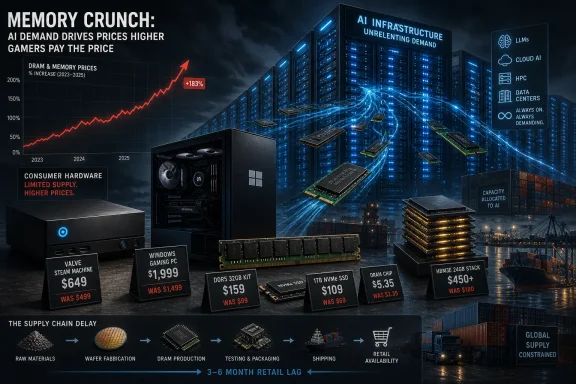
Aldehayyat’s most important observation is not simply that memory remains expensive. It is that retail shelves may lag bulk supply conditions by three to six months.That delay exists because consumer electronics do not move directly from a memory factory to a store. Hardware manufacturers negotiate contracts, reserve components, assemble systems, ship finished products through distribution networks, and sometimes maintain inventory purchased under earlier agreements. Retail pricing can therefore reflect yesterday’s component costs rather than the prices manufacturers must pay for their next production run.
A retailer might still have gaming PCs, SSDs, or memory kits acquired when wholesale costs were lower. A manufacturer may similarly have a limited supply of components covered by an older contract. Once that inventory is exhausted, replacement products can arrive with higher wholesale costs embedded in their pricing.
Why the warning is unusually credible
Valve has direct exposure to component procurement for the Steam Machine and its other hardware. Its engineers and supply-chain teams can see quotations, order availability, lead times, allocation limits, and contract negotiations that consumers cannot.Aldehayyat’s comments do not guarantee that every retail memory product will become more expensive. Promotions, inventory corrections, exchange rates, regional demand, and retailer competition can still produce temporary discounts. However, his warning suggests that isolated sales should not be mistaken for a broad market recovery.
The distinction is critical. A short-lived drop in the price of one 32GB DDR5 kit may reflect excess inventory at a distributor, while the underlying contract market continues moving in the opposite direction.
Why Artificial Intelligence Is Consuming So Much Memory
AI systems need more than processors
Public discussion of the AI hardware boom often centers on GPUs and specialized accelerators, but compute units cannot operate efficiently without enormous amounts of fast memory. Large models require memory capacity to hold parameters, activations, inference caches, and intermediate data, while bandwidth determines how quickly processors can access that information.High-bandwidth memory, or HBM, is especially important for advanced accelerators. HBM packages stack multiple memory dies and connect them through extremely wide interfaces, delivering far greater bandwidth than ordinary desktop DDR5.
Producing HBM is complex. It requires suitable DRAM dies, advanced packaging, careful stacking, and additional testing. Yield challenges and packaging constraints can make each usable HBM package substantially more resource-intensive than a conventional desktop memory component.
The pressure spreads beyond HBM
A consumer may reasonably ask why demand for HBM should affect a standard DDR5 kit. The answer is that memory categories are connected through shared capital, manufacturing decisions, engineering resources, and production lines.Memory manufacturers naturally prefer products with stronger demand and higher margins. When server customers commit to large, long-term orders, suppliers have an incentive to dedicate more output to HBM, high-capacity server DRAM, and enterprise storage. That can leave less capacity available for desktop DIMMs, laptop memory, mobile products, and consumer SSDs.
The consequences extend into NAND flash as AI data centers deploy large storage systems for model data, training sets, inference workloads, and checkpoints. A gaming computer therefore faces pressure on two fronts: the memory used while software is running and the flash storage used to install games.
Inference is extending the cycle
The first phase of the AI infrastructure boom emphasized training increasingly large models. The expansion of commercial inference now adds another persistent workload, because deployed models must process user requests continuously.That transition matters because it reduces the likelihood that memory demand will vanish after an initial data-center construction wave. Training clusters may operate in bursts, but popular inference services require ongoing capacity, redundancy, and regional deployment.
AI demand is consequently becoming embedded in ordinary cloud infrastructure rather than remaining confined to a relatively small number of experimental supercomputers. That makes the pressure on memory supply more structural and less likely to resolve through a single inventory correction.
What the Three-to-Six-Month Lag Means
The pipeline can conceal future increases
Aldehayyat’s three-to-six-month estimate creates a disturbing timeline for consumers. Conditions observed by manufacturers in July 2026 may not be fully reflected in store prices until the final quarter of 2026 or even early 2027.The transmission process can unfold in stages:
- Memory suppliers raise contract prices or restrict allocations.
- Device manufacturers absorb part of the increase while using older inventory.
- New production runs become more expensive to assemble.
- Distributors receive systems carrying higher wholesale prices.
- Retailers raise prices, reduce discounts, or replace products with cost-cut configurations.
Discounts could disappear before list prices rise
The first symptom may be the disappearance of attractive deals rather than a dramatic change to the manufacturer’s suggested retail price. Gaming hardware frequently sells below list price after its launch period, particularly when vendors compete for seasonal demand.If component costs rise, manufacturers and retailers can protect margins simply by ending promotions. A machine that remains at $1,049 throughout the year may still have become effectively more expensive if buyers had previously expected it to fall below $900 during a major sales event.
Consumers should therefore track street prices, bundled accessories, storage capacity, warranty terms, and availability—not merely the official launch price.
The Steam Machine’s Particular Vulnerability
Valve lacks the scale of the largest console makers
Sony, Microsoft, and Nintendo operate enormous hardware ecosystems and can negotiate component contracts across millions of units. They may also accept narrow or negative hardware margins because software licensing, subscriptions, accessories, and digital storefront revenue can compensate over the lifetime of a console.Valve has a powerful digital store, but the Steam Machine remains a less predictable hardware product. Lower production volume can weaken purchasing leverage, while uncertain demand makes it risky to commit to excessive inventory.
This leaves Valve balancing two dangers. Ordering too few components can produce shortages and long reservation queues, while ordering too many at elevated prices can leave the company holding expensive inventory if demand cools.
A compact design limits substitution
A conventional Windows desktop gives manufacturers and builders considerable flexibility. They can replace one memory kit with another, substitute a different SSD, change the motherboard, or use a different enclosure when supply conditions shift.A compact console-style PC is less adaptable. Thermal limits, physical dimensions, firmware validation, power requirements, acoustic targets, and support obligations narrow the list of acceptable substitutes. Even a technically compatible component may require new testing before Valve can use it in a production system.
This is one reason specialized hardware can remain expensive even when seemingly equivalent desktop parts become cheaper. The manufacturer is paying not only for the component but also for predictability, validation, logistics, and warranty support.
Price increases could undermine the concept
The Steam Machine’s central challenge is explaining why someone should buy it rather than a console, gaming laptop, handheld, or self-built Windows PC. At $1,049, it already asks consumers to value convenience, SteamOS integration, compactness, and access to an existing Steam library.A substantial increase would push it deeper into premium PC territory. Buyers would then compare it against upgradeable Windows desktops with stronger components, discounted laptops that include displays, and consoles costing considerably less.
Valve may choose to absorb some cost increases to protect adoption. Yet that strategy has limits, particularly if the memory shortage persists across multiple production cycles.
Implications for Windows PC Builders
RAM is no longer an easy upgrade decision
For years, system builders could treat memory as one of the simplest parts of a PC purchase. Mainstream kits were widely available, competition was intense, and users could often add capacity later at a lower cost.That assumption is becoming less reliable. If prices continue rising, delaying a planned upgrade may mean paying more for the same capacity, while purchasing a minimal configuration today could create a costly expansion problem later.
Windows 11 remains usable with 16GB for many everyday tasks, but 32GB has become a more comfortable target for gaming, content creation, development tools, heavy browser use, virtual machines, and local AI applications. Enthusiasts increasingly view 64GB as practical rather than extravagant, especially when combining modern games with streaming, recording, modding, or professional workloads.
Higher memory costs could reverse that trend. Manufacturers may return to selling expensive systems with only 16GB, leaving buyers to choose between constrained multitasking and overpriced upgrades.
Platform decisions become more complicated
A builder facing high DDR5 prices might consider extending the life of a DDR4 platform. That can make sense when an existing processor still meets performance needs, but buying into an older platform solely to avoid DDR5 costs carries its own risks.Older motherboards offer a shorter upgrade path, while aging processors may eventually bottleneck high-end graphics cards. DDR4 is also not automatically protected from the shortage, because suppliers can reduce production as they migrate manufacturing capacity toward newer and more profitable products.
The most sensible decision depends on the complete system cost rather than the price of memory in isolation. A discounted DDR5 motherboard and processor bundle can still be better value than an apparently cheaper legacy platform.
Prebuilt PCs may hide the increase
Large PC vendors can use several methods to preserve appealing advertised prices:- They may ship a single memory module instead of a matched pair, reducing bandwidth.
- They may install slower or higher-latency memory without emphasizing the difference.
- They may reduce SSD capacity from 2TB to 1TB or from 1TB to 512GB.
- They may limit upgradeability by using soldered memory or proprietary components.
- They may shift desirable configurations into higher-priced product tiers.
Effects on Consoles and Gaming Handhelds
Fixed-price console economics are under strain
Traditional consoles usually become cheaper to manufacture as their generation progresses. Chip designs mature, production yields improve, storage costs decline, and manufacturers redesign internal hardware to remove unnecessary complexity.The current memory market disrupts that pattern. If DRAM and NAND costs rise faster than efficiency improvements reduce other expenses, a console can become more expensive to manufacture several years after launch.
Platform holders then face three unattractive options: increase the retail price, absorb lower margins, or revise the product. Recent industry behavior has already weakened the old expectation that consoles inevitably receive permanent price cuts late in their lifecycle.
Handhelds face an even tighter constraint
Gaming handhelds depend heavily on integrated memory. Many use unified memory architectures in which the processor and graphics hardware share the same pool, making both capacity and bandwidth essential to performance.Manufacturers cannot easily reduce memory without compromising the operating system, current games, or long-term compatibility. Soldered packages also prevent consumers from performing ordinary upgrades.
Storage creates another pressure point. Modern games routinely require tens or hundreds of gigabytes, so cutting SSD capacity makes a handheld less useful and shifts the expense toward costly removable storage or a later drive replacement.
The result may be fewer entry-level models, longer periods between discounts, and greater reliance on premium configurations. Some companies may also keep older handhelds in production because launching a more capable successor would require additional memory at exactly the wrong time.
Enterprise and Commercial Consequences
Business PCs could face another refresh shock
The RAM shortage is not merely a gaming story. Enterprises planning Windows 11 migrations, workstation upgrades, virtual desktop deployments, or AI PC rollouts may encounter higher system prices and less favorable configurations.Businesses typically buy through negotiated contracts rather than retail channels, so they may feel wholesale changes sooner. Large customers can secure allocations, but suppliers will price those guarantees according to scarcity and risk.
Organizations that postponed PC refreshes during earlier economic uncertainty may now discover that waiting has not produced the expected savings. Older hardware also creates security, reliability, battery-life, and support costs that cannot be ignored indefinitely.
Memory-heavy workloads become more expensive
Developers, engineers, video editors, data analysts, and cybersecurity teams often need 64GB, 128GB, or more. A modest increase per gigabyte becomes substantial across hundreds or thousands of workstations.Virtualization magnifies the problem because memory frequently determines how many workloads a host can run. A processor may have spare compute capacity while insufficient RAM prevents another virtual machine from being deployed.
Enterprises may respond by extending leases, reallocating high-memory systems, using cloud infrastructure selectively, or tightening approval requirements for workstation upgrades. Each strategy can reduce capital spending, but it can also create productivity bottlenecks.
Procurement discipline becomes a competitive advantage
Companies with accurate inventories and workload data will navigate the shortage more effectively than those using fixed replacement schedules. The objective should not be to refresh every device early, but to identify where memory capacity directly affects productivity or operational resilience.IT departments should distinguish between machines that merely appear old and systems whose limitations create measurable business costs. That analysis supports targeted purchasing before further increases arrive while avoiding panic-driven overbuying.
How Memory Suppliers May Respond
New capacity will take time
Rising prices create an incentive to build more memory capacity, but semiconductor production cannot be expanded like an ordinary assembly line. New fabrication plants require enormous investment, specialized equipment, permits, utilities, construction, process qualification, and trained personnel.Even when manufacturers expand existing facilities, additional output may take many quarters to reach customers. Suppliers must also decide which memory technologies will remain profitable by the time new capacity becomes operational.
That delay explains why high prices can persist despite public announcements of new factories. A planned facility does nothing to lower the cost of a Steam Machine being assembled this month.
Supply may not return to consumer products immediately
Additional capacity does not guarantee an immediate flood of cheap desktop memory. If AI companies continue paying premiums for HBM and server DRAM, manufacturers will prioritize those orders.The memory industry has also experienced painful boom-and-bust cycles. Suppliers have learned that uncontrolled expansion can produce oversupply, collapsing prices, inventory write-downs, and factory underutilization.
They may therefore add capacity cautiously rather than race to restore the ultra-low consumer memory prices seen during previous downturns. A future improvement in availability does not necessarily mean a return to historical pricing.
Competition could still change the balance
Expanding production from emerging suppliers, including China’s memory industry, could eventually increase global output. Greater competition may place downward pressure on commodity DRAM pricing, particularly in markets where products can be substituted easily.However, geopolitical restrictions, patent disputes, export controls, qualification requirements, and differences in manufacturing technology may limit how quickly that output reaches international consumer devices. Major PC and console vendors also require stable quality and long-term supply, not simply chips available at a lower spot price.
How Hardware Companies Could Adapt
Specifications may become more creative
Manufacturers will search for ways to reduce the amount of expensive memory needed without making products feel slower. Better compression, faster storage caching, improved memory scheduling, and more efficient operating systems can all help.Game developers may also place greater emphasis on asset streaming and scalable memory settings. Those techniques cannot eliminate physical requirements, but they can reduce waste and make lower-capacity systems viable for longer.
Local AI features will face additional scrutiny. Reserving several gigabytes for background models is harder to justify when games and ordinary applications already compete for limited capacity. Windows PC vendors may need to prove that bundled AI services deliver enough value to warrant their hardware overhead.
Product segmentation may become harsher
Scarcity encourages vendors to reserve desirable components for high-margin devices. A manufacturer with limited access to 32GB memory packages may prefer to place them in a $2,000 gaming laptop rather than a $900 mainstream model.This can create artificial gaps in product lines. Buyers may find plenty of underpowered entry-level systems and numerous premium machines, but few balanced products in the middle.
Valve faces the same dilemma. It could maintain a single well-defined Steam Machine specification, introduce a lower-memory model, or create premium configurations that better absorb component costs. Each choice affects software targets and consumer clarity.
Longer product lifecycles become attractive
When components are scarce, keeping a validated design in production can be safer than launching frequent revisions. Manufacturers avoid the cost of qualifying new parts and can negotiate larger orders around a stable bill of materials.Consumers may therefore see fewer dramatic annual upgrades. Instead, vendors could focus on firmware improvements, operating-system optimization, replacement parts, and modest internal revisions.
That outcome would not be entirely negative. Longer support periods and less disposable hardware could improve reliability and reduce electronic waste, provided companies do not use scarcity as an excuse to neglect performance or charge excessive premiums.
Strengths and Opportunities
The memory crisis creates serious difficulties, but it may also encourage healthier decisions across the PC and gaming industries.Opportunities for consumers and vendors
- Software optimization can regain importance. Developers have less freedom to assume that every new device will ship with dramatically more memory, encouraging tighter code and better resource management.
- Upgradeable desktops become more valuable. Standard DIMM slots, replaceable SSDs, and non-proprietary components give Windows users flexibility that soldered or closed systems cannot offer.
- Repair and refurbishment markets can expand. Older PCs with sufficient memory may remain useful after a processor, graphics card, battery, or storage upgrade.
- Valve can differentiate through efficiency. If SteamOS delivers a streamlined gaming experience with lower background overhead than a general-purpose desktop installation, the Steam Machine may justify part of its premium.
- Enterprises can improve asset management. Detailed hardware inventories and workload-based refresh policies can reduce waste while protecting high-value users from shortages.
- Alternative suppliers may gain credibility. Sustained demand creates an opening for additional memory manufacturers, module vendors, and system integrators to compete.
- Game streaming may become more attractive in limited cases. Users with strong internet connections could postpone local hardware purchases, although subscriptions, latency, image quality, and service ownership remain concerns.
Risks and Concerns
The most serious danger is that the memory shortage becomes a prolonged structural feature of the technology market rather than a temporary disruption.The major downside scenarios
- Gaming hardware could become less accessible. Higher console, PC, and handheld prices may exclude younger players and budget-conscious households.
- Entry-level specifications could stagnate. Systems may continue shipping with 16GB of RAM and small SSDs even as software requirements increase.
- Manufacturers could disguise price increases. Reduced capacities, slower components, weaker warranties, and fewer accessories can make nominally unchanged prices misleading.
- AI demand could crowd out ordinary computing investment. Data centers can outbid consumer manufacturers for memory because their revenue models support much higher component costs.
- Developers could target premium hardware too aggressively. If optimization deteriorates, users with affordable systems will experience more stuttering, loading delays, and forced upgrades.
- Enterprise refresh projects could be deferred unsafely. Organizations may keep unsupported or unreliable systems in service because replacement costs exceed budgets.
- Market concentration could reduce pricing pressure. A small number of major memory manufacturers control much of global production, limiting the speed at which competition can correct shortages.
- Speculative buying could worsen availability. Distributors, resellers, and consumers may accumulate inventory in anticipation of further increases, creating additional short-term scarcity.
What Buyers Should Do Now
Avoid panic, but revise old assumptions
No one should buy unsuitable hardware merely because prices might rise. A rushed purchase can waste more money than a later increase, particularly if the system fails to meet performance, noise, portability, or upgradeability requirements.However, consumers should abandon the assumption that waiting automatically produces a lower price. Component markets can move in both directions, and Aldehayyat’s warning suggests that additional wholesale pressure has yet to reach all retail products.
Buyers with a definite need within the next six months should establish a target specification and monitor real prices. Those who find a strong deal from a reputable seller may have less reason than usual to postpone.
Prioritize capacity and upgradeability
For a new Windows gaming PC, 32GB remains a sensible general target when the budget allows. Users running professional applications, virtual machines, heavily modded games, or local AI tools should calculate their requirements carefully rather than relying on a generic recommendation.A system with two available memory slots offers more flexibility than one with every slot occupied by low-capacity modules. Likewise, a second M.2 slot can make future storage expansion easier and prevent the original SSD from becoming electronic waste.
Laptop and handheld buyers must be especially cautious because soldered memory cannot be upgraded. Saving money on a low-memory configuration can become expensive if the entire machine must be replaced earlier.
Evaluate the complete platform
The Steam Machine should be judged as a complete product rather than as a pile of components. Its value includes enclosure design, acoustics, controller integration, SteamOS, support, power efficiency, and living-room convenience.The same principle applies to Windows PCs. A slightly more expensive system may be better value if it has a standard motherboard, capable cooling, a high-quality power supply, dual-channel memory, and room for upgrades.
Headline prices conceal these differences. During a shortage, careful specification analysis becomes more important because vendors have stronger incentives to cut costs in places that are not immediately visible.
What to Watch Next
Valve’s pricing and availability
The first signal will be whether Valve can maintain the Steam Machine’s $1,049 starting price through the rest of 2026. Reservation wait times, regional availability, configuration changes, and bundled offers will reveal how effectively the company secured components.If estimated weekly sales remain strong, Valve may have more confidence to place larger orders. Higher volume could improve negotiating leverage, but it could also accelerate consumption of inventory acquired under earlier contracts.
A price increase would validate the severity of the supply warning, while stable pricing could mean Valve is absorbing costs, benefiting from prior agreements, or redesigning its component mix. Without detailed financial disclosure, the sticker price alone will not explain which strategy it has chosen.
Holiday PC configurations
The 2026 holiday season will provide a clearer picture of how wholesale memory costs are reaching consumers. Watch whether gaming laptops and desktops retain their previous capacities, not merely whether their advertised prices change.A nominal discount on a machine revised from 32GB to 16GB is not necessarily a bargain. The same applies to systems that substitute a 512GB SSD for a 1TB drive or move from dual-channel to single-channel memory.
Major sales events will also test affordability limits. If consumers resist higher prices, vendors may accept lower margins temporarily, but weak demand will not immediately solve supply constraints created by data-center purchasing.
Memory contract trends
Industry contract prices are more informative than isolated retail listings. Sustained increases across conventional DRAM, server memory, mobile memory, and NAND would indicate that the shortage remains broad.Inventory levels matter just as much. Prices can rise rapidly when suppliers and manufacturers hold little buffer stock, because even a modest disruption leaves customers competing for available output.
Any evidence that suppliers are restoring conventional DRAM production would be encouraging, but the market will need time to translate additional wafers into packaged, tested, and qualified consumer products.
New manufacturing capacity
Factory expansions, packaging investments, and output from newer competitors could improve the longer-term outlook. The crucial questions are when production begins, what type of memory it targets, and which customers receive the first shipments.Announcements should not be confused with immediate supply. Semiconductor capacity usually arrives slowly, and the most profitable server products are likely to remain the priority while AI infrastructure spending stays elevated.
A meaningful consumer recovery may require several developments at once: additional fabrication capacity, improved HBM packaging supply, slower data-center order growth, healthier inventories, and stronger competition among memory producers.
The sustainability of AI spending
The largest uncertainty is whether AI infrastructure demand continues at its current intensity. If cloud providers and technology companies maintain aggressive capital spending, memory manufacturers will have little reason to redirect output toward lower-margin consumer products.If AI revenue disappoints or data-center expansion slows, canceled and deferred orders could eventually release supply. That would not produce an instant retail collapse, because contracts and inventory pipelines would still need to unwind.
For now, hardware buyers should plan around observable conditions rather than predicting an AI investment reversal. Valve’s direct warning indicates that manufacturers are not yet seeing the relief consumers hope will arrive.
The Steam Machine may be the most visible symbol of the problem, but it is not the cause and will not be the last device affected. Valve’s warning exposes a broader realignment in which AI infrastructure customers can pay more for memory than gaming and PC manufacturers, overturning the familiar expectation that electronics become steadily cheaper with age. For Windows enthusiasts, the practical response is neither panic buying nor indefinite delay, but disciplined comparison: prioritize sufficient memory, standard components, realistic upgrade paths, and complete-system value. If wholesale conditions are truly three to six months ahead of retail shelves, the next wave of price pressure is already moving through the pipeline—and the industry’s old assumptions about cheaper PCs and consoles may need to be rewritten.
References
- Primary source: Operation Sports
Published: 2026-07-20T15:00:00+00:00
Steam Machine Engineer Warns RAM Supply Issues Are Still Getting Worse - Operation Sports
Oh boy. www.operationsports.com
- Related coverage: pcgamer.com
Valve says there's no end in sight to the memory crisis, and prices are only going to increase: 'Honestly, it's still getting worse' | PC Gamer
Retail availability is lagging bulk supply by "at least three to six months" according to a Valve engineer.www.pcgamer.com - Related coverage: gamesradar.com
- Related coverage: abit.ee
Steam Machine Sales Beat Expectations, Reaching Up to 15,000 Units a Week
Analysts at Boiling Steam estimate Valve is selling 12,000-15,000 Steam Machine units weekly, based on the device's ranking on Steam's bestseller chart.abit.ee
- Related coverage: club386.com
Valve warns RAM prices are getting worse, suggesting Steam Machine will become more expensive | Club386
Retail prices lag behind memory supply costs by three to six months, according to Valve, hinting at potential Steam Machine price hikes. www.club386.com
- Related coverage: arstechnica.com
Valve's Steam Machine ships June 29 for $1,049, but you probably won't be able to buy one yet - Ars Technica
Valve says it's using a randomized purchase queue to make the experience "less frustrating and more fair."arstechnica.com
