

SteamOS’s momentum is real: the Linux-based gaming stack that began as a niche experiment is now a visible force in handhelds, OEM strategy and developer planning — but make no mistake, Windows 11 still dominates PC gaming and will for the foreseeable future. erview
The conversation that used to live in forums and specialized blogs — can Linux ever be a viable gaming platform? — has moved into mainstream coverage. Valve’s SteamOS, the Proton compatibility layer and the Steam Deck created a practical pathway off Windows for many gamers, and recent telemetry shows measurable growth in Linux usage on Steam. Valve’s own monthly Hardware & Software Survey recorded Windows at roughly 94.23% of Steam installs in December 2025 while Linux rose into the mid‑3 percent range, with a corrected December figure of 3.58% noted by multiple trackers.
Those percentages may look small compared with Windows, but in the volume world of Steam even single percentage-point moves represent millions of engaged users and a shifting engineering calculus for publishers and OEMs. At the same time, high‑profile hardware announcements — notably OEM SteamOS handhelds like Lenovo’s Legion Go 2 Powered by SteamOS — have turned an experiment into a product roadmap item for major vendors.
This article summarizes the latest signals, verifies technical claims, weighs the strengths and risks of SteamOS’s rise, and explains what gamers, developers and OEMs should watch for in 2026.
Yet Windows remains the practical default for the majority of PC gaming: its ecosystem of anti‑cheat, driver vendor validation, and integration with developer toolchains keeps it firmly in the lead. The near future looks like coexistence: Valve’s SteamOS will continue to grow in niches where a lean, console‑style gaming experience matters (handhelds, single‑player AAA and indie catalogs), while Windows will remain the broad compatibility baseline for competitive multiplayer and Windows‑first titles.
For players, the smart path is pragmatic experimentation: test SteamOS where it fits your library and habits, keep Windows available for anti‑cheat‑protected competitive titles, and watch OEM support and anti‑cheat adoption closely — those two vectors will determine whether SteamOS’s modest gains translate into a larger strategic realignment in PC gaming.
Source: Windows Central https://www.windowscentral.com/microsoft/windows/reasons-steamos-pc-gamers-windows/
The conversation that used to live in forums and specialized blogs — can Linux ever be a viable gaming platform? — has moved into mainstream coverage. Valve’s SteamOS, the Proton compatibility layer and the Steam Deck created a practical pathway off Windows for many gamers, and recent telemetry shows measurable growth in Linux usage on Steam. Valve’s own monthly Hardware & Software Survey recorded Windows at roughly 94.23% of Steam installs in December 2025 while Linux rose into the mid‑3 percent range, with a corrected December figure of 3.58% noted by multiple trackers.
Those percentages may look small compared with Windows, but in the volume world of Steam even single percentage-point moves represent millions of engaged users and a shifting engineering calculus for publishers and OEMs. At the same time, high‑profile hardware announcements — notably OEM SteamOS handhelds like Lenovo’s Legion Go 2 Powered by SteamOS — have turned an experiment into a product roadmap item for major vendors.
This article summarizes the latest signals, verifies technical claims, weighs the strengths and risks of SteamOS’s rise, and explains what gamers, developers and OEMs should watch for in 2026.
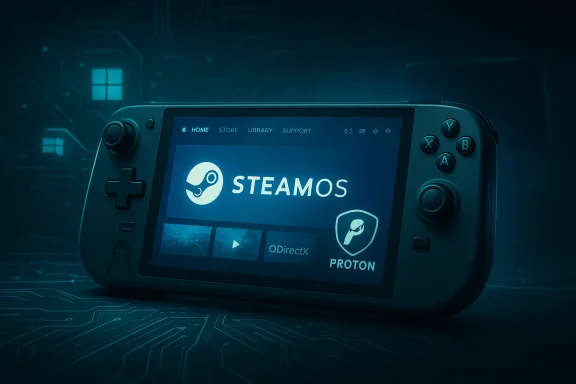 Why SteamOS is no longer a curiosity
Valve’s three-tier push: OS + compatibility + hardware
Valve’s approach wasn’t a piecemeal hobby; it was systemic. The company shipped:- SteamOS, a Linux distribution tailored for gaming and a console-style UI.
- Proton, a compatibility layer that lets many Windows games run on Linux without source ports.
- Steam Deck, a mass-market handheld that normalized the user experience and generated telemetric footprint for Linux gaming.
OEM validation: more than Valve hardware
What separates a hobby from a market shift is OEM buy-in. Lenovo’s decision to ship a SteamOS variant of the Legion Go 2 — announced at CES 2026 with availability expected in June 2026 — is concrete evidence that manufacturers see a market for a gaming-first Linux experience on premium handhelds. Multiple outlets and Lenovo’s own press materials reported the SteamOS Legion Go 2 with the same high-end hardware as the Windows model: an 8.8‑inch 144Hz OLED, Ryzen Z2/Z2 Extreme configurations, 74Wh battery and a $1,199 starting price. That moves SteamOS from Valve-only to OEM-tier distribution.Real-world traction, not just hype
Steam’s monthly survey — imperfect but influential — shows Linux reaching multi‑month highs at the end of 2025, and third‑party trackers amended Valve’s December snapshot to record Linux at 3.58% after corrections. Those increases were small in absolute terms but significant directionally: they show a sustained trend rather than a single-month blip. For developers, that trend changes decisions about whether a Linux-compatible build or Proton testing is worth the investment.Performance and efficiency: where Linux shines
Leaner stacks, lower overhead
One of SteamOS’s most consistent technical advantages is its lean runtime environment. A gaming-focused Linux image boots into a thin compositor and runs fewer background services compared to a full Windows 11 desktop. On thermally constrained devices — handhelds, small-form-factor PCs — that difference can translate into:- Better sustained clocks under thermal limits
- Fewer micro‑stutters caused by background scheduler wakeups
- Longer battery life in real play sessions
Shader caching and driver timing
Modern engines compile many shader permutations at runtime; how the OS, driver and runtime handle on-the-fly shader compilation affects micro‑stutters and perceived smoothness. Valve and Mesa contributors have improved shader caching strategies for Proton, reducing costly runtime shader compiles that used to plague Linux gameplay. In narrow, repeatable tests, those improvements show up as smoother frame delivery in shader‑heavy scenes. Still, outcomes are per‑title and per‑driver; results vary widely across engines, GPU vendors and specific driver versions.The Windows counter: compatibility and feature parity
Windows’s strengths remain material: DirectX pipelines, vendor‑validated drivers, day‑one optimizations and an ecosystem of game tooling produce raw performance and feature parity that’s hard to beat universally. Titles that target Microsoft technologies or exploit vendor-specific features (ray tracing paths, proprietary upscalers) still perform best on Windows. The net effect is a cross‑platform reality: SteamOS can outperform Windows in some cases, match it in others, and trail it in the most cutting-edge or anti‑cheat–protected multiplayer titles.Anti‑cheat and the multiplayer bottleneck
The blocker that matters
Anti‑cheat systems are the single most consequential technical and commercial barrier to broad SteamOS adoption. Historically, kernel‑mode anti‑cheat and Windows‑only middleware prevented many multiplayer titles from being playable on Linux. That’s changed in part: vendors like Epic Games (Easy Anti‑Cheat) and BattlEye have developed user-space runtimes and compatibility modes for Proton, and some titles now run with their protections intact. Yet adoption remains uneven because publishers must opt‑in, and some studios still refuse to enable Linux targets for policy or antipathy toward perceived increased cheat exposure.What’s improving — and what’s not
- Improvements: EAC has been extended to cover more architectures (including ARM) and runtime modes that work with Proton, and BattlEye support has been added in recent Proton releases, opening the door for more titles to function on SteamOS. These changes are technical enablers that make Linux a practical option for a growing swath of titles.
- Remaining issues: Some developers continue to withhold support for business or competitive reasons, and titles that require kernel‑level anti‑cheat features or deep platform integration remain Windows‑exclusive. That means competitive esports, many MMOs and some modern live‑service shooters will keep players tied to Windows for the near term.
Practical outcome
For many single‑player and non‑competitive AAA titles the anti‑cheat barrier is eroding; for high‑stakes multiplayer scenes it persists. The practical player strategy for now is dual‑boot or keep a Windows fallback for anti‑cheat–protected servers while using SteamOS for the majority of your library where Proton compatibility is good.Steam’s network effect and the scale argument
Steam is massive. It sets expectations for developers and playetform’s sheer size is a critical reason Valve’s Linux push matters.- Steam’s concurrent user peaks set public records in 2025; independent reporting captured a record 41.7 million concurrent users on October 12, 2025. Those kinds of numbers underscore Steam’s centrality in PC gaming and the marketing power Valve can bring to SteamOS. A large, active platform gives Valve leverage to encourage developers and OEMs to treat SteamOS as a first‑class target.
- Steam’s store, community features and compatibility labeling (Deck Verified, Playable, Unsupported) give consumers clear signals about what will work on SteamOS. That lowers the risk for buyers considering a SteamOS device.
Microsoft’s response: product fixes and tactical moves
Microsoft is not idle. Windows is still the platform of choice for most developers, and Microsoft has been prioritizing gaming improvements in Windows 11:- The Xbox Full Screen Experience and other handheld‑oriented optimizations aim to reduce background noise and reclaim memory on portable Windows devices.
- Updates to DirectX tooling, scheduling, and driver ecosystems continue to maintain Windows’s lead in multiplayer and DRM‑heavy titles.
Buyer’s guide: should you choose SteamOS or Windows?
Choosing an OS for gaming in 2026 is less binary than it was five years ago. Use this checklist to pick the right platform for your needs.Quick checklist (practical)
- Inventory your must‑play titles and flag any multiplayer or anti‑cheat titles.
- Check ProtonDB, Deck Verified and publisher guidance for each title.
- If buying a handheld, decide whether you want an official SteamOS SKU (lower support friction) or Windows (wider compatibility).
- Test battery life and suspend/resume behavior for real play sessions when possible.
- Keep a Windows recovery plan if you plan to experiment (dual‑boot, external SSD image, etc.).
When to pick SteamOS
- You primarily play single‑player AAA and indie titles available on Steam.
- You value battery life, sustained frame‑time stability on handhelds, and a console‑like, pick‑up‑and‑play UX.
- You want a lower‑maintenance gaming surface on a pinned hardware configuration (e.g., Legion Go 2 Powered by SteamOS or Steam Deck).
When to stick with Windows
- You need broad anti‑cheat and multiplayer compatibility for competitive play.
- You rely on Windows‑only apps, launchers, or vendor utilities (RGB suites, custom firmware tools).
- You need maximum compatibility for ray tracing, proprietary upscalers and day‑one driver support.
Developer and publisher considerations
From a development perspective, SteamOS’s rise changes the testing and distribution equation:- Smaller but rising Linux shares increase the case for Proton testing and Linux CI pipelines.
- Publishers still weigh the costs: anti‑cheat enablement, QA resources and build support versus the incremental revenue from Linux users.
- For indies and single‑player experiences, Proton often reduces the need for a native port; for big multiplayer titles, native support plus anti‑cheat enablement still matters.
Risks, caveats and what to watch
Data and measurement caveats
- Steam’s Hardware & Software Survey is voluntary and gamer‑centric; it overrepresents active, upgrade‑prone users. Interpreting Steam percentages as global OS market share is a mistake. Still, Steam’s survey is the industry bellwether for developers and publishers.
Volatility in drivers and runtimes
- Small upgrades to Mesa, Proton, or vendor drivers can swing outcomes. Benchmarks freeze at a snapshot; everyday users will see variability. Plan for occasional rollbacks or driver tweaks if you pursue a SteamOS‑first approach.
Anti‑cheat and publisher choices
- Anti‑cheat remains the major single‑point failure for a pure‑SteamOS strategy. Until more publishers opt into Proton‑compatible anti‑cheat modes consistently, many players will need Windows for competitive play.
The OEM experiment risk
- OEM adoption is promising but not guaranteed to scale. If third‑party SteamOS devices suffer from poor driver support, slow firmware updates, or lack of vendor backing, consumer trust will erode. By contrast, successful, well‑supported OEM SteamOS launches (for example, a well‑maintained Legion Go 2 SteamOS with timely updates) could accelerate adoption. Monitor vendor update cadence and official support channels closely.
Strategic outlook: coexistence, competition, and the next 18 months
SteamOS is not a mortal threat to Windows’s dominance in PC gaming — at least not in 2026. But it is a strategic competitor that will change ecosystem dynamics:- Expect continued OEM experiments (more SteamOS SKUs from non‑Valve vendors) and incremental improvements in Proton and Mesa that keep expanding the playable catalog.
- Microsoft will continue to hone Windows for gaming with focused optimizations (FSE, scheduler updates, DirectX tooling), reducing SteamOS’s narrow efficiency advantages on handhelds and constrained devices.
- Anti‑cheat normalization — either via vendor support or publisher cooperation — is the cliff that decides whether SteamOS remains a niche player or becomes a mass‑market alternative for more multiplayer titles.
Conclusion
SteamOS’s rise is meaningful because it is engineered — Valve built a compatibility stack (Proton), created a product (Steam Deck), and is now convincing OEMs to ship SteamOS devices. Tced measurable shifts in gamer behavior and developer incentives, visible in Steam’s late‑2025 telemetry and in OEM announcements such as Lenovo’s SteamOS Legion Go 2.Yet Windows remains the practical default for the majority of PC gaming: its ecosystem of anti‑cheat, driver vendor validation, and integration with developer toolchains keeps it firmly in the lead. The near future looks like coexistence: Valve’s SteamOS will continue to grow in niches where a lean, console‑style gaming experience matters (handhelds, single‑player AAA and indie catalogs), while Windows will remain the broad compatibility baseline for competitive multiplayer and Windows‑first titles.
For players, the smart path is pragmatic experimentation: test SteamOS where it fits your library and habits, keep Windows available for anti‑cheat‑protected competitive titles, and watch OEM support and anti‑cheat adoption closely — those two vectors will determine whether SteamOS’s modest gains translate into a larger strategic realignment in PC gaming.
Source: Windows Central https://www.windowscentral.com/microsoft/windows/reasons-steamos-pc-gamers-windows/
