

Rebecca Sutherlin of Steele Early College High School in Northwest ISD won the Microsoft PowerPoint Microsoft 365 Apps division at the 2026 Microsoft Office Specialist U.S. National Championship in Nashville, Tennessee, after competing against a national field of student finalists in mid-June. Her classmate Yaw Oppong-Bawuah also represented Steele in the Microsoft Word Microsoft 365 Apps competition, giving the Texas early-college campus a rare two-student showing on a national stage. The story is easy to treat as a feel-good school announcement, but it says something larger about where digital fluency now lives: not in abstract “computer literacy,” but in timed, judged, practical command of the tools that still run classrooms, offices, and small businesses.
There is a temptation, especially among technologists, to smirk at a national championship built around Word, Excel, and PowerPoint. In an industry obsessed with AI models, cloud platforms, and developer frameworks, Microsoft Office can look like the wallpaper of computing: always there, rarely noticed, and supposedly too ordinary to celebrate. That reaction misses the point.
The Microsoft Office Specialist competition is not a spelling bee for ribbon menus. It is a test of how precisely a student can translate a finished business document, spreadsheet, or presentation into a working digital artifact under pressure. That is a different skill from merely knowing where the buttons are. It is closer to the daily work of an analyst, project coordinator, teacher, administrative assistant, marketer, or small-business operator who must turn fuzzy instructions into something polished enough to circulate.
Sutherlin’s win in PowerPoint matters because PowerPoint remains one of the least respected and most consequential software tools in the professional world. It is where budgets are sold, technical decisions are simplified, classroom lessons are sequenced, nonprofit pitches are made, and executives often encounter complex ideas for the first time. A person who can build a clean, accurate, persuasive presentation is not just decorating slides. They are shaping how information moves.
Steele Early College High School’s showing also underlines the value of career and technical education when it is allowed to be more than a credential treadmill. The school did not just produce a student who passed an exam. It sent two students to a national competition, one of whom left as a champion, and it did so through the kind of classroom preparation that connects certification, competition, and confidence.
That structure is important because it strips away much of the fluff that surrounds modern discussions of digital skills. There is no room for claiming to be “good with computers” in the abstract. A finalist has to build the thing, match the thing, and do it under contest conditions.
For PowerPoint, that can mean more than choosing a theme and inserting a few images. Competitive performance can involve alignment, object ordering, master layouts, formatting consistency, animation choices, image treatment, typography, chart presentation, and the basic discipline of making a slide deck look intentional rather than assembled in panic. Anyone who has sat through a chaotic workplace presentation knows that this is not a trivial distinction.
It also explains why students who excel in these contests often have the mindset of careful operators rather than casual users. The software is familiar, but the standard is exacting. In that sense, the championship is less about Office as a product and more about the habits Office can reveal: attention to detail, time management, visual judgment, and procedural fluency.
That is why a student championship in PowerPoint still belongs in a Windows and Microsoft ecosystem conversation. These apps are no longer boxed software installed from a disc and forgotten for five years. They are continuously updated services, tied to cloud storage, identity, collaboration, templates, accessibility checks, export formats, and increasingly AI-assisted workflows.
The PowerPoint category Sutherlin won was specifically for Microsoft 365 Apps, not an older perpetual Office release. That distinction matters. Microsoft 365 Apps represents the subscription-era Office client: familiar on the surface, but connected to a broader service model underneath. Students competing in that track are demonstrating skill in the version of Office most aligned with current workplace deployments.
For IT pros, this is the understated reality behind productivity software. The same suite that frustrates help desks with licensing puzzles, update channels, add-ins, macro policies, file-sync conflicts, and template governance is also the suite students are being trained to master before they enter the workforce. The classroom contest and the enterprise admin center are separated by age and context, but they orbit the same platform.
That blend can be powerful when it avoids two traps. The first trap is treating certification as a checkbox, where students memorize enough to pass but never develop judgment. The second is treating career training as narrow job prep, disconnected from broader academic growth. A national competition cuts through both problems because the student has to perform, not just pass.
Teacher Sarah Zeballos’s role, recognized by the district, is part of the story because competitions like this rarely happen by accident. Students need access to software, structured practice, exam pathways, feedback, travel support, and someone who understands how to translate classroom time into competitive readiness. Behind a student trophy is usually an adult who built the conditions for it.
The practical value is obvious. A student who earns a high-level Microsoft Office credential and competes nationally can point to measurable evidence of skill. That matters in internships, college applications, scholarship conversations, and first jobs. It also matters psychologically: the student is no longer merely learning software used by adults; the student has beaten peers from across the country at using it.
A generated presentation is only useful if someone can evaluate whether it is accurate, coherent, formatted correctly, audience-appropriate, and visually readable. An AI-generated spreadsheet formula still has to be checked. A Word document drafted by a model still needs structure, citation discipline, accessibility, and review. Automation raises the floor, but it does not eliminate the need for operators who understand the medium.
This is where competitions like the Microsoft Office Specialist championship may become more relevant rather than less. They reward the ability to reproduce a desired result with precision. That ability transfers naturally into an AI-assisted workplace, where the core task often becomes steering, correcting, and refining machine-generated output.
For WindowsForum readers, the connection is especially direct. Many of the hardest IT problems inside organizations are not caused by exotic zero-days or kernel regressions. They are caused by ordinary users doing ordinary work in ordinary apps at scale. Better-trained users reduce friction: fewer broken templates, fewer malformed spreadsheets, fewer accessibility failures, fewer document-version disasters, and fewer support tickets that begin with “PowerPoint changed everything.”
The global event changes the frame. At the national level, a student proves that they can outperform peers across the United States. At the world level, they enter a broader contest of training systems, school cultures, test-center networks, and national approaches to digital skills. The student remains the visible competitor, but the competition quietly compares pipelines.
That is why the invitation matters almost as much as the Nashville win. Sutherlin is not merely being congratulated for a completed achievement; she is being moved into the next tier of competition. The U.S. title becomes both an award and a qualification.
There is also a useful humility in this structure. Office mastery is not uniquely American, and Microsoft’s productivity stack is global. A world championship in Anaheim will bring together students who may have learned the same tools in very different educational systems, languages, and economic contexts. That makes the competition a small but telling snapshot of how universal office software has become.
But blaming PowerPoint for bad communication is like blaming Excel for bad accounting. The tool exposes habits. It does not create them from nothing.
A strong PowerPoint user understands hierarchy, compression, pacing, and audience. They know when a slide needs one idea instead of seven, when an image clarifies rather than decorates, and when consistency is doing invisible work. In a competition setting, those instincts are narrowed into the measurable task of recreating a target deck; in the workplace, they become the difference between a message that lands and one that dies in a conference room.
This is why Sutherlin’s category is more interesting than it first appears. PowerPoint sits at the intersection of technical execution and communication. It is not programming, but it is not mere clerical work either. It is applied information design for people who may never call themselves designers.
The Microsoft Office Specialist competition helps certification by adding a performance layer. A passing score can qualify a student for consideration, but the championship asks finalists to demonstrate skill live. That does not solve every criticism of certification, but it makes the credential feel less abstract.
For schools, this distinction matters. A certification program can be sold to parents, administrators, and local employers as evidence that students are learning something practical. A national placement or championship makes the case more vividly. It gives the credential a story.
For students, the value is not just the certificate. It is the experience of preparing for a standard that exists outside the classroom. That external benchmark can be bracing. It tells students that their work will be judged against national peers, not just local expectations.
Productivity software only produces productivity when people understand how to use it well. That includes students, teachers, office workers, managers, analysts, and administrators. It also includes the IT professionals who must configure, secure, update, and support the environment in which that work happens.
The Office championship sits at the user end of that chain, but it has consequences for the whole chain. A workforce that understands documents, spreadsheets, and presentations deeply is easier to support and more capable of adopting advanced features. A workforce that only understands the surface of those tools is more likely to misuse automation, mishandle data, and turn collaboration platforms into file chaos.
The AI layer will not remove this distinction. If anything, it will widen it. Users with strong foundational skills will use AI to accelerate good work. Users without those skills may use AI to produce faster messes.
Those needs sound basic until organizations discover how unevenly distributed they are. Many young people are fluent in phones and social platforms but have had fewer reasons to master desktop productivity software. The old assumption that “digital native” means “digitally competent” has been false for years.
This is where school-based certification and competition can serve as a corrective. It gives students a structured reason to learn professional tools deeply. It also gives employers a clearer signal than a vague claim of computer proficiency.
The strongest version of this model does not pretend Office skills are the endpoint. Instead, it treats them as part of a ladder. A student who masters PowerPoint may move into design, marketing, education, business analytics, project management, or software-adjacent roles. The tool is the entry point; the discipline is broader.
But the more durable prize is reputational. Sutherlin now has a national title attached to her name before her junior year of high school. Oppong-Bawuah has national competition experience before his senior year. Steele ECHS has evidence that its CTE pathway can produce nationally competitive students.
For a school, that kind of proof can compound. It can motivate younger students, attract attention to career programs, encourage community support, and validate teachers who often do highly practical work outside the spotlight. One student’s win becomes part of the institution’s story.
The danger is letting the story become too tidy. Not every valuable student outcome ends with a trophy, and not every strong program produces a national champion every year. But when a championship does happen, it reveals what the system can make possible.
Sutherlin’s PowerPoint championship belongs in that wider definition. It is a reminder that the technology workforce is not only built from computer science departments. It is also built in business classrooms, CTE labs, early-college high schools, certification centers, and the overlooked corners of curriculum where students learn to produce useful work.
For Windows enthusiasts and IT pros, this should feel familiar. The Windows ecosystem has always been broad rather than pure. It includes developers and gamers, yes, but also accountants, teachers, dispatchers, nurses, analysts, office managers, and students. Microsoft’s power has never come only from the elegance of its software; it has come from the number of people who know how to make that software do something practical.
That is the deeper reason a high school PowerPoint title deserves more than a congratulatory blurb. It points to the kind of competence that keeps institutions running. It is not flashy. It is not always celebrated. But when it is absent, everyone notices.
Rebecca Sutherlin’s national championship is a local win with a broader message: the future of work will not be built only by people who can prompt an AI model or write code from scratch, but also by people who can turn information into clear, accurate, usable artifacts under pressure. As she heads from Nashville’s national stage toward the world championship in Anaheim, the larger contest is already visible. Schools, vendors, and employers are all trying to define what practical digital mastery looks like in the AI era, and a Steele student just offered one convincing answer.
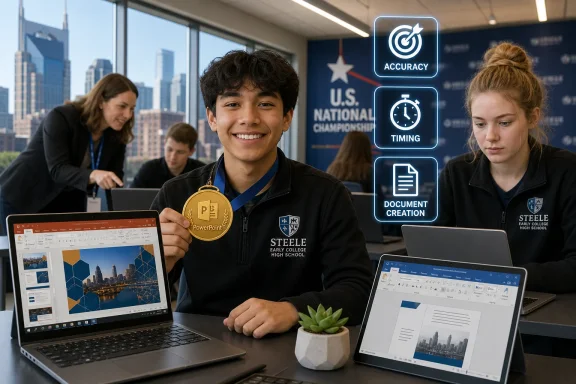 A PowerPoint Trophy Says More Than It Seems
There is a temptation, especially among technologists, to smirk at a national championship built around Word, Excel, and PowerPoint. In an industry obsessed with AI models, cloud platforms, and developer frameworks, Microsoft Office can look like the wallpaper of computing: always there, rarely noticed, and supposedly too ordinary to celebrate. That reaction misses the point.The Microsoft Office Specialist competition is not a spelling bee for ribbon menus. It is a test of how precisely a student can translate a finished business document, spreadsheet, or presentation into a working digital artifact under pressure. That is a different skill from merely knowing where the buttons are. It is closer to the daily work of an analyst, project coordinator, teacher, administrative assistant, marketer, or small-business operator who must turn fuzzy instructions into something polished enough to circulate.
Sutherlin’s win in PowerPoint matters because PowerPoint remains one of the least respected and most consequential software tools in the professional world. It is where budgets are sold, technical decisions are simplified, classroom lessons are sequenced, nonprofit pitches are made, and executives often encounter complex ideas for the first time. A person who can build a clean, accurate, persuasive presentation is not just decorating slides. They are shaping how information moves.
Steele Early College High School’s showing also underlines the value of career and technical education when it is allowed to be more than a credential treadmill. The school did not just produce a student who passed an exam. It sent two students to a national competition, one of whom left as a champion, and it did so through the kind of classroom preparation that connects certification, competition, and confidence.
The Contest Rewards Precision, Not Vibes
The national championship format is deliberately unsentimental. Students qualify by earning top scores on Microsoft Office Specialist certification exams in Word, Excel, or PowerPoint. At the live event, finalists receive printed instructions, digital assets, and a target document, workbook, or presentation to recreate. Their work is scored by accuracy against the original.That structure is important because it strips away much of the fluff that surrounds modern discussions of digital skills. There is no room for claiming to be “good with computers” in the abstract. A finalist has to build the thing, match the thing, and do it under contest conditions.
For PowerPoint, that can mean more than choosing a theme and inserting a few images. Competitive performance can involve alignment, object ordering, master layouts, formatting consistency, animation choices, image treatment, typography, chart presentation, and the basic discipline of making a slide deck look intentional rather than assembled in panic. Anyone who has sat through a chaotic workplace presentation knows that this is not a trivial distinction.
It also explains why students who excel in these contests often have the mindset of careful operators rather than casual users. The software is familiar, but the standard is exacting. In that sense, the championship is less about Office as a product and more about the habits Office can reveal: attention to detail, time management, visual judgment, and procedural fluency.
Microsoft 365 Is Boring Until It Becomes Infrastructure
Microsoft has spent the past few years pushing Copilot, Azure AI, security tooling, and cloud productivity as the glamorous edge of its platform. Yet the Office applications remain the company’s most durable front door into work. Word, Excel, PowerPoint, Outlook, Teams, OneDrive, and SharePoint form the everyday layer where most users actually experience Microsoft 365.That is why a student championship in PowerPoint still belongs in a Windows and Microsoft ecosystem conversation. These apps are no longer boxed software installed from a disc and forgotten for five years. They are continuously updated services, tied to cloud storage, identity, collaboration, templates, accessibility checks, export formats, and increasingly AI-assisted workflows.
The PowerPoint category Sutherlin won was specifically for Microsoft 365 Apps, not an older perpetual Office release. That distinction matters. Microsoft 365 Apps represents the subscription-era Office client: familiar on the surface, but connected to a broader service model underneath. Students competing in that track are demonstrating skill in the version of Office most aligned with current workplace deployments.
For IT pros, this is the understated reality behind productivity software. The same suite that frustrates help desks with licensing puzzles, update channels, add-ins, macro policies, file-sync conflicts, and template governance is also the suite students are being trained to master before they enter the workforce. The classroom contest and the enterprise admin center are separated by age and context, but they orbit the same platform.
Early-College Career Training Is Becoming the New Talent Pipeline
Steele Early College High School’s success is not just a point of local pride for Northwest ISD. It is a reminder that early-college and career-and-technical programs are increasingly where students encounter professional software as a serious subject rather than a casual requirement. These programs often combine high school coursework with college credit, industry certifications, and workplace-oriented instruction.That blend can be powerful when it avoids two traps. The first trap is treating certification as a checkbox, where students memorize enough to pass but never develop judgment. The second is treating career training as narrow job prep, disconnected from broader academic growth. A national competition cuts through both problems because the student has to perform, not just pass.
Teacher Sarah Zeballos’s role, recognized by the district, is part of the story because competitions like this rarely happen by accident. Students need access to software, structured practice, exam pathways, feedback, travel support, and someone who understands how to translate classroom time into competitive readiness. Behind a student trophy is usually an adult who built the conditions for it.
The practical value is obvious. A student who earns a high-level Microsoft Office credential and competes nationally can point to measurable evidence of skill. That matters in internships, college applications, scholarship conversations, and first jobs. It also matters psychologically: the student is no longer merely learning software used by adults; the student has beaten peers from across the country at using it.
The Office Skills Gap Is Still Real, Even in the AI Era
The rise of generative AI has made some people impatient with traditional productivity skills. If AI can draft a document, summarize a spreadsheet, or generate a slide outline, why spend time learning the old tools? The answer is that AI makes software judgment more important, not less.A generated presentation is only useful if someone can evaluate whether it is accurate, coherent, formatted correctly, audience-appropriate, and visually readable. An AI-generated spreadsheet formula still has to be checked. A Word document drafted by a model still needs structure, citation discipline, accessibility, and review. Automation raises the floor, but it does not eliminate the need for operators who understand the medium.
This is where competitions like the Microsoft Office Specialist championship may become more relevant rather than less. They reward the ability to reproduce a desired result with precision. That ability transfers naturally into an AI-assisted workplace, where the core task often becomes steering, correcting, and refining machine-generated output.
For WindowsForum readers, the connection is especially direct. Many of the hardest IT problems inside organizations are not caused by exotic zero-days or kernel regressions. They are caused by ordinary users doing ordinary work in ordinary apps at scale. Better-trained users reduce friction: fewer broken templates, fewer malformed spreadsheets, fewer accessibility failures, fewer document-version disasters, and fewer support tickets that begin with “PowerPoint changed everything.”
Nashville Was the National Stage, Anaheim Is the Global One
The 2026 U.S. National Championship took place June 15–17 in Nashville, with finalists competing across Word, Excel, and PowerPoint tracks for both Office 2019 and Microsoft 365 Apps. First-place winners receive prizes that include cash, hardware, a medal, a trophy, and an invitation to the Microsoft Office Specialist World Championship. For Sutherlin, that means the story continues in Anaheim in late July.The global event changes the frame. At the national level, a student proves that they can outperform peers across the United States. At the world level, they enter a broader contest of training systems, school cultures, test-center networks, and national approaches to digital skills. The student remains the visible competitor, but the competition quietly compares pipelines.
That is why the invitation matters almost as much as the Nashville win. Sutherlin is not merely being congratulated for a completed achievement; she is being moved into the next tier of competition. The U.S. title becomes both an award and a qualification.
There is also a useful humility in this structure. Office mastery is not uniquely American, and Microsoft’s productivity stack is global. A world championship in Anaheim will bring together students who may have learned the same tools in very different educational systems, languages, and economic contexts. That makes the competition a small but telling snapshot of how universal office software has become.
PowerPoint Is the Unfashionable Skill That Keeps Winning
PowerPoint is often blamed for bad meetings, shallow thinking, and corporate theater. Some of that criticism is deserved. A terrible slide deck can flatten nuance faster than almost any other business artifact.But blaming PowerPoint for bad communication is like blaming Excel for bad accounting. The tool exposes habits. It does not create them from nothing.
A strong PowerPoint user understands hierarchy, compression, pacing, and audience. They know when a slide needs one idea instead of seven, when an image clarifies rather than decorates, and when consistency is doing invisible work. In a competition setting, those instincts are narrowed into the measurable task of recreating a target deck; in the workplace, they become the difference between a message that lands and one that dies in a conference room.
This is why Sutherlin’s category is more interesting than it first appears. PowerPoint sits at the intersection of technical execution and communication. It is not programming, but it is not mere clerical work either. It is applied information design for people who may never call themselves designers.
Certification Has a Reputation Problem, but Competitions Help Fix It
Industry certifications have always carried a tension. At their best, they provide portable proof that a learner has reached a defined standard. At their worst, they become paper credentials optimized for test-taking rather than competence.The Microsoft Office Specialist competition helps certification by adding a performance layer. A passing score can qualify a student for consideration, but the championship asks finalists to demonstrate skill live. That does not solve every criticism of certification, but it makes the credential feel less abstract.
For schools, this distinction matters. A certification program can be sold to parents, administrators, and local employers as evidence that students are learning something practical. A national placement or championship makes the case more vividly. It gives the credential a story.
For students, the value is not just the certificate. It is the experience of preparing for a standard that exists outside the classroom. That external benchmark can be bracing. It tells students that their work will be judged against national peers, not just local expectations.
The Windows Ecosystem Still Runs on Human Skill
A common mistake in technology coverage is to treat platforms as if they operate independently of users. Microsoft ships the suite, IT deploys it, and everyone gets productivity. Reality is messier.Productivity software only produces productivity when people understand how to use it well. That includes students, teachers, office workers, managers, analysts, and administrators. It also includes the IT professionals who must configure, secure, update, and support the environment in which that work happens.
The Office championship sits at the user end of that chain, but it has consequences for the whole chain. A workforce that understands documents, spreadsheets, and presentations deeply is easier to support and more capable of adopting advanced features. A workforce that only understands the surface of those tools is more likely to misuse automation, mishandle data, and turn collaboration platforms into file chaos.
The AI layer will not remove this distinction. If anything, it will widen it. Users with strong foundational skills will use AI to accelerate good work. Users without those skills may use AI to produce faster messes.
A Local School Story With a National Labor-Market Subtext
Northwest ISD’s announcement appropriately centers the students: Sutherlin as the national champion, Oppong-Bawuah as a national competitor, and Zeballos as the teacher behind the effort. But the labor-market subtext is hard to ignore. Employers routinely say they need workers who can communicate, handle data, produce documents, and learn tools quickly.Those needs sound basic until organizations discover how unevenly distributed they are. Many young people are fluent in phones and social platforms but have had fewer reasons to master desktop productivity software. The old assumption that “digital native” means “digitally competent” has been false for years.
This is where school-based certification and competition can serve as a corrective. It gives students a structured reason to learn professional tools deeply. It also gives employers a clearer signal than a vague claim of computer proficiency.
The strongest version of this model does not pretend Office skills are the endpoint. Instead, it treats them as part of a ladder. A student who masters PowerPoint may move into design, marketing, education, business analytics, project management, or software-adjacent roles. The tool is the entry point; the discipline is broader.
The Real Prize Is Not the Surface Pro
The prizes are real: a medal, trophy, certificate, Microsoft Surface Pro, $3,000, and a trip onward to the world championship. Those rewards matter, especially for a high school student. They give the achievement tangible weight.But the more durable prize is reputational. Sutherlin now has a national title attached to her name before her junior year of high school. Oppong-Bawuah has national competition experience before his senior year. Steele ECHS has evidence that its CTE pathway can produce nationally competitive students.
For a school, that kind of proof can compound. It can motivate younger students, attract attention to career programs, encourage community support, and validate teachers who often do highly practical work outside the spotlight. One student’s win becomes part of the institution’s story.
The danger is letting the story become too tidy. Not every valuable student outcome ends with a trophy, and not every strong program produces a national champion every year. But when a championship does happen, it reveals what the system can make possible.
The Steele Win Redraws the Map of “Tech Talent”
The easy stereotype of tech talent is still the hoodie-wearing coder building apps or training models. That image is incomplete. Modern technical competence includes people who can manage information, present decisions, automate workflows, structure documents, and make software serve organizational goals.Sutherlin’s PowerPoint championship belongs in that wider definition. It is a reminder that the technology workforce is not only built from computer science departments. It is also built in business classrooms, CTE labs, early-college high schools, certification centers, and the overlooked corners of curriculum where students learn to produce useful work.
For Windows enthusiasts and IT pros, this should feel familiar. The Windows ecosystem has always been broad rather than pure. It includes developers and gamers, yes, but also accountants, teachers, dispatchers, nurses, analysts, office managers, and students. Microsoft’s power has never come only from the elegance of its software; it has come from the number of people who know how to make that software do something practical.
That is the deeper reason a high school PowerPoint title deserves more than a congratulatory blurb. It points to the kind of competence that keeps institutions running. It is not flashy. It is not always celebrated. But when it is absent, everyone notices.
The Lesson for Schools Is Hiding in Plain Sight
The Steele result offers a practical blueprint for schools that want technology education to feel concrete rather than aspirational.- Students need access to current productivity tools, not just general encouragement to be “digital.”
- Certification programs work best when they are paired with authentic performance challenges.
- Teachers who build competitive pathways deserve institutional support, because national results usually reflect sustained preparation.
- PowerPoint, Word, and Excel remain workforce skills even as AI changes how those tools are used.
- Early-college and CTE programs can give students credible achievements before they leave high school.
- The best digital-skills programs teach accuracy, judgment, and communication, not just menu navigation.
Rebecca Sutherlin’s national championship is a local win with a broader message: the future of work will not be built only by people who can prompt an AI model or write code from scratch, but also by people who can turn information into clear, accurate, usable artifacts under pressure. As she heads from Nashville’s national stage toward the world championship in Anaheim, the larger contest is already visible. Schools, vendors, and employers are all trying to define what practical digital mastery looks like in the AI era, and a Steele student just offered one convincing answer.
References
- Primary source: Northwest Independent School District
Published: 2026-06-23T21:52:07.191770
Steele student wins Microsoft Office National Championship | Details - Northwest Independent School District
Details - Northwest Independent School Districtwww.nisdtx.org
- Related coverage: prnewswire.com
Pearson Crowns Certiport 2026 Microsoft Office Specialist U.S. National Champions
/PRNewswire/ -- Pearson (FTSE: PSON.L) announced the winners of the 24th annual Certiport 2026 Microsoft Office Specialist U.S. National Championship. This... www.prnewswire.com
- Related coverage: astanait.edu.kz
- Related coverage: pue.es
Campeonato Nacional Microsoft Office Specialist | PUE Academy
Inscribe a tu centro educativo en la nueva edición del Campeonato Nacional de Microsoft Excel y lleva a tus mejores estudiantes a la gran final el 3 de junio en Microsoft Madrid.www.pue.es - Related coverage: ad-hoc-news.de
MOS Championship: 140 US-Talente kämpfen um Office-Titel
Die nationalen Sieger in Word, Excel und PowerPoint stehen fest. Im Juli geht es für die Talente zur Weltmeisterschaft nach Anaheim.www.ad-hoc-news.de - Official source: news.microsoft.com
Student founders bring AI startups to Microsoft’s 2026 Imagine Cup | Microsoft
At Microsoft’s Imagine Cup and Red Bull Basement finals, student founders showcase AI startups and sharpen the skills they need to pitch and build in an AI-shaped world.news.microsoft.com

- Related coverage: thedowneypatriot.com
Downey High junior named California Microsoft PowerPoint champion — The Downey Patriot
DOWNEY — Downey Unified announced that Downey High School’s Aakriti Shaw, a junior in the Business Career Technical Education (CTE) program, has been named the California Microsoft Champion in Microsoft PowerPoint, qualifying her for the 2026 Microsoft Office Specialist (MOS) U.S. National Championwww.thedowneypatriot.com
- Related coverage: fastweb.com
Microsoft Office Specialist U.S. National Championship | Fastweb
Students ages 13–22 can turn their Microsoft Office skills into scholarship money. Learn how to qualify for the MOS U.S. National Championship and compete for up to $3,000 — plus a shot at the $8,000 World Championship prize in July 2026.www.fastweb.com
- Related coverage: moschampionship.com
