

Microsoft and Verizon are pitching the Surface Pro 5G for Business as a summer travel machine for hybrid teams in 2026, combining Microsoft’s 13-inch Surface Pro for Business hardware, Intel Core Ultra Series 3 processors, optional 5G connectivity, and Verizon’s mobile network for work away from the office. The pitch is simple: the modern business PC is no longer just a laptop, and the modern office is no longer a place. But the more interesting story is not that a Surface can work from an airport lounge or rental house. It is that Microsoft, Verizon, and Intel are all trying to turn mobility, security, and AI into one procurement decision.
The PCMag article is explicitly promotional, but the premise it leans on is real enough: business computing has escaped the desk, and IT departments are still trying to catch up. Hybrid work used to be discussed as a calendar problem, then as a collaboration problem, and now as an endpoint problem. If employees are working from hotels, client sites, conference centers, family trips, and kitchen tables, the device itself becomes the most consistent piece of infrastructure they touch.
That is why a 5G Surface Pro is more than another thin Windows tablet with a kickstand. It is Microsoft’s long-running Surface idea adjusted for a moment when connectivity is not a convenience but a control plane. The device is pitched as a way to keep workers off unknown public Wi-Fi networks, maintain access without hotspot juggling, and preserve enough performance for AI-assisted workflows that increasingly assume an always-connected machine.
The timing is not accidental. Summer travel is the seasonal hook, but the buying argument is annual. A device that can survive peak vacation chaos can also survive the rest of the year’s conference travel, field work, hybrid schedules, and airport delays. Verizon gets to sell the network as part of the PC experience; Microsoft gets to sell the PC as part of the enterprise security stack.
There is a quiet inversion here. For years, mobile connectivity on PCs felt like a niche feature for executives, field workers, and road warriors. In the AI PC era, vendors are trying to make it feel like the default posture for serious business hardware: local compute when you can, cloud services when you must, managed connectivity whenever possible.
The PCMag piece highlights familiar Surface use cases: a second screen at a coworking desk, a note-taking tablet in a conference session, a presentation device at lunch, or a quick-access travel computer pulled from a bag. None of that is new to Surface owners. What has changed is that hybrid work has made these transitions less exotic and more mundane.
A conventional clamshell laptop is still the better shape for long writing sessions, heavy spreadsheet work, and lap use in cramped seats. Surface Pro’s detachable design still asks users to accept the realities of a kickstand, a separate keyboard cover, and a tablet-first chassis. But for teams whose work shifts between meetings, markup, video calls, note-taking, and quick document edits, the form factor remains unusually elastic.
That elasticity matters because business travel rarely resembles the tidy productivity montages used to sell it. Real travel work happens on tray tables, in noisy terminals, at temporary desks, and during short windows between obligations. A 2-in-1 does not magically make those environments pleasant, but it does reduce the number of moments when the device shape itself becomes the blocker.
Microsoft’s addition of display refinements, pen support, and premium configuration options keeps the Surface Pro positioned as a high-end business tool rather than a commodity tablet. The LCD PixelSense Flow display and optional OLED panel on select 13-inch models are part of that premium framing. So is the Surface Slim Pen, which remains one of the few accessories that can make a Windows tablet feel like something other than a laptop with the keyboard removed.
The Core Ultra Series 3 story is built around three claims: better general performance, stronger integrated graphics, and a neural processing unit for local AI tasks. Microsoft says the new business Surface portfolio is designed for “AI on the edge,” which is vendor-speak for doing more inference on the PC rather than sending every request to a cloud service. Whether most office workers feel that distinction day to day is still an open question.
The NPU matters more as a platform commitment than as a single killer feature. It allows Microsoft and Intel to say these machines are built for the next several years of Windows features, Copilot experiences, conferencing effects, indexing, summarization, and local assistance. IT buyers may not know exactly which AI workload will justify the chip, but they do know that buying a premium fleet without one in 2026 would look short-sighted.
That is the real business case for the AI PC right now: not proven productivity transformation, but risk avoidance. Nobody wants to refresh a fleet and discover 18 months later that new Windows capabilities, security features, or Microsoft 365 integrations run best on hardware they skipped. Microsoft is turning that uncertainty into urgency.
There is still a gap between the marketing language and daily office reality. Copilot can be useful, but it is not uniformly embedded in every workflow, and features like Recall have been controversial because they involve sensitive local activity history. For many administrators, the relevant question is not whether AI is impressive in a demo. It is whether the device can support AI features while remaining governable, explainable, and compliant.
A PC with built-in 5G reduces the need for employees to tether to phones, hunt for conference Wi-Fi passwords, accept captive portal terms, or connect to networks with names that merely look legitimate. That does not make cellular networking invincible, and it does not eliminate the need for VPNs, conditional access, endpoint detection, or strong identity controls. It does, however, let IT departments standardize one more piece of the remote-work chain.
This is where Verizon’s role becomes strategically useful. The carrier is not just providing bandwidth; it is offering procurement departments a cleaner story about secure mobility. Buy the business Surface through Verizon, attach it to a managed data plan, and suddenly the PC feels closer to a corporate phone in the management model than a free-floating laptop on whatever network happens to be nearby.
That analogy has limits. A Windows PC is still a vastly more complex endpoint than a phone, with a broader software surface and more opportunities for misconfiguration. But built-in cellular does change user behavior, and user behavior is where many security controls fail. The best network is often the one the employee actually uses without workarounds.
There is also a productivity argument hiding under the security one. A reliable connection before boarding, in a rideshare, at a client site, or outside a conference room can prevent the kind of small delays that cascade through a travel day. The business value of 5G is not that every worker will stream high-definition video from a rooftop café. It is that the device is less likely to become useless when the schedule stops cooperating.
That is a difficult triangle. Local AI is attractive because it can reduce latency, preserve some privacy, and make features available when cloud round trips are undesirable. Cloud AI is attractive because the biggest models, company knowledge stores, and Microsoft 365 integrations live there. Management is the glue that determines whether any of this is acceptable in regulated or security-conscious environments.
Microsoft Intune, Surface Management Portal, Surface IT Toolkit, Windows Hello, BitLocker, and Microsoft Pluton all appear in this orbit. Some are mature enterprise technologies; others are part of Microsoft’s attempt to make Surface hardware feel like the reference implementation of a managed Windows PC. The message to IT is that the device is not merely compatible with Microsoft’s stack. It is designed to demonstrate it.
Pluton is a particularly telling part of the pitch. By integrating a security processor into the CPU package, Microsoft can talk about protecting credentials, encryption keys, and identity material closer to the silicon. That sounds abstract until you remember that modern endpoint security is increasingly about identity theft, token abuse, and persistence rather than old-fashioned malware alone.
Still, hardware security features are not magic shields. They only matter when paired with disciplined policy, patching, least privilege, identity governance, and monitoring. A Pluton-equipped PC on a managed cellular network is a better starting point than an unmanaged laptop on hotel Wi-Fi, but it is not an excuse to relax the rest of the security program.
But sponsored content can still be revealing because it shows where vendors think the market’s anxieties are. Here, the anxieties are obvious: scattered workers, insecure networks, unpredictable travel, AI readiness, device sprawl, and the fear that productivity will collapse when people are away from the office. Microsoft and Verizon are not selling summer convenience so much as they are selling managerial calm.
That matters because the PC market has been searching for a post-pandemic replacement cycle. Many companies bought hardware in a rush during the first remote-work wave, stretched refresh windows afterward, and are now being asked to buy into a new AI PC category before the business case is fully settled. Vendors need a reason for buyers to move now.
“Work travel” is a softer argument than “your old PC is obsolete,” but it may be more effective. It ties the purchase to familiar frustrations rather than abstract benchmarks. Nobody needs to understand TOPS ratings to understand a missed file upload at the airport or a risky connection at a hotel.
The risk for Microsoft is that the pitch becomes too broad. If every premium PC is now secure, AI-ready, mobile, flexible, and built for hybrid work, the differentiation gets muddy. Surface Pro still has a distinctive shape, but the broader AI PC claims are becoming industry boilerplate. Verizon’s 5G angle helps sharpen the message because connectivity is concrete in a way that “AI-powered productivity” often is not.
For writers, analysts, developers, engineers, finance teams, and anyone who spends long hours in keyboard-heavy applications, a traditional laptop may still be the better tool. A detachable keyboard and kickstand are workable, sometimes even pleasant, but they are not the same as a rigid laptop base. The Surface Pro’s portability advantage can become an ergonomic compromise if the device is used all day as a primary machine without a dock and monitor.
There is also the cost question. Premium Surface configurations, 5G models, keyboard covers, pens, data plans, support agreements, and management overhead can add up quickly. The device may be easy to justify for executives, consultants, sales teams, field personnel, healthcare staff, or workers who move constantly between environments. It is harder to justify for employees whose “hybrid” pattern means a home desk and an office desk, both with stable Wi-Fi.
Battery life deserves the same sober treatment. “All-day” claims are useful shorthand, but travel days are cruel to batteries: video calls, poor signal conditions, brightness outdoors, standby drain, browser tabs, VPNs, and AI features all take their share. A good mobile PC reduces battery anxiety; it does not repeal physics.
The OLED option is another example of the premium trade-off. It can deliver better contrast and richer visuals, which may matter to designers, presenters, and anyone who values display quality. But for broad enterprise fleets, LCD models often make more sense on cost, consistency, and battery grounds. The most attractive configuration is not always the most rational one.
A decade ago, IT could assume that most serious work happened on a corporate network or at least from a known location. Today, a routine work week can include a home office, a shared desk, a client visit, a train ride, an airport, and a hotel. The endpoint now has to carry more of the trust relationship because the environment around it changes constantly.
That is why mobile connectivity is re-entering the Windows conversation with more force. The rise of cloud apps made the network more important, and the rise of AI assistants may make it more important still. A disconnected PC can still do plenty, but a disconnected AI-era business workflow can feel strangely amputated if documents, chats, knowledge bases, meetings, and agents all live somewhere else.
The irony is that the “work from anywhere” promise depends on reducing the number of choices workers have to make. The best remote-work setup is not the one with the most possible configurations; it is the one where the employee opens the device and everything expected is already governed, connected, authenticated, and ready. That is the enterprise version of convenience.
Surface Pro 5G on Verizon is therefore a bet on fewer improvisations. Fewer hotspots. Fewer unknown networks. Fewer “can you send that when you get back?” moments. Fewer exceptions that turn into help-desk tickets.
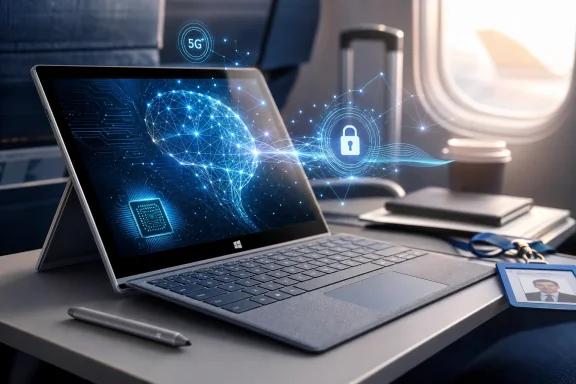 The Travel PC Is Becoming the Office Network
The PCMag article is explicitly promotional, but the premise it leans on is real enough: business computing has escaped the desk, and IT departments are still trying to catch up. Hybrid work used to be discussed as a calendar problem, then as a collaboration problem, and now as an endpoint problem. If employees are working from hotels, client sites, conference centers, family trips, and kitchen tables, the device itself becomes the most consistent piece of infrastructure they touch.That is why a 5G Surface Pro is more than another thin Windows tablet with a kickstand. It is Microsoft’s long-running Surface idea adjusted for a moment when connectivity is not a convenience but a control plane. The device is pitched as a way to keep workers off unknown public Wi-Fi networks, maintain access without hotspot juggling, and preserve enough performance for AI-assisted workflows that increasingly assume an always-connected machine.
The timing is not accidental. Summer travel is the seasonal hook, but the buying argument is annual. A device that can survive peak vacation chaos can also survive the rest of the year’s conference travel, field work, hybrid schedules, and airport delays. Verizon gets to sell the network as part of the PC experience; Microsoft gets to sell the PC as part of the enterprise security stack.
There is a quiet inversion here. For years, mobile connectivity on PCs felt like a niche feature for executives, field workers, and road warriors. In the AI PC era, vendors are trying to make it feel like the default posture for serious business hardware: local compute when you can, cloud services when you must, managed connectivity whenever possible.
Surface Pro’s Old Trick Fits the New Workday
Surface Pro has always been a compromise machine by design. It is a tablet that wants to be a laptop, a laptop that can become a clipboard, and a portable display that can be propped up almost anywhere. That ambiguity used to be the point of debate; now it is the point of the sales pitch.The PCMag piece highlights familiar Surface use cases: a second screen at a coworking desk, a note-taking tablet in a conference session, a presentation device at lunch, or a quick-access travel computer pulled from a bag. None of that is new to Surface owners. What has changed is that hybrid work has made these transitions less exotic and more mundane.
A conventional clamshell laptop is still the better shape for long writing sessions, heavy spreadsheet work, and lap use in cramped seats. Surface Pro’s detachable design still asks users to accept the realities of a kickstand, a separate keyboard cover, and a tablet-first chassis. But for teams whose work shifts between meetings, markup, video calls, note-taking, and quick document edits, the form factor remains unusually elastic.
That elasticity matters because business travel rarely resembles the tidy productivity montages used to sell it. Real travel work happens on tray tables, in noisy terminals, at temporary desks, and during short windows between obligations. A 2-in-1 does not magically make those environments pleasant, but it does reduce the number of moments when the device shape itself becomes the blocker.
Microsoft’s addition of display refinements, pen support, and premium configuration options keeps the Surface Pro positioned as a high-end business tool rather than a commodity tablet. The LCD PixelSense Flow display and optional OLED panel on select 13-inch models are part of that premium framing. So is the Surface Slim Pen, which remains one of the few accessories that can make a Windows tablet feel like something other than a laptop with the keyboard removed.
Intel’s Return to the Surface Story Is About Trust as Much as Speed
The Surface Pro 5G for Business being pitched here uses Intel Core Ultra Series 3 processors, and that detail is more consequential than a routine spec bump. Microsoft has spent the last two years pushing Windows on Arm and Copilot+ PCs, while business buyers have continued to care about x86 compatibility, device management habits, driver maturity, and long-standing procurement channels. Intel inside a Surface Pro for Business is a comfort signal.The Core Ultra Series 3 story is built around three claims: better general performance, stronger integrated graphics, and a neural processing unit for local AI tasks. Microsoft says the new business Surface portfolio is designed for “AI on the edge,” which is vendor-speak for doing more inference on the PC rather than sending every request to a cloud service. Whether most office workers feel that distinction day to day is still an open question.
The NPU matters more as a platform commitment than as a single killer feature. It allows Microsoft and Intel to say these machines are built for the next several years of Windows features, Copilot experiences, conferencing effects, indexing, summarization, and local assistance. IT buyers may not know exactly which AI workload will justify the chip, but they do know that buying a premium fleet without one in 2026 would look short-sighted.
That is the real business case for the AI PC right now: not proven productivity transformation, but risk avoidance. Nobody wants to refresh a fleet and discover 18 months later that new Windows capabilities, security features, or Microsoft 365 integrations run best on hardware they skipped. Microsoft is turning that uncertainty into urgency.
There is still a gap between the marketing language and daily office reality. Copilot can be useful, but it is not uniformly embedded in every workflow, and features like Recall have been controversial because they involve sensitive local activity history. For many administrators, the relevant question is not whether AI is impressive in a demo. It is whether the device can support AI features while remaining governable, explainable, and compliant.
5G Is the Feature That Makes the Security Pitch Plausible
The strongest part of the Verizon-backed argument is not speed. It is control. Public Wi-Fi has improved over the years, and VPNs, modern browsers, HTTPS, endpoint protection, and identity controls have reduced some of the old coffee-shop horror stories. But for enterprise IT, unknown networks are still an avoidable variable.A PC with built-in 5G reduces the need for employees to tether to phones, hunt for conference Wi-Fi passwords, accept captive portal terms, or connect to networks with names that merely look legitimate. That does not make cellular networking invincible, and it does not eliminate the need for VPNs, conditional access, endpoint detection, or strong identity controls. It does, however, let IT departments standardize one more piece of the remote-work chain.
This is where Verizon’s role becomes strategically useful. The carrier is not just providing bandwidth; it is offering procurement departments a cleaner story about secure mobility. Buy the business Surface through Verizon, attach it to a managed data plan, and suddenly the PC feels closer to a corporate phone in the management model than a free-floating laptop on whatever network happens to be nearby.
That analogy has limits. A Windows PC is still a vastly more complex endpoint than a phone, with a broader software surface and more opportunities for misconfiguration. But built-in cellular does change user behavior, and user behavior is where many security controls fail. The best network is often the one the employee actually uses without workarounds.
There is also a productivity argument hiding under the security one. A reliable connection before boarding, in a rideshare, at a client site, or outside a conference room can prevent the kind of small delays that cascade through a travel day. The business value of 5G is not that every worker will stream high-definition video from a rooftop café. It is that the device is less likely to become useless when the schedule stops cooperating.
Microsoft Wants the Endpoint to Be the AI Boundary
The Surface Pro 5G for Business pitch bundles Copilot, local AI hardware, mobile connectivity, and device management into a single story because Microsoft’s broader Windows strategy depends on that bundle holding together. If AI is going to become a normal layer of business computing, the endpoint must be powerful enough to run some workloads locally, connected enough to reach cloud intelligence, and managed enough to keep data exposure within policy.That is a difficult triangle. Local AI is attractive because it can reduce latency, preserve some privacy, and make features available when cloud round trips are undesirable. Cloud AI is attractive because the biggest models, company knowledge stores, and Microsoft 365 integrations live there. Management is the glue that determines whether any of this is acceptable in regulated or security-conscious environments.
Microsoft Intune, Surface Management Portal, Surface IT Toolkit, Windows Hello, BitLocker, and Microsoft Pluton all appear in this orbit. Some are mature enterprise technologies; others are part of Microsoft’s attempt to make Surface hardware feel like the reference implementation of a managed Windows PC. The message to IT is that the device is not merely compatible with Microsoft’s stack. It is designed to demonstrate it.
Pluton is a particularly telling part of the pitch. By integrating a security processor into the CPU package, Microsoft can talk about protecting credentials, encryption keys, and identity material closer to the silicon. That sounds abstract until you remember that modern endpoint security is increasingly about identity theft, token abuse, and persistence rather than old-fashioned malware alone.
Still, hardware security features are not magic shields. They only matter when paired with disciplined policy, patching, least privilege, identity governance, and monitoring. A Pluton-equipped PC on a managed cellular network is a better starting point than an unmanaged laptop on hotel Wi-Fi, but it is not an excuse to relax the rest of the security program.
The Sponsored Pitch Accidentally Reveals the Real Procurement Battle
Because the PCMag article is a branded piece, it does what branded pieces do: it turns every feature into an unambiguous advantage. The Surface is flexible, the network is reliable, the battery lasts all day, the AI is helpful, and the security layers are reassuring. Readers should understand that tone for what it is.But sponsored content can still be revealing because it shows where vendors think the market’s anxieties are. Here, the anxieties are obvious: scattered workers, insecure networks, unpredictable travel, AI readiness, device sprawl, and the fear that productivity will collapse when people are away from the office. Microsoft and Verizon are not selling summer convenience so much as they are selling managerial calm.
That matters because the PC market has been searching for a post-pandemic replacement cycle. Many companies bought hardware in a rush during the first remote-work wave, stretched refresh windows afterward, and are now being asked to buy into a new AI PC category before the business case is fully settled. Vendors need a reason for buyers to move now.
“Work travel” is a softer argument than “your old PC is obsolete,” but it may be more effective. It ties the purchase to familiar frustrations rather than abstract benchmarks. Nobody needs to understand TOPS ratings to understand a missed file upload at the airport or a risky connection at a hotel.
The risk for Microsoft is that the pitch becomes too broad. If every premium PC is now secure, AI-ready, mobile, flexible, and built for hybrid work, the differentiation gets muddy. Surface Pro still has a distinctive shape, but the broader AI PC claims are becoming industry boilerplate. Verizon’s 5G angle helps sharpen the message because connectivity is concrete in a way that “AI-powered productivity” often is not.
The Surface Pro 5G Is Still a Trade-Off Machine
The strongest argument against this kind of device is not that it fails at its mission. It is that the mission is not universal. A Surface Pro is excellent for some work styles and merely tolerable for others, and business buyers should resist the temptation to standardize around elegance alone.For writers, analysts, developers, engineers, finance teams, and anyone who spends long hours in keyboard-heavy applications, a traditional laptop may still be the better tool. A detachable keyboard and kickstand are workable, sometimes even pleasant, but they are not the same as a rigid laptop base. The Surface Pro’s portability advantage can become an ergonomic compromise if the device is used all day as a primary machine without a dock and monitor.
There is also the cost question. Premium Surface configurations, 5G models, keyboard covers, pens, data plans, support agreements, and management overhead can add up quickly. The device may be easy to justify for executives, consultants, sales teams, field personnel, healthcare staff, or workers who move constantly between environments. It is harder to justify for employees whose “hybrid” pattern means a home desk and an office desk, both with stable Wi-Fi.
Battery life deserves the same sober treatment. “All-day” claims are useful shorthand, but travel days are cruel to batteries: video calls, poor signal conditions, brightness outdoors, standby drain, browser tabs, VPNs, and AI features all take their share. A good mobile PC reduces battery anxiety; it does not repeal physics.
The OLED option is another example of the premium trade-off. It can deliver better contrast and richer visuals, which may matter to designers, presenters, and anyone who values display quality. But for broad enterprise fleets, LCD models often make more sense on cost, consistency, and battery grounds. The most attractive configuration is not always the most rational one.
The Summer Hook Points to a Permanent Work Pattern
What makes the Surface Pro 5G for Business interesting is not that employees might answer email poolside. That image is both plausible and faintly depressing. The more meaningful shift is that work has become less tied to predictable infrastructure.A decade ago, IT could assume that most serious work happened on a corporate network or at least from a known location. Today, a routine work week can include a home office, a shared desk, a client visit, a train ride, an airport, and a hotel. The endpoint now has to carry more of the trust relationship because the environment around it changes constantly.
That is why mobile connectivity is re-entering the Windows conversation with more force. The rise of cloud apps made the network more important, and the rise of AI assistants may make it more important still. A disconnected PC can still do plenty, but a disconnected AI-era business workflow can feel strangely amputated if documents, chats, knowledge bases, meetings, and agents all live somewhere else.
The irony is that the “work from anywhere” promise depends on reducing the number of choices workers have to make. The best remote-work setup is not the one with the most possible configurations; it is the one where the employee opens the device and everything expected is already governed, connected, authenticated, and ready. That is the enterprise version of convenience.
Surface Pro 5G on Verizon is therefore a bet on fewer improvisations. Fewer hotspots. Fewer unknown networks. Fewer “can you send that when you get back?” moments. Fewer exceptions that turn into help-desk tickets.
The Real Win Is Fewer Excuses for Bad Remote Work
The practical lesson from this launch pitch is that the travel PC has become a policy object. It is not just a device category; it is where networking, identity, endpoint security, AI readiness, and user experience meet. The companies that benefit most will be the ones that match the hardware to actual work patterns rather than treating it as a fashionable refresh.- The Surface Pro 5G for Business makes the most sense for employees whose work genuinely moves between offices, travel environments, client sites, and meeting-heavy days.
- Built-in 5G is less about peak speed than about reducing dependence on unknown public Wi-Fi, phone tethering, and fragile captive portals.
- Intel Core Ultra Series 3 gives Microsoft a business-friendly AI PC story that preserves x86 compatibility while preparing for more local AI workloads.
- Microsoft’s security pitch is strongest when the device is managed through Intune and related Surface tools, not when hardware features are treated as standalone protection.
- The 2-in-1 form factor remains a trade-off, and buyers should test it against real typing, docking, note-taking, and travel workflows before standardizing on it.
- The strongest business case is not “summer productivity” but a more durable reduction in remote-work friction across the year.
References
- Primary source: PCMag
Published: Tue, 30 Jun 2026 14:29:19 GMT
Microsoft’s 2-in-1 PC on Verizon Is Built For Summer Work Travel. Here’s Why | PCMag
The Verizon-powered Microsoft Surface Pro 5G for Business with Intel Core Ultra Series 3 processors is a hybrid working hero for conference hoppers and digital nomads.www.pcmag.com - Related coverage: insight.com
Surface Pro 5G for Business, 13-inch (12th Edition) | Intel | Insight
Discover the Surface Pro 5G for Business (12th edition). Powered by Intel Core Ultra Series 3 with a 50 TOPS NPU for advanced AI and secure 5G speed. www.insight.com
- Official source: microsoft.com
Surface Pro for Business 12th Edition – Intel and Snapdragon Laptop Tablet | Microsoft Surface
Discover Surface Pro for Business 12th Edition. These AI 2-in-1 laptop tablets are available with Intel® or Snapdragon® processors in 12-inch or 13-inch, with optional 5G. Built for teams that work anywhere.www.microsoft.com
- Official source: learn.microsoft.com
Tech specs—Surface Pro for Business, Copilot+ PC 12-inch - Surface | Microsoft Learn
See technical specifications for Surface Pro for Business with Snapdragon X Plus, including display, battery life, and ports.learn.microsoft.com - Related coverage: itpro.com
Microsoft reveals Surface Pro and Surface Laptop for Business with Intel Core Ultra 3 series processors | IT Pro
New 13in Pro and Laptop claim big performance improvements and vast AI capabilitieswww.itpro.com - Related coverage: techrepublic.com
Microsoft Launches New Surface AI PCs for Business Buyers
Microsoft launched new Surface for Business PCs with Intel Core Ultra Series 3 chips, AI features, 5G options, and enterprise security tools.www.techrepublic.com
- Official source: blogs.windows.com
Introducing new Surface devices built for business and AI acceleration
Every IT leader and partner we work with is navigating the same challenges: AI is changing the demands of how teams work, security threats are growing more sophisticated and agents are changing investment decisions for the future. All under greater sblogs.windows.com - Related coverage: tomshardware.com
Microsoft finally has a Surface Laptop with 5G — Intel Core Ultra-powered laptop will ship as part of business line | Tom's Hardware
The company has gone deep on antennas.www.tomshardware.com - Related coverage: techradar.com
Microsoft unveils new Surface for Business laptops and Surface Pro for Business 2 in 1s — showing your next work device will have AI at the core | TechRadar
Microsoft unveils new Surface designed with AI in mindwww.techradar.com - Related coverage: windowscentral.com
Microsoft confirms that it will bring Snapdragon X2 chips to new Surface Pro and Surface Laptop this year | Windows Central
Although not available today, the company has confirmed that customers will be able to buy its new Surface devices with Snapdragon X2 chips later this year.www.windowscentral.com - Related coverage: verizon.com
- Related coverage: gizmochina.com
Microsoft Surface Laptop 5G Launched for Business With Intel Core Ultra (Series 2) and Built-in 5G - Gizmochina
Microsoft launches Surface Laptop 5G with Intel Core Ultra, 13.8-inch 120Hz screen, 5G support, and up to 1TB SSD for businesses. www.gizmochina.com
- Related coverage: phonescoop.com
Verizon Opens up Dedicated First Responder Network to Mobile Devices (Phone Scoop)
After a successful but limited launch of its dedicated virtual network for first responders last year, Verizon is now opening up the network to compatible smartphones, tablets, and laptops. Verizon started its rollout of the network almost exactly one year ago with 30 markets, expanding... www.phonescoop.com
