

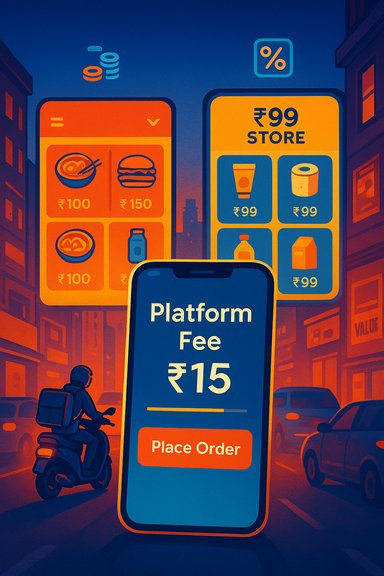
Swiggy has quietly but deliberately increased its per-order platform fee to ₹15 and restructured parts of its subscription and low-cost delivery offerings to protect margins as delivery discounts and competitive pressure intensify across India’s food‑delivery market. The company’s Q2 results and management commentary make clear that the move is designed to offset rising subsidised deliveries — particularly under the Swiggy One programme — while preserving the ability to compete on price through targeted low-cost formats such as the new Toing app and the longstanding ₹99 store. This is a strategic pivot that trades a small, visible surcharge to all customers for more controlled subsidy spend where it matters most, and it comes at the same time rival players — notably Zomato and new entrants like Rapido — recalibrate pricing and delivery models.
India’s food‑delivery market has spent most of the last decade in a familiar pattern: heavy discounting and subsidy-driven user acquisition followed by episodic attempts at monetization through subscription products and per-order levies. Two trends collided in the months leading up to Swiggy’s Q2 commentary. First, the festival season and promotional pushes lifted order volumes but also re‑ignited aggressive discounting at the restaurant and platform level. Second, new market entrants and niche plays have emerged with alternative delivery economics — lower unit delivery fees, subscription‑style restaurant pricing, or radically lean courier models — and they are exerting measurable pressure on margins across incumbents. Swiggy’s platform fee adjustment is best understood as a response to both pressures: it shores up unit economics while leaving room for selective price‑led offerings aimed at value shoppers.
Key consumer implications:
That said, the policy is not without friction. Visible per‑order surcharges risk consumer dissatisfaction and invite competitive responses from vertical or regional challengers who can profitably undercut incumbent delivery economics. The longer‑term question is whether the industry will embed a stable, multi‑product model — subscription for loyalty, low‑cost apps for value shoppers, and regular orders with modest platform fees — or slip back into episodic discounting and margin compression when competition intensifies.
Given the arithmetic and the evidence from public reporting, the platform fee raise is a material lever for immediate margin improvement, but it is not a substitute for structural cost optimization in delivery logistics, restaurant economics, and operational efficiency. Observers should therefore watch short‑term revenue lifts for confirmation and look for sustained improvements in cost per order and customer lifetime value as the real test of durability.
A note on sources and verification: public financial commentary and media reports formed the basis of the figures and claims above; independent filings and company investor materials provide the definitive numbers but are distributed across quarterly disclosures and earnings call transcripts. A review of uploaded internal files returned no additional, contradictory disclosures beyond what public reporting has covered.
Conclusion
Swiggy’s move to raise the platform fee to ₹15, while expanding targeted affordable formats, is a carefully measured attempt to balance growth, retention and profitability in an increasingly crowded market. It preserves the company’s ability to subsidise strategic cohorts while making the broader customer base contribute a little more to the economics of each order. The coming quarters will reveal whether this calibration delivers durable margin improvement or whether competition — especially models that attack the cost of last‑mile delivery — forces another round of product and price innovation.
Source: Storyboard18 Swiggy uses platform fee hike to offset rising delivery discounts, competition
 Background / Overview
India’s food‑delivery market has spent most of the last decade in a familiar pattern: heavy discounting and subsidy-driven user acquisition followed by episodic attempts at monetization through subscription products and per-order levies. Two trends collided in the months leading up to Swiggy’s Q2 commentary. First, the festival season and promotional pushes lifted order volumes but also re‑ignited aggressive discounting at the restaurant and platform level. Second, new market entrants and niche plays have emerged with alternative delivery economics — lower unit delivery fees, subscription‑style restaurant pricing, or radically lean courier models — and they are exerting measurable pressure on margins across incumbents. Swiggy’s platform fee adjustment is best understood as a response to both pressures: it shores up unit economics while leaving room for selective price‑led offerings aimed at value shoppers. What Swiggy changed and why it matters
The platform fee: a small surcharge with outsized effect
Swiggy raised the per‑order platform fee to ₹15 in high‑demand markets and timeframes, up from earlier levels that had bounced between ₹12 and a brief ₹14 test during national holidays. This flat fee is added to each order alongside restaurant pricing, GST, delivery fees, and other surcharges. For a company operating at scale, a seemingly modest per‑order raise becomes material quickly — at an estimated run rate of roughly 2 million deliveries per day, the fee increase can move the dial on quarterly and annual revenues by tens to hundreds of crores. The company’s public commentary and market reporting highlight this as a deliberate lever to “protect margins” while allowing targeted consumer subsidies to continue.- Why it’s effective: platform fees are visible, predictable, and easy to implement across geographies and demand windows.
- Why it’s sensitive: they are also politically and commercially visible to price‑sensitive consumers and can be framed as a blanket surcharge rather than targeted monetization.
Swiggy One and the subsidy trade-off
Management flagged that Swiggy adjusted Swiggy One — its subscription offering — in a “targeted” fashion to avoid short‑term customer churn. That adjustment led to a temporary uptick in subsidised deliveries under the subscription bundle, increasing the unit cost of fulfilling those orders. The platform fee increase is portrayed as the counter‑measure that preserves the subscription’s value proposition while preventing indiscriminate margin erosion. In short: Swiggy is subsidising selectively and offsetting the overall impact with a uniform per‑order charge.Low‑cost formats: Toing, ₹99 store, and experimentation
Parallel to the fee hike, Swiggy has been expanding and experimenting with lower‑cost delivery formats that target price‑sensitive cohorts. The notable examples:- Toing — a standalone app launched in Pune offering meals primarily in the ₹100–₹150 range, and flash deals under ₹99, designed for students and young workers. The app positions itself as a low‑friction, low‑margin channel to retain value shoppers.
- The ₹99 store — an established in‑app section across many cities promoting items at or below ₹99 to capture budget demand without subsidising mainstream full‑price orders.
The competitive landscape: why Swiggy felt pressure
Rapido’s arrival: a delivery cost disruptor
Rapido — best known as a bike‑taxi and hyperlocal transport operator — has moved into food delivery with a low‑cost model built on a fixed delivery fee and simplified restaurant commercial terms. Reuters and other outlets detail Rapido’s approach: flat delivery fees for orders above a threshold, lower restaurant commission expectations, and plans for restaurant subscriptions. This model directly challenges incumbents’ delivery economics by undercutting the per‑order delivery price and offering predictable costs to restaurants and consumers. For Swiggy, Rapido’s presence increases the risk of a price war in the delivery leg of the stack — the most margin‑sensitive part of the business.Zomato’s parallel rate increase
Zomato concurrently raised its platform fee to ₹12 per order, signaling that both large platforms are pursuing similar trade‑offs in the lead up to festival demand. When multiple players take the same step, it becomes less of a unilateral price shock and more of a market re‑pricing that rebalances short‑term demand elasticity against sustainable unit economics. The synchronized timing reduces the incentive for any one player to reverse course for fear of losing margin parity.Verifying the arithmetic: how meaningful is ₹15?
Swiggy’s scale turns a small per‑order increment into large headline numbers. We cross‑checked the reported math across multiple outlets to confirm the order‑of‑magnitude impact:- Reported order volumes: several credible news reports cite Swiggy’s daily order volume at or above ~2 million orders per day (the exact number varies across outlets and quarters). That figure is presented as a working estimate rather than a precise, audited number.
- Revenue delta from the fee change: increasing the platform fee from ₹12 to ₹15 on 2 million daily orders yields:
- Daily incremental revenue: (₹15 − ₹12) × 2,000,000 = ₹6,000,000 (₹60 lakh).
- Quarterly incremental revenue (90 days): ≈ ₹54 crore.
- Annual incremental revenue: ≈ ₹216 crore.
Several outlets replicated this arithmetic when describing the fee change; the numbers are straight multiplication and therefore easy to validate, but they rest on the key assumption of the base order volume.
Strategic trade‑offs: strengths and risks
Strengths of the approach
- Immediate margin relief: platform fees are visible revenue lines that improve unit economics quickly without complex contract changes with restaurants or riders.
- Flexible subsidy targeting: by keeping Swiggy One and low‑cost apps, the company can concentrate subsidies toward retention or price‑sensitive user segments while recovering cost elsewhere.
- Market signaling: synchronized moves with Zomato reduce the chance of a single‑player price war and help normalize a new pricing baseline across the industry.
Material risks and downsides
- Consumer backlash and churn risk: per‑order fees are visible to customers and can be perceived as a “tax” rather than a targeted cost recovery — that matters in price‑sensitive segments and could accelerate churn among occasional users.
- Elasticity during promotions: festival seasons often bring heightened sensitivity to delivery and platform charges; if the fee leads to lower order frequency, the net benefit may be attenuated or reversed.
- Regulatory and reputational scrutiny: visible surcharges invite scrutiny from consumer groups and regulators, particularly if platforms are simultaneously running promotions that mask true price increases.
- Competitive retaliation: entrants like Rapido or regional players could double down on lower delivery fees or subscription offers targeted at younger cohorts, eroding the customer base Swiggy hopes to protect with Toing and the ₹99 store.
Consumer impact: segmentation, fairness, and perception
The platform fee change shifts some cost burden back to consumers, but not uniformly. Subscribers and heavy users who value free or subsidised deliveries may see better net value if Swiggy concentrates subsidy support on them. Price‑sensitive, infrequent users — who are less likely to have a subscription — will feel the fee more acutely.Key consumer implications:
- A small, consistent surcharge tends to erode satisfaction more than an equivalent, less frequent increase (e.g., an annual subscription bump).
- Dedicated low‑price channels (Toing, ₹99 store) help preserve affordability for students and budget shoppers but may segment the user base and change long‑term lifetime value dynamics.
- Perceived fairness matters: if subscribers continue to enjoy better deals while casual users pay a visible per‑order fee, the company can justify the change strategically — provided the value proposition for subscribing is clear and compelling.
Operational and financial implications
From an operational standpoint, the platform fee hike is simple to deploy (a product configuration) but has several downstream implications:- Revenue recognition and tax treatment: platform fees often attract GST and require clear accounting to ensure correct tax collected and remittances.
- Payments and reconciliation: more line‑items make receipts more complex and increase reconciliation loads for merchant partners that must process orders and settlements.
- Marketing economics: the fee gives the company more budget headroom to fund targeted promotions — but only if the incremental revenue is allocated toward smart, measured subsidy programs rather than broad discounting.
What incumbents and newcomers are doing — a snapshot
- Swiggy: lifting platform fee to ₹15 in select markets; expanding Toing and leveraging ₹99 store to capture budget customers; adjusting Swiggy One to target retention.
- Zomato: raising its platform fee to ₹12, mirroring the margin‑protection logic while preparing for festival demand.
- Rapido: rolling out a food delivery arm with a flat delivery fee model and simpler restaurant economics, aiming to undercut incumbents on delivery cost. This move increases the chance of sustained price competition in the delivery leg.
Tactical checklist: what to watch next (for industry observers and investors)
- Order volumes and frequency: any sustained drop after the fee hike would signal stronger than expected consumer elasticity.
- Swiggy One net additions and churn: if subscription uptake accelerates, the company has successfully signalled value and mitigated public backlash.
- Unit delivery cost trends: watch for improvements in cost per delivery as Swiggy scales Toing or changes last‑mile logistics.
- Promotional intensity and subsidy allocation: whether the incremental fee is invested back into targeted promotions (retention, high‑LTV cohorts) or used to shore up reported margins will shape long‑term unit economics.
- Competitive moves from Rapido and regional players: discounts, flat‑fee substitutes, or restaurant subscription products would be the natural counterpunch.
Final analysis: a pragmatic recalibration, not a revolution
Swiggy’s platform‑fee increase to ₹15 is a pragmatic, tactical step that reveals two things about the current phase of India’s food‑delivery market. First, companies are intent on defending margin per order after years of subsidy-driven growth. Second, incumbents are experimenting with product segmentation (subscriptions, low‑cost apps, curated stores) to retain cohorts without resorting to blanket discounts.That said, the policy is not without friction. Visible per‑order surcharges risk consumer dissatisfaction and invite competitive responses from vertical or regional challengers who can profitably undercut incumbent delivery economics. The longer‑term question is whether the industry will embed a stable, multi‑product model — subscription for loyalty, low‑cost apps for value shoppers, and regular orders with modest platform fees — or slip back into episodic discounting and margin compression when competition intensifies.
Given the arithmetic and the evidence from public reporting, the platform fee raise is a material lever for immediate margin improvement, but it is not a substitute for structural cost optimization in delivery logistics, restaurant economics, and operational efficiency. Observers should therefore watch short‑term revenue lifts for confirmation and look for sustained improvements in cost per order and customer lifetime value as the real test of durability.
A note on sources and verification: public financial commentary and media reports formed the basis of the figures and claims above; independent filings and company investor materials provide the definitive numbers but are distributed across quarterly disclosures and earnings call transcripts. A review of uploaded internal files returned no additional, contradictory disclosures beyond what public reporting has covered.
Conclusion
Swiggy’s move to raise the platform fee to ₹15, while expanding targeted affordable formats, is a carefully measured attempt to balance growth, retention and profitability in an increasingly crowded market. It preserves the company’s ability to subsidise strategic cohorts while making the broader customer base contribute a little more to the economics of each order. The coming quarters will reveal whether this calibration delivers durable margin improvement or whether competition — especially models that attack the cost of last‑mile delivery — forces another round of product and price innovation.
Source: Storyboard18 Swiggy uses platform fee hike to offset rising delivery discounts, competition
