

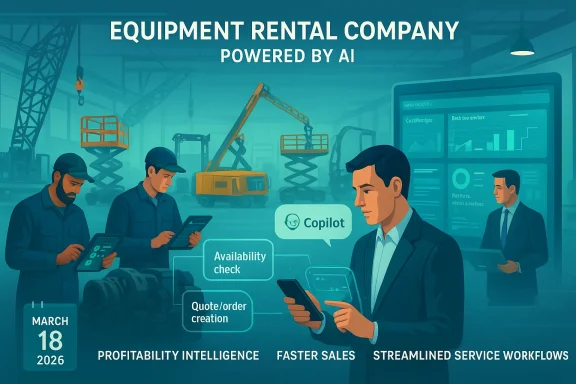
Sycor’s Spring Release 2026 for Sycor.Rental arrives at a moment when equipment rental businesses are under pressure to do more with less: more utilization, more visibility, more responsiveness, and less manual coordination. The new release leans hard into that reality with three headline themes — equipment profitability, AI-supported sales, and enhanced workshop and service processes — while positioning Microsoft Copilot as a practical layer inside daily rental operations rather than a novelty feature. Sycor says the update will land on March 18, 2026, and the company’s own product pages frame it as a move toward faster decision-making, stronger margins, and more mobile work.
Equipment rental software has always lived at the intersection of assets, maintenance, utilization, billing, and customer service. That mix makes it a natural fit for ERP-driven process management, but it also means that even small inefficiencies can cascade across the business. When a crane, lift, generator, or specialized tool is sitting idle because of poor planning, the loss is not just operational; it is financial.
Sycor.Rental is built on Microsoft Dynamics 365 Finance & Supply Chain Management, which gives Sycor a platform with strong finance, inventory, and process foundations. That matters because rental companies do not merely need a front-end quoting tool; they need a system of record that can track equipment, pricing, maintenance, and margins in one place. Sycor’s spring release for 2026 follows the same pattern the company used in 2025, where it focused on mobility, field service improvements, and practical workflow refinements.
What changes in 2026 is the emphasis on AI-assisted execution. Microsoft has been steadily expanding Copilot capabilities across Dynamics 365, especially in supply chain, sales, and field service scenarios. Official Microsoft documentation and announcements show a broader strategy: use conversational AI to speed up quoting, support decision-making, and reduce the friction of moving between business tasks. Sycor is clearly trying to translate that broader platform trend into the specialized language of rental operations.
That is a meaningful shift in how rental software is marketed and, potentially, how it is used. In earlier generations, rental ERP value was sold mainly through control and compliance: fewer errors, better billing, tighter inventory management. Now the argument is more ambitious. Vendors increasingly claim their software can improve profitability intelligence and frontline speed at the same time, which is a much higher bar to clear.
The timing also reflects a larger market pattern. Microsoft has been pushing AI into everyday business workflows, not just analytics dashboards. In supply chain and sales, Microsoft’s own materials describe Copilot as a way to analyze plans, surface relevant insights, and assist with quotation and order work. Sycor’s announcement is interesting because it takes those generic platform ideas and applies them to a niche vertical where asset availability, service quality, and margin control all matter simultaneously.
In Sycor’s own description, the release will provide real-time transparency into costs, revenues, and margins for equipment profitability analysis. That is more than a reporting feature. It is an attempt to make every asset easier to evaluate strategically, from whether it should be purchased again to whether it should be redeployed, repaired, or retired.
The second headline is AI-supported sales through Microsoft Copilot. Sycor says sales teams will be able to check availability and create quotes or orders using voice or text, from mobile or desktop, without having to actively navigate the ERP interface. That kind of workflow is designed for speed, but it also signals a more consumer-like expectation for enterprise software: talk to the system, ask for what you need, and move on.
The third theme is improved workshop and service operations. Sycor’s materials point to better planning, integrated quality inspections, and simplified workflows. In rental, that matters because workshop delays can create hidden availability problems elsewhere in the fleet. A delayed inspection today can become a missed booking tomorrow, which means service process quality is directly tied to revenue.
The release also feels more mature than the typical “AI announcement” that merely adds a chatbot to a product page. Here, the AI is being tied to concrete tasks: availability checks, order creation, document handling, and faster service workflows. That makes it more credible, although the real test will be how seamlessly these features work under production conditions.
Sycor says the feature uses a customizable view and central database to support BI analysis and strategic decisions. That matters because rental operations rarely fit one standardized model. A construction fleet, a medical equipment rental business, and a specialist industrial rental company will all care about different cost categories, depreciation assumptions, and utilization thresholds. Flexibility is therefore not a luxury; it is a requirement.
Microsoft’s own Dynamics 365 materials reinforce the logic here. The company has been pushing AI-assisted insights and supply chain analytics as ways to help managers make faster, better-informed decisions. In that sense, Sycor is extending a broader Microsoft pattern into the rental vertical, turning platform-level analytics into asset-level profitability insight.
It also changes how conversations happen between finance and operations. Instead of finance asking for retrospective explanations at month-end, teams can work from a common picture of margin performance as it develops. That is a subtle but significant shift toward operational finance.
The underlying idea is simple: if a salesperson can ask the system a question in natural language and receive an actionable response, then the quote-to-order cycle becomes shorter. Microsoft has already been pushing similar dynamics in Dynamics 365 through Copilot-assisted sales, AI summaries, and order automation. Sycor is packaging that capability for rental use cases where the user needs to know not just what can be sold, but what can be reserved, dispatched, and supported.
That matters because rental sales are often time-sensitive. Customers may be calling because they need equipment for a job starting tomorrow, which means every minute spent navigating menus is a minute that risks losing the deal. In that context, Copilot is not just a convenience; it is part of the competitive response time of the business.
The key question is whether Copilot is being used as a true productivity multiplier or as a thin interface on top of existing processes. If the assistant merely surfaces data faster, that is useful. If it also reduces task switching, training burden, and quote delays, then it becomes strategically important.
Sycor says the release adds better planning, integrated quality inspections, and simplified workflows. That combination suggests a push toward more structured service execution, where inspection results and job progress are less likely to live in disconnected systems or manual notes. Microsoft’s own service and supply-chain materials show that quality checks, work order management, and field service integration are all part of the modern Dynamics 365 playbook.
The business significance is easy to miss. In rental, workshop time is not just cost; it is opportunity cost. Every hour a unit spends waiting for inspection or a part is an hour it cannot produce revenue, and a process improvement that shortens that delay can have a direct impact on utilization. That is why service workflow design is inseparable from fleet profitability.
Better planning also means fewer surprises. If workshop capacity, parts availability, and quality checkpoints are managed in one flow, managers can see bottlenecks before they become missed delivery commitments. The result is less firefighting and more predictable throughput.
In that sense, Sycor’s use of Microsoft Copilot looks more credible than many generic AI claims. Microsoft has already built a foundation of Copilot scenarios around sales, supply chain, and field service. The important issue is whether Sycor can align those capabilities with rental-specific business logic, such as reserving equipment by date, tracking service impact on availability, and converting inspection outcomes into usable operational data.
The danger, of course, is overpromising. AI can accelerate routine actions, but it does not eliminate the need for proper master data, clean processes, and governance. If availability data is poor or service records are incomplete, an AI assistant will simply help users make decisions faster on top of flawed inputs.
Sycor’s challenge will be to show that the release improves not just user experience but operational accuracy. That will be especially important for enterprise buyers who have already heard many claims about copilots, agents, and assistants. Skeptical customers will want proof that the system shortens tasks without introducing errors.
For mid-sized companies, the appeal may be even more immediate. These businesses often lack large back-office teams, which makes automated assistance and better dashboards disproportionately valuable. A small increase in quote speed or workshop efficiency can translate into a meaningful business gain when staff are already stretched.
Microsoft’s platform positioning helps Sycor here. Because the release sits on Dynamics 365 Finance & Supply Chain Management, it inherits a familiar enterprise architecture and a wider AI roadmap. That can reduce buyer anxiety, especially among organizations already standardized on Microsoft technologies.
Longer term, the release could also help customer-facing staff deliver a more modern experience. Faster answers, faster quotes, and smoother service handoffs usually show up as better customer satisfaction, even if the customer never sees the software behind the scenes.
This release also reflects a broader competitive truth: rental software is becoming less about isolated modules and more about connected decision systems. If a competitor cannot show how quoting, service, finance, and AI are linked, it may struggle to match the narrative Sycor is building. Sycor is essentially saying that the best rental system is one where information moves quickly enough to influence action before the opportunity disappears.
Microsoft’s own Dynamics roadmap makes this increasingly plausible. With Copilot capabilities expanding across sales, supply chain, and service, partners can attach vertical workflows to a fast-moving AI platform rather than invent every capability from scratch. That gives Sycor a leverage advantage, provided it can package the platform in a way that remains genuinely rental-specific.
Still, competitors may respond by emphasizing specialization, offline workflows, mobile service depth, or industry-specific compliance. That could create a split market: one group buys ecosystem breadth, while another buys vertical depth. Sycor’s release attempts to sit in the middle by offering both.
The equipment profitability feature, for example, will only be as good as the underlying cost allocation model and transactional discipline. Likewise, Copilot-based sales assistance will depend on whether availability, pricing, and customer data are properly maintained. In workshop operations, quality and planning improvements will only work if employees adopt the new process instead of reverting to old habits.
That is why releases like this tend to succeed best when they are implemented alongside process governance, training, and change management. Software can accelerate good practice, but it cannot substitute for it. In that respect, Sycor’s promise is strong, but the customer’s execution burden still matters enormously.
Those are not glamorous requirements, but they are the difference between digital transformation and digital decoration. Companies that already run disciplined rental operations will likely see faster gains than those still wrestling with fragmented processes.
The broader market implication is that rental software is entering a more mature AI phase. The winners will not be the companies that mention Copilot first, but the ones that connect AI to real operational outcomes: faster quotes, better asset decisions, fewer workshop delays, and more reliable service execution. That is a much harder standard, but it is also the one buyers are starting to demand.
Source: PRLog Sycor Introduces Spring Release 2026 of Sycor.Rental with AI-Driven Innovations and Enhanced Service Processes
 Background
Equipment rental software has always lived at the intersection of assets, maintenance, utilization, billing, and customer service. That mix makes it a natural fit for ERP-driven process management, but it also means that even small inefficiencies can cascade across the business. When a crane, lift, generator, or specialized tool is sitting idle because of poor planning, the loss is not just operational; it is financial.Sycor.Rental is built on Microsoft Dynamics 365 Finance & Supply Chain Management, which gives Sycor a platform with strong finance, inventory, and process foundations. That matters because rental companies do not merely need a front-end quoting tool; they need a system of record that can track equipment, pricing, maintenance, and margins in one place. Sycor’s spring release for 2026 follows the same pattern the company used in 2025, where it focused on mobility, field service improvements, and practical workflow refinements.
What changes in 2026 is the emphasis on AI-assisted execution. Microsoft has been steadily expanding Copilot capabilities across Dynamics 365, especially in supply chain, sales, and field service scenarios. Official Microsoft documentation and announcements show a broader strategy: use conversational AI to speed up quoting, support decision-making, and reduce the friction of moving between business tasks. Sycor is clearly trying to translate that broader platform trend into the specialized language of rental operations.
That is a meaningful shift in how rental software is marketed and, potentially, how it is used. In earlier generations, rental ERP value was sold mainly through control and compliance: fewer errors, better billing, tighter inventory management. Now the argument is more ambitious. Vendors increasingly claim their software can improve profitability intelligence and frontline speed at the same time, which is a much higher bar to clear.
The timing also reflects a larger market pattern. Microsoft has been pushing AI into everyday business workflows, not just analytics dashboards. In supply chain and sales, Microsoft’s own materials describe Copilot as a way to analyze plans, surface relevant insights, and assist with quotation and order work. Sycor’s announcement is interesting because it takes those generic platform ideas and applies them to a niche vertical where asset availability, service quality, and margin control all matter simultaneously.
What Sycor Is Actually Announcing
The core message of the Spring Release 2026 is straightforward: Sycor wants rental organizations to be more profitable and more responsive without adding more administrative burden. The release combines financial visibility, conversational AI, and service workflow refinement into a single story. That combination is important because it suggests Sycor sees rental profitability as an end-to-end process problem, not just an accounting problem.In Sycor’s own description, the release will provide real-time transparency into costs, revenues, and margins for equipment profitability analysis. That is more than a reporting feature. It is an attempt to make every asset easier to evaluate strategically, from whether it should be purchased again to whether it should be redeployed, repaired, or retired.
The second headline is AI-supported sales through Microsoft Copilot. Sycor says sales teams will be able to check availability and create quotes or orders using voice or text, from mobile or desktop, without having to actively navigate the ERP interface. That kind of workflow is designed for speed, but it also signals a more consumer-like expectation for enterprise software: talk to the system, ask for what you need, and move on.
The third theme is improved workshop and service operations. Sycor’s materials point to better planning, integrated quality inspections, and simplified workflows. In rental, that matters because workshop delays can create hidden availability problems elsewhere in the fleet. A delayed inspection today can become a missed booking tomorrow, which means service process quality is directly tied to revenue.
Why This Release Reads Differently
This update is notable because it is framed less as a bundle of software features and more as a business operating model upgrade. Sycor is speaking the language of profitability, productivity, and decision quality, which is exactly where the market has been moving. The language is also tailored to mid-market and enterprise rental firms that care about measurable operational gains, not AI for its own sake.The release also feels more mature than the typical “AI announcement” that merely adds a chatbot to a product page. Here, the AI is being tied to concrete tasks: availability checks, order creation, document handling, and faster service workflows. That makes it more credible, although the real test will be how seamlessly these features work under production conditions.
- Profitability visibility is the financial anchor.
- Copilot-enabled sales is the frontline productivity layer.
- Workshop enhancements are the operational reliability layer.
- The release is aimed at rental-specific pain points, not generic ERP users.
- The business case is about margin discipline as much as speed.
Equipment Profitability as a Strategic Tool
The most financially important part of the release is the new equipment profitability capability. By consolidating costs, revenues, and margins into a single view, Sycor is trying to give rental operators a clearer answer to a question that often gets obscured by spreadsheets: which assets are actually earning their keep? In a fleet business, that is the difference between growth and expensive overexpansion.Sycor says the feature uses a customizable view and central database to support BI analysis and strategic decisions. That matters because rental operations rarely fit one standardized model. A construction fleet, a medical equipment rental business, and a specialist industrial rental company will all care about different cost categories, depreciation assumptions, and utilization thresholds. Flexibility is therefore not a luxury; it is a requirement.
Microsoft’s own Dynamics 365 materials reinforce the logic here. The company has been pushing AI-assisted insights and supply chain analytics as ways to help managers make faster, better-informed decisions. In that sense, Sycor is extending a broader Microsoft pattern into the rental vertical, turning platform-level analytics into asset-level profitability insight.
What Profitability Visibility Changes
Profitability visibility changes how businesses think about acquisition, utilization, and retirement. If a machine appears profitable only when fully loaded, then low usage periods become visible not as temporary quirks but as management problems. That kind of insight can influence fleet renewal, pricing strategy, and branch-level asset allocation.It also changes how conversations happen between finance and operations. Instead of finance asking for retrospective explanations at month-end, teams can work from a common picture of margin performance as it develops. That is a subtle but significant shift toward operational finance.
- Asset-level margin clarity improves investment decisions.
- Revenue leakage becomes easier to spot.
- Underused equipment can be identified sooner.
- Strategic BI reporting becomes more defensible.
- Branch-to-branch comparisons become more meaningful.
AI-Supported Sales and the Copilot Effect
Sycor’s second major theme is AI-supported sales, and this is where the release most clearly reflects current enterprise software trends. The company says sales staff will be able to check availability and create quotes or orders using voice or text, via Microsoft Copilot, from multiple devices and in multiple contexts. That suggests a workflow designed for speed in the field, at the counter, or in a customer call.The underlying idea is simple: if a salesperson can ask the system a question in natural language and receive an actionable response, then the quote-to-order cycle becomes shorter. Microsoft has already been pushing similar dynamics in Dynamics 365 through Copilot-assisted sales, AI summaries, and order automation. Sycor is packaging that capability for rental use cases where the user needs to know not just what can be sold, but what can be reserved, dispatched, and supported.
That matters because rental sales are often time-sensitive. Customers may be calling because they need equipment for a job starting tomorrow, which means every minute spent navigating menus is a minute that risks losing the deal. In that context, Copilot is not just a convenience; it is part of the competitive response time of the business.
How This Compares With Broader Microsoft Copilot Strategy
Microsoft’s broader Copilot messaging in Dynamics 365 has consistently focused on making work more conversational and less page-driven. In supply chain management, Microsoft documents AI summaries and demand-planning analysis. In field service, it has highlighted natural-language assistance for frontline workers and AI-assisted task handling. Sycor appears to be channeling the same philosophy into rental sales workflows.The key question is whether Copilot is being used as a true productivity multiplier or as a thin interface on top of existing processes. If the assistant merely surfaces data faster, that is useful. If it also reduces task switching, training burden, and quote delays, then it becomes strategically important.
- Voice and text input lower the barrier to action.
- Mobile access makes field selling more practical.
- Availability checking reduces quote friction.
- Quote creation becomes faster and more standardized.
- The experience could be especially strong for inside sales and field teams.
Workshop and Service Operations: The Quiet Profit Center
The third area of focus is workshop and service enhancements, and this may be the most underestimated part of the release. Rental businesses often talk loudly about fleet acquisition and customer growth, but the hidden margin often lives in service quality, maintenance timing, and asset readiness. A better workshop process can increase uptime, reduce repeat work, and prevent avoidable losses downstream.Sycor says the release adds better planning, integrated quality inspections, and simplified workflows. That combination suggests a push toward more structured service execution, where inspection results and job progress are less likely to live in disconnected systems or manual notes. Microsoft’s own service and supply-chain materials show that quality checks, work order management, and field service integration are all part of the modern Dynamics 365 playbook.
The business significance is easy to miss. In rental, workshop time is not just cost; it is opportunity cost. Every hour a unit spends waiting for inspection or a part is an hour it cannot produce revenue, and a process improvement that shortens that delay can have a direct impact on utilization. That is why service workflow design is inseparable from fleet profitability.
Quality, Planning, and Repeatability
Integrated quality inspections help standardize the service experience. When inspection steps are part of the core workflow rather than an afterthought, teams can avoid ad hoc decisions that create variation and compliance risk. That matters especially in regulated or high-value rental segments where safety and documentation cannot be improvised.Better planning also means fewer surprises. If workshop capacity, parts availability, and quality checkpoints are managed in one flow, managers can see bottlenecks before they become missed delivery commitments. The result is less firefighting and more predictable throughput.
- Standardized inspections improve consistency.
- Shorter turnaround times increase fleet availability.
- Better planning reduces workshop congestion.
- Simplified workflows cut administrative overhead.
- Repeatable processes support training and scaling.
Why AI Matters Here More Than in Generic ERP
AI announcements are everywhere, but the rental industry has a particular need for them because it operates on dense, exception-heavy workflows. An equipment rental company has to manage item availability, transport timing, condition checks, contract terms, service history, and customer-specific requirements. That complexity creates a real opportunity for AI to save time, not just produce summaries.In that sense, Sycor’s use of Microsoft Copilot looks more credible than many generic AI claims. Microsoft has already built a foundation of Copilot scenarios around sales, supply chain, and field service. The important issue is whether Sycor can align those capabilities with rental-specific business logic, such as reserving equipment by date, tracking service impact on availability, and converting inspection outcomes into usable operational data.
The danger, of course, is overpromising. AI can accelerate routine actions, but it does not eliminate the need for proper master data, clean processes, and governance. If availability data is poor or service records are incomplete, an AI assistant will simply help users make decisions faster on top of flawed inputs.
Practical Value Versus Marketing Value
This is where the difference between AI as real workflow support and AI as presentation layer becomes obvious. A system that helps a salesperson query inventory in natural language while also enforcing the underlying business rules is valuable. A system that merely wraps a search box in a chat window is not.Sycor’s challenge will be to show that the release improves not just user experience but operational accuracy. That will be especially important for enterprise buyers who have already heard many claims about copilots, agents, and assistants. Skeptical customers will want proof that the system shortens tasks without introducing errors.
- Real workflow support beats cosmetic AI.
- Data quality remains a prerequisite.
- Rules-based process control must stay intact.
- User trust will depend on consistent answers.
- Measured efficiency gains will matter more than hype.
Enterprise and Mid-Market Implications
For enterprise customers, the release is most attractive if it scales across branches, asset classes, and service teams without fragmenting process control. Larger rental organizations usually care about governance, reporting, and integration with finance. If Sycor.Rental can provide a stronger profitability view alongside AI-assisted order handling, that combination will be appealing to organizations that need both operational speed and management control.For mid-sized companies, the appeal may be even more immediate. These businesses often lack large back-office teams, which makes automated assistance and better dashboards disproportionately valuable. A small increase in quote speed or workshop efficiency can translate into a meaningful business gain when staff are already stretched.
Microsoft’s platform positioning helps Sycor here. Because the release sits on Dynamics 365 Finance & Supply Chain Management, it inherits a familiar enterprise architecture and a wider AI roadmap. That can reduce buyer anxiety, especially among organizations already standardized on Microsoft technologies.
Who Benefits First
The first beneficiaries are likely to be sales teams, dispatch planners, workshop supervisors, and finance leaders. Those groups feel the pain of slow decision-making most directly. They also stand to gain the most if AI trims repetitive work and gives them better visibility into asset and service performance.Longer term, the release could also help customer-facing staff deliver a more modern experience. Faster answers, faster quotes, and smoother service handoffs usually show up as better customer satisfaction, even if the customer never sees the software behind the scenes.
- Large fleets gain better governance.
- Smaller teams gain leverage through automation.
- Finance leaders get clearer margin insight.
- Sales teams get faster response capability.
- Service teams get more disciplined workflow support.
Competitive Pressure on the Rental Software Market
Sycor’s move raises the bar for other rental software vendors, especially those still relying on conventional ERP efficiency arguments. The market is shifting toward systems that do three things at once: control assets, surface profitability, and assist users conversationally. That is a much tougher pitch for rivals who lack an integrated AI story or a deep Microsoft ecosystem connection.This release also reflects a broader competitive truth: rental software is becoming less about isolated modules and more about connected decision systems. If a competitor cannot show how quoting, service, finance, and AI are linked, it may struggle to match the narrative Sycor is building. Sycor is essentially saying that the best rental system is one where information moves quickly enough to influence action before the opportunity disappears.
Microsoft’s own Dynamics roadmap makes this increasingly plausible. With Copilot capabilities expanding across sales, supply chain, and service, partners can attach vertical workflows to a fast-moving AI platform rather than invent every capability from scratch. That gives Sycor a leverage advantage, provided it can package the platform in a way that remains genuinely rental-specific.
The Strategic Rivalry
The real rivalry is no longer only between rental software vendors. It is also between ecosystem strategies. Microsoft-centric partners have the advantage of inheriting platform trust, while independent vendors must persuade buyers that their AI and analytics stack is equally future-proof. That could shift procurement decisions in Sycor’s favor, especially among customers already invested in Microsoft infrastructure.Still, competitors may respond by emphasizing specialization, offline workflows, mobile service depth, or industry-specific compliance. That could create a split market: one group buys ecosystem breadth, while another buys vertical depth. Sycor’s release attempts to sit in the middle by offering both.
- Ecosystem integration becomes a differentiator.
- Rental-specific AI is now a competitive expectation.
- Mobile and field workflows remain important battlegrounds.
- Profitability analytics may influence buying decisions.
- Platform trust can outweigh feature checklists.
Implementation Reality: The Hard Part Behind the Headlines
The release is compelling, but implementation will decide whether it becomes a real operational advantage or just a better brochure. Rental companies often struggle not because they lack software features, but because data is fragmented, workflows are inconsistent, and operational discipline varies by branch or team. An AI assistant cannot fix that by itself.The equipment profitability feature, for example, will only be as good as the underlying cost allocation model and transactional discipline. Likewise, Copilot-based sales assistance will depend on whether availability, pricing, and customer data are properly maintained. In workshop operations, quality and planning improvements will only work if employees adopt the new process instead of reverting to old habits.
That is why releases like this tend to succeed best when they are implemented alongside process governance, training, and change management. Software can accelerate good practice, but it cannot substitute for it. In that respect, Sycor’s promise is strong, but the customer’s execution burden still matters enormously.
What Successful Adoption Requires
There are a few practical requirements that will likely determine whether the release produces measurable value. First, organizations need clean master data. Second, they need clear ownership for profitability and service metrics. Third, they need adoption incentives so that users actually rely on the new workflows rather than bypassing them.Those are not glamorous requirements, but they are the difference between digital transformation and digital decoration. Companies that already run disciplined rental operations will likely see faster gains than those still wrestling with fragmented processes.
- Define asset cost and margin rules before rollout.
- Train sales and workshop users on the new workflow paths.
- Validate AI responses against real-world business cases.
- Monitor adoption and exception handling closely.
- Review profitability reports with finance and operations together.
- Data discipline will make or break the release.
- User training is as important as features.
- Governance must accompany AI assistance.
- Change management should not be treated as optional.
- Measured pilot deployments are likely the safest path.
Strengths and Opportunities
Sycor’s release has several clear strengths, especially for rental companies that already live inside the Microsoft stack and want a more modern operating model. The strongest opportunity is the way the update connects financial insight, sales speed, and service efficiency into one narrative. That is exactly the kind of integrated value proposition enterprise buyers tend to respect.- Clear business outcomes: profitability, speed, and efficiency are easy to explain.
- Strong platform alignment: Microsoft Copilot and Dynamics 365 add credibility.
- Vertical specificity: the release is tailored to rental operations, not generic ERP.
- Better frontline usability: voice and text interfaces reduce friction.
- Improved decision support: equipment profitability strengthens capital allocation.
- Service process discipline: workshop improvements can lift utilization.
- Scalability potential: the model can appeal to both mid-market and larger firms.
Risks and Concerns
The release is promising, but it also carries familiar risks that come with any AI-forward ERP update. The first concern is that AI assistance may outpace data quality, which would undermine confidence quickly. The second is that customers may overestimate what conversational interfaces can reliably do in high-stakes rental workflows.- Data quality dependency could limit the value of AI-assisted decisions.
- Overreliance on Copilot may create trust issues if answers are inconsistent.
- Change resistance could slow adoption in workshop and sales teams.
- Integration complexity may increase rollout effort for larger customers.
- Process standardization might expose weak spots in existing operations.
- Expectation risk is high because AI branding raises buyer expectations.
- Governance gaps could create compliance or reporting problems.
Looking Ahead
The most important thing to watch is whether Sycor can turn this release into a repeatable business case for rental customers. The product story is strong because it links operational metrics to margin impact, which is exactly the kind of language finance and operations leaders understand. If the rollout goes well, Sycor may strengthen its position as a serious vertical player in the Microsoft ecosystem.The broader market implication is that rental software is entering a more mature AI phase. The winners will not be the companies that mention Copilot first, but the ones that connect AI to real operational outcomes: faster quotes, better asset decisions, fewer workshop delays, and more reliable service execution. That is a much harder standard, but it is also the one buyers are starting to demand.
- March 18, 2026 release availability will be the first key milestone.
- Customer adoption stories will reveal whether the AI features are practical.
- Profitability reporting quality will show how strong the financial model is.
- Workshop workflow usage will indicate whether service changes stick.
- Microsoft Copilot alignment will remain a major selling point.
Source: PRLog Sycor Introduces Spring Release 2026 of Sycor.Rental with AI-Driven Innovations and Enhanced Service Processes
Last edited:
