

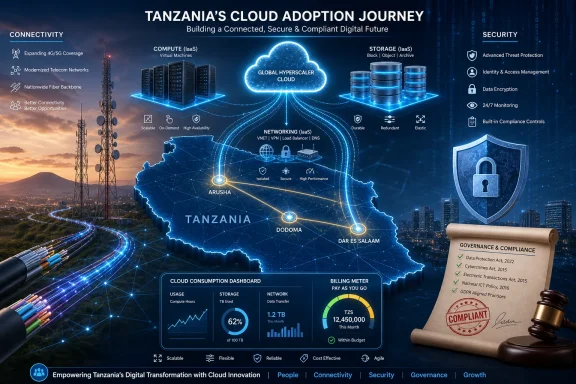
Infrastructure as a Service in Tanzania is a small but strategically important public-cloud market in which businesses, government agencies, and digital service providers rent compute, storage, and networking capacity from global cloud platforms rather than buying and operating their own hardware. Statista frames the market as part of Tanzania’s broader public cloud economy, with AWS, Microsoft Azure, Google Cloud, and IBM Cloud among the reference players. The real story is not simply that Tanzania is “moving to the cloud.” It is that cloud infrastructure is becoming a test of whether the country’s digital ambitions can outrun the limits of connectivity, regulation, latency, skills, and trust.
For years, infrastructure discussions in emerging digital markets revolved around towers, fiber, submarine cables, and mobile money rails. Those still matter, but the next layer is now harder to ignore: where the applications actually run. In Tanzania, IaaS sits at that layer, turning physical infrastructure into rented capacity that a bank, startup, hospital, university, retailer, or ministry can provision in minutes.
That shift is consequential because IaaS changes the economics of experimentation. A Tanzanian software company no longer needs to buy servers before discovering whether a product has customers. A public agency can pilot a digital service without waiting for a traditional procurement cycle to deliver racks, cooling, and backup power. A bank can scale transaction processing during peak demand without permanently overbuilding its own data center.
But this is not a fairy tale about the cloud dissolving every local constraint. Tanzania’s IaaS market depends on global hyperscalers whose nearest major African regions are generally outside the country, especially in South Africa. That means Tanzanian customers may get the flexibility of AWS, Azure, or Google Cloud, but they still face the physics of distance, the politics of data governance, and the practical problem of managing cloud bills in a currency and procurement environment that was not designed around elastic consumption.
The market is therefore best understood as an adoption curve with a catch. Demand is rising because digital services are expanding. Yet the most important question is not whether Tanzanian organizations will use IaaS. They already do, directly or indirectly. The harder question is whether the local ecosystem can develop enough governance, connectivity, talent, and regulatory clarity to make IaaS a foundation rather than a dependency.
IaaS lets organizations rent virtual machines, block storage, object storage, load balancers, virtual networks, firewalls, and backup capacity as needed. For a company with uncertain growth, that can be rational. For a public-sector project whose usage may spike around deadlines, registration windows, tax seasons, or election-related services, elasticity can look like prudence rather than luxury.
The attraction is even clearer for startups and software firms. Tanzania’s digital economy needs builders who can ship products without first becoming facilities managers. Cloud infrastructure lowers the threshold for building web apps, payment integrations, analytics platforms, logistics tools, telemedicine services, and learning systems. In a market where capital is not always patient, avoiding upfront infrastructure costs can be the difference between shipping and stalling.
Yet IaaS also moves spending from visible hardware to invisible meters. A server in a room is easy to count. A fleet of virtual machines, snapshots, managed disks, outbound data transfers, idle databases, and forgotten test environments is not. Tanzanian businesses adopting IaaS will discover the same lesson learned elsewhere: the cloud is cheap when governed well and punishing when treated as magic.
That matters because latency is not a branding problem. If an application serving users in Dar es Salaam runs in Johannesburg, Cape Town, Europe, or the Middle East, every request has to travel. For many workloads, that is acceptable. Email systems, back-office applications, analytics pipelines, backups, enterprise resource planning tools, and collaboration services can tolerate delay. For real-time payments, gaming, voice, video, industrial monitoring, and high-frequency transaction systems, the distance becomes harder to ignore.
This is where the Tanzanian IaaS market splits into tiers. Commodity workloads can live comfortably in foreign regions if connectivity is stable and costs are understood. Sensitive, latency-dependent, or sovereignty-constrained workloads may need local hosting, private cloud, colocation, hybrid architectures, or partnerships with regional data center operators. The phrase cloud-first sounds decisive until a network trace shows where the packets are going.
The practical future is likely hybrid rather than pure public cloud. Tanzanian organizations will use hyperscalers for scale, managed services, security tooling, disaster recovery, and access to advanced platforms. They will also keep some systems local for performance, regulation, cost control, or institutional comfort. That is not backwardness. It is architecture responding to geography.
Tanzania has seen rising internet use and expanding mobile connectivity, and those trends are essential for IaaS demand. Public cloud infrastructure becomes more valuable as more services move online: banking, education, government portals, health records, e-commerce, media, logistics, and agriculture platforms. Every digital front end creates a back-end infrastructure question.
But connectivity quality matters as much as headline penetration. Cloud applications need dependable routing, reasonable latency, sufficient bandwidth, and predictable uptime. A business can migrate its systems to a global provider and still deliver a poor user experience if the last-mile connection is unstable or if international transit is congested. The cloud does not erase the network; it exposes it.
This is why internet exchange points, local caching, carrier-neutral data centers, submarine cable capacity, and domestic fiber routes are part of the IaaS story. They may not appear on the same market chart as virtual machines, but they determine whether those virtual machines feel close or distant. Tanzania’s cloud future will be built as much by network engineers as by cloud architects.
Data protection rules can help the market if they create clear expectations for consent, processing, storage, breach reporting, cross-border transfers, and accountability. Enterprises are more likely to adopt cloud services when they understand what is permitted and what controls are expected. Ambiguity, by contrast, pushes organizations toward defensive conservatism. Nobody wants to be the test case that discovers a cloud architecture was noncompliant after the fact.
The risk is that data sovereignty becomes a blunt instrument. If policymakers require broad categories of data to remain physically inside national borders before the local market has enough resilient, certified, affordable infrastructure, cloud adoption can slow. If rules are too vague, organizations may overcompensate by keeping everything on-premises, even when public cloud would be more secure, more resilient, and easier to audit.
A more productive approach is classification. Not every workload carries the same risk. Public websites, anonymized analytics, software development environments, and generic collaboration tools do not need the same controls as citizen identity systems, health records, core banking platforms, tax data, or law-enforcement systems. The IaaS market matures when regulators, cloud providers, and customers stop treating “the cloud” as one thing.
But the phrase “well-configured” is doing a lot of work. Public cloud does not remove customer responsibility. It redistributes it. The provider secures the underlying facilities, hardware, and core cloud platform; the customer still has to manage identities, permissions, network exposure, operating systems, data classification, logging, backup policies, application security, and incident response.
This shared-responsibility model is where many organizations stumble. A storage bucket left open to the internet is not a failure of cloud infrastructure. An administrator account without multifactor authentication is not a failure of hyperscale engineering. A virtual machine that is never patched is still vulnerable, even if it runs in one of the most advanced data centers on earth.
For Tanzanian IT teams, cloud security requires a change in muscle memory. The old perimeter model gives way to identity-first administration, least-privilege access, automated patching, centralized logging, secrets management, and continuous compliance. That is a higher operational standard, not a lower one. The cloud makes better security possible, but it does not make it automatic.
Azure’s pitch is especially strong in hybrid environments. A Tanzanian enterprise can extend identity into Entra ID, manage Windows workloads, connect on-premises networks to cloud resources, use Azure Backup or Azure Site Recovery, and modernize gradually rather than rewriting everything at once. That matters in a market where cloud adoption will often begin with disaster recovery, test environments, backups, and selected applications rather than wholesale data center evacuation.
AWS remains formidable because of its breadth, maturity, ecosystem, and developer mindshare. Google Cloud has strengths in data analytics, Kubernetes, and AI-oriented infrastructure. IBM can remain relevant in regulated enterprise and hybrid scenarios. But Microsoft benefits from the installed base. When the server room already speaks Windows, the road to Azure is politically and technically smoother.
That does not mean Azure automatically wins. Procurement, pricing, skills, partner availability, support quality, connectivity, and sector-specific requirements will all shape decisions. But in Tanzania, as elsewhere, the cloud market is not fought only on raw infrastructure. It is fought through identity, productivity suites, developer tools, databases, security consoles, and the comfort level of administrators who have spent years keeping Windows estates alive.
A traditional server administrator could specialize in hardware, operating systems, or directory services. A cloud engineer is often expected to understand infrastructure as code, security groups, routing tables, managed databases, monitoring, CI/CD pipelines, and billing anomalies. The skills bar rises even as the initial user interface becomes friendlier.
This creates a risk of shallow adoption. An organization may migrate workloads to IaaS without changing its operating model. It may recreate an old data center in the cloud, using virtual machines as expensive replicas of physical servers. That approach captures some benefits, especially procurement speed and hardware avoidance, but misses the deeper value of automation, elasticity, resilience, and managed services.
Training and local partner ecosystems will therefore shape the market as much as vendor announcements. Universities, technical institutes, certification programs, managed service providers, telecom operators, and systems integrators all have a role. Tanzania does not merely need cloud customers. It needs people who can interrogate cloud architecture before the invoice or the outage arrives.
In Tanzania, that problem may feel sharper because budgets are tighter and foreign-currency exposure can make cloud costs harder to predict. Public cloud pricing is often denominated in U.S. dollars, while many local revenues and budgets are not. Currency movement, taxes, payment methods, and procurement rules can all complicate what looks like a simple pay-as-you-go model.
This is why FinOps should not be treated as a late-stage enterprise discipline. Cost tagging, budgets, alerts, reserved capacity planning, rightsizing, lifecycle policies, and shutdown schedules should arrive early. The organizations that govern cloud from the beginning will see IaaS as a flexible platform. Those that do not may conclude, incorrectly, that the cloud itself is too expensive.
The more mature conversation is not cloud versus on-premises. It is workload economics. Some workloads are cheaper and better in public cloud. Some are cheaper on dedicated infrastructure. Some belong in SaaS rather than IaaS. Some should be retired instead of migrated. Tanzania’s IaaS market will mature when buyers stop asking whether cloud is cheaper and start asking which architecture fits which job.
But government demand can also distort a young market if procurement frameworks are too rigid or too vendor-specific. Traditional IT procurement often assumes fixed assets, predictable quantities, and long refresh cycles. IaaS assumes variable consumption, service-level agreements, identity controls, audit logs, and ongoing optimization. A tender written for servers does not magically become a cloud strategy because the word “cloud” is inserted.
The public sector also faces higher trust requirements. Citizens rarely care which cloud provider hosts a service, but they care when systems fail, data leaks, or access becomes unreliable. Government cloud adoption therefore has to be boring in the best sense: documented, auditable, resilient, and boringly competent.
A national cloud strategy that encourages interoperability, clear data classification, security baselines, and competitive procurement would help. A strategy that becomes a slogan would not. Tanzania’s public sector can give the IaaS market credibility, but only if it treats cloud as operating reform rather than outsourced hardware.
Local providers can compete on proximity, support, data residency, billing flexibility, managed services, and knowledge of Tanzanian customer requirements. They can host workloads that need low latency within the country, provide private cloud environments for regulated sectors, and act as operational bridges for organizations that are not ready to manage hyperscale platforms directly.
Telecom operators are especially important. They already own customer relationships, connectivity assets, billing systems, and network operations experience. If they can pair reliable data center infrastructure with credible cloud services and strong partnerships, they can become more than pipes. If they cannot, they risk watching value migrate upward to global platforms while they carry the traffic.
The likely outcome is not a binary contest. Tanzanian organizations will use global clouds, local hosting, SaaS platforms, private infrastructure, and managed service providers in combination. The winners will be the providers that make this complexity manageable instead of pretending it does not exist.
This matters because AI workloads are infrastructure-hungry. They need compute, storage, networking, data governance, and security controls. Training frontier models is beyond the reach of most organizations, but running inference, building retrieval systems, processing local-language content, and integrating AI into business workflows will still require cloud capacity.
For Tanzania, AI could make the cloud more useful and more unequal at the same time. Large banks, telecoms, insurers, and government agencies will be better positioned to experiment with data-intensive systems. Smaller firms may rely on SaaS tools or managed platforms. The risk is a two-tier digital economy in which cloud-native organizations accelerate while others remain trapped in manual or legacy processes.
The opportunity is equally real. Cloud-based AI services could help Tanzanian developers build products without owning specialized hardware. Local language support, agricultural advisory systems, medical triage tools, education platforms, and public-service automation could all benefit. But the same old constraints return: connectivity, data quality, governance, skills, and cost.
Do Tanzanian organizations trust cloud providers with sensitive workloads? Do regulators trust cross-border processing arrangements? Do finance teams trust consumption billing? Do users trust digital services to work when needed? Do boards trust their IT teams to control risk? Do developers trust local networks enough to build cloud-native systems for domestic users?
Every yes expands the market. Every no slows it down. IaaS adoption is not merely a technical migration; it is an institutional confidence game. The providers that understand this will invest in local partnerships, compliance clarity, training, transparent pricing, and support models that match Tanzanian realities.
The worst version of the market would be cloud as dependency: foreign infrastructure, unclear bills, weak local skills, vague regulation, and limited bargaining power. The best version would be cloud as leverage: global-scale infrastructure combined with local expertise, strong governance, competitive providers, and applications that solve Tanzanian problems. The difference will not be determined by marketing copy.
 Tanzania’s Cloud Market Is Small, but the Direction Is Not Ambiguous
For years, infrastructure discussions in emerging digital markets revolved around towers, fiber, submarine cables, and mobile money rails. Those still matter, but the next layer is now harder to ignore: where the applications actually run. In Tanzania, IaaS sits at that layer, turning physical infrastructure into rented capacity that a bank, startup, hospital, university, retailer, or ministry can provision in minutes.That shift is consequential because IaaS changes the economics of experimentation. A Tanzanian software company no longer needs to buy servers before discovering whether a product has customers. A public agency can pilot a digital service without waiting for a traditional procurement cycle to deliver racks, cooling, and backup power. A bank can scale transaction processing during peak demand without permanently overbuilding its own data center.
But this is not a fairy tale about the cloud dissolving every local constraint. Tanzania’s IaaS market depends on global hyperscalers whose nearest major African regions are generally outside the country, especially in South Africa. That means Tanzanian customers may get the flexibility of AWS, Azure, or Google Cloud, but they still face the physics of distance, the politics of data governance, and the practical problem of managing cloud bills in a currency and procurement environment that was not designed around elastic consumption.
The market is therefore best understood as an adoption curve with a catch. Demand is rising because digital services are expanding. Yet the most important question is not whether Tanzanian organizations will use IaaS. They already do, directly or indirectly. The harder question is whether the local ecosystem can develop enough governance, connectivity, talent, and regulatory clarity to make IaaS a foundation rather than a dependency.
The Cloud Arrives First as an Accounting Decision
The first appeal of IaaS is brutally simple: it converts capital expenditure into operating expenditure. That sentence is repeated so often in cloud marketing that it has become background noise, but in Tanzania it remains one of the strongest arguments for adoption. Buying servers is expensive. Maintaining them is more expensive. Keeping them secure, cooled, patched, backed up, and useful over a multi-year lifecycle is where the real bill arrives.IaaS lets organizations rent virtual machines, block storage, object storage, load balancers, virtual networks, firewalls, and backup capacity as needed. For a company with uncertain growth, that can be rational. For a public-sector project whose usage may spike around deadlines, registration windows, tax seasons, or election-related services, elasticity can look like prudence rather than luxury.
The attraction is even clearer for startups and software firms. Tanzania’s digital economy needs builders who can ship products without first becoming facilities managers. Cloud infrastructure lowers the threshold for building web apps, payment integrations, analytics platforms, logistics tools, telemedicine services, and learning systems. In a market where capital is not always patient, avoiding upfront infrastructure costs can be the difference between shipping and stalling.
Yet IaaS also moves spending from visible hardware to invisible meters. A server in a room is easy to count. A fleet of virtual machines, snapshots, managed disks, outbound data transfers, idle databases, and forgotten test environments is not. Tanzanian businesses adopting IaaS will discover the same lesson learned elsewhere: the cloud is cheap when governed well and punishing when treated as magic.
Hyperscalers Sell Global Reach, but Tanzania Still Buys Distance
AWS, Azure, Google Cloud, and IBM Cloud are global brands, but cloud geography is not evenly distributed. Hyperscale cloud regions are expensive to build, difficult to power, and dependent on enterprise demand, fiber density, regulatory predictability, and large customer pipelines. Tanzania may consume global cloud services, but it is not yet a hyperscale region in the way South Africa has become for several major providers.That matters because latency is not a branding problem. If an application serving users in Dar es Salaam runs in Johannesburg, Cape Town, Europe, or the Middle East, every request has to travel. For many workloads, that is acceptable. Email systems, back-office applications, analytics pipelines, backups, enterprise resource planning tools, and collaboration services can tolerate delay. For real-time payments, gaming, voice, video, industrial monitoring, and high-frequency transaction systems, the distance becomes harder to ignore.
This is where the Tanzanian IaaS market splits into tiers. Commodity workloads can live comfortably in foreign regions if connectivity is stable and costs are understood. Sensitive, latency-dependent, or sovereignty-constrained workloads may need local hosting, private cloud, colocation, hybrid architectures, or partnerships with regional data center operators. The phrase cloud-first sounds decisive until a network trace shows where the packets are going.
The practical future is likely hybrid rather than pure public cloud. Tanzanian organizations will use hyperscalers for scale, managed services, security tooling, disaster recovery, and access to advanced platforms. They will also keep some systems local for performance, regulation, cost control, or institutional comfort. That is not backwardness. It is architecture responding to geography.
Connectivity Is the Real Cloud On-Ramp
Cloud adoption is often described as a software decision, but in Tanzania it begins with telecom infrastructure. More internet users, more mobile broadband subscriptions, and higher data consumption all expand the addressable market for cloud-backed services. If citizens and businesses are not consistently online, the cloud remains a back-office tool. If connectivity improves, the cloud becomes a delivery platform.Tanzania has seen rising internet use and expanding mobile connectivity, and those trends are essential for IaaS demand. Public cloud infrastructure becomes more valuable as more services move online: banking, education, government portals, health records, e-commerce, media, logistics, and agriculture platforms. Every digital front end creates a back-end infrastructure question.
But connectivity quality matters as much as headline penetration. Cloud applications need dependable routing, reasonable latency, sufficient bandwidth, and predictable uptime. A business can migrate its systems to a global provider and still deliver a poor user experience if the last-mile connection is unstable or if international transit is congested. The cloud does not erase the network; it exposes it.
This is why internet exchange points, local caching, carrier-neutral data centers, submarine cable capacity, and domestic fiber routes are part of the IaaS story. They may not appear on the same market chart as virtual machines, but they determine whether those virtual machines feel close or distant. Tanzania’s cloud future will be built as much by network engineers as by cloud architects.
Regulation Can Either Clarify Trust or Freeze the Market
Every country discovering cloud at scale eventually confronts the same uncomfortable question: where is the data? In Tanzania, that question intersects with personal data protection, public-sector governance, financial regulation, tax record requirements, cybersecurity policy, and institutional caution. IaaS is attractive because it abstracts infrastructure, but regulators and auditors do not live in abstractions.Data protection rules can help the market if they create clear expectations for consent, processing, storage, breach reporting, cross-border transfers, and accountability. Enterprises are more likely to adopt cloud services when they understand what is permitted and what controls are expected. Ambiguity, by contrast, pushes organizations toward defensive conservatism. Nobody wants to be the test case that discovers a cloud architecture was noncompliant after the fact.
The risk is that data sovereignty becomes a blunt instrument. If policymakers require broad categories of data to remain physically inside national borders before the local market has enough resilient, certified, affordable infrastructure, cloud adoption can slow. If rules are too vague, organizations may overcompensate by keeping everything on-premises, even when public cloud would be more secure, more resilient, and easier to audit.
A more productive approach is classification. Not every workload carries the same risk. Public websites, anonymized analytics, software development environments, and generic collaboration tools do not need the same controls as citizen identity systems, health records, core banking platforms, tax data, or law-enforcement systems. The IaaS market matures when regulators, cloud providers, and customers stop treating “the cloud” as one thing.
Security Improves in the Cloud Only When Somebody Owns the Controls
One of the strongest arguments for IaaS in Tanzania is security. Major cloud providers invest in physical security, platform hardening, identity systems, encryption, monitoring, DDoS protection, hardware lifecycle management, and compliance programs at a scale few local organizations can match. For many Tanzanian businesses, a well-configured cloud environment would be safer than an aging server under a desk or an underfunded server room with irregular patching.But the phrase “well-configured” is doing a lot of work. Public cloud does not remove customer responsibility. It redistributes it. The provider secures the underlying facilities, hardware, and core cloud platform; the customer still has to manage identities, permissions, network exposure, operating systems, data classification, logging, backup policies, application security, and incident response.
This shared-responsibility model is where many organizations stumble. A storage bucket left open to the internet is not a failure of cloud infrastructure. An administrator account without multifactor authentication is not a failure of hyperscale engineering. A virtual machine that is never patched is still vulnerable, even if it runs in one of the most advanced data centers on earth.
For Tanzanian IT teams, cloud security requires a change in muscle memory. The old perimeter model gives way to identity-first administration, least-privilege access, automated patching, centralized logging, secrets management, and continuous compliance. That is a higher operational standard, not a lower one. The cloud makes better security possible, but it does not make it automatic.
Microsoft’s Opportunity Runs Through the Windows Estate
For WindowsForum readers, the Tanzania IaaS story has an obvious Microsoft angle. Many organizations already run Windows Server, Active Directory, SQL Server, Exchange-derived workflows, Microsoft 365, endpoint management tools, and line-of-business applications built around the Microsoft stack. For those customers, Azure is not merely another cloud provider. It is the migration path that looks least alien.Azure’s pitch is especially strong in hybrid environments. A Tanzanian enterprise can extend identity into Entra ID, manage Windows workloads, connect on-premises networks to cloud resources, use Azure Backup or Azure Site Recovery, and modernize gradually rather than rewriting everything at once. That matters in a market where cloud adoption will often begin with disaster recovery, test environments, backups, and selected applications rather than wholesale data center evacuation.
AWS remains formidable because of its breadth, maturity, ecosystem, and developer mindshare. Google Cloud has strengths in data analytics, Kubernetes, and AI-oriented infrastructure. IBM can remain relevant in regulated enterprise and hybrid scenarios. But Microsoft benefits from the installed base. When the server room already speaks Windows, the road to Azure is politically and technically smoother.
That does not mean Azure automatically wins. Procurement, pricing, skills, partner availability, support quality, connectivity, and sector-specific requirements will all shape decisions. But in Tanzania, as elsewhere, the cloud market is not fought only on raw infrastructure. It is fought through identity, productivity suites, developer tools, databases, security consoles, and the comfort level of administrators who have spent years keeping Windows estates alive.
The Skills Gap Is a Bigger Constraint Than the Server Gap
The easiest part of IaaS is provisioning infrastructure. The harder part is designing it correctly. Tanzania’s cloud market will need architects who understand virtual networking, IAM, backup design, cost governance, security baselines, Linux and Windows administration, containers, databases, compliance, automation, and incident response. That is a long list because cloud roles collapse boundaries that used to be split across teams.A traditional server administrator could specialize in hardware, operating systems, or directory services. A cloud engineer is often expected to understand infrastructure as code, security groups, routing tables, managed databases, monitoring, CI/CD pipelines, and billing anomalies. The skills bar rises even as the initial user interface becomes friendlier.
This creates a risk of shallow adoption. An organization may migrate workloads to IaaS without changing its operating model. It may recreate an old data center in the cloud, using virtual machines as expensive replicas of physical servers. That approach captures some benefits, especially procurement speed and hardware avoidance, but misses the deeper value of automation, elasticity, resilience, and managed services.
Training and local partner ecosystems will therefore shape the market as much as vendor announcements. Universities, technical institutes, certification programs, managed service providers, telecom operators, and systems integrators all have a role. Tanzania does not merely need cloud customers. It needs people who can interrogate cloud architecture before the invoice or the outage arrives.
Cloud Bills Will Teach Governance Faster Than Strategy Decks
Cloud waste is universal. It happens in Silicon Valley, London, Johannesburg, Nairobi, and Dar es Salaam for the same reason: infrastructure becomes too easy to create and too easy to forget. A developer spins up a test instance. A database is overprovisioned. Snapshots accumulate. Logs are retained indefinitely. Data leaves a region and triggers transfer charges. Nobody notices until finance asks why the bill doubled.In Tanzania, that problem may feel sharper because budgets are tighter and foreign-currency exposure can make cloud costs harder to predict. Public cloud pricing is often denominated in U.S. dollars, while many local revenues and budgets are not. Currency movement, taxes, payment methods, and procurement rules can all complicate what looks like a simple pay-as-you-go model.
This is why FinOps should not be treated as a late-stage enterprise discipline. Cost tagging, budgets, alerts, reserved capacity planning, rightsizing, lifecycle policies, and shutdown schedules should arrive early. The organizations that govern cloud from the beginning will see IaaS as a flexible platform. Those that do not may conclude, incorrectly, that the cloud itself is too expensive.
The more mature conversation is not cloud versus on-premises. It is workload economics. Some workloads are cheaper and better in public cloud. Some are cheaper on dedicated infrastructure. Some belong in SaaS rather than IaaS. Some should be retired instead of migrated. Tanzania’s IaaS market will mature when buyers stop asking whether cloud is cheaper and start asking which architecture fits which job.
Government Demand Could Legitimize the Market or Distort It
Public-sector adoption can be a powerful accelerant for IaaS. Government services create large, visible workloads: identity, licensing, tax, land records, education systems, health platforms, procurement portals, and citizen engagement tools. If designed well, public cloud can improve resilience, reduce duplication, and speed deployment of digital services.But government demand can also distort a young market if procurement frameworks are too rigid or too vendor-specific. Traditional IT procurement often assumes fixed assets, predictable quantities, and long refresh cycles. IaaS assumes variable consumption, service-level agreements, identity controls, audit logs, and ongoing optimization. A tender written for servers does not magically become a cloud strategy because the word “cloud” is inserted.
The public sector also faces higher trust requirements. Citizens rarely care which cloud provider hosts a service, but they care when systems fail, data leaks, or access becomes unreliable. Government cloud adoption therefore has to be boring in the best sense: documented, auditable, resilient, and boringly competent.
A national cloud strategy that encourages interoperability, clear data classification, security baselines, and competitive procurement would help. A strategy that becomes a slogan would not. Tanzania’s public sector can give the IaaS market credibility, but only if it treats cloud as operating reform rather than outsourced hardware.
Local Providers Still Have a Role in a Hyperscaler World
It is tempting to assume that IaaS markets inevitably collapse into a few global platforms. At the top end, the hyperscalers do have advantages that are almost impossible to replicate: global regions, specialized hardware, managed databases, AI infrastructure, mature security tooling, and vast partner ecosystems. But that does not make local and regional providers irrelevant.Local providers can compete on proximity, support, data residency, billing flexibility, managed services, and knowledge of Tanzanian customer requirements. They can host workloads that need low latency within the country, provide private cloud environments for regulated sectors, and act as operational bridges for organizations that are not ready to manage hyperscale platforms directly.
Telecom operators are especially important. They already own customer relationships, connectivity assets, billing systems, and network operations experience. If they can pair reliable data center infrastructure with credible cloud services and strong partnerships, they can become more than pipes. If they cannot, they risk watching value migrate upward to global platforms while they carry the traffic.
The likely outcome is not a binary contest. Tanzanian organizations will use global clouds, local hosting, SaaS platforms, private infrastructure, and managed service providers in combination. The winners will be the providers that make this complexity manageable instead of pretending it does not exist.
AI Will Pull IaaS Demand Forward, Even Before Most Firms Are Ready
The next wave of IaaS demand will not come only from websites and enterprise applications. It will come from data pipelines, model hosting, GPU workloads, analytics platforms, document processing, fraud detection, language tools, call-center automation, and sector-specific AI services. Even organizations that are cautious about cloud migration may find themselves consuming cloud infrastructure indirectly through AI-enabled software.This matters because AI workloads are infrastructure-hungry. They need compute, storage, networking, data governance, and security controls. Training frontier models is beyond the reach of most organizations, but running inference, building retrieval systems, processing local-language content, and integrating AI into business workflows will still require cloud capacity.
For Tanzania, AI could make the cloud more useful and more unequal at the same time. Large banks, telecoms, insurers, and government agencies will be better positioned to experiment with data-intensive systems. Smaller firms may rely on SaaS tools or managed platforms. The risk is a two-tier digital economy in which cloud-native organizations accelerate while others remain trapped in manual or legacy processes.
The opportunity is equally real. Cloud-based AI services could help Tanzanian developers build products without owning specialized hardware. Local language support, agricultural advisory systems, medical triage tools, education platforms, and public-service automation could all benefit. But the same old constraints return: connectivity, data quality, governance, skills, and cost.
The Market Will Be Measured in Trust, Not Just Revenue
Statista’s market framing is useful because it gives IaaS a commercial shape: revenue, revenue growth, average spend per employee, and vendor shares. Those metrics matter. They help quantify a market that can otherwise dissolve into anecdotes about digital transformation. But the deeper measurement problem is trust.Do Tanzanian organizations trust cloud providers with sensitive workloads? Do regulators trust cross-border processing arrangements? Do finance teams trust consumption billing? Do users trust digital services to work when needed? Do boards trust their IT teams to control risk? Do developers trust local networks enough to build cloud-native systems for domestic users?
Every yes expands the market. Every no slows it down. IaaS adoption is not merely a technical migration; it is an institutional confidence game. The providers that understand this will invest in local partnerships, compliance clarity, training, transparent pricing, and support models that match Tanzanian realities.
The worst version of the market would be cloud as dependency: foreign infrastructure, unclear bills, weak local skills, vague regulation, and limited bargaining power. The best version would be cloud as leverage: global-scale infrastructure combined with local expertise, strong governance, competitive providers, and applications that solve Tanzanian problems. The difference will not be determined by marketing copy.
The Tanzania IaaS Bet Comes Down to Five Practical Realities
The public-cloud story can become abstract quickly, so the practical implications deserve to be stated plainly. Tanzania’s IaaS market is promising, but it will reward disciplined adopters more than enthusiastic ones.- Tanzanian organizations should treat IaaS as an operating model, not merely a cheaper place to run virtual machines.
- Latency, connectivity, and data residency will decide which workloads can move easily and which need hybrid or local architectures.
- Cloud security will improve outcomes only when customers invest in identity, monitoring, patching, backup, and least-privilege access.
- Microsoft Azure has a natural opening wherever Windows Server, Active Directory, SQL Server, and Microsoft 365 already shape the enterprise estate.
- Cost governance must arrive at the start of cloud adoption because unmanaged consumption can turn flexibility into budget shock.
- Local providers, telecom operators, and managed service firms will remain essential if they can translate hyperscale capabilities into Tanzanian operational reality.
References
- Primary source: Statista
Published: 2026-06-22T03:40:07.867184
- Official source: cloud.google.com
Global Locations - Regions & Zones | Google Cloud
Google Cloud offers regions across the world to provide customers with global coverage, low cost, low latency, and application availability.cloud.google.com
- Related coverage: docs.aws.amazon.com
AWS Regions - AWS Regions and Availability Zones
List of available AWS Regions and their opt-in status.docs.aws.amazon.com
- Related coverage: datareportal.com
Digital 2024: Tanzania — DataReportal – Global Digital Insights
All the data, insights, and trends you need to help you make sense of the “state of digital” in Tanzania in 2024, including detailed statistics for internet use, social media use, and mobile use, as well as user numbers for all the top social platforms.datareportal.com
- Related coverage: internetgovernance.org
Tanzania Is Getting Online. Its Digital Economy Isn't Following. - Internet Governance Project
Across most of the developing world, the story of the last two decades has been a hopeful one: as people come online, the digital economy grows, services expand, new businesses take root, people make more money and lift themselves by their bootstraps. Tanzania was supposed to follow that script...www.internetgovernance.org - Related coverage: aws.amazon.com
Global Infrastructure Regions & AZs
aws.amazon.com
- Related coverage: regionping.cloud
Cloud Region Ping Test — AWS, GCP, Azure & More · regionping
Browser ping test for 286 public cloud regions across AWS, Google Cloud, Azure, and 13 more providers. No signup, no install.regionping.cloud - Related coverage: info.ushijima-law.gr.jp
</rdf:Alt> </dc:title> <dc:description> <rdf:Alt> <rdf:li xml:lang="x-default"/> </rdf:Alt> </dc:description> <dc:creator> <rdf:Seq> <rdf:li>Masmuha
</rdf:Alt> </dc:description> <dc:creator> <rdf:Seq> <rdf:li>Masmuha Ibrahiminfo.ushijima-law.gr.jp
- Related coverage: tmc.co.tz
- Related coverage: dataprotection.africa
