

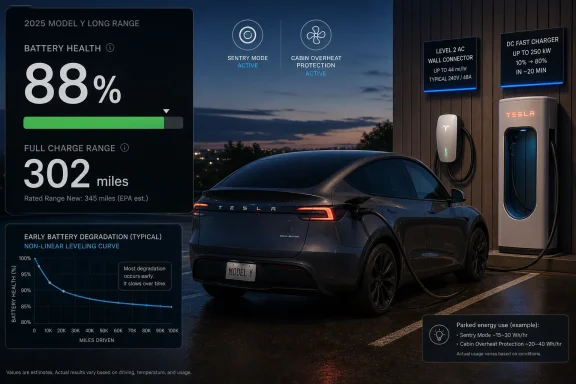
InsideEVs reported that an 18-month-old 2025 Tesla Model Y Long Range Rear-Wheel Drive owned by YouTuber Branden Flasch showed 88% battery health after Tesla’s built-in test, with 13,162 miles on the odometer and 302 miles displayed at full charge. That is the kind of number that makes EV skeptics reach for a megaphone and EV defenders reach for a spreadsheet. Both reactions miss the more useful lesson: early battery degradation is real, uneven, and poorly explained by mileage alone. For buyers, lessees, and fleet managers, the story is less about one unlucky Model Y than about how little the dashboard tells us about the life a battery has actually lived.
The Model Y in question is not a taxi, not a six-figure-mile rideshare veteran, and not an auction car with an unknown past. It is a privately owned, relatively new crossover with just over 13,000 miles, a figure many American drivers would consider one year of ordinary use. That is why the 88% state-of-health result lands with force.
Tesla’s rated range for the 2025 Model Y Long Range Rear-Wheel Drive was commonly listed around 337 miles, depending on configuration and testing context. After the health test, Flasch’s car reportedly displayed 302 miles at 100%. A loss of 36 displayed miles in 18 months is not catastrophic in warranty terms, but it is enough to puncture the comforting idea that low mileage equals a nearly fresh EV battery.
The story also has a paper trail within the car’s own diagnostic ecosystem. Flasch reportedly ran Tesla’s built-in battery health test earlier in the car’s life, seeing about 95% health around 6,000 miles and 90% around 11,000 miles. The latest 88% figure therefore does not appear as a single weird readout, but as part of a downward sequence.
That matters because EV battery stories often collapse into anecdotes. One owner says their car has barely degraded after 100,000 miles; another says range fell off a cliff before the first tire replacement. This Model Y is useful precisely because it sits in the uncomfortable middle: the test is more credible than a casual dashboard guess, but still not a laboratory teardown.
Tesla’s range display is tied to rated consumption assumptions, not the owner’s recent driving efficiency in the way some other EVs calculate a “guess-o-meter.” That makes it more stable than many rival displays, but it does not make it a perfect instrument. Software changes, calibration drift, temperature effects, cell balancing, and battery-management assumptions can all influence what the car reports.
The stronger data point here is Tesla’s built-in battery health procedure, which requires the vehicle to be plugged into a Level 2 charger while it discharges the pack deeply and charges back to full. That process is meant to give the battery-management system a clearer look at usable capacity. It is not something most owners will run casually, and the reported 12-hour duration underlines that this is closer to a diagnostic event than a dashboard glance.
Even so, “88% battery health” is not the same as “this car has lost exactly 12% of every useful mile it will ever deliver.” Battery health estimates are model-driven. They are attempts to infer a complex electrochemical reality from voltage, current, temperature, charge throughput, and behavior across a pack made of many cells. The number is meaningful, but it is still an estimate.
That distinction cuts both ways. It prevents panic over a single result, but it also prevents dismissal. If Tesla’s own test says a young pack is down to 88%, the burden shifts from “maybe the owner is reading the display wrong” to “why is this pack aging faster than expected?”
An EV pack ages from use, but also from time, temperature, state of charge, charging power, and how often it is cycled through stressful zones. A low-mileage car can still move a lot of energy through its pack if it spends time powering accessories, climate control, or thermal management while parked. It can also age faster if it is frequently charged at high power or left sitting at high states of charge in heat.
That is where this Model Y becomes interesting. According to the report, about 43% of its charging came from Level 2 AC charging at home, while 57% came from DC fast charging. That is a high DC share for a privately owned low-mileage vehicle, though the owner reportedly noted that not all of it was peak-rate Supercharging; some was slower 50 kW DC charging.
The distinction matters. A 250 kW Supercharger session is not the same stress event as a 50 kW DC charge, and Tesla’s battery-management system actively controls charging speed based on temperature, state of charge, and pack condition. Still, DC charging tends to involve higher pack currents and more heat-management work than home AC charging. Over time, that can become part of the degradation story, especially when paired with other stressors.
The mileage number also leaves out parked energy use. Flasch reportedly keeps Sentry Mode and Cabin Overheat Protection active while the car sits outside. Those features can draw meaningful energy, especially in warm weather. The odometer may barely move, but the battery is still working.
But Sentry Mode consumes power. The same is true of Cabin Overheat Protection, which can run fans and air conditioning to keep the cabin from reaching extreme temperatures. Tesla does not hide the fact that these features use energy, but the psychological effect is different when the car is parked. Owners may perceive the vehicle as idle when, electrically, it is not.
This is where EV ownership still differs sharply from gasoline ownership. A parked combustion car can slowly drain a 12-volt battery, but it is not repeatedly cycling the equivalent of propulsion energy to run climate systems or camera computers. A parked Tesla can be doing useful things, but those useful things are still battery work.
That does not automatically prove these features caused the Model Y’s 88% result. The available information does not establish how many hours Sentry Mode ran, how hot the car’s environment was, how often Cabin Overheat Protection activated, what states of charge the car sat at, or how the pack was thermally managed. But it does make the case that miles driven is an incomplete proxy for battery life consumed.
For IT-minded readers, the analogy is obvious. A laptop with low keyboard wear but thousands of plugged-in, high-temperature, full-charge hours is not equivalent to a gently cycled machine stored cool and half-full. The battery remembers the workload even when the chassis looks new.
This is where the gap between legal protection and customer expectation opens wide. A buyer who sees a 337-mile EV does not mentally price in a drop toward 300 displayed miles before the second birthday. Tesla can be within its warranty obligations while the owner still feels shortchanged.
Automakers know this gap exists. Warranty thresholds are designed to define failure, not delight. A gas engine burning oil within a manufacturer’s “acceptable” limit can still annoy an owner; an EV battery above 70% can still feel disappointing if it lost range quickly in early life.
The resale market adds another layer. Used EV shoppers increasingly ask about battery health, but the industry has not settled on a universally trusted, transparent, cross-brand health certificate. A Model Y at 88% after 13,000 miles may still be a perfectly usable vehicle, yet it could face a harsher buyer reaction than a similar car showing 94%.
That uncertainty is not just a Tesla problem. It is an EV-market problem. As battery health becomes the new odometer, the tools for interpreting it remain uneven, brand-specific, and sometimes opaque.
If Flasch’s Model Y went from 100% to 88% in 18 months, a straight-line projection would be alarming. It would suggest the pack could approach the low 80s by the end of a three-year lease. But batteries do not necessarily age like tires, shedding capacity in neat, linear increments with every month or mile.
The report notes that Davide Giacobbe of EV battery testing company Voltest described a pattern in which much of the degradation happens earlier, with the rate often slowing once a pack reaches around 90% health. That fits a common EV-owner experience: a noticeable early drop, then a long plateau. It does not guarantee this particular Model Y will stabilize, but it argues against extrapolating the first 18 months into the next six years.
That nuance is crucial because the internet loves curves that point down and to the right. A single owner’s data can become a morality play about an entire technology. The more accurate conclusion is narrower and more useful: this car’s early health result is worse than many buyers would expect, and its future trajectory now matters more than its past mileage.
The next test, not the current one, may be the revealing moment. If the pack stabilizes near 88%, the story becomes one of unpleasant but bounded early loss. If it continues dropping rapidly, it becomes a stronger case for service escalation, deeper diagnostics, or at least a clearer explanation from Tesla.
Tesla’s Supercharger network is one of the company’s biggest advantages, and the cars are designed to use it. A Model Y owner should not have to treat DC fast charging as a forbidden emergency tool. Road trips, apartment living, and irregular schedules make fast charging central to EV adoption.
Still, “designed to use” does not mean “identical to slow charging in every circumstance.” High-power charging can increase heat and stress, especially at higher states of charge or under unfavorable thermal conditions. Tesla’s software reduces charging speed when needed, but physics has not been repealed by a good user interface.
The reported 57% DC charging share is therefore a plausible contributor, not a smoking gun. It is high enough to be worth noticing, but not so extreme that it alone explains everything. Plenty of high-mileage Teslas with heavy Supercharger use have shown respectable battery health, while some lower-mileage cars show more degradation than expected.
That is the frustrating part for owners. EV degradation is probabilistic. Two seemingly similar vehicles can age differently because of cell variation, thermal history, parking conditions, charging patterns, software behavior, and plain manufacturing tolerance.
But the user-facing result remains thin. If a car reports 88%, owners naturally want to know why. Was the loss driven by calendar aging? High temperature? DC charging? deep cycles? cell imbalance? excessive parked drain? Tesla’s consumer interface does not give that level of explanation.
That opacity is increasingly hard to defend as EVs mature. A $40,000-to-$50,000 vehicle is also a rolling battery system whose long-term value depends heavily on pack condition. Owners can see tire pressure, energy consumption, charging speed, and camera feeds, but the most economically important component remains summarized by a small set of abstract numbers.
The comparison to Windows telemetry is almost too easy for this audience. Administrators do not merely want to know that a server is “unhealthy.” They want logs, thresholds, history, error codes, and enough context to distinguish a real fault from a noisy metric. EV owners are slowly becoming battery administrators, whether automakers admit it or not.
This does not mean Tesla should dump engineering dashboards into every owner’s lap. Raw cell data could confuse more than enlighten. But a clearer degradation history, charging-stress summary, and thermal exposure profile would make battery health less of a black box and more of a managed asset.
That does not make the single case representative. It does mean the community will be watching for echoes. If more 2024 and 2025 Model Y Long Range Rear-Wheel Drive owners report similar early health drops, the story gets larger. If most owners cluster in the low-to-mid 90s after similar time and mileage, this car looks more like an outlier.
Tesla’s unusual position in the market amplifies the stakes. The company has spent years arguing, often persuasively, that EVs are simpler, lower-maintenance, and more durable than combustion vehicles. Battery degradation is the one issue that can still make mainstream buyers nervous because it is expensive, technical, and hard to evaluate from the outside.
The Model Y also sits at the center of used-EV normalization. As more lease returns, trade-ins, and private sales hit the market, battery health will become a mainstream shopping concern rather than an enthusiast obsession. A young vehicle showing 88% health forces the question every used buyer will eventually ask: what number is normal?
That question needs better answers than forum folklore. It needs large datasets, standardized tests, and transparent reporting. Until then, individual cases will carry more narrative weight than they should.
The lesson from this Model Y is that mileage-only fleet assumptions are inadequate. Vehicles parked outside with security systems running, climate protection enabled, and frequent DC charging may age differently from vehicles charged slowly overnight and driven predictable routes. Two cars with the same odometer reading can carry very different battery histories.
This is familiar territory for IT departments. Device health is not measured only by age. A laptop used for light office work and one used for constant video rendering may share a purchase date, but they do not share a thermal history. EVs bring that same asset-management logic to transportation.
For fleets, policy may matter as much as procurement. Charging rules, maximum daily charge limits, parking settings, cabin-protection defaults, and driver education can all influence long-term battery outcomes. The operational details that seem minor at delivery can become residual-value line items three years later.
This is where Tesla’s software-defined nature is both advantage and risk. The company can expose more controls, change battery-management behavior, and improve diagnostics over time. But it can also leave managers trying to interpret a moving target without enough documentation.
The problem is that Tesla’s product experience can make battery care feel optional. Supercharging is easy. Sentry Mode is useful. Cabin Overheat Protection sounds protective by definition. The car abstracts away the complexity so well that owners may not see the cumulative cost of convenience.
That does not mean owners should baby their cars to the point of resentment. An EV that requires ritualized anxiety is a failed consumer product. But there is a middle ground between paranoia and indifference, especially for people who plan to keep a vehicle beyond the lease term.
The better framing is not “never fast charge” or “turn off every feature.” It is “know what the car is doing when you are not driving.” If Sentry Mode runs all day at work, if the cabin is being cooled in a hot driveway, and if most charging happens on DC infrastructure, the odometer is understating the battery’s workload.
But EV adoption is not driven only by practical sufficiency. It is driven by confidence. Buyers want to believe that the expensive battery under the floor will age slowly and predictably. When a low-mileage example posts an 88% health result, predictability takes the hit.
This is where Tesla’s warranty floor can unintentionally make owners feel worse. The company can say, accurately, that 88% is far above the 70% minimum. The owner can reply, reasonably, that losing roughly one-eighth of measured health in 18 months is not what they expected from a lightly driven vehicle. Both statements can be true.
The industry needs to get more comfortable with that tension. Not every disappointing degradation result is a warranty failure. Not every warranty-compliant battery outcome is a satisfying ownership outcome. The space between those two ideas is where trust is either built or lost.
That puts pressure on Tesla and the wider EV industry to improve transparency. Battery health should not require YouTube diagnostics, community guesswork, or anxious extrapolation from a displayed range number. It should be a normal part of vehicle ownership, as visible and explainable as service history.
For WindowsForum readers, the parallels to computing are direct. Batteries are not fuel tanks; they are managed systems. Their health depends on firmware, thermals, usage patterns, background processes, and user behavior. The car may have wheels, but the ownership problem increasingly looks like device administration.
The next phase of EV maturity will not be about proving that batteries can last. Many already have. It will be about proving that owners can understand how they are lasting, why they are aging, and what can be done when one pack falls outside expectations.
 A Low-Mileage Tesla Makes the Wrong Kind of Battery News
The Model Y in question is not a taxi, not a six-figure-mile rideshare veteran, and not an auction car with an unknown past. It is a privately owned, relatively new crossover with just over 13,000 miles, a figure many American drivers would consider one year of ordinary use. That is why the 88% state-of-health result lands with force.Tesla’s rated range for the 2025 Model Y Long Range Rear-Wheel Drive was commonly listed around 337 miles, depending on configuration and testing context. After the health test, Flasch’s car reportedly displayed 302 miles at 100%. A loss of 36 displayed miles in 18 months is not catastrophic in warranty terms, but it is enough to puncture the comforting idea that low mileage equals a nearly fresh EV battery.
The story also has a paper trail within the car’s own diagnostic ecosystem. Flasch reportedly ran Tesla’s built-in battery health test earlier in the car’s life, seeing about 95% health around 6,000 miles and 90% around 11,000 miles. The latest 88% figure therefore does not appear as a single weird readout, but as part of a downward sequence.
That matters because EV battery stories often collapse into anecdotes. One owner says their car has barely degraded after 100,000 miles; another says range fell off a cliff before the first tire replacement. This Model Y is useful precisely because it sits in the uncomfortable middle: the test is more credible than a casual dashboard guess, but still not a laboratory teardown.
The Dashboard Range Number Is Evidence, Not a Verdict
Tesla owners have long treated the displayed full-charge range as a kind of battery blood pressure reading. It is simple, visible, and emotionally powerful. But it is not the same thing as a measured energy-capacity test under controlled conditions.Tesla’s range display is tied to rated consumption assumptions, not the owner’s recent driving efficiency in the way some other EVs calculate a “guess-o-meter.” That makes it more stable than many rival displays, but it does not make it a perfect instrument. Software changes, calibration drift, temperature effects, cell balancing, and battery-management assumptions can all influence what the car reports.
The stronger data point here is Tesla’s built-in battery health procedure, which requires the vehicle to be plugged into a Level 2 charger while it discharges the pack deeply and charges back to full. That process is meant to give the battery-management system a clearer look at usable capacity. It is not something most owners will run casually, and the reported 12-hour duration underlines that this is closer to a diagnostic event than a dashboard glance.
Even so, “88% battery health” is not the same as “this car has lost exactly 12% of every useful mile it will ever deliver.” Battery health estimates are model-driven. They are attempts to infer a complex electrochemical reality from voltage, current, temperature, charge throughput, and behavior across a pack made of many cells. The number is meaningful, but it is still an estimate.
That distinction cuts both ways. It prevents panic over a single result, but it also prevents dismissal. If Tesla’s own test says a young pack is down to 88%, the burden shifts from “maybe the owner is reading the display wrong” to “why is this pack aging faster than expected?”
Mileage Was Always the Lazy Shortcut
The internal-combustion world trained buyers to think in odometers. A 13,000-mile car is nearly new; a 130,000-mile car is aging; a 230,000-mile car is a gamble. Batteries do not ignore mileage, but they do not obey it the same way pistons, bearings, and gearboxes do.An EV pack ages from use, but also from time, temperature, state of charge, charging power, and how often it is cycled through stressful zones. A low-mileage car can still move a lot of energy through its pack if it spends time powering accessories, climate control, or thermal management while parked. It can also age faster if it is frequently charged at high power or left sitting at high states of charge in heat.
That is where this Model Y becomes interesting. According to the report, about 43% of its charging came from Level 2 AC charging at home, while 57% came from DC fast charging. That is a high DC share for a privately owned low-mileage vehicle, though the owner reportedly noted that not all of it was peak-rate Supercharging; some was slower 50 kW DC charging.
The distinction matters. A 250 kW Supercharger session is not the same stress event as a 50 kW DC charge, and Tesla’s battery-management system actively controls charging speed based on temperature, state of charge, and pack condition. Still, DC charging tends to involve higher pack currents and more heat-management work than home AC charging. Over time, that can become part of the degradation story, especially when paired with other stressors.
The mileage number also leaves out parked energy use. Flasch reportedly keeps Sentry Mode and Cabin Overheat Protection active while the car sits outside. Those features can draw meaningful energy, especially in warm weather. The odometer may barely move, but the battery is still working.
Tesla’s Convenience Features Are Not Free
Sentry Mode is one of Tesla’s cleverest ownership features and one of its most misunderstood energy drains. It turns the car into a rolling surveillance system, using cameras and onboard computing to monitor activity around the vehicle. For owners parking on city streets, in apartment lots, or at public chargers, it offers peace of mind that a conventional parked car does not.But Sentry Mode consumes power. The same is true of Cabin Overheat Protection, which can run fans and air conditioning to keep the cabin from reaching extreme temperatures. Tesla does not hide the fact that these features use energy, but the psychological effect is different when the car is parked. Owners may perceive the vehicle as idle when, electrically, it is not.
This is where EV ownership still differs sharply from gasoline ownership. A parked combustion car can slowly drain a 12-volt battery, but it is not repeatedly cycling the equivalent of propulsion energy to run climate systems or camera computers. A parked Tesla can be doing useful things, but those useful things are still battery work.
That does not automatically prove these features caused the Model Y’s 88% result. The available information does not establish how many hours Sentry Mode ran, how hot the car’s environment was, how often Cabin Overheat Protection activated, what states of charge the car sat at, or how the pack was thermally managed. But it does make the case that miles driven is an incomplete proxy for battery life consumed.
For IT-minded readers, the analogy is obvious. A laptop with low keyboard wear but thousands of plugged-in, high-temperature, full-charge hours is not equivalent to a gently cycled machine stored cool and half-full. The battery remembers the workload even when the chassis looks new.
The Warranty Floor Is Not the Ownership Expectation
Tesla’s battery warranty is both reassuring and sobering. For Model Y Long Range and Performance variants, Tesla has generally offered 8 years or 120,000 miles of battery and drive unit coverage, with a minimum 70% battery-capacity retention threshold during the warranty period. That means 88% health at 18 months is well above the formal warranty floor.This is where the gap between legal protection and customer expectation opens wide. A buyer who sees a 337-mile EV does not mentally price in a drop toward 300 displayed miles before the second birthday. Tesla can be within its warranty obligations while the owner still feels shortchanged.
Automakers know this gap exists. Warranty thresholds are designed to define failure, not delight. A gas engine burning oil within a manufacturer’s “acceptable” limit can still annoy an owner; an EV battery above 70% can still feel disappointing if it lost range quickly in early life.
The resale market adds another layer. Used EV shoppers increasingly ask about battery health, but the industry has not settled on a universally trusted, transparent, cross-brand health certificate. A Model Y at 88% after 13,000 miles may still be a perfectly usable vehicle, yet it could face a harsher buyer reaction than a similar car showing 94%.
That uncertainty is not just a Tesla problem. It is an EV-market problem. As battery health becomes the new odometer, the tools for interpreting it remain uneven, brand-specific, and sometimes opaque.
Early Degradation Can Be Real Without Being Linear
The most important caution in this story is that the degradation curve may not continue at the same rate. EV batteries often lose capacity faster early in life and then settle into a slower decline. That pattern has been observed across many lithium-ion applications, from phones and laptops to cars, though the exact curve depends on chemistry, design, software, and use.If Flasch’s Model Y went from 100% to 88% in 18 months, a straight-line projection would be alarming. It would suggest the pack could approach the low 80s by the end of a three-year lease. But batteries do not necessarily age like tires, shedding capacity in neat, linear increments with every month or mile.
The report notes that Davide Giacobbe of EV battery testing company Voltest described a pattern in which much of the degradation happens earlier, with the rate often slowing once a pack reaches around 90% health. That fits a common EV-owner experience: a noticeable early drop, then a long plateau. It does not guarantee this particular Model Y will stabilize, but it argues against extrapolating the first 18 months into the next six years.
That nuance is crucial because the internet loves curves that point down and to the right. A single owner’s data can become a morality play about an entire technology. The more accurate conclusion is narrower and more useful: this car’s early health result is worse than many buyers would expect, and its future trajectory now matters more than its past mileage.
The next test, not the current one, may be the revealing moment. If the pack stabilizes near 88%, the story becomes one of unpleasant but bounded early loss. If it continues dropping rapidly, it becomes a stronger case for service escalation, deeper diagnostics, or at least a clearer explanation from Tesla.
DC Fast Charging Is a Suspect, Not a Conviction
Fast charging has always carried a reputational shadow. EV advocates often say modern battery-management systems make it safe; skeptics say dumping high power into a pack must have consequences. The truth is less satisfying: fast charging is one variable among many, and its effect depends on context.Tesla’s Supercharger network is one of the company’s biggest advantages, and the cars are designed to use it. A Model Y owner should not have to treat DC fast charging as a forbidden emergency tool. Road trips, apartment living, and irregular schedules make fast charging central to EV adoption.
Still, “designed to use” does not mean “identical to slow charging in every circumstance.” High-power charging can increase heat and stress, especially at higher states of charge or under unfavorable thermal conditions. Tesla’s software reduces charging speed when needed, but physics has not been repealed by a good user interface.
The reported 57% DC charging share is therefore a plausible contributor, not a smoking gun. It is high enough to be worth noticing, but not so extreme that it alone explains everything. Plenty of high-mileage Teslas with heavy Supercharger use have shown respectable battery health, while some lower-mileage cars show more degradation than expected.
That is the frustrating part for owners. EV degradation is probabilistic. Two seemingly similar vehicles can age differently because of cell variation, thermal history, parking conditions, charging patterns, software behavior, and plain manufacturing tolerance.
The Real Scandal Is How Little Owners Can See
Tesla deserves credit for exposing a battery health test at all. Many automakers still leave owners guessing, relying on vague range displays or dealer-only diagnostics. A built-in test that cycles the pack and reports health is better than mysticism.But the user-facing result remains thin. If a car reports 88%, owners naturally want to know why. Was the loss driven by calendar aging? High temperature? DC charging? deep cycles? cell imbalance? excessive parked drain? Tesla’s consumer interface does not give that level of explanation.
That opacity is increasingly hard to defend as EVs mature. A $40,000-to-$50,000 vehicle is also a rolling battery system whose long-term value depends heavily on pack condition. Owners can see tire pressure, energy consumption, charging speed, and camera feeds, but the most economically important component remains summarized by a small set of abstract numbers.
The comparison to Windows telemetry is almost too easy for this audience. Administrators do not merely want to know that a server is “unhealthy.” They want logs, thresholds, history, error codes, and enough context to distinguish a real fault from a noisy metric. EV owners are slowly becoming battery administrators, whether automakers admit it or not.
This does not mean Tesla should dump engineering dashboards into every owner’s lap. Raw cell data could confuse more than enlighten. But a clearer degradation history, charging-stress summary, and thermal exposure profile would make battery health less of a black box and more of a managed asset.
The Model Y Is Now Too Common for Edge Cases to Stay Edge Cases
The Model Y’s scale changes the meaning of stories like this. A rare failure in a low-volume EV can be treated as a curiosity. A strange result in one of the world’s best-selling electric vehicles becomes part of a much larger ownership dataset.That does not make the single case representative. It does mean the community will be watching for echoes. If more 2024 and 2025 Model Y Long Range Rear-Wheel Drive owners report similar early health drops, the story gets larger. If most owners cluster in the low-to-mid 90s after similar time and mileage, this car looks more like an outlier.
Tesla’s unusual position in the market amplifies the stakes. The company has spent years arguing, often persuasively, that EVs are simpler, lower-maintenance, and more durable than combustion vehicles. Battery degradation is the one issue that can still make mainstream buyers nervous because it is expensive, technical, and hard to evaluate from the outside.
The Model Y also sits at the center of used-EV normalization. As more lease returns, trade-ins, and private sales hit the market, battery health will become a mainstream shopping concern rather than an enthusiast obsession. A young vehicle showing 88% health forces the question every used buyer will eventually ask: what number is normal?
That question needs better answers than forum folklore. It needs large datasets, standardized tests, and transparent reporting. Until then, individual cases will carry more narrative weight than they should.
Enterprise IT Should Read This as a Fleet-Management Warning
For private owners, a degradation surprise is frustrating. For fleets, it is a forecasting problem. A company deploying EVs has to model residual value, charging infrastructure, duty cycles, driver behavior, and warranty risk across hundreds or thousands of vehicles.The lesson from this Model Y is that mileage-only fleet assumptions are inadequate. Vehicles parked outside with security systems running, climate protection enabled, and frequent DC charging may age differently from vehicles charged slowly overnight and driven predictable routes. Two cars with the same odometer reading can carry very different battery histories.
This is familiar territory for IT departments. Device health is not measured only by age. A laptop used for light office work and one used for constant video rendering may share a purchase date, but they do not share a thermal history. EVs bring that same asset-management logic to transportation.
For fleets, policy may matter as much as procurement. Charging rules, maximum daily charge limits, parking settings, cabin-protection defaults, and driver education can all influence long-term battery outcomes. The operational details that seem minor at delivery can become residual-value line items three years later.
This is where Tesla’s software-defined nature is both advantage and risk. The company can expose more controls, change battery-management behavior, and improve diagnostics over time. But it can also leave managers trying to interpret a moving target without enough documentation.
The Consumer Advice Is Boring, Which Is Why It Matters
There is no magic ritual that guarantees an EV battery will age gracefully. But the practical guidance remains consistent: avoid unnecessary heat, avoid leaving the pack full for long periods, use DC fast charging when it is useful rather than reflexive, and understand that parked features consume energy. None of that is exciting, but it is the EV equivalent of changing oil and watching tire pressure.The problem is that Tesla’s product experience can make battery care feel optional. Supercharging is easy. Sentry Mode is useful. Cabin Overheat Protection sounds protective by definition. The car abstracts away the complexity so well that owners may not see the cumulative cost of convenience.
That does not mean owners should baby their cars to the point of resentment. An EV that requires ritualized anxiety is a failed consumer product. But there is a middle ground between paranoia and indifference, especially for people who plan to keep a vehicle beyond the lease term.
The better framing is not “never fast charge” or “turn off every feature.” It is “know what the car is doing when you are not driving.” If Sentry Mode runs all day at work, if the cabin is being cooled in a hot driveway, and if most charging happens on DC infrastructure, the odometer is understating the battery’s workload.
The 302-Mile Tesla Still Works, But the Confidence Gap Widens
A Model Y that displays 302 miles at full charge remains a highly usable EV. For most owners, that is more than enough daily range and still sufficient for road trips with Supercharger access. The car has not become defective in the ordinary sense.But EV adoption is not driven only by practical sufficiency. It is driven by confidence. Buyers want to believe that the expensive battery under the floor will age slowly and predictably. When a low-mileage example posts an 88% health result, predictability takes the hit.
This is where Tesla’s warranty floor can unintentionally make owners feel worse. The company can say, accurately, that 88% is far above the 70% minimum. The owner can reply, reasonably, that losing roughly one-eighth of measured health in 18 months is not what they expected from a lightly driven vehicle. Both statements can be true.
The industry needs to get more comfortable with that tension. Not every disappointing degradation result is a warranty failure. Not every warranty-compliant battery outcome is a satisfying ownership outcome. The space between those two ideas is where trust is either built or lost.
This Model Y’s Battery Story Has Already Outgrown One Car
The concrete lesson from Flasch’s Model Y is not that Tesla batteries are fragile. The evidence does not support that sweeping claim. The lesson is that battery aging can be surprisingly individual, and the tools owners use to understand it are still immature.That puts pressure on Tesla and the wider EV industry to improve transparency. Battery health should not require YouTube diagnostics, community guesswork, or anxious extrapolation from a displayed range number. It should be a normal part of vehicle ownership, as visible and explainable as service history.
For WindowsForum readers, the parallels to computing are direct. Batteries are not fuel tanks; they are managed systems. Their health depends on firmware, thermals, usage patterns, background processes, and user behavior. The car may have wheels, but the ownership problem increasingly looks like device administration.
The next phase of EV maturity will not be about proving that batteries can last. Many already have. It will be about proving that owners can understand how they are lasting, why they are aging, and what can be done when one pack falls outside expectations.
The Numbers Owners Should Remember From This Tesla
The useful response is not panic, but better literacy. This case gives owners and fleet managers a compact set of numbers to keep in mind when judging their own vehicles.- The reported Model Y had 13,162 miles and 18 months of use when Tesla’s built-in test showed 88% battery health.
- The car reportedly displayed 302 miles at a full charge, down 36 miles from its original displayed range when new.
- Earlier tests reportedly showed about 95% health around 6,000 miles and about 90% around 11,000 miles.
- About 57% of the car’s charging reportedly came from DC fast charging, while about 43% came from Level 2 AC charging.
- Parked features such as Sentry Mode and Cabin Overheat Protection may consume enough energy to make mileage a poor proxy for total battery workload.
- Tesla’s warranty threshold is far lower than this result, so an owner can experience disappointing degradation without necessarily having a warranty claim.
References
- Primary source: InsideEVs
Published: Sun, 14 Jun 2026 07:46:00 GMT
This Low-Mileage 2025 Tesla Model Y Lost A Lot Of Range Fast
After 18 months and just over 13,000 miles, Tesla’s own battery-health test showed a result its owner called unacceptable. insideevs.com
- Related coverage: recharged.com
Tesla Model Y Battery Warranty: What It Covers (2026 Guide) | Recharged
Learn exactly what the Tesla Model Y battery warranty covers, what voids it, coverage length by trim, and how it affects used Model Y buyers.recharged.com - Related coverage: edmunds.com
- Related coverage: tesla.com
- Related coverage: motortrend.com
Understanding Tesla’s Battery Warranty: What You Need to Know
A battery is as important to an EV as an engine is to an ICE car, making the Tesla battery warranty an important facet of the popular electric vehicles.www.motortrend.com - Related coverage: thecostguide.com
- Related coverage: bev-database.com
Tesla Model Y Long Range RWD 2025: EPA 337 mi, 250 kW, 5.4s
Full specs for the Tesla Model Y Long Range RWD 2025: EPA range, BEVDB real range, NACS charging, 10–80% time, cargo and efficiency. bev-database.com
- Related coverage: digitalassets.tesla.com
- Related coverage: techradar.com
Tesla’s sales are plummeting, so it’s adding a cheaper all-wheel-drive Model Y in the US in a bid to drum up interest | TechRadar
Performance comes at the cost of luxurieswww.techradar.com
