

CD Projekt Red is raising the minimum PC requirements for The Witcher 3: Wild Hunt and its newly announced Songs of the Past expansion, due in 2027 for PC, PlayStation 5, and Xbox Series X|S, with Windows 11, DirectX 12, an SSD, and substantially newer CPU and GPU hardware becoming the new baseline. The move is more than a spec-sheet refresh for an old RPG. It is a line in the sand for the post-Windows 10 gaming PC, and one of the clearest examples yet of how software support, platform lifecycles, and “forever games” are beginning to collide.
For years, The Witcher 3 has occupied a rare place in PC gaming: a prestige open-world RPG that could still run on hardware old enough to feel archaeological by modern standards. CD Projekt Red’s new requirements change that bargain. The game may still be the same 2015 classic in the cultural imagination, but the version that will be supported into 2027 is being rebuilt around a much newer definition of a usable Windows gaming machine.
The surprise is not simply that The Witcher 3 is getting new paid expansion content more than a decade after launch. That is unusual enough. The larger story is that CD Projekt Red is treating the expansion as a platform transition, not merely a content drop.
The previous minimum requirements belonged to a very different PC world. A Core i5-2500K or AMD A10-5800K, a GeForce GTX 660 or Radeon HD 7870, 6GB of RAM, and 50GB of disk space made sense when The Witcher 3 was built for the PlayStation 4 and Xbox One generation. That old baseline said, in effect, that a mid-range gaming PC from the early 2010s could still enter the Continent.
The new baseline is dramatically different. CD Projekt Red now lists an AMD Ryzen 5 2600 or Intel Core i5-8400, a GeForce GTX 1660 or Radeon RX 5500 XT with 8GB of VRAM, 12GB of system memory, 70GB of SSD storage, and 64-bit Windows 11. Those are not extravagant specs in 2026, but they are not legacy-friendly either.
That distinction matters. This is not about chasing ultra settings, ray tracing, or 4K screenshots. These are minimum requirements. CD Projekt Red is not saying older PCs will deliver a diminished experience; it is saying the supported floor has moved.
Microsoft ended mainstream Windows 10 support on October 14, 2025. That date has now become a useful dividing line for developers that no longer want to test, certify, and troubleshoot against an aging OS. CD Projekt Red’s stated rationale tracks that logic: new content requires updated requirements to maintain smooth performance and forward compatibility.
That does not mean Windows 10 suddenly became technically incapable of launching a fantasy RPG. It means Windows 10 has become a support liability. Once the OS exits the normal security and maintenance channel, developers have a cleaner argument for dropping it, even if the underlying APIs and drivers remain familiar.
Steam’s own hardware survey reinforces why publishers feel increasingly comfortable doing this. Windows 11 now represents a large majority of Steam users, while Windows 10 has fallen into second place. For a studio making decisions about 2027 support, the incentives point in one direction: follow the users who are already on the supported Microsoft platform, and let the holdouts age out.
An HDD-era game could assume slow asset loading and hide it behind doors, transitions, cutscenes, and compromises. Modern open-world games increasingly assume fast random reads, predictable streaming, and fewer accommodations for mechanical storage. Even when a game was born in the HDD era, new content can change the balance.
For The Witcher 3, this is especially interesting because its world was originally built around older console constraints. Its 2022 next-gen update already nudged the game toward a more modern rendering and asset pipeline, adding features such as ray-traced global illumination on capable systems and a DirectX 12 mode. Songs of the Past appears to continue that evolution.
An SSD requirement is also easier to defend than many users might expect. Solid-state drives are cheap, common, and transformative. But they also mark a support boundary. If CD Projekt Red no longer has to guarantee tolerable behavior on mechanical drives, it can tune loading, streaming, and patch structure around the hardware most active PC gamers already use.
That is a classic late-life software problem. Supporting an old game for years sounds simple until each supported configuration becomes a tax. Every rendering path, driver class, OS version, storage assumption, and console generation adds testing overhead. At some point, the choice is not between supporting old hardware and abandoning old hardware; it is between building new features against a manageable target or not building them at all.
DirectX 12 has its own history of unevenness on PC, and The Witcher 3’s next-gen update was not immune from performance complaints when it arrived. But by 2026, the industry’s center of gravity has moved. If a 2027 expansion is going to be maintained alongside modern drivers and modern GPUs, CD Projekt Red has little incentive to keep treating the older path as equal.
The phrase “minimum requirements” can obscure this. A minimum spec is not merely a promise to users. It is an internal production tool. It tells QA what machines matter, tells engineers what assumptions are safe, and tells support staff which problems are no longer theirs to solve.
The Xbox One was designed around a slow hard drive, a weak Jaguar CPU, and a memory architecture that demanded compromise. It hosted The Witcher 3 admirably for its time, but its continued inclusion would shape any expansion built around it. If Songs of the Past is meant to feel like a new premium chapter rather than archival content, keeping Xbox One in the matrix would impose a ceiling.
This is where CD Projekt Red’s decision becomes easier to understand, even for users who dislike it. A 2027 expansion aimed at Xbox Series X|S, PlayStation 5, and PC can assume SSD storage, more CPU headroom, and a much cleaner baseline. That does not guarantee ambition, but it removes one obvious excuse for limitation.
It also reflects the reality of console support in 2026. Cross-generation releases have lingered longer than many expected, partly because of pandemic-era supply constraints and the sheer size of the last-gen install base. But that grace period is ending. The Witcher 3 is not leading the break; it is joining it.
But The Witcher 3 is no longer being treated as a frozen 2015 product. CD Projekt Red has kept updating it, reissued it for newer consoles, folded in quality-of-life improvements, and now plans to sell or deliver a new major expansion. The studio is effectively maintaining a living version of a classic, and living software sheds old skin.
The harder question is whether users who simply want to keep playing the original experience will retain access to older branches or legacy builds. On PC, that matters enormously. A studio can modernize the supported version while still preserving a path for archival play, especially on platforms such as GOG and Steam where branch management is possible.
That is where CD Projekt Red should be watched closely. Raising requirements for future content is defensible. Making the old experience unnecessarily difficult to access would be a different matter.
The Witcher 3 update looks like the same philosophy applied to a more beloved and older game. CD Projekt Red appears to be standardizing its long-term support posture around modern Windows, modern graphics APIs, and SSD-first assumptions. That may frustrate some users, but it is not random.
The studio also has a larger franchise calendar to consider. A new Witcher saga is in development, the remake of the first Witcher is being built with Fool’s Theory, and Songs of the Past is reportedly tied into that same wider orbit of projects. The expansion is not simply nostalgia; it is franchise bridgework.
That makes the technical requirements part of the marketing message. CD Projekt Red wants The Witcher 3 to feel current enough to sit near its future games, not like a museum piece with a new quest stapled on top.
A game can remain in your library while its supported future moves beyond your machine. That is not new, but it becomes more visible when the game in question is a beloved single-player RPG rather than a live service shooter. Players who ignored hardware churn because their old favorites still worked are now seeing those favorites become active software again.
The danger for publishers is that PC gamers have long memories and strong expectations around backward compatibility. A 2015 game that once ran on Windows 7 and a GTX 660 carries a different moral weight than a 2027 release with modern requirements from day one. Changing the floor after a decade invites scrutiny.
The reasonable compromise is transparency. If new content requires Windows 11, DirectX 12, and an SSD, say so plainly. If legacy builds remain available, make that equally plain. If they do not, expect backlash.
But compared with the original minimum spec, the leap is enormous. The Core i5-2500K was legendary, but it is now fifteen-year-old silicon. The GTX 660 belongs to an era before modern low-level APIs, contemporary VRAM expectations, and the asset density that current games assume.
The RAM increase from 6GB to 12GB is similarly revealing. It acknowledges what Windows and modern game clients have already made obvious: 8GB PCs are increasingly uncomfortable, and 6GB gaming machines are relics. The new floor is not extravagant; it is simply honest.
That honesty will still sting for users who kept The Witcher 3 installed precisely because it remained playable on an old rig. The game’s reputation as a scalable classic was part of its charm. CD Projekt Red is now choosing a different identity for its next chapter.
That is particularly awkward because many Windows 10 machines cannot officially upgrade to Windows 11. Microsoft’s TPM, CPU, and security requirements left a large number of otherwise functional PCs outside the supported upgrade path. For those users, CD Projekt Red’s Windows 11 requirement is not just an update; it may imply a new PC.
There are workarounds, of course, and enthusiasts know them well. But unsupported OS upgrades are not a serious answer for mainstream players, and they are certainly not a supportable answer for a game publisher. CD Projekt Red is unlikely to tune its 2027 expansion around registry edits and installation bypasses.
This is the broader Windows story hiding inside a Witcher headline. Microsoft made Windows 11 the supported destination. Developers are now beginning to act accordingly.
A new expansion, a new minimum API path, and a new supported OS baseline could all ripple through existing mod dependencies. Some mods will survive untouched. Others may need updates. A few may break permanently if their maintainers have moved on.
That is the hidden cost of reviving an old game. The official product can move forward, but the surrounding community infrastructure may not move at the same pace. The older the game, the more likely that essential community knowledge is scattered across abandoned forums, old GitHub repositories, and Discord servers with half-remembered fixes.
CD Projekt Red has generally benefited from goodwill among PC players, but it should not assume that goodwill is automatic. A smooth migration path for modders could do as much for the expansion’s reception as any trailer.
The alternative is less attractive than it sounds. If CD Projekt Red were forced to support Windows 10, HDDs, DirectX 11, Xbox One, and ancient GPUs, Songs of the Past would likely be smaller, safer, and more compromised. Backward compatibility can preserve access, but it can also become a design prison.
That does not absolve the company of responsibility. A decade-old game carries a preservation burden. Users who bought The Witcher 3 for older systems should not be treated as if they were unreasonable for expecting the game they bought to remain playable in some form.
The real test is not whether CD Projekt Red raises the requirements. It is whether the studio manages the transition with respect for the game’s long tail.
For years, The Witcher 3 has occupied a rare place in PC gaming: a prestige open-world RPG that could still run on hardware old enough to feel archaeological by modern standards. CD Projekt Red’s new requirements change that bargain. The game may still be the same 2015 classic in the cultural imagination, but the version that will be supported into 2027 is being rebuilt around a much newer definition of a usable Windows gaming machine.
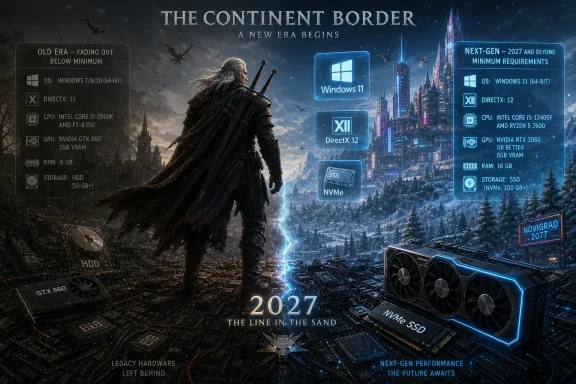 Geralt Returns, but Not to the Same PC Era
The surprise is not simply that The Witcher 3 is getting new paid expansion content more than a decade after launch. That is unusual enough. The larger story is that CD Projekt Red is treating the expansion as a platform transition, not merely a content drop.The previous minimum requirements belonged to a very different PC world. A Core i5-2500K or AMD A10-5800K, a GeForce GTX 660 or Radeon HD 7870, 6GB of RAM, and 50GB of disk space made sense when The Witcher 3 was built for the PlayStation 4 and Xbox One generation. That old baseline said, in effect, that a mid-range gaming PC from the early 2010s could still enter the Continent.
The new baseline is dramatically different. CD Projekt Red now lists an AMD Ryzen 5 2600 or Intel Core i5-8400, a GeForce GTX 1660 or Radeon RX 5500 XT with 8GB of VRAM, 12GB of system memory, 70GB of SSD storage, and 64-bit Windows 11. Those are not extravagant specs in 2026, but they are not legacy-friendly either.
That distinction matters. This is not about chasing ultra settings, ray tracing, or 4K screenshots. These are minimum requirements. CD Projekt Red is not saying older PCs will deliver a diminished experience; it is saying the supported floor has moved.
Windows 11 Becomes a Gaming Requirement by Accumulation
The most politically charged item in the new list is not the GPU. It is the operating system. Windows 11 as the minimum requirement turns The Witcher 3 into another pressure point in the long, uneven migration away from Windows 10.Microsoft ended mainstream Windows 10 support on October 14, 2025. That date has now become a useful dividing line for developers that no longer want to test, certify, and troubleshoot against an aging OS. CD Projekt Red’s stated rationale tracks that logic: new content requires updated requirements to maintain smooth performance and forward compatibility.
That does not mean Windows 10 suddenly became technically incapable of launching a fantasy RPG. It means Windows 10 has become a support liability. Once the OS exits the normal security and maintenance channel, developers have a cleaner argument for dropping it, even if the underlying APIs and drivers remain familiar.
Steam’s own hardware survey reinforces why publishers feel increasingly comfortable doing this. Windows 11 now represents a large majority of Steam users, while Windows 10 has fallen into second place. For a studio making decisions about 2027 support, the incentives point in one direction: follow the users who are already on the supported Microsoft platform, and let the holdouts age out.
The SSD Requirement Is the Quieter, More Important Cut
The move from “available space” to “SSD required” may prove more consequential in practice than the operating system line. Windows 11 attracts the argument, but storage changes how games are designed, streamed, patched, and tested.An HDD-era game could assume slow asset loading and hide it behind doors, transitions, cutscenes, and compromises. Modern open-world games increasingly assume fast random reads, predictable streaming, and fewer accommodations for mechanical storage. Even when a game was born in the HDD era, new content can change the balance.
For The Witcher 3, this is especially interesting because its world was originally built around older console constraints. Its 2022 next-gen update already nudged the game toward a more modern rendering and asset pipeline, adding features such as ray-traced global illumination on capable systems and a DirectX 12 mode. Songs of the Past appears to continue that evolution.
An SSD requirement is also easier to defend than many users might expect. Solid-state drives are cheap, common, and transformative. But they also mark a support boundary. If CD Projekt Red no longer has to guarantee tolerable behavior on mechanical drives, it can tune loading, streaming, and patch structure around the hardware most active PC gamers already use.
DirectX 12 Is No Longer the Optional Path
The old Witcher 3 lived in a DirectX 11 world. The updated version has increasingly lived in a split reality, with DirectX 11 offering compatibility and DirectX 12 enabling newer rendering features. Making DirectX 12 the central path is another sign that CD Projekt Red wants fewer branches to maintain.That is a classic late-life software problem. Supporting an old game for years sounds simple until each supported configuration becomes a tax. Every rendering path, driver class, OS version, storage assumption, and console generation adds testing overhead. At some point, the choice is not between supporting old hardware and abandoning old hardware; it is between building new features against a manageable target or not building them at all.
DirectX 12 has its own history of unevenness on PC, and The Witcher 3’s next-gen update was not immune from performance complaints when it arrived. But by 2026, the industry’s center of gravity has moved. If a 2027 expansion is going to be maintained alongside modern drivers and modern GPUs, CD Projekt Red has little incentive to keep treating the older path as equal.
The phrase “minimum requirements” can obscure this. A minimum spec is not merely a promise to users. It is an internal production tool. It tells QA what machines matter, tells engineers what assumptions are safe, and tells support staff which problems are no longer theirs to solve.
Xbox One Is the Other Casualty of a Longer Console Generation
Dropping Xbox One support fits the same pattern. The Witcher 3 began life as a cross-generation-feeling game even in 2015, built for the then-current PlayStation 4 and Xbox One while remaining deeply PC-centric. More than a decade later, the Xbox One is no longer just old; it is two platform strategies ago.The Xbox One was designed around a slow hard drive, a weak Jaguar CPU, and a memory architecture that demanded compromise. It hosted The Witcher 3 admirably for its time, but its continued inclusion would shape any expansion built around it. If Songs of the Past is meant to feel like a new premium chapter rather than archival content, keeping Xbox One in the matrix would impose a ceiling.
This is where CD Projekt Red’s decision becomes easier to understand, even for users who dislike it. A 2027 expansion aimed at Xbox Series X|S, PlayStation 5, and PC can assume SSD storage, more CPU headroom, and a much cleaner baseline. That does not guarantee ambition, but it removes one obvious excuse for limitation.
It also reflects the reality of console support in 2026. Cross-generation releases have lingered longer than many expected, partly because of pandemic-era supply constraints and the sheer size of the last-gen install base. But that grace period is ending. The Witcher 3 is not leading the break; it is joining it.
The Old Minimum Spec Was a Promise CD Projekt Could No Longer Keep
There is a temptation to frame this as a betrayal: users bought a game that ran on their machine, and now the requirements are changing. That reaction is understandable, especially for a single-player RPG whose longevity has depended on modders, patient gamers, and deep discount sales. PC players are used to old games staying old.But The Witcher 3 is no longer being treated as a frozen 2015 product. CD Projekt Red has kept updating it, reissued it for newer consoles, folded in quality-of-life improvements, and now plans to sell or deliver a new major expansion. The studio is effectively maintaining a living version of a classic, and living software sheds old skin.
The harder question is whether users who simply want to keep playing the original experience will retain access to older branches or legacy builds. On PC, that matters enormously. A studio can modernize the supported version while still preserving a path for archival play, especially on platforms such as GOG and Steam where branch management is possible.
That is where CD Projekt Red should be watched closely. Raising requirements for future content is defensible. Making the old experience unnecessarily difficult to access would be a different matter.
This Is Also a Cyberpunk Story in Disguise
CD Projekt Red has already walked this road with Cyberpunk 2077. Ahead of Phantom Liberty, the company raised PC requirements and moved the game’s baseline forward, arguing that the changes reflected the demands of continued development. That decision was controversial, but it also signaled a studio trying to stop dragging old targets through new production.The Witcher 3 update looks like the same philosophy applied to a more beloved and older game. CD Projekt Red appears to be standardizing its long-term support posture around modern Windows, modern graphics APIs, and SSD-first assumptions. That may frustrate some users, but it is not random.
The studio also has a larger franchise calendar to consider. A new Witcher saga is in development, the remake of the first Witcher is being built with Fool’s Theory, and Songs of the Past is reportedly tied into that same wider orbit of projects. The expansion is not simply nostalgia; it is franchise bridgework.
That makes the technical requirements part of the marketing message. CD Projekt Red wants The Witcher 3 to feel current enough to sit near its future games, not like a museum piece with a new quest stapled on top.
PC Gamers Are Learning That “Ownership” Has Branches
The WindowsForum audience will recognize the pattern from enterprise software: the supported version is not always the version that still technically runs. The PC gaming world is arriving at the same distinction, only with more emotion attached.A game can remain in your library while its supported future moves beyond your machine. That is not new, but it becomes more visible when the game in question is a beloved single-player RPG rather than a live service shooter. Players who ignored hardware churn because their old favorites still worked are now seeing those favorites become active software again.
The danger for publishers is that PC gamers have long memories and strong expectations around backward compatibility. A 2015 game that once ran on Windows 7 and a GTX 660 carries a different moral weight than a 2027 release with modern requirements from day one. Changing the floor after a decade invites scrutiny.
The reasonable compromise is transparency. If new content requires Windows 11, DirectX 12, and an SSD, say so plainly. If legacy builds remain available, make that equally plain. If they do not, expect backlash.
The Hardware Jump Is Bigger Than the Numbers Suggest
On paper, the new CPU and GPU requirements look modest. A Ryzen 5 2600 and Core i5-8400 are midrange parts from the late 2010s. A GTX 1660 or RX 5500 XT is hardly bleeding-edge hardware. Many PC gamers have already moved beyond them.But compared with the original minimum spec, the leap is enormous. The Core i5-2500K was legendary, but it is now fifteen-year-old silicon. The GTX 660 belongs to an era before modern low-level APIs, contemporary VRAM expectations, and the asset density that current games assume.
The RAM increase from 6GB to 12GB is similarly revealing. It acknowledges what Windows and modern game clients have already made obvious: 8GB PCs are increasingly uncomfortable, and 6GB gaming machines are relics. The new floor is not extravagant; it is simply honest.
That honesty will still sting for users who kept The Witcher 3 installed precisely because it remained playable on an old rig. The game’s reputation as a scalable classic was part of its charm. CD Projekt Red is now choosing a different identity for its next chapter.
Windows 10 Holdouts Are Running Out of Friendly Software
For Windows 10 users, this is another reminder that the end of Microsoft support was never going to be a single dramatic cliff. It was always going to be a slow narrowing of options. One app at a time, one driver branch at a time, one game requirement at a time, Windows 10 becomes less convenient.That is particularly awkward because many Windows 10 machines cannot officially upgrade to Windows 11. Microsoft’s TPM, CPU, and security requirements left a large number of otherwise functional PCs outside the supported upgrade path. For those users, CD Projekt Red’s Windows 11 requirement is not just an update; it may imply a new PC.
There are workarounds, of course, and enthusiasts know them well. But unsupported OS upgrades are not a serious answer for mainstream players, and they are certainly not a supportable answer for a game publisher. CD Projekt Red is unlikely to tune its 2027 expansion around registry edits and installation bypasses.
This is the broader Windows story hiding inside a Witcher headline. Microsoft made Windows 11 the supported destination. Developers are now beginning to act accordingly.
The Modding Community Will Feel the Shock First
The Witcher 3 has remained alive partly because of mods. Texture packs, interface changes, combat tweaks, bug fixes, reshades, and quality-of-life improvements have extended the game’s lifespan far beyond its official release cycle. Any major technical update risks disturbing that ecosystem.A new expansion, a new minimum API path, and a new supported OS baseline could all ripple through existing mod dependencies. Some mods will survive untouched. Others may need updates. A few may break permanently if their maintainers have moved on.
That is the hidden cost of reviving an old game. The official product can move forward, but the surrounding community infrastructure may not move at the same pace. The older the game, the more likely that essential community knowledge is scattered across abandoned forums, old GitHub repositories, and Discord servers with half-remembered fixes.
CD Projekt Red has generally benefited from goodwill among PC players, but it should not assume that goodwill is automatic. A smooth migration path for modders could do as much for the expansion’s reception as any trailer.
The Case for the Upgrade Is Stronger Than the Outrage
There is a credible argument that CD Projekt Red is doing exactly what players often claim to want. Rather than tossing out a token quest pack constrained by 2013 hardware, the studio is making a cleaner break and building for the machines that will define 2027. That is how old games get meaningful new life.The alternative is less attractive than it sounds. If CD Projekt Red were forced to support Windows 10, HDDs, DirectX 11, Xbox One, and ancient GPUs, Songs of the Past would likely be smaller, safer, and more compromised. Backward compatibility can preserve access, but it can also become a design prison.
That does not absolve the company of responsibility. A decade-old game carries a preservation burden. Users who bought The Witcher 3 for older systems should not be treated as if they were unreasonable for expecting the game they bought to remain playable in some form.
The real test is not whether CD Projekt Red raises the requirements. It is whether the studio manages the transition with respect for the game’s long tail.
The New Continent Has a New Border
The practical picture is clear enough for anyone planning a replay before Songs of the Past. The new expansion is being built for a post-Windows 10, SSD-first, DirectX 12 PC landscape, and the old console generation is being left behind. That will be annoying for some players, but it is also the direction the industry has been moving for years.- Players on Windows 10 should assume they will need Windows 11 for the supported 2027 version of The Witcher 3 and Songs of the Past.
- PCs still using mechanical hard drives as game storage are outside the new minimum baseline.
- The new minimum GPU class is far above the original GTX 660 and Radeon HD 7870 era, even if it remains modest by 2026 standards.
- Xbox One owners should not expect the new expansion, because CD Projekt Red is targeting Xbox Series X|S, PlayStation 5, and PC.
- Mod users should prepare for compatibility churn when the next major update arrives.
- The most important unanswered preservation issue is whether older PC builds remain easily available for players who do not want the new content.
References
- Primary source: Windows Central
Published: Wed, 27 May 2026 12:44:03 GMT
The Witcher 3’s new expansion drops Xbox One and Windows 10 — “Hardware capabilities have evolved” | Windows Central
The Witcher 3’s next expansion raises PC requirements and drops support for Xbox One and Windows 10 ahead of its 2027 launch.www.windowscentral.com - Related coverage: en.gamegpu.com
The announcement of Songs of the Past significantly increased the system requirements for The Witcher 3
Developers CD Projekt RED have significantly increased the minimum system requirements for The Witcher 3 Wild Hunt in preparation for the expansion's release Songs of the Past.en.gamegpu.com - Related coverage: techspot.com
The Witcher 3 is getting a third expansion in 2027, but minimum specs are increasing | TechSpot
Rumors that a third expansion for the Witcher 3 was in the works really picked up steam back in January when Polish industry insider Borys Nieśpielak claimed...www.techspot.com - Related coverage: support.cdprojektred.com
Bevorstehende Änderungen an den Mindestanforderungen für The Witcher 3: Wild Hunt — The Witcher 3: Wild Hunt | Technischer Support - CD PROJEKT RED
Willkommen beim technischen Support von CD PROJEKT RED! Hier gibt es Hilfe zu unseren Spielen und Dienstleistungen sowie Antworten auf häufig gestellte Fragen.support.cdprojektred.com - Related coverage: tbreak.com
The Witcher 3 Songs of the Past DLC announced for 2027
The Witcher 3 gets a surprise third expansion after 11 years. Songs of the Past arrives in 2027 exclusively on PS5, Xbox Series X|S and PC, developed with former Witcher 3 creators at Fool's Theory.tbreak.com - Related coverage: wolfsgamingblog.com
The Witcher 3: Songs of The Past DLC Announced For 2027 – WGB
CD Projekt Red has announced a new expansion for The Witcher 3 titled “Songs of the Past,” featuring Geralt, set to release in 2027. More details will be revealed in late summer. Window…wolfsgamingblog.com
- Related coverage: gamespot.com
The Witcher 3 Is Getting New DLC Nearly 12 Years After Launch - GameSpot
The new Witcher 3 expansion has been officially confirmed, with more details coming later this year.www.gamespot.com - Related coverage: dotesports.com
CDPR reveals The Witcher 3: Songs of the Past expansion alongside new PC system requirements
CDPR confirms The Witcher 3's third expansion, Songs of the Past. It launches in 2027 for PC, PS5, and Xbox Series X/S.dotesports.com - Related coverage: as.com
Es oficial: CD Projekt anuncia Songs of the Past, la nueva expansión de The Witcher 3: Wild Hunt
Geralt volverá en 2027 con Songs of the Past, la nueva expansión de The Witcher 3 co-desarrollada por Fool’s Theory.as.com
- Related coverage: pcgamesn.com
It's official, The Witcher 3 is getting new DLC, and it's a full-sized Geralt story - PCGamesN
New The Witcher 3 DLC Songs of the Past is a "full-fledged expansion" featuring Geralt of Rivia, and it's set to lay the table for the sequel.www.pcgamesn.com - Official source: support.microsoft.com
Windows 10 support has ended on October 14, 2025 - Microsoft Support
Windows 10 support ends on October 14, 2025. Upgrade to Windows 11 now to ensure continued security and feature updates. Learn more about the transition.support.microsoft.com - Official source: learn.microsoft.com
Windows 10 reaching end of support - Microsoft Lifecycle | Microsoft Learn
Announcing Windows 10 reaching end of support.learn.microsoft.com - Official source: microsoft.com
End of support for Windows 10, Windows 8.1, and Windows 7 | Microsoft Windows
Make a smooth transition to Windows 11 from your unsupported operating system with help from Microsoft. Enjoy the benefits of upgrading to a Windows 11 PC.www.microsoft.com - Related coverage: windowsreport.com

Valve Steam Survey April 2026: Windows 11 Grows, Mid-Range PCs Still Dominate
Steam Survey April 2026 shows Windows 11 at 67.74%, RTX 3060 still leads, and 16GB RAM remains the standard
windowsreport.com
- Related coverage: notebookcheck.com
Windows 11 legt unter Steam-Nutzern weiter zu, Linux verliert an Anteil - Notebookcheck News
Die Ergebnisse der neuesten Steam-Hardware- und Software-Umfrage sind veröffentlicht worden, und besonders im Bereich der Betriebssysteme zeigen sich interessante Entwicklungen. Im April 2026 konnte Windows 11 weiter zulegen, während Linux einen spürbaren Rückgang seiner Nutzerbasis verzeichnete. www.notebookcheck.com
- Related coverage: notebookcheck.net
Windows 11 continues to grow among Steam users as Linux pulls back - Notebookcheck News
The latest Steam Hardware & Software Survey results are here, and among all, there's an interesting shift happening in the operating system segment. In April 2026, Windows 11 saw another growth, while Linux lost a fair share of the user base. www.notebookcheck.net
- Related coverage: tomshardware.com
Windows 10 support ends today — here's who's affected and what you need to do | Tom's Hardware
Update if you can, upgrade if you can't, or at least get the extended support license.www.tomshardware.com - Related coverage: tomsguide.com
Windows 10 end of life — 3 risks you're taking by not upgrading before October 14 | Tom's Guide
Microsoft will stop supporting Windows 10. These are the risks you're taking by continuing to use the updated operating system.www.tomsguide.com - Related coverage: techradar.com
Microsoft in 2025: year in review | TechRadar
Microsoft pushed AI even harder this year – and Windows 11 users rebelledwww.techradar.com - Related coverage: atomicdata.com
