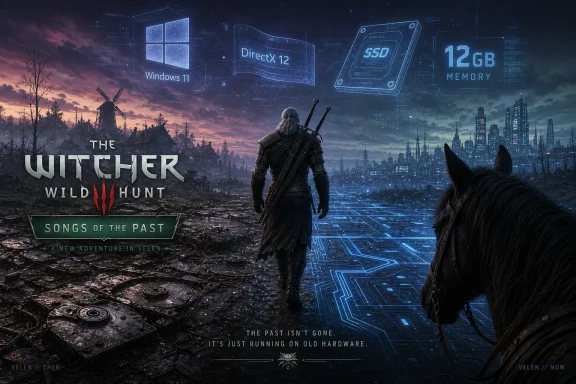
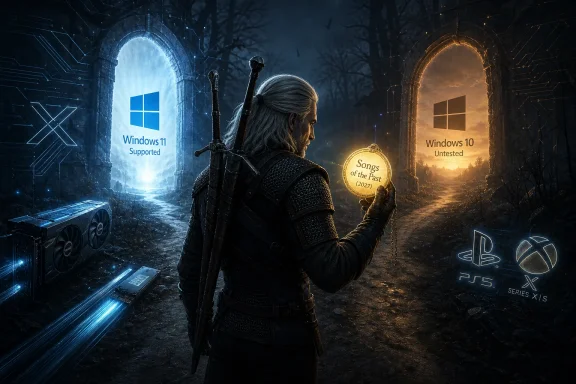
CD Projekt Red announced on May 27, 2026, that The Witcher 3: Wild Hunt will receive a new expansion called Songs of the Past in 2027 for PC, Xbox Series X|S, and PlayStation 5, with development support from Fool’s Theory. The surprise is not merely that Geralt is coming back after more than a decade; it is that one of PC gaming’s most durable Windows 7 and Windows 10-era blockbusters is being pulled into a Windows 11, SSD, DirectX 12 future. For players, this is nostalgia with a hardware bill attached. For the PC ecosystem, it is another reminder that the end of Windows 10 support is no longer an abstract Microsoft lifecycle notice — it is becoming a line item in game launchers.
There is something almost mischievous about CD Projekt Red returning to The Witcher 3 in 2027. The base game launched in May 2015, at a time when Windows 10 itself was still weeks away from release, SSDs were desirable but not yet assumed, and DirectX 11 was the safe common denominator for ambitious PC games. The Witcher 3 survived that era not as a fossil, but as a living product: patched, reissued, graphically upgraded, and kept relevant by a player base that never quite left the Continent.
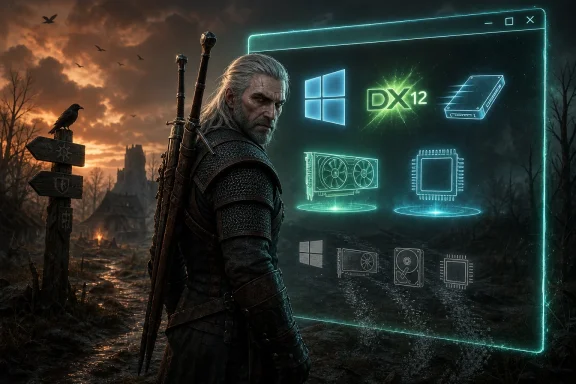
Songs of the Past changes the terms of that longevity. CD Projekt Red is not simply bolting another questline onto an old executable and calling it a victory lap. The company is using the expansion and its supporting update to reset the game’s baseline around modern Windows gaming assumptions: Windows 11, active GPU driver support, SSD storage, and DirectX 12.
That is the real news for WindowsForum readers. The content announcement is the hook, but the platform decision is the tell. A beloved 2015 game is becoming a 2027 product, and that means the operating system beneath it is no longer treated as a neutral layer.
The official reasoning is straightforward enough. Windows 10 exits mainstream consumer support on October 14, 2025, and CD Projekt Red says it will no longer test The Witcher 3 or Cyberpunk 2077 on an operating system that has lost ongoing security updates, official platform support, and continuing driver coverage. That is not a flourish. It is a support matrix being trimmed in public.
This is smart franchise management. Geralt remains the series’ safest ambassador, especially while the next mainline game prepares to shift the spotlight. A 2027 expansion gives CD Projekt Red something tangible to sell, stream, trailer, benchmark, and discuss before the studio asks players to fully embrace the next era.
But marketing bridges are not technically weightless. If Songs of the Past is meant to stand beside the game’s next-gen update rather than behind it, CDPR cannot pretend the PC baseline is still 2015. Asset streaming, shader compilation, modern upscaling pipelines, ray-tracing-adjacent rendering features, and platform QA all become harder when the developer has to preserve compatibility with machines and storage patterns from a different decade.
That does not mean every dropped platform is impossible to support. It means the cost of supporting it is no longer worth paying. The distinction matters, because PC gamers often hear “minimum requirements” as a moral judgment on their rigs. In practice, it is usually a business decision dressed in technical language.
CD Projekt Red’s answer is blunt: after Microsoft ends support for Windows 10, CDPR will not keep carrying it. That is a defensible engineering position, but it will not feel neutral to players whose machines can run The Witcher 3 today and may be blocked from future updates tomorrow. A game they bought in the Windows 7 and Windows 10 era is effectively being split into two versions: the legacy track and the expansion-capable track.
This is where the phrase Windows 11 minimum requirement lands harder than a normal spec bump. A CPU or GPU requirement says, “your machine may not be fast enough.” An OS requirement says, “your machine may be outside the supported world even if the frame rate would be fine.”
The nuance is that CD Projekt Red is reportedly allowing players to revert to an earlier version of the game. That softens the blow without eliminating it. Legacy access preserves the thing people bought, but it does not grant access to the new branch of the game. In other words, the past remains playable; the future asks for a new platform.
The Witcher 3 was originally designed for a world in which mechanical drives were still common in consoles and PCs. Developers learned to hide loading with roads, gates, elevators, cutscenes, animation locks, and clever world layout. The current console generation and modern PC storage norms have eroded that design constraint. Games now assume faster random access because the platforms around them increasingly provide it.
CDPR’s explanation follows the industry line: SSDs allow faster loading, smoother streaming, and better overall performance. That is not controversial. What is notable is seeing that line applied retroactively to The Witcher 3, a game long celebrated for scaling across a wide variety of machines.
This is the hidden bargain of long-lived PC games. The longer a title remains commercially alive, the more likely it is to be pulled forward by the expectations of new hardware. Longevity starts as compatibility and ends as modernization.
DirectX 12 has never been just a graphics API in the abstract. For Windows gaming, it is also a statement about where optimization responsibility sits. It gives developers more explicit control and can better exploit modern hardware, but it also makes driver quality, shader behavior, and platform consistency more visible.
That matters for CDPR because the company is not supporting a throwaway patch. It is preparing a paid or at least major content beat for one of the most scrutinized RPGs in the world. A broken renderer, stuttering launch, or compatibility mess would not be treated as a footnote. It would become the story.
The company also has institutional memory here. Cyberpunk 2077 launched under the weight of expectations and platform compromises that became a case study in what happens when ambition outruns execution. CDPR’s more conservative support policy now reads partly as technical prudence and partly as brand self-defense.
This also lets CDPR preserve internal focus. The studio has multiple major projects in flight, and assigning parts of a new Witcher 3 expansion to a trusted external partner keeps the franchise active without necessarily draining the teams responsible for the next flagship release. That is how modern franchise studios operate: not as single teams shipping single games, but as networks of internal and external production.
Still, co-development cuts both ways. Fans will expect Songs of the Past to feel like CDPR at its peak, not like a licensed side story. The bar is not “more content.” The bar is Hearts of Stone and Blood and Wine, two expansions that helped define what premium RPG DLC could be.
That is an unforgiving comparison. If Songs of the Past is slight, it will look cynical. If it is ambitious, it will have to justify why this particular story needed Geralt back in 2027.
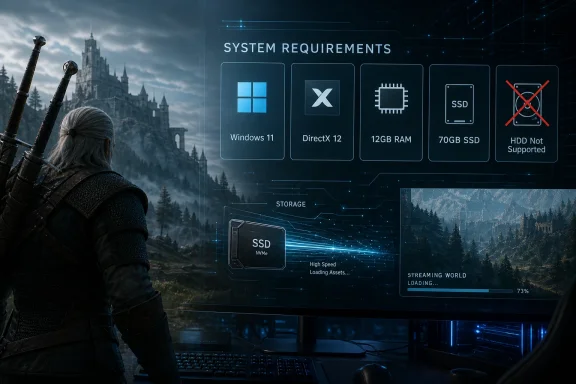
The minimum specs reportedly include CPUs such as the Ryzen 5 2600 and Core i5-8400, GPUs such as the GeForce GTX 1660 and Radeon RX 5500 XT 8GB, 12GB of RAM, 6GB of VRAM, and a 70GB SSD. That is not an absurdly high floor by 2026 standards. Many budget and midrange systems clear it easily.
The catch is not raw performance. It is eligibility. Windows 11 support rules, TPM requirements, Secure Boot configurations, and CPU generation cutoffs have already made Microsoft’s OS transition more complicated than a normal upgrade. A PC can be powerful enough for a game and still live outside the cleanest supported Windows 11 path.
That is why this story will sting for some enthusiasts. The desktop PC has always been sold as the platform where old hardware can outlive corporate schedules. In practice, the industry is now tightening around security baselines, driver support windows, and storage expectations that make the PC look more console-like in its lifecycle discipline.
If CD Projekt Red is aligning both games around Windows 11, SSDs, modern CPUs, and active driver support, then this is not just about one expansion. It is a studio-wide narrowing of what “supported PC” means for its living catalog. That has implications for GOG users, Steam users, modders, benchmarkers, and anyone maintaining older Windows gaming boxes.
The practical result is that Windows 10’s end of support will ripple through entertainment software even before every player personally feels unsafe running it. Developers do not have to wait for an exploit wave to move on. They only have to decide that QA on an unsupported OS is wasted effort.
For Microsoft, this is the quiet leverage of ecosystem policy. Windows 11 adoption is not driven only by pop-ups and upgrade prompts. It is also driven when the software people care about begins to say, politely or otherwise, that the old platform is no longer part of the test plan.
Any time a long-lived game receives a substantial update, mods break. Script extenders need updates, texture and lighting mods need validation, gameplay overhauls collide with new systems, and load orders become tiny acts of archaeology. If the new update also changes OS, API, and storage assumptions, the split between “legacy Witcher 3” and “modern Witcher 3” becomes more than a version number.
This is not necessarily bad. A refreshed technical baseline can give modders more stable ground once the dust settles. But the transition period will be messy, and players with heavily customized installs should expect caution to be the default recommendation.
The best outcome would be for CD Projekt Red to communicate versioning clearly and preserve rollback options in a way that does not punish preservation-minded users. PC players can forgive a lot when they know which branch they are on and why.
CD Projekt Red has a better reputation than many publishers on this front, helped by GOG’s DRM-free identity and a history of substantial post-launch support. That reputation matters. It gives the company more room to say that modernization is necessary and that older builds will remain accessible.
Even so, the optics are delicate. A game that once ran on older Windows versions is receiving new content that does not. Players who bought the complete experience years ago are not losing it, but they are being told that the next chapter belongs to a different PC baseline. That is not betrayal, but it is a boundary.
This is the modern software bargain in miniature. Games are no longer static products, but living products inherit the lifecycle politics of every dependency beneath them. Operating systems age out, drivers stop arriving, storage assumptions change, APIs become legacy, and the launcher becomes the place where all of that history comes due.
The most concrete lessons are not buried in the romance of Geralt’s return. They are sitting in the requirements table and the support explanation.
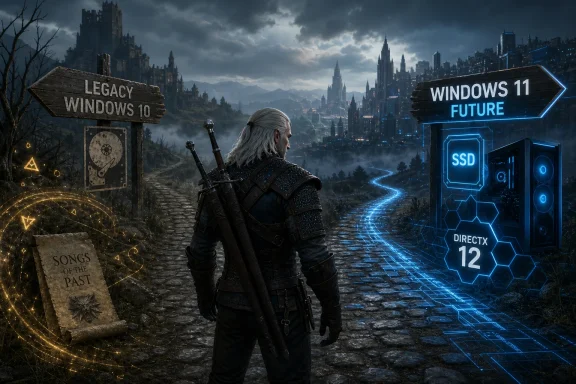 Geralt Returns, But Not to the Same PC Era
There is something almost mischievous about CD Projekt Red returning to The Witcher 3 in 2027. The base game launched in May 2015, at a time when Windows 10 itself was still weeks away from release, SSDs were desirable but not yet assumed, and DirectX 11 was the safe common denominator for ambitious PC games. The Witcher 3 survived that era not as a fossil, but as a living product: patched, reissued, graphically upgraded, and kept relevant by a player base that never quite left the Continent.Songs of the Past changes the terms of that longevity. CD Projekt Red is not simply bolting another questline onto an old executable and calling it a victory lap. The company is using the expansion and its supporting update to reset the game’s baseline around modern Windows gaming assumptions: Windows 11, active GPU driver support, SSD storage, and DirectX 12.
That is the real news for WindowsForum readers. The content announcement is the hook, but the platform decision is the tell. A beloved 2015 game is becoming a 2027 product, and that means the operating system beneath it is no longer treated as a neutral layer.
The official reasoning is straightforward enough. Windows 10 exits mainstream consumer support on October 14, 2025, and CD Projekt Red says it will no longer test The Witcher 3 or Cyberpunk 2077 on an operating system that has lost ongoing security updates, official platform support, and continuing driver coverage. That is not a flourish. It is a support matrix being trimmed in public.
The Expansion Is a Marketing Bridge With Technical Consequences
The timing is not accidental. CD Projekt Red has been repositioning the Witcher franchise around its next generation of games, including the project now known as The Witcher 4, while Fool’s Theory is already tied to the broader Witcher revival through its work on the remake of the original game. A new Geralt expansion lets CDPR reawaken the audience that made The Witcher 3 a cultural object rather than just a successful RPG.This is smart franchise management. Geralt remains the series’ safest ambassador, especially while the next mainline game prepares to shift the spotlight. A 2027 expansion gives CD Projekt Red something tangible to sell, stream, trailer, benchmark, and discuss before the studio asks players to fully embrace the next era.
But marketing bridges are not technically weightless. If Songs of the Past is meant to stand beside the game’s next-gen update rather than behind it, CDPR cannot pretend the PC baseline is still 2015. Asset streaming, shader compilation, modern upscaling pipelines, ray-tracing-adjacent rendering features, and platform QA all become harder when the developer has to preserve compatibility with machines and storage patterns from a different decade.
That does not mean every dropped platform is impossible to support. It means the cost of supporting it is no longer worth paying. The distinction matters, because PC gamers often hear “minimum requirements” as a moral judgment on their rigs. In practice, it is usually a business decision dressed in technical language.
Windows 10 Becomes the Casualty Everyone Saw Coming
The Windows 11 requirement will be the most contentious part of this story, and for good reason. Windows 10 remains widely installed, familiar, and entirely adequate for a large population of gaming PCs. Many players have avoided Windows 11 because their hardware is unsupported, because they dislike the interface changes, because they distrust Microsoft’s account and telemetry direction, or simply because their current installation works.CD Projekt Red’s answer is blunt: after Microsoft ends support for Windows 10, CDPR will not keep carrying it. That is a defensible engineering position, but it will not feel neutral to players whose machines can run The Witcher 3 today and may be blocked from future updates tomorrow. A game they bought in the Windows 7 and Windows 10 era is effectively being split into two versions: the legacy track and the expansion-capable track.
This is where the phrase Windows 11 minimum requirement lands harder than a normal spec bump. A CPU or GPU requirement says, “your machine may not be fast enough.” An OS requirement says, “your machine may be outside the supported world even if the frame rate would be fine.”
The nuance is that CD Projekt Red is reportedly allowing players to revert to an earlier version of the game. That softens the blow without eliminating it. Legacy access preserves the thing people bought, but it does not grant access to the new branch of the game. In other words, the past remains playable; the future asks for a new platform.
The SSD Requirement Is the Less Emotional, More Important Cutoff
The end of hard-drive support will generate fewer headlines than Windows 11, but it may matter more to how the expansion actually plays. Open-world games are increasingly built around assumptions that data can be pulled from storage quickly and predictably. HDDs can still store enormous libraries cheaply, but they are poor partners for seamless traversal, dense asset streaming, and rapid state changes.The Witcher 3 was originally designed for a world in which mechanical drives were still common in consoles and PCs. Developers learned to hide loading with roads, gates, elevators, cutscenes, animation locks, and clever world layout. The current console generation and modern PC storage norms have eroded that design constraint. Games now assume faster random access because the platforms around them increasingly provide it.
CDPR’s explanation follows the industry line: SSDs allow faster loading, smoother streaming, and better overall performance. That is not controversial. What is notable is seeing that line applied retroactively to The Witcher 3, a game long celebrated for scaling across a wide variety of machines.
This is the hidden bargain of long-lived PC games. The longer a title remains commercially alive, the more likely it is to be pulled forward by the expectations of new hardware. Longevity starts as compatibility and ends as modernization.
DirectX 12 Turns the Old RPG Into a Modern Windows Test Case
The DirectX 12-only shift is another sign that CD Projekt Red wants to reduce the number of paths it has to maintain. The original Witcher 3 world was built around DirectX 11, while the next-gen update introduced a more modern rendering path with features suited to contemporary hardware. Maintaining old and new rendering assumptions indefinitely is expensive, especially when new content must be tested across combinations of CPUs, GPUs, drivers, operating systems, and graphics settings.DirectX 12 has never been just a graphics API in the abstract. For Windows gaming, it is also a statement about where optimization responsibility sits. It gives developers more explicit control and can better exploit modern hardware, but it also makes driver quality, shader behavior, and platform consistency more visible.
That matters for CDPR because the company is not supporting a throwaway patch. It is preparing a paid or at least major content beat for one of the most scrutinized RPGs in the world. A broken renderer, stuttering launch, or compatibility mess would not be treated as a footnote. It would become the story.
The company also has institutional memory here. Cyberpunk 2077 launched under the weight of expectations and platform compromises that became a case study in what happens when ambition outruns execution. CDPR’s more conservative support policy now reads partly as technical prudence and partly as brand self-defense.
Fool’s Theory Gives the Announcement a Familiar Witcher Shadow
The involvement of Fool’s Theory is important because it suggests CD Projekt Red is not treating Songs of the Past as a tiny nostalgia quest. Fool’s Theory has Witcher-adjacent credibility, and its role on the Witcher remake makes it a logical co-development partner for content that needs to understand both the old tone and the new pipeline.This also lets CDPR preserve internal focus. The studio has multiple major projects in flight, and assigning parts of a new Witcher 3 expansion to a trusted external partner keeps the franchise active without necessarily draining the teams responsible for the next flagship release. That is how modern franchise studios operate: not as single teams shipping single games, but as networks of internal and external production.
Still, co-development cuts both ways. Fans will expect Songs of the Past to feel like CDPR at its peak, not like a licensed side story. The bar is not “more content.” The bar is Hearts of Stone and Blood and Wine, two expansions that helped define what premium RPG DLC could be.
That is an unforgiving comparison. If Songs of the Past is slight, it will look cynical. If it is ambitious, it will have to justify why this particular story needed Geralt back in 2027.
The Real Upgrade Path Is Not Just a GPU
For years, PC gaming upgrades were discussed mostly in terms of graphics cards. Could your GPU run the game? Did you have enough VRAM? Could you turn on ray tracing, or would you live in the medium preset trenches? The Songs of the Past requirements point to a broader shift: the upgrade path now includes the operating system, the storage device, the CPU support list, and the driver lifecycle.The minimum specs reportedly include CPUs such as the Ryzen 5 2600 and Core i5-8400, GPUs such as the GeForce GTX 1660 and Radeon RX 5500 XT 8GB, 12GB of RAM, 6GB of VRAM, and a 70GB SSD. That is not an absurdly high floor by 2026 standards. Many budget and midrange systems clear it easily.
The catch is not raw performance. It is eligibility. Windows 11 support rules, TPM requirements, Secure Boot configurations, and CPU generation cutoffs have already made Microsoft’s OS transition more complicated than a normal upgrade. A PC can be powerful enough for a game and still live outside the cleanest supported Windows 11 path.
That is why this story will sting for some enthusiasts. The desktop PC has always been sold as the platform where old hardware can outlive corporate schedules. In practice, the industry is now tightening around security baselines, driver support windows, and storage expectations that make the PC look more console-like in its lifecycle discipline.
Cyberpunk 2077 Being Pulled Along Is the Bigger Signal
The support note reportedly applies not only to The Witcher 3 but also to Cyberpunk 2077. That matters because Cyberpunk is not a 2015 game being dragged into the present. It is a 2020 title that has already been updated, expanded, and used as a showcase for demanding PC graphics features.If CD Projekt Red is aligning both games around Windows 11, SSDs, modern CPUs, and active driver support, then this is not just about one expansion. It is a studio-wide narrowing of what “supported PC” means for its living catalog. That has implications for GOG users, Steam users, modders, benchmarkers, and anyone maintaining older Windows gaming boxes.
The practical result is that Windows 10’s end of support will ripple through entertainment software even before every player personally feels unsafe running it. Developers do not have to wait for an exploit wave to move on. They only have to decide that QA on an unsupported OS is wasted effort.
For Microsoft, this is the quiet leverage of ecosystem policy. Windows 11 adoption is not driven only by pop-ups and upgrade prompts. It is also driven when the software people care about begins to say, politely or otherwise, that the old platform is no longer part of the test plan.
Modders Will Be the First to Feel the Branch Split
The Witcher 3 modding community has kept the game alive in ways no publisher roadmap can fully capture. Visual upgrades, balance changes, restored content, interface improvements, and quality-of-life fixes have all extended the game’s relevance. A major expansion and technical baseline shift will energize that community, but it may also fracture it.Any time a long-lived game receives a substantial update, mods break. Script extenders need updates, texture and lighting mods need validation, gameplay overhauls collide with new systems, and load orders become tiny acts of archaeology. If the new update also changes OS, API, and storage assumptions, the split between “legacy Witcher 3” and “modern Witcher 3” becomes more than a version number.
This is not necessarily bad. A refreshed technical baseline can give modders more stable ground once the dust settles. But the transition period will be messy, and players with heavily customized installs should expect caution to be the default recommendation.
The best outcome would be for CD Projekt Red to communicate versioning clearly and preserve rollback options in a way that does not punish preservation-minded users. PC players can forgive a lot when they know which branch they are on and why.
The Backlash Will Be About Ownership, Not Just Specs
The predictable complaint is easy to caricature: gamers angry that a 12-year-old game now needs Windows 11. But the underlying issue is more serious. When a purchased game continues changing years after release, players begin to ask what exactly they own.CD Projekt Red has a better reputation than many publishers on this front, helped by GOG’s DRM-free identity and a history of substantial post-launch support. That reputation matters. It gives the company more room to say that modernization is necessary and that older builds will remain accessible.
Even so, the optics are delicate. A game that once ran on older Windows versions is receiving new content that does not. Players who bought the complete experience years ago are not losing it, but they are being told that the next chapter belongs to a different PC baseline. That is not betrayal, but it is a boundary.
This is the modern software bargain in miniature. Games are no longer static products, but living products inherit the lifecycle politics of every dependency beneath them. Operating systems age out, drivers stop arriving, storage assumptions change, APIs become legacy, and the launcher becomes the place where all of that history comes due.
The Continent’s New Road Signs Are Written in System Requirements
For Windows users, the practical message is unusually clear. If you intend to play Songs of the Past on PC in 2027, treat the next year as a compatibility audit rather than a last-minute scramble. The game may not demand a monster rig, but it will demand that your platform align with where CD Projekt Red is drawing the support line.The most concrete lessons are not buried in the romance of Geralt’s return. They are sitting in the requirements table and the support explanation.
- Players who stay on Windows 10 should expect to remain on older supported game builds rather than the expansion-ready branch.
- Systems without SSD storage are increasingly outside the assumptions of major open-world PC releases, even when the underlying game began life in the HDD era.
- DirectX 12 is becoming the default development target for modernized Windows games, not merely an optional high-end rendering path.
- CPU and GPU support now depends as much on driver and OS eligibility as on raw benchmark performance.
- Modded installations should be treated cautiously until CD Projekt Red and the modding community clarify how the new update affects existing tools and content.
- The rollback option is important, but it preserves access to the past rather than guaranteeing participation in the game’s future.
References
- Primary source: Wccftech
Published: Wed, 27 May 2026 09:22:00 GMT
The Witcher 3 Stuns Players With Songs of The Past DLC, Launching 12 Years After The Base Game Released
The Witcher 3 gets a surprise 2027 expansion, Songs of the Past, alongside strict new Windows 11 PC requirementswccftech.com
- Related coverage: support.cdprojektred.com
The Witcher 3: Wild Hunt System Requirements — The Witcher 3: Wild Hunt | Technical Support — CD PROJEKT RED
Welcome to CD PROJEKT RED Technical Support! Here you will find help regarding our games and services, as well as answers to frequently asked questions.support.cdprojektred.com - Related coverage: thephrasemaker.com
The Witcher 3 Officially Getting Third Expansion, ‘Songs of the Past’
CD Projekt Red shocks the gaming industry by announcing a massive third story expansion for The Witcher 3.thephrasemaker.com - Related coverage: gamesradar.com
New The Witcher 3 DLC announced, as Songs of the Past confirms we're returning to Geralt's adventure in 2027 | GamesRadar+
The rumors were truewww.gamesradar.com - Related coverage: insider-gaming.com
Songs Of The Past Expansion Officially Announced For The Witcher 3 - Insider Gaming
The third DLC for The Witcher 3 has been officially announced, with the next expansion titled Songs of the Past.insider-gaming.com - Related coverage: rpgsite.net
The Witcher 3: Wild Hunt - Songs of the Past expansion announced for 2027 release on PS5, Xbox, and PC | RPG Site
The Witcher 3: Wild Hunt - Songs of the Past is the third expansion for the game and it is being co-developed with Fool's Theory. www.rpgsite.net