CD Projekt Red announced on May 27, 2026, that The Witcher 3: Wild Hunt will receive a new expansion called Songs of the Past in 2027 for PC, Xbox Series X|S, and PlayStation 5, with development support from Fool’s Theory. The surprise is not merely that Geralt is coming back after more than a decade; it is that one of PC gaming’s most durable Windows 7 and Windows 10-era blockbusters is being pulled into a Windows 11, SSD, DirectX 12 future. For players, this is nostalgia with a hardware bill attached. For the PC ecosystem, it is another reminder that the end of Windows 10 support is no longer an abstract Microsoft lifecycle notice — it is becoming a line item in game launchers.

A witcher-like warrior stands in a dark city street, facing Windows 10 legacy vs Windows 11 future tech signs.Geralt Returns, But Not to the Same PC Era​

There is something almost mischievous about CD Projekt Red returning to The Witcher 3 in 2027. The base game launched in May 2015, at a time when Windows 10 itself was still weeks away from release, SSDs were desirable but not yet assumed, and DirectX 11 was the safe common denominator for ambitious PC games. The Witcher 3 survived that era not as a fossil, but as a living product: patched, reissued, graphically upgraded, and kept relevant by a player base that never quite left the Continent.
Songs of the Past changes the terms of that longevity. CD Projekt Red is not simply bolting another questline onto an old executable and calling it a victory lap. The company is using the expansion and its supporting update to reset the game’s baseline around modern Windows gaming assumptions: Windows 11, active GPU driver support, SSD storage, and DirectX 12.
That is the real news for WindowsForum readers. The content announcement is the hook, but the platform decision is the tell. A beloved 2015 game is becoming a 2027 product, and that means the operating system beneath it is no longer treated as a neutral layer.
The official reasoning is straightforward enough. Windows 10 exits mainstream consumer support on October 14, 2025, and CD Projekt Red says it will no longer test The Witcher 3 or Cyberpunk 2077 on an operating system that has lost ongoing security updates, official platform support, and continuing driver coverage. That is not a flourish. It is a support matrix being trimmed in public.

The Expansion Is a Marketing Bridge With Technical Consequences​

The timing is not accidental. CD Projekt Red has been repositioning the Witcher franchise around its next generation of games, including the project now known as The Witcher 4, while Fool’s Theory is already tied to the broader Witcher revival through its work on the remake of the original game. A new Geralt expansion lets CDPR reawaken the audience that made The Witcher 3 a cultural object rather than just a successful RPG.
This is smart franchise management. Geralt remains the series’ safest ambassador, especially while the next mainline game prepares to shift the spotlight. A 2027 expansion gives CD Projekt Red something tangible to sell, stream, trailer, benchmark, and discuss before the studio asks players to fully embrace the next era.
But marketing bridges are not technically weightless. If Songs of the Past is meant to stand beside the game’s next-gen update rather than behind it, CDPR cannot pretend the PC baseline is still 2015. Asset streaming, shader compilation, modern upscaling pipelines, ray-tracing-adjacent rendering features, and platform QA all become harder when the developer has to preserve compatibility with machines and storage patterns from a different decade.
That does not mean every dropped platform is impossible to support. It means the cost of supporting it is no longer worth paying. The distinction matters, because PC gamers often hear “minimum requirements” as a moral judgment on their rigs. In practice, it is usually a business decision dressed in technical language.

Windows 10 Becomes the Casualty Everyone Saw Coming​

The Windows 11 requirement will be the most contentious part of this story, and for good reason. Windows 10 remains widely installed, familiar, and entirely adequate for a large population of gaming PCs. Many players have avoided Windows 11 because their hardware is unsupported, because they dislike the interface changes, because they distrust Microsoft’s account and telemetry direction, or simply because their current installation works.
CD Projekt Red’s answer is blunt: after Microsoft ends support for Windows 10, CDPR will not keep carrying it. That is a defensible engineering position, but it will not feel neutral to players whose machines can run The Witcher 3 today and may be blocked from future updates tomorrow. A game they bought in the Windows 7 and Windows 10 era is effectively being split into two versions: the legacy track and the expansion-capable track.
This is where the phrase Windows 11 minimum requirement lands harder than a normal spec bump. A CPU or GPU requirement says, “your machine may not be fast enough.” An OS requirement says, “your machine may be outside the supported world even if the frame rate would be fine.”
The nuance is that CD Projekt Red is reportedly allowing players to revert to an earlier version of the game. That softens the blow without eliminating it. Legacy access preserves the thing people bought, but it does not grant access to the new branch of the game. In other words, the past remains playable; the future asks for a new platform.

The SSD Requirement Is the Less Emotional, More Important Cutoff​

The end of hard-drive support will generate fewer headlines than Windows 11, but it may matter more to how the expansion actually plays. Open-world games are increasingly built around assumptions that data can be pulled from storage quickly and predictably. HDDs can still store enormous libraries cheaply, but they are poor partners for seamless traversal, dense asset streaming, and rapid state changes.
The Witcher 3 was originally designed for a world in which mechanical drives were still common in consoles and PCs. Developers learned to hide loading with roads, gates, elevators, cutscenes, animation locks, and clever world layout. The current console generation and modern PC storage norms have eroded that design constraint. Games now assume faster random access because the platforms around them increasingly provide it.
CDPR’s explanation follows the industry line: SSDs allow faster loading, smoother streaming, and better overall performance. That is not controversial. What is notable is seeing that line applied retroactively to The Witcher 3, a game long celebrated for scaling across a wide variety of machines.
This is the hidden bargain of long-lived PC games. The longer a title remains commercially alive, the more likely it is to be pulled forward by the expectations of new hardware. Longevity starts as compatibility and ends as modernization.

DirectX 12 Turns the Old RPG Into a Modern Windows Test Case​

The DirectX 12-only shift is another sign that CD Projekt Red wants to reduce the number of paths it has to maintain. The original Witcher 3 world was built around DirectX 11, while the next-gen update introduced a more modern rendering path with features suited to contemporary hardware. Maintaining old and new rendering assumptions indefinitely is expensive, especially when new content must be tested across combinations of CPUs, GPUs, drivers, operating systems, and graphics settings.
DirectX 12 has never been just a graphics API in the abstract. For Windows gaming, it is also a statement about where optimization responsibility sits. It gives developers more explicit control and can better exploit modern hardware, but it also makes driver quality, shader behavior, and platform consistency more visible.
That matters for CDPR because the company is not supporting a throwaway patch. It is preparing a paid or at least major content beat for one of the most scrutinized RPGs in the world. A broken renderer, stuttering launch, or compatibility mess would not be treated as a footnote. It would become the story.
The company also has institutional memory here. Cyberpunk 2077 launched under the weight of expectations and platform compromises that became a case study in what happens when ambition outruns execution. CDPR’s more conservative support policy now reads partly as technical prudence and partly as brand self-defense.

Fool’s Theory Gives the Announcement a Familiar Witcher Shadow​

The involvement of Fool’s Theory is important because it suggests CD Projekt Red is not treating Songs of the Past as a tiny nostalgia quest. Fool’s Theory has Witcher-adjacent credibility, and its role on the Witcher remake makes it a logical co-development partner for content that needs to understand both the old tone and the new pipeline.
This also lets CDPR preserve internal focus. The studio has multiple major projects in flight, and assigning parts of a new Witcher 3 expansion to a trusted external partner keeps the franchise active without necessarily draining the teams responsible for the next flagship release. That is how modern franchise studios operate: not as single teams shipping single games, but as networks of internal and external production.
Still, co-development cuts both ways. Fans will expect Songs of the Past to feel like CDPR at its peak, not like a licensed side story. The bar is not “more content.” The bar is Hearts of Stone and Blood and Wine, two expansions that helped define what premium RPG DLC could be.
That is an unforgiving comparison. If Songs of the Past is slight, it will look cynical. If it is ambitious, it will have to justify why this particular story needed Geralt back in 2027.

The Real Upgrade Path Is Not Just a GPU​

For years, PC gaming upgrades were discussed mostly in terms of graphics cards. Could your GPU run the game? Did you have enough VRAM? Could you turn on ray tracing, or would you live in the medium preset trenches? The Songs of the Past requirements point to a broader shift: the upgrade path now includes the operating system, the storage device, the CPU support list, and the driver lifecycle.
The minimum specs reportedly include CPUs such as the Ryzen 5 2600 and Core i5-8400, GPUs such as the GeForce GTX 1660 and Radeon RX 5500 XT 8GB, 12GB of RAM, 6GB of VRAM, and a 70GB SSD. That is not an absurdly high floor by 2026 standards. Many budget and midrange systems clear it easily.
The catch is not raw performance. It is eligibility. Windows 11 support rules, TPM requirements, Secure Boot configurations, and CPU generation cutoffs have already made Microsoft’s OS transition more complicated than a normal upgrade. A PC can be powerful enough for a game and still live outside the cleanest supported Windows 11 path.
That is why this story will sting for some enthusiasts. The desktop PC has always been sold as the platform where old hardware can outlive corporate schedules. In practice, the industry is now tightening around security baselines, driver support windows, and storage expectations that make the PC look more console-like in its lifecycle discipline.

Cyberpunk 2077 Being Pulled Along Is the Bigger Signal​

The support note reportedly applies not only to The Witcher 3 but also to Cyberpunk 2077. That matters because Cyberpunk is not a 2015 game being dragged into the present. It is a 2020 title that has already been updated, expanded, and used as a showcase for demanding PC graphics features.
If CD Projekt Red is aligning both games around Windows 11, SSDs, modern CPUs, and active driver support, then this is not just about one expansion. It is a studio-wide narrowing of what “supported PC” means for its living catalog. That has implications for GOG users, Steam users, modders, benchmarkers, and anyone maintaining older Windows gaming boxes.
The practical result is that Windows 10’s end of support will ripple through entertainment software even before every player personally feels unsafe running it. Developers do not have to wait for an exploit wave to move on. They only have to decide that QA on an unsupported OS is wasted effort.
For Microsoft, this is the quiet leverage of ecosystem policy. Windows 11 adoption is not driven only by pop-ups and upgrade prompts. It is also driven when the software people care about begins to say, politely or otherwise, that the old platform is no longer part of the test plan.

Modders Will Be the First to Feel the Branch Split​

The Witcher 3 modding community has kept the game alive in ways no publisher roadmap can fully capture. Visual upgrades, balance changes, restored content, interface improvements, and quality-of-life fixes have all extended the game’s relevance. A major expansion and technical baseline shift will energize that community, but it may also fracture it.
Any time a long-lived game receives a substantial update, mods break. Script extenders need updates, texture and lighting mods need validation, gameplay overhauls collide with new systems, and load orders become tiny acts of archaeology. If the new update also changes OS, API, and storage assumptions, the split between “legacy Witcher 3” and “modern Witcher 3” becomes more than a version number.
This is not necessarily bad. A refreshed technical baseline can give modders more stable ground once the dust settles. But the transition period will be messy, and players with heavily customized installs should expect caution to be the default recommendation.
The best outcome would be for CD Projekt Red to communicate versioning clearly and preserve rollback options in a way that does not punish preservation-minded users. PC players can forgive a lot when they know which branch they are on and why.

The Backlash Will Be About Ownership, Not Just Specs​

The predictable complaint is easy to caricature: gamers angry that a 12-year-old game now needs Windows 11. But the underlying issue is more serious. When a purchased game continues changing years after release, players begin to ask what exactly they own.
CD Projekt Red has a better reputation than many publishers on this front, helped by GOG’s DRM-free identity and a history of substantial post-launch support. That reputation matters. It gives the company more room to say that modernization is necessary and that older builds will remain accessible.
Even so, the optics are delicate. A game that once ran on older Windows versions is receiving new content that does not. Players who bought the complete experience years ago are not losing it, but they are being told that the next chapter belongs to a different PC baseline. That is not betrayal, but it is a boundary.
This is the modern software bargain in miniature. Games are no longer static products, but living products inherit the lifecycle politics of every dependency beneath them. Operating systems age out, drivers stop arriving, storage assumptions change, APIs become legacy, and the launcher becomes the place where all of that history comes due.

The Continent’s New Road Signs Are Written in System Requirements​

For Windows users, the practical message is unusually clear. If you intend to play Songs of the Past on PC in 2027, treat the next year as a compatibility audit rather than a last-minute scramble. The game may not demand a monster rig, but it will demand that your platform align with where CD Projekt Red is drawing the support line.
The most concrete lessons are not buried in the romance of Geralt’s return. They are sitting in the requirements table and the support explanation.
  • Players who stay on Windows 10 should expect to remain on older supported game builds rather than the expansion-ready branch.
  • Systems without SSD storage are increasingly outside the assumptions of major open-world PC releases, even when the underlying game began life in the HDD era.
  • DirectX 12 is becoming the default development target for modernized Windows games, not merely an optional high-end rendering path.
  • CPU and GPU support now depends as much on driver and OS eligibility as on raw benchmark performance.
  • Modded installations should be treated cautiously until CD Projekt Red and the modding community clarify how the new update affects existing tools and content.
  • The rollback option is important, but it preserves access to the past rather than guaranteeing participation in the game’s future.
The irony is that Songs of the Past is being sold on memory while enforcing a clean break from the PC past that helped make The Witcher 3 legendary. That does not make CD Projekt Red wrong. It makes the expansion a marker for where Windows gaming now stands: nostalgic in content, modern in dependencies, and increasingly unwilling to let old operating systems define the next release. Geralt may be walking the Path again, but this time the trail runs through Windows 11, SSDs, and a support calendar that no amount of sentiment can dodge.

References​

  1. Primary source: Wccftech
    Published: Wed, 27 May 2026 09:22:00 GMT
  2. Related coverage: support.cdprojektred.com
  3. Related coverage: thephrasemaker.com
  4. Related coverage: gamesradar.com
  5. Related coverage: insider-gaming.com
  6. Related coverage: rpgsite.net
 

CD Projekt Red announced on May 27, 2026, that The Witcher 3: Wild Hunt will receive a third expansion, Songs of the Past, in 2027 for PC, PlayStation 5, and Xbox Series X|S, alongside sharply higher minimum PC requirements that move the game to Windows 11, DirectX 12, and SSD storage. The story is not just that Geralt is being pulled out of retirement. It is that one of PC gaming’s great long-tail success stories is finally drawing a hard technical line under the hardware and operating systems that carried it for more than a decade. For Windows users, especially those who treat old games as permanent fixtures in their library, this is a small but telling preview of what the post-Windows 10 gaming landscape is going to feel like.

Warrior with sword sparks in a medieval fantasy battle while facing glowing Windows and game icons in cyberspace.Geralt Returns, But Not to the Same PC Era​

The immediate headline is irresistible: The Witcher 3 is getting new paid narrative content roughly twelve years after its original 2015 launch and more than a decade after Blood and Wine seemed to close the book on Geralt’s story. CD Projekt Red says Songs of the Past will return players to Geralt of Rivia for a new adventure, co-developed with Fool’s Theory, the Polish studio already entrusted with the remake of the first Witcher game. More details are promised for late summer 2026, which gives the announcement the shape of a teaser rather than a full reveal.
But the PC requirement change is the part that will matter most to WindowsForum readers. According to the reported updated minimums, The Witcher 3 will require Windows 11 64-bit, DirectX 12, 12GB of RAM, 70GB of SSD storage, 6GB of VRAM, and hardware in the range of a Ryzen 5 2600 or Core i5-8400 paired with a GeForce GTX 1660 or Radeon RX 5500 XT. That is no longer “old laptop with a discrete GPU” territory. It is a floor built around the late-2010s mainstream gaming PC.
This is a dramatic shift because The Witcher 3 has long occupied a special place in the PC library: old enough to be cheap and widely owned, modern enough to still look handsome, scalable enough to run on a broad sweep of hardware, and culturally important enough to keep returning to. The 2022 next-gen update raised expectations, added ray tracing and visual improvements, and created some performance controversy, but it did not fundamentally reclassify the game as current-generation-only. Songs of the Past appears to do exactly that.
There is a blunt logic to CD Projekt Red’s move. If a studio is going to ship new content in 2027 for a game still carrying active commercial weight, it has to test, support, and patch against a manageable target. Windows 10 will be out of standard support by then, mechanical hard drives are a disastrous baseline for open-world streaming, and DirectX 11 is increasingly the compatibility path rather than the development path. The company is not merely adding an expansion. It is deciding which version of PC gaming history it wants to keep maintaining.

The Windows 11 Requirement Is a Support Decision Wearing a Gaming Hat​

The most provocative phrase in the Eurogamer and IGN framing is that the new requirements will “force” PC players to use Windows 11. For a portion of the audience, that is exactly how it will feel. A game bought in 2015, updated over the years, and perhaps installed on a Windows 10 machine in a Steam or GOG library may now have a future branch of support that leaves that OS behind.
Still, it is worth separating three things that often get collapsed into one outrage cycle. First, there is the playable version users already own. Second, there is the future updated version of the game that CD Projekt Red intends to support. Third, there is the new expansion, which will be designed and QA-tested against the new floor. The practical details of whether legacy builds remain selectable on storefronts will matter enormously, and they are precisely the kind of detail publishers often under-communicate at announcement time.
The Windows 11 requirement is not surprising in isolation. Microsoft ended standard support for Windows 10 on October 14, 2025, and the PC games industry has been slowly aligning its official support matrices around that fact. Studios can and often do support older operating systems beyond Microsoft’s dates, but doing so comes with cost: driver weirdness, security assumptions, QA time, crash triage, and a growing mismatch between what modern middleware expects and what legacy systems provide.
For CD Projekt Red, the timing is convenient. A 2027 expansion gives the company a plausible reason to recut the game’s support baseline without making it look like a purely administrative decision. “We need to ensure smooth performance and compatibility going forward” is the kind of corporate phrasing that sounds bloodless, but in this case it is probably accurate. The game is no longer just a static artifact; it is becoming an active product again.
That distinction matters because PC gaming’s promise has always been a little mythic. We like to say that our libraries are forever, that backward compatibility is the platform’s secret weapon, that old games remain alive through modders, wrappers, community patches, and brute-force hardware. All of that is still true. But a live commercial game with new paid content is governed less by preservation romance than by support economics.

The SSD Mandate Is the More Honest Requirement​

If the Windows 11 line will draw the loudest complaints, the SSD requirement may be the more meaningful technical change. Mechanical hard drives have been dying as a gaming baseline for years, but many PC requirement sheets treated SSDs as recommendations long after the design assumptions had moved on. A minimum spec that explicitly says SSD is a minimum spec that admits how modern streaming works.
Open-world games are not just big folders of textures and meshes. They are constant data logistics problems. As the player rides through forests, cities, swamps, interiors, and combat spaces, the engine has to feed assets into memory fast enough to avoid visible hitches, missing geometry, texture pop-in, and loading stalls. A hard drive can still store the bits, but storage is not merely archival in a modern game; it is part of the performance pipeline.
The current-generation consoles normalized this reality. PlayStation 5 and Xbox Series X|S were designed around fast solid-state storage, and once developers target those systems as the floor, PC requirements inevitably follow. The PC has more variety, more knobs, and more potential brute force, but it cannot indefinitely pretend that a 5400 rpm laptop drive and an NVMe SSD are simply different-sized buckets.
For The Witcher 3, an SSD requirement may feel odd because the original game was built for the PlayStation 4 and Xbox One era, when slow storage was assumed. But Songs of the Past is not being built in 2015. Even if it uses the same underlying world, even if it does not transform the engine into something unrecognizable, CD Projekt Red and Fool’s Theory are developing against player expectations shaped by a different decade of hardware.
There is also a simple QA angle. Supporting hard drives does not just mean tolerating longer loading screens. It means testing for streaming stalls, save/load behavior, traversal edge cases, and inconsistent performance across a device category that varies wildly by age, fragmentation, cache behavior, and laptop power profile. At some point, the correct technical decision is to stop pretending the lowest common denominator is still common enough to deserve the denominator.

DirectX 12 Becomes the Baseline, Not the Bonus Path​

DirectX 12 has had an uneven reputation among PC gamers, and The Witcher 3 itself contributed to that ambiguity after its next-gen update. The DX12 version enabled the newest visual features, including ray tracing, but it also became a source of performance complaints for players who found the DX11 path smoother on their machines. For years, the practical PC advice around many games has been: try DX12 if you need the features, fall back to DX11 if you want stability.
Making DirectX 12 the minimum changes that bargain. It tells players that the compatibility path is no longer the real path. This does not necessarily mean every player will be forced into ray tracing or heavy visual modes, but it does mean the renderer, driver expectations, and toolchain assumptions are moving forward.
For developers, DirectX 12 offers lower-level control and better alignment with modern graphics architectures, but it also pushes more responsibility onto the game. That is part of why DX12 implementations can vary so dramatically in quality. A good DX12 renderer can scale well and make sophisticated use of modern GPUs. A poor one can expose players to shader stutter, CPU bottlenecks, and driver-specific headaches that DX11’s older abstraction layer sometimes papered over.
The new minimum GPU class is therefore important. A GTX 1660 is not exotic in 2026 terms, but it is a substantial leap from the old GTX 660-era minimum that defined the original PC release. The Radeon RX 5500 XT 8GB target, similarly, points to a world where 6GB or more of VRAM is no longer a luxury line item. The game that once ran on early-2010s midrange cards is being re-anchored around hardware from the end of that decade.
This is not CD Projekt Red demanding the bleeding edge. It is more interesting than that. The new floor is a declaration that mainstream now means something different. The PC that counts as modest in 2027 is not the PC that counted as modest in 2015, and the industry is becoming less willing to keep both definitions alive inside one supported build.

The Strange Politics of Updating a Game People Already Bought​

The emotional problem with changing requirements for an old game is not that the technical argument is weak. It is that ownership expectations are strong. Players do not think of a purchased game as a service contract governed by future platform matrices. They think of it as their game, and when a future update changes what “their game” requires, even for understandable reasons, it can feel like a boundary has been crossed.
This is especially sensitive for games distributed through auto-updating platforms. A boxed PC game from 2002 might be a compatibility headache, but it is at least inert. A modern digital game can be reshaped, patched, delisted, recompiled, or made dependent on launcher behavior years after purchase. The convenience of live updates carries the quiet cost of mutability.
That is why the handling of legacy branches matters. If CD Projekt Red preserves an older Windows 10/DX11-compatible branch through Steam betas, GOG installers, or a clearly labeled classic build, much of the practical harm is reduced. Players who want the new expansion can upgrade. Players who want the game as it existed can stay put. The platform then behaves more like a library and less like a conveyor belt.
GOG gives CD Projekt Red a particular responsibility here. The company’s storefront has long traded on the language of preservation, offline installers, and user control. If any publisher understands the cultural value of keeping older PC builds accessible, it should be CD Projekt. The irony of a beloved old game becoming harder to run on older systems would be sharper under the same corporate roof as a store that built its reputation on exactly the opposite promise.
The harder case is Steam, where most players probably own and launch the game. Steam’s branch system can preserve old builds, but it requires publisher intent and clear communication. If the requirement change simply arrives as an update and the legacy path is obscure or absent, the backlash will not be about DirectX documentation. It will be about trust.

Windows 10’s Afterlife Will Be Full of These Cuts​

For WindowsForum readers, this story fits into a broader pattern. Windows 10 did not stop running on October 14, 2025, and millions of machines will continue using it for years. But “still runs” and “still supported by current software” are different states. The post-support period is when users discover, product by product, which vendors are willing to carry the old OS and which are ready to move on.
Games are among the most visible cuts because they sit at the intersection of drivers, anti-cheat systems, GPU APIs, launchers, storefronts, and hardware telemetry. A productivity app can often remain useful on an old OS with fewer moving parts. A major game has to survive a much more chaotic stack. Once GPU driver support and middleware support start narrowing, the game publisher becomes the customer-facing messenger for decisions made across the ecosystem.
That does not mean every Windows 10 gamer needs to panic. Many titles will continue to work, and older games with stable builds may remain perfectly playable for a long time. But the direction is clear: new releases, new expansions, and new “enhanced” versions will increasingly treat Windows 11 as the default Windows PC target. The weird transitional era, where Windows 10 and Windows 11 are both listed as equals, is ending.
The hardware eligibility issue makes this more fraught than past Windows transitions. Some perfectly functional gaming PCs cannot officially move to Windows 11 because of TPM, CPU generation, or platform requirements. For users on those machines, “upgrade to Windows 11” may actually mean replace a motherboard, CPU, or entire system. A game requirement sheet becomes a proxy notice that the rest of the PC industry has moved past them.
This is why Microsoft’s Windows 11 push has always had a gaming dimension. DirectStorage, Auto HDR, newer scheduler work, security baselines, and console-adjacent platform messaging were all part of the sales pitch. But the real migration pressure rarely arrives as a Microsoft ad. It arrives when a game you care about stops listing your OS.

CD Projekt Red Is Rebuilding Trust While Spending Nostalgia​

The expansion itself is also strategically interesting. CD Projekt Red has spent the years since Cyberpunk 2077’s disastrous launch trying to rebuild credibility, first through patches and the excellent Phantom Liberty, then through a more cautious communications posture. Returning to The Witcher 3 is both safe and risky. It is safe because the game remains the company’s most reliable goodwill engine. It is risky because Blood and Wine is widely remembered as one of the best farewells in modern RPGs.
Fool’s Theory’s involvement is a sensible hedge. The studio includes developers with prior Witcher experience, and its work on The Thaumaturge showed an interest in morally textured narrative design rather than generic open-world content. CD Projekt Red keeping creative oversight while sharing development with a trusted Polish partner sounds like a way to expand capacity without handing the crown jewels to a random support house.
But nostalgia is a volatile currency. Players may say they want more Geralt, but they also want the memory of Geralt protected. A perfunctory expansion would cheapen the ending. A technically rough expansion would revive the exact concerns CD Projekt Red has worked so hard to bury. A brilliant expansion, by contrast, could serve as a bridge between the old trilogy and the next era of The Witcher franchise.
The technical requirements are part of that trust equation. If CD Projekt Red is asking players to accept a higher floor, the payoff needs to be visible in stability, loading behavior, asset quality, world density, and polish. “We dropped Windows 10 and hard drives so the new content runs better” is a defensible argument only if the new content actually runs better. Otherwise, the requirement change becomes another example of PC players losing compatibility without gaining confidence.
This is particularly important because The Witcher 3 already has a complicated technical legacy. The next-gen update was generous, ambitious, and uneven. Many players loved the visual improvements, while others stuck to older modes or wrestled with performance. CD Projekt Red does not get to assume that “newer technical baseline” automatically reads as “better experience.” It has to prove it.

The PC Minimum Spec Is Becoming a Cultural Statement​

Minimum requirements used to be treated as dull buying guidance. Could your machine launch the game? Would it hit the lowest settings? Did you have enough disk space? They were a practical checklist, not a cultural artifact.
That has changed. Requirement sheets now signal who a publisher imagines its PC audience to be. They tell laptop users whether they are still invited, tell Windows holdouts whether they are still worth supporting, and tell desktop owners whether their once-excellent rig has aged into the margins. The move from HDD to SSD and Windows 10 to Windows 11 is not just technical housekeeping. It is a declaration of the new normal.
This is why the reaction will be sharper than the numbers alone justify. A Ryzen 5 2600, Core i5-8400, GTX 1660, or RX 5500 XT is hardly extravagant by 2026 standards. Many active PC gamers already exceed those specs. SSDs are cheap, RAM is plentiful, and Windows 11 is widely available on supported systems. From one angle, CD Projekt Red is merely stating the obvious.
From another angle, The Witcher 3 is not an obvious place to state it. This is not a brand-new Unreal Engine 5 showcase. It is a 2015 RPG that many users bought specifically because it scaled across generations of hardware. Its identity as a PC game is partly tied to that breadth. Raising the floor so dramatically makes sense for the expansion, but it also alters the symbolic contract around the base game.
The best version of this transition would be additive. The new branch becomes the living, supported, expansion-ready version. The old branch remains accessible for preservation, mod compatibility, and older hardware. Players understand the split and choose accordingly. That would honor both sides of PC gaming: progress and continuity.
The worst version would be muddled. Requirements change, patches arrive, mods break, Windows 10 users discover the problem only after an update, and the publisher spends weeks clarifying what should have been clear on day one. That would turn a celebratory announcement into another case study in how not to manage an aging live product.

Modders May Feel the Ground Move Under Their Feet​

No discussion of The Witcher 3 on PC is complete without mods. For many players, the game’s long life has been sustained not only by official patches but by texture packs, lighting tweaks, quality-of-life changes, gameplay rebalances, bug fixes, UI improvements, and script-heavy overhauls. A major technical baseline change can ripple through that ecosystem in ways that do not show up on a storefront requirement sheet.
The question is not simply whether mods break. Mods often break after major updates, and communities often repair them. The question is whether the new branch changes assumptions deeply enough to fragment the mod scene between legacy and current versions. If Windows 10/DX11-era builds remain popular for compatibility, while Songs of the Past requires the new branch, mod authors may have to decide which audience they serve.
That is not inherently bad. Some of the healthiest PC modding communities are built around explicit versioning and stable legacy targets. But it requires tooling, documentation, and time. A publisher that benefits from mod-driven longevity should treat mod compatibility as part of its communications plan, not as an afterthought for Discord archaeology.
The Witcher 3’s modding scene also intersects with performance. Many users install mods to reduce friction, improve visuals, or modernize the interface on machines that are not top-end. If the official baseline rises, some players may lean harder on community fixes to keep older setups viable. Others may abandon mods temporarily to keep the new expansion stable. Either way, the community will absorb work created by a corporate technical decision.
CD Projekt Red has generally been more mod-friendly than many large publishers, and that gives it an opportunity here. Clear branching, advance documentation, and honest communication about rendering or scripting changes would go a long way. PC players are often forgiving when they are treated like adults. They are far less forgiving when they feel surprised by avoidable breakage.

The Console Versions Explain the PC Cutoff​

The platform list also tells a story. Songs of the Past is coming to PlayStation 5, Xbox Series X|S, and PC. It is not being positioned as a PlayStation 4 or Xbox One expansion. That alone explains much of the new PC floor.
Once last-generation consoles are out of the picture, slow storage and weaker CPUs stop being design anchors. Developers can assume faster decompression, better memory behavior, and a more modern I/O profile. The PC equivalent does not map perfectly to consoles, but the philosophy does: stop treating 2013 hardware assumptions as a constraint on 2027 content.
This is the point that often gets lost in PC requirement debates. Minimum specs are not just about whether the game could technically be made to run on something weaker. With enough settings, hacks, and compromises, many games can be pushed below their official floors. The question is what experience the developer is willing to certify, support, and troubleshoot.
The Xbox Series S complicates this, as it often does. If a game runs on Series S, some PC users reasonably ask why it cannot support older desktop GPUs or lower-memory machines. The answer is that consoles are fixed platforms with predictable storage, memory, OS, drivers, and certification paths. A weaker-but-fixed console can be easier to optimize for than a chaotic PC landscape with old Windows installs and unknown drive behavior.
That is not a moral judgment; it is an engineering reality. The PC’s openness is its greatest strength and its most expensive support burden. Raising minimum requirements is one way publishers convert chaos into a narrower problem they can actually solve.

The Line CD Projekt Red Has Drawn for Geralt’s Second Afterlife​

The practical message for PC players is not complicated, but it deserves to be stated without panic or sugarcoating. The Witcher 3 is entering a new support era, and the machines that could comfortably claim membership in the old era may not qualify for the new one. If CD Projekt Red manages the transition well, this will be an annoyance for some and a non-event for many. If it manages it badly, it will become a preventable fight over ownership, preservation, and Windows 11.
  • Players who want Songs of the Past on PC should plan around Windows 11 64-bit, DirectX 12, SSD storage, 12GB of RAM, and a substantially newer CPU/GPU floor than the original 2015 release required.
  • Windows 10 users may still be able to play existing versions depending on branch availability, but the future supported version is being aligned with Microsoft’s post-Windows 10 ecosystem.
  • The SSD requirement is not cosmetic; it reflects modern open-world streaming assumptions and the end of hard drives as a credible baseline for current-generation development.
  • CD Projekt Red needs to communicate clearly about legacy builds, storefront behavior, and mod compatibility before the update lands.
  • The expansion’s technical ambition must justify the raised floor, because PC players will not accept lost compatibility on faith alone.
  • This announcement is a preview of the broader 2026–2027 PC transition, where beloved older games with new content increasingly become Windows 11-era products.
The return of Geralt should be good news. It probably is good news. But on PC, good news increasingly arrives with a platform migration attached. Songs of the Past may give The Witcher 3 a remarkable second afterlife, yet it also shows how even beloved old games are being pulled into the gravitational field of Windows 11, SSD-first design, and current-generation support economics. The next year will tell us whether CD Projekt Red can make that transition feel like a considered modernization rather than a quiet eviction notice for the PCs that helped make its masterpiece endure.

References​

  1. Primary source: Eurogamer
    Published: Wed, 27 May 2026 10:56:56 GMT
  2. Independent coverage: IGN
    Published: Wed, 27 May 2026 10:08:53 GMT
  3. Related coverage: press.cdprojektred.com
  4. Related coverage: gamespot.com
  5. Related coverage: support.cdprojektred.com
  6. Related coverage: techradar.com
 

CD Projekt Red announced on May 27, 2026, that The Witcher 3: Wild Hunt will receive a third story expansion, Songs of the Past, in 2027 for PC, PlayStation 5, and Xbox Series X|S. The surprise is not merely that Geralt is coming back, but that CDPR is using one of the most durable RPGs of the last decade as a bridge between eras: old saves, old hardware expectations, old fan affection, and a much more modern platform baseline. For Windows users, the announcement carries a second message beneath the nostalgia: the long tail of Windows 10 gaming is starting to shorten.

A witcher stands between fantasy ruins and a neon cyberworld, with magic icons, a book, and gaming PCs.CD Projekt Reopens the Book It Once Closed​

When Blood and Wine arrived in 2016, it felt like a graceful full stop. Geralt rode into a sunlit retirement fantasy, CD Projekt Red collected awards by the armful, and the studio’s attention moved toward the future that would eventually become Cyberpunk 2077. For years, The Witcher 3 was treated less like a live platform than a monument: patched, upgraded, re-released, but narratively complete.
Songs of the Past changes that framing. This is not a minor cosmetics pack or a compatibility refresh dressed up as news. CDPR is calling it a new expansion, bringing Geralt back as the playable lead, and positioning it for current-generation consoles and PC rather than the full sprawl of platforms that originally carried The Witcher 3 across the last decade.
That makes the announcement more interesting than a simple victory lap. CDPR is taking a game associated with the PlayStation 4, Xbox One, and Windows 7-to-10 era and attaching it to a 2027 release calendar. The studio is not just extending the life of a beloved RPG; it is deciding which parts of that old life are worth carrying forward.
The choice of co-developer matters, too. Fool’s Theory is not a random outsourcing house in this story. The studio has worked in the same broad orbit of dense, choice-driven RPG design, and its involvement suggests CDPR wants to preserve The Witcher 3’s quest-first identity while its main teams remain occupied with the next generation of Witcher projects.

Nostalgia Is the Hook, Platform Strategy Is the Point​

A new Geralt adventure is the headline because Geralt is still one of gaming’s most bankable protagonists. But the announcement’s sharper edge is technical. CDPR is using Songs of the Past to reset the PC floor: Windows 11, SSD storage, DirectX 12, newer CPUs, and graphics cards with active driver support.
That is a striking move because The Witcher 3 has long been a comfort game for older PCs. It launched in 2015, scaled well over time, and became a fixture on machines that aged alongside it. Even after the 2022 current-gen update added ray tracing and other enhancements, the game remained culturally associated with flexibility: you could play it on a monster desktop, a modest gaming laptop, a console, or even the Switch in compromised form.
The new requirements say that era has limits. CDPR’s stated logic is straightforward: Windows 10 support has ended, GPU vendors will increasingly concentrate driver work on supported operating systems, and modern asset streaming works better from SSDs than mechanical hard drives. In other words, the studio is aligning the game’s next chapter with the maintenance reality of the PC ecosystem rather than the sentimental reality of the installed base.
This is where the WindowsForum readership should pay attention. A beloved older title getting a new expansion is one thing; a beloved older title becoming a lever for OS and storage migration is another. Songs of the Past may become one of the more visible consumer examples of how post-Windows 10 support decisions ripple into gaming.

Windows 10 Becomes the Ghost in the Machine​

Microsoft’s end of support for Windows 10 on October 14, 2025, has always looked different depending on where you sit. For enterprise IT, it is a lifecycle deadline. For consumers, it is a confusing mixture of nags, upgrade eligibility checks, and security warnings. For PC gamers, it has often felt abstract because games do not instantly stop launching when an operating system leaves support.
CDPR is giving that abstraction a concrete shape. The studio is not saying every Windows 10 machine will explode on October 15, 2025, or that The Witcher 3 will vanish from existing libraries. It is saying that its forward-looking test matrix no longer includes Windows 10 for this content path. That distinction matters, but it will not comfort everyone.
The hardest-hit users are not necessarily the ones with the weakest GPUs. They are the owners of perfectly usable older gaming PCs that fail Windows 11’s CPU, TPM, or firmware requirements. Those machines may still run The Witcher 3 beautifully today, yet fall outside the official support envelope for the expansion because the operating system line has moved.
There is an irony here that PC veterans will recognize. Windows gaming has long sold itself on continuity: your library follows you, old games can often be coaxed into life, and hardware generations overlap instead of snapping cleanly. But modern security requirements, driver support policies, and engine assumptions are making continuity more conditional.
CDPR’s compromise is to offer a way to revert to an older version of the game on PC. That is the right move, and arguably the minimum acceptable one. It preserves access for players who own the game and cannot or will not move to the new requirements, but it also formalizes a split between the preserved version and the expanding version.

The SSD Requirement Says More Than the OS Requirement​

Windows 11 will attract the loudest arguments, but the SSD requirement may be the more technically revealing shift. For years, PC games listed SSDs as recommended while tolerating hard drives at the low end. That tolerance is fading as developers build worlds around faster asset streaming and fewer hidden loading tricks.
The Witcher 3 is not a new open-world engine in the same sense as a 2027 blockbuster built from scratch, but its next expansion will still have to run acceptably on the platforms CDPR officially supports. If the studio is building new environments, new quest spaces, or more demanding streaming scenarios, a mechanical drive becomes less a quaint legacy option and more a liability.
This is not just about load screens. Open-world RPGs are elaborate data delivery systems. Textures, audio, NPC states, quest scripting, geometry, and animation all need to arrive at the right moment without stutter or pop-in that breaks the illusion. SSDs do not make bad optimization disappear, but they give developers a more predictable baseline.
For Windows users, this is another sign that the “minimum spec” is becoming less forgiving. The old minimum spec asked whether a game could technically boot and render. The new minimum spec increasingly asks whether the whole experience can be maintained without support teams chasing bugs caused by hardware the developer no longer designs around.
There will be complaints, and some will be fair. A 70GB SSD requirement is not exotic in 2026, but it still excludes some budget systems and older living-room PCs pressed into gaming duty. Yet from a developer’s perspective, the cost of supporting spinning disks for a premium story expansion in 2027 may simply outweigh the goodwill gained.

DirectX 12 Becomes the Only Road Forward​

The DirectX 12-only requirement is another quiet dividing line. The Witcher 3 has lived across multiple renderer eras, and PC players have become accustomed to toggling between old and new paths when performance or compatibility demanded it. CDPR now appears ready to treat DirectX 12 as the sole supported foundation for the expansion path.
That decision is not surprising. DirectX 12 is where modern Windows graphics work has concentrated for years, especially for features tied to advanced rendering, upscaling, shader compilation behavior, and lower-level control of GPU resources. Maintaining older graphics paths is not free; it multiplies testing and makes every new visual feature a negotiation.
The risk is that DirectX 12 has also been a source of PC frustration when implemented poorly. Shader stutter, inconsistent frame pacing, and driver-specific oddities have haunted enough big releases that “DX12 only” can read less like progress than like a warning label. CDPR has reason to be careful here, because The Witcher 3’s next-gen update itself had performance controversies on PC at launch.
Still, the broader trajectory is clear. If Songs of the Past is meant to keep The Witcher 3 technically relevant into 2027 and beyond, CDPR is not going to build that future around legacy renderer support. The studio is effectively saying that the cost of dragging the old PC stack forward is no longer justified.
That should not be read as contempt for older players. It is the same calculation every long-lived software product eventually faces. At some point, compatibility becomes a feature that competes with new work rather than a neutral virtue.

Geralt Returns Because CDPR Needs a Stable Bridge​

The narrative secrecy around Songs of the Past is almost total. CDPR has revealed the title, the return of Geralt, the platforms, the co-development arrangement, and the release year. It has not shown gameplay footage, a map, a villain, a premise, or the exact place this story sits in the Witcher timeline.
That vacuum naturally invites speculation. The title hints at memory, unfinished business, or some encounter pulled from Geralt’s earlier life. Fans are already wondering whether the expansion might connect The Witcher 3 to The Witcher 4, particularly because the next mainline Witcher game is expected to shift the saga’s center of gravity away from Geralt.
But CDPR does not need Songs of the Past to be a lore bridge for it to be a business bridge. The studio has several large projects in motion, including the next Witcher game, the remake of the original Witcher, future Cyberpunk work, and new intellectual property ambitions. A 2027 Witcher 3 expansion gives the company a known quantity in a period where its biggest future bets are still gestating.
It also gives CDPR a chance to demonstrate discipline. The studio’s reputation was battered by the launch state of Cyberpunk 2077, then rebuilt through patches, current-gen updates, and the well-received Phantom Liberty. Returning to The Witcher 3 is safe in one sense, but dangerous in another: players have extremely clear memories of what excellence looked like in that game.
A mediocre expansion would not merely disappoint. It would feel like vandalism of a nearly sacred text. That is why this project is more than fan service; it is a test of whether CDPR can revisit its most beloved work without flattening it into brand management.

The Expansion Revives an Old Debate About Finished Games​

For much of gaming history, “finished” was a technical condition. A game shipped on a disc or cartridge, maybe received a patch later, and then existed as a largely fixed object. Modern games are more fluid, but The Witcher 3 belonged to a transitional moment: it had substantial expansions and updates, yet it still felt like a complete authored work.
Reopening that work in 2027 complicates the idea of completion. On one hand, more high-quality Witcher storytelling is an easy sell. On the other, there is something faintly unsettling about the industry’s growing inability to leave successful worlds alone.
The crucial difference will be whether Songs of the Past feels additive rather than extractive. Hearts of Stone and Blood and Wine worked because they were not mere appendices. They brought strong themes, memorable antagonists, and distinctive tones that justified their existence beyond “more map icons.”
That is the bar CDPR has set for itself. A third expansion arriving more than a decade after launch cannot rely on novelty. It must make a case that there was still something unsaid in this world, and that saying it now improves the whole rather than merely extending the invoice.
There is also the question of save continuity. Players have old decisions, old endings, old romances, and old modded installs. Any expansion that returns to Geralt after so much time must either respect that tangled legacy or choose a clean narrative entry point that avoids collapsing under it.

Modders Will Be the First Compatibility Casualties​

The PC version of The Witcher 3 has benefited enormously from modders. Texture packs, balance tweaks, interface improvements, lighting changes, and quest-adjacent experiments have helped keep the game alive beyond its official update cadence. Any major expansion and technical baseline shift will disturb that ecosystem.
This is not a reason to avoid the expansion. It is a predictable cost of development after a long dormancy. New executables, updated scripting behavior, renderer changes, and asset pipeline adjustments can break mods that players now treat as part of their personal version of the game.
The reversion option becomes important here as well. For some PC players, the “best” version of The Witcher 3 is not the newest official branch but a carefully stabilized mod setup. Those players may decide that Songs of the Past is worth a clean install; others may keep their old branch frozen and watch from a distance.
CDPR has generally understood the cultural value of mods better than many large publishers. But understanding does not eliminate conflict. Supporting a new commercial expansion and preserving every community alteration made over ten years are different goals, and they will collide.
The healthy outcome would be transparent branch management, clear documentation, and early communication with toolmakers where possible. The unhealthy outcome would be a messy update that breaks long-standing setups without giving players enough control. The announcement’s promise of rollback suggests CDPR knows which outcome it needs to avoid.

Console Players Get a Cleaner Story Than PC Players​

On consoles, the platform message is simpler: Songs of the Past is for PlayStation 5 and Xbox Series X|S. That excludes last-generation machines but avoids the messy middle ground that defines PC. A console either qualifies or it does not.
This is one reason developers like current-generation-only targets. The Xbox Series S may impose its own constraints, but the overall environment is far more predictable than the PC matrix of old CPUs, unsupported Windows installs, driver branches, HDDs, and GPU feature gaps. CDPR can build, test, and certify against a known range.
For Xbox users, the absence of Xbox One support may sting, especially given that many bought The Witcher 3 originally on that platform. But by 2027, supporting Xbox One would mean optimizing new premium content for hardware first released in 2013. At some point, the word “support” becomes a euphemism for designing around a bottleneck.
PlayStation follows the same logic. The PS5 is no longer an early-adopter machine; by 2027 it will be deep into its lifecycle. If Songs of the Past is intended as a modern expansion rather than a museum exhibit, last-gen console support was always unlikely.
The PC difference is psychological. Console players expect generational cuts. PC players expect negotiation. CDPR has chosen a console-like cut for the expansion’s official support path, and that will be the most contentious part of the announcement among Windows diehards.

The Witcher 4 Shadow Hangs Over Every Detail​

Even without story details, Songs of the Past will be interpreted through the lens of The Witcher 4. CDPR has already shown that the franchise’s next major chapter will not simply be The Witcher 3 again. That creates both opportunity and anxiety.
A Geralt-led expansion can reassure fans who are wary of change. It gives CDPR one more chance to speak in the voice that made the franchise a global phenomenon before asking players to follow a new lead or a new structure. It is the familiar tavern before the road turns unfamiliar.
But it can also sharpen the comparison problem. If Songs of the Past is excellent, some players will ask why CDPR moved away from Geralt at all. If it is weak, others will worry the studio has lost touch with what made the Witcher world work. A bridge can stabilize a transition, but it can also make both sides more visible.
There is also a scheduling implication. A 2027 expansion suggests CDPR wants Witcher energy in the market before the next mainline game is ready. That does not necessarily mean The Witcher 4 is close; if anything, it may imply the opposite. A substantial expansion can keep the audience engaged while the larger, riskier project remains in development.
The smartest version of Songs of the Past would not over-explain the next game. It would not turn Geralt into a marketing courier for the future. It would tell a self-contained story that deepens the world while leaving enough thematic residue to make the next chapter feel inevitable.

The PC Requirements Are a Preview of Gaming’s Post-Windows 10 Reality​

For WindowsForum readers, the announcement is a small but telling case study in what happens after an operating system’s support clock runs out. The impact is not instant catastrophe. It is gradual attrition. First, vendors stop testing. Then, drivers narrow. Then, new content quietly raises the floor. Eventually, the unsupported system is not blocked by one wall but surrounded by many small fences.
That is what CDPR is doing here. Windows 10 is not being made incompatible with The Witcher 3 as it exists today. Instead, the new branch of the game is being defined around Windows 11 and the hardware assumptions that come with it. The old branch remains, but the future branch moves on.
This is the part of lifecycle policy that consumer messaging often fails to explain. Security updates are only the most visible dimension of support. There is also the ecosystem of testing, certification, driver QA, middleware validation, anti-cheat compatibility, storefront assumptions, and developer confidence. Once that ecosystem shifts, unsupported platforms become increasingly expensive to include.
The CPU language is especially important. “Only processors supported on Windows 11” is not the same as “only processors powerful enough to run the game.” It ties game support to Microsoft’s platform eligibility rules, which have been controversial precisely because many excluded CPUs remain capable in everyday use.
That does not make CDPR uniquely harsh. It makes CDPR part of the larger software migration pattern. Game studios do not want to adjudicate the gray zone between technically possible and officially supportable. They would rather inherit the OS vendor’s line and build from there.

The Real Backlash Will Come From People Who Can Still Run the Game​

The players most likely to be annoyed are not those on ancient machines that clearly belong to another era. They are the ones whose PCs run The Witcher 3 well today, perhaps even with the next-gen update, but fail one part of the new official stack. Their frustration will be understandable because the change will feel administrative rather than experiential.
A Windows 10 machine with a decent GPU and an SSD may not feel obsolete to its owner. It may handle modern games acceptably, run productivity apps without complaint, and receive unofficial workarounds from a community that dislikes arbitrary lines. But official support is not a vibes-based category.
CDPR’s challenge is communication. If the studio frames the change as purely technical, users will point to examples where their systems seem technically adequate. If it frames the change as support-policy alignment, users will accuse it of outsourcing judgment to Microsoft. Both criticisms contain some truth.
The cleanest message is the most honest one: supporting old configurations costs time, and CDPR wants that time spent on the expansion and its modern branch. That will not satisfy everyone, but it respects the audience enough not to hide a business decision behind a fog machine of vague optimization language.
The rollback option softens the blow but does not erase it. Players can keep what they already bought, yet the new thing is gated. That is fairer than breaking old access, but it is still a line in the sand.

Geralt’s Return Carries an Unusual Burden​

Most late-life expansions exist because a live-service game needs content, a remaster needs a selling point, or a franchise wants a marketing beat. Songs of the Past is stranger. It returns to a single-player RPG that already received two of the most respected expansions in the genre.
That means the creative burden is high. A Witcher story is not remembered for map size alone. It is remembered for bargains that sour, monsters that turn out to be human in all the worst ways, humans that turn out to be monstrous in all the ordinary ways, and choices that leave residue long after the XP reward disappears.
Geralt is useful because he brings a moral grammar with him. He is tired, dry, observant, and professionally cynical, but the best Witcher stories use that cynicism as a lens rather than a wall. If Songs of the Past merely offers callbacks, it will miss the point. If it finds a new angle on age, memory, obligation, or mythmaking, it could justify its improbable existence.
The title gives CDPR a thematic opening. “Songs” implies stories preserved and distorted by repetition. “Past” implies debt. The Witcher universe is full of both: ballads that lie, legends that simplify, and old choices that refuse to stay buried.
That is why a Geralt expansion in 2027 could be more than nostalgia. Geralt himself is a character built to interrogate nostalgia. He usually arrives after the song has already made a mess of the facts.

The Calendar Is Both Generous and Dangerous​

A 2027 release gives CDPR time, but it also creates a long runway for speculation. Every silence will be read as evidence. Every screenshot will be dissected for connections to The Witcher 4. Every technical requirement will be folded into broader arguments about Windows 11, PC ownership, and whether developers are abandoning older users too quickly.
The upside is that CDPR has room to show the expansion properly. A rushed reveal would have been counterproductive, especially with no gameplay footage currently public. The studio can pace the rollout: premise first, systems later, then a deeper technical breakdown for PC players who need to know whether their machines qualify.
The risk is that expectations inflate beyond the project’s likely scope. “Expansion” means different things to different people. For some, it means Blood and Wine, with a huge new region and near-sequel ambition. For others, it means a shorter but polished story. CDPR will need to define the scale before fans define it for them.
That is particularly important because co-development can be misread. Fool’s Theory’s involvement may signal smart resource allocation and relevant expertise. It may also prompt some players to wonder how much of CDPR’s original Witcher magic is directly involved. The answer will matter less than the result, but perception will shape the pre-release conversation.
A decade later, The Witcher 3 no longer has the luxury of surprise. It has the burden of memory.

The Fine Print Is Where the Future Shows Up​

The announcement’s concrete implications are easy to miss if the only thing you see is Geralt’s return. The fan-service layer is real, but the platform layer is just as important. For Windows users and PC builders, Songs of the Past is a clean example of how beloved legacy games can become modern software again, with all the compatibility consequences that entails.
  • Songs of the Past is a third story expansion for The Witcher 3: Wild Hunt, planned for 2027 on PC, PlayStation 5, and Xbox Series X|S.
  • CD Projekt Red says Geralt of Rivia will return as the playable lead, but it has not yet revealed gameplay footage or detailed story information.
  • The PC version’s new support path raises the floor to Windows 11, SSD storage, DirectX 12, newer CPUs, and actively supported gaming GPUs.
  • Windows 10 users are not losing the existing game, but they may be pushed onto an older branch if their systems do not meet the expansion’s requirements.
  • The expansion will test whether CDPR can revisit The Witcher 3 without turning one of gaming’s best endings into a mere content pipeline.
  • The announcement is an early preview of how post-Windows 10 support decisions will increasingly affect mainstream PC games, not just enterprise software.
The most interesting thing about Songs of the Past is not that CD Projekt Red found another reason to put a sword in Geralt’s hands. It is that the studio is using a 2015 masterpiece to draw a 2027 boundary around what modern PC gaming support means. If CDPR gets the story right, players will remember the monsters, the choices, and the melancholy pleasure of returning to the Continent; if it gets the platform transition right, Windows users may also remember this as one of the moments when the post-Windows 10 gaming era stopped being theoretical and started showing up in their libraries.

References​

  1. Primary source: Neowin
    Published: 2026-05-27T10:20:13.097061
  2. Related coverage: press.cdprojektred.com
  3. Related coverage: invenglobal.com
  4. Related coverage: gamespot.com
  5. Related coverage: techradar.com
  6. Related coverage: investing.com
 

CD Projekt confirmed on May 27, 2026, that The Witcher 3: Wild Hunt will get a new 2027 expansion, Songs of the Past, and that its next PC requirements will make 64-bit Windows 11, DirectX 12, and SSD storage the new floor. The remarkable part is not that an 11-year-old game is getting more content; CD Projekt has turned old games into long-tail platforms before. The remarkable part is that one of PC gaming’s great compatibility showpieces is now being used to draw a hard line under the Windows 10 era. Geralt is coming back, but not for every PC that carried him through Velen the first time.

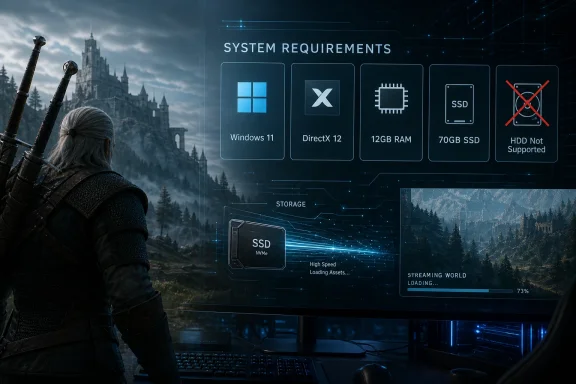
Witcher-like warrior stands in foggy ruins as a glowing DX12 tech UI overlays the scene.Geralt’s Return Comes With a Platform Cutoff​

The Witcher 3 has always belonged to the awkward middle of modern PC history. It launched in 2015 as a Windows 7 and Windows 8-era blockbuster, became a Windows 10 staple, and then received a next-gen update that pulled it toward ray tracing, upscalers, DirectX 12, and the expectations of newer GPUs. That made it both old and current, a game that could still function as a benchmark while also remaining a comfort-food RPG for machines that had long since aged out of the enthusiast conversation.
Songs of the Past changes that bargain. CD Projekt says the new minimum PC specification will require a Ryzen 5 2600 or Core i5-8400, a GeForce GTX 1660 or Radeon RX 5500 XT 8 GB, 6 GB of VRAM, 12 GB of system memory, 70 GB of SSD storage, and 64-bit Windows 11. The studio also says DirectX 11 support is being dropped in favor of DirectX 12 only.
On paper, this is not an extravagant 2026 gaming PC. A GTX 1660 is hardly exotic, and a Ryzen 5 2600 is a mainstream chip from a very different hardware cycle. But requirements are not just about performance; they are also about what a developer is willing to test, support, patch, and defend. That is why the Windows 11 line matters more than the GPU line.
The old Witcher 3 minimums belonged to a different world: Windows 7 or 8, 6 GB of RAM, a GTX 660 or Radeon HD 7870, and a 50 GB hard drive install. That spec tells a story about optical-disc-era assumptions, DirectX 11 ubiquity, and the idea that a big PC game should stretch backward as far as possible. The new spec tells a different story: a live product is no longer a museum piece just because its box art is old.

Windows 10’s End of Support Is Now a Game Requirement​

CD Projekt’s stated logic is straightforward. Windows 10 reached end of support on October 14, 2025, outside of paid or special extended-support arrangements, and the studio says it will no longer test its games on Windows 10 because the platform no longer has the same security-update, official-support, and driver-support footing it once had. That is a defensible engineering position, but it lands differently when applied to a game people already own.
This is the uncomfortable new reality for PC gaming after Windows 10. Microsoft’s operating-system lifecycle has moved from background IT trivia into the foreground of consumer software compatibility. Gamers who ignored Windows 11’s hardware requirements, TPM debates, interface changes, and upgrade nags could still reasonably assume their libraries would continue to run. CD Projekt is not saying otherwise for every existing install, but it is saying the supported path for The Witcher 3’s future now goes through Windows 11.
That distinction is the whole story. “Not supported” does not mean “the executable will instantly refuse to launch.” It means if something breaks, stutters, crashes, misrenders, or fails during installation, the user is outside the fence. For hobbyists, that may be tolerable. For ordinary players returning for a paid or major expansion, it is a very different proposition.
The move also exposes the split personality of Windows 10 in 2026. It is simultaneously obsolete by Microsoft’s mainstream lifecycle and still widely present in the real world. Steam’s hardware survey has shown the migration to Windows 11 progressing, but Windows 10 has not vanished from gaming desks, living-room rigs, and secondary PCs. Software vendors can see that installed base and still decide it is not worth anchoring future development to it.

DirectX 12 Becomes the Price of Staying Modern​

The DirectX 11 cutoff will sting a different group of users. DX11 has been the fallback path for years: less glamorous, less future-facing, but often more predictable on older hardware or under compatibility layers. The Witcher 3’s next-gen update already made DirectX 12 the path for the most advanced visuals, but preserving DX11 meant the game still had a technical escape hatch.
Dropping DX11 simplifies the development matrix. Every rendering feature, shader path, driver interaction, and troubleshooting report becomes easier to reason about when the studio is no longer maintaining parallel assumptions. That matters for a game being expanded more than a decade after launch, particularly if CD Projekt wants Songs of the Past to sit naturally beside the current version rather than feel like a grafted-on relic.
It also reflects where GPU vendors have been pushing the ecosystem. Upscaling technologies, modern frame pacing work, ray-tracing features, shader compilation behavior, and driver optimization efforts are concentrated around newer APIs and newer hardware. Supporting an older API does not merely preserve a button in a launcher; it preserves a second class of bugs.
Still, DX12’s history on PC is not a fairy tale. Many players associate it with shader stutter, inconsistent performance, and games that ask the user to pick between visual features and stability. CD Projekt’s challenge is therefore not just to mandate DX12, but to make the DX12 version feel like the obvious default rather than the price of admission.

The SSD Requirement Is the Least Surprising Line and the Most Symbolic​

Of all the changes, the death of hard-drive support is the least controversial from a technical standpoint. SSDs have been the baseline expectation for modern games for years, and current consoles made fast storage part of the development target rather than an enthusiast luxury. A sprawling open-world RPG that streams textures, geometry, audio, and quest data benefits enormously from storage that does not behave like a spinning archive.
But the symbolism is still powerful. The original Witcher 3 minimum spec lived in a world where “available space” was the storage requirement. The new one specifies the medium. That is the industry saying the bottleneck is no longer merely capacity; it is latency, throughput, and the predictability of data delivery.
For players on older PCs, the SSD requirement may actually be the easiest problem to solve. A SATA SSD can revive an aging machine more dramatically than many CPU upgrades, and the cost per gigabyte is no longer prohibitive for most gaming builds. If a user is still playing from a mechanical drive in 2026, The Witcher 3 is not the first game to complain, and it certainly will not be the last.
The harder part is the combined effect. Windows 11, DX12, SSD storage, newer CPU support, and a stronger GPU floor each sound modest in isolation. Together, they move The Witcher 3 out of the “runs on anything remotely decent” category and into the same maintenance stream as a contemporary PC release.

A Decade-Old Game Is Becoming a Live Platform​

The Witcher 3’s upgrade path now looks less like traditional preservation and more like platform stewardship. CD Projekt is not simply leaving a finished game alone; it is preparing that game to absorb a major expansion in 2027, to keep selling on modern storefronts, and to remain technically coherent across PC, PlayStation 5, and Xbox Series X|S. That requires choices old boxed games never had to make.
There is precedent inside CD Projekt’s own catalog. Cyberpunk 2077’s Phantom Liberty era brought raised PC requirements and a more aggressive focus on current hardware, because the studio was trying to move the game’s baseline closer to where its engine and content ambitions had gone. The Witcher 3 is older, but the logic is similar: when new content arrives, the minimum target stops being whatever the game tolerated at launch.
This is also how the PC market quietly sheds its past. Microsoft ends support, GPU vendors reduce attention on older driver branches, engines move forward, middleware changes, and storefronts normalize newer defaults. No one switch kills an old system. The cumulative effect is what kills it.
That can feel unfair because PC gaming has long sold itself on continuity. A console generation ends cleanly; PC libraries are supposed to follow the user from build to build. But continuity is not the same as indefinite support. The executable may persist, the old version may remain accessible, and the community may find workarounds, yet the official product keeps moving.

The Classic Branch Is a Lifeboat, Not a Time Machine​

CD Projekt’s support documentation points Steam and GOG users toward The Witcher 3: Wild Hunt Classic as an older build available through a beta option. That matters. It gives preservation-minded players, mod users, and older-system holdouts a way to avoid the newest requirement stack, at least for the base game experience.
But the Classic branch should not be mistaken for full continuity. CD Projekt has not made clear that Songs of the Past will support the older build, and it would be surprising if a 2027 expansion designed around the new baseline also targeted the old one. The point of raising requirements is to reduce the number of environments that must be carried forward.
There is also an uncomfortable storefront split. Steam and GOG have mechanisms for older builds, while Epic Games Store players may not have the same rollback option. That is not a small detail for a Windows audience. In the modern PC ecosystem, “owning the game” often means owning access to whatever version your storefront and publisher expose at a given moment.
This is where CD Projekt’s heritage cuts both ways. GOG built its brand on preservation, offline installers, and a more user-controlled relationship with old games. The Witcher 3’s future now has to balance that philosophy with the engineering reality of shipping new content into a moving Windows and GPU-driver landscape.

Windows Enthusiasts Will Recognize the Pattern​

For WindowsForum readers, the Witcher 3 news is not really about one RPG. It is about the moment when Windows 11 stops being an optional upgrade nag and becomes the practical baseline for new work. Microsoft can publish lifecycle notices, but consumers often internalize platform change only when a favorite application or game draws the line.
That line is especially sharp because many Windows 10 PCs are not “bad” computers. A system with a capable CPU, 16 GB of RAM, and a decent graphics card can still play a huge library well. Some machines are blocked from Windows 11 by official CPU lists or firmware requirements rather than obvious performance inadequacy. For those users, CD Projekt’s new requirement will feel less like progress and more like bureaucracy disguised as compatibility.
Developers see it differently. Supporting Windows 10 after its mainstream end of support means accepting a growing tail of edge cases: security assumptions that no longer hold for unpaid users, driver combinations that may receive less attention, and bugs that reproduce only on platforms the OS vendor itself wants retired. At scale, that tail costs money.
The gaming public tends to treat system requirements as a promise about frame rates. Studios treat them as a promise about accountability. CD Projekt is narrowing where it is willing to be accountable.

The Real Fight Is Over Who Owns the Baseline​

The controversy around these requirements will probably not be about whether a GTX 1660 is too demanding. It will be about who gets to redefine the baseline for a game sold in 2015. Players understandably think the baseline was set when they bought the product. Developers counter that the baseline for future updates is set by the future.
Both positions have merit. A player who purchased The Witcher 3 years ago should not lose access to the old experience because the studio wants to sell or ship a new expansion. At the same time, a studio producing new content in 2027 should not be forced to optimize, test, and support a modern expansion for Windows 7-era assumptions.
The ethical answer is version access. If the modern branch moves to Windows 11, the old branch should remain reachable, documented, and stable for users who want the game they already had. CD Projekt appears to be preserving that path for Steam and GOG users, but the Epic exception shows how fragile this model becomes when stores differ in build-management features.
The technical answer is transparency. Players can accept raised requirements when they understand what they gain and what they lose. If Songs of the Past meaningfully benefits from the new floor — better streaming, more stable rendering, cleaner patching, stronger mod boundaries, or fewer driver-specific compromises — CD Projekt should say so plainly as the expansion approaches.

The Witcher 3 Is Now a Test Case for Post-Windows-10 Gaming​

The timing matters. In May 2026, Windows 10 is no longer Microsoft’s mainstream consumer future, but it is still present enough to shape the PC gaming market. That creates a liminal period in which every major Windows-only requirement announcement becomes a referendum on how quickly publishers should move.
Some will move cautiously, especially for competitive games, MMOs, and free-to-play titles where the installed base is the business model. Others will move faster, particularly studios shipping premium single-player content with high production values and a desire to simplify testing. The Witcher 3 sits oddly between those categories: a beloved single-player game with a huge long-tail audience and new content on the way.
That makes CD Projekt’s choice more consequential than a requirement sheet for a brand-new 2027 release. Nobody expects a future AAA game to support Windows 7. Many users did expect The Witcher 3, specifically, to remain friendly to older rigs because it already had. The studio is effectively saying that the future version of The Witcher 3 is not the same compatibility promise as the launch version of The Witcher 3.
This is the model we should expect more often. Old games that become platforms will inherit modern platform requirements. Old games that remain frozen will remain easier to preserve. The moment a classic gets new official content, it re-enters the current support economy.

The Small Print Now Matters as Much as the Trailer​

The announcement of Songs of the Past should have been a nostalgia bomb. Geralt returning in a new expansion after Blood and Wine is the kind of news that sends players back through old saves, mod lists, and half-finished New Game Plus plans. Instead, the PC discussion immediately turned to operating systems, APIs, and SSDs.
That is not a failure of marketing. It is the modern PC condition. The platform is powerful because it is layered, configurable, and long-lived, but every one of those virtues becomes a support burden when a developer wants to ship something ambitious across a decade of hardware and software history.
The best outcome is boring: the new requirements prove conservative, the DX12 path is stable, the SSD requirement prevents avoidable streaming problems, and Windows 11 users get a cleaner experience while older-build access remains intact. The worst outcome is more familiar: players on the margins discover that “unsupported” means inconsistent behavior, old branches become confusing, and storefront differences decide who can preserve what.
For IT pros, the lesson is blunt. Consumer software is following the same lifecycle gravity that enterprise administrators already know. Once the OS vendor moves on, application vendors eventually stop pretending the old baseline is neutral.

The Upgrade Path Runs Through More Than One Component​

For anyone planning a 2027 return to The Witcher 3 on PC, the practical reading is less dramatic than the headlines and more serious than the nostalgia. The new requirements are not extreme by current gaming standards, but they do close the door on a meaningful slice of older Windows machines. That matters most for players who have treated The Witcher 3 as a reliable fallback game for aging desktops and laptops.
  • The next supported PC version of The Witcher 3 and Songs of the Past will require 64-bit Windows 11 rather than Windows 10 or earlier Windows releases.
  • CD Projekt is dropping DirectX 11 support and making DirectX 12 the only supported rendering path for the future version of the game.
  • SSD storage is becoming part of the minimum specification, which makes storage latency part of the official baseline rather than a quality-of-life upgrade.
  • The listed CPU and GPU requirements are modest for a 2026 gaming PC, but they exclude many machines that could run the original 2015 game acceptably.
  • Steam and GOG users should have access to a Classic branch for older builds, while support for the upcoming expansion on that branch remains uncertain.
  • The change is best understood as a support boundary, not necessarily an immediate technical lockout for every unsupported machine.
The smart move for players is to separate two questions that are often collapsed into one. Can an older PC still run some version of The Witcher 3? Very likely, especially through older builds. Will CD Projekt support that PC for the expansion era? Increasingly, no.
Geralt’s next contract is therefore also a preview of the Windows gaming market after Windows 10: not an instant cliff, but a steadily narrowing bridge. CD Projekt is betting that by 2027, enough of its active audience will be on Windows 11, SSDs, and DX12-capable hardware to justify leaving the old baseline behind. If that bet holds, Songs of the Past may be remembered as another late triumph for one of PC gaming’s great RPGs; if it wobbles, it will become an early warning that preservation and live development are now pulling classic games in opposite directions.

References​

  1. Primary source: PC Gamer
    Published: Wed, 27 May 2026 17:01:23 GMT
  2. Related coverage: nvidia.com
  3. Related coverage: support.cdprojektred.com
  4. Related coverage: tbreak.com
  5. Related coverage: witcher.fandom.com
  6. Related coverage: gamespot.com
 

CD Projekt Red says The Witcher 3: Wild Hunt will require Windows 11, DirectX 12, 12GB of RAM, and 70GB of SSD storage on PC when its new paid expansion, Songs of the Past, launches in 2027 for PC, PlayStation 5, and Xbox Series X|S. That is a remarkable line to draw under a game that began life in 2015 as a last-generation open-world RPG designed to run on mechanical drives and Windows 7-era assumptions. The company is not selling this as a visual reboot, which makes the move feel less like a graphics milestone and more like a platform cutover. For Windows users, the message is blunt: the future of even old games is increasingly being written around Windows 11 and solid-state storage.

A gamer stands by a monitor showing PC system requirements: Windows 11, DirectX 12, RAM, SSD, and HDD not supported.CD Projekt Turns a 2015 Classic Into a 2027 Compatibility Test​

The strange thing about this announcement is not that a new Witcher 3 expansion exists. CD Projekt has spent years proving that its biggest worlds can have long commercial tails, and Geralt remains one of the most bankable characters in modern RPGs. The strange thing is that Songs of the Past arrives with a PC requirements shift that feels more like a new game launch than a late-life add-on.
The headline requirements are not outrageous by contemporary gaming standards. A Ryzen 5 2600 or Core i5-8400, a GeForce GTX 1660 or Radeon RX 5500 XT-class card, and 12GB of RAM are not enthusiast hardware in 2026. Many midrange PCs have cleared that bar for years.
But requirements are not judged only by how expensive they look on a spreadsheet. They are judged by who they exclude. In this case, the exclusion zone is obvious: Windows 10 machines, older PCs that cannot officially move to Windows 11, and systems still relying on hard drives for large game libraries.
That matters because The Witcher 3 is not merely another item in a Steam backlog. It is one of the defining PC RPGs of the last decade, a game whose install base sprawls across old desktops, living-room PCs, laptops, and upgraded machines that may have gained a better GPU without ever replacing the motherboard. A late expansion to that kind of game inherits an older audience by design.
CD Projekt is therefore making a bet about the shape of its active audience. It appears to believe that the players who will buy a premium expansion in 2027 are already on SSDs, already on current-generation consoles, or already inside the Windows 11 tent. That may be commercially rational. It is still a meaningful break with the idea that a game’s original PC footprint should remain the baseline for its future content.

Windows 10’s Retirement Becomes a Gaming Cutoff​

The Windows 11 requirement is the more politically charged part of the change because it turns Microsoft’s lifecycle calendar into a game-access rule. Windows 10 reached the end of standard support on October 14, 2025, and CD Projekt is explicitly aligning its PC support posture with that reality. In security terms, that is not an unreasonable position.
Game studios do not want to certify new content against operating systems their platform vendor has already moved beyond. They also do not want to spend engineering time chasing driver, middleware, overlay, launcher, and anti-tamper bugs on a retired OS. The closer a release gets to 2027, the easier it becomes for publishers to argue that Windows 10 is no longer a viable baseline.
The problem is that Windows 10 retirement is not just a software update story. Windows 11’s official requirements have always carried a hardware implication: TPM support, Secure Boot, and CPU eligibility left some perfectly functional older machines outside Microsoft’s preferred upgrade path. For a desktop built around a pre-2018 platform, the practical route to Windows 11 may be a motherboard and processor replacement, not a Tuesday-night update.
That is why this requirement will sting differently from a GPU bump. A graphics card requirement says, “Your game may not run well.” An operating system requirement says, “Your platform is no longer welcome.” For users who bought The Witcher 3 years ago and kept a stable Windows 10 gaming PC around precisely because it still worked, the distinction is not academic.
There is also a trust dimension. PC gaming has traditionally sold itself on backward compatibility, ownership continuity, and the ability to carry a library across hardware generations. Every time a major game draws a hard OS line, that promise becomes more conditional. The library survives, but the supported version narrows.

The SSD Mandate Is the Real No-Exceptions Moment​

If Windows 11 is the political requirement, the SSD mandate is the architectural one. CD Projekt’s stated framing is asset streaming rather than visual fidelity. In plain English, the expansion is being designed around the assumption that the game can pull world data from storage quickly and predictably enough that a hard drive is no longer an acceptable minimum.
That is not a wild assumption in 2027. Modern consoles have normalized SSD-first design, and PC developers increasingly build around faster storage because it reduces the compromises that once shaped open-world streaming. Texture pop-in, traversal bottlenecks, disguised loading corridors, duplicated assets, and conservative world layouts all have roots in storage limits.
Still, The Witcher 3 is not a brand-new Unreal Engine 5 showcase being built from scratch for current hardware. It is an expansion to a 2015 RPG whose original world streamed from hard drives because it had to. Asking for an SSD without announcing a corresponding visual overhaul creates a messaging gap that CD Projekt will have to fill.
The charitable reading is that Songs of the Past may push the old engine in ways that are less visible in screenshots than they are in play. More dense environments, fewer loading seams, larger streaming cells, and more aggressive asset reuse can all demand faster storage without looking like a ray-tracing demo. The less charitable reading is that dropping HDD support simplifies testing and support more than it transforms the player experience.
Both can be true. Developers are allowed to simplify support matrices, especially for an expansion arriving twelve years after the base game. But players are also allowed to ask what they receive in exchange for the new floor. When a publisher says “SSD required,” many PC users now hear “current-gen design.” If the delivered expansion feels like a conventional quest pack, the requirement will be judged harshly.

The Modest GPU Bar Makes the Storage Decision Louder​

The GPU requirement is telling precisely because it is not extreme. A GTX 1660 or RX 5500 XT is not the sort of minimum that screams generational reset. It suggests CD Projekt is not trying to make The Witcher 3 into a path-traced spectacle that leaves older midrange PCs behind.
That makes the hard drive exclusion more prominent. If the graphics floor had jumped to an RTX-class card, the story would be simple: a major rendering upgrade needs modern hardware. Instead, the requirements imply that the company is less worried about shader throughput than about platform consistency.
That distinction matters to PC enthusiasts because it changes the upgrade logic. A player with an older but still decent GPU may be technically close to the new minimums while still blocked by Windows 10 or storage. Another player may have an SSD but a Windows 11-ineligible CPU platform. The expensive part of compliance may not be the part that improves frame rate.
It also raises an uncomfortable question about what minimum requirements are supposed to communicate. In the old model, they were a performance warning. In the new model, they are increasingly a support boundary. The hardware might be capable of limping through, but the developer is choosing not to validate it.
For administrators and technically minded users, that is a familiar pattern. Enterprise software vendors routinely narrow support to reduce unknowns, even when older configurations might function. PC gamers, however, have historically expected more flexibility. The Witcher 3 change is a reminder that big-budget games are adopting enterprise-style lifecycle discipline, one compatibility table at a time.

The Fallback Exists, But It Splits the PC Audience​

There is a safety valve for some players: previous game versions on Steam and GOG can typically be preserved through branch or rollback mechanisms. If CD Projekt keeps that path available, Windows 10 and HDD users may be able to continue playing the existing build indefinitely. That softens the blow, but it does not erase it.
A rollback is not the same as support. It is a museum door. You can keep the old version, but you are stepping out of the forward-moving branch of the game.
That distinction becomes more important if future patches, mod compatibility updates, bug fixes, or launcher-level changes follow the new requirements. The community may end up with two Witcher 3 realities: the living 2027 branch with Songs of the Past, and the preserved legacy branch for players who cannot or will not upgrade. For a single-player RPG, that split is manageable. For a mod-heavy classic, it can still be disruptive.
The platform split is sharper for players on storefronts without robust version rollback. Steam and GOG have long been friendlier to preservation-minded PC users because they provide more practical control over builds. If Epic Games Store users lack an equivalent rollback path for this case, the same purchase can become meaningfully different depending on where it was made.
That is one of the under-discussed consequences of modern PC gaming. We talk about “PC” as though it is one platform, but the real user experience is mediated by launchers, depots, branch policies, offline installers, cloud saves, and entitlement rules. A system requirement change is not just a hardware story. It is a storefront story.

Fool’s Theory Gives the Expansion Credibility, Not Immunity​

The involvement of Fool’s Theory is a smart move. The Polish studio has Witcher veterans in its orbit and is already working on the remake of the original Witcher. For CD Projekt, that makes it a natural partner for a project designed to return to Geralt without pulling the core studio fully away from newer priorities.
It also gives Songs of the Past a certain narrative credibility. This does not look like a random outsourcing arrangement bolted onto a beloved game for brand extraction. It looks like CD Projekt trying to use a trusted regional partner to extend the life of its most enduring RPG while the next mainline Witcher project moves elsewhere.
But credibility is not immunity. A third expansion for The Witcher 3 arrives under enormous expectations because Hearts of Stone and Blood and Wine were not throwaway DLCs. They helped define what premium RPG expansions could be: substantial, sharply written, and worth treating almost like standalone games.
That legacy cuts both ways. If Songs of the Past is rich enough, the new requirements may be seen as the cost of revisiting Geralt properly in 2027. If it feels slight, the requirements will look like an exclusionary footnote attached to nostalgia. CD Projekt does not merely have to justify the price; it has to justify the platform break.
The company has not yet disclosed pricing or full story details, and more information is expected later. That leaves room for the picture to improve. It also leaves room for suspicion, especially among players who have learned to read system requirements as part marketing, part engineering, and part support policy.

A Late Expansion Becomes a Windows 11 Adoption Signal​

For WindowsForum readers, the broader implication is more interesting than the fate of a single RPG. The Witcher 3 is the kind of legacy blockbuster that reveals where the PC market is actually moving because it straddles generations. It launched in an era when hard drives were normal, Windows 10 was new, and the PlayStation 4 and Xbox One defined console baselines. Its 2027 expansion belongs to a world of SSD consoles, Windows 11, and OS security requirements that publishers increasingly do not want to fight.
That makes CD Projekt’s decision a useful signal. If even a long-lived 2015 game can move its active branch to Windows 11 and SSD-only storage, then similar moves from other publishers will become easier to defend. The precedent will not be that every old game must do this. The precedent will be that major new content can reset the contract.
This is where Microsoft’s hardware policy and game publishers’ support economics start to reinforce each other. Microsoft ends mainstream support for Windows 10. GPU vendors tune drivers and tooling for newer stacks. Middleware vendors prioritize current platforms. Studios follow the support trail. Users experience the result as an upgrade requirement that appears to come from a game, even though it is really the endpoint of several industry decisions.
There is nothing conspiratorial about that. It is how platforms age. But for users, the practical effect is the same: a working PC becomes “legacy” not because it fails, but because the ecosystem stops wanting to test against it.
That is especially relevant for households and hobbyists who maintain older gaming rigs. A machine that remains excellent for esports, indie games, older AAA titles, media playback, and general use may be locked out of new content for reasons that have little to do with raw capability. The PC does not become useless. It becomes increasingly segmented.

The Old PC Gaming Bargain Is Being Rewritten​

The old bargain of PC gaming was messy but generous. You could often run a game below spec, hack a configuration file, tolerate stutter, reduce textures, or accept long loading times. The machine might complain, but it rarely refused on principle.
Modern platform requirements are less forgiving. DirectX versions, CPU instruction sets, storage expectations, driver models, kernel protections, anti-cheat systems, and OS support windows are harder gates than the old “turn the settings down” culture. They make development cleaner, but they make ownership feel less open-ended.
The SSD transition is a good example. For years, SSDs were a quality-of-life upgrade. They made Windows boot faster and games load more quickly, but most titles still tolerated hard drives. Then current-generation consoles made fast storage part of the design baseline, and the PC version of that shift has been uneven but unmistakable.
Windows 11 is following a similar path. At first, it was optional for many gamers. Then it became the default on new systems. Now it is becoming the supported minimum for some forward-looking releases and updates. The transition is gradual until, for a particular game or tool, it suddenly is not.
This is not necessarily bad for the medium. Developers can do more when they stop designing around the slowest widely installed hardware. Security improves when unsupported operating systems fade out of the active matrix. Support teams can spend less time triaging bugs caused by ancient drivers and unpredictable storage stalls. The industry does gain something.
But the cost is borne unevenly. Enthusiasts who upgrade often barely notice. Budget users, preservationists, students, rural players with older family PCs, and those who deliberately avoid Windows 11 notice immediately. A requirement that looks modest in a gaming hardware survey can still be a wall for the people on the wrong side of it.

CD Projekt Is Selling Confidence, But Also Forcing a Choice​

There is an unmistakable confidence in this move. CD Projekt is effectively saying that the audience for a 2027 Witcher 3 expansion is modern enough to absorb a stricter baseline. Given SSD adoption and the age of Windows 10, the company may be right.
The risk is that the affected users are not random edge cases. They are often the very players who kept old games alive, modded them, replayed them, recommended them, and bought complete editions years after launch. A late expansion trades heavily on that loyalty. Excluding part of that audience is commercially defensible, but emotionally awkward.
The no-exceptions posture also changes how the expansion will be discussed before anyone plays it. Instead of the first conversation being about Geralt’s return, the setting, or how the new story connects to the next Witcher era, a large slice of the PC audience is debating operating systems and storage. That is not ideal marketing for a fantasy RPG.
CD Projekt can reduce the backlash with clarity. It should explain whether the requirement applies to the base game after a future update or only to the new content branch. It should document rollback options by storefront. It should be explicit about whether existing owners can remain on older builds without forced disruption. Most of all, it should show what the SSD assumption enables in the expansion itself.
Players are more accepting of higher requirements when they can see the trade. They are less accepting when the requirement looks like a quiet support-policy cleanup wrapped around a paid product.

The Practical Advice Is Less Romantic Than the Return to Geralt​

For users planning ahead, the safest interpretation is simple: treat Songs of the Past as a current-generation PC release that happens to attach to an old game. If your machine cannot officially run Windows 11 and does not have an SSD large enough for the install, assume you are outside the supported path. Waiting for a last-minute exception is not a strategy.
The storage part is the easier fix for many desktops. SATA SSDs remain cheap, and even older systems can often gain a dramatic improvement from replacing a hard drive. If the rest of the machine is Windows 11-ready, the SSD mandate may be more annoying than devastating.
The OS part is harder. Users on unsupported CPUs face the familiar choice: stay on Windows 10 and legacy game branches, attempt unsupported Windows 11 installation paths, or rebuild around a supported platform. For a single expansion, that may be an unreasonable upgrade trigger. For users already seeing other software leave Windows 10 behind, The Witcher 3 may simply become one more item on a growing list.
There is also a preservation-minded path: freeze the current build where possible, back up saves, and avoid assuming that every storefront will treat version control equally. GOG’s offline-installer heritage and Steam’s branch system have practical value here. Launcher choice becomes part of a long-term ownership strategy.
This is where the PC’s flexibility still matters. The new requirements may close one door, but users are not powerless. They can choose when to upgrade, where to buy, which build to preserve, and whether a 2027 expansion is worth reorganizing a machine around.

Geralt’s Next Contract Comes With Fine Print​

The important details are concrete enough that players should not treat this as ordinary pre-release noise. CD Projekt’s requirements sketch a real boundary around the 2027 expansion, and that boundary runs through two of the biggest transition points in modern Windows gaming: operating system support and storage architecture.
  • Songs of the Past is being positioned as a new paid expansion for The Witcher 3 in 2027, not a simple compatibility patch.
  • Windows 11 is the new PC operating system floor, which leaves Windows 10 users outside the supported path after Microsoft’s standard support window has ended.
  • SSD storage is required, which makes hard drives unsuitable even if the rest of the PC meets the CPU, GPU, and memory targets.
  • The CPU and GPU requirements are moderate enough that the Windows 11 and SSD rules will be the real blockers for many older systems.
  • Steam and GOG rollback options may preserve access to older builds, but that is not the same as receiving the new expansion on legacy hardware.
  • CD Projekt still needs to show what the new storage and platform assumptions buy players inside the actual expansion.
The irony is that The Witcher 3 became a PC classic partly because it survived across so many hardware eras. It ran, evolved, received a next-gen update, and kept finding new players long after its original launch window closed. Songs of the Past now asks that same audience to accept a cleaner, narrower future. If CD Projekt delivers an expansion worthy of Geralt’s legacy, the new requirements may be remembered as a sensible modernization. If it does not, they will be remembered as the moment a beloved old game started behaving like a new platform gatekeeper.

References​

  1. Primary source: gagadget.com
    Published: 2026-05-27T16:20:10.250414
  2. Related coverage: gamespot.com
  3. Related coverage: gameinformer.com
  4. Related coverage: pushsquare.com
  5. Related coverage: gamesradar.com
  6. Related coverage: notebookcheck.com
 

CD Projekt Red announced on May 27, 2026, that The Witcher 3: Wild Hunt will get a new 2027 expansion, Songs of the Past, for PC, PlayStation 5, and Xbox Series X|S, while raising the PC floor to Windows 11, DirectX 12, and SSD storage. The fan backlash is predictable, but the Windows 10 cutoff is not just a CDPR choice. It is a signal that the post-Windows 10 gaming era is no longer theoretical. A beloved 2015 RPG has become the latest pressure point in Microsoft’s long, messy platform transition.

Geralt stands before a glowing tech portal linking Windows 11, DirectX 12, and SSD in a futuristic forest.Geralt Returns, But The Old PC Baseline Does Not​

There is something almost absurdly generous about a third story expansion for The Witcher 3 arriving in 2027. The base game launched in May 2015, Hearts of Stone followed later that year, and Blood and Wine arrived in 2016 as one of the rare expansions that felt like a full sequel in disguise. For CD Projekt Red to return to Geralt more than a decade later is, on its face, fan service of the highest order.
But the announcement landed with a second message attached: the version of the PC ecosystem that carried The Witcher 3 through its first decade is being left behind. The new minimum requirements move the game to Windows 11, require DirectX 12, and assume SSD storage. Older console platforms are also off the list, with PlayStation 4, Xbox One, and Nintendo Switch absent from the expansion’s target platforms.
That changes the emotional register of the announcement. For some players, Songs of the Past is a surprise victory lap for one of the most respected RPGs of the last generation. For others, it reads like a retroactive rewrite of what they thought they owned: a game that ran on Windows 10 yesterday may no longer be officially supported tomorrow.
CDPR’s clarification matters. The studio has said the change does not necessarily mean The Witcher 3 will refuse to launch on Windows 10. It means the developer will no longer test or support that configuration going forward. In consumer language, that distinction sounds slippery; in engineering language, it is the whole point.

Unsupported Is Not The Same As Broken, But It Is A Warning​

PC gamers tend to hear “minimum requirements” as a gate. Either the game runs or it does not. But support matrices are usually more bureaucratic than binary, especially for long-lived titles with multiple render paths, storefront versions, mods, and legacy save files.
When a developer says Windows 10 is no longer supported, it is not necessarily adding a hard operating-system check to the executable. It is saying QA time will not be spent reproducing bugs on that OS, driver regressions on that OS will not become launch blockers, and future patches will be judged against the supported environment. If Windows 10 users discover a crash, shader issue, input bug, or performance cliff, the answer may be sympathy rather than a fix.
That is cold comfort to players who have deliberately stayed on Windows 10. Many did so because Windows 11’s hardware requirements excluded otherwise capable PCs. Others stayed because they disliked Windows 11’s interface changes, telemetry posture, account prompts, Start menu design, or perceived performance overhead. For that audience, “unsupported” sounds less like a technical distinction and more like a corporate shrug.
Still, the practical meaning is narrower than the online argument suggests. Existing copies do not evaporate. CDPR says players will be able to revert to the current version if later updates cause problems on Windows 10. That rollback option is important, because it frames the move less as confiscation and more as a fork: the old game remains available, but the forward branch is being built for the current platform stack.

Windows 10’s End Of Support Is Now Everyone Else’s Excuse​

Microsoft ended mainstream Windows 10 support on October 14, 2025. That date has been on calendars for years, but its real consequences were always going to arrive unevenly. Operating systems do not die in a flash; they lose oxygen as vendors, drivers, storefronts, anti-cheat providers, engines, and studios stop treating them as part of the normal test surface.
That is what makes CDPR’s move notable. It is not just about The Witcher 3. It shows how Windows 10’s end of support becomes a permission structure for the rest of the industry. Once Microsoft stops providing free security updates and normal support for an OS, every software vendor has a ready-made explanation for dropping it too.
Nvidia’s support plan adds another layer. The company has said it will continue full Windows 10 Game Ready and Studio Driver support only through October 2026, then shift to quarterly security updates for several more years. That schedule does not mean Windows 10 gaming suddenly ends in 2026, but it does mean the platform becomes progressively less attractive for developers trying to ship and support new PC releases in 2027 and beyond.
The timing of Songs of the Past is therefore not incidental. A 2027 expansion would arrive after Microsoft’s Windows 10 end-of-support date and after Nvidia’s full driver cadence for Windows 10 has ended. CDPR can argue, plausibly, that supporting Windows 10 at that point means testing against an operating system and driver ecosystem that the wider industry has already moved into maintenance mode.

The SSD Requirement May Matter More Than The Windows 11 Logo​

Windows 11 will dominate the argument because operating systems carry identity politics in the PC world. But the SSD requirement may be the more revealing technical line. It says CDPR is no longer designing the updated game around the lowest common denominator of last-generation storage.
That matters because modern open-world games increasingly assume fast random access, aggressive streaming, and reduced tolerance for long asset-loading stalls. Even when an HDD can technically run a game, the cost shows up in traversal stutter, slow texture pop-in, longer loading screens, and more conservative world streaming. Developers can support mechanical drives, but doing so often means building around the slowest storage path.
For The Witcher 3, this is especially symbolic. The original game was a triumph of scale on 2015 hardware, and it shipped into an era when HDDs were still common in gaming PCs and consoles. The next-gen update already pulled the game toward modern rendering expectations with ray tracing options and DirectX 12 support, even if that update also exposed the complexity of dragging an old engine into a newer rendering world.
By making SSD storage a minimum, CDPR is saying the 2027 branch of The Witcher 3 belongs to the PS5, Xbox Series X|S, and contemporary PC design assumptions. It is not merely a DLC pack taped onto a museum piece. It is an attempt to keep an old game alive by letting go of some of the hardware that made its original reach possible.

The DirectX 12 Shift Reopens An Old Wound​

The move to DirectX 12 is the other part of the announcement that deserves scrutiny. DirectX 12 is not new, and Windows 10 itself supports it. But for The Witcher 3, DX12 has been a fraught subject because the game’s next-gen update introduced modern rendering features through a path that has not always pleased performance-sensitive players.
The DX11 version of The Witcher 3 has long been prized for its relative smoothness and broad compatibility. The DX12 path enabled newer effects and features, but it also became associated with higher CPU overhead, stutter complaints, and uneven performance depending on hardware and settings. That history makes any DX12-only framing feel less like inevitable modernization and more like a risky bet on a renderer that has not earned universal trust.
There is a broader industry pattern here. DirectX 12 gives developers more explicit control over GPU work, but that control comes with complexity. Games that use it well can scale beautifully; games that use it awkwardly can leave players wondering why a nominally newer API performs worse than the old one.
CDPR will need to show, not merely assert, that the 2027 update is technically mature. If Songs of the Past arrives with improved asset streaming, stable frame pacing, and sensible shader handling, the new baseline will look justified. If it ships with the same old DX12 rough edges, the Windows 11 requirement will become an easy villain for frustrations that actually belong to the rendering stack.

The Backlash Is About Trust, Not Just Compatibility​

The angry posts practically write themselves. Players who bought The Witcher 3 during the Windows 10 era feel that a game they already own is being reclassified around an operating system they did not ask for. The fact that the new content is arriving unusually late only sharpens the resentment.
That reaction is not irrational. PC gaming has always been built on the promise of flexibility. A console generation ends because the box stops receiving games; a PC, in theory, evolves piece by piece. When a software requirement cuts across that model, especially with an operating system as contested as Windows 11, it feels like the console logic has invaded the desktop.
But the other side of the argument is not trivial either. Supporting old platforms is not free. Every additional OS, GPU driver branch, storage class, and API path expands the matrix of things that can fail. For a studio returning to an 11-year-old game while also working on future Witcher and Cyberpunk projects, narrowing that matrix may be the difference between shipping a polished expansion and spending months chasing bugs on configurations the platform owner itself has stopped prioritizing.
The harder truth is that compatibility is a product decision disguised as a technical one. CDPR is choosing which players it can afford to disappoint. Windows 10 loyalists are loud, numerous, and often technically savvy. But by 2027, the studio appears to believe they are not the baseline around which a new premium expansion should be built.

Microsoft Wins Even When It Is Not In The Room​

One reason this story has detonated so quickly is that Windows 11 is not just another requirement. It is the operating system many users feel Microsoft has been trying too hard to force on them. TPM requirements, CPU eligibility lists, Microsoft account pressure, Copilot integration, advertising-like prompts, and UI changes have made Windows 11 a proxy fight over who controls the PC.
That is why a game requirement can become a culture war. CDPR can say, accurately, that it is responding to security updates, platform support, and driver maintenance. Players can still hear, emotionally, that Microsoft’s upgrade campaign has found another messenger.
Microsoft benefits from that dynamic without needing to cut a check or twist an arm. Once major games, tools, and drivers normalize Windows 11 as the supported baseline, the upgrade pressure becomes decentralized. The nudge no longer comes only from Windows Update. It comes from Steam pages, launcher warnings, system requirements, anti-cheat notices, GPU driver notes, and support tickets.
That is the quiet power of ecosystem control. Microsoft does not need every user to love Windows 11. It needs the cost of staying behind to rise slowly enough that the decision feels inevitable. The Witcher 3 joining that procession is symbolically potent because it is not a disposable live-service title; it is a beloved single-player RPG that many players expected to remain comfortably anchored in the Windows 10 era.

The Preservation Problem Is Getting Harder To Ignore​

There is also a preservation angle that the industry still handles poorly. When a single-player game receives major updates years after release, the line between preservation and replacement becomes blurry. The version people remember can be overwritten by the version the storefront now serves.
CDPR’s rollback promise is therefore more than a customer-service gesture. It is a recognition that a legacy branch has value. If the current version remains accessible for players on Windows 10 or older hardware, the studio avoids the worst version of this story: a future update that turns a working library item into an unsupported experiment.
PC gaming has always relied on a messy combination of official support, community fixes, mods, archived installers, and sheer stubbornness. That culture is one of its strengths. But it also means companies can underestimate how personally players take changes to old games. A console player expects the platform holder to define the lifecycle. A PC player expects to negotiate with time.
The danger for CDPR is not that every Windows 10 user will be unable to play. The danger is that the company’s stewardship of The Witcher 3 becomes entangled with a larger anxiety: that even single-player games are becoming moving targets, subject to platform policy shifts long after purchase. The rollback path helps, but it will need to be clear, durable, and easy to find.

Enterprise IT Will Recognize The Pattern Immediately​

For sysadmins, none of this is surprising. The phrase “unsupported but may still work” is the wallpaper of enterprise life. Old operating systems, legacy applications, and specialized hardware often limp along for years after official support ends, but every month adds risk and reduces the number of vendors willing to help.
The consumer gaming version is messier because the emotional contract is different. A corporate IT department can assign risk, budget migrations, and isolate legacy systems. A player with an older but functional PC sees a favorite game moving beyond reach and reasonably asks why a story expansion needs an operating-system migration.
Still, the underlying logic is familiar. Unsupported platforms become exceptions. Exceptions require documentation, testing, escalation paths, and often bespoke troubleshooting. Eventually, someone decides the exception is too expensive to keep.
That is the story Windows 10 users are now living through in miniature. The OS will continue to boot. Many games will continue to run. Security updates may be available through extended programs for some users and organizations. But the center of gravity has moved, and each new support matrix will make that clearer.

This Is The 2027 PC Gaming Baseline Taking Shape​

The most important part of the Songs of the Past announcement may be what it implies about the next wave of PC releases. Windows 11, SSD storage, DirectX 12, and current-generation consoles are no longer premium targets. They are becoming the default assumption for developers shipping new content in 2027.
That shift has been slower than many expected. Cross-generation development lasted deep into the PS5 and Xbox Series X|S cycle, partly because the install base for older consoles was enormous and partly because PC developers still had to account for wildly varied hardware. But the long tail is finally being cut.
The irony is that The Witcher 3 is an old game helping draw a new line. That makes the change feel harsher, because nobody expects a 2015 title to be the thing that tells a 2018-era PC it is aging out. Yet that is exactly why the story matters. If even a legacy RPG expansion is now targeting Windows 11 and SSDs, the industry’s patience for older baselines is clearly thinning.
This does not mean every PC gamer needs to upgrade today. It does mean the grace period is ending. By the time Songs of the Past launches, Windows 10 will not merely be old; it will be outside the normal support assumptions of Microsoft, major hardware vendors, and an increasing number of game developers.

The Real Test Is Whether CDPR Makes The Trade Worth It​

There is a fair version of CDPR’s argument: a late-life expansion deserves a modern foundation if that foundation produces better results. Faster storage can support denser environments and smoother streaming. A narrower OS and driver matrix can reduce bugs. A current-generation-only target can free designers from last-gen constraints.
But there is also a fair version of the player complaint: if the visible result is just a Windows 11 label, a DX12 mandate, and no dramatic improvement in experience, the trade will feel punitive. Players are more willing to accept raised requirements when they can see the benefit. They are less forgiving when the benefit is mostly internal to development workflow.
That puts pressure on the eventual reveal. CDPR cannot rely on nostalgia alone. It will need to show why Songs of the Past needs this new baseline, whether through scale, fidelity, world complexity, animation, loading behavior, or simply an unusually polished technical release.
The studio has earned goodwill through The Witcher 3, spent some of it during the troubled launch of Cyberpunk 2077, and rebuilt much of it through years of fixes and Phantom Liberty. This expansion arrives inside that complicated trust ledger. Fans will forgive modernization if it feels like craft. They will resent it if it feels like housekeeping.

The Old Continent Now Has A New System Requirement​

The practical advice is less dramatic than the discourse. Windows 10 players do not need to panic about their existing installation today, but they should understand what the support change means before the 2027 update lands. The safest path for anyone who wants the new expansion will be a Windows 11-capable PC with an SSD and hardware suited to the updated requirements.
The concrete picture is now fairly clear:
  • Songs of the Past is planned for 2027 on PC, PlayStation 5, and Xbox Series X|S, with older console platforms left behind.
  • CD Projekt Red is moving the supported PC baseline for The Witcher 3 to Windows 11, DirectX 12, and SSD storage.
  • Windows 10 may still run the game in practice, but CDPR is saying it will not test or guarantee that configuration.
  • Microsoft ended standard Windows 10 support on October 14, 2025, making vendor support drop-offs increasingly likely.
  • Nvidia’s full Windows 10 Game Ready and Studio Driver support runs only through October 2026 before shifting to a more limited security-update cadence.
  • CDPR’s rollback option will be important for players who want to preserve the current Windows 10-friendly branch.
That is the shape of the compromise. The old version remains a refuge. The new version moves on.
The larger lesson is that Windows 10’s end was never going to be defined by a single Microsoft deadline; it was always going to arrive through accumulated decisions like this one, where a developer, a driver vendor, or a storefront quietly narrows the future. The Witcher 3: Songs of the Past may be sold as a return to Geralt’s world, but on PC it is also a marker on the road away from the Windows 10 decade. By 2027, the question for many players will no longer be whether Windows 11 is better. It will be whether staying behind is still worth the increasing number of doors that no longer open.

References​

  1. Primary source: GameSpot
    Published: Wed, 27 May 2026 19:37:11 GMT
  2. Related coverage: pcgamesn.com
  3. Related coverage: tweakers.net
  4. Related coverage: cdprojekt.com
  5. Related coverage: techspot.com
  6. Related coverage: gagadget.com
 

CD Projekt Red announced on May 27, 2026, that The Witcher 3: Wild Hunt will receive a third expansion, Songs of the Past, in 2027 for PC, PlayStation 5, and Xbox Series X|S, while raising the PC floor to Windows 11, DirectX 12, SSD storage, and 12GB of RAM. The surprise is not simply that Geralt is being dragged back out of retirement more than a decade after launch. It is that one of PC gaming’s great long-tail success stories is now drawing a hard technical line through its own audience. For Windows users, the expansion is less a nostalgia play than a very modern compatibility notice.

Cyberpunk fantasy “The Witcher 3” poster with swordsman and cat-like figure over a glitchy city grid.Geralt Returns, But Not to the Same PC Landscape​

The Witcher 3 launched in 2015 into a PC world where Windows 7 still mattered, hard drives were ordinary, and 6GB of system RAM could pass as a minimum spec without raising eyebrows. By 2027, that world will be a museum exhibit. CD Projekt Red’s new floor — Windows 11 64-bit, DirectX 12, 12GB of RAM, 70GB of SSD storage, and GPUs in the GeForce GTX 1660 or Radeon RX 5500 XT class — is not outrageous by modern standards, but it is a declaration that the old version of “runs on my PC” is over.
That distinction matters because The Witcher 3 is not a new game asking new-game things of new hardware. It is a beloved, heavily modded, frequently replayed RPG whose reputation was built partly on endurance. Players who bought it years ago and treated it as a permanent fixture in their library are now being told that the living version of the game is moving on.
CD Projekt Red is giving itself a defensible argument. The expansion is coming to PC, PlayStation 5, and Xbox Series X|S, not last-generation consoles, and the company is co-developing it with Fool’s Theory, a studio with Witcher veterans in its ranks. A 2027 expansion built around current consoles and modern PC APIs was never likely to treat old storage and old operating systems as first-class targets.
Still, there is an emotional asymmetry here. A studio sees a platform baseline. A player sees a game they already own.

Windows 11 Becomes the Real Minimum Spec​

The headline requirement is not the GTX 1660. It is Windows 11. GPUs age visibly, storage fills up, and RAM shortages show themselves in stutter and hitching. Operating system requirements feel more political because they sit at the intersection of security, user preference, hardware eligibility, and Microsoft’s own upgrade pressure.
Windows 10 reached the end of mainstream support on October 14, 2025. For software vendors, that date changed the risk calculation. Supporting Windows 10 after that point means testing against an operating system that no longer receives free security fixes from Microsoft, even if some users and businesses continue through paid or extended arrangements.
CD Projekt Red’s position is therefore predictable: Windows 11 is the supported baseline, Windows 10 is at best a place where things might still work. That is a familiar phrase in PC gaming, and it is often more meaningful than it sounds. “May work” means “do not build a support ticket around it.”
The practical result is that The Witcher 3 joins a growing category of older software whose active branch becomes more demanding than its original release. This is not unique to games. Browsers, creative suites, security tools, and enterprise agents all eventually stop pretending that old operating systems are harmless. The difference is that games are personal archives as much as they are software products.

The SSD Requirement Is the Quiet Platform Shift​

The death of HDD support may be the least surprising change, but it is one of the most consequential. Open-world games increasingly assume that asset streaming can happen quickly and predictably. A mechanical hard drive can still store a huge library, but it is no longer a neutral performance variable when a developer is building for current consoles and modern PC expectations.
The Witcher 3 has already lived through one major technological renovation with its next-gen update, which added ray tracing options and other visual improvements. Songs of the Past appears to be another step toward treating the game not as a preserved 2015 artifact, but as an active platform. Once a developer does that, old bottlenecks become expensive.
The 70GB SSD requirement is modest compared with some contemporary blockbusters, but the phrasing matters. This is not “SSD recommended.” It is the minimum. That tells PC users that loading behavior, streaming assumptions, and patch architecture are being designed around solid-state storage.
For sysadmins and technically minded players, this is the same lesson enterprise software has been teaching for years: storage type is now a compatibility feature. Capacity alone is not enough. The medium matters.

The Hardware Floor Is Modern, Not Extreme​

The move to 12GB of RAM and 6GB-class VRAM GPUs sounds dramatic only if measured against The Witcher 3’s original footprint. Measured against 2026 PC gaming, it is relatively restrained. A GTX 1660 or RX 5500 XT is not luxury hardware; it is a practical dividing line between older DirectX 11-era expectations and a baseline that can plausibly survive another few years.
The CPU examples being circulated — Ryzen 5 2600 and Core i5-8400 class hardware — point in the same direction. CD Projekt Red is not demanding the latest enthusiast rig. It is asking for a midrange system from the late 2010s or better, with enough memory and storage performance to avoid designing around the slowest surviving machines.
That will not comfort everyone. The systems most likely to be caught out are not high-end gaming PCs, but secondary machines, budget builds, living-room PCs, handheld-adjacent setups, and older laptops that survived because The Witcher 3 was historically scalable. The old game rewarded compromise. The new expansion may not.
This is the awkward truth of long-lived PC games: longevity can create expectations that no new development effort can fully honor. If a studio keeps shipping meaningful updates, it eventually has to choose between backward compatibility and forward capability.

The Rollback Option Is a Safety Valve, Not a Strategy​

CD Projekt Red’s reported assurance that players can roll back patches is important, but it should not be mistaken for full continuity. A rollback preserves access to an older branch. It does not make the new expansion compatible with old assumptions.
For preservation-minded players, that distinction is everything. The pre-Songs version of The Witcher 3 can remain playable, modded, and archived. But the active commercial and technical future of the game will live elsewhere. In PC terms, the fork has begun.
This approach is better than the worst alternative. Players are not simply losing access to the version they know. They are being offered a path to stay on older builds if their machines or mod setups require it. That is a meaningful concession in an era when many games are effectively service endpoints disguised as local installs.
But it also creates a split community. Mod authors, performance guides, troubleshooting posts, and forum advice will need to specify which branch they mean. “The Witcher 3” will no longer be a single technical object.

Modders Are About to Re-Litigate the Next-Gen Update​

The Witcher 3 modding scene has already been through a painful modernization cycle. The next-gen update improved the official game but complicated compatibility for many mods, scripts, lighting packages, UI changes, and quality-of-life tweaks. Songs of the Past is likely to reopen that wound.
A new expansion with raised requirements implies new executable behavior, new content hooks, and possibly new assumptions about rendering and asset structure. Even if CD Projekt Red tries to minimize disruption, mod ecosystems are brittle because they depend on unofficial knowledge. A small technical change can break a beloved load order.
For players who treat The Witcher 3 as a curated personal build rather than a vanilla RPG, the safest move will be boring: back up saves, document mod lists, disable automatic updates where possible, and wait for the community to test the new branch. The first week of a major update is rarely the best moment to discover that a 200-hour save depends on a script merger setup nobody remembers.
This is where the Windows angle becomes especially relevant. Modding tools, launchers, script utilities, and older dependencies may have their own compatibility quirks on Windows 11. The game may be the headline, but the surrounding toolchain is what keeps many PC installs alive.

CD Projekt Red Is Also Rehearsing for The Witcher 4​

Songs of the Past is arriving before the next mainline Witcher game, and that timing is difficult to ignore. CD Projekt Red has already moved its future development to modern pipelines and expectations. A new expansion for The Witcher 3 can serve as fan service, revenue, technical rehearsal, and brand bridge all at once.
That does not mean Songs of the Past is merely a marketing appetizer. Blood and Wine was substantial enough to stand as one of the most respected expansions ever released. CD Projekt Red knows that returning to Geralt carries reputational risk. A thin nostalgia product would be punished precisely because The Witcher 3 is so revered.
But the platform choices tell us something about the company’s priorities. CD Projekt Red is not trying to make a last hurrah for every machine that ever ran Wild Hunt. It is trying to bring a 2015 classic into a 2027 production environment without dragging the oldest supported PCs behind it.
For WindowsForum readers, this is the part worth watching. Gaming requirements often foreshadow mainstream desktop expectations. When major consumer software stops treating Windows 10 and HDDs as viable baselines, the cultural migration to Windows 11 is no longer just Microsoft’s campaign.

Windows 10 Holdouts Are Losing the Third-Party Argument​

For years, the best argument for staying on Windows 10 was simple: everything still worked. Windows 11 had hardware requirements some users disliked, UI changes many users resented, and few must-have features for traditional desktop computing. If your games, tools, and drivers worked on Windows 10, inertia was rational.
That argument has weakened since support ended. Security was the first pressure point, but security alone rarely moves enthusiasts who understand the risks and believe they can manage them. Third-party support is the second pressure point, and it is harder to route around.
When a major game publisher says Windows 11 is the minimum for a new branch of a beloved title, it gives Microsoft a win without Microsoft needing to say anything. The ecosystem does the pushing. Users who rejected the Windows 11 upgrade prompt may still upgrade for Geralt.
There is an irony here. The Witcher 3 was not built to sell operating systems. Yet in 2027, it may do more to move some gaming PCs off Windows 10 than another round of Microsoft nag screens ever could.

The Security Case Is Stronger Than the Marketing Case​

It is easy to frame every Windows 11 requirement as platform coercion, and sometimes that cynicism is earned. But in this case, the security argument is not imaginary. A developer shipping and supporting new PC code in 2027 has to think about drivers, overlays, anti-tamper systems, crash reporting, platform APIs, and customer support exposure.
Windows 10 machines will not suddenly stop functioning. Many will remain useful for years in controlled or offline roles. But a gaming PC is rarely a static appliance. It downloads launchers, updates drivers, runs overlays, talks to storefronts, syncs saves, installs mods, and executes third-party tools from all over the web.
That makes the unsupported OS question more than a checkbox. If CD Projekt Red officially supports Windows 10, it implicitly invites troubleshooting on a platform whose security and driver future is receding. If it does not, the support boundary is cleaner.
This is the part users may dislike but administrators will recognize. Support matrices are not moral judgments. They are risk containment documents.

PC Gaming’s Backward Compatibility Myth Meets Its Limits​

PC gaming sells itself on continuity. Your Steam library follows you. Old games can be patched, modded, emulated, wrapped, and resurrected. Compared with console generations, the PC looks like a place where software outlives hardware cycles.
That promise is real, but it is not absolute. Backward compatibility works best when software is finished. The moment an old game becomes a live development target again, it re-enters the world of tradeoffs. Every new feature has a testing cost, and every old platform expands the matrix.
The Witcher 3 is now caught between two identities. It is a classic RPG that players expect to preserve, and it is a commercial product being extended into the current generation. CD Projekt Red can honor both only by separating branches and being clear about expectations.
That clarity will matter. If the company communicates early, documents rollback paths, and gives modders time to prepare, the raised requirements will be controversial but manageable. If the transition is messy, the Windows 11 requirement will become the symbol for every broken mod, failed launch, and lost save, whether or not it caused them.

The Real Upgrade Is Trust​

CD Projekt Red has spent years rebuilding trust after Cyberpunk 2077’s launch. The company’s later work, including major updates and the Phantom Liberty era, helped repair that reputation. A return to The Witcher 3 gives the studio a friendlier stage, but also less room for excuses.
Players know this game. They know how it should feel. They know its quirks, its pacing, its combat debates, its atmosphere, and its technical history. Any expansion will be judged not only as new content but as an intervention into something already treasured.
That raises the bar for the system requirement change. If Songs of the Past feels substantial, polished, and technically justified, the new baseline will look like the cost of doing serious work on an old masterpiece. If it feels slight or unstable, the requirements will look like needless exclusion.
The issue is not whether 12GB of RAM is unreasonable in 2027. It is whether players believe the trade bought them something worth having.

The Upgrade Path Runs Through Velen, Not Redmond​

There are a few concrete conclusions Windows gamers can draw now, even before CD Projekt Red releases deeper technical details later in 2026. The requirements are not panic-inducing, but they are specific enough to start planning around.
  • Players who want Songs of the Past on PC should assume Windows 11 64-bit, DirectX 12, SSD storage, 12GB of RAM, and a 6GB-class GPU are the practical entry point.
  • Windows 10 may remain capable of launching older branches of The Witcher 3, but it should not be treated as a supported platform for the expansion.
  • Anyone with a heavily modded install should preserve a working copy before the expansion-era patch cycle begins.
  • The SSD requirement is likely to matter as much as the GPU requirement for smooth traversal and loading behavior.
  • Older PCs that once ran The Witcher 3 well may still be excellent retro or backlog machines, but they may no longer qualify for the game’s active future.
  • The console target is now clearly current generation, which makes the PC baseline easier to understand even if it is frustrating for holdouts.
The lesson is not that CD Projekt Red has betrayed PC gaming’s past. It is that PC gaming’s past is finally being asked to stop defining its future.
The Witcher 3 endured because it felt larger than its release window, and Songs of the Past will test whether that endurance can survive a platform reset. For Windows users, the expansion is a preview of the next phase of PC compatibility: less patience for unsupported operating systems, less tolerance for mechanical storage, and more old favorites returning with new demands. Geralt may be riding back into familiar country, but the road beneath Roach has been rebuilt.

References​

  1. Primary source: TweakTown
    Published: Wed, 27 May 2026 20:39:05 GMT
  2. Related coverage: techspot.com
  3. Related coverage: gamespot.com
  4. Related coverage: windowsforum.com
  5. Related coverage: pcmrace.com
  6. Related coverage: witcher.fandom.com
 

CD Projekt Red’s newly announced The Witcher 3: Wild Hunt expansion, Songs of the Past, is scheduled for 2027 on PC, PlayStation 5, and Xbox Series X|S, and its updated PC requirements make Windows 11 the supported baseline rather than Windows 10. That does not mean every Windows 10 install will instantly refuse to launch Geralt’s next adventure. It does mean one of PC gaming’s most beloved long-tail titles is now being pulled into the same operating-system migration fight that has already consumed offices, schools, and home desktops. The real story is not a single DLC requirement; it is the moment when Windows 10 stops being merely “old” and starts becoming commercially inconvenient.

Geralt with swords faces rival portals showing Windows 11 supported vs Windows 10 untested.CD Projekt Red Turns a Game Expansion Into an Operating-System Deadline​

There is a certain absurd poetry in The Witcher 3 becoming a Windows 11 story in 2026. This is a game born in the Windows 7 and Windows 8.1 era, sharpened during Windows 10’s reign, upgraded for ray tracing and current consoles, and now being used as evidence that the PC ecosystem has moved on whether users like it or not.
Songs of the Past is not a routine cosmetics pack. CD Projekt Red is positioning it as a proper story expansion, arriving more than a decade after Hearts of Stone and Blood and Wine helped define the modern prestige RPG add-on. That history matters because The Witcher 3 has never behaved like disposable software. It has been patched, remastered, modded, rebought, and replayed across hardware generations.
The updated requirements therefore land differently than they would for a brand-new release. Nobody is shocked when a 2027 game asks for a modern OS, DirectX 12, an SSD, and a current console baseline. But when an 11-year-old game’s next chapter tells Windows 10 users they are no longer inside the tested circle, it feels less like progress and more like eviction.
CD Projekt Red has tried to soften that line. The studio’s clarification is important: the game may still run on Windows 10, but the company will not test the new expansion or future updates against that platform and will not guarantee stable behavior. In practical PC terms, that is the difference between a locked door and a bridge with no inspection certificate.

Windows 10 Is No Longer the Safe Default​

For years, Windows 10 occupied a privileged place in PC gaming. It was the boringly sensible choice: widely supported, familiar, less demanding than Windows 11 in hardware policy, and free of some of the interface and telemetry grievances that made Microsoft’s newer OS a culture-war object among power users.
That era is over, at least from the perspective of software vendors making forward-looking support decisions. Microsoft ended mainstream Windows 10 support on October 14, 2025, and while extended security options exist in limited forms, the mass-market signal is unmistakable. Windows 10 is no longer the default supported consumer Windows platform. Windows 11 is.
Game developers do not need to hate Windows 10 to abandon it. They only need to calculate that the cost of testing, certifying, debugging, and supporting an old OS is no longer worth the market goodwill gained by keeping it on the requirements sheet. That calculation becomes easier once Microsoft itself has shifted the burden to users and organizations that choose to remain behind.
This is why CD Projekt Red’s move should be read less as a shocking anti-Windows 10 decree and more as an early visible example of a post-support market norm. When the operating-system vendor stops treating a platform as current, every other vendor gets permission to reduce its own promises. The first few high-profile cases sting; after that, the pattern becomes background noise.

“Unsupported” Is the Word That Does the Damage​

PC gamers are trained to think in binaries: supported or unsupported, compatible or incompatible, launches or crashes. Real-world software support is messier. CD Projekt Red’s stated position leaves Windows 10 users in a gray zone where the game might run, might run well, and might continue running for years — until a patch, driver, shader compiler change, launcher update, anti-cheat dependency, or graphics feature breaks something nobody is assigned to fix.
That is what unsupported really means. It is not a prediction of immediate failure. It is a withdrawal of obligation.
For enthusiasts, this ambiguity can sound acceptable. PC gaming has always involved unsupported combinations: old CPUs, hacked drivers, Proton layers, community patches, mod loaders, registry tweaks, and “it works on my machine” forum posts. Many Windows 10 users will reasonably decide that they can tolerate some risk, especially if their existing hardware is stable and Windows 11 offers them little obvious benefit.
But for developers and support teams, ambiguity is expensive. Every extra OS matrix multiplies QA time. Every rare crash report from an untested platform becomes harder to triage. Every “but the base game works” complaint becomes a customer-service sinkhole. At some point, the studio’s support page becomes a boundary marker: if you stand outside it, you are on your own.
That boundary is what changed here.

The Windows 11 Requirement Is Also a Hardware Requirement in Disguise​

The backlash is not only about taste. Many Windows 10 holdouts are there because Windows 11’s official requirements locked out otherwise usable machines. TPM 2.0, Secure Boot expectations, CPU generation cutoffs, and Microsoft’s broader security model turned an OS upgrade into a hardware sorting mechanism.
That is why a Windows 11-only requirement can feel punitive even when the game itself is not necessarily demanding some magical Windows 11 feature. For a subset of users, upgrading the OS is not a one-hour task. It means replacing a motherboard, CPU, or entire PC. For others, it means moving from a known-good performance configuration into an environment they distrust.
The updated Witcher 3 requirements reportedly go beyond the OS line as well, moving the baseline toward DirectX 12 and SSD storage. That matters because the Windows 11 controversy can obscure the more ordinary technical reality: a 2027 expansion built for PS5, Xbox Series X|S, and modern PCs is not being tuned for the assumptions of 2015.
Hard drives are the clearest example. The industry has spent years treating SSDs as the practical minimum for modern open-world streaming, not because developers are lazy, but because the performance envelope changed after current-generation consoles standardized fast storage. A studio building new content today is not optimizing for the same asset pipeline that shipped alongside the PlayStation 4 and Xbox One.
The Windows 11 line is the headline. The underlying message is broader: CD Projekt Red is rebuilding the floor beneath The Witcher 3, and that floor now looks like the current console generation.

Old Consoles Were Cut for the Same Reason, With Less Outrage​

The absence of PlayStation 4, Xbox One, and Nintendo Switch versions tells the same story with fewer emotional complications. Nobody seriously expects a 2027 expansion for an already upgraded open-world RPG to keep targeting every legacy console SKU. The old machines had their decade. Their limitations are understood.
PC is different because it sells itself as continuous. A Windows desktop is not supposed to have console generations, at least not culturally. Users swap GPUs, add RAM, clone drives, install drivers, and expect the platform to stretch. That expectation is one of PC gaming’s great strengths, but it also creates resentment when software vendors impose generational lines anyway.
In this case, the PC line and console line rhyme. PS4, Xbox One, Switch, HDD-first assumptions, Windows 10, and older driver stacks all belong to the same design past. They are not identical, but they represent the same support burden: platforms that can still run plenty of games, but no longer define the target for new high-profile content.
The emotional difference is ownership. Console players know when a generation ends because the box under the TV stops receiving major releases. PC users often discover it one requirement table at a time.

Nvidia’s Driver Clock Makes the Argument Easier​

CD Projekt Red’s explanation also leans on the GPU ecosystem, and that is where the Windows 10 story becomes more than a Microsoft policy dispute. Nvidia has said it will continue full Windows 10 Game Ready and Studio driver support only through October 2026, then transition to quarterly security updates for several more years. That distinction is crucial for games.
Security updates are not the same as day-one optimizations, performance fixes, game-specific profiles, or rapid bug response. A new RPG expansion launching in 2027 wants to arrive in a world where GPU vendors are actively tuning for its behavior on supported platforms. If Windows 10 is already moving into a reduced driver-support lane, developers have less incentive to promise parity.
AMD and Intel have their own support policies and hardware priorities, but the broader direction is familiar. Graphics vendors follow the money and the platform momentum. They optimize for current operating systems, current APIs, and current hardware features. Once an OS is outside the mainstream lane, gaming support becomes increasingly conditional.
This does not mean Windows 10 gaming suddenly collapses. Steam libraries will not vanish. Existing games will keep running. But the newest releases and major updates will increasingly treat Windows 10 as a compatibility accident rather than a first-class target. That is a subtle shift until it is your favorite game on the wrong side of the line.

The Revert Option Is Sensible, but It Is Not Preservation​

CD Projekt Red’s promise that users can revert to the current version of The Witcher 3 if future updates or the expansion prove unstable on Windows 10 is the right mitigation. It acknowledges the reality of a huge installed base, a passionate modding community, and a game whose existing content remains valuable even without the new expansion.
But rollback is not the same as support. A frozen branch preserves a moment; it does not keep a platform current. Players who stay on the older version may avoid breakage, but they may also lose access to future fixes, new content, compatibility updates, or ecosystem improvements tied to the modern branch.
For GOG users, the idea of version control and offline installers fits naturally with the store’s preservation-friendly identity. For Steam users, branch management is usually less visible but still possible when developers expose older builds. The implementation details will matter enormously. A clearly labeled legacy branch can turn a messy transition into an acceptable compromise. A vague rollback process buried in support notes will not.
This is where CD Projekt Red has an opportunity to do better than the industry average. The studio has a PC audience that remembers both generosity and technical missteps. If it wants goodwill during an OS cutoff, it should treat version preservation as part of the product, not a grudging escape hatch.

The Modding Community Will Feel the Split First​

The Witcher 3 is not just a game installation; for many PC players, it is a curated ecosystem of mods, reshades, script extenders, texture packs, balance changes, and community fixes. Any major branch split risks creating a new compatibility map: legacy Windows 10-friendly builds on one side, current expansion-ready builds on the other.
Mod authors will follow their own incentives. Some will target the newest version because that is where the attention goes. Others will freeze support around older builds because their tools, dependencies, or personal setups remain there. Users will be left navigating load orders and version notes with the caution usually reserved for Bethesda games.
This is not a reason to avoid progress. It is a reason to communicate it clearly. A modernized engine path, new content pipeline, and Windows 11 baseline may be perfectly defensible, but PC communities punish ambiguity. If a patch changes script behavior, rendering assumptions, file structures, or mod hooks, players need specifics rather than marketing language about evolved hardware capabilities.
The harsh truth is that old games with active communities are harder to update than new games. Their technical debt is social as much as architectural. Every improvement touches someone’s carefully maintained setup.

Windows 10 Holdouts Are Not a Monolith​

It is tempting to caricature Windows 10 users as stubborn nostalgics refusing the future. That misses the practical reasons many people remain there. Some prefer the interface. Some dislike Windows 11’s account nudges, defaults, ads, Start menu changes, or hardware rules. Some are running older but capable systems. Some simply see no reason to disturb a stable gaming PC.
There is also a trust issue. Microsoft’s Windows 11 era has been defined not only by security upgrades and platform modernization, but by aggressive promotion of cloud services, AI features, and user-interface changes that many power users experience as friction. For that audience, “just upgrade” sounds less like advice and more like surrender.
At the same time, Windows 10 users cannot reasonably expect indefinite first-class support for every new release. The OS is past its mainstream support endpoint. Driver support is narrowing. Developers are targeting hardware and APIs that did not define the PC market when The Witcher 3 launched. Both things can be true: Microsoft made the migration more painful than it needed to be, and software vendors are not obligated to carry that pain forever.
The result is a classic PC transition: technically defensible, emotionally messy, and unevenly distributed. Some users will upgrade without incident. Some will dual-boot, freeze builds, or wait for community reports. Some will decide the expansion is not worth the platform move.

This Is a Preview of the Next Two Years of PC Gaming​

The Songs of the Past requirement change matters because it previews a broader wave. As 2026 turns into 2027, more developers will look at Windows 10 and ask whether supporting it is still worth the QA cost. For new games built around DirectX 12, current GPU drivers, SSD streaming, and current-console assumptions, the answer will increasingly be no.
The shift will not happen all at once. Indie games, esports titles, and lower-spec releases will often keep Windows 10 compatibility longer because their audiences and technical needs differ. Live-service games may move cautiously because large player bases punish abrupt cutoffs. Enterprise-adjacent software has its own slower rhythm.
Big-budget games are different. They are built around launch windows, marketing beats, graphics showcases, and driver partnerships. They benefit from a clean support matrix. When a publisher can say “Windows 11, SSD, DX12, current consoles,” it reduces uncertainty and aligns with where hardware vendors want the ecosystem to go.
That is why The Witcher 3 is a symbolic case. This is not a brand-new engine flexing on old PCs. It is a beloved legacy title being pulled forward by new content. If even Geralt’s old world now requires a modern support contract, the direction of travel is obvious.

The Practical Advice Is Boring, Which Means It Is Probably Right​

For WindowsForum readers, the useful response is not outrage or blind acceptance. It is inventory. If The Witcher 3: Songs of the Past matters to you, the relevant question is not whether Windows 10 can be made to run it on launch day. The question is whether you want your 2027 gaming setup to depend on an unsupported operating system, reduced GPU driver attention, and developer goodwill.
If your hardware supports Windows 11 and you have avoided upgrading mainly out of preference, the next year is the time to test the move on your own schedule rather than under the pressure of a release date. Image your drive, check your firmware settings, validate game performance, and make sure your peripherals and tools behave. A controlled migration is almost always better than a panicked one.
If your hardware does not officially support Windows 11, the calculus is harder. You may be able to keep playing the existing Witcher 3 branch, and you may even get the expansion working. But you should treat that as an experiment, not a guarantee. The more future-facing your gaming habits are, the more that old platform will become a recurring negotiation.
For administrators, labs, streamers, and anyone managing multiple machines, CD Projekt Red’s move is one more data point in the Windows 10 retirement file. Gaming PCs are often treated as less formal than workstations, but they rely on the same driver and security ecosystems. Unsupported does not mean unusable; it means every problem starts with fewer people responsible for solving it.

Geralt’s New Contract Comes With Fine Print​

The concrete lesson from this announcement is not complicated, but it is easy to blur in the noise. CD Projekt Red is not necessarily blocking Windows 10 users at the executable level. It is removing Windows 10 from the promise.
  • Songs of the Past is scheduled for 2027 and is being targeted at PC, PlayStation 5, and Xbox Series X|S rather than the previous console generation.
  • Windows 11 is now the supported PC baseline for the new expansion and future-facing The Witcher 3 requirements.
  • Windows 10 may still run the game, but CD Projekt Red says it will not test the DLC on that OS or guarantee stable performance after future updates.
  • The cutoff aligns with Microsoft’s Windows 10 end-of-support timeline and the narrowing of full GPU driver support for the old OS.
  • The ability to revert to an older game version is a useful safety valve, but it does not make Windows 10 a supported platform again.
  • Players with heavily modded installs should expect the branch split and future updates to create compatibility work, not just a simple launcher decision.
The irony is that The Witcher 3 has always been a story about consequences arriving late. In 2027, one of those consequences will be technical rather than narrative: a game that survived three console generations is finally drawing a line under the Windows era that carried much of its PC life. Windows 10 will not disappear from gaming overnight, and many users will keep squeezing value from it for years, but the center of gravity has moved. The next phase of PC gaming will be written for Windows 11 first, with Windows 10 increasingly left to the ingenuity of holdouts, modders, and anyone willing to live outside the tested path.

References​

  1. Primary source: Mezha
    Published: Thu, 28 May 2026 11:17:00 GMT
  2. Related coverage: gamesradar.com
  3. Related coverage: windowscentral.com
  4. Related coverage: techradar.com
  5. Related coverage: cdprojekt.com
  6. Related coverage: gamespot.com
 

Back
Top