

Thermal cameras have moved from specialist military and industrial equipment into affordable consumer toolkits, with standalone imagers, phone-connected dongles, and rugged smartphones now letting homeowners and technicians see heat patterns that can reveal electrical faults, insulation gaps, moisture, plumbing leaks, and failing electronics. That is the practical lesson behind Adrian Kingsley-Hughes’ latest ZDNET field report, but the bigger story is that thermal imaging has become a new kind of everyday diagnostic literacy. The camera is not magic, and it is certainly not a substitute for electrical training or building inspection experience. But it changes the first question from “What do I guess is wrong?” to “What does the heat tell me?”
The consumer tool market has spent decades teaching people to buy more torque, more battery packs, more laser-guided accuracy, and more digital displays. Thermal imaging belongs to a different category. It does not help you cut, fasten, grind, or measure a visible distance; it helps you notice that the physical world is already broadcasting clues your eyes cannot receive.
That is why Kingsley-Hughes’ argument lands with more force than a normal gadget recommendation. He is not praising a novelty accessory or another smart-home bauble. He is describing a tool that has repeatedly changed the outcome of a repair job by revealing heat where heat should not be, or cold where cold should not be.
For WindowsForum readers, that distinction matters. Many of us already own diagnostic tools for PCs, networks, storage, batteries, and power delivery. We check SMART data, watch thermals in HWiNFO, examine event logs, and distrust “it seems fine” as a troubleshooting method. A thermal camera extends that same diagnostic instinct into the physical environment around the machine.
The point is not that everyone needs a professional thermography rig. It is that the cheapest useful thermal camera now occupies the same mental shelf as a multimeter, cable tester, USB power meter, or non-contact voltage tester. It is not used every day, but when it is needed, it can collapse hours of uncertainty into one glance.
That era is over. The market Kingsley-Hughes describes now has three recognizable tiers: dedicated handheld cameras, smartphone dongles, and rugged phones with thermal sensors built in. The important change is not simply price. It is availability, portability, and the fact that thermal imaging no longer requires someone to justify a four-figure purchase before seeing whether the technology is useful.
Standalone cameras remain the cleanest version of the idea. They are purpose-built, usually easier to hold near awkward spaces, and less dependent on a phone app or connector standard. The better units also tend to offer more predictable controls, more robust housings, and better workflows for people who inspect electrical panels, HVAC equipment, vehicles, or buildings as part of paid work.
The dongle category is more interesting for ordinary users. A small USB-C or Lightning thermal camera does not look impressive in a toolbox, but it benefits from the phone’s display, storage, and sharing features. For a homeowner documenting a suspected leak, a sysadmin checking a suspiciously warm power strip, or an electronics hobbyist watching a regulator cook itself, the ability to capture and send an image instantly is not a convenience; it is part of the diagnostic record.
Then there are the rugged Android phones with thermal cameras built in. They are unlikely to tempt iPhone loyalists or flagship-phone buyers who care about camera processing, thinness, and premium materials. But for field work, workshops, farms, construction sites, and disaster-prone garages, the proposition is obvious: the tool you remembered to charge is the tool you can actually use.
That casual use is central to Kingsley-Hughes’ advice. The way to learn thermal imaging is not to wait for a crisis and then try to interpret a false-color image under pressure. It is to point the camera at everything: walls, chargers, cables, appliances, windows, breaker panels, radiators, pipes, laptops, pets, cups of coffee, and the ghostly heat print left by a hand on a table.
This is not childish tinkering. It is calibration by experience. A person who has spent weeks seeing what normal heat looks like is better prepared to notice abnormal heat. That is the same pattern that separates competent PC troubleshooting from panic: you need a baseline before an anomaly has meaning.
There is also a behavioral effect. A tool that lives in a drawer and requires a charged battery, a proprietary cable, and a forgotten app password will not be used often. A dongle in a small case or a phone with the camera built in turns thermal imaging into a quick check rather than an event. That shift is what makes the technology practical.
The result is a new kind of informal inspection culture. People who would never call themselves thermographers can still spot a charger running hotter than its identical neighbor, a window frame bleeding heat, or a breaker that looks suspicious compared with the rest of the panel. They may still need an expert to confirm the diagnosis, but they are no longer starting from ignorance.
That is why thermal cameras fit so naturally into energy audits. Heat loss around doors, windows, rooflines, attic hatches, and poorly insulated wall sections often produces visible thermal contrast. A homeowner does not need a full building-science credential to understand that a bright or dark streak at the wrong place deserves investigation.
Moisture is more subtle. A thermal camera does not see water as water, and it does not see mold hiding inside a wall. It sees surface temperature differences that may be caused by evaporation, changed thermal mass, missing insulation, air movement, or something else entirely. That limitation is not a reason to dismiss the tool; it is a reason to treat it as a pointer rather than a verdict.
Plumbing leaks follow the same logic. Wet materials store and release heat differently than dry ones. Under the right conditions, that difference can reveal a hidden path of water before staining, rot, or swelling becomes visible. Under the wrong conditions, it can mislead. The camera starts the inquiry; moisture meters, pressure tests, visual inspection, and common sense finish it.
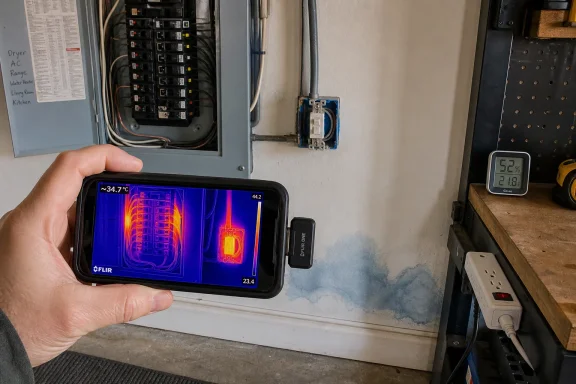
Electrical work is where the stakes rise. Resistance creates heat, and poor connections, overloaded conductors, failing breakers, and damaged components can all show thermal anomalies. But this is also where amateur confidence becomes dangerous. A thermal image can justify calling an electrician sooner; it should not justify poking around live gear without training.
This is not a superhero story. It is a troubleshooting story. The thermal camera did not replace electrical knowledge, and it did not unscrew the switch or secure the conductor. It simply revealed that one part of the circuit was warmer than expected, narrowing the search from “the water-heating system is unreliable” to “look closely here.”
That narrowing is where tools earn their keep. Most expensive repairs are not expensive only because the part is costly. They are expensive because uncertainty consumes time, and because replacing plausible parts can become a paid guessing game. A thermal camera reduces the search space.
This same principle applies to PCs and electronics. A dead board may contain a shorted capacitor, overheating regulator, failed MOSFET, or current-hungry chip. Thermal imaging can expose the component heating abnormally before it is obvious by touch, smell, or smoke. For repair benches, the camera is becoming what the POST card once was: a way to make invisible failure modes visible enough to investigate.
The boringness is the point. The best diagnostic tools do not feel dramatic when they work. They make the next step obvious.
A thermal camera detects infrared radiation from surfaces. It does not see through walls in the cinematic sense. If heat from a pipe, cable, animal, or leak changes the temperature of the surface you are looking at, the camera may reveal the pattern. If the heat does not conduct or radiate to that visible surface in a detectable way, the camera will not magically bypass physics.
Reflective and low-emissivity materials are another trap. Shiny metal, glass, polished surfaces, and some plastics can reflect thermal radiation from the environment rather than accurately reporting their own temperature. A bright spot on a reflective surface may be a real hot component, or it may be a reflection of your hand, your body, a lamp, or the sky.
Emissivity is the jargon that matters here. Different materials emit infrared radiation with different efficiency, so the same actual temperature can produce different apparent readings. Many household surfaces are forgiving enough for rough inspection, but precise temperature measurement demands more care than pointing and believing the number.
This is why experienced users often rely on contrast, comparison, and repeatability rather than a single absolute temperature. Is this breaker warmer than the adjacent breakers under similar load? Is this charger hotter than the identical charger next to it? Does the cold patch appear only after rain? Does the suspected area change when the system is turned on or off? Thermal imaging becomes powerful when it is treated as evidence, not prophecy.
Resolution matters. A low-resolution thermal image can identify broad hot and cold regions, but small components, narrow conductors, and distant targets require more pixels. Thermal sensitivity matters too, because some building problems and moisture patterns involve subtle differences rather than obvious hot spots. Refresh rate, focus, calibration, field of view, software, durability, reporting features, and measurement accuracy all separate casual tools from professional instruments.
That does not make cheap cameras toys. For many users, an inexpensive dongle or entry-level standalone unit is enough to find drafts, compare chargers, inspect a laptop exhaust path, check a radiator, or identify a suspiciously warm connector. The mistake is expecting a budget sensor to perform like a certified inspection platform.
The phone-dongle category has its own trade-offs. It benefits from a large display and easy image sharing, but it depends on app support, connector compatibility, and the physical awkwardness of attaching a small sensor to an expensive phone. Anyone who has watched USB-C accessories wobble in real-world use understands why a dedicated handheld unit still has appeal.
Built-in rugged-phone cameras solve the “where did I put the dongle?” problem, but they create a different one. You have to want the phone. Many of these devices are thick, heavy, and optimized for survivability rather than mainstream polish. For some users that is exactly right; for others, it is too much compromise for a sensor they will use once a month.
That includes the PC builder who worries about a power connector, the homelabber with a crowded rack, the homeowner chasing a recurring damp smell, the EV owner curious about charging gear, the camper checking heat loss, the radio hobbyist debugging a board, and the sysadmin responsible for a closet full of aging UPS units. These people already understand that failure often announces itself before it arrives. They just need another sense organ.
A thermal camera is especially useful around power. USB-C chargers, power strips, extension cords, wall wart adapters, battery packs, inverters, UPS units, PoE switches, and laptop docks all convert electrical inefficiency into heat. Some warmth is normal. As Kingsley-Hughes notes with cables, even bends and load conditions can create patterns that look suspicious until you learn what normal looks like. But asymmetry is information.
The same applies to airflow. PCs, NAS boxes, mini PCs, routers, switches, and external drives often fail slowly because heat management degrades gradually. Dust builds up, fans weaken, vents get blocked, thermal pads age, and cramped installations trap warm air. A thermal camera will not replace internal sensor data, but it can show the external heat map of a system in its actual environment.
That environmental view is often what software lacks. A CPU temperature reading tells you about the chip. A thermal image can show that the machine sits under a shelf that traps exhaust, that a power brick is baking against carpet, or that a network switch is dumping heat into a closed cabinet. Diagnostics are better when the digital and physical stories meet.
In the consumer world, we often encounter these hazards only after they have escalated. A plug feels hot. A breaker trips. A charger smells strange. A battery pack swells. A ceiling stain appears. A thermal camera can move detection earlier, when the response is still measured rather than emergency-driven.
That does not mean the camera makes dangerous work safe. If anything, it should make careful users more cautious. Seeing a hot breaker, switch, outlet, or conductor is not an invitation to keep testing casually. It is a reason to remove load where appropriate, avoid contact, document the condition, and bring in a qualified professional when live electrical systems are involved.
For IT pros, this safety lens should feel familiar. We do not wait for servers to crash before caring about temperature, airflow, and power quality. We monitor because prevention is cheaper than incident response. Thermal imaging brings that preventive mindset to the rooms, walls, boxes, and cables that support the machines.
The domestic version is no less serious. A bad connection in a wall switch is not merely an inconvenience if it is generating abnormal heat. A damp ceiling is not merely cosmetic if water is traveling near wiring. A failing power adapter is not merely annoying if it sits unattended under a desk. The camera does not create the risk; it makes denial harder.
The more important advance is habit formation. A thermal image is most valuable when compared against a known-good state. The same outlet under the same load last month. The same wall after rain. The same laptop dock before and after a firmware update changes power behavior. The same breaker panel after a new appliance is installed.
That kind of recordkeeping does not require enterprise software. It requires taking pictures, naming them sensibly, and resisting the urge to treat every color gradient as a crisis. For forum readers, this is almost second nature. We already know the value of screenshots, logs, baseline benchmarks, and “before” photos.
A disciplined thermal workflow is simple: observe, compare, confirm, and act. Observe the pattern. Compare it with nearby equivalents or prior images. Confirm with another tool or expert when the stakes are real. Act only within your competence.
The danger is that consumer thermal imaging will be sold as certainty. The opportunity is that it can teach a broader public to think diagnostically. Those are very different outcomes, and the difference is education.
 The Best New Tool in the Box Is Not a Drill
The consumer tool market has spent decades teaching people to buy more torque, more battery packs, more laser-guided accuracy, and more digital displays. Thermal imaging belongs to a different category. It does not help you cut, fasten, grind, or measure a visible distance; it helps you notice that the physical world is already broadcasting clues your eyes cannot receive.That is why Kingsley-Hughes’ argument lands with more force than a normal gadget recommendation. He is not praising a novelty accessory or another smart-home bauble. He is describing a tool that has repeatedly changed the outcome of a repair job by revealing heat where heat should not be, or cold where cold should not be.
For WindowsForum readers, that distinction matters. Many of us already own diagnostic tools for PCs, networks, storage, batteries, and power delivery. We check SMART data, watch thermals in HWiNFO, examine event logs, and distrust “it seems fine” as a troubleshooting method. A thermal camera extends that same diagnostic instinct into the physical environment around the machine.
The point is not that everyone needs a professional thermography rig. It is that the cheapest useful thermal camera now occupies the same mental shelf as a multimeter, cable tester, USB power meter, or non-contact voltage tester. It is not used every day, but when it is needed, it can collapse hours of uncertainty into one glance.
Thermal Imaging Finally Escaped the Specialist Cabinet
For years, thermal cameras carried the aura of defense contractors, firefighters, building inspectors, and industrial maintenance crews. Popular culture did not help. Infrared vision meant Predator, night raids, or expensive kit locked in a professional van.That era is over. The market Kingsley-Hughes describes now has three recognizable tiers: dedicated handheld cameras, smartphone dongles, and rugged phones with thermal sensors built in. The important change is not simply price. It is availability, portability, and the fact that thermal imaging no longer requires someone to justify a four-figure purchase before seeing whether the technology is useful.
Standalone cameras remain the cleanest version of the idea. They are purpose-built, usually easier to hold near awkward spaces, and less dependent on a phone app or connector standard. The better units also tend to offer more predictable controls, more robust housings, and better workflows for people who inspect electrical panels, HVAC equipment, vehicles, or buildings as part of paid work.
The dongle category is more interesting for ordinary users. A small USB-C or Lightning thermal camera does not look impressive in a toolbox, but it benefits from the phone’s display, storage, and sharing features. For a homeowner documenting a suspected leak, a sysadmin checking a suspiciously warm power strip, or an electronics hobbyist watching a regulator cook itself, the ability to capture and send an image instantly is not a convenience; it is part of the diagnostic record.
Then there are the rugged Android phones with thermal cameras built in. They are unlikely to tempt iPhone loyalists or flagship-phone buyers who care about camera processing, thinness, and premium materials. But for field work, workshops, farms, construction sites, and disaster-prone garages, the proposition is obvious: the tool you remembered to charge is the tool you can actually use.
The Consumer Breakthrough Is Less About Price Than Friction
It is tempting to reduce the story to “thermal cameras got cheap.” That is true, but incomplete. Plenty of tools become cheap without becoming useful. The more important change is that thermal imaging has become low-friction enough to use casually.That casual use is central to Kingsley-Hughes’ advice. The way to learn thermal imaging is not to wait for a crisis and then try to interpret a false-color image under pressure. It is to point the camera at everything: walls, chargers, cables, appliances, windows, breaker panels, radiators, pipes, laptops, pets, cups of coffee, and the ghostly heat print left by a hand on a table.
This is not childish tinkering. It is calibration by experience. A person who has spent weeks seeing what normal heat looks like is better prepared to notice abnormal heat. That is the same pattern that separates competent PC troubleshooting from panic: you need a baseline before an anomaly has meaning.
There is also a behavioral effect. A tool that lives in a drawer and requires a charged battery, a proprietary cable, and a forgotten app password will not be used often. A dongle in a small case or a phone with the camera built in turns thermal imaging into a quick check rather than an event. That shift is what makes the technology practical.
The result is a new kind of informal inspection culture. People who would never call themselves thermographers can still spot a charger running hotter than its identical neighbor, a window frame bleeding heat, or a breaker that looks suspicious compared with the rest of the panel. They may still need an expert to confirm the diagnosis, but they are no longer starting from ignorance.
The House Is Full of Heat Signatures Trying to Warn You
The most compelling examples are domestic because houses hide failure so effectively. A wall can look perfect while water travels behind it. A switch can look normal while a loose connection warms the metal box. A ceiling can appear clean while damp insulation changes temperature in a pattern no coat of paint can conceal.That is why thermal cameras fit so naturally into energy audits. Heat loss around doors, windows, rooflines, attic hatches, and poorly insulated wall sections often produces visible thermal contrast. A homeowner does not need a full building-science credential to understand that a bright or dark streak at the wrong place deserves investigation.
Moisture is more subtle. A thermal camera does not see water as water, and it does not see mold hiding inside a wall. It sees surface temperature differences that may be caused by evaporation, changed thermal mass, missing insulation, air movement, or something else entirely. That limitation is not a reason to dismiss the tool; it is a reason to treat it as a pointer rather than a verdict.
Plumbing leaks follow the same logic. Wet materials store and release heat differently than dry ones. Under the right conditions, that difference can reveal a hidden path of water before staining, rot, or swelling becomes visible. Under the wrong conditions, it can mislead. The camera starts the inquiry; moisture meters, pressure tests, visual inspection, and common sense finish it.
Electrical work is where the stakes rise. Resistance creates heat, and poor connections, overloaded conductors, failing breakers, and damaged components can all show thermal anomalies. But this is also where amateur confidence becomes dangerous. A thermal image can justify calling an electrician sooner; it should not justify poking around live gear without training.
The ZDNET Anecdote Works Because It Is Boring
Kingsley-Hughes’ water-heater story is exactly the kind of repair anecdote that sounds modest until you think about the economics. A previous visit reportedly cost around $1,500 for diagnosis, parts, and labor, yet did not fix the intermittent fault. On the later failure, a thermal camera helped him trace the problem to a hot wall switch box caused by a bad connection.This is not a superhero story. It is a troubleshooting story. The thermal camera did not replace electrical knowledge, and it did not unscrew the switch or secure the conductor. It simply revealed that one part of the circuit was warmer than expected, narrowing the search from “the water-heating system is unreliable” to “look closely here.”
That narrowing is where tools earn their keep. Most expensive repairs are not expensive only because the part is costly. They are expensive because uncertainty consumes time, and because replacing plausible parts can become a paid guessing game. A thermal camera reduces the search space.
This same principle applies to PCs and electronics. A dead board may contain a shorted capacitor, overheating regulator, failed MOSFET, or current-hungry chip. Thermal imaging can expose the component heating abnormally before it is obvious by touch, smell, or smoke. For repair benches, the camera is becoming what the POST card once was: a way to make invisible failure modes visible enough to investigate.
The boringness is the point. The best diagnostic tools do not feel dramatic when they work. They make the next step obvious.
The Camera Sees Surfaces, Not Secrets
Every consumer thermal-camera article needs a cold shower, and here it is: thermal imaging is easy to use badly. The false-color image looks authoritative because it is vivid. That authority is partly an illusion.A thermal camera detects infrared radiation from surfaces. It does not see through walls in the cinematic sense. If heat from a pipe, cable, animal, or leak changes the temperature of the surface you are looking at, the camera may reveal the pattern. If the heat does not conduct or radiate to that visible surface in a detectable way, the camera will not magically bypass physics.
Reflective and low-emissivity materials are another trap. Shiny metal, glass, polished surfaces, and some plastics can reflect thermal radiation from the environment rather than accurately reporting their own temperature. A bright spot on a reflective surface may be a real hot component, or it may be a reflection of your hand, your body, a lamp, or the sky.
Emissivity is the jargon that matters here. Different materials emit infrared radiation with different efficiency, so the same actual temperature can produce different apparent readings. Many household surfaces are forgiving enough for rough inspection, but precise temperature measurement demands more care than pointing and believing the number.
This is why experienced users often rely on contrast, comparison, and repeatability rather than a single absolute temperature. Is this breaker warmer than the adjacent breakers under similar load? Is this charger hotter than the identical charger next to it? Does the cold patch appear only after rain? Does the suspected area change when the system is turned on or off? Thermal imaging becomes powerful when it is treated as evidence, not prophecy.
Cheap Cameras Are Good Enough Until They Aren’t
The democratization of thermal imaging inevitably produces a buyer’s dilemma. If a $100 device can show heat, why would anyone pay several hundred or several thousand dollars? The answer is that “seeing heat” is not one specification.Resolution matters. A low-resolution thermal image can identify broad hot and cold regions, but small components, narrow conductors, and distant targets require more pixels. Thermal sensitivity matters too, because some building problems and moisture patterns involve subtle differences rather than obvious hot spots. Refresh rate, focus, calibration, field of view, software, durability, reporting features, and measurement accuracy all separate casual tools from professional instruments.
That does not make cheap cameras toys. For many users, an inexpensive dongle or entry-level standalone unit is enough to find drafts, compare chargers, inspect a laptop exhaust path, check a radiator, or identify a suspiciously warm connector. The mistake is expecting a budget sensor to perform like a certified inspection platform.
The phone-dongle category has its own trade-offs. It benefits from a large display and easy image sharing, but it depends on app support, connector compatibility, and the physical awkwardness of attaching a small sensor to an expensive phone. Anyone who has watched USB-C accessories wobble in real-world use understands why a dedicated handheld unit still has appeal.
Built-in rugged-phone cameras solve the “where did I put the dongle?” problem, but they create a different one. You have to want the phone. Many of these devices are thick, heavy, and optimized for survivability rather than mainstream polish. For some users that is exactly right; for others, it is too much compromise for a sensor they will use once a month.
The Real Buyer Is the Person Who Keeps Saying “That’s Odd”
The best thermal-camera customer is not necessarily the contractor, electrician, or home inspector. Those professionals already know whether they need one. The more interesting buyer is the technically curious person who notices small anomalies and wants a better way to test them.That includes the PC builder who worries about a power connector, the homelabber with a crowded rack, the homeowner chasing a recurring damp smell, the EV owner curious about charging gear, the camper checking heat loss, the radio hobbyist debugging a board, and the sysadmin responsible for a closet full of aging UPS units. These people already understand that failure often announces itself before it arrives. They just need another sense organ.
A thermal camera is especially useful around power. USB-C chargers, power strips, extension cords, wall wart adapters, battery packs, inverters, UPS units, PoE switches, and laptop docks all convert electrical inefficiency into heat. Some warmth is normal. As Kingsley-Hughes notes with cables, even bends and load conditions can create patterns that look suspicious until you learn what normal looks like. But asymmetry is information.
The same applies to airflow. PCs, NAS boxes, mini PCs, routers, switches, and external drives often fail slowly because heat management degrades gradually. Dust builds up, fans weaken, vents get blocked, thermal pads age, and cramped installations trap warm air. A thermal camera will not replace internal sensor data, but it can show the external heat map of a system in its actual environment.
That environmental view is often what software lacks. A CPU temperature reading tells you about the chip. A thermal image can show that the machine sits under a shelf that traps exhaust, that a power brick is baking against carpet, or that a network switch is dumping heat into a closed cabinet. Diagnostics are better when the digital and physical stories meet.
The Safety Case Is Stronger Than the Gadget Case
It is easy to market thermal cameras as money-saving tools, and Kingsley-Hughes does exactly that. The stronger argument may be safety. Heat is a common early symptom of electrical trouble, battery stress, mechanical friction, overloaded equipment, and failing components.In the consumer world, we often encounter these hazards only after they have escalated. A plug feels hot. A breaker trips. A charger smells strange. A battery pack swells. A ceiling stain appears. A thermal camera can move detection earlier, when the response is still measured rather than emergency-driven.
That does not mean the camera makes dangerous work safe. If anything, it should make careful users more cautious. Seeing a hot breaker, switch, outlet, or conductor is not an invitation to keep testing casually. It is a reason to remove load where appropriate, avoid contact, document the condition, and bring in a qualified professional when live electrical systems are involved.
For IT pros, this safety lens should feel familiar. We do not wait for servers to crash before caring about temperature, airflow, and power quality. We monitor because prevention is cheaper than incident response. Thermal imaging brings that preventive mindset to the rooms, walls, boxes, and cables that support the machines.
The domestic version is no less serious. A bad connection in a wall switch is not merely an inconvenience if it is generating abnormal heat. A damp ceiling is not merely cosmetic if water is traveling near wiring. A failing power adapter is not merely annoying if it sits unattended under a desk. The camera does not create the risk; it makes denial harder.
The Next Step Is Not Smarter AI, It Is Better Habits
Thermal cameras will inevitably get more software. Apps will classify anomalies, compare historical images, generate reports, and probably add AI language around risk. Some of that will be useful. Some of it will be overconfident.The more important advance is habit formation. A thermal image is most valuable when compared against a known-good state. The same outlet under the same load last month. The same wall after rain. The same laptop dock before and after a firmware update changes power behavior. The same breaker panel after a new appliance is installed.
That kind of recordkeeping does not require enterprise software. It requires taking pictures, naming them sensibly, and resisting the urge to treat every color gradient as a crisis. For forum readers, this is almost second nature. We already know the value of screenshots, logs, baseline benchmarks, and “before” photos.
A disciplined thermal workflow is simple: observe, compare, confirm, and act. Observe the pattern. Compare it with nearby equivalents or prior images. Confirm with another tool or expert when the stakes are real. Act only within your competence.
The danger is that consumer thermal imaging will be sold as certainty. The opportunity is that it can teach a broader public to think diagnostically. Those are very different outcomes, and the difference is education.
The Heat Map Belongs Beside the Multimeter
The practical lesson from years of hands-on testing is not that everyone should rush out and buy the most expensive imager they can find. It is that thermal cameras have crossed the threshold from specialist curiosity to practical diagnostic tool, and their value depends less on glamour than on repeated, ordinary use.- A basic thermal camera can reveal temperature patterns that point toward insulation gaps, air leaks, overheating electronics, electrical faults, damp areas, and plumbing problems.
- A standalone camera is usually the best fit for regular tool use, while a phone dongle is often the best entry point for occasional inspection and easy documentation.
- A rugged phone with a built-in thermal sensor makes sense when the phone itself fits the job, not merely because the sensor is appealing.
- A thermal image should be treated as a clue that needs confirmation, especially around moisture, reflective surfaces, and live electrical systems.
- The most valuable skill is learning what normal heat looks like before a fault forces you to interpret an image under pressure.
- The money-saving promise is real, but the safety benefit may be more important when heat reveals a problem before it becomes visible, expensive, or dangerous.
References
- Primary source: ZDNET
Published: 2026-06-28T12:52:10.968091
Thermal cameras can spot problems you can't see - what I've learned after years of testing
Thermal cameras have saved me thousands over the years. Just the other day, one simple check saved me $1,000.www.zdnet.com - Related coverage: flir.com

How Does Emissivity Affect Thermal Imaging? | Flir
Emissivity is a measure of how efficiently an object radiates heat, i.e. how well the surface of an object “tells the truth” about its temperature. Emissivity values range from 0 (a theoretically perfect mirror that reflects all energy) to 1 (a theoretical object called a blackbody that...
www.flir.com
- Related coverage: inspectandtest.net
FLIR Thermal Imaging: What Homeowners Need to Know - InspectandTest
A 2026 guide to FLIR thermal imaging for homeowners and inspectors — how it works, model lineup, common use cases, and limitations.inspectandtest.net - Related coverage: superiortac.com
Can Thermal Imaging Cameras See Through Walls? The Truth.
Can thermal imaging cameras see through walls? We bust Hollywood myths, explain the science, and show how professionals like law enforcement use them.superiortac.com - Related coverage: tequipment.net
- Related coverage: sperdirect.com
Thermal Imaging Cameras: What Can They Actually See? (And What They Ca – Sper Scientific Direct
Thermal imaging cameras have become one of the most talked-about tools in building inspection, HVAC, electrical maintenance and industrial troubleshooting. With prices dropping and resolution improving, more professionals are adding them to their kits. But there's also a lot of confusion and... sperdirect.com
