

Microsoft CEO Satya Nadella said on The New York Times’ Hard Fork podcast in June 2026 that Microsoft does “a lot” of AI tokenmaxxing, called the habit addictive, and argued that workers should stop using frontier models for routine problems. The admission matters because it reframes enterprise AI from a simple productivity story into a resource-management problem. Microsoft is not backing away from AI; it is trying to make AI consumption behave more like cloud computing, where every query has a cost, a risk profile, and an owner.
The first phase of workplace generative AI was defined by permission. Employees were encouraged to experiment, managers wanted adoption numbers, and vendors treated usage as proof that copilots and chatbots were becoming indispensable. In that world, “more tokens” sounded like “more productivity.”
Nadella’s tokenmaxxing comment marks a shift into the second phase. Microsoft still wants AI everywhere, but it no longer wants every task routed through the most expensive, most capable model by default. The new message is not “use less AI.” It is “stop using premium AI as if it were free.”
That distinction is important for Windows users and IT departments because Microsoft’s AI strategy increasingly sits inside the tools people already use: Windows, Microsoft 365, GitHub, Azure, Visual Studio Code, Teams, and Edge. If model choice becomes a hidden cost center, then AI governance becomes less about whether an employee is allowed to use a chatbot and more about which model answers which request.
The phrase “tokenmaxxing” sounds like internet slang because it is. But the behavior behind it is familiar to anyone who has watched a new enterprise tool become fashionable. When a system feels powerful, frictionless, and magically helpful, people overuse it before they learn where it actually adds value.
That sounds obvious until you put it inside a real company. A developer may use a frontier model to rename variables, draft a commit message, explain a small error, generate test scaffolding, and then ask for architectural advice. Some of those tasks might justify the premium model; many will not. The hard part is not knowing that cheaper models exist, but making the cheaper path the default when the work does not need anything more.
This is why Nadella pointed to Copilot’s Auto Mode as the idealized answer. Auto-routing promises to move model selection out of the user’s hands and into the product layer. The user asks for an outcome, and the system chooses a model based on task complexity, performance, and economics.
That is the Microsoft version of the fix: abstract the model market behind a Copilot interface. Users should not have to think about whether a request needs a small model, a reasoning model, or a frontier system. Microsoft would rather make that decision inside the platform, where it can optimize for latency, price, safety, and vendor control.
The catch is that abstraction also hides power. When an enterprise lets a platform choose the model, it is also letting the platform decide what counts as a “frontier” problem. That may be efficient, but it turns AI governance into a trust relationship with the vendor.
Claude Code became popular because agentic coding tools can feel dramatically more useful than older autocomplete systems. They can inspect files, propose changes, run commands, and act more like an assistant than a suggestion box. For engineers, that kind of tool can quickly become part of the daily workflow.
But Microsoft owns GitHub, owns Copilot, and has every incentive to push employees into its own development stack. Internal adoption is not just about saving license fees. It produces feedback, telemetry, product pressure, and institutional muscle memory around Microsoft’s own tools.
This is where the tokenmaxxing story becomes more than a funny executive aside. If employees are burning through costly third-party AI usage while Microsoft is trying to sell its own AI developer platform, then the company has both a financial and strategic reason to redirect behavior. The answer is not merely “use fewer tokens.” It is “use the tokens that strengthen our platform.”
For WindowsForum readers, the practical takeaway is that enterprise AI tools are no longer neutral utilities. They are becoming strategic control points, much like identity, device management, and cloud tenancy. The model your company chooses is not just a technical preference; it shapes spending, compliance, workflows, and vendor leverage.
But the less obvious cost is organizational noise. If workers reflexively ask AI to process everything, companies end up with a flood of generated drafts, summaries, code suggestions, speculative plans, and half-reviewed artifacts. That output still requires judgment. AI can reduce the cost of producing text and code, but it does not eliminate the cost of deciding whether the output is good.
There is also a security cost. Every prompt is a potential data disclosure event. Every attached file, copied stack trace, internal email, customer record, design document, or codebase snippet becomes part of the risk calculation. The more casual AI use becomes, the harder it is for security teams to distinguish routine productivity from accidental leakage.
This is why model routing and data governance are now inseparable. A company cannot responsibly optimize only for the cheapest model if the cheaper path weakens controls. Nor can it route everything to the safest premium model if the economics collapse. The enterprise answer has to balance quality, cost, latency, and data handling.
That balance is exactly what Microsoft wants Copilot to embody. The company’s pitch is that employees should stay inside governed channels where identity, permissions, compliance boundaries, and logging can be enforced. The counterargument is that employees will keep reaching for the tools that feel best, especially if internal alternatives lag behind.
For everyday users, model announcements tend to focus on benchmark scores, coding ability, reasoning quality, and speed. Enterprises read a different spec sheet. They care about whether prompts and outputs are stored, who can access them, how long they are retained, whether zero-data-retention terms apply, and what happens when safety systems flag content.
That is why the Fable 5 episode matters even if most Windows users will never touch the model directly. The frontier model race is not simply a contest over intelligence. It is a contest over acceptable data exposure. A model can be brilliant and still be unusable for sensitive work if its retention rules do not match the customer’s obligations.
Microsoft’s reported caution also undercuts the simplistic idea that AI adoption is a one-way march toward more capable models. Sometimes the most capable model is the wrong model because the contractual and compliance envelope is wrong. In regulated environments, the answer to “which model is best?” often begins with “which model are we allowed to use?”
That dynamic will shape the next generation of Windows and Microsoft 365 administration. IT teams will need policies that do more than enable or disable AI. They will need to govern categories of work, sensitivity labels, model tiers, retention rules, and whether certain prompts can leave a particular tenant boundary.
The risk is that automatic model selection can make AI feel less accountable. If a bad answer appears, which model produced it? If sensitive data was processed, where did it go? If the bill spikes, which workflows caused it? Enterprises will need visibility into routing decisions, not just a comforting promise that the platform handled it.
This is a familiar pattern in Microsoft’s history. Windows made hardware abstraction practical. Azure made infrastructure consumption programmable. Microsoft 365 made collaboration continuous and administratively centralized. Copilot is now trying to make AI model choice invisible, but invisibility only works when administrators can still audit what happened.
That is where the Windows ecosystem may feel the pressure first. A Copilot button in the operating system is simple for users. Copilot controls in Microsoft 365 admin portals are simple for policy teams. But the underlying reality is messy: different models, different data paths, different pricing, and different risk profiles.
If Microsoft gets this right, most users will never think about tokens at all. If it gets it wrong, tokenmaxxing becomes the new shadow IT: employees find the smartest model outside the sanctioned path, expense it quietly, and leave security teams to discover the implications later.
A better measurement regime would ask harder questions. Did the AI-assisted code survive review? Did the meeting summary reduce follow-up confusion? Did the support response resolve the customer’s issue? Did the model save time after including verification, correction, and compliance overhead?
Nadella’s warning suggests Microsoft understands that raw consumption is not the same as value. This is especially important for software development, where generated code can be cheap to produce and expensive to maintain. A coding assistant that creates more pull requests is not necessarily improving engineering throughput if reviewers spend more time untangling plausible but flawed output.
For sysadmins, the same principle applies to scripts, configuration advice, and troubleshooting plans. An AI-generated PowerShell command that looks correct can still be dangerous if copied blindly. The value is not in the number of tokens processed; it is in whether the tool helps a skilled operator reach a correct, auditable outcome faster.
This is the cultural correction enterprises now need. The novelty period rewarded enthusiasm. The next period will reward restraint, instrumentation, and taste.
Now the company is telling users not to overdo it. That is not hypocrisy so much as the predictable arc of platform adoption. First, Microsoft needed people to believe AI belonged everywhere. Now it needs them to use AI in a way that does not turn enterprise deployment into an uncontrolled utility bill.
The cloud computing analogy is useful here. Early cloud adoption celebrated elasticity: spin up what you need, when you need it. Then the bill arrived, and FinOps became a discipline. AI is following the same path at much higher speed. Tokenmaxxing is what happens before AI FinOps matures.
Microsoft has an advantage because it can bundle the discipline into products customers already pay for. Copilot can be framed not just as an assistant, but as the policy-aware layer that keeps employees from making bad model choices. That is a powerful sales pitch to CIOs who want AI adoption without chaos.
But it also raises the stakes for trust. If Microsoft is both the promoter of AI usage and the broker that decides how usage is routed, customers will need transparency. Otherwise, “use the right model for the job” becomes a slogan rather than an enforceable governance model.
That means organizations need to inventory where AI is already present. Copilot in Microsoft 365 is different from GitHub Copilot. GitHub Copilot CLI is different from a browser-based chatbot. Azure AI services are different from third-party model subscriptions. Each has its own identity model, logging posture, retention terms, and administrative controls.
The governance work should start with data classification. Employees need clear rules for what kinds of information can be entered into which AI tools. If the rule is “do not paste confidential data into unapproved systems,” the company must also define which systems are approved for confidential data and under what conditions.
Procurement also needs to get closer to engineering. Developers adopt tools quickly when the tools save time. If official channels are slow, inferior, or poorly documented, unofficial usage will grow. The answer is not merely stricter blocking; it is providing a sanctioned toolchain good enough that employees do not feel punished for following policy.
Cost controls should be visible before they become punitive. Teams need to understand that model choice affects budgets just as cloud instance choice does. A culture that treats frontier models as special-purpose tools, rather than default utilities, will be better prepared for the next wave of agentic workflows.
That loop is not limited to Microsoft employees. Power users do it when they ask AI to rewrite every email. Developers do it when they run every small coding decision through an agent. Managers do it when they turn vague strategy into polished slides before they have done the thinking.
The fix is not abstinence. The fix is knowing when the model is doing leverage work and when it is merely adding polish. AI is valuable when it compresses search, accelerates synthesis, catches errors, explores alternatives, or handles drudgery. It is less valuable when it becomes a reflexive middleman between the worker and the work.
Microsoft’s answer, naturally, is productized discipline. Let Copilot choose. Let policy govern. Let the platform route. That may be the right direction, but it should not absolve users and administrators from understanding what is happening behind the curtain.
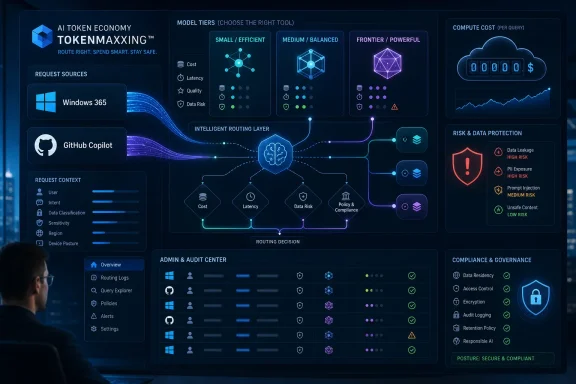 The AI Boom Has Reached Its Expense-Report Phase
The first phase of workplace generative AI was defined by permission. Employees were encouraged to experiment, managers wanted adoption numbers, and vendors treated usage as proof that copilots and chatbots were becoming indispensable. In that world, “more tokens” sounded like “more productivity.”Nadella’s tokenmaxxing comment marks a shift into the second phase. Microsoft still wants AI everywhere, but it no longer wants every task routed through the most expensive, most capable model by default. The new message is not “use less AI.” It is “stop using premium AI as if it were free.”
That distinction is important for Windows users and IT departments because Microsoft’s AI strategy increasingly sits inside the tools people already use: Windows, Microsoft 365, GitHub, Azure, Visual Studio Code, Teams, and Edge. If model choice becomes a hidden cost center, then AI governance becomes less about whether an employee is allowed to use a chatbot and more about which model answers which request.
The phrase “tokenmaxxing” sounds like internet slang because it is. But the behavior behind it is familiar to anyone who has watched a new enterprise tool become fashionable. When a system feels powerful, frictionless, and magically helpful, people overuse it before they learn where it actually adds value.
Nadella’s Simple Fix Is Really a New Operating Discipline
Nadella’s proposed fix was blunt: do not use frontier models for non-frontier problems. In plain English, do not send routine summarization, formatting, classification, or boilerplate drafting to the most advanced model in the stack simply because it is available.That sounds obvious until you put it inside a real company. A developer may use a frontier model to rename variables, draft a commit message, explain a small error, generate test scaffolding, and then ask for architectural advice. Some of those tasks might justify the premium model; many will not. The hard part is not knowing that cheaper models exist, but making the cheaper path the default when the work does not need anything more.
This is why Nadella pointed to Copilot’s Auto Mode as the idealized answer. Auto-routing promises to move model selection out of the user’s hands and into the product layer. The user asks for an outcome, and the system chooses a model based on task complexity, performance, and economics.
That is the Microsoft version of the fix: abstract the model market behind a Copilot interface. Users should not have to think about whether a request needs a small model, a reasoning model, or a frontier system. Microsoft would rather make that decision inside the platform, where it can optimize for latency, price, safety, and vendor control.
The catch is that abstraction also hides power. When an enterprise lets a platform choose the model, it is also letting the platform decide what counts as a “frontier” problem. That may be efficient, but it turns AI governance into a trust relationship with the vendor.
The Claude Code Cutoff Shows the Business Logic Under the Philosophy
Nadella’s comments landed against a larger backdrop: Microsoft has reportedly been ending many internal Claude Code licenses and steering engineers toward GitHub Copilot CLI by June 30, 2026. That timing is hard to ignore because June 30 is also the end of Microsoft’s fiscal year. Even if the company frames the move as product consolidation, the cost-control logic is sitting in plain sight.Claude Code became popular because agentic coding tools can feel dramatically more useful than older autocomplete systems. They can inspect files, propose changes, run commands, and act more like an assistant than a suggestion box. For engineers, that kind of tool can quickly become part of the daily workflow.
But Microsoft owns GitHub, owns Copilot, and has every incentive to push employees into its own development stack. Internal adoption is not just about saving license fees. It produces feedback, telemetry, product pressure, and institutional muscle memory around Microsoft’s own tools.
This is where the tokenmaxxing story becomes more than a funny executive aside. If employees are burning through costly third-party AI usage while Microsoft is trying to sell its own AI developer platform, then the company has both a financial and strategic reason to redirect behavior. The answer is not merely “use fewer tokens.” It is “use the tokens that strengthen our platform.”
For WindowsForum readers, the practical takeaway is that enterprise AI tools are no longer neutral utilities. They are becoming strategic control points, much like identity, device management, and cloud tenancy. The model your company chooses is not just a technical preference; it shapes spending, compliance, workflows, and vendor leverage.
The Real Cost Is Not Just the Model Bill
The obvious cost of tokenmaxxing is compute. Frontier models are expensive to run, and agentic workflows can multiply usage by calling models repeatedly while reading files, writing code, checking outputs, and revising plans. What feels like one request to the user may be a chain of requests under the hood.But the less obvious cost is organizational noise. If workers reflexively ask AI to process everything, companies end up with a flood of generated drafts, summaries, code suggestions, speculative plans, and half-reviewed artifacts. That output still requires judgment. AI can reduce the cost of producing text and code, but it does not eliminate the cost of deciding whether the output is good.
There is also a security cost. Every prompt is a potential data disclosure event. Every attached file, copied stack trace, internal email, customer record, design document, or codebase snippet becomes part of the risk calculation. The more casual AI use becomes, the harder it is for security teams to distinguish routine productivity from accidental leakage.
This is why model routing and data governance are now inseparable. A company cannot responsibly optimize only for the cheapest model if the cheaper path weakens controls. Nor can it route everything to the safest premium model if the economics collapse. The enterprise answer has to balance quality, cost, latency, and data handling.
That balance is exactly what Microsoft wants Copilot to embody. The company’s pitch is that employees should stay inside governed channels where identity, permissions, compliance boundaries, and logging can be enforced. The counterargument is that employees will keep reaching for the tools that feel best, especially if internal alternatives lag behind.
Claude Fable 5 Turns Model Choice Into a Compliance Problem
The reported restriction on Microsoft employee use of Claude Fable 5 adds another layer to the story. According to reporting on the decision, Microsoft limited use of Anthropic’s new model because of data retention requirements that legal and compliance teams wanted to review. That is not a small administrative wrinkle; it is the kind of issue that determines whether a tool is suitable for corporate work at all.For everyday users, model announcements tend to focus on benchmark scores, coding ability, reasoning quality, and speed. Enterprises read a different spec sheet. They care about whether prompts and outputs are stored, who can access them, how long they are retained, whether zero-data-retention terms apply, and what happens when safety systems flag content.
That is why the Fable 5 episode matters even if most Windows users will never touch the model directly. The frontier model race is not simply a contest over intelligence. It is a contest over acceptable data exposure. A model can be brilliant and still be unusable for sensitive work if its retention rules do not match the customer’s obligations.
Microsoft’s reported caution also undercuts the simplistic idea that AI adoption is a one-way march toward more capable models. Sometimes the most capable model is the wrong model because the contractual and compliance envelope is wrong. In regulated environments, the answer to “which model is best?” often begins with “which model are we allowed to use?”
That dynamic will shape the next generation of Windows and Microsoft 365 administration. IT teams will need policies that do more than enable or disable AI. They will need to govern categories of work, sensitivity labels, model tiers, retention rules, and whether certain prompts can leave a particular tenant boundary.
Auto Mode Is Convenient, but It Moves the Argument Upstairs
Microsoft’s Auto Mode idea is attractive because it matches how normal people work. Users do not want to become procurement analysts every time they ask an assistant to summarize a meeting or draft a PowerShell script. They want the software to make the right call.The risk is that automatic model selection can make AI feel less accountable. If a bad answer appears, which model produced it? If sensitive data was processed, where did it go? If the bill spikes, which workflows caused it? Enterprises will need visibility into routing decisions, not just a comforting promise that the platform handled it.
This is a familiar pattern in Microsoft’s history. Windows made hardware abstraction practical. Azure made infrastructure consumption programmable. Microsoft 365 made collaboration continuous and administratively centralized. Copilot is now trying to make AI model choice invisible, but invisibility only works when administrators can still audit what happened.
That is where the Windows ecosystem may feel the pressure first. A Copilot button in the operating system is simple for users. Copilot controls in Microsoft 365 admin portals are simple for policy teams. But the underlying reality is messy: different models, different data paths, different pricing, and different risk profiles.
If Microsoft gets this right, most users will never think about tokens at all. If it gets it wrong, tokenmaxxing becomes the new shadow IT: employees find the smartest model outside the sanctioned path, expense it quietly, and leave security teams to discover the implications later.
Productivity Metrics Are About to Get Less Naive
The phrase “tokenmaxxing” also exposes a weak spot in how companies have been measuring AI success. If the metric is simply how much AI is used, then employees have every incentive to use more of it. That creates a dashboard-friendly illusion of transformation while saying little about whether the work improved.A better measurement regime would ask harder questions. Did the AI-assisted code survive review? Did the meeting summary reduce follow-up confusion? Did the support response resolve the customer’s issue? Did the model save time after including verification, correction, and compliance overhead?
Nadella’s warning suggests Microsoft understands that raw consumption is not the same as value. This is especially important for software development, where generated code can be cheap to produce and expensive to maintain. A coding assistant that creates more pull requests is not necessarily improving engineering throughput if reviewers spend more time untangling plausible but flawed output.
For sysadmins, the same principle applies to scripts, configuration advice, and troubleshooting plans. An AI-generated PowerShell command that looks correct can still be dangerous if copied blindly. The value is not in the number of tokens processed; it is in whether the tool helps a skilled operator reach a correct, auditable outcome faster.
This is the cultural correction enterprises now need. The novelty period rewarded enthusiasm. The next period will reward restraint, instrumentation, and taste.
Microsoft Is Selling Discipline After Selling Excitement
There is an irony in Microsoft becoming the voice of AI moderation. This is the same company that has spent the last few years putting Copilot branding across nearly every surface it owns. It helped normalize the idea that generative AI should be available in documents, inboxes, browsers, IDEs, terminals, and operating systems.Now the company is telling users not to overdo it. That is not hypocrisy so much as the predictable arc of platform adoption. First, Microsoft needed people to believe AI belonged everywhere. Now it needs them to use AI in a way that does not turn enterprise deployment into an uncontrolled utility bill.
The cloud computing analogy is useful here. Early cloud adoption celebrated elasticity: spin up what you need, when you need it. Then the bill arrived, and FinOps became a discipline. AI is following the same path at much higher speed. Tokenmaxxing is what happens before AI FinOps matures.
Microsoft has an advantage because it can bundle the discipline into products customers already pay for. Copilot can be framed not just as an assistant, but as the policy-aware layer that keeps employees from making bad model choices. That is a powerful sales pitch to CIOs who want AI adoption without chaos.
But it also raises the stakes for trust. If Microsoft is both the promoter of AI usage and the broker that decides how usage is routed, customers will need transparency. Otherwise, “use the right model for the job” becomes a slogan rather than an enforceable governance model.
Windows Shops Should Treat AI Like a Managed Resource Now
For Windows administrators, the lesson is not to wait for AI usage to become a budget emergency before writing policy. The old approach — block consumer chatbots, approve a few enterprise tools, and move on — is already too crude. AI is becoming embedded in first-party software, developer tools, and workflow automation.That means organizations need to inventory where AI is already present. Copilot in Microsoft 365 is different from GitHub Copilot. GitHub Copilot CLI is different from a browser-based chatbot. Azure AI services are different from third-party model subscriptions. Each has its own identity model, logging posture, retention terms, and administrative controls.
The governance work should start with data classification. Employees need clear rules for what kinds of information can be entered into which AI tools. If the rule is “do not paste confidential data into unapproved systems,” the company must also define which systems are approved for confidential data and under what conditions.
Procurement also needs to get closer to engineering. Developers adopt tools quickly when the tools save time. If official channels are slow, inferior, or poorly documented, unofficial usage will grow. The answer is not merely stricter blocking; it is providing a sanctioned toolchain good enough that employees do not feel punished for following policy.
Cost controls should be visible before they become punitive. Teams need to understand that model choice affects budgets just as cloud instance choice does. A culture that treats frontier models as special-purpose tools, rather than default utilities, will be better prepared for the next wave of agentic workflows.
The Useful Lesson Hidden in Nadella’s Confession
Nadella’s line works because it admits the human part. Tokenmaxxing is addictive because good AI systems produce a satisfying loop: ask, receive, refine, repeat. The output arrives quickly enough that the user feels productive even when the underlying value is uncertain.That loop is not limited to Microsoft employees. Power users do it when they ask AI to rewrite every email. Developers do it when they run every small coding decision through an agent. Managers do it when they turn vague strategy into polished slides before they have done the thinking.
The fix is not abstinence. The fix is knowing when the model is doing leverage work and when it is merely adding polish. AI is valuable when it compresses search, accelerates synthesis, catches errors, explores alternatives, or handles drudgery. It is less valuable when it becomes a reflexive middleman between the worker and the work.
Microsoft’s answer, naturally, is productized discipline. Let Copilot choose. Let policy govern. Let the platform route. That may be the right direction, but it should not absolve users and administrators from understanding what is happening behind the curtain.
The New Rules of Microsoft’s Token Economy
The practical story is narrower than the hype and broader than one podcast quote. Microsoft is trying to normalize AI at enterprise scale while preventing the behavior that enterprise scale makes expensive.- Microsoft’s message is no longer just that employees should use AI, but that they should use the cheapest adequate model for the task.
- Copilot’s Auto Mode is designed to turn model selection into a platform decision rather than a user decision.
- The reported Claude Code cutoff shows that internal AI tool choice is also a question of vendor strategy and fiscal discipline.
- The reported Claude Fable 5 restriction shows that frontier-model capability can be outweighed by data-retention and compliance concerns.
- Windows and Microsoft 365 administrators should treat AI usage as a managed resource with policies, logs, cost controls, and data-classification rules.
- The productivity metric that matters is not token volume, but whether AI-assisted work survives review and produces measurable value.
References
- Primary source: Windows Central
Published: 2026-06-13T13:06:10.303212

Microsoft CEO Satya Nadella says AI tokenmaxxing is costly: "I'm a tokenmaxxer too, it's addictive." | Windows Central
The executive wants staffers to rethink how they use frontier AI models to solve problems.www.windowscentral.com - Related coverage: techradar.com

Microsoft limits employee use of Claude Fable 5 over data retention concerns | TechRadar
Anthropic requires data retention for at least 30 dayswww.techradar.com - Related coverage: tomshardware.com

Claude Fable 5 brings Mythos to the masses — Anthropic's new frontier model is 'state-of-the-art on nearly all tested benchmarks' | Tom's Hardware
Queries regarding cybersecurity, biology and chemistry, and distillation will be redirected to the prior-gen Opus 4.8, howeverwww.tomshardware.com - Related coverage: itpro.com

Anthropic just launched Claude Fable 5, its first Mythos-class AI model – but it has new safeguards to prevent misuse and will ‘fall back’ to Opus 4.8 for queries in ‘high risk’ topics | IT Pro
The launch of Claude Fable 5 marks the first public release of a Mythos-class AI modelwww.itpro.com - Related coverage: techrepublic.com

Microsoft Restricts Claude Fable 5 Access Amid AI Safety Review
Microsoft reportedly limited internal use of Claude Fable 5 while legal teams review Anthropic’s 30-day data-retention policy.www.techrepublic.com
- Related coverage: advancedai.com

Microsoft Drops Claude Code. Who Chooses Your AI Tools? | Advanced AI
Microsoft canceled internal Claude Code licenses with a June 30 deadline, routing engineers to GitHub Copilot CLI — while PwC simultaneously went all-in on Claude. The AI coding tool you rely on may not be yours to keep. www.advancedai.com
- Related coverage: insights.itdukes.com

Microsoft Drops Claude Code by June 30, 2026: Inside the AI Budget Blowout | IT Dukes
Data-driven research on email deliverability, AI development, cybersecurity, and modern development practices. Free AI-powered tools and actionable insights backed by real-world data.insights.itdukes.com
- Related coverage: gigazine.net

「Claude Fable 5」では会話履歴がAnthropicの従業員によって読まれる場合がある、Microsoftはリスク評価のために従業員による使用を保留中 - GIGAZINE
高度なサイバー攻撃が可能だとして限られた組織向けに限定公開されていたAnthropicのAIモデル「Claude Mythos」の一般公開版「Claude Fable 5」が2026年6月9日に登場しました。このモデルについて、Microsoftの従業員が「データ保持のポリシーが評価されるまでMicrosoftでの利用が許可されていない」と証言したことが分かりました。gigazine.net - Related coverage: shacknews.com

Microsoft reportedly bans employees from using Claude's new model over data retention concerns | Shacknews
Previous versions of Anthropic's Claude are still available to Microsoft employees.www.shacknews.com - Related coverage: benzinga.com

Microsoft CEO Satya Nadella Warns Against AI Overuse - Microsoft (NASDAQ:MSFT) - Benzinga
Microsoft CEO Satya Nadella urged employees to use AI more efficiently, warning against unnecessary reliance on costly advanced models.www.benzinga.com - Related coverage: forbes.com

Microsoft Ends Claude Code Licenses As It Shifts Developers To Copilot
Microsoft ends Claude Code licenses and shifts developers to its in‑house Copilot model, signaling a strategic move toward AI self‑sufficiency and distribution power.www.forbes.com - Related coverage: streetinsider.com

Microsoft limits employee use of Anthropic's Claude Fable 5 over data retention concerns, The Verge reports
June 10 (Reuters) - Microsoft is limiting employees' use of Anthropic's Claude Fable 5 because of the AI startup's new data retention requirements, The Verge reported on Wednesday, citing sources. Anthropic on Tuesday said it is rolling out...www.streetinsider.com - Related coverage: moneycontrol.com

Microsoft pulls Claude Code licenses, shifts engineers to GitHub Copilot CLI amid rising AI costs
According to The Verge, Claude Code becamewww.moneycontrol.com
