

Hadoop Survived by Becoming Less Visible
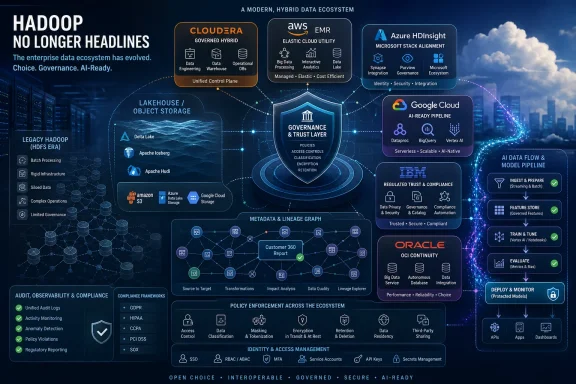
Hadoop’s great trick in 2026 is that it remains important while rarely being the headline. The name still appears in product pages, cluster options, migration guides, and legacy data-lake conversations, but the commercial center of gravity has shifted toward Spark, lakehouse formats, object storage, managed notebooks, AI pipelines, and governance catalogs.
That does not mean Hadoop is irrelevant. It means Hadoop has become plumbing. Enterprises still have HDFS estates, Hive workloads, YARN-era operational habits, and years of data engineering logic tied to the ecosystem. For many large organizations, “moving off Hadoop” is not a weekend migration; it is a multi-year re-architecture of storage, access control, lineage, job scheduling, and data ownership.
The more interesting question is not whether Hadoop is alive. It is whether a vendor can make Hadoop-era investments useful inside an AI-era architecture. That is why the strongest providers in 2026 are not merely those that can spin up a cluster, but those that can wrap distributed data processing in policy, automation, security, cost controls, and model-ready data access.
Cloudera Owns the Enterprise Memory of Hadoop
Cloudera remains the most direct heir to the Hadoop enterprise market because it understands the institutions that made Hadoop hard in the first place. Banks, insurers, manufacturers, telecoms, healthcare systems, and public-sector agencies did not adopt Hadoop because it was fashionable; they adopted it because they had large, messy, regulated data estates that did not fit neatly into traditional databases.
That history still matters. Cloudera’s pitch in 2026 is not simply “we run Hadoop.” It is “we can give you a governed hybrid data platform across on-premises and cloud infrastructure.” That distinction is crucial because many Hadoop customers are precisely the organizations least able to dump sensitive workloads wholesale into one public cloud.
Cloudera’s strength is governance at scale. Its Shared Data Experience model, hybrid deployment story, and focus on security controls speak to enterprises that have auditors, data residency obligations, and decades of operational complexity. For those buyers, AI does not reduce the need for governance; it multiplies it.
The company’s challenge is perception. Hadoop’s brand has aged, and younger data teams often associate modern analytics with Databricks, Snowflake, BigQuery, Fabric, or serverless Spark rather than with a traditional Hadoop platform. Cloudera’s task is to convince the market that its hybrid foundation is not legacy packaging but a practical answer to where enterprise data actually resides.
That argument is stronger in 2026 than it was during the peak of cloud-first enthusiasm. AI has made data locality, lineage, sovereign deployment, and workload placement newly important. Cloudera benefits from the fact that the enterprise world has rediscovered a truth Hadoop customers already knew: the data center is not dead just because cloud marketing wanted it to be.
AWS EMR Wins When Hadoop Becomes a Utility
Amazon EMR represents the opposite pole from Cloudera’s enterprise-platform narrative. It treats Hadoop and adjacent frameworks as elastic cloud services, not as a philosophical commitment. If an organization wants Spark, Hive, HBase, Presto, Trino, or related tools running in the AWS ecosystem, EMR is the familiar default.
That utility model is powerful. Teams can provision clusters, connect to S3, integrate with IAM, feed data pipelines, and scale workloads without taking on the full operational burden of self-managed infrastructure. For cloud-native or cloud-migrated organizations, EMR is often less a Hadoop strategy than an AWS data-processing primitive.
The advantage is speed and ecosystem gravity. Once data is in S3 and identity, monitoring, networking, and billing are already standardized on AWS, EMR becomes a relatively natural place to run big-data workloads. It also gives organizations a way to preserve Hadoop-era tools while modernizing the underlying storage and operations model.
The trade-off is lock-in by convenience. EMR may run open-source frameworks, but the operational architecture quickly becomes AWS-shaped. That may be acceptable, even desirable, for companies committed to Amazon’s cloud, but it is a strategic decision disguised as a managed-service choice.
AWS is strongest for organizations that know they want cloud elasticity more than hybrid neutrality. Its appeal is not nostalgia for Hadoop; it is the ability to turn distributed processing into an on-demand service inside a massive cloud platform.
Azure HDInsight Still Matters, but Microsoft’s Center of Gravity Has Moved
Microsoft Azure HDInsight remains a recognizable managed service for Hadoop, Spark, Hive, Kafka, and HBase workloads. For enterprises already standardized on Azure, Active Directory, Power BI, Synapse-style analytics, and Microsoft security tooling, HDInsight can still fit neatly into the broader estate.
But Microsoft’s big-data story in 2026 is no longer centered on Hadoop branding. The company’s attention is spread across Microsoft Fabric, OneLake, Azure Databricks partnerships, Synapse lineage, Power BI, Purview, and Azure AI. HDInsight remains useful, but it is not the charismatic center of Microsoft’s analytics platform.
That matters for buyers. A service can be supported and still not be the place where the vendor’s strategic energy is going. Enterprises considering HDInsight should look carefully at workload fit, component lifecycle notices, VM availability constraints, migration paths, and whether the service is the best landing zone for new development or mainly a bridge for existing workloads.
Microsoft’s strength is integration. Governance, identity, reporting, and AI services are unusually compelling when an organization is already deep in the Microsoft stack. The risk is that Hadoop becomes a transitional layer rather than the long-term architecture.
For WindowsForum readers in enterprise IT, this is the familiar Microsoft pattern: the platform’s value often lies less in one product than in the gravitational pull of the ecosystem. HDInsight can still be useful, but the strategic question is whether Hadoop workloads should remain Hadoop workloads, or whether they should move into Microsoft’s newer data fabric.
Google Cloud Turns Hadoop Into an On-Ramp for AI
Google Cloud’s Hadoop story is really a Dataproc, BigQuery, Vertex AI, and governance story. The company’s advantage is not that it treats Hadoop as the star. It is that it can make Hadoop and Spark workloads part of a wider analytics and machine-learning pipeline.
Dataproc gives Google Cloud a managed route for Spark and Hadoop ecosystem jobs, while BigQuery remains one of the strongest cloud-native analytics warehouses on the market. Add Vertex AI, BigLake, and Dataplex-style governance, and the pitch becomes clear: bring your distributed processing workloads into a cloud designed around analytics and AI.
That makes Google attractive to organizations whose Hadoop question is really an AI-readiness question. If the business goal is to use large datasets for forecasting, personalization, model training, fraud detection, or real-time analytics, Google’s platform can feel more modern than a traditional cluster-centric approach.
The weakness is enterprise incumbency. Google Cloud has strong technology, but many large companies still have deeper procurement, identity, compliance, and operational relationships with Microsoft, AWS, IBM, Oracle, or Cloudera. Technical elegance does not automatically defeat institutional inertia.
Still, Google’s position is increasingly persuasive. Hadoop’s original promise was to unlock large-scale data. In 2026, the commercial promise is to convert that data into AI systems and operational intelligence. Google does not need Hadoop to be fashionable if it can make Hadoop workloads feed higher-value analytics.
IBM Sells Trust Where Everyone Else Sells Scale
IBM’s role in the Hadoop market is best understood through regulated-industry anxiety. The company is not trying to win by being the trendiest cloud or the cheapest managed cluster provider. It is selling governance, hybrid operations, watsonx.data, data lineage, compliance posture, and institutional trust.
That makes IBM relevant in sectors where “move fast” is not a strategy. Banking, insurance, government, healthcare, and industrial enterprises often need explainability, policy enforcement, access control, and auditability as much as they need raw compute. In those environments, a big-data platform that cannot satisfy risk officers is not a platform; it is a liability.
IBM’s big-data messaging also reflects the broader industry shift from Hadoop clusters to AI-ready data foundations. The company talks about connecting distributed data, applying governance, and enabling analytics and AI across hybrid environments. Hadoop becomes part of the estate, not the identity of the product.
The challenge for IBM is proving that its AI and data stack can compete not just in governance decks but in developer adoption and day-to-day usability. Enterprise credibility gets a vendor into the room. Platform experience keeps it there.
IBM is therefore a strong candidate for organizations that place compliance, sovereignty, and governance above cloud-native fashion. It is less compelling for teams that primarily want the fastest path to elastic experimentation unless those teams already live inside IBM’s enterprise orbit.
Oracle Is the Pragmatist’s Choice for Oracle-Centric Estates
Oracle’s Hadoop position is easiest to understand inside Oracle-heavy enterprises. If an organization already depends on Oracle databases, Oracle applications, and Oracle Cloud Infrastructure, then Oracle Big Data Service and related OCI offerings provide a practical route for running Hadoop, Spark, Hive, Trino, Flink, and adjacent workloads without abandoning the Oracle environment.
That is not a small advantage. Many enterprise data strategies fail not because the target architecture is wrong, but because the migration path is too disruptive. Oracle’s value is continuity: keep transactional systems, analytics, integration services, and cloud infrastructure under a familiar operational model.
Oracle’s managed big-data services also reflect the same industry pattern seen elsewhere. Hadoop is present, but the product conversation is broader: open-source components, autoscaling, notebooks, cloud storage, cataloging, and integration with OCI services. The point is not to recreate the Hadoop appliance era in the cloud; it is to make existing data estates usable in modern analytics workflows.
The risk is ecosystem narrowness. Oracle can be an excellent fit for Oracle customers and a less obvious choice for organizations trying to preserve multi-cloud optionality or standardize on a different analytics platform. That is not a flaw so much as a boundary.
For the right buyer, Oracle’s pitch is refreshingly practical. Not every company wants to reinvent its data architecture around a new vendor’s worldview. Some simply need to modernize what already works without detonating the systems that run the business.
The Vendor List Hides the Real Buying Decision
The familiar top-vendor format makes the Hadoop market look cleaner than it is. Cloudera, AWS, Azure, Google Cloud, IBM, and Oracle all appear to offer answers to the same problem. In practice, they answer different versions of the problem.
If the core issue is hybrid governance, Cloudera and IBM rise quickly. If the issue is elastic processing inside an established cloud, AWS and Google become more attractive. If the issue is Microsoft ecosystem alignment, Azure remains a rational choice. If the issue is Oracle estate modernization, Oracle has a natural claim.
The mistake is treating Hadoop selection as a feature checklist. Most serious enterprises will find that every major vendor can talk about scalability, security, AI integration, and governance. The harder work is determining which vendor’s operating model matches the organization’s data reality.
That reality includes where the data lives, who owns it, how sensitive it is, what compliance regime governs it, which developers maintain the pipelines, what identity provider controls access, and how quickly the business expects AI projects to move from prototype to production. Those questions matter more than whether a product page mentions Hive or HBase.
Hadoop vendors are now competing on architecture, not just software. The winning platform is the one that reduces friction between old data investments and new analytical ambitions.
AI Has Made Governance the New Cluster Manager
In the first Hadoop boom, the heroic figure was the engineer who could keep clusters alive and jobs moving. In 2026, the heroic figure may be the architect who can tell an AI system which data it is allowed to use, where that data came from, and whether its output can be trusted.
That is why governance has become the most important word in the Hadoop vendor conversation. AI systems are hungry for enterprise data, but enterprise data is politically, legally, and operationally complicated. The more companies connect large language models, predictive systems, and automated agents to internal datasets, the more dangerous sloppy data access becomes.
A Hadoop-era data lake could become a swamp if metadata, ownership, and quality were neglected. An AI-era data platform can become something worse: a system that confidently automates decisions from poorly governed information. That risk changes the buying criteria.
Security is no longer just encryption at rest, network isolation, and role-based access control. It is lineage, policy enforcement, model governance, auditability, data classification, and the ability to prove why a system used a particular dataset. Vendors that cannot answer those questions will struggle in regulated enterprises no matter how scalable their processing engines are.
This shift helps explain why older enterprise vendors still matter. The market may love novelty, but compliance departments prefer evidence. Hadoop’s future belongs less to the vendor with the loudest AI demo and more to the vendor that can make AI operational without making risk officers revolt.
The Cloud Did Not Kill Hadoop; It Changed Its Economics
The cloud was supposed to make Hadoop clusters feel obsolete. In some ways, it did. Object storage weakened the centrality of HDFS, serverless engines reduced the need for persistent clusters, and cloud warehouses made many analytics workloads easier to run without managing distributed infrastructure directly.
Yet Hadoop’s ecosystem did not vanish because the workload patterns remained. Enterprises still need batch processing, transformation pipelines, large-scale joins, semi-structured data handling, and cost-conscious analytics over enormous datasets. What changed is the economic model around those workloads.
In the old world, organizations bought or leased hardware, built clusters, hired specialists, and tried to keep utilization high. In the newer world, they rent elasticity, separate storage from compute, use managed services where possible, and shift more operational responsibility to vendors. That is an economic transformation, not merely a technical one.
This creates a split market. Some organizations want to minimize Hadoop-specific skills and consume managed services. Others have enough scale, regulation, or customization needs to keep deeper control. Both positions are rational.
The worst strategy is pretending the choice is purely technical. Hadoop modernization is an accounting, staffing, security, and procurement decision as much as a data engineering decision. The platform that looks cheapest in a proof of concept may not be cheapest once migration, governance, egress, retraining, and operational lock-in are included.
Windows Shops Should Watch the Identity and Tooling Layer
For many WindowsForum readers, the Hadoop vendor conversation intersects with Microsoft identity, endpoint management, BI tooling, and security operations. Even when Hadoop clusters run on Linux and cloud infrastructure, the people consuming the data may live in Excel, Power BI, Teams, Entra ID, Purview, Defender, and Windows-managed workstations.
That makes Azure attractive for Microsoft-heavy organizations, but not automatically decisive. AWS, Google Cloud, Cloudera, IBM, and Oracle can all coexist with Microsoft identity and desktop ecosystems to varying degrees. The question is how much integration the organization needs and how much complexity it is willing to absorb.
Identity is especially important. Data platforms are only as trustworthy as their access model. If role mapping, directory synchronization, privileged access, and audit trails become brittle, the organization has created a security problem disguised as an analytics platform.
Tooling matters too. Data engineers may prefer notebooks, Spark shells, CI/CD pipelines, and infrastructure-as-code workflows. Business users may want Power BI, Looker, Oracle Analytics, Cognos, or embedded dashboards. Security teams may care most about logs, anomaly detection, and policy reporting.
A Hadoop vendor decision that ignores these user groups will disappoint someone. The best platform is not simply the one architects admire; it is the one that fits how the organization actually works.
The 2026 Hadoop Shortlist Says More About You Than the Vendors
The practical lesson from the current vendor landscape is that there is no universal “best Hadoop vendor” in 2026. There are only better and worse matches for a company’s data gravity, compliance burden, cloud commitment, AI ambition, and operational maturity.
Cloudera is compelling when hybrid governance and continuity matter. AWS EMR is compelling when elasticity inside AWS is the priority. Azure HDInsight remains relevant when Microsoft alignment and managed open-source clusters are needed. Google Cloud is strong when analytics and AI pipelines drive the architecture. IBM appeals when trust, governance, and regulated-industry posture dominate. Oracle makes sense when Oracle data estates need modernization without unnecessary upheaval.
The concrete takeaways are less glamorous than vendor rankings, but more useful:
- Enterprises should evaluate Hadoop vendors by data location, governance needs, and AI-readiness before comparing individual framework support.
- Cloudera remains strongest where hybrid deployment, policy consistency, and legacy Hadoop continuity are central requirements.
- AWS EMR and Google Cloud Dataproc are best understood as cloud-native processing layers rather than traditional Hadoop platforms.
- Azure HDInsight can still serve Microsoft-oriented enterprises, but buyers should consider Microsoft’s broader shift toward newer analytics and data-fabric services.
- IBM and Oracle are most persuasive when the big-data decision is tied to existing enterprise platforms, regulatory obligations, or modernization without wholesale migration.
- Hadoop remains relevant in 2026, but mostly as part of a larger architecture built around Spark, object storage, governance, analytics, and AI.
The Hadoop market in 2026 is not a revival story, and it is not an obituary. It is a consolidation story: a once-disruptive open-source ecosystem has been folded into the operating fabric of enterprise data platforms. The vendors that win will not be the ones that merely keep Hadoop alive, but the ones that make old data estates useful, governed, and economically defensible in an AI-driven decade.
References
- Top Hadoop Vendors for Your Big Data Needs in 2026 Analytics Insight · 2026-06-27T06:30:08.960634