

Ubuntu 26.04 LTS brings AMD’s ROCm AI and machine-learning stack into the Ubuntu archive, letting users install it through ordinary package tools, but the initial release ships ROCm 7.1 while Canonical says newer ROCm releases, including 7.2, will arrive later through Stable Release Updates. That is a genuine win for AMD users who have spent years treating GPU compute on Linux as a scavenger hunt. It is also a reminder that “easy AI” is not the same thing as “stable AI.” Canonical is trying to turn ROCm into a normal Ubuntu component, and the hardest part of that job begins after the first successful
For years, the practical story of AMD GPU compute has been less about silicon and more about plumbing. NVIDIA’s CUDA became the default mental model for developers not merely because the hardware was fast, but because the software stack was usually where the documentation said it would be. AMD’s ROCm has improved substantially, yet the experience has often remained fragmented: supported GPU lists, kernel dependencies, distribution-specific instructions, container workarounds, and the familiar Linux ritual of discovering that one apparently minor version mismatch is the whole problem.
Ubuntu 26.04 changes the tone. By putting ROCm 7.1 into the Ubuntu Universe repository, Canonical is telling users that AMD acceleration is no longer something bolted onto the operating system from the outside. It is part of the release’s AI pitch, alongside CUDA support and a broader attempt to make Ubuntu the default workstation and server substrate for local models, agent tooling, and developer experimentation.
That matters because packaging is policy. A package in the Ubuntu archive can be installed, updated, mirrored, audited, and managed with the same machinery administrators already use. It also means Canonical can apply its normal release engineering habits: dependency checks, CI pipelines, and Stable Release Updates rather than telling users to paste commands from a vendor page and hope the result survives the next kernel update.
But ROCm is not a text editor. It sits at the awkward intersection of drivers, kernels, compilers, math libraries, runtimes, Python wheels, frameworks, and hardware enablement. Bringing it into the archive lowers the entry barrier; it does not erase the complexity. In fact, it moves that complexity from the user’s terminal into Canonical’s update process.
That is the right direction. Local AI is no longer just a datacenter sport. Enthusiasts are running LLMs at home, developers are testing inference on workstations, artists are experimenting with diffusion models, and small teams are trying to avoid renting cloud GPUs for every prototype. For those users, the current Linux GPU-compute experience often feels less like engineering and more like archaeology.
Canonical understands the opportunity. Ubuntu already has credibility with developers, cloud operators, and desktop Linux users. If it can make AMD AI acceleration feel routine, Ubuntu becomes more attractive on a class of machines where GPU capability is increasingly central. This is not only about hobbyists asking whether their Radeon card can run a model; it is about whether AMD-based laptops, workstations, and servers can become less risky choices for AI development.
The timing is also commercially useful. AMD has been pushing harder into AI accelerators and data-center GPUs, while consumer and workstation Radeon hardware remains attractive on price and availability. A smoother Ubuntu story gives AMD a friendlier software on-ramp. It also gives Canonical another reason to argue that Ubuntu LTS is not just a conservative server base, but an operating system that can absorb fast-moving AI infrastructure without turning into a rolling-release distribution.
In ordinary desktop software, being one minor version behind is rarely fatal. In AI stacks, it can be the difference between a supported GPU and an unsupported one, a framework build that works and one that refuses to load, or a performance regression that turns a local experiment into a mystery. The people who care about ROCm are often the same people who care about precise versions of PyTorch, TensorFlow, Triton, HIP, MIOpen, RCCL, and every dependency underneath them.
This is where the promise of automatic improvement becomes double-edged. If Canonical holds ROCm too still, Ubuntu looks stale. If Canonical moves ROCm too aggressively, Ubuntu starts to feel like a rolling target. The SRU mechanism is meant to thread that needle, but the needle is narrow because machine-learning stacks are not built like traditional application packages.
The “older version now, newer version later” approach is not necessarily a mistake. Shipping ROCm at all in an LTS release is a significant integration job, and a tested 7.1 can be more useful than a hastily packaged 7.2. But users should understand what they are buying into: Ubuntu is not simply adding an AI toolkit; it is taking responsibility for a compatibility surface that AMD, framework maintainers, and users will all keep stretching.
A ROCm update can change more than a version string. It may alter runtime behavior, supported architectures, compiler assumptions, library paths, kernel interactions, or the way frameworks detect available devices. Even when APIs are intended to remain compatible, the lived reality of GPU compute is that “compatible” often means “compatible if every other layer also cooperates.”
That is why the Windows Update comparison lands, even though it is not technically perfect. Everyone who manages PCs knows the genre: a driver update fixes a real problem for many users and breaks an essential workflow for a few. The vendor sees a net improvement; the affected user sees a lost morning. In AI work, that lost morning may be a failed training run, an irreproducible benchmark, or a demo machine that suddenly cannot find the GPU.
The deeper issue is not whether Canonical will be careless. It is that automatic update systems are designed around the idea that newer packages are normally safer than older ones. AI development often inverts that logic. A known-good environment is valuable precisely because it is known. Once a model, framework, driver, and runtime combination has been validated, change becomes a risk to manage rather than a gift to accept.
AI workloads push that nuance into the foreground. The ecosystem moves at a pace closer to web development than traditional enterprise Linux. New model architectures appear quickly, framework releases chase accelerator support, and hardware vendors constantly tune libraries to unlock performance that was theoretically present on day one but practically inaccessible until the software caught up.
Canonical’s ROCm plan therefore borrows from two cultures that do not naturally trust each other. From the LTS world, it takes the archive, the SRU process, and the promise of tested updates. From the AI world, it accepts that standing still for two years would make the stack irrelevant. The result is neither pure stability nor pure freshness; it is a managed compromise.
That compromise can work, but only if Canonical is clear about its compatibility guarantees. “We will update ROCm” is not enough. Users need to know whether minor updates can alter ABI expectations, whether older ROCm packages can be retained, how long a given ROCm branch will receive fixes, and whether Ubuntu will document known framework combinations rather than merely declaring the system package installable.
But containers do not make the host irrelevant. ROCm still depends on kernel drivers, device nodes, firmware, permissions, and runtime components that bridge host and container. A host update can still change what the container sees. Anyone who has debugged GPU pass-through, WSL acceleration, or containerized CUDA and ROCm workloads knows that isolation has limits when the hardware stack is shared.
Containers also do not solve the problem for the audience Canonical is trying to court with a one-command install. The developer experimenting with Ollama, ComfyUI, PyTorch, or a local inference server may not want to become an expert in image pinning and device mapping. The point of putting ROCm into Ubuntu is to make AMD acceleration feel ordinary. If the official answer to update anxiety is “build a disciplined container workflow,” the convenience story starts to thin out.
There is a middle ground. Ubuntu can make ROCm easy for casual use while documenting how advanced users should freeze environments. It can support multiple package streams or provide clear pinning guidance. It can warn when an SRU includes meaningful compatibility changes. None of that is glamorous, but it is exactly the kind of boring operational detail that turns a promising platform feature into something administrators trust.
The lesson is not that updates are bad. The lesson is that update systems optimize for fleets, not for your one fragile workflow. Microsoft can improve security and compatibility for millions of machines while still ruining one department’s label printer. Canonical can improve ROCm for most Ubuntu users while still breaking the one PyTorch stack somebody finally got working at 2 a.m.
That is why the “Windows Update Edition” joke is sharper than it first appears. Linux users often imagine package managers as a more transparent alternative to opaque vendor update systems, and in many ways they are. But once a distribution owns a fast-moving hardware-compute stack, it inherits the same governance problem: who decides when your working driver, runtime, or library should change?
The answer, in professional environments, should not be “whoever pushed the update first.” It should be policy. Workstations used for casual inference can track updates quickly. Research machines should stage updates. Production inference servers should pin known-good combinations until validation passes. The operating system can help, but it cannot know the cost of breaking your workload.
But AMD still owns much of the long-term credibility problem. ROCm’s support matrix has improved, yet users continue to care deeply about which GPUs are officially supported, which ones merely work, and which ones fail because they sit outside the blessed path. If Ubuntu users discover that
The same is true for framework compatibility. Most users do not wake up wanting ROCm as an abstract achievement. They want PyTorch to see the GPU. They want an inference engine to stop falling back to CPU. They want a diffusion model to run without building half the stack from source. The success metric is not installation; it is usable acceleration.
Canonical can package ROCm, but it cannot by itself make the entire AI ecosystem treat AMD as a first-class target. That requires AMD to keep improving documentation, upstream support, developer relations, and release discipline. Ubuntu 26.04 can be a better front door. The house behind it still has to be habitable.
That may sound obvious, but AI projects often grow out of informal experimentation. A workstation becomes a shared machine. A shared machine becomes a team dependency. A team dependency becomes a production-adjacent service. Somewhere along the way, the software stack that began as “just install the package” becomes infrastructure.
Ubuntu’s SRU process gives administrators a framework to work with, but it does not replace internal validation. Teams should know which ROCm version they are using, which framework versions are certified against it, and which machines are allowed to receive updates automatically. They should also preserve rollback paths, because GPU compute bugs are often discovered only under real workloads.
The irony is that Canonical’s convenience pitch may make professional discipline more important, not less. When installation was painful, only determined users got far enough to create dependencies. When installation becomes easy, more people will build workflows on top of it. Easy adoption expands the blast radius of bad update hygiene.
If the update creates visible breakage, the narrative will harden quickly. The criticism will not be that Canonical shipped an older ROCm version at launch; it will be that Canonical invited users to trust the archive and then moved the ground under them. In software platforms, trust is lost less through delay than through surprise.
This is why communication matters. Release notes should be unusually specific. Known issues should be easy to find. Package transitions should not hide behind generic update language. If a ROCm SRU changes behavior that developers can feel, Canonical should say so plainly before users discover it in a failed run.
A good update story would make Ubuntu more attractive than vendor repositories for many users. A bad one would send advanced users back to manual installs, pinned containers, and forum threads full of incantations. The difference will be decided not by the existence of ROCm in the archive, but by the quality of the next several updates.
apt install.
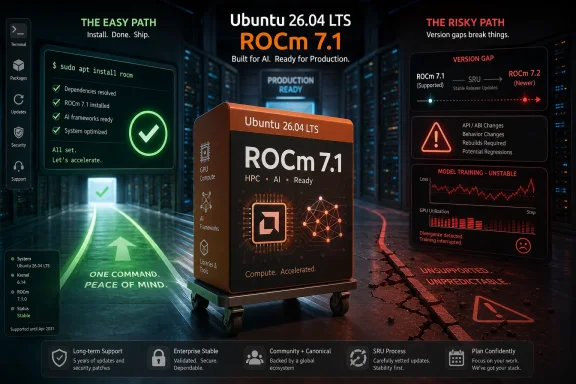 Canonical Turns ROCm Into a Distribution Feature, Not a Weekend Project
For years, the practical story of AMD GPU compute has been less about silicon and more about plumbing. NVIDIA’s CUDA became the default mental model for developers not merely because the hardware was fast, but because the software stack was usually where the documentation said it would be. AMD’s ROCm has improved substantially, yet the experience has often remained fragmented: supported GPU lists, kernel dependencies, distribution-specific instructions, container workarounds, and the familiar Linux ritual of discovering that one apparently minor version mismatch is the whole problem.Ubuntu 26.04 changes the tone. By putting ROCm 7.1 into the Ubuntu Universe repository, Canonical is telling users that AMD acceleration is no longer something bolted onto the operating system from the outside. It is part of the release’s AI pitch, alongside CUDA support and a broader attempt to make Ubuntu the default workstation and server substrate for local models, agent tooling, and developer experimentation.
That matters because packaging is policy. A package in the Ubuntu archive can be installed, updated, mirrored, audited, and managed with the same machinery administrators already use. It also means Canonical can apply its normal release engineering habits: dependency checks, CI pipelines, and Stable Release Updates rather than telling users to paste commands from a vendor page and hope the result survives the next kernel update.
But ROCm is not a text editor. It sits at the awkward intersection of drivers, kernels, compilers, math libraries, runtimes, Python wheels, frameworks, and hardware enablement. Bringing it into the archive lowers the entry barrier; it does not erase the complexity. In fact, it moves that complexity from the user’s terminal into Canonical’s update process.
The One-Command Install Is the Easy Part
The appeal is obvious. If you own a supported AMD GPU, the promise is that AI acceleration becomes something closer to a normal software install. Instead of juggling AMD’s repository setup and hunting for compatibility notes, users can install ROCm from Ubuntu’s package system and get on with running models.That is the right direction. Local AI is no longer just a datacenter sport. Enthusiasts are running LLMs at home, developers are testing inference on workstations, artists are experimenting with diffusion models, and small teams are trying to avoid renting cloud GPUs for every prototype. For those users, the current Linux GPU-compute experience often feels less like engineering and more like archaeology.
Canonical understands the opportunity. Ubuntu already has credibility with developers, cloud operators, and desktop Linux users. If it can make AMD AI acceleration feel routine, Ubuntu becomes more attractive on a class of machines where GPU capability is increasingly central. This is not only about hobbyists asking whether their Radeon card can run a model; it is about whether AMD-based laptops, workstations, and servers can become less risky choices for AI development.
The timing is also commercially useful. AMD has been pushing harder into AI accelerators and data-center GPUs, while consumer and workstation Radeon hardware remains attractive on price and availability. A smoother Ubuntu story gives AMD a friendlier software on-ramp. It also gives Canonical another reason to argue that Ubuntu LTS is not just a conservative server base, but an operating system that can absorb fast-moving AI infrastructure without turning into a rolling-release distribution.
The Version Gap Is Not a Footnote
The uncomfortable detail is that Ubuntu 26.04 arrives with ROCm 7.1 while ROCm 7.2 and subsequent patch releases are already part of the upstream AMD story. Canonical says it is working on newer ROCm versions through Stable Release Updates and that its internal testing is meant to preserve a stable path. That is sensible, but it also exposes the central tension: AI infrastructure moves quickly, while LTS distributions exist to move deliberately.In ordinary desktop software, being one minor version behind is rarely fatal. In AI stacks, it can be the difference between a supported GPU and an unsupported one, a framework build that works and one that refuses to load, or a performance regression that turns a local experiment into a mystery. The people who care about ROCm are often the same people who care about precise versions of PyTorch, TensorFlow, Triton, HIP, MIOpen, RCCL, and every dependency underneath them.
This is where the promise of automatic improvement becomes double-edged. If Canonical holds ROCm too still, Ubuntu looks stale. If Canonical moves ROCm too aggressively, Ubuntu starts to feel like a rolling target. The SRU mechanism is meant to thread that needle, but the needle is narrow because machine-learning stacks are not built like traditional application packages.
The “older version now, newer version later” approach is not necessarily a mistake. Shipping ROCm at all in an LTS release is a significant integration job, and a tested 7.1 can be more useful than a hastily packaged 7.2. But users should understand what they are buying into: Ubuntu is not simply adding an AI toolkit; it is taking responsibility for a compatibility surface that AMD, framework maintainers, and users will all keep stretching.
Automatic Updates Are a Feature Until They Touch Your Model
The risk described in the source material is real, even if the most dramatic version of it needs some qualification. Ubuntu package updates normally do not arrive as total surprises to administrators who pin packages, manage unattended upgrades, use staging machines, or run production workloads in containers. But many desktop users and small teams do accept distribution updates with minimal ceremony, and AI environments are unusually sensitive to small shifts.A ROCm update can change more than a version string. It may alter runtime behavior, supported architectures, compiler assumptions, library paths, kernel interactions, or the way frameworks detect available devices. Even when APIs are intended to remain compatible, the lived reality of GPU compute is that “compatible” often means “compatible if every other layer also cooperates.”
That is why the Windows Update comparison lands, even though it is not technically perfect. Everyone who manages PCs knows the genre: a driver update fixes a real problem for many users and breaks an essential workflow for a few. The vendor sees a net improvement; the affected user sees a lost morning. In AI work, that lost morning may be a failed training run, an irreproducible benchmark, or a demo machine that suddenly cannot find the GPU.
The deeper issue is not whether Canonical will be careless. It is that automatic update systems are designed around the idea that newer packages are normally safer than older ones. AI development often inverts that logic. A known-good environment is valuable precisely because it is known. Once a model, framework, driver, and runtime combination has been validated, change becomes a risk to manage rather than a gift to accept.
LTS Stability Meets AI’s Rolling Release Culture
Ubuntu LTS releases are popular because they promise a stable base. That promise has always been more nuanced than marketing suggests. Security fixes land. Hardware enablement stacks evolve. Browsers update continuously. Some packages receive major refreshes when maintainers decide the alternative is worse.AI workloads push that nuance into the foreground. The ecosystem moves at a pace closer to web development than traditional enterprise Linux. New model architectures appear quickly, framework releases chase accelerator support, and hardware vendors constantly tune libraries to unlock performance that was theoretically present on day one but practically inaccessible until the software caught up.
Canonical’s ROCm plan therefore borrows from two cultures that do not naturally trust each other. From the LTS world, it takes the archive, the SRU process, and the promise of tested updates. From the AI world, it accepts that standing still for two years would make the stack irrelevant. The result is neither pure stability nor pure freshness; it is a managed compromise.
That compromise can work, but only if Canonical is clear about its compatibility guarantees. “We will update ROCm” is not enough. Users need to know whether minor updates can alter ABI expectations, whether older ROCm packages can be retained, how long a given ROCm branch will receive fixes, and whether Ubuntu will document known framework combinations rather than merely declaring the system package installable.
Containers Will Not Save Everyone
The obvious answer from experienced AI developers is containerization. If your ROCm environment matters, freeze it in a container image, pin your base image, specify your framework versions, and treat the host OS as a GPU provider. That is good advice, and for serious work it remains the best default.But containers do not make the host irrelevant. ROCm still depends on kernel drivers, device nodes, firmware, permissions, and runtime components that bridge host and container. A host update can still change what the container sees. Anyone who has debugged GPU pass-through, WSL acceleration, or containerized CUDA and ROCm workloads knows that isolation has limits when the hardware stack is shared.
Containers also do not solve the problem for the audience Canonical is trying to court with a one-command install. The developer experimenting with Ollama, ComfyUI, PyTorch, or a local inference server may not want to become an expert in image pinning and device mapping. The point of putting ROCm into Ubuntu is to make AMD acceleration feel ordinary. If the official answer to update anxiety is “build a disciplined container workflow,” the convenience story starts to thin out.
There is a middle ground. Ubuntu can make ROCm easy for casual use while documenting how advanced users should freeze environments. It can support multiple package streams or provide clear pinning guidance. It can warn when an SRU includes meaningful compatibility changes. None of that is glamorous, but it is exactly the kind of boring operational detail that turns a promising platform feature into something administrators trust.
Windows Users Know This Movie
For a WindowsForum audience, the obvious comparison is not Linux purity versus Microsoft chaos. It is the shared reality that modern operating systems increasingly treat hardware support as a living service. Windows users have seen GPU drivers, printer drivers, chipset packages, and firmware-adjacent components arrive through update channels that were designed for safety but occasionally produce collateral damage.The lesson is not that updates are bad. The lesson is that update systems optimize for fleets, not for your one fragile workflow. Microsoft can improve security and compatibility for millions of machines while still ruining one department’s label printer. Canonical can improve ROCm for most Ubuntu users while still breaking the one PyTorch stack somebody finally got working at 2 a.m.
That is why the “Windows Update Edition” joke is sharper than it first appears. Linux users often imagine package managers as a more transparent alternative to opaque vendor update systems, and in many ways they are. But once a distribution owns a fast-moving hardware-compute stack, it inherits the same governance problem: who decides when your working driver, runtime, or library should change?
The answer, in professional environments, should not be “whoever pushed the update first.” It should be policy. Workstations used for casual inference can track updates quickly. Research machines should stage updates. Production inference servers should pin known-good combinations until validation passes. The operating system can help, but it cannot know the cost of breaking your workload.
AMD Gets a Better Linux Story, but Not a Free Pass
AMD benefits from Canonical’s move because distribution integration reduces one of ROCm’s historic weaknesses: installation friction. The easier ROCm is to install on Ubuntu, the easier it becomes for reviewers, developers, and organizations to evaluate AMD hardware without first discounting it for software hassle. That matters in a market where mindshare is as important as benchmarks.But AMD still owns much of the long-term credibility problem. ROCm’s support matrix has improved, yet users continue to care deeply about which GPUs are officially supported, which ones merely work, and which ones fail because they sit outside the blessed path. If Ubuntu users discover that
apt install rocm works cleanly only for a narrower set of hardware than they expected, frustration will land on both Canonical and AMD.The same is true for framework compatibility. Most users do not wake up wanting ROCm as an abstract achievement. They want PyTorch to see the GPU. They want an inference engine to stop falling back to CPU. They want a diffusion model to run without building half the stack from source. The success metric is not installation; it is usable acceleration.
Canonical can package ROCm, but it cannot by itself make the entire AI ecosystem treat AMD as a first-class target. That requires AMD to keep improving documentation, upstream support, developer relations, and release discipline. Ubuntu 26.04 can be a better front door. The house behind it still has to be habitable.
Enterprise IT Will Treat This as a Change-Control Problem
In managed environments, the correct reaction to Ubuntu’s ROCm integration is neither panic nor blind enthusiasm. It is change control. If ROCm matters to your workload, it belongs in the same governance category as GPU drivers, CUDA toolkits, database engines, and hypervisor components. You test before you roll.That may sound obvious, but AI projects often grow out of informal experimentation. A workstation becomes a shared machine. A shared machine becomes a team dependency. A team dependency becomes a production-adjacent service. Somewhere along the way, the software stack that began as “just install the package” becomes infrastructure.
Ubuntu’s SRU process gives administrators a framework to work with, but it does not replace internal validation. Teams should know which ROCm version they are using, which framework versions are certified against it, and which machines are allowed to receive updates automatically. They should also preserve rollback paths, because GPU compute bugs are often discovered only under real workloads.
The irony is that Canonical’s convenience pitch may make professional discipline more important, not less. When installation was painful, only determined users got far enough to create dependencies. When installation becomes easy, more people will build workflows on top of it. Easy adoption expands the blast radius of bad update hygiene.
The Real Test Comes After 7.2 Lands
ROCm 7.2 is the first obvious test of Canonical’s balancing act. If the update arrives smoothly, preserves practical compatibility, and improves hardware or framework behavior, Ubuntu’s approach will look vindicated. Users will get the freshness they need without leaving the distribution’s guardrails.If the update creates visible breakage, the narrative will harden quickly. The criticism will not be that Canonical shipped an older ROCm version at launch; it will be that Canonical invited users to trust the archive and then moved the ground under them. In software platforms, trust is lost less through delay than through surprise.
This is why communication matters. Release notes should be unusually specific. Known issues should be easy to find. Package transitions should not hide behind generic update language. If a ROCm SRU changes behavior that developers can feel, Canonical should say so plainly before users discover it in a failed run.
A good update story would make Ubuntu more attractive than vendor repositories for many users. A bad one would send advanced users back to manual installs, pinned containers, and forum threads full of incantations. The difference will be decided not by the existence of ROCm in the archive, but by the quality of the next several updates.
The Raccoon’s AI Trick Works Best With a Leash
Ubuntu 26.04’s ROCm integration is still a meaningful step forward, but the safest interpretation is that Canonical has made AMD AI easier to start, not automatically safe to maintain. The practical takeaway is to enjoy the convenience while refusing to surrender control of environments that matter.- Ubuntu 26.04 LTS includes ROCm 7.1 in the Ubuntu archive, making AMD GPU compute easier to install through standard package tools.
- Canonical says newer ROCm versions, including ROCm 7.2, are being prepared through Stable Release Updates rather than requiring users to manage AMD’s repositories manually.
- Automatic or routine package updates can still disrupt AI workflows when runtimes, libraries, frameworks, and drivers depend on precise version combinations.
- Casual local inference users will benefit most from the simplified install path, while training, benchmarking, and production users should pin and validate their environments.
- Containers remain important for reproducibility, but they do not fully isolate AI workloads from host driver, kernel, firmware, and runtime changes.
- AMD and Canonical will be judged less by the first
apt install rocmthan by how reliably the stack survives the next year of updates.
References
- Primary source: Foro3D
Published: 2026-06-03T21:22:07.428480
Ubuntu twenty six point zero four and ROCm: Easy AI, but with tricky updates
Ubuntu 26.04 will integrate AMDs ROCm for easy AI, but with an older version. Canonical promises to automatically update it to version 7.2 and then to recent versions. The convenience for AMD users hides a hidden cost.foro3d.com - Related coverage: phoronix.com
Ubuntu 26.04 Allows "sudo apt install rocm" But It's Months Out-Of-Date - Phoronix
Canonical announced last year that in collaboration with AMD they would be bringing the ROCm software libraries into the Ubuntu archive for Ubuntu 26.04 LTSwww.phoronix.com
- Related coverage: releases.ubuntu.com
- Related coverage: documentation.ubuntu.com
Ubuntu 26.04 LTS changes since 25.10
If you’re upgrading to Ubuntu 26.04 LTS from the previous interim release, Ubuntu 25.10 (Questing Quokka), the following changes apply to you. New features and improvements: Desktop features: GNOME...documentation.ubuntu.com - Related coverage: canonical.com
AI with AMD ROCm on Ubuntu: your questions answered | Canonical
Canonical and AMD teamed up to integrate ROCm AI/ML libraries into Ubuntu 26.04 LTS. Get a seamless, out-of-the-box experience for high-performance AI and HPC on AMD hardware with simple installation and automatic updates.1canonical.com - Related coverage: cn.ubuntu.com

Canonical 发布 Ubuntu 26.04 LTS Resolute Raccoon | Ubuntu
Ubuntu 为企业工作负载提供深度芯片优化与前沿安全防护(第 11 个长期支持版本)。 2026 年 4 月 23 日,Canonical 正式发布代号为 “Resolute Raccoon” 的 Ubuntu 26.04 LTS,用户可通过 Ubuntu 下载页面进行下载并安装。 Resolute Raccoon 在过渡版本推出的高稳定性优化基础上进一步升级,支持 TPM 硬件全盘加密、优化应用权限弹窗提示功能、为基于 Arm® 架构的服务器提供 Livepatch 实时补丁更新,并采用基于 Rust 语言的工具以提升内存安全性。该版本原生支持 NVIDIA CUDA、AMD...
cn.ubuntu.com
- Related coverage: jp.ubuntu.com
Canonical、Ubuntu 26.04 LTS Resolute Raccoonを公開 | Ubuntu
Ubuntuの11番目のLTS(長期サポート)リリースで、エンタープライズワークロード向けにシリコンを高度に最適化し、最新のセキュリティを搭載。 Canonicalは本日、Ubuntu 26.04(コードネーム「Resolute Raccoon」)をリリースしました。jp.ubuntu.com/dow…jp.ubuntu.com - Related coverage: hardwarepremium.com
El estado actual de la integración de ROCm en Ubuntu 26.04 aún está en desarrollo
El estado actual de la integración de ROCm en Ubuntu 26.04 aún está en desarrollo, aunque Canonical prometió una instalación más sencillawww.hardwarepremium.com - Related coverage: agent-wars.com
Ubuntu 26.04 Ships CUDA and ROCm Out of the Box
Agent Wars — Tracking the rise of AI agents. The definitive directory of AI agent platforms, tools, and frameworks. agent-wars.com
- Related coverage: us.releases.ubuntu.com
- Related coverage: rocm.docs.amd.com
