

Valve will launch its new Steam Machine on June 30, 2026, starting at $1,049 for a 512GB model and rising to $1,428 for a 2TB bundle with a Steam Controller and extra faceplates. The reservation window closes June 25 at 10 AM PT, and Valve will notify selected buyers during the week of June 29. The headline is not merely that Valve has priced its console-like PC aggressively; it is that the company has chosen to sell a living-room Linux gaming box at gaming-PC prices while asking customers to trust SteamOS as the value layer. That makes the Steam Machine less a console challenger than a referendum on whether Valve’s ecosystem can now carry hardware that no longer has the Steam Deck’s obvious bargain aura.
The first Steam Machine era failed partly because nobody could explain what a Steam Machine was supposed to be. Was it a console? A small-form-factor PC? A living-room Linux experiment? A way to pressure Microsoft? The new model answers that identity crisis more clearly: it is a compact SteamOS gaming PC built by Valve, designed around a fixed hardware target and a storefront that already dominates PC gaming.
But the price immediately complicates that pitch. At $1,049 for the entry-level 512GB model, Valve is not sneaking under the living-room console market. It is standing several hundred dollars above the price band where PlayStation and Xbox buyers have been trained to expect subsidized hardware, and it is doing so at a moment when even enthusiast PC builders are tired of paying more for less.
That does not automatically make the Steam Machine overpriced. A console is sold as a closed appliance, often with vendor subsidy, platform lock-in, and a long software tail. A PC is sold as a more flexible, more expensive, more open-ended device. Valve’s bet is that enough customers now see SteamOS as the missing middle: console-like behavior without the console business model.
The problem is that this middle is expensive. A $1,049 box has to do more than boot straight into Steam and look neat beside a TV. It has to convince buyers that the software integration, controller story, shader cache, suspend-and-resume behavior, verified compatibility, and living-room polish are worth paying for instead of building or buying a Windows gaming PC.
That split memory arrangement matters. Unlike many console-style designs that rely on unified memory, Valve is putting the GPU on its own VRAM pool. For PC games, especially those built with Windows desktops and discrete GPUs in mind, that should make the Steam Machine feel less like a compromise and more like a standardized low-to-midrange gaming rig.
Still, nobody should mistake this for a miracle box. Six Zen 4 CPU cores are enough for modern gaming, but they are not a workstation flex. Twenty-eight RDNA 3 compute units should make the machine substantially more capable than a handheld, but it will not bend the high-end GPU market around itself. The 8GB of VRAM is likely to be the most argued-over number, because modern PC games have a habit of turning yesterday’s reasonable memory configurations into tomorrow’s texture-setting negotiation.
Valve’s real advantage is not raw specification. It is target discipline. Developers and Valve’s compatibility team can reason about one known Steam Machine profile in a way they never could about the chaotic original Steam Machine ecosystem. The device may not beat a carefully selected gaming PC on value, but it can beat a random living-room PC on predictability.
That structure says something important. Valve knows the Steam audience is large enough, and the supply chain constrained enough, that a conventional preorder button would become a bot contest. The company also knows that a botched launch would damage the narrative before the first units reached living rooms.
The account-history requirement is a familiar anti-scalping move, but it is also a platform-owner privilege. Sony, Microsoft, and Nintendo have used similar loyalty filters and direct-sale queues in various forms, but Valve’s version is particularly natural because Steam accounts already represent years of purchase behavior. A Steam account is not just a login; it is a ledger of customer history.
There is a tradeoff. Randomized or curated reservation systems feel fairer than a checkout stampede, but they also remind everyone that early access is managed scarcity. Valve gets to say it is fighting scalpers. Customers get to wait for an email and hope the algorithm smiles.
On the Steam Deck, SteamOS solves an obvious problem. Windows was never designed to be delightful on a small handheld with thumbsticks, a battery, and a sleep button. SteamOS made PC gaming feel appliance-like, and Proton made enough Windows games work that the exceptions became manageable.
In the living room, the comparison is harsher. Windows may be clumsy on a TV, but it remains familiar, compatible, and brutally practical. A mini gaming PC running Windows can access every launcher, every anti-cheat configuration that supports Windows, every mod utility, and every oddball peripheral driver a player might need.
Valve therefore has to sell SteamOS not as a workaround, but as an upgrade. The pitch is that a living-room PC should stop behaving like a desktop with an HDMI cable and start behaving like a console that happens to play PC games. If Valve gets that right, the Steam Machine becomes more than a hardware SKU. It becomes a credible answer to the question Windows has never quite solved: why is the PC still so awkward from ten feet away?
Valve’s new approach removes the partner chaos. The company now controls the hardware, the OS, the storefront, the verification program, and the controller integration. That is the right lesson from the Steam Deck. Valve learned that if it wants a platform experience, it cannot outsource the platform feeling.
But the new pricing revives the hardest old question: why buy this instead of a PC? At $1,049, the buyer is no longer making an impulse purchase. At $1,428 for the 2TB bundle with controller and faceplates, the buyer is well into enthusiast territory. Valve can argue that comparable compact Windows gaming PCs are not cheap either, especially when built with dedicated graphics and living-room acoustics in mind. Even so, the customer’s mental comparison will not be neat.
Some will compare it with a PlayStation 5 or Xbox Series X and see sticker shock. Others will compare it with a self-built PC and see less flexibility. The Steam Machine’s natural customer is narrower: someone with a deep Steam library, a preference for console-style use, some tolerance for Linux compatibility boundaries, and enough money to pay for integration.
That customer exists. The Steam Deck proved it. The open question is whether that customer exists in living-room numbers.
But Valve has always treated input as strategic. The first Steam Controller was strange, divisive, and more influential than its sales suggested. It tried to solve the problem of playing PC games from a couch when those games assumed a mouse, keyboard, or standard gamepad. The new controller’s presence in the premium bundle signals that Valve still sees the living room as an input problem as much as a compute problem.
The integrated wireless adapter inside both Steam Machine models reinforces that point. Valve does not want the Steam Controller to feel like a Bluetooth afterthought. It wants the box and controller to behave as a single system, with low friction and fewer living-room support headaches.
That is exactly the kind of detail that can separate a platform device from a small PC. It is also the kind of detail that customers often underestimate until it works well. If pairing, wake, latency, remapping, gyro, and Steam Input profiles are seamless, Valve gains an advantage that does not show up in a spec table.
The microSD slot helps, especially for less demanding games, emulation-adjacent libraries where legal ownership applies, and archival storage. But a microSD card is not a substitute for a roomy internal NVMe drive when modern games expect fast storage and when shader caches, updates, and downloadable content keep expanding.
That makes the 2TB configuration more attractive than Valve might like. The base model gets the starting price into four figures instead of higher into four figures, but many buyers will look at 512GB and immediately price in an upgrade. If the machine is easy to open and upgrade, that softens the blow. If it is fussy, the premium bundle starts looking less optional.
The awkward part is that storage pricing is visible to PC buyers. Enthusiasts know roughly what SSDs cost, even when supply swings distort the market. A large jump between configurations always invites accusations that the vendor is monetizing convenience. Valve may not be alone in doing that, but Steam customers are not console customers conditioned to treat internal storage as a sealed platform tax.
Windows remains the compatibility king. It is still the default target for PC game developers, GPU driver teams, anti-cheat vendors, modding tools, performance overlays, capture software, and obscure peripherals. For many players, that ecosystem gravity outweighs any annoyance caused by desktop pop-ups on a television.
But Microsoft has never made the Windows gaming PC feel like a console without making it feel like a skin over Windows. Big Picture-style interfaces, launcher overlays, and controller-friendly shells help only until a driver update, account prompt, installer dialog, or anti-cheat error drags the user back to the desktop. Valve’s opportunity is not that Windows cannot play the games. It is that Windows often cannot stay out of the way.
The Steam Machine is therefore a pressure campaign. If it succeeds, it tells Microsoft that the gaming PC experience cannot remain an operating-system afterthought. If it fails, it still shows that a meaningful portion of the market wants something cleaner than a tower under the TV and less locked down than a console.
For a launch like this, that is probably the right call. The Steam Machine is not being positioned as a mass-market console for people with no Steam history. Its first wave should go to users who already own libraries, understand Steam, and are more likely to judge the device as a SteamOS PC rather than a PlayStation replacement.
That early audience matters because first impressions will be disproportionately loud. If the initial units land with Linux-curious enthusiasts and Steam Deck veterans, Valve gets testers who understand the premise. If they land mostly with scalpers or confused console shoppers, Valve gets anger, returns, and bad social media clips.
There is a risk in preaching to the installed base, though. The Steam Machine needs enthusiasts to validate it, but it eventually needs normal households to understand it. A reservation system that begins as anti-scalper hygiene can also make the product feel clubby, scarce, and opaque.
Size alone is not enough. Thermals and acoustics will decide whether the Steam Machine feels premium or merely dense. A compact gaming PC with a dedicated GPU-class component can become irritating quickly if fan noise ramps under load. Console buyers are relatively intolerant of that, and PC buyers know enough to listen for it.
Valve’s experience with the Steam Deck should help. The company has already learned hard lessons about power envelopes, suspend behavior, shader compilation, and the difference between benchmark performance and perceived smoothness. But a plugged-in TV box has different expectations. It is allowed to use more power, but it is also expected to run bigger screens, longer sessions, and more ambitious settings.
If Valve has tuned the Steam Machine around realistic living-room targets rather than marketing fantasy, it has a chance. If buyers expect uncompromised 4K gaming from a compact $1,049 Linux box, disappointment will arrive quickly. The device’s success may depend on whether Valve can message performance honestly before YouTube does it for them.
That does not make it a console in the traditional development sense. There is no exclusive runtime, no single closed certification path, and no guarantee that every Steam game will behave. The value is softer but still important: developers can see a known Valve device, with known controls, known display assumptions, known OS behavior, and known customer expectations.
That could improve the Verified-style ecosystem around Steam Machine. Games that already run well on Steam Deck may have a path to looking better on the living-room device. Games that miss Deck targets because the handheld is too constrained may suddenly become good candidates for a SteamOS TV profile.
The risk is that the market remains too small to influence development priorities. Studios optimize where customers are. Valve can create the target, promote the badge, and smooth the tooling, but it cannot force publishers to care unless the hardware sells.
That last point is critical because Valve hardware has a complicated history. The company has produced brilliant experiments, abandoned oddities, and category-shaping successes. The Steam Deck changed the way many people think about PC gaming. The original Steam Machines did not. The Steam Controller became a cult object. Steam Link became a useful idea that survived better as software than as a box.
Customers remember all of that, even if they do not list it out. A $1,049 purchase demands confidence that the device is not just another Valve moonshot. The reservation process can create launch excitement, but long-term trust will come from updates, repairability, replacement parts, transparent compatibility work, and visible iteration.
Valve has one advantage few hardware companies enjoy: its store gives it a reason to care after the sale. Every Steam Machine that keeps a customer buying and playing inside Steam is valuable beyond the hardware margin. That incentive does not guarantee good support, but it aligns Valve’s interests with continued platform health better than a one-and-done gadget business would.
That makes the Steam Machine a convenience purchase. It reduces friction, centralizes the experience, and avoids the weirdness of streaming from a machine someone else in the house might be using. But convenience at $1,049 is a premium proposition.
For some households, that premium will be reasonable. A compact, quiet, controller-integrated SteamOS box could be cleaner than dragging a tower into the living room or maintaining a separate Windows install for couch gaming. For others, it will be a luxury version of a problem they already solved.
This is where Valve’s software polish becomes decisive. If the Steam Machine merely launches games, it is expensive. If it makes a Steam library feel native to the television in a way Windows still does not, the price becomes easier to understand. Not cheap, but understandable.
The more important test is friction. How quickly does a reservation holder go from box opening to game launch? How often does the system expose the Linux desktop? How graceful are unsupported games? How readable are settings on a television? How reliable is suspend and resume? How seamless is controller wake? How much does the user need to know?
Valve’s achievement with the Steam Deck was not that it made Linux gaming perfect. It made imperfections feel bounded. A game might be unsupported, but the overall device still felt coherent. The Steam Machine needs the same emotional contract at a higher price and on a bigger screen.
If that contract holds, Valve can survive arguments about whether the GPU should have been larger or the SSD cheaper. If it breaks, every price complaint becomes louder. Expensive hardware is allowed to have limitations; it is not allowed to feel unfinished.
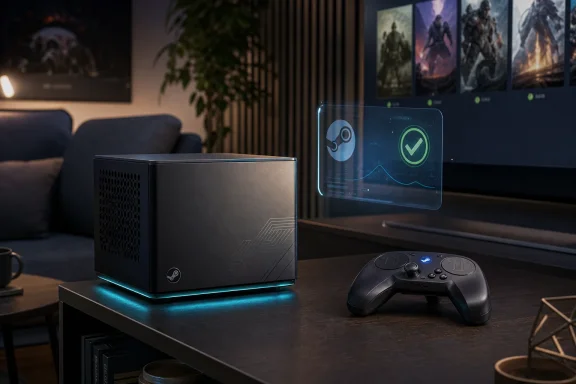 Valve Is Selling a Console Shape at PC Prices
The first Steam Machine era failed partly because nobody could explain what a Steam Machine was supposed to be. Was it a console? A small-form-factor PC? A living-room Linux experiment? A way to pressure Microsoft? The new model answers that identity crisis more clearly: it is a compact SteamOS gaming PC built by Valve, designed around a fixed hardware target and a storefront that already dominates PC gaming.But the price immediately complicates that pitch. At $1,049 for the entry-level 512GB model, Valve is not sneaking under the living-room console market. It is standing several hundred dollars above the price band where PlayStation and Xbox buyers have been trained to expect subsidized hardware, and it is doing so at a moment when even enthusiast PC builders are tired of paying more for less.
That does not automatically make the Steam Machine overpriced. A console is sold as a closed appliance, often with vendor subsidy, platform lock-in, and a long software tail. A PC is sold as a more flexible, more expensive, more open-ended device. Valve’s bet is that enough customers now see SteamOS as the missing middle: console-like behavior without the console business model.
The problem is that this middle is expensive. A $1,049 box has to do more than boot straight into Steam and look neat beside a TV. It has to convince buyers that the software integration, controller story, shader cache, suspend-and-resume behavior, verified compatibility, and living-room polish are worth paying for instead of building or buying a Windows gaming PC.
The Specs Are Sensible, Not Miraculous
The hardware reads like Valve is trying to avoid the two classic traps of prebuilt gaming boxes: exotic parts that age badly, and underpowered silicon that never had a chance. The semi-custom AMD processor combines a Zen 4 six-core, twelve-thread CPU with a semi-custom RDNA 3 GPU carrying 28 compute units. The system also includes 16GB of DDR5 system memory and 8GB of dedicated GDDR6 VRAM.That split memory arrangement matters. Unlike many console-style designs that rely on unified memory, Valve is putting the GPU on its own VRAM pool. For PC games, especially those built with Windows desktops and discrete GPUs in mind, that should make the Steam Machine feel less like a compromise and more like a standardized low-to-midrange gaming rig.
Still, nobody should mistake this for a miracle box. Six Zen 4 CPU cores are enough for modern gaming, but they are not a workstation flex. Twenty-eight RDNA 3 compute units should make the machine substantially more capable than a handheld, but it will not bend the high-end GPU market around itself. The 8GB of VRAM is likely to be the most argued-over number, because modern PC games have a habit of turning yesterday’s reasonable memory configurations into tomorrow’s texture-setting negotiation.
Valve’s real advantage is not raw specification. It is target discipline. Developers and Valve’s compatibility team can reason about one known Steam Machine profile in a way they never could about the chaotic original Steam Machine ecosystem. The device may not beat a carefully selected gaming PC on value, but it can beat a random living-room PC on predictability.
The Reservation System Is a Confession About Demand and Supply
Valve is not using a simple first-come, first-served preorder race. Instead, sign-ups are open until June 25 at 10 AM PT, after which selected customers will receive emails during the week of June 29. Applicants need a Steam account in good standing and must have made a purchase before April 27, 2026. Valve is also limiting reservations to one per household.That structure says something important. Valve knows the Steam audience is large enough, and the supply chain constrained enough, that a conventional preorder button would become a bot contest. The company also knows that a botched launch would damage the narrative before the first units reached living rooms.
The account-history requirement is a familiar anti-scalping move, but it is also a platform-owner privilege. Sony, Microsoft, and Nintendo have used similar loyalty filters and direct-sale queues in various forms, but Valve’s version is particularly natural because Steam accounts already represent years of purchase behavior. A Steam account is not just a login; it is a ledger of customer history.
There is a tradeoff. Randomized or curated reservation systems feel fairer than a checkout stampede, but they also remind everyone that early access is managed scarcity. Valve gets to say it is fighting scalpers. Customers get to wait for an email and hope the algorithm smiles.
SteamOS Has Become the Product, Not the Side Project
The most important component in the Steam Machine is not the CPU, GPU, SSD, or controller dongle. It is SteamOS 3. Valve spent years turning Linux gaming from a defiant hobby into a surprisingly normal consumer experience, and the Steam Deck was the proof point. The Steam Machine asks whether that proof can move from handheld convenience to living-room permanence.On the Steam Deck, SteamOS solves an obvious problem. Windows was never designed to be delightful on a small handheld with thumbsticks, a battery, and a sleep button. SteamOS made PC gaming feel appliance-like, and Proton made enough Windows games work that the exceptions became manageable.
In the living room, the comparison is harsher. Windows may be clumsy on a TV, but it remains familiar, compatible, and brutally practical. A mini gaming PC running Windows can access every launcher, every anti-cheat configuration that supports Windows, every mod utility, and every oddball peripheral driver a player might need.
Valve therefore has to sell SteamOS not as a workaround, but as an upgrade. The pitch is that a living-room PC should stop behaving like a desktop with an HDMI cable and start behaving like a console that happens to play PC games. If Valve gets that right, the Steam Machine becomes more than a hardware SKU. It becomes a credible answer to the question Windows has never quite solved: why is the PC still so awkward from ten feet away?
The Price Reopens the Old Steam Machine Argument
The original Steam Machines suffered from fragmentation, weak messaging, and hardware partners that could not agree on what market they were serving. Some models were cheap and underpowered. Others were expensive and difficult to justify. The result was a category that sounded bold in theory and looked confused on retail shelves.Valve’s new approach removes the partner chaos. The company now controls the hardware, the OS, the storefront, the verification program, and the controller integration. That is the right lesson from the Steam Deck. Valve learned that if it wants a platform experience, it cannot outsource the platform feeling.
But the new pricing revives the hardest old question: why buy this instead of a PC? At $1,049, the buyer is no longer making an impulse purchase. At $1,428 for the 2TB bundle with controller and faceplates, the buyer is well into enthusiast territory. Valve can argue that comparable compact Windows gaming PCs are not cheap either, especially when built with dedicated graphics and living-room acoustics in mind. Even so, the customer’s mental comparison will not be neat.
Some will compare it with a PlayStation 5 or Xbox Series X and see sticker shock. Others will compare it with a self-built PC and see less flexibility. The Steam Machine’s natural customer is narrower: someone with a deep Steam library, a preference for console-style use, some tolerance for Linux compatibility boundaries, and enough money to pay for integration.
That customer exists. The Steam Deck proved it. The open question is whether that customer exists in living-room numbers.
The Controller Bundle Is Doing More Work Than It Seems
The premium package is not simply a storage bump. It includes the Steam Controller and two additional faceplates, with red fabric and solid walnut finishes. That sounds like boutique garnish, and in one sense it is. Nobody needs walnut on a game controller accessory story.But Valve has always treated input as strategic. The first Steam Controller was strange, divisive, and more influential than its sales suggested. It tried to solve the problem of playing PC games from a couch when those games assumed a mouse, keyboard, or standard gamepad. The new controller’s presence in the premium bundle signals that Valve still sees the living room as an input problem as much as a compute problem.
The integrated wireless adapter inside both Steam Machine models reinforces that point. Valve does not want the Steam Controller to feel like a Bluetooth afterthought. It wants the box and controller to behave as a single system, with low friction and fewer living-room support headaches.
That is exactly the kind of detail that can separate a platform device from a small PC. It is also the kind of detail that customers often underestimate until it works well. If pairing, wake, latency, remapping, gyro, and Steam Input profiles are seamless, Valve gains an advantage that does not show up in a spec table.
Storage Is the Upgrade Everyone Will Argue About
The base model includes a 512GB NVMe SSD, while the premium version raises storage to 2TB. In 2026, 512GB is a difficult starting point for a living-room gaming system. It is not unusable, but it is psychologically cramped. Large PC games routinely push past 100GB, and a machine built around a Steam library invites experimentation, not restraint.The microSD slot helps, especially for less demanding games, emulation-adjacent libraries where legal ownership applies, and archival storage. But a microSD card is not a substitute for a roomy internal NVMe drive when modern games expect fast storage and when shader caches, updates, and downloadable content keep expanding.
That makes the 2TB configuration more attractive than Valve might like. The base model gets the starting price into four figures instead of higher into four figures, but many buyers will look at 512GB and immediately price in an upgrade. If the machine is easy to open and upgrade, that softens the blow. If it is fussy, the premium bundle starts looking less optional.
The awkward part is that storage pricing is visible to PC buyers. Enthusiasts know roughly what SSDs cost, even when supply swings distort the market. A large jump between configurations always invites accusations that the vendor is monetizing convenience. Valve may not be alone in doing that, but Steam customers are not console customers conditioned to treat internal storage as a sealed platform tax.
Windows Is the Unnamed Rival in Every Room
For WindowsForum readers, the Steam Machine is interesting precisely because it is not running Windows. Valve is selling a PC-shaped device that attempts to make Windows unnecessary for a large slice of PC gaming. That does not mean Windows gaming is in trouble. It means Microsoft has ceded enough of the living-room user experience that Valve can plausibly attack it.Windows remains the compatibility king. It is still the default target for PC game developers, GPU driver teams, anti-cheat vendors, modding tools, performance overlays, capture software, and obscure peripherals. For many players, that ecosystem gravity outweighs any annoyance caused by desktop pop-ups on a television.
But Microsoft has never made the Windows gaming PC feel like a console without making it feel like a skin over Windows. Big Picture-style interfaces, launcher overlays, and controller-friendly shells help only until a driver update, account prompt, installer dialog, or anti-cheat error drags the user back to the desktop. Valve’s opportunity is not that Windows cannot play the games. It is that Windows often cannot stay out of the way.
The Steam Machine is therefore a pressure campaign. If it succeeds, it tells Microsoft that the gaming PC experience cannot remain an operating-system afterthought. If it fails, it still shows that a meaningful portion of the market wants something cleaner than a tower under the TV and less locked down than a console.
The Anti-Scalper Rules Double as Ecosystem Gatekeeping
Valve’s reservation rules are practical, but they also reveal how platform power works. A Steam account in good standing with a purchase before April 27, 2026, becomes a ticket to the launch queue. That makes sense if the goal is to keep freshly created bot accounts away from scarce hardware. It also privileges existing Steam customers over would-be converts.For a launch like this, that is probably the right call. The Steam Machine is not being positioned as a mass-market console for people with no Steam history. Its first wave should go to users who already own libraries, understand Steam, and are more likely to judge the device as a SteamOS PC rather than a PlayStation replacement.
That early audience matters because first impressions will be disproportionately loud. If the initial units land with Linux-curious enthusiasts and Steam Deck veterans, Valve gets testers who understand the premise. If they land mostly with scalpers or confused console shoppers, Valve gets anger, returns, and bad social media clips.
There is a risk in preaching to the installed base, though. The Steam Machine needs enthusiasts to validate it, but it eventually needs normal households to understand it. A reservation system that begins as anti-scalper hygiene can also make the product feel clubby, scarce, and opaque.
The Compact Box Has to Win the Living Room Physically
Valve’s chassis is described as measuring roughly six inches on each side. That is small enough to matter. The living room punishes hardware that looks like a PC, sounds like a PC, or demands PC-like cable sprawl. A cube that can disappear onto a media shelf has a better chance of being treated as an appliance.Size alone is not enough. Thermals and acoustics will decide whether the Steam Machine feels premium or merely dense. A compact gaming PC with a dedicated GPU-class component can become irritating quickly if fan noise ramps under load. Console buyers are relatively intolerant of that, and PC buyers know enough to listen for it.
Valve’s experience with the Steam Deck should help. The company has already learned hard lessons about power envelopes, suspend behavior, shader compilation, and the difference between benchmark performance and perceived smoothness. But a plugged-in TV box has different expectations. It is allowed to use more power, but it is also expected to run bigger screens, longer sessions, and more ambitious settings.
If Valve has tuned the Steam Machine around realistic living-room targets rather than marketing fantasy, it has a chance. If buyers expect uncompromised 4K gaming from a compact $1,049 Linux box, disappointment will arrive quickly. The device’s success may depend on whether Valve can message performance honestly before YouTube does it for them.
Developers Get a Target, but Not a New Console
One of the more subtle consequences of Valve-built hardware is that developers finally get a SteamOS living-room target that is not imaginary. The Steam Deck created a performance profile that studios could test against and optimize for. A fixed Steam Machine configuration could do something similar for higher-power couch gaming.That does not make it a console in the traditional development sense. There is no exclusive runtime, no single closed certification path, and no guarantee that every Steam game will behave. The value is softer but still important: developers can see a known Valve device, with known controls, known display assumptions, known OS behavior, and known customer expectations.
That could improve the Verified-style ecosystem around Steam Machine. Games that already run well on Steam Deck may have a path to looking better on the living-room device. Games that miss Deck targets because the handheld is too constrained may suddenly become good candidates for a SteamOS TV profile.
The risk is that the market remains too small to influence development priorities. Studios optimize where customers are. Valve can create the target, promote the badge, and smooth the tooling, but it cannot force publishers to care unless the hardware sells.
The Steam Machine Is a Test of Trust
Valve is asking buyers to trust several things at once. Trust that SteamOS compatibility is broad enough. Trust that Proton and driver updates will keep improving. Trust that anti-cheat holdouts will become less painful over time. Trust that the hardware will remain useful as game requirements rise. Trust that the company will support a living-room device with the same persistence it has shown with the Steam Deck.That last point is critical because Valve hardware has a complicated history. The company has produced brilliant experiments, abandoned oddities, and category-shaping successes. The Steam Deck changed the way many people think about PC gaming. The original Steam Machines did not. The Steam Controller became a cult object. Steam Link became a useful idea that survived better as software than as a box.
Customers remember all of that, even if they do not list it out. A $1,049 purchase demands confidence that the device is not just another Valve moonshot. The reservation process can create launch excitement, but long-term trust will come from updates, repairability, replacement parts, transparent compatibility work, and visible iteration.
Valve has one advantage few hardware companies enjoy: its store gives it a reason to care after the sale. Every Steam Machine that keeps a customer buying and playing inside Steam is valuable beyond the hardware margin. That incentive does not guarantee good support, but it aligns Valve’s interests with continued platform health better than a one-and-done gadget business would.
The Real Competition Is the PC You Already Own
The Steam Machine’s hardest rival may not be a console or a new gaming desktop. It may be the Windows PC already sitting in another room. Steam Remote Play, Moonlight-style streaming setups, long HDMI runs, and handheld PCs have all trained enthusiasts to solve living-room gaming in improvised ways.That makes the Steam Machine a convenience purchase. It reduces friction, centralizes the experience, and avoids the weirdness of streaming from a machine someone else in the house might be using. But convenience at $1,049 is a premium proposition.
For some households, that premium will be reasonable. A compact, quiet, controller-integrated SteamOS box could be cleaner than dragging a tower into the living room or maintaining a separate Windows install for couch gaming. For others, it will be a luxury version of a problem they already solved.
This is where Valve’s software polish becomes decisive. If the Steam Machine merely launches games, it is expensive. If it makes a Steam library feel native to the television in a way Windows still does not, the price becomes easier to understand. Not cheap, but understandable.
The June 30 Launch Will Be Judged by Friction, Not Frames
Launch-day coverage will inevitably fixate on frame rates, settings comparisons, thermals, teardown shots, and SSD upgrade paths. Those matter. They will define whether the box is a good PC. But they will not fully define whether it is a good Steam Machine.The more important test is friction. How quickly does a reservation holder go from box opening to game launch? How often does the system expose the Linux desktop? How graceful are unsupported games? How readable are settings on a television? How reliable is suspend and resume? How seamless is controller wake? How much does the user need to know?
Valve’s achievement with the Steam Deck was not that it made Linux gaming perfect. It made imperfections feel bounded. A game might be unsupported, but the overall device still felt coherent. The Steam Machine needs the same emotional contract at a higher price and on a bigger screen.
If that contract holds, Valve can survive arguments about whether the GPU should have been larger or the SSD cheaper. If it breaks, every price complaint becomes louder. Expensive hardware is allowed to have limitations; it is not allowed to feel unfinished.
The Price Tag Turns Valve’s Experiment Into a Platform Trial
The practical shape of the launch is now clear, even if the market verdict is not. Valve has put a premium price on a standardized SteamOS living-room PC and is using a filtered reservation system to keep early demand from turning into a scalper carnival.- The Steam Machine launches June 30, 2026, with reservation sign-ups closing June 25 at 10 AM PT.
- The 512GB model starts at $1,049, while the 2TB bundle with a Steam Controller and extra faceplates reaches $1,428.
- The hardware is built around a semi-custom AMD Zen 4 CPU and RDNA 3 GPU, with 16GB of DDR5 memory and 8GB of GDDR6 VRAM.
- The reservation rules favor established Steam users, requiring an account in good standing and a purchase before April 27, 2026.
- The device’s success will depend less on beating every Windows PC benchmark and more on making SteamOS feel like the natural living-room home for a PC game library.
References
- Primary source: Noisy Pixel
Published: 2026-06-22T20:01:24.448074
- Related coverage: tech4gamers.com
Steam Machine Priced At $1050; 2TB Variant To Cost Nearly $1500
Valve has finally shared official details regarding the Steam Machine, confirming a steep MSRP of over $1000. tech4gamers.com
- Related coverage: as.com
- Related coverage: tomshardware.com
Valve says Steam Machine and Steam Frame 'shipping this summer' — company confirms release window as it expands Verified program | Tom's Hardware
2026's most anticipated gaming product is finally ready to ship.www.tomshardware.com - Related coverage: windowscentral.com
"We want to manage expectations": Valve's Steam Controller reservations extend into 2027 as it tries "to get as many out" as possible amid restock hopes | Windows Central
If you haven't reserved a Steam Controller yet, Valve says you won't get one until 2027.www.windowscentral.com - Related coverage: gamesradar.com
Valve's Steam Machine reservation page code points towards four package flavors, and two could ditch the controller | GamesRadar+
Valve has seemingly added four Steam Machine product codes to its reservation JavaScript, and it could mean different bundles with and without the controller.www.gamesradar.com
- Related coverage: darkhorizons.com
Valve Unveils Steam Machine Pricing - Dark Horizons
Valve has unveiled the pricing for its new Steam Machines, which will arrive this Summer, and a console killer this ain’t. The machine will be available in four configurations: two with a 512Gb hard disk and two with a 2Tb hard disk. The only difference between the two of each size is the... www.darkhorizons.com
- Related coverage: overclock3d.net
It's dead... - Valve launches its Steam Machine - OC3D
Valve's Steam Machine has launched, and in my eyes it is dead on arrival. It's too pricy for what it is, and we can't blame Valve for that.overclock3d.net - Related coverage: cashwalklabs.io
Valve reservation code reportedly references four Steam Machine packages | Global Cashwalk
Steam Machine package IDs appear in Valve reservation system update Steam Machine may use the same reservation system as the Steam Controller, based oncashwalklabs.io - Related coverage: store.steampowered.com
Save 40% on Vending Machine Co. on Steam
Run your kawaii vending machine company! A relaxing sim where you manage, restock, and repair your vending machines across a charming Japanese city. Pick neighborhoods, stock up on snacks, set the perfect price, upgrade your machines. Enjoy lots of fun minigames along the way.store.steampowered.com
- Related coverage: frandroid.com
Steam Machine : suite au fiasco du Steam Controller, Valve instaure un tirage au sort bien plus équitable pour les précommandes — Frandroid
Valve ouvre les pré-commandes de sa Steam Machine, mais oublie le clic le plus rapide : cette fois, c'est un tirage au sort qui décide qui achète. Une répowww.frandroid.com - Related coverage: comicbook.com
New Valve Report Teases Imminent Steam Machine Release
Valve seems to be in the final phases of preparing to release the Steam Machine if a new report is any indication.comicbook.com
