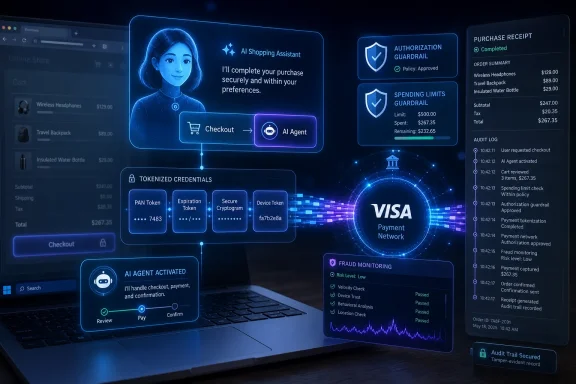
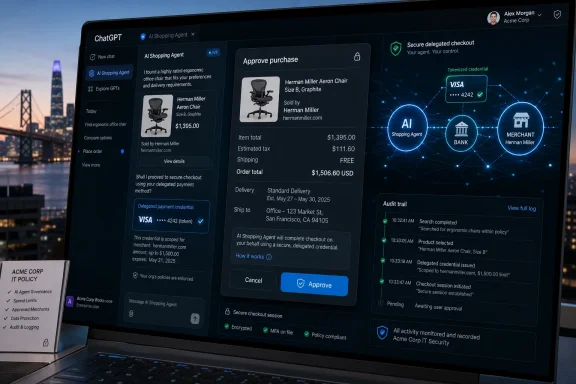
Visa announced on June 10, 2026, at its Visa Payments Forum in San Francisco that it is partnering with OpenAI to embed Visa payment infrastructure into OpenAI experiences, letting AI agents initiate purchases on users’ cards under defined permissions and security controls. The pitch is not merely that ChatGPT might help you find a new laptop bag or book a trip. It is that the assistant could become an authorized actor in the payment chain. That makes this less a shopping feature than a bid to decide who governs the next checkout button.
The most important word in Visa’s announcement is not “AI.” It is “authorized.”
For years, payments companies have sold convenience as a sequence of disappearing steps: the magnetic stripe gave way to the chip, the chip gave way to contactless, passwords gave way to wallets, and checkout pages gave way to one-click buying. Agentic commerce asks for a larger leap. It asks consumers to let software not only recommend a product, but act on their intent, present credentials, and trigger a real financial transaction.
That leap breaks the assumptions under much of online commerce. A merchant website can tell when a browser session is associated with a device, an account, a shipping address, and a payment credential. It can make educated guesses about fraud. But an AI agent shopping across the web looks, from many merchants’ point of view, uncomfortably similar to automation: a bot with purchasing power.
Visa’s partnership with OpenAI is an attempt to make that bot legible. The agent is not supposed to be a mysterious script scraping catalog pages and pasting card details into forms. It is supposed to carry identity signals, operate within user-set limits, and present payment credentials that can be tokenized, scoped, monitored, and revoked.
That framing matters because the checkout page has always been more than a form. It is a trust ritual. The consumer confirms the merchant, the amount, the shipping details, the payment method, and the final click. Visa and OpenAI are now proposing to redistribute that ritual between the user, the AI assistant, the merchant, and the payment network.
The basic idea is familiar to anyone who has used Apple Pay, Google Pay, or a modern card-on-file system. Instead of exposing the underlying primary account number, the system uses a token that represents the payment credential in a constrained context. If the token is stolen or misused, the blast radius is smaller than if the actual card number has leaked.
With AI agents, the constraint becomes more complicated. A token may need to be bound not only to a cardholder and a merchant, but also to an agent, a task, a spending limit, a time window, and a category of purchase. “Buy dishwasher detergent under $25” is a very different authorization from “book any flight to New York next week,” and both are different from “handle monthly software renewals for a small business.”
That is where Visa’s existing machinery becomes valuable. The company already operates global authorization, risk scoring, dispute, token, and fraud-monitoring systems. Its strategic claim is that these rails can be extended into AI-mediated commerce without asking every merchant, bank, developer, and consumer to invent a new trust model from scratch.
OpenAI brings the interface and the agent. Visa brings the payment infrastructure that tells the rest of the world the transaction is not just some bot doing bot things. In theory, that combination lets an assistant shop without ever being handed the raw credential it could leak, hallucinate around, or expose through a compromised integration.
The user is expected to define permissions. That may include spending ceilings, allowed merchant categories, trusted sellers, approval thresholds, and cases where the agent must stop and ask before completing the purchase. The agent does the comparison shopping, the form-filling, and eventually the payment initiation, but the authority comes from a human-defined boundary.
The interesting question is whether consumers will experience that as control or as configuration burden. A normal checkout screen is annoying, but it is obvious. You can see the final price and press the button. Agentic commerce replaces that moment with a policy: “You may buy household staples under $50 from these merchants, but ask me before substitutions.”
That may be powerful for repeat purchases, corporate procurement, travel policies, and other areas where rules already exist. It may be far less comfortable for emotional, high-value, or ambiguous purchases. Nobody wants an AI agent confidently buying the wrong appliance because it found a discount, misunderstood a compatibility note, or optimized for price when the user cared about warranty support.
This is where agentic commerce runs into the oldest problem in automation. The more useful the system becomes, the more authority it needs. The more authority it gets, the more painful its mistakes become.
Instant Checkout, launched in September 2025 with Stripe and the Agentic Commerce Protocol, was the first big signal that OpenAI wanted shopping to happen inside the chat interface rather than after a referral click. The user could ask for a product, inspect options, and buy without leaving ChatGPT, at least in supported flows. Etsy was the initial live example, with Shopify merchants positioned as the next expansion path.
The Visa partnership is different in emphasis. Stripe’s role was about enabling a native checkout experience and a protocol for merchants and payment providers. Visa is trying to provide a broader credential and authorization layer that can work across the card ecosystem. That is a natural ambition for a network whose business depends on being present when value changes hands.
OpenAI benefits because it does not have to persuade the world that ChatGPT alone should be trusted with money movement. It can point to Visa’s infrastructure, banks, tokens, fraud models, and merchant acceptance. That does not solve every problem, but it gives the agent a passport into the existing payment system.
It also gives OpenAI a way to deepen commercial activity without presenting itself as the merchant of record, the payment processor, and the bank all at once. For a company already under scrutiny for market power, data handling, safety, and platform dependency, that separation is not cosmetic. It is a risk-management strategy.
Visa has its Trusted Agent Protocol. Mastercard has been pushing Agent Pay. Stripe and OpenAI co-developed the Agentic Commerce Protocol. Google has been advancing its own agent payments work alongside broader commerce protocols. Stripe and Tempo have explored machine-payment infrastructure with stablecoin-friendly assumptions. Coinbase’s x402 points toward a world where agents pay for online services directly using crypto-native rails.
The common thread is obvious: every major platform wants to define how an agent proves who it is, what it is allowed to do, and how it pays. The differences matter. Some approaches center card networks. Some center payment processors. Some center merchants. Some center web protocols. Some imagine stablecoins or programmable money as the natural payment substrate for machines.
This is why Visa’s announcement should not be read as a finished product launch. It is a positioning move in a fight over defaults. If ChatGPT becomes a major shopping interface, the payment method that feels native inside ChatGPT gains power. If merchants need to optimize for agent traffic, the protocol that large platforms support becomes the integration priority. If banks want to remain relevant, they will prefer models that preserve cardholder controls, issuer authorization, and familiar dispute processes.
Standards often look boring until they determine who gets taxed. In agentic commerce, the standard may decide whether the economics flow through card networks, processors, wallets, stablecoin systems, app stores, retailer platforms, or AI assistants themselves.
The card network’s power comes from being in the path of a transaction. If the consumer’s AI agent still pays with a Visa credential, Visa remains part of authorization, risk, settlement, and economics. If agents begin transacting through stablecoin protocols, account-to-account transfers, wallet balances, closed-loop merchant credits, or platform-native payment instruments, the card network’s role becomes less guaranteed.
That threat is not theoretical. AI agents are software, and software tends to route around friction. If one payment method is cheaper, programmable, globally available, and easier for agents to use, developers will experiment with it. Merchants have long complained about card fees. Platforms have long wanted more control over payment flows. Stablecoin advocates are eager to frame machine payments as a use case where traditional card rails look overbuilt or expensive.
Visa’s answer is to make card rails programmable enough that developers do not feel compelled to leave. Tokenized credentials, agent identity, usage limits, fraud scoring, and automated authorization are all ways of saying: the existing network can do this too.
That is the core strategic bet. Visa does not need every AI payment to look like today’s checkout page. It needs tomorrow’s AI payment to still look enough like a Visa transaction that the network remains indispensable.
A human shopper browses, compares, hesitates, responds to design, notices promotions, reads reviews, and sometimes buys the thing that was not strictly optimal. An agent may reduce that process to a constrained optimization problem: cheapest eligible item, fastest shipping, highest review score, best return policy, lowest total cost. That could be wonderful for consumers and punishing for merchants who rely on presentation, upsell, loyalty, or impulse.
The payment layer does not answer those questions. It simply makes the agent’s decision executable. That is why agentic commerce is not just a payments story. It is also a search story, an advertising story, a marketplace story, and a power story.
If ChatGPT or another assistant becomes the intermediary between buyer and seller, merchants will need to understand how their products are represented to the agent. They will need structured data, inventory accuracy, clear policies, and machine-readable offers. They may also need to pay for visibility in whatever ranking system the assistant uses, whether openly through advertising or indirectly through platform integration.
Visa can help merchants distinguish a legitimate shopping agent from malicious automation. It cannot guarantee that the agent will choose their product.
Agentic commerce faces a harder trust curve because the fear is not merely that a payment could fail. The fear is that the AI might misunderstand intent. A fraudulent card charge is familiar; a bot buying the wrong thing with valid authorization feels stranger and more personal.
Early demand numbers should be treated cautiously, but the pattern is clear enough: many consumers are happy to let AI help them research purchases, while far fewer are ready to let AI complete the transaction autonomously. That gap is the market Visa and OpenAI are trying to close. The infrastructure is arriving before the social contract.
The most likely adoption path is therefore not broad consumer autonomy on day one. It is narrow, repetitive, low-regret tasks. Reordering office supplies. Buying household staples. Booking within a corporate travel policy. Paying approved invoices. Renewing subscriptions under a threshold. These are areas where rules can be explicit and mistakes can be bounded.
The less structured the purchase, the more visible the human approval step will remain. The dream of a fully autonomous personal shopper may be technologically tempting, but the mainstream version will probably look more like supervised delegation.
Visa and OpenAI have already gestured toward procurement, invoicing, reconciliation, and developer workflows involving Codex. That is where agentic payments could become operationally interesting. An AI assistant that can compare SaaS plans, submit a purchase request, reconcile an invoice, or trigger payment inside policy could save real time.
It could also create a new class of shadow IT. If employees can ask an agent to procure services, subscribe to tools, or buy cloud resources, organizations will need controls that map agent permissions to identity, role, budget, vendor approval, compliance requirements, and audit logging. A human employee misusing a corporate card is one problem. An authorized agent acting on a vague instruction from that employee is another.
The governance stack will need to answer basic questions. Who instructed the agent? What policy did it consult? What data did it use to select the vendor? Did it expose confidential information while negotiating or comparing options? Was the payment approved by the right person or merely permitted by a broad automation rule?
This is where the phrase agent identity stops being marketing language and becomes an audit requirement. Enterprises will not accept agents that simply appear as generic API clients with payment rights. They will want logs, attestations, revocation, policy enforcement, and integration with existing identity and access management systems.
A malicious website might try to manipulate an agent into choosing a fraudulent product. A poisoned review corpus might distort recommendations. A compromised merchant integration might present different terms to the agent than to the user. A prompt-injection attack might attempt to override purchasing constraints or exfiltrate order details. A social-engineering campaign might persuade users to grant broad permissions to a fake or compromised agent.
Traditional payment security is very good at asking whether a transaction looks suspicious. Agentic commerce also needs to ask whether the transaction faithfully represents the user’s intent. That is a more difficult problem because intent is contextual, linguistic, and sometimes ambiguous.
Consider a user who says, “Find me a good replacement charger for my work laptop and buy it if it is under $60.” The agent needs to know the exact laptop model, distinguish genuine parts from unsafe knockoffs, evaluate seller reputation, respect workplace procurement rules, and avoid being manipulated by misleading product pages. The payment token can be perfectly secure while the purchase is still bad.
This is why fraud monitoring alone will not be enough. The full system needs secure browsing, trustworthy merchant data, constrained permissions, explainable decisions, and human checkpoints for categories where mistakes matter. The money movement is the final step; the attack surface starts much earlier.
On Windows, that shift is already visible in Copilot, browser-based AI actions, developer agents, and automation tools that can inspect screens, write code, summarize documents, and interact with services. Payments are the missing dangerous capability. Once an agent can spend money, every identity, endpoint, browser, and policy problem becomes more serious.
For individual users, the practical concern is account hygiene. If AI shopping becomes normal, the Microsoft account, Google account, OpenAI account, password manager, browser profile, and payment wallet become part of a larger delegated-action environment. Compromise one layer, and an attacker may not need the card number. They may only need the ability to instruct or authorize the agent.
For administrators, the issue is policy sprawl. Organizations already struggle to control OAuth grants, SaaS subscriptions, browser extensions, Teams apps, and unmanaged AI tools. Agentic payments add financial authority to that mix. A user-approved agent with limited purchasing rights may look harmless until those rights are combined with sensitive data access, vendor impersonation, or poor approval workflows.
That does not mean enterprises should block the category reflexively. It means they should treat payment-capable agents like privileged automation. The old rule still applies: if a script can make a change that costs money, leaks data, or changes production state, it deserves governance. Calling it an agent does not make it safer.
Large payment networks and AI platforms often announce partnerships before the plumbing is visible because they are trying to recruit the ecosystem. Issuers need to prepare. Merchants need to integrate. Developers need APIs. Regulators need reassurance. Consumers need a story simple enough to trust.
The danger is that the rhetoric outruns the reality. “AI agents will shop for you” is a cleaner sentence than “a limited number of supported agents may initiate tokenized payments at participating merchants under predefined user and issuer controls.” The second version is less exciting, but it is closer to how this will actually arrive.
That gap matters because disappointment can poison trust. If early agentic shopping experiences are brittle, confusing, or prone to awkward approval loops, users may decide the feature is not worth the risk. If they are too permissive and something goes wrong, regulators and banks will tighten the leash. The successful version will feel boringly controlled before it feels magical.
Visa’s advantage is that boring control is its native language. OpenAI’s challenge is that consumer AI has been sold on surprise, flexibility, and conversational ease. Agentic commerce will require those cultures to meet in the middle.
That is the conceptual shift behind the Visa-OpenAI deal. Instead of approving every transaction at the end of a browsing session, users may approve a class of transactions in advance. Instead of a merchant presenting a cart to a person, a merchant may present machine-readable terms to an agent. Instead of fraud systems judging only a cardholder and merchant, they may judge an agent, a policy, a task, and a chain of delegated authority.
This will not replace ordinary checkout quickly. People will still buy things the old way because the old way is explicit and familiar. But agent-mediated buying will creep into categories where the value of delegation exceeds the discomfort of letting software act.
The most important competition will not be over whether AI can click “buy.” It will be over who defines the permission model around that click. Visa wants that model anchored in card-network trust. OpenAI wants it embedded in the conversational interface. Stripe, Mastercard, Google, merchants, banks, and crypto-native payment systems all want their own influence over the same moment.
That is why this announcement deserves attention even without a shiny demo. Whoever owns the agent checkout standard may gain leverage over discovery, payment, fraud, data, and customer relationships at once.
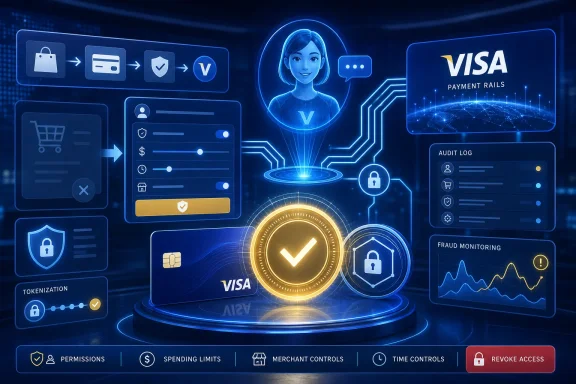 Visa Is Trying to Become the Trust Layer for the Agent Economy
The most important word in Visa’s announcement is not “AI.” It is “authorized.”For years, payments companies have sold convenience as a sequence of disappearing steps: the magnetic stripe gave way to the chip, the chip gave way to contactless, passwords gave way to wallets, and checkout pages gave way to one-click buying. Agentic commerce asks for a larger leap. It asks consumers to let software not only recommend a product, but act on their intent, present credentials, and trigger a real financial transaction.
That leap breaks the assumptions under much of online commerce. A merchant website can tell when a browser session is associated with a device, an account, a shipping address, and a payment credential. It can make educated guesses about fraud. But an AI agent shopping across the web looks, from many merchants’ point of view, uncomfortably similar to automation: a bot with purchasing power.
Visa’s partnership with OpenAI is an attempt to make that bot legible. The agent is not supposed to be a mysterious script scraping catalog pages and pasting card details into forms. It is supposed to carry identity signals, operate within user-set limits, and present payment credentials that can be tokenized, scoped, monitored, and revoked.
That framing matters because the checkout page has always been more than a form. It is a trust ritual. The consumer confirms the merchant, the amount, the shipping details, the payment method, and the final click. Visa and OpenAI are now proposing to redistribute that ritual between the user, the AI assistant, the merchant, and the payment network.
The Card Number Is the Thing Everyone Wants to Avoid
Visa’s public description leans heavily on tokenization, and for good reason. If agentic commerce is going to work at scale, raw card numbers cannot become another secret passed through prompts, browser automation, plug-ins, extensions, or merchant-specific hacks.The basic idea is familiar to anyone who has used Apple Pay, Google Pay, or a modern card-on-file system. Instead of exposing the underlying primary account number, the system uses a token that represents the payment credential in a constrained context. If the token is stolen or misused, the blast radius is smaller than if the actual card number has leaked.
With AI agents, the constraint becomes more complicated. A token may need to be bound not only to a cardholder and a merchant, but also to an agent, a task, a spending limit, a time window, and a category of purchase. “Buy dishwasher detergent under $25” is a very different authorization from “book any flight to New York next week,” and both are different from “handle monthly software renewals for a small business.”
That is where Visa’s existing machinery becomes valuable. The company already operates global authorization, risk scoring, dispute, token, and fraud-monitoring systems. Its strategic claim is that these rails can be extended into AI-mediated commerce without asking every merchant, bank, developer, and consumer to invent a new trust model from scratch.
OpenAI brings the interface and the agent. Visa brings the payment infrastructure that tells the rest of the world the transaction is not just some bot doing bot things. In theory, that combination lets an assistant shop without ever being handed the raw credential it could leak, hallucinate around, or expose through a compromised integration.
The User Is Still in Charge, but the Meaning of Control Is Changing
Both companies are careful to say the human remains in control. That is not a throwaway reassurance; it is the entire legal and practical premise of the model.The user is expected to define permissions. That may include spending ceilings, allowed merchant categories, trusted sellers, approval thresholds, and cases where the agent must stop and ask before completing the purchase. The agent does the comparison shopping, the form-filling, and eventually the payment initiation, but the authority comes from a human-defined boundary.
The interesting question is whether consumers will experience that as control or as configuration burden. A normal checkout screen is annoying, but it is obvious. You can see the final price and press the button. Agentic commerce replaces that moment with a policy: “You may buy household staples under $50 from these merchants, but ask me before substitutions.”
That may be powerful for repeat purchases, corporate procurement, travel policies, and other areas where rules already exist. It may be far less comfortable for emotional, high-value, or ambiguous purchases. Nobody wants an AI agent confidently buying the wrong appliance because it found a discount, misunderstood a compatibility note, or optimized for price when the user cared about warranty support.
This is where agentic commerce runs into the oldest problem in automation. The more useful the system becomes, the more authority it needs. The more authority it gets, the more painful its mistakes become.
OpenAI Gets a Checkout Layer Without Becoming a Bank
For OpenAI, the Visa deal fits a broader attempt to turn ChatGPT from a conversation surface into an action surface. Answering questions is useful. Completing tasks is monetizable.Instant Checkout, launched in September 2025 with Stripe and the Agentic Commerce Protocol, was the first big signal that OpenAI wanted shopping to happen inside the chat interface rather than after a referral click. The user could ask for a product, inspect options, and buy without leaving ChatGPT, at least in supported flows. Etsy was the initial live example, with Shopify merchants positioned as the next expansion path.
The Visa partnership is different in emphasis. Stripe’s role was about enabling a native checkout experience and a protocol for merchants and payment providers. Visa is trying to provide a broader credential and authorization layer that can work across the card ecosystem. That is a natural ambition for a network whose business depends on being present when value changes hands.
OpenAI benefits because it does not have to persuade the world that ChatGPT alone should be trusted with money movement. It can point to Visa’s infrastructure, banks, tokens, fraud models, and merchant acceptance. That does not solve every problem, but it gives the agent a passport into the existing payment system.
It also gives OpenAI a way to deepen commercial activity without presenting itself as the merchant of record, the payment processor, and the bank all at once. For a company already under scrutiny for market power, data handling, safety, and platform dependency, that separation is not cosmetic. It is a risk-management strategy.
The Standards War Is Already Underway
Visa and OpenAI are not entering an empty field. They are stepping into a standards fight that has been accelerating for months.Visa has its Trusted Agent Protocol. Mastercard has been pushing Agent Pay. Stripe and OpenAI co-developed the Agentic Commerce Protocol. Google has been advancing its own agent payments work alongside broader commerce protocols. Stripe and Tempo have explored machine-payment infrastructure with stablecoin-friendly assumptions. Coinbase’s x402 points toward a world where agents pay for online services directly using crypto-native rails.
The common thread is obvious: every major platform wants to define how an agent proves who it is, what it is allowed to do, and how it pays. The differences matter. Some approaches center card networks. Some center payment processors. Some center merchants. Some center web protocols. Some imagine stablecoins or programmable money as the natural payment substrate for machines.
This is why Visa’s announcement should not be read as a finished product launch. It is a positioning move in a fight over defaults. If ChatGPT becomes a major shopping interface, the payment method that feels native inside ChatGPT gains power. If merchants need to optimize for agent traffic, the protocol that large platforms support becomes the integration priority. If banks want to remain relevant, they will prefer models that preserve cardholder controls, issuer authorization, and familiar dispute processes.
Standards often look boring until they determine who gets taxed. In agentic commerce, the standard may decide whether the economics flow through card networks, processors, wallets, stablecoin systems, app stores, retailer platforms, or AI assistants themselves.
Visa’s Real Fear Is Being Abstracted Away
Visa’s public language is about security, control, and consumer confidence. Those are real concerns. But there is also a defensive business logic here.The card network’s power comes from being in the path of a transaction. If the consumer’s AI agent still pays with a Visa credential, Visa remains part of authorization, risk, settlement, and economics. If agents begin transacting through stablecoin protocols, account-to-account transfers, wallet balances, closed-loop merchant credits, or platform-native payment instruments, the card network’s role becomes less guaranteed.
That threat is not theoretical. AI agents are software, and software tends to route around friction. If one payment method is cheaper, programmable, globally available, and easier for agents to use, developers will experiment with it. Merchants have long complained about card fees. Platforms have long wanted more control over payment flows. Stablecoin advocates are eager to frame machine payments as a use case where traditional card rails look overbuilt or expensive.
Visa’s answer is to make card rails programmable enough that developers do not feel compelled to leave. Tokenized credentials, agent identity, usage limits, fraud scoring, and automated authorization are all ways of saying: the existing network can do this too.
That is the core strategic bet. Visa does not need every AI payment to look like today’s checkout page. It needs tomorrow’s AI payment to still look enough like a Visa transaction that the network remains indispensable.
The Merchant’s Problem Is Not Just Payment
For merchants, an AI agent that can buy things is both an opportunity and a headache. On one hand, agents could reduce abandoned carts, help consumers navigate large catalogs, and bring demand from users who would otherwise give up. On the other hand, agents may collapse brand discovery into a brutal ranking game.A human shopper browses, compares, hesitates, responds to design, notices promotions, reads reviews, and sometimes buys the thing that was not strictly optimal. An agent may reduce that process to a constrained optimization problem: cheapest eligible item, fastest shipping, highest review score, best return policy, lowest total cost. That could be wonderful for consumers and punishing for merchants who rely on presentation, upsell, loyalty, or impulse.
The payment layer does not answer those questions. It simply makes the agent’s decision executable. That is why agentic commerce is not just a payments story. It is also a search story, an advertising story, a marketplace story, and a power story.
If ChatGPT or another assistant becomes the intermediary between buyer and seller, merchants will need to understand how their products are represented to the agent. They will need structured data, inventory accuracy, clear policies, and machine-readable offers. They may also need to pay for visibility in whatever ranking system the assistant uses, whether openly through advertising or indirectly through platform integration.
Visa can help merchants distinguish a legitimate shopping agent from malicious automation. It cannot guarantee that the agent will choose their product.
Trust Will Arrive More Slowly Than Infrastructure
The payments industry often builds for a future before consumers are ready to inhabit it. Contactless cards, mobile wallets, QR payments, and buy-now-pay-later all needed years of habit formation, merchant support, and consumer education before becoming ordinary.Agentic commerce faces a harder trust curve because the fear is not merely that a payment could fail. The fear is that the AI might misunderstand intent. A fraudulent card charge is familiar; a bot buying the wrong thing with valid authorization feels stranger and more personal.
Early demand numbers should be treated cautiously, but the pattern is clear enough: many consumers are happy to let AI help them research purchases, while far fewer are ready to let AI complete the transaction autonomously. That gap is the market Visa and OpenAI are trying to close. The infrastructure is arriving before the social contract.
The most likely adoption path is therefore not broad consumer autonomy on day one. It is narrow, repetitive, low-regret tasks. Reordering office supplies. Buying household staples. Booking within a corporate travel policy. Paying approved invoices. Renewing subscriptions under a threshold. These are areas where rules can be explicit and mistakes can be bounded.
The less structured the purchase, the more visible the human approval step will remain. The dream of a fully autonomous personal shopper may be technologically tempting, but the mainstream version will probably look more like supervised delegation.
Enterprise IT Will See Both a Productivity Tool and a Governance Problem
For WindowsForum’s core audience of administrators, IT managers, and security-minded power users, the consumer shopping demo is only half the story. The more consequential version may be business workflows.Visa and OpenAI have already gestured toward procurement, invoicing, reconciliation, and developer workflows involving Codex. That is where agentic payments could become operationally interesting. An AI assistant that can compare SaaS plans, submit a purchase request, reconcile an invoice, or trigger payment inside policy could save real time.
It could also create a new class of shadow IT. If employees can ask an agent to procure services, subscribe to tools, or buy cloud resources, organizations will need controls that map agent permissions to identity, role, budget, vendor approval, compliance requirements, and audit logging. A human employee misusing a corporate card is one problem. An authorized agent acting on a vague instruction from that employee is another.
The governance stack will need to answer basic questions. Who instructed the agent? What policy did it consult? What data did it use to select the vendor? Did it expose confidential information while negotiating or comparing options? Was the payment approved by the right person or merely permitted by a broad automation rule?
This is where the phrase agent identity stops being marketing language and becomes an audit requirement. Enterprises will not accept agents that simply appear as generic API clients with payment rights. They will want logs, attestations, revocation, policy enforcement, and integration with existing identity and access management systems.
Security Teams Should Worry About Intent, Not Just Credentials
Tokenization reduces the risk of stolen card numbers, but it does not eliminate the risk of bad outcomes. In agentic commerce, the most interesting attacks may target intent rather than credentials.A malicious website might try to manipulate an agent into choosing a fraudulent product. A poisoned review corpus might distort recommendations. A compromised merchant integration might present different terms to the agent than to the user. A prompt-injection attack might attempt to override purchasing constraints or exfiltrate order details. A social-engineering campaign might persuade users to grant broad permissions to a fake or compromised agent.
Traditional payment security is very good at asking whether a transaction looks suspicious. Agentic commerce also needs to ask whether the transaction faithfully represents the user’s intent. That is a more difficult problem because intent is contextual, linguistic, and sometimes ambiguous.
Consider a user who says, “Find me a good replacement charger for my work laptop and buy it if it is under $60.” The agent needs to know the exact laptop model, distinguish genuine parts from unsafe knockoffs, evaluate seller reputation, respect workplace procurement rules, and avoid being manipulated by misleading product pages. The payment token can be perfectly secure while the purchase is still bad.
This is why fraud monitoring alone will not be enough. The full system needs secure browsing, trustworthy merchant data, constrained permissions, explainable decisions, and human checkpoints for categories where mistakes matter. The money movement is the final step; the attack surface starts much earlier.
The Windows Angle Is the Return of the Assistant as Operator
Microsoft is not the company in the headline, but Windows users should pay attention anyway. The industry is moving from assistants that answer questions to assistants that operate software.On Windows, that shift is already visible in Copilot, browser-based AI actions, developer agents, and automation tools that can inspect screens, write code, summarize documents, and interact with services. Payments are the missing dangerous capability. Once an agent can spend money, every identity, endpoint, browser, and policy problem becomes more serious.
For individual users, the practical concern is account hygiene. If AI shopping becomes normal, the Microsoft account, Google account, OpenAI account, password manager, browser profile, and payment wallet become part of a larger delegated-action environment. Compromise one layer, and an attacker may not need the card number. They may only need the ability to instruct or authorize the agent.
For administrators, the issue is policy sprawl. Organizations already struggle to control OAuth grants, SaaS subscriptions, browser extensions, Teams apps, and unmanaged AI tools. Agentic payments add financial authority to that mix. A user-approved agent with limited purchasing rights may look harmless until those rights are combined with sensitive data access, vendor impersonation, or poor approval workflows.
That does not mean enterprises should block the category reflexively. It means they should treat payment-capable agents like privileged automation. The old rule still applies: if a script can make a change that costs money, leaks data, or changes production state, it deserves governance. Calling it an agent does not make it safer.
The Launch Gap Is the Story Behind the Announcement
Visa and OpenAI have described a direction, not a finished consumer product with a clear rollout schedule. There is no mass-market interface to evaluate, no pricing model to compare, and no detailed merchant adoption map. That does not make the announcement meaningless. It makes it strategic.Large payment networks and AI platforms often announce partnerships before the plumbing is visible because they are trying to recruit the ecosystem. Issuers need to prepare. Merchants need to integrate. Developers need APIs. Regulators need reassurance. Consumers need a story simple enough to trust.
The danger is that the rhetoric outruns the reality. “AI agents will shop for you” is a cleaner sentence than “a limited number of supported agents may initiate tokenized payments at participating merchants under predefined user and issuer controls.” The second version is less exciting, but it is closer to how this will actually arrive.
That gap matters because disappointment can poison trust. If early agentic shopping experiences are brittle, confusing, or prone to awkward approval loops, users may decide the feature is not worth the risk. If they are too permissive and something goes wrong, regulators and banks will tighten the leash. The successful version will feel boringly controlled before it feels magical.
Visa’s advantage is that boring control is its native language. OpenAI’s challenge is that consumer AI has been sold on surprise, flexibility, and conversational ease. Agentic commerce will require those cultures to meet in the middle.
The Next Checkout Button Will Be a Policy Decision
The old checkout button was a moment. The new checkout button may be a standing instruction.That is the conceptual shift behind the Visa-OpenAI deal. Instead of approving every transaction at the end of a browsing session, users may approve a class of transactions in advance. Instead of a merchant presenting a cart to a person, a merchant may present machine-readable terms to an agent. Instead of fraud systems judging only a cardholder and merchant, they may judge an agent, a policy, a task, and a chain of delegated authority.
This will not replace ordinary checkout quickly. People will still buy things the old way because the old way is explicit and familiar. But agent-mediated buying will creep into categories where the value of delegation exceeds the discomfort of letting software act.
The most important competition will not be over whether AI can click “buy.” It will be over who defines the permission model around that click. Visa wants that model anchored in card-network trust. OpenAI wants it embedded in the conversational interface. Stripe, Mastercard, Google, merchants, banks, and crypto-native payment systems all want their own influence over the same moment.
That is why this announcement deserves attention even without a shiny demo. Whoever owns the agent checkout standard may gain leverage over discovery, payment, fraud, data, and customer relationships at once.
The Fine Print Is Where This Future Becomes Real
Visa and OpenAI’s partnership is best understood through the concrete constraints it will have to satisfy, not the grand language around agentic commerce. The promise is broad, but adoption will turn on whether the system gives users and institutions enough confidence to delegate spending without feeling reckless.- Visa is positioning its card network, tokenization systems, authorization controls, and fraud monitoring as the trust layer for AI agents that initiate payments.
- OpenAI gains a path to deeper commerce inside ChatGPT and related products without asking users or merchants to trust the AI assistant with raw card details.
- Consumers will likely see narrow, rule-bound purchasing before they see broad autonomous shopping, because repetitive and low-risk transactions are easier to delegate.
- Merchants will need to prepare for AI agents as a new class of customer interface, but payment acceptance alone will not solve ranking, discovery, or brand visibility problems.
- Enterprise IT should treat payment-capable agents as privileged automation requiring identity controls, audit logs, spend policies, and revocation mechanisms.
- The biggest unresolved fight is not technical feasibility, but standard-setting: whether agent payments flow through card networks, processors, wallets, platform protocols, or crypto-native rails.
References
- Primary source: H2S Media
Published: 2026-06-11T06:10:08.487623
Visa and OpenAI Partner to Let AI Agents Pay With Your Card
Visa is integrating its payment network into OpenAI's products so ChatGPT agents can shop securely using tokenized cards. Here's how it works and who Visa is racing against.www.how2shout.com - Related coverage: stripe.com
Stripe powers Instant Checkout in ChatGPT and releases Agentic Commerce Protocol codeveloped with OpenAI
Stripe releases Agentic Commerce Protocol, an open standard codeveloped with OpenAI, to help businesses grow in the era of agentic commerce. stripe.com
- Official source: openai.com
Buy it in ChatGPT: Instant Checkout and the Agentic Commerce Protocol | OpenAI
We’re taking first steps toward agentic commerce in ChatGPT with new ways for people, AI agents, and businesses to shop together.openai.com - Related coverage: eco.com
ACP (Agentic Commerce Protocol) Explained | Support
ACP is the OpenAI + Stripe open standard for agent checkout. How Shared Payment Tokens, merchant scoping, and the post-Instant-Checkout state actually work.eco.com - Related coverage: techcrunch.com
OpenAI takes on Google, Amazon with new agentic shopping system | TechCrunch
This type of frictionless experience has the potential to spark a new movement in how people shop online – one that moves away from search engines like Google and e-commerce platforms like Amazon toward conversational agents with curated recommendations, comparisons, and easy checkout experiences.techcrunch.com - Related coverage: letsdatascience.com
Visa partners with OpenAI for agentic commerce | Let's Data Science
On June 10, 2026, Visa announced a strategic collaboration with OpenAI at the Visa Payments Forum in San Francisco to embed Visa's payment network directly into ChatGPT (Axios; Visa). Through the partnership, AI agents running in ChatGPT can independently browse, select, and complete purchases... letsdatascience.com
- Related coverage: paytech.events
Visa Payments Forum 2026 — San Francisco | Dates, Tickets & Agenda
Visa Payments Forum 2026 runs June 9 - 11, 2026 in San Francisco, United States. Registration on request. Agenda, speakers, hotels near Moscone West. Updated June 2026. paytech.events
- Related coverage: es.investing.com
Visa se asocia con OpenAI para habilitar pagos mediante agentes de IA Por Investing.com
Visa se asocia con OpenAI para habilitar pagos mediante agentes de IAes.investing.com - Related coverage: yard.global
Visa Payments Forum 2026 - YARD
 www.yard.global
- Related coverage: moscone.com
- Related coverage: axios.com
ChatGPT's Instant Checkout lets you shop in ChatGPT
The feature launches today with support for Etsy.www.axios.com
- Related coverage: eyemaginetech.com
- Related coverage: corporate.visa.com
1278971359
Beautiful mixed race woman posing outdoors, background with blurred neon lightscorporate.visa.com
- Related coverage: techxplore.com