

Westcoast has become an official Intel Processor Distribution Partner in the United Kingdom, adding Intel Core Ultra desktop processors to its channel portfolio in June 2026 and giving resellers, system builders, and integrators another authorized route to source Intel-based PC components. The announcement is not just a distribution win for one UK wholesaler. It is a small but telling marker of where the PC channel thinks the next refresh cycle will be fought: not merely on laptops, not only on AI branding, but on the gritty mechanics of availability, bundling, credit, and build logistics. Intel needs more than silicon to make Core Ultra matter in the market; it needs routes to desks, workshops, and procurement systems.
Intel has spent the past few years trying to turn the phrase AI PC from a marketing abstraction into a procurement category. That project has mostly been visible at the glamorous end of the industry: keynote demos, benchmark slides, laptop launches, and arguments about neural processing units. Westcoast’s new processor role is the less glamorous half of the same story.
The agreement brings Intel Core Ultra processors, including the Core Ultra 200S Plus desktop chips, into Westcoast’s UK components portfolio. The named range includes the Core Ultra 7 270K Plus, Core Ultra 5 250KF Plus, and Core Ultra 5 250K Plus, giving channel partners an official route to parts aimed at high-performance desktops, custom systems, creators, gamers, and business users with heavier local workloads.
That matters because Intel’s AI PC campaign is entering the phase where slogans are no longer enough. Corporate buyers do not refresh fleets because a processor family has an NPU. They refresh fleets when their incumbent machines are aging, Windows requirements are shifting, application needs become more demanding, and trusted suppliers can deliver systems on predictable terms.
Westcoast’s appointment is therefore best read as infrastructure for Intel’s next selling cycle. If the AI PC category is going to become more than a premium notebook story, Intel needs distributors that can help partners assemble complete solutions around processors, motherboards, memory, storage, finance, and fulfillment. A chip launch creates interest; distribution turns that interest into invoices.
Westcoast already had an established relationship with Intel across devices and technology products. Adding processor distribution widens that relationship into the components stack, allowing partners to source more of an Intel-powered build through one account. That is a quiet but important shift in channel economics.
For small and mid-sized resellers, supplier sprawl is a tax. Every additional distributor brings another credit line, another stock feed, another returns process, another conversation about allocation, and another set of operational risks. If Westcoast can let a partner source Intel processors alongside related PC products, the distributor becomes more than a price sheet; it becomes a procurement simplifier.
That is why Mike Botto’s framing of the deal around “complete Intel-powered solutions” is more than ceremonial channel language. The modern reseller is under pressure from direct vendors, hyperscale marketplaces, and increasingly sophisticated end customers. A distributor that reduces complexity can be as valuable as one that shaves a few pounds off a component price.
Desktops matter in places where performance, serviceability, standardization, and upgrade paths matter. That includes creator workstations, gaming rigs, small-business desktops, lab machines, CAD systems, local development boxes, and office fleets built around predictable maintenance rather than portability. These are exactly the kinds of markets where system builders and integrators still have room to add value.
The Core Ultra 200S Plus chips give Intel a refreshed desktop story at a moment when it needs one. The initial Core Ultra desktop push had to contend with tough comparisons, especially in gaming and enthusiast circles where AMD has been formidable. A mid-cycle refresh with sharper pricing and performance claims gives Intel’s partners something easier to position than a vague “next generation” promise.
Westcoast’s channel role also suggests that Intel sees desktop AI readiness as a distribution challenge, not just a product spec. Desktop buyers may not be asking for local AI acceleration in the same way laptop vendors advertise it, but they are asking for systems that feel future-proof. For the channel, “AI-ready” is often shorthand for a machine that will not look obsolete halfway through a depreciation cycle.
The Core Ultra 7 270K Plus and Core Ultra 5 250K Plus were positioned as refreshed desktop parts with additional efficiency cores, updated performance characteristics, and aggressive suggested pricing. The Core Ultra 5 250KF Plus variant removes integrated graphics for buyers who plan to pair the system with a discrete GPU. That makes sense for builders targeting gaming and creator systems, where an iGPU may be less important than keeping the bill of materials tight.
Intel’s challenge is that value cannot be asserted into existence. It has to be proven by availability, street pricing, motherboard cost, cooling requirements, memory compatibility, and real application performance. A processor that looks compelling in a launch deck can lose its shine if the channel cannot get it in volume or if adjacent platform costs make the total system less attractive.
This is where distribution becomes strategic. Westcoast’s ability to support logistics, finance, and supply chain services may sound like the plumbing of the business, but plumbing determines whether a value story reaches customers intact. In the PC channel, the “best” processor is often the one that can be bought, financed, bundled, shipped, and supported without drama.
For Intel, the UK channel matters on its own, but it also sits inside a broader European distribution puzzle. Vendors want reach, but they increasingly want reach that can be coordinated across markets and product categories. A distributor connected to a larger platform can potentially help a vendor turn a product push into a repeatable campaign.
For Westcoast, the processor agreement strengthens a components business that can sit alongside hardware, software, cloud, cybersecurity, virtualization, and AI offerings across the parent group’s broader ecosystem. That is the modern distributor’s ambition: not simply to move boxes, but to occupy more of the partner’s commercial workflow. The more categories a distributor can credibly serve, the harder it becomes for a reseller to leave.
There is also a defensive logic here. Distribution is a scale business living under constant pressure from direct sales, online marketplaces, and vendor consolidation. Adding processors to an existing Intel relationship gives Westcoast another reason to be in the conversation when partners plan PC refreshes, custom builds, or workstation projects.
Westcoast’s expanded Intel relationship speaks directly to that tension. A reseller quoting a business refresh or a custom desktop project does not want to spend days stitching together availability from separate component wholesalers. It wants to know whether it can build the system, protect margin, and deliver when promised.
That becomes more important as the AI PC story complicates buying decisions. Customers may ask whether they need a new processor for AI features, whether a desktop should have an NPU, whether a GPU matters more, whether Windows features will require certain hardware, and whether now is the right time to refresh. The reseller’s job is partly technical and partly theatrical: translate industry noise into a configuration a customer can approve.
A distributor with stock, finance, and supply chain services gives that reseller more room to operate. It cannot solve every uncertainty about the AI PC market, but it can remove operational excuses. In a refresh cycle, that matters.
That elasticity helps vendors sell the category, but it creates risk for the channel. If every new PC is described as AI-ready, the phrase stops helping customers distinguish between machines. Worse, it may create expectations that local hardware will magically transform workflows that still depend on cloud services, application support, data governance, and user training.
Desktop systems make this especially complicated. A high-performance desktop may be “AI-ready” in practical terms because it has a strong CPU, a discrete GPU, ample memory, and fast storage, even if its NPU story is less central than a laptop’s. Conversely, a machine with fashionable AI branding may not be useful for a customer’s actual workload if the rest of the configuration is weak.
This is where good channel partners can still earn their keep. The reseller who understands the difference between vendor positioning and customer workload will sell fewer disappointments. Westcoast’s expanded portfolio gives those partners more tools, but it does not absolve them of the need to configure honestly.
The Core Ultra 200S Plus chips give Intel a sharper desktop pitch, particularly around value and performance-per-pound in systems where buyers are price-sensitive but still demanding. Yet the company’s broader position depends on more than benchmark charts. It depends on whether partners can explain the platform clearly, source it reliably, and support it without costly surprises.
Distribution partners are the unsung carriers of that discipline. If stock is inconsistent, if pricing drifts too far from the intended value message, or if partners cannot bundle the right adjacent components, a product strategy gets diluted before it reaches the customer. Intel’s appointment of Westcoast gives the UK channel another path, but it also creates another test of execution.
There is a political economy to this as well. Vendors like Intel want broad reach without losing control of positioning. Distributors want margin, differentiation, and relevance. Resellers want availability and credit. End customers want the whole stack to behave as though it came from one coherent source. The closer those interests align, the more credible Intel’s AI PC push becomes.
Westcoast’s processor appointment fits that model. Processors are not isolated items in most commercial sales. They anchor builds, shape compatibility, influence performance tiers, and affect the economics of everything around them. Adding CPUs to a distributor’s portfolio can pull through motherboards, memory, storage, cases, cooling, GPUs, operating system licenses, warranties, and support services.
That is why the move has implications beyond enthusiasts assembling rigs. A business desktop refresh may begin with a CPU generation, but it ends as a procurement exercise involving service levels, deployment windows, finance terms, asset management, and support escalation. Distributors that can sit across more of that chain gain leverage.
The same logic applies to integrators building systems for creators and specialist users. These customers often care about actual workflow performance more than brand slogans. If Westcoast can help partners source Intel-based configurations reliably, those partners can spend more time on tuning, support, and customer relationships rather than procurement gymnastics.
Intel’s Core Ultra 200S Plus strategy appears designed in part to make that comparison less painful. Aggressive pricing, refreshed specifications, and a narrower set of enthusiast-friendly desktop parts give resellers a cleaner argument than “trust the brand.” In value-conscious builds, clarity is useful.
But AMD’s strength also explains why distribution matters. When performance leadership is contested, availability and bundle economics become decisive. A reseller may choose the platform that delivers the best customer outcome at the right price and the least operational risk. That is not always the theoretical winner in a benchmark suite.
For Intel, Westcoast’s appointment adds another route to keep its processors in front of UK partners at the moment configurations are being decided. That is the point at which vendor marketing either becomes a sale or evaporates. In the channel, mindshare has to be stocked on a shelf.
For Windows-focused buyers, the next PC decision is increasingly tangled with questions about security baselines, manageability, endpoint performance, and whether systems bought today will support features that become standard tomorrow. That does not mean every buyer needs the newest desktop chip. It does mean the conversation has moved away from “does the old PC still boot?” toward “does the old PC still fit the operating model?”
Intel wants Core Ultra to be part of that answer. Westcoast wants to be the distributor partners call when that answer turns into a purchase order. The fit is obvious: a major processor vendor needs channel reach, and a major distributor wants a bigger role in the refresh cycle.
The risk is that AI messaging gets ahead of practical demand. If customers do not see immediate value in local AI acceleration, partners will need to sell Core Ultra systems on conventional grounds: performance, efficiency, reliability, supportability, and total cost. That may be less glamorous, but it is often more persuasive.
For gaming systems, the Core Ultra 200S Plus range will be judged by frame rates, platform cost, thermals, and upgrade logic. For creator systems, it will be judged by export times, multitasking, application behavior, and GPU pairing. For business desktops, it will be judged by stability, image compatibility, manageability, and whether the procurement team can buy the same configuration repeatedly.
That is a more demanding sales motion than shifting commodity CPUs. It requires partners to understand both the product and the buyer. Westcoast’s role is to make the supply side easier; it cannot make weak positioning strong.
The better partners will use the agreement to narrow customer confusion. They will avoid treating “AI-ready” as a magic phrase and instead explain what workloads benefit today, what may benefit later, and when a cheaper or different configuration is the better choice. That kind of honesty builds repeat business, even if it sometimes costs an upsell.
If a partner starts a quote with Intel silicon sourced through Westcoast, Westcoast has an opening to attach complementary components and services. Intel gets a better chance of remaining the default platform. The reseller gets a simpler buying path. The customer gets a system that is less likely to be assembled from whatever parts happened to be available from scattered suppliers.
This does not guarantee success. Distribution appointments are common, and many of them disappear into the background noise of the channel. The difference here is the moment. Intel is trying to make Core Ultra meaningful across desktops and AI PCs at the same time that partners are looking for simpler procurement and customers are weighing refreshes.
The result is a deal whose importance is mostly practical. It is not a grand strategic pivot. It is a piece of channel machinery being installed just as the next PC selling cycle accelerates.
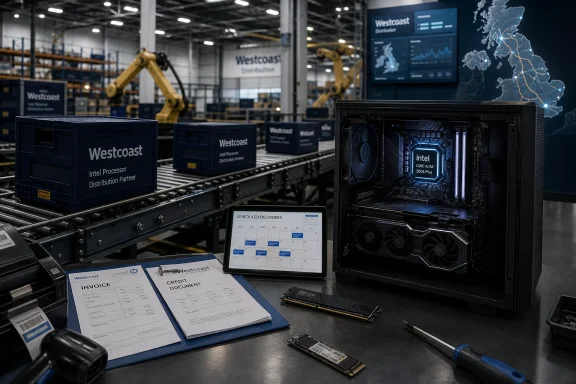 Intel’s AI PC Push Now Has to Survive the Channel
Intel has spent the past few years trying to turn the phrase AI PC from a marketing abstraction into a procurement category. That project has mostly been visible at the glamorous end of the industry: keynote demos, benchmark slides, laptop launches, and arguments about neural processing units. Westcoast’s new processor role is the less glamorous half of the same story.The agreement brings Intel Core Ultra processors, including the Core Ultra 200S Plus desktop chips, into Westcoast’s UK components portfolio. The named range includes the Core Ultra 7 270K Plus, Core Ultra 5 250KF Plus, and Core Ultra 5 250K Plus, giving channel partners an official route to parts aimed at high-performance desktops, custom systems, creators, gamers, and business users with heavier local workloads.
That matters because Intel’s AI PC campaign is entering the phase where slogans are no longer enough. Corporate buyers do not refresh fleets because a processor family has an NPU. They refresh fleets when their incumbent machines are aging, Windows requirements are shifting, application needs become more demanding, and trusted suppliers can deliver systems on predictable terms.
Westcoast’s appointment is therefore best read as infrastructure for Intel’s next selling cycle. If the AI PC category is going to become more than a premium notebook story, Intel needs distributors that can help partners assemble complete solutions around processors, motherboards, memory, storage, finance, and fulfillment. A chip launch creates interest; distribution turns that interest into invoices.
Westcoast Is Selling Less Friction, Not Just More Silicon
The headline says processors, but the product Westcoast is really adding is convenience. For a reseller or system builder, buying CPUs is only one part of the job. The harder problem is making sure all the parts, terms, warranties, and delivery dates line up well enough to serve customers who increasingly want complete systems rather than a bag of components.Westcoast already had an established relationship with Intel across devices and technology products. Adding processor distribution widens that relationship into the components stack, allowing partners to source more of an Intel-powered build through one account. That is a quiet but important shift in channel economics.
For small and mid-sized resellers, supplier sprawl is a tax. Every additional distributor brings another credit line, another stock feed, another returns process, another conversation about allocation, and another set of operational risks. If Westcoast can let a partner source Intel processors alongside related PC products, the distributor becomes more than a price sheet; it becomes a procurement simplifier.
That is why Mike Botto’s framing of the deal around “complete Intel-powered solutions” is more than ceremonial channel language. The modern reseller is under pressure from direct vendors, hyperscale marketplaces, and increasingly sophisticated end customers. A distributor that reduces complexity can be as valuable as one that shaves a few pounds off a component price.
The Desktop Still Refuses to Die Quietly
The most interesting part of the announcement is that it is about desktop processors. The PC industry’s AI conversation has often orbited around thin-and-light laptops, Copilot-branded experiences, and battery-efficient NPUs. Yet Westcoast’s new line includes Intel’s Core Ultra 200S Plus desktop range, a reminder that the desktop remains strategically useful even when it is no longer the cultural center of personal computing.Desktops matter in places where performance, serviceability, standardization, and upgrade paths matter. That includes creator workstations, gaming rigs, small-business desktops, lab machines, CAD systems, local development boxes, and office fleets built around predictable maintenance rather than portability. These are exactly the kinds of markets where system builders and integrators still have room to add value.
The Core Ultra 200S Plus chips give Intel a refreshed desktop story at a moment when it needs one. The initial Core Ultra desktop push had to contend with tough comparisons, especially in gaming and enthusiast circles where AMD has been formidable. A mid-cycle refresh with sharper pricing and performance claims gives Intel’s partners something easier to position than a vague “next generation” promise.
Westcoast’s channel role also suggests that Intel sees desktop AI readiness as a distribution challenge, not just a product spec. Desktop buyers may not be asking for local AI acceleration in the same way laptop vendors advertise it, but they are asking for systems that feel future-proof. For the channel, “AI-ready” is often shorthand for a machine that will not look obsolete halfway through a depreciation cycle.
Core Ultra 200S Plus Is Intel’s Value Argument in Disguise
Intel’s Core Ultra 200S Plus range is not simply another set of part numbers. It is a tactical answer to a market that has become brutally sensitive to value. Enthusiasts have become savvier about platform longevity, gaming performance, thermals, and total build cost. Business buyers are just as skeptical, though their language is different: standard images, warranty terms, power budgets, and application compatibility.The Core Ultra 7 270K Plus and Core Ultra 5 250K Plus were positioned as refreshed desktop parts with additional efficiency cores, updated performance characteristics, and aggressive suggested pricing. The Core Ultra 5 250KF Plus variant removes integrated graphics for buyers who plan to pair the system with a discrete GPU. That makes sense for builders targeting gaming and creator systems, where an iGPU may be less important than keeping the bill of materials tight.
Intel’s challenge is that value cannot be asserted into existence. It has to be proven by availability, street pricing, motherboard cost, cooling requirements, memory compatibility, and real application performance. A processor that looks compelling in a launch deck can lose its shine if the channel cannot get it in volume or if adjacent platform costs make the total system less attractive.
This is where distribution becomes strategic. Westcoast’s ability to support logistics, finance, and supply chain services may sound like the plumbing of the business, but plumbing determines whether a value story reaches customers intact. In the PC channel, the “best” processor is often the one that can be bought, financed, bundled, shipped, and supported without drama.
The ALSO Connection Gives This Deal More Weight Than a Normal Line Card Update
Westcoast is not just another local distributor adding another vendor badge. It is part of ALSO Holding, a European technology provider with reach across dozens of countries, a large reseller base, and relationships with hundreds of vendors. That scale changes how the Intel appointment should be read.For Intel, the UK channel matters on its own, but it also sits inside a broader European distribution puzzle. Vendors want reach, but they increasingly want reach that can be coordinated across markets and product categories. A distributor connected to a larger platform can potentially help a vendor turn a product push into a repeatable campaign.
For Westcoast, the processor agreement strengthens a components business that can sit alongside hardware, software, cloud, cybersecurity, virtualization, and AI offerings across the parent group’s broader ecosystem. That is the modern distributor’s ambition: not simply to move boxes, but to occupy more of the partner’s commercial workflow. The more categories a distributor can credibly serve, the harder it becomes for a reseller to leave.
There is also a defensive logic here. Distribution is a scale business living under constant pressure from direct sales, online marketplaces, and vendor consolidation. Adding processors to an existing Intel relationship gives Westcoast another reason to be in the conversation when partners plan PC refreshes, custom builds, or workstation projects.
Resellers Want Fewer Suppliers Because Their Customers Want Faster Answers
The channel has always lived between vendor ambition and customer impatience. Vendors want partners to promote new platforms. Customers want systems that arrive on time, run the applications they already use, and do not turn support desks into archaeology departments. Distributors make their money by absorbing some of that mismatch.Westcoast’s expanded Intel relationship speaks directly to that tension. A reseller quoting a business refresh or a custom desktop project does not want to spend days stitching together availability from separate component wholesalers. It wants to know whether it can build the system, protect margin, and deliver when promised.
That becomes more important as the AI PC story complicates buying decisions. Customers may ask whether they need a new processor for AI features, whether a desktop should have an NPU, whether a GPU matters more, whether Windows features will require certain hardware, and whether now is the right time to refresh. The reseller’s job is partly technical and partly theatrical: translate industry noise into a configuration a customer can approve.
A distributor with stock, finance, and supply chain services gives that reseller more room to operate. It cannot solve every uncertainty about the AI PC market, but it can remove operational excuses. In a refresh cycle, that matters.
The AI PC Label Is Useful, But It Is Also Dangerously Elastic
Intel and its partners are right to talk about AI-ready systems, but the term is already stretched thin. For some buyers, it means an NPU capable of accelerating on-device inference. For others, it means a modern CPU with enough performance headroom for software that may become more AI-inflected over time. For many, it means little more than “new enough not to regret.”That elasticity helps vendors sell the category, but it creates risk for the channel. If every new PC is described as AI-ready, the phrase stops helping customers distinguish between machines. Worse, it may create expectations that local hardware will magically transform workflows that still depend on cloud services, application support, data governance, and user training.
Desktop systems make this especially complicated. A high-performance desktop may be “AI-ready” in practical terms because it has a strong CPU, a discrete GPU, ample memory, and fast storage, even if its NPU story is less central than a laptop’s. Conversely, a machine with fashionable AI branding may not be useful for a customer’s actual workload if the rest of the configuration is weak.
This is where good channel partners can still earn their keep. The reseller who understands the difference between vendor positioning and customer workload will sell fewer disappointments. Westcoast’s expanded portfolio gives those partners more tools, but it does not absolve them of the need to configure honestly.
Intel Needs Distribution Discipline as Much as Benchmark Wins
Intel’s desktop problem has not been a lack of attention. It has been consistency. Enthusiasts and IT buyers have watched the company navigate process delays, branding changes, platform transitions, competition from AMD, and debates over real-world performance. The Core Ultra era is an attempt to reset that story, but resets only work when the market sees sustained execution.The Core Ultra 200S Plus chips give Intel a sharper desktop pitch, particularly around value and performance-per-pound in systems where buyers are price-sensitive but still demanding. Yet the company’s broader position depends on more than benchmark charts. It depends on whether partners can explain the platform clearly, source it reliably, and support it without costly surprises.
Distribution partners are the unsung carriers of that discipline. If stock is inconsistent, if pricing drifts too far from the intended value message, or if partners cannot bundle the right adjacent components, a product strategy gets diluted before it reaches the customer. Intel’s appointment of Westcoast gives the UK channel another path, but it also creates another test of execution.
There is a political economy to this as well. Vendors like Intel want broad reach without losing control of positioning. Distributors want margin, differentiation, and relevance. Resellers want availability and credit. End customers want the whole stack to behave as though it came from one coherent source. The closer those interests align, the more credible Intel’s AI PC push becomes.
The UK Channel Is Becoming a Packaging Business
The phrase “distribution partner” can make the deal sound like a simple matter of moving CPUs from manufacturer to reseller. That is too narrow. The UK channel is increasingly about packaging: hardware with finance, components with services, devices with cloud subscriptions, and refresh projects with lifecycle management.Westcoast’s processor appointment fits that model. Processors are not isolated items in most commercial sales. They anchor builds, shape compatibility, influence performance tiers, and affect the economics of everything around them. Adding CPUs to a distributor’s portfolio can pull through motherboards, memory, storage, cases, cooling, GPUs, operating system licenses, warranties, and support services.
That is why the move has implications beyond enthusiasts assembling rigs. A business desktop refresh may begin with a CPU generation, but it ends as a procurement exercise involving service levels, deployment windows, finance terms, asset management, and support escalation. Distributors that can sit across more of that chain gain leverage.
The same logic applies to integrators building systems for creators and specialist users. These customers often care about actual workflow performance more than brand slogans. If Westcoast can help partners source Intel-based configurations reliably, those partners can spend more time on tuning, support, and customer relationships rather than procurement gymnastics.
AMD Is the Unnamed Shadow in the Room
The announcement does not need to mention AMD for AMD to be present. Every Intel desktop channel push exists against the reality that AMD has become a formidable competitor in gaming, workstation, and enthusiast segments. Intel’s partners know this, and so do customers who arrive at buying decisions armed with benchmark videos and forum arguments.Intel’s Core Ultra 200S Plus strategy appears designed in part to make that comparison less painful. Aggressive pricing, refreshed specifications, and a narrower set of enthusiast-friendly desktop parts give resellers a cleaner argument than “trust the brand.” In value-conscious builds, clarity is useful.
But AMD’s strength also explains why distribution matters. When performance leadership is contested, availability and bundle economics become decisive. A reseller may choose the platform that delivers the best customer outcome at the right price and the least operational risk. That is not always the theoretical winner in a benchmark suite.
For Intel, Westcoast’s appointment adds another route to keep its processors in front of UK partners at the moment configurations are being decided. That is the point at which vendor marketing either becomes a sale or evaporates. In the channel, mindshare has to be stocked on a shelf.
Windows Refresh Pressure Gives the Deal Its Timing
The timing of this agreement is hard to separate from the broader Windows PC refresh environment. Many organizations are reassessing device fleets as older machines age out, software requirements evolve, and IT departments weigh the cost of stretching hardware against the cost of replacing it. AI may be the banner, but lifecycle pressure is often the engine.For Windows-focused buyers, the next PC decision is increasingly tangled with questions about security baselines, manageability, endpoint performance, and whether systems bought today will support features that become standard tomorrow. That does not mean every buyer needs the newest desktop chip. It does mean the conversation has moved away from “does the old PC still boot?” toward “does the old PC still fit the operating model?”
Intel wants Core Ultra to be part of that answer. Westcoast wants to be the distributor partners call when that answer turns into a purchase order. The fit is obvious: a major processor vendor needs channel reach, and a major distributor wants a bigger role in the refresh cycle.
The risk is that AI messaging gets ahead of practical demand. If customers do not see immediate value in local AI acceleration, partners will need to sell Core Ultra systems on conventional grounds: performance, efficiency, reliability, supportability, and total cost. That may be less glamorous, but it is often more persuasive.
The Deal Rewards System Builders Who Can Explain the Stack
System builders and integrators stand to benefit most if they can turn Westcoast’s expanded Intel access into coherent offerings. The opportunity is not simply to advertise that a machine contains a Core Ultra 7 or Core Ultra 5 chip. It is to build systems where the processor choice makes sense alongside memory capacity, GPU selection, cooling, storage, motherboard features, and the customer’s intended workload.For gaming systems, the Core Ultra 200S Plus range will be judged by frame rates, platform cost, thermals, and upgrade logic. For creator systems, it will be judged by export times, multitasking, application behavior, and GPU pairing. For business desktops, it will be judged by stability, image compatibility, manageability, and whether the procurement team can buy the same configuration repeatedly.
That is a more demanding sales motion than shifting commodity CPUs. It requires partners to understand both the product and the buyer. Westcoast’s role is to make the supply side easier; it cannot make weak positioning strong.
The better partners will use the agreement to narrow customer confusion. They will avoid treating “AI-ready” as a magic phrase and instead explain what workloads benefit today, what may benefit later, and when a cheaper or different configuration is the better choice. That kind of honesty builds repeat business, even if it sometimes costs an upsell.
The Real Win Is Control Over the Build Conversation
Westcoast’s processor distribution deal gives Intel another UK route to market, but the deeper significance is control over the build conversation. Whoever supplies the processor often influences the rest of the system. That makes CPUs commercially magnetic: they pull other decisions into their orbit.If a partner starts a quote with Intel silicon sourced through Westcoast, Westcoast has an opening to attach complementary components and services. Intel gets a better chance of remaining the default platform. The reseller gets a simpler buying path. The customer gets a system that is less likely to be assembled from whatever parts happened to be available from scattered suppliers.
This does not guarantee success. Distribution appointments are common, and many of them disappear into the background noise of the channel. The difference here is the moment. Intel is trying to make Core Ultra meaningful across desktops and AI PCs at the same time that partners are looking for simpler procurement and customers are weighing refreshes.
The result is a deal whose importance is mostly practical. It is not a grand strategic pivot. It is a piece of channel machinery being installed just as the next PC selling cycle accelerates.
The Signal Beneath the Stock Feed
Westcoast’s Intel processor appointment is easy to underestimate because it is operational rather than theatrical. Yet for WindowsForum readers, the practical consequences are the story: more official supply routes, more bundled build options, and a clearer path for UK partners building Intel-based systems around the latest Core Ultra desktop parts.- Westcoast is now an official UK Intel Processor Distribution Partner, expanding an existing Intel relationship from devices and technology products into desktop processor distribution.
- The available range includes Intel Core Ultra 200S Plus desktop chips such as the Core Ultra 7 270K Plus, Core Ultra 5 250K Plus, and Core Ultra 5 250KF Plus.
- The agreement gives resellers, system builders, and integrators a simpler route to source Intel-based PC components through a distributor that also offers logistics, finance, and supply chain services.
- The timing aligns with a broader PC refresh cycle in which vendors are pushing AI-ready systems while customers still care about availability, pricing, support, and real workload value.
- The deal strengthens Westcoast’s role in the UK components market while giving Intel another channel route for a desktop lineup that must compete on value as much as branding.
References
- Primary source: ChannelLife UK
Published: Fri, 26 Jun 2026 09:30:00 GMT
Westcoast becomes Intel processor distribution partner
The move gives UK resellers a single source for Intel Core Ultra desktop chips as demand rises for AI-ready PCs. channellife.co.uk
- Related coverage: newsroom.intel.com
Intel Announces New Intel Core Ultra 200S Plus Series Desktop Processors - Intel Newsroom
Intel Core Ultra 200S Plus delivers up to 2x performance for creators versus competition &Intel’s fastest desktop gaming processor ever with the Core Ultra 7 270K Plus.newsroom.intel.com - Related coverage: corsair.com
- Related coverage: gadgets360.com
- Related coverage: pugetsystems.com
Intel Core Ultra 200S Plus Series | Puget Systems
This mid-generation update brings more E-cores and other performance improvements, plus lower prices, to the new Ultra 7 270K Plus & Ultra 5 250K Plus CPUs.www.pugetsystems.com - Related coverage: pokde.net
Intel Announces Core Ultra 7 270K Plus & Core Ultra 5 250K Plus Processors For Desktops - Pokde.Net
Intel's newly-announced Arrow Lake Refresh lineup features just two new chips - the Core Ultra 7 270K Plus and Core Ultra 5 250K Plus - but there's more upgrades than meets the eye.pokde.net
- Related coverage: gigazine.net
Intelがゲーマー向けCPU「Core Ultra 200S Plus」シリーズを発表 - GIGAZINE
Intelがデスクトップ向けプロセッサの「Intel Core Ultra 200S Plus」シリーズ(270K、250K Plus)を発表しました。ゲームのパフォーマンスを向上させる新しい最適化機能が初めて搭載されていることが特徴です。gigazine.net - Related coverage: windowscentral.com
Intel Core Ultra 5 250K and 270K Plus review: CPUs for creators | Windows Central
Intel's Arrow Lake Refresh is a duo of refreshed processors with the Core Ultra 200S series, and they're refreshingly cheap with gaming benefits on the side.www.windowscentral.com - Related coverage: thefpsreview.com
Intel Announces Core Ultra 7 270K Plus at $299 & Core Ultra 5 250K Plus at $199
Intel is announcing it's Arrow Lake Refresh Intel Core Ultra 7 270K Plus and Intel Core Ultra 5 250K Plus at $299 & $199 Respectively, We've Got The Specs.www.thefpsreview.com - Related coverage: tomshardware.com
Intel's new Core Ultra 200HX Plus mobile CPUs include 290HX, 270HX Plus flagships — 8% faster gaming claims fall short of 15% boost promised by desktop Arrow Lake Refresh | Tom's Hardware
No performance metrics for the 270HX Plus yet.www.tomshardware.com - Related coverage: pcgamer.com
Intel Core Ultra 7 270K Plus review | PC Gamer
The latest Review,,,reviews, breaking news, comment, reviews and features from the experts at PC Gamerwww.pcgamer.com - Related coverage: download.intel.com
- Related coverage: techradar.com
'The fastest desktop gaming processors Intel has ever built': new Arrow Lake Refresh CPUs are priced to sell, and AMD should be worried | TechRadar
Meet the Intel Core Ultra 7 270K Plus and Core Ultra 5 250K Pluswww.techradar.com
