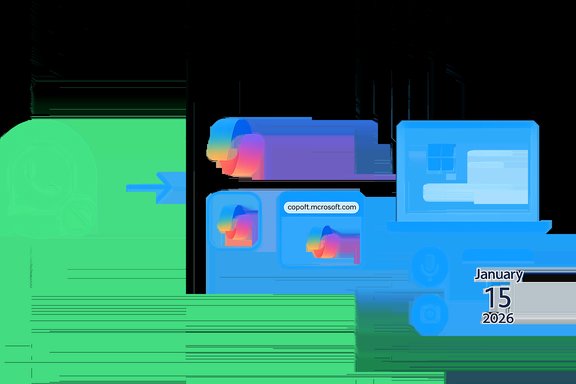
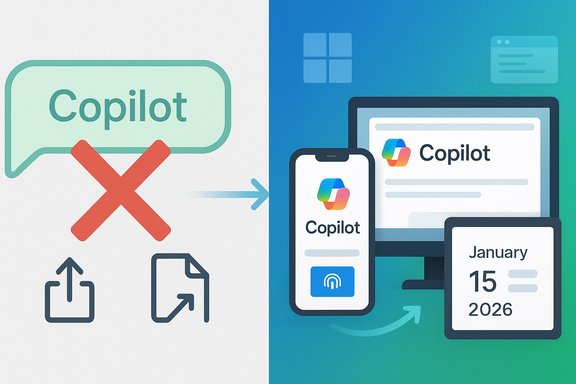
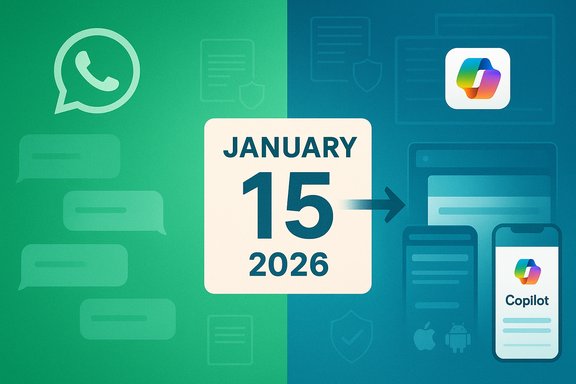
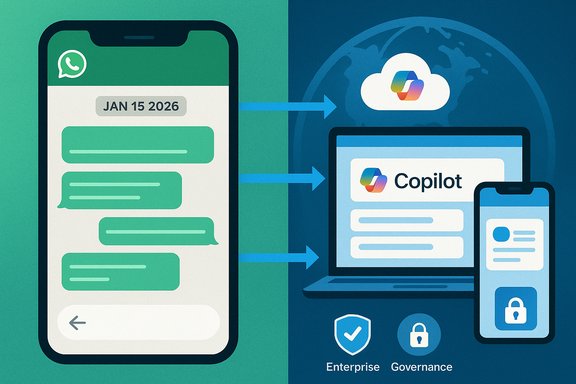
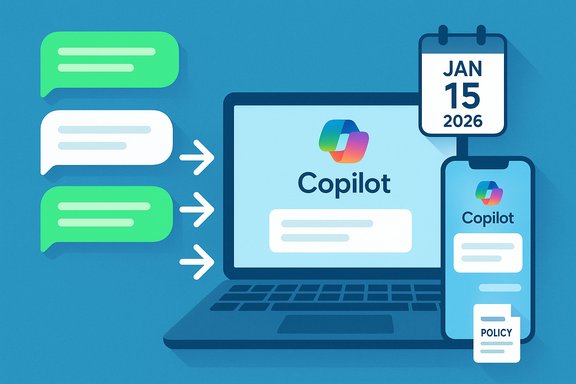
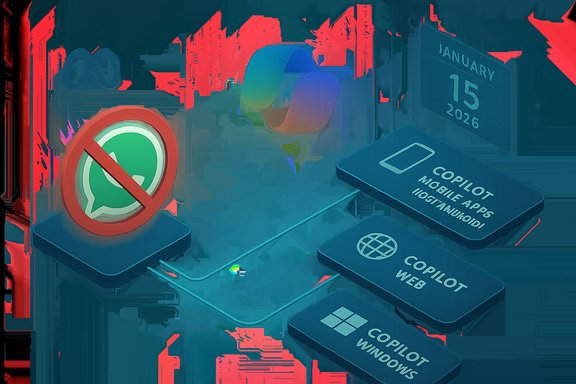
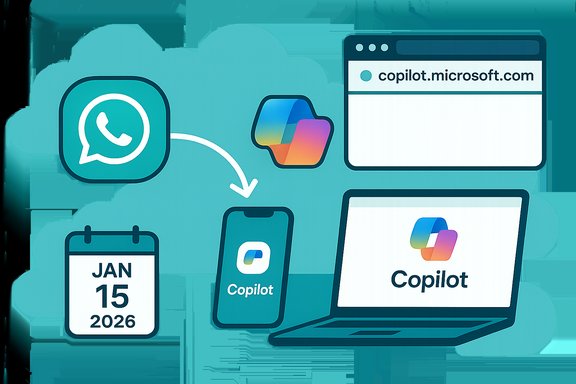
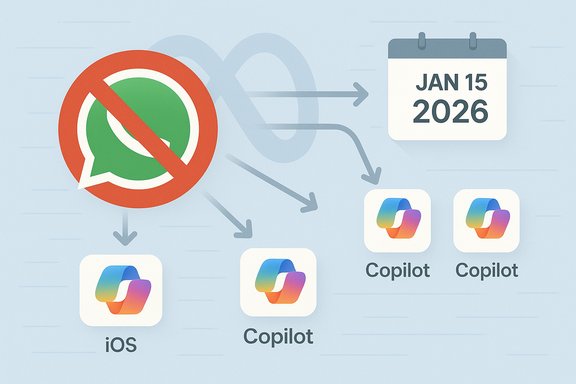
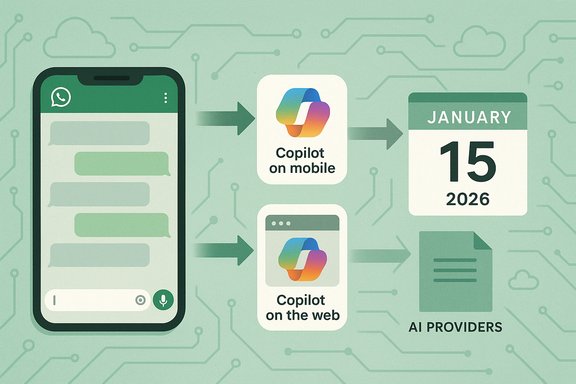
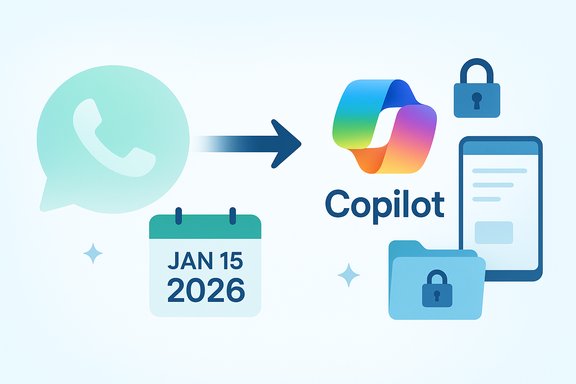
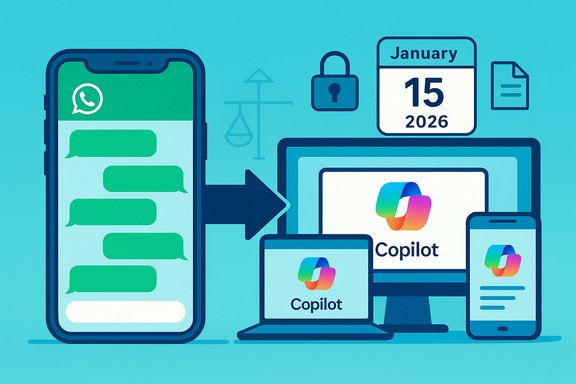
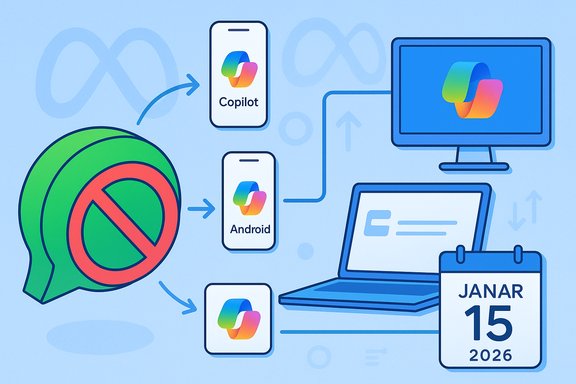
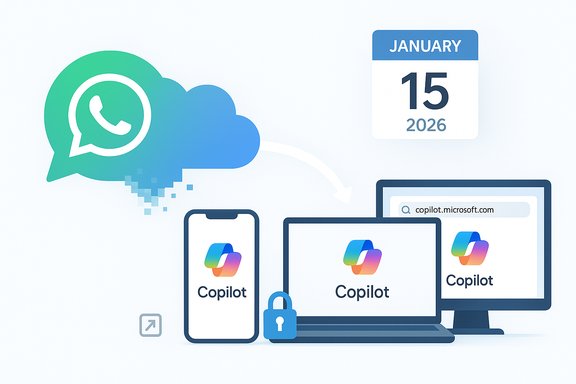
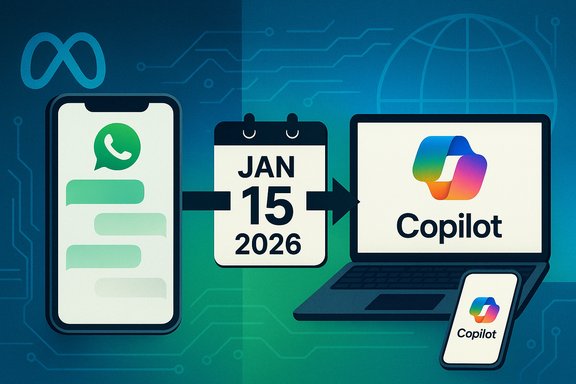
Microsoft’s decision to pull Copilot off WhatsApp is the latest and most visible sign that the era of distributing full‑featured large language model (LLM) assistants inside third‑party messaging platforms is colliding with platform policy, infrastructure limits, and emerging regulatory caution. Users can keep using Copilot on the web, the Copilot mobile apps for iOS and Android, and the native Windows Copilot experience, but the WhatsApp integration will stop functioning after January 15, 2026. This change affects millions of interactions, shifts distribution strategy for AI assistants, and raises urgent questions for consumers and businesses that relied on conversational AI inside WhatsApp.
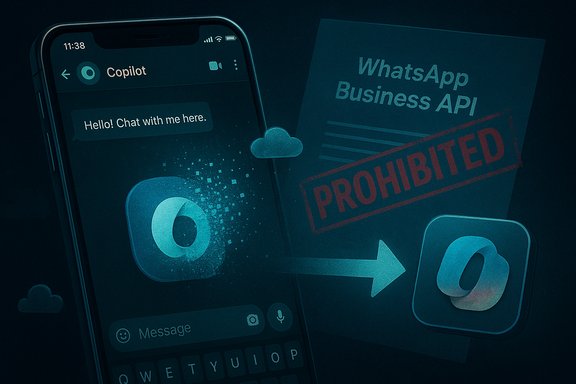
Microsoft launched Copilot integrations across multiple platforms to reach users where they already communicate and work. One of those distribution channels was WhatsApp, where Copilot offered conversational access to Microsoft’s assistant in a familiar chat environment. According to Microsoft, Copilot on WhatsApp launched in late 2024 and reached “millions” of users. The company now says the WhatsApp service will be discontinued because WhatsApp updated its platform rules to prohibit general‑purpose LLM chatbots on the platform, with the policy change taking effect January 15, 2026.
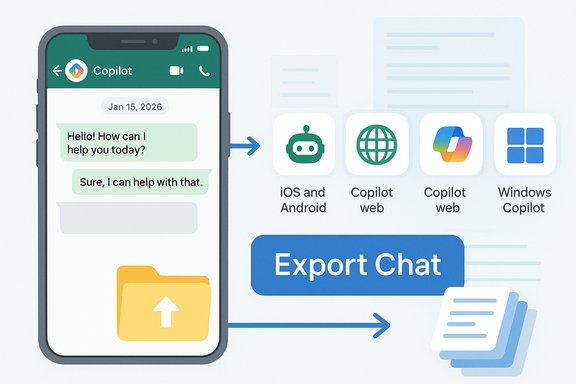
WhatsApp’s updated terms draw a sharp line between narrowly scoped, business‑centric automation (for order status, appointment confirmation, FAQ automation) and general‑purpose AI assistants that provide open‑ended conversational services. Platforms like WhatsApp are repositioning their Business APIs around predictable, business‑to‑consumer traffic and revenue models, and in the process are restricting third‑party LLM distribution. Microsoft’s public guidance to users is straightforward: Copilot on WhatsApp remains active until January 15, 2026, after which users should transition to Copilot’s other surfaces (web, mobile, Windows) and use WhatsApp’s export tools if they want to retain chat history.
What you lose:
At the same time, the WhatsApp exit underscores a fundamental vulnerability: when an app’s distribution strategy depends on another company’s platform and policy, the vendor is one policy tweak away from losing access to millions of users. This is a cautionary tale for startups and product leaders: platform reach is seductive, but platform control is transient.
For consumers, the change means a brief period of inconvenience and archiving chores, followed by potentially better features on Copilot’s home surfaces. For businesses, the announcement is a forcing function to build resilient, multi‑channel architectures and to reexamine how generative AI is woven into customer touchpoints.
Microsoft has laid out clear migration paths and timelines; the next six to eight weeks are the practical window for exporting archives, updating internal architecture, and onboarding users to Copilot’s native experiences. The larger lesson is systemic: the future of conversational AI will be decided as much by platform policy, infrastructure economics, and privacy practice as by model capability. The companies that design for portability, authenticated identity, and ownership of the user relationship will be best positioned to retain users when platforms redraw the rules.
Source: Microsoft Copilot is leaving WhatsApp: What's next | Microsoft Copilot Blog
 Background
Microsoft launched Copilot integrations across multiple platforms to reach users where they already communicate and work. One of those distribution channels was WhatsApp, where Copilot offered conversational access to Microsoft’s assistant in a familiar chat environment. According to Microsoft, Copilot on WhatsApp launched in late 2024 and reached “millions” of users. The company now says the WhatsApp service will be discontinued because WhatsApp updated its platform rules to prohibit general‑purpose LLM chatbots on the platform, with the policy change taking effect January 15, 2026.WhatsApp’s updated terms draw a sharp line between narrowly scoped, business‑centric automation (for order status, appointment confirmation, FAQ automation) and general‑purpose AI assistants that provide open‑ended conversational services. Platforms like WhatsApp are repositioning their Business APIs around predictable, business‑to‑consumer traffic and revenue models, and in the process are restricting third‑party LLM distribution. Microsoft’s public guidance to users is straightforward: Copilot on WhatsApp remains active until January 15, 2026, after which users should transition to Copilot’s other surfaces (web, mobile, Windows) and use WhatsApp’s export tools if they want to retain chat history.
What Microsoft announced — the essentials
- Copilot on WhatsApp will be discontinued effective January 15, 2026.
- The reason given: WhatsApp updated its platform policies to remove LLM chatbots from the platform.
- Copilot remains available on:
- Copilot mobile app (iOS and Android)
- Copilot on the web (copilot.microsoft.com)
- Copilot on Windows
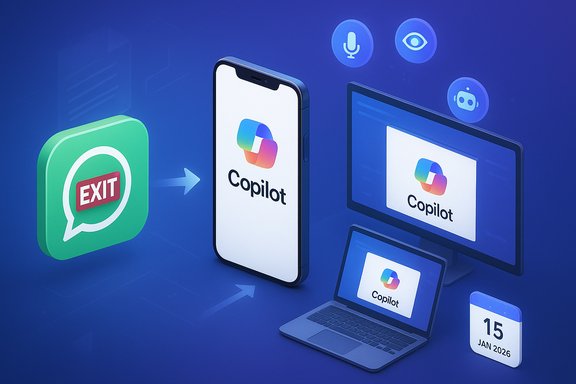
- Microsoft recommends exporting WhatsApp chat history before the January 15 cutoff because conversations on WhatsApp cannot be migrated to Copilot’s other surfaces (the WhatsApp integration is unauthenticated and chat history cannot be imported automatically).
- The Copilot mobile and web experiences include additional capabilities not available on WhatsApp—Copilot Voice, Copilot Vision, and Mico, among others—and the core functionality will be preserved.
Why this matters
This is more than a single product change. It highlights three structural dynamics that will shape AI distribution and user experience in 2026 and beyond:- Platform policy is now a first‑class constraint. Messaging platforms are writing rules that explicitly restrict how third‑party LLMs can operate, and those rules can be enforced with short lead times.
- Infrastructure and cost pressures. Open‑ended AI assistants generate high volumes of messages, media, and sessions that differ dramatically from traditional business traffic; platforms cite capacity, abuse mitigation, and monetization concerns when tightening rules.
- The migration toward owned channels. Vendors will increasingly push users into vendor‑controlled surfaces—native apps, web apps, and OS integrations—where they can assure identity, measure usage, monetize features, and implement richer modalities (voice, vision, persistent memory).
Short timeline and immediate actions for users
If you rely on Copilot inside WhatsApp, treat the January 15, 2026 date as a hard deadline for migration and data preservation.Immediate checklist (for everyone)
- Export any WhatsApp conversations you want to keep. Use WhatsApp’s built‑in export functionality and choose whether to include media.
- Install or update the Copilot mobile app (iOS/Android) and sign in with your Microsoft account to preserve continuity of identity and saved settings where supported.
- Bookmark copilot.microsoft.com and test the web experience on desktop and mobile browsers.
- If you used Copilot on WhatsApp for important workflows (notes, receipts, reference content), copy essential content into a personal note app, email, or cloud storage that the Copilot app or web interface can access if you want consolidated context.
How to export WhatsApp chats (quick steps)
- Open the chat in WhatsApp.
- Tap the contact or group name to open chat settings.
- Choose “Export chat” (or similar option); select whether to include media.
- Save the exported file to your preferred location (email, cloud storage, files app).
For power users and businesses: migration and contingency planning
Organizations that used Copilot (or any LLM) on WhatsApp as a customer channel should treat this as a case study in platform risk management. Here’s a pragmatic playbook.1. Audit current usage
- Identify which conversational workflows used the WhatsApp–Copilot channel (support, lead gen, document Q&A, internal automation).
- Measure volume, peak load, and the set of content types (text only, images, voice notes) used in those workflows.
2. Classify bots and use cases
- Determine whether the bot is general‑purpose (open conversational assistant) or task‑specific (order status, shipping updates, appointment confirmations).
- If your bot is task‑specific, redesign to comply with WhatsApp’s permitted use cases. If it’s general‑purpose, WhatsApp’s policy prohibits it on the Business API.
3. Decouple business logic from transport
- Implement a platform‑agnostic backend layer that separates conversation logic, storage, and model orchestration from the messaging transport.
- This approach reduces lock‑in: switch WhatsApp to another transport (Telegram, SMS, RCS, in‑app chat, Slack, Microsoft Teams) with minimal changes to AI logic.
4. Reconsider authentication and identity
- WhatsApp’s Copilot integration was unauthenticated; moving to owned surfaces with authenticated sign‑in preserves user state, personalization, and persistent memory.
- Migrate active users to a sign‑in flow (OAuth / Microsoft account) where appropriate; offer clear guidance and incentives to register.
5. Explore alternative channels
- In order of relevance: in‑app web chat, native mobile app, Microsoft Teams/Slack, Telegram, SMS/RCS, email, and voice IVR.
- Evaluate reach vs. control: WhatsApp has massive reach but limited control; in‑app channels require distribution but provide richer capabilities and ownership.
6. Communicate proactively to customers
- Announce the change with clear timelines and step‑by‑step instructions for migrating to the Copilot app or web, and how to export chat history.
- For enterprise customers, provide technical migration support, migration scripts for logs, and assistance reworking any bot connectors.
Technical and product implications for Microsoft and competitors
Microsoft’s choice to move users to Copilot’s owned surfaces is strategic and predictable. There are clear product benefits and business risks.Product benefits
- Richer multimodal experiences: native apps and Windows allow voice and vision integration (Copilot Voice, Copilot Vision) and animated companions (Mico).
- Authenticated context and memory: owning the surface enables personalization and persistent memory that improve continuity across sessions.
- Better monetization: in‑app purchases, subscriptions, and feature gating become feasible; Copilot Pro trial offers a template for premium upsells.
Business risks
- Distribution friction: moving users off a ubiquitous messaging app increases acquisition cost and reduces serendipitous usage.
- Competitive fragmentation: other AI assistants or providers that remain on permissive platforms (or that integrate into other messaging apps) can capture conversational mindshare.
- Brand and trust risks: abrupt service changes can erode user trust, especially if important historical chats are lost or difficult to export.
Policy, privacy, and safety considerations
WhatsApp’s policy change is part technical, part business, and part safety. The platform’s stated rationale centers on preventing misuse, ensuring predictable telemetry for billing, and limiting infrastructure strain. The policy also aligns with broader privacy and safety concerns around third‑party LLMs accessing extensive user conversations.- Privacy nuance: personal WhatsApp chats are end‑to‑end encrypted; however, interactions with business accounts and third‑party services may have different handling and metadata exposure. Users should assume that moving to another surface changes the data governance model.
- Data migration limits: because Copilot’s WhatsApp integration was unauthenticated, Microsoft cannot import exported WhatsApp conversation logs to recreate session history in the Copilot app or web — exported chats are archival only.
- Safety tradeoffs: platform restrictions reduce the attack surface for abuse on WhatsApp, but they also centralize conversational AI into vendor‑controlled apps where different guardrails and telemetry policies apply.
User experience: what changes and what improves
Copilot users should expect a mixed bag: a loss of the convenience of chatting inside WhatsApp, but gains in capability and continuity when moving to Copilot’s native experiences.What you lose:
- The conversational convenience of “just chat in WhatsApp” without installing another app.
- Any ephemeral context left solely in WhatsApp chats if not exported.
- Better support for voice conversations, visual inputs (camera/photo understanding), and a more persistent Copilot that can remember user preferences.
- A consistent authentication model that enables cross‑device sync and opt‑in memory.
- Access to advanced features like Mico, Groups for collaborative Copilot sessions, and Pro features available via subscription.
Market and competitive fallout
This policy shift will ripple across the AI assistant ecosystem:- Smaller AI startups that used WhatsApp as a distribution channel for general‑purpose assistants will need to pivot to other channels or shut down these products.
- Enterprise vendors will revisit their channel strategies and may accelerate investments in in‑app experiences and platform‑agnostic conversational layers.
- Platform divergence will increase: some messaging apps will allow open LLMs, others will restrict them, and users will see a fragmented assistant landscape where capabilities depend on which transport you choose.
Practical migration templates
Below are concise migration templates for common stakeholders.Consumer template (simple)
- Export important WhatsApp chats to archive.
- Install the Copilot app on iOS or Android and sign in.
- Try the web experience at copilot.microsoft.com and save bookmarks.
- Recreate any short workflows you used in WhatsApp in Copilot (pin messages, use notes, or link Copilot with connectors where available).
Small business template (customer support)
- Inventory WhatsApp conversational flows and volume.
- If flows are narrow (order status, confirmation), reconfigure them to comply with WhatsApp’s business API rules; otherwise, plan to move to an alternate channel.
- Build a platform‑agnostic backend using callbacks/webhooks and a unified message queue.
- Recreate customer journeys in an in‑app web chat or SMS/RCS where appropriate.
- Communicate transition windows to customers and provide fallback contact options.
Enterprise template (strategic)
- Conduct a rapid impact assessment of all customer touchpoints that used general‑purpose LLMs on WhatsApp.
- Prioritize migration for high‑value flows and set a technical deadline well before January 15, 2026.
- Migrate to authenticated experiences and integrate Copilot where possible into sanctioned enterprise apps (Teams, Windows, in‑house web apps).
- Review data governance and compliance: update privacy notices, data retention policies, and vendor agreements to reflect the platform change.
Risk matrix: what to watch for
- Data leakage during export: exported chats can include sensitive content. Use secure storage and delete temporary copies after migration.
- User drop‑off: expect a decline in casual engagement when moving from WhatsApp to a proprietary app. Counter with onboarding nudges and incentives.
- Policy churn: platform rules can change again. Maintain a multi‑channel posture to avoid single‑point dependency.
- Operational overhead: running your own channels means more responsibility for availability, moderation, and abuse mitigation.
Strategic takeaways for product leaders
- Design for portability: separate conversational AI logic from the transport layer; store conversation artifacts and logs in neutral formats that can be ported.
- Favor authenticated experiences where personalization and continuity matter; unauthenticated integrations are fragile for long‑term product value.
- Invest in discoverability: if you move users away from a ubiquitous messenger, invest in marketing, links, app integrations, and single‑click enrollments.
- Plan for resilience: create fallback channels (email, SMS, web widget) and automated routing so that policy changes at one platform don’t break critical user flows.
Final assessment — strengths and concerns
Microsoft’s move to accelerate Copilot adoption on owned surfaces is defensible from a product and business perspective. Native apps and web interfaces unlock multimodal capabilities, authenticated sessions, and monetization opportunities that WhatsApp’s platform model didn’t permit. For users who value richer interactions—voice conversations, image understanding, persistent memory—Copilot’s app and web experiences will likely be superior.At the same time, the WhatsApp exit underscores a fundamental vulnerability: when an app’s distribution strategy depends on another company’s platform and policy, the vendor is one policy tweak away from losing access to millions of users. This is a cautionary tale for startups and product leaders: platform reach is seductive, but platform control is transient.
For consumers, the change means a brief period of inconvenience and archiving chores, followed by potentially better features on Copilot’s home surfaces. For businesses, the announcement is a forcing function to build resilient, multi‑channel architectures and to reexamine how generative AI is woven into customer touchpoints.
Microsoft has laid out clear migration paths and timelines; the next six to eight weeks are the practical window for exporting archives, updating internal architecture, and onboarding users to Copilot’s native experiences. The larger lesson is systemic: the future of conversational AI will be decided as much by platform policy, infrastructure economics, and privacy practice as by model capability. The companies that design for portability, authenticated identity, and ownership of the user relationship will be best positioned to retain users when platforms redraw the rules.
Source: Microsoft Copilot is leaving WhatsApp: What's next | Microsoft Copilot Blog