
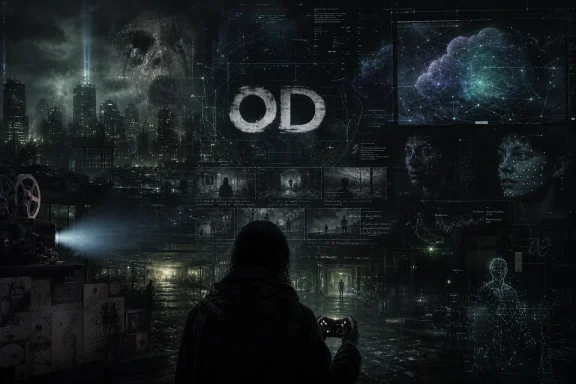
 Microsoft’s Reset Spares the Weirdest Bet on the Board
The obvious read is that Microsoft spared OD because Hideo Kojima is Hideo Kojima. That is not wrong, but it is incomplete. Kojima’s name buys attention in a way few creators’ names still do, and in an industry where platform holders increasingly talk about “engagement” with all the romance of a spreadsheet macro, attention has become one of the last scarce commodities.
But OD is a peculiar survivor. It is not a safe annualized franchise. It is not a reboot of a dormant Xbox property. It is not a neat Game Pass filler title with known scope, known genre, and known audience behavior. It is a horror-adjacent, cloud-linked, film-blurring Kojima production whose clearest commercial promise is that people will want to know what on Earth it actually is.
That makes the reported decision to keep it alive more revealing than a cancellation would have been. A Microsoft under pressure could easily have decided that this was the sort of high-concept external publishing deal that looked better in 2022 than it does in 2026. Instead, according to the latest reporting, Xbox is drawing a line between projects it sees as dispensable and projects it believes can still define the brand.
The catch is that this line is being drawn during a period of fear. Reports around Microsoft’s reset have pointed toward possible studio closures, layoffs, canceled games, and a harder look at outside publishing agreements. In that context, every surviving project becomes a political signal. Every canceled one becomes an autopsy.
OD surviving, then, is not merely good news for Kojima fans. It is a glimpse of the new Xbox investment doctrine: fewer bets, more scrutiny, and an apparent willingness to keep funding projects that can offer either scale, prestige, technological differentiation, or some combination of the three.
Kojima Gives Xbox Something Its Portfolio Keeps Struggling to Manufacture
Xbox has plenty of games. What it has lacked, too often, is gravitational pull.
That is a different problem from output. Microsoft can point to studios, franchises, subscription value, cloud infrastructure, PC reach, and now one of the largest content libraries in the industry. Yet the company has spent years fighting the perception that Xbox is more impressive as a corporate asset map than as a cultural force. It has the pieces, but the audience often has to be reminded why those pieces add up to a destination.
Kojima offers a shortcut around that problem. A new Kojima project automatically produces speculation, trailer analysis, Reddit archaeology, YouTube essays, skeptical backlash, and industry curiosity. The game does not even need to be understood to be discussed. In fact, not being understood is part of the product.
That dynamic is especially valuable for Xbox because Microsoft’s platform identity has become diffuse. Xbox is a console, a PC storefront, a subscription, a cloud service, a publisher, and increasingly a label appearing on rival hardware. The old console-war answer — buy this box to play these games — has been softened by Microsoft’s own strategy. That may be rational business, but it makes exclusivity and identity harder to communicate.
A Kojima partnership solves some of that by making Xbox feel like a patron of unusual work rather than merely a distributor of content. The original pitch in 2022 leaned heavily on Microsoft’s cloud technology, framing the project as something Kojima wanted to make but could only make with Xbox. Whether the finished product ultimately proves that claim is another matter. As positioning, though, it was exactly the kind of message Xbox needed: this platform enables things others do not.
That is why canceling OD would have been so damaging beyond the loss of one game. It would have suggested that Microsoft’s appetite for experimental prestige was conditional on easier financial weather. It would have told developers that Xbox’s biggest promises could evaporate when the next restructuring memo arrived. It would have turned a cloud-powered creative partnership into another entry in the industry’s growing ledger of abandoned ambition.
The Cloud Pitch Is Still the Least Understood Part of OD
The strangest thing about OD is not that it is a horror game. It is that Microsoft and Kojima have spent years orbiting a technical pitch that remains deliberately opaque.
When the partnership was announced, the emphasis was not simply on Xbox publishing another Kojima game. It was on using Microsoft’s cloud technology to create something “never-before-seen,” or at least something positioned that way. That language fit the moment. In 2022, cloud gaming was still being discussed as a possible frontier rather than merely a convenient delivery option. Microsoft wanted Xbox Cloud Gaming to look less like remote access to a console and more like a creative platform.
Four years later, the market is less enchanted by cloud rhetoric. Streaming games exists, works better than skeptics once expected, and remains constrained by latency, infrastructure, business models, and user habits. It is useful, but it has not replaced local hardware. It has expanded access, but it has not rewritten game design at scale.
That makes OD a lingering test case. If the game uses cloud technology only as a backend flourish, the original positioning will look inflated. If it genuinely depends on networked computation, live performance, audience interaction, or some other structure that cannot be cleanly replicated offline, then Microsoft will have a rare proof point for a decade of cloud evangelism.
For Windows users and PC players, this matters because Xbox’s cloud experiments rarely stay confined to consoles. Microsoft’s gaming strategy treats PC, console, and cloud as overlapping access layers. A project like OD could therefore become less about selling a single Xbox box and more about demonstrating a Microsoft gaming environment: Azure infrastructure, Xbox identity, PC distribution, Game Pass economics, and cross-device reach.
That is a difficult story to tell in a trailer. It is also the kind of story Microsoft desperately wants to be able to tell.
The 100-Day Reset Is Really a Test of Memory
Corporate resets always come with a promise of discipline. The language is familiar: priorities, focus, alignment, efficiency, sustainable growth. The gaming industry has learned to translate that vocabulary quickly. It usually means people lose jobs, projects disappear, and leadership insists that the remaining plan is stronger for having been narrowed.
The problem for Microsoft is that Xbox has already asked the audience and developers to absorb multiple strategic turns. It has moved from console-first messaging to ecosystem messaging, from acquisition blitz to integration pain, from Game Pass euphoria to subscription realism, from exclusivity to multiplatform pragmatism. Each step may be defensible on its own. Together, they create fatigue.
That fatigue changes how every rumor lands. When reports suggest that Microsoft may pull back from certain publishing agreements or cut internal projects, the community does not process that as an isolated business adjustment. It fits the broader story of an Xbox division still trying to decide what kind of company it wants to be after buying its way into enormous scale.
In that environment, OD becomes a memory test. Microsoft once stood beside Kojima and sold the idea that Xbox could make his unusual concept possible. If that project had been dropped amid a reset, the old promise would have aged badly. The reported decision to continue development keeps the promise alive, but it does not settle the question of whether Xbox’s promises are durable.
For developers, durability is everything. External studios do not just need checks; they need confidence that the publisher’s strategy will not mutate halfway through production. Internal teams need to know whether leadership still believes in games that do not immediately map to a franchise spreadsheet. Players need some reason to believe that a showcase announcement is more than a temporary asset in a quarterly narrative.
That is why Microsoft’s statement that it is not reducing overall investment in games, but changing where it invests, deserves close reading. It is meant to reassure. It also implies a harsher internal sorting mechanism. The money may still be there, but the tolerance for being on the wrong side of the priority stack is shrinking.
OD Survives Because It Is Risky in the Right Direction
At first glance, keeping OD while canceling or scrutinizing other projects can look inconsistent. Why preserve a mysterious horror experiment while reconsidering more conventional games? The answer may be that Microsoft is no longer allergic to risk. It is becoming allergic to ordinary risk.
Ordinary risk is a mid-budget game without a clear audience. It is a prestige project with no obvious marketing hook. It is a second-tier franchise revival that costs like a blockbuster but lands like a niche product. It is a title that fills the calendar without changing anyone’s perception of the platform.
OD is risky, but it is not ordinary. It has a creator whose name functions as marketing. It has a genre with streaming and social-media potential. It has Hollywood adjacency through Jordan Peele and a cast that has already generated attention. It has the lingering ghost of P.T., the canceled Silent Hills teaser that remains one of the most analyzed horror artifacts in modern games. Most importantly for Microsoft, it has a technological story that can be made to sound uniquely Xbox.
That combination does not guarantee commercial success. Kojima’s work is polarizing by design, and the more experimental OD becomes, the harder it may be to translate curiosity into broad adoption. But if Microsoft is choosing fewer projects, it makes sense to choose projects that can cut through noise.
This is the brutal logic of the modern platform holder. A merely good game may not be enough if it does not move perception, subscriptions, hardware engagement, storefront traffic, or cultural attention. A strange game with a famous author might do all of those things, even if it sells fewer traditional copies than a safer release.
That is not a comforting conclusion for the industry. It suggests that originality is safest when attached to celebrity, technology branding, or both. Still, for OD, those attachments may be exactly what kept it out of the shredder.
Horror Is the Perfect Genre for an Unclear Platform Strategy
Horror has always thrived on limitation. Fixed cameras, awkward controls, obscured information, unreliable sound, and the threat of the unseen have all been turned into virtues. That makes it a natural fit for a project whose own shape remains obscure. The less Microsoft and Kojima explain, the easier it is for the audience to project dread into the gaps.
It also makes horror unusually compatible with modern attention economies. Players may not finish every horror game they buy, but they watch them, clip them, stream them, and dare friends to endure them. A Kojima horror project is almost engineered for communal investigation. Even people who never intend to play it may still participate in decoding it.
That matters for Xbox because Game Pass-era value is not only measured by unit sales. It is measured by conversation, retention, perceived library quality, and the sense that something culturally necessary is happening inside the ecosystem. A horror project that becomes a streaming event can punch above its weight, especially if it launches into a service environment where sampling friction is low.
The danger is that this same dynamic can reward spectacle over substance. Microsoft does not need OD merely to be weird. It needs it to be playable, coherent enough to recommend, and technically stable enough not to become a meme for the wrong reasons. Kojima can get away with a great deal, but he cannot suspend the basic laws of user experience.
For Windows and Xbox players, the practical question is whether OD becomes a traditional premium release, a Game Pass centerpiece, a cloud-forward experiment, or some hybrid that complicates those categories. Microsoft has not yet given the audience enough detail to judge that. The reported survival of the project is therefore only the first answer. The next one is what kind of product Microsoft believes it saved.
The IO Interactive Shadow Makes the Kojima News Harder, Not Easier
The report that OD remains safe lands alongside claims that other externally backed projects have not been so fortunate. IO Interactive’s fantasy project has been cited as one of the apparent casualties or pressure points in Microsoft’s publishing reassessment. That contrast is uncomfortable because it shows the reset is not theoretical.
IO Interactive is not an unknown studio. It is the team behind the modern Hitman trilogy, one of the more impressive examples of systemic design and long-tail live support in recent memory. If a studio with that pedigree can find a Microsoft-backed project imperiled, then external partners have reason to be anxious.
The distinction may come down to fit. A new fantasy RPG from IO might be promising, but it lives in a crowded category where Microsoft already has significant internal and acquired exposure. Between Bethesda, Obsidian, Blizzard, and other role-playing or fantasy-adjacent assets, Xbox does not lack ways to serve that audience. The project may have been good and still not sufficiently differentiated for the new regime.
OD, by contrast, occupies a more singular lane. Xbox does not have another Kojima cloud-horror-media experiment waiting in the wings. It does not have many projects that can be teased with a few seconds of unsettling performance capture and reliably dominate speculation. In a narrower portfolio, uniqueness becomes a shield.
That is harsh, but it is also how restructuring logic tends to work. The question is not whether a project has merit in the abstract. The question is whether it survives a newly defined strategic filter. That filter may favor global IP, creator-led prestige, technical showcases, and franchises that can scale across devices.
The industry should be wary of mistaking survival for virtue. Many canceled games are not bad games. Many surviving games are not automatically wise investments. The sorting process reveals management priorities more clearly than it reveals creative quality.
Asha Sharma’s Xbox Inherits Phil Spencer’s Promises and Microsoft’s Math
The reported 100-day reset is being interpreted through the leadership change at Xbox, with Asha Sharma now associated with a more selective phase for Microsoft’s gaming business. Whether every rumored move should be laid at the feet of a new executive is another matter. These decisions are shaped by Microsoft’s broader financial expectations, post-acquisition integration, and the industry’s cooling economics after years of pandemic-era overexpansion.
Still, leadership symbolism matters. Phil Spencer’s Xbox spent years cultivating the image of a player-friendly platform with deep pockets, broad access, and unusual patience. That image was always partly myth, but it was useful. It gave Xbox a softer edge than Microsoft’s size might otherwise suggest.
Sharma’s Xbox appears to be inheriting both the benefits and liabilities of that era. The benefit is an enormous portfolio and a subscription ecosystem that competitors cannot easily replicate. The liability is that every promise now has a carrying cost. Every studio acquired during the expansion years must justify itself. Every external deal must compete with internal priorities. Every showcase beat becomes a liability if it later disappears.
In that context, OD surviving can be read as continuity. Microsoft is still willing to stand behind a creator-led project that was announced under the previous regime. That matters because abrupt reversals would deepen the impression that Xbox’s strategy is rewritten every fiscal year.
But it can also be read as selectivity. The company is not keeping everything. It is reportedly protecting the projects it believes still tell the right story about Xbox’s future. If that story is cloud-enabled, cross-media, creator-branded, and globally legible, OD fits rather neatly.
The risk for Sharma is that selectivity can look like vision only if the survivors deliver. If the reset cuts deeply and the remaining slate fails to excite, discipline becomes indistinguishable from retreat. If the survivors land, Microsoft can argue that it finally stopped confusing breadth with strength.
Xbox’s Publishing Problem Is Trust
The easiest thing for Microsoft to lose right now is not money. It is trust.
Players already understand that games get canceled. Developers understand it more painfully than anyone. What corrodes trust is the feeling that platform strategy has become too unstable for creative commitments to mean much. Xbox has spent years telling audiences that its ecosystem reduces barriers. It now has to prove that its business decisions do not create a different kind of barrier: uncertainty.
External publishing is especially sensitive to that. A first-party studio may be reorganized, merged, renamed, or refocused, but it remains inside the corporate perimeter until it does not. An outside studio lives with more ambiguity. If Microsoft changes priorities, the external partner may be left with a partially built project, staffing commitments, and no easy path to replacement funding.
That is why the OD report is reassuring in one direction and chilling in another. It reassures because a marquee partnership appears intact. It chills because it implies Microsoft is indeed reviewing projects aggressively enough for the question to be asked in the first place.
For WindowsForum readers, the enterprise analogy is obvious. A vendor can promise a roadmap, but customers learn to watch which products survive budget season. Microsoft’s gaming division is now going through the same credibility cycle familiar to IT departments: strategy deck, consolidation, cuts, renewed commitment, and then the long wait to see what actually ships.
The difference is that games are emotional purchases as well as technical products. People attach identity to platforms, creators, and studios. When Microsoft cancels a game, it is not just reallocating capital. It is breaking a small public covenant made at a showcase, in an interview, or on a stage.
OD remains one of those covenants. Keeping it alive preserves the possibility that Xbox can still be a home for the improbable. Shipping it well is the only thing that will make that possibility count.
The Physical Media Anxiety Is Part of the Same Story
The user anger around physical media, subscription dependency, and platform control may seem separate from a Kojima horror game, but it is not. It comes from the same underlying fear: that the games industry is becoming less durable for players while becoming more optimized for corporate flexibility.
When platform holders move away from discs, players lose a visible form of ownership. When publishers cancel digital projects, delist titles, or restructure services, players are reminded that access is conditional. When layoffs erase teams after successful releases, fans learn that even good work may not protect the people who made it.
Microsoft’s Xbox strategy sits at the center of that unease because it has been one of the loudest advocates for access over ownership. Game Pass, cloud streaming, Play Anywhere, and multiplatform publishing all make sense in a world where users want convenience. But convenience can curdle into dependence if the platform holder’s priorities shift faster than the user’s library feels stable.
OD is not a physical media story yet; we do not even know its full release model. But the anxiety surrounding it reflects a broader loss of confidence. If Microsoft can fund an ambitious project one year and reportedly reconsider whole categories of investment the next, users wonder what else can change. If Xbox becomes more selective, they wonder whether that selectivity serves players, shareholders, or both.
The uncomfortable answer is both, but not always evenly. A healthier Xbox business can fund better games. A narrower Xbox business can also abandon projects that communities cared about. The line between discipline and disposability is thin, and Microsoft has not always walked it gracefully.
This is where OD has symbolic weight disproportionate to its known details. A strange Kojima horror game surviving the reset says Microsoft has not reduced its ambitions to only the safest bets. It does not answer whether the ecosystem those ambitions live inside will feel more or less secure for players.
Kojima’s Independence Changes the Power Balance
Kojima Productions is not a Microsoft studio, and that matters. The company has worked with Sony, announced an Xbox partnership, pursued film and television projects, and maintained a public identity centered on Kojima rather than any single platform holder. That independence gives OD a different texture from an internal Xbox project.
For Microsoft, the upside is obvious. It gets association with one of the industry’s few true auteurs without having to own the studio. It can present Xbox as a partner to creative ambition rather than merely a consolidator of studios. That is valuable after years in which Microsoft’s gaming story has been dominated by acquisition.
The downside is control. An external project is not as easily absorbed into platform planning. It depends on negotiated rights, production milestones, technical collaboration, and the priorities of a studio that has other ambitions. If the relationship works, it looks visionary. If it falters, it can become expensive ambiguity.
For Kojima, Microsoft offers infrastructure and reach. The cloud pitch was not incidental; it was the justification for why this partnership existed at all. Kojima has repeatedly framed his post-Konami career around crossing boundaries between games, cinema, and new forms of media. Microsoft, with Azure and Xbox, can credibly claim to provide tools for that experiment.
The survival of OD suggests both sides still see value in the bargain. But it also raises expectations. If Microsoft protected this project during a reset, the company will want it to justify that protection not just as art, but as strategy. If Kojima accepted the Xbox bet because the technology made something new possible, the finished work will have to show more than branding.
That is a difficult burden for any game. It is especially difficult for one whose mystique depends on not explaining itself too early.
The Game Pass Question Hangs Over Everything
It is impossible to discuss a major Xbox-backed game without eventually arriving at Game Pass. Microsoft’s subscription service remains the company’s most distinctive gaming product and its most persistent source of industry argument. It can lower the barrier to trying unusual games. It can also reshape how projects are valued internally.
For OD, Game Pass could be a perfect delivery mechanism. Horror thrives on sampling, social pressure, and curiosity. A player who might hesitate to spend full price on an experimental Kojima project may happily install it as part of a subscription. If the game is short, strange, episodic, reactive, or otherwise unconventional, subscription access could reduce the mismatch between expectation and price.
But Game Pass also complicates success metrics. A traditional boxed or digital sale gives the market a blunt signal. A subscription launch produces a fog of internal numbers: installs, hours, retention, reactivation, completion, social reach, and perceived value. Microsoft can declare success in ways outsiders cannot verify.
That opacity matters during a reset. If projects are being judged by internal contribution to the ecosystem, the public may never know why one game was protected and another was cut. A title might be valuable because it keeps subscribers engaged for a weekend. Another might be canceled because its projected contribution does not justify its cost, even if it would have found a passionate retail audience.
OD may benefit from that math. It is exactly the sort of title that could make Game Pass feel less like a backlog warehouse and more like a place where strange events happen. The service needs those moments. A subscription full of competent games can still feel inert if nothing demands attention.
Yet Microsoft should be careful not to treat Game Pass as a magic solvent for risk. A subscription can get players through the door. It cannot make an unclear concept satisfying, a broken launch acceptable, or a thin experiment feel substantial. If OD becomes a Game Pass centerpiece, it will still have to earn its own fear.
Xbox Needs Fewer Announcements and More Arrivals
The modern showcase economy has trained companies to sell futures they cannot always deliver. Xbox has been particularly vulnerable to this because it has often needed the future to compensate for the present. Announcing partnerships, acquisitions, and far-off projects helped sustain faith during thin release periods and strategic transitions.
That strategy has costs. Every long-tail announcement creates a debt. The longer the gap between reveal and release, the more the project becomes a symbol rather than a game. Symbols are useful until they are not. They attract hope, but they also accumulate skepticism.
OD has lived in that symbolic zone for years. It began as a mysterious Xbox-Kojima partnership in 2022, became a named project at The Game Awards in 2023, and has since existed as a collage of unsettling footage, celebrity collaboration, cloud language, and fan inference. That is enough to keep interest alive. It is not enough forever.
If Microsoft is entering a more selective era, it should also enter a more disciplined announcement era. Fewer speculative reveals would make the surviving slate feel more credible. More frequent, concrete updates would reduce the sense that projects vanish into corporate fog. The company does not need to explain every creative secret, but it does need to show that its major bets are progressing toward reality.
For OD, the next important milestone is not another cryptic slogan. It is a clearer demonstration of form. What does the player do? How does the cloud matter? Is this a conventional horror game with experimental presentation, or a genuinely new structure? What platforms are included at launch? How will Microsoft position it for Game Pass, PC, console, and cloud users?
Those questions do not need to be answered all at once. But they do need answers before the mystique starts to feel like camouflage.
The Surviving Nightmare Gives Xbox a Narrow Path Forward
The reported survival of OD does not redeem Microsoft’s reset, and it does not soften the human cost if layoffs and closures arrive as expected. It does, however, clarify the kind of project Xbox still appears willing to defend. Near the close of this latest round of uncertainty, the pattern looks less like a blanket retreat from games and more like a ruthless narrowing of what Microsoft believes can matter.
- OD reportedly remains in development at Kojima Productions with Xbox support despite Microsoft’s broader reset of its gaming business.
- Microsoft’s public line is that overall games investment is not being reduced, but the company is changing where and how that money is allocated.
- The project’s survival likely reflects its unusual mix of creator prestige, horror-market visibility, cloud positioning, and cross-media potential.
- The contrast with reportedly endangered or canceled projects shows that Xbox’s new selectivity may protect distinctive bets while punishing projects that overlap with existing portfolio priorities.
- The next real test is whether OD can demonstrate a playable idea strong enough to justify years of cloud-powered mystery.
- For players and developers, the larger issue is not whether one Kojima game survives, but whether Xbox can make its commitments feel durable again.
The good news for Microsoft is that OD still gives Xbox a story its competitors cannot simply copy: a legendary designer, a horror premise, a cloud-era experiment, and a platform holder trying to prove that its infrastructure can enable art rather than merely distribute it. The harder news is that surviving a reset is not the same as surviving release. If OD ships as a genuinely unsettling, technically meaningful work, Microsoft will have evidence that discipline did not extinguish ambition; if it arrives as another over-teased curiosity, the company will have protected the symbol and missed the point.
