

Microsoft’s PC Game Pass argument in June 2026 is that the subscription still works as a discovery engine for Windows players, even as the company heads into its June 7 Xbox Games Showcase under new Xbox chief Asha Sharma after a bruising pricing fight. The interesting part is that this argument is not really about Microsoft’s own games. It is about the library effect: the strange, durable power of a low-friction catalog to turn “maybe someday” into “I’ll try it tonight.” For PC players, that may be the strongest version of Game Pass Microsoft has left.
The most generous way to understand PC Game Pass is not as a buffet of blockbusters, but as a library card with a GPU requirement. That distinction matters because Microsoft has spent years selling Game Pass with the language of abundance: day-one releases, big franchises, cloud access, EA Play, perks, and the comforting idea that one monthly fee can smooth out the modern games industry’s $70 sharp edges. But for many PC players, the service’s stickiness has always come from something smaller and more personal.
A library does not work because every book on the shelf is a bestseller. It works because the cost of curiosity is close to zero. You walk in for one thing, come out with three you did not plan to read, and sometimes the accidental pickup becomes the one that changes your taste.
That is the case PCGamesN’s Ken Allsop makes in his reflection on why PC Game Pass still works for him. The service, in his telling, is not primarily a Microsoft showcase. It is the thing that made him try Blue Prince, Tunic, Sea of Stars, Monster Train, Pacific Drive, Roboquest, Wild Hearts, and a spread of co-op and indie games that might otherwise have lingered forever on a Steam wishlist.
That is the version of Game Pass Microsoft should be studying most closely. Not the version that asks whether a new Call of Duty makes the monthly price mathematically defensible, but the version that asks whether a player keeps stumbling into something worth loving.
Once that happens, the service loses part of its magic. A player who is asking, “Did I get enough value this month?” is no longer wandering the stacks. They are auditing Microsoft.
That is why the recent pullback matters, even if the details of the new pricing structure still deserve scrutiny. Sharma’s reported acknowledgment that Game Pass had become too expensive landed because it conceded what users had already felt: Microsoft had pushed the service toward a tier of obligation rather than invitation. A subscription can be expensive and still feel valuable, but it cannot feel punitive.
PC Game Pass has always occupied a different emotional space than console Game Pass Ultimate. PC players already live in a world of Steam sales, Epic giveaways, Humble bundles, itch.io experiments, deep discounts, and sprawling backlogs. They do not need Microsoft to be the only store in town. They need Microsoft to justify why its library deserves a permanent place beside everything else.
That justification weakens the moment the monthly bill becomes loud. The user starts comparing against Steam wishlists, publisher sales, and the comforting permanence of ownership. Game Pass cannot win every one of those comparisons, so it has to avoid provoking them too often.
In practice, the first-party promise has been messier. Some of Microsoft’s best Game Pass arguments have come from its studios: Forza Horizon, Grounded, Pentiment, Hi-Fi Rush, Gears Tactics, Flight Simulator, and Obsidian’s output all gave the service moments of clarity. But those successes sit alongside delays, uneven releases, platform strategy confusion, and a growing sense that Xbox’s identity is being renegotiated in public.
For PC users, the issue is not whether Microsoft has good games. It plainly does. The issue is whether Microsoft’s own release calendar can carry the emotional weight the company keeps placing on it.
This is where Allsop’s argument cuts deeper than a simple “Game Pass is good” endorsement. The games he credits with sustaining his subscription are often not Microsoft’s tentpoles. They are indies, smaller third-party releases, older curiosities, co-op experiments, and genre pieces that benefit from reduced friction. Game Pass works for him because it widens the funnel of play, not because it guarantees every first-party mega-release will be worth the price of admission.
That should worry Microsoft a little. The most beloved use case for its gaming subscription may be one it does not fully control.
A Windows player can buy from Steam, GOG, Epic, Microsoft, Ubisoft, EA, Battle.net, itch.io, and storefronts most people have already forgotten they installed. They can mod, sideload, emulate, stream, dual-boot, and wait for a bundle. They can build a library across decades and then complain, accurately, that no launcher is quite good enough.
That makes PC Game Pass less of a platform fortress and more of a behavioral nudge. The Xbox app is not Steam, and Microsoft should stop pretending it can become Steam by force of branding. What it can be is a useful front door into games that benefit from being tried rather than purchased.
That is especially true for genres where uncertainty is high. A Metroidvania can sound derivative until its movement clicks. A deckbuilder can look like homework until its rules produce a little lightning storm in the brain. A co-op shooter can seem disposable until three friends accidentally turn it into their Thursday night ritual. A survival game, roguelite, tactics release, or strange narrative puzzle box often needs an hour of grace that a store page cannot provide.
PC Game Pass is at its best when it buys that hour.
Buying a game creates a small moral debt. If you spend $30, $50, or $70 on something, you want it to justify the purchase. You tolerate a slow opening, fight with a bad tutorial, promise yourself it gets better, and sometimes confuse persistence with enjoyment.
A subscription changes that. If a game does not work, you leave. No refund timer, no buyer’s remorse, no need to write a courtroom brief in your head explaining why you are done. That freedom makes experimentation feel safe.
Paradoxically, the ability to quit can make players more patient. Allsop’s account of MIO: Memories in Orbit is a useful example: the game apparently did not grab him immediately, but because there was no price anxiety attached, he kept going until it unfolded into something special. Game Pass did not merely make it easier to sample the game. It made it easier to meet the game on its own terms.
This is where Microsoft’s subscription still has a distinctive advantage over traditional storefronts. Steam’s refund window is consumer-friendly, but it is still a window. Game Pass has no equivalent countdown. The pressure is not “decide quickly whether this was worth buying.” The pressure is closer to “see what happens.”
That difference can rescue games from the purgatory of “looks fun, but not enough of us will buy it.” Aliens: Fireteam Elite, Remnant: From the Ashes, Roboquest, Grounded, and similar titles all benefit from the same dynamic. The subscription reduces the social risk of proposing a game to friends.
This is not just a consumer perk. It changes the commercial life of games. A title that might struggle to convert a whole group at retail can find an audience through frictionless access, then make money through DLC, expansions, sequels, or simple word of mouth. A player who would never have bought the base game may gladly pay for more once the group is invested.
That is the healthier version of subscription economics: discovery first, monetization later. It is also the version Microsoft should emphasize if it wants developers to believe Game Pass is more than a lump-sum visibility trade-off.
The risk, of course, is that subscriptions can train users not to buy. But the co-op pattern suggests something more nuanced. Game Pass can suppress some purchases while creating others that would never have existed. The problem is that Microsoft has not always been transparent enough for developers, players, or analysts to understand which side of that ledger dominates.
But Game Pass does not live by tentpoles alone. It needs texture.
A healthy Game Pass month is not merely one enormous release sitting atop filler. It is a blend of recognizable names, eccentric indies, genre specialists, older games worth revisiting, and day-one oddities that feel too risky for an impulse purchase but perfect for a download. That mix is what makes the library feel alive.
Microsoft’s challenge is that showcases naturally overrepresent scale. The big trailers get the time. The first-party logos get the applause. The corporate strategy gets wrapped in orchestral swells and cinematic cuts. Yet the lived experience of PC Game Pass often happens in the quieter rows of the catalog.
That mismatch is not fatal, but it is important. If Microsoft treats Game Pass only as a delivery vehicle for its biggest bets, it will misunderstand why many PC users still keep paying. The service’s soul is not just in the headliners. It is in the games users almost did not notice.
Yet there is a credible argument that Game Pass is healthier when Call of Duty is not allowed to distort the entire conversation. A franchise that large changes the perceived cost structure of the service. It pushes Microsoft toward higher prices, pushes users toward annualized value calculations, and turns every subscription debate into a referendum on a single shooter.
For players who live inside Call of Duty, that may be exactly what they want. For everyone else, it can make the service worse.
The Game Pass that PC players like Allsop describe is not a Call of Duty subsidy. It is a discovery layer. It works because a user can bounce from Blue Prince to Sea of Stars to Pacific Drive to Monster Train to Final Fantasy classics without treating any one game as the reason the whole machine exists.
Microsoft does not have to abandon blockbusters. It does need to stop letting blockbusters define value so completely that the rest of the catalog becomes invisible.
For WindowsForum readers, this is not a cosmetic complaint. Launcher quality affects backups, modding, file access, patching, download reliability, storage management, controller behavior, cloud saves, and the simple confidence that a game will launch when clicked. PC gamers will forgive a lot, but they do not easily forgive a platform that feels like it is fighting the operating system it supposedly belongs to.
Microsoft has made progress on installation folders, app performance, and integration, yet Game Pass on PC still carries a faint residue of Games for Windows Live trauma. That history matters. When Microsoft asks PC players to trust another gaming layer, it is asking them to forget several earlier attempts that ranged from awkward to catastrophic.
The opportunity is obvious because Windows is Microsoft’s home turf. PC Game Pass should feel native, fast, transparent, and technically boring in the best possible way. The fact that the catalog can still shine through the app’s lingering reputation is a testament to the strength of the model, but it is also an indictment of how long Microsoft has taken to make PC gaming on Windows feel like a first-class Microsoft product.
That does not mean every small game becomes a breakout. Most will not. But the aggregate effect matters. A library that regularly delivers intriguing mid-sized and independent games creates a habit of checking in. It turns the Xbox app from a place users open when a Microsoft release lands into a place they browse when they are bored.
That habit is valuable. It is also fragile.
If Microsoft cuts too deeply into third-party deals to protect margins, PC Game Pass risks becoming a narrower service with better-known brands and less discovery. That might look cleaner in a boardroom, but it would weaken the very behavior that keeps many subscribers around between major releases. The danger is not that users will revolt all at once. It is that they will open the app less often, install fewer experiments, and eventually realize they do not miss it.
The library card metaphor has a business edge. A library with only famous books is not much of a library. The serendipity comes from the shelves you did not know you wanted.
Game Pass lowers that irritation. It gives players permission to revisit older games without turning nostalgia into another transaction. That matters more as the industry grows older and back catalogs become a larger part of gaming culture.
For Microsoft, older catalog titles also help solve a pacing problem. New games are unpredictable, expensive, and prone to delay. Classics are known quantities, but in a subscription context they can feel newly accessible. They fill gaps without necessarily feeling like padding.
This is especially important on PC, where preservation, compatibility, and library fragmentation are constant background issues. A well-curated subscription can make old games feel present without pretending they are new. That is a different kind of value from a day-one release, but it is real value.
Xbox’s biggest recent problem has not been a lack of assets. It has been inconsistency. One month the message is exclusive ecosystem value; the next it is multiplatform reach. One year Game Pass is the future of all gaming; the next the pricing suggests the future has become expensive to maintain. One moment users are told day-one access is sacred; the next they are asked to understand why certain giants may sit outside the bundle.
Some of those changes are rational. The console market is not growing quickly enough, development costs are brutal, and Microsoft did not spend tens of billions on Activision Blizzard to win forum arguments about purity. But rational strategy can still feel chaotic when communicated poorly.
PC users are more tolerant of platform fluidity than console loyalists, but they are not indifferent to confusion. They want to know what they are paying for. If the answer changes every few months, they will default back to Steam and selective purchases.
That should be an advantage. Microsoft owns Windows, DirectX, the Xbox network, the Store infrastructure, cloud services, and a giant gaming portfolio. It has relationships across publishers and developers. It has the technical reach to make PC Game Pass feel deeply integrated rather than bolted on.
And yet, for much of its life, PC Game Pass has felt like a console strategy translated into Windows rather than a Windows-native gaming strategy. The catalog was the star; the surrounding experience lagged behind. Microsoft’s opportunity now is to reverse that hierarchy.
Imagine PC Game Pass as a genuinely polished Windows gaming layer: clean installs, excellent performance visibility, easy mod support where permitted, cloud saves that never require faith, reliable handheld PC behavior, strong family controls, and transparent game departure notices. None of that is as exciting as a showcase trailer. All of it matters more after the trailer fades.
Every PC gamer has one. It lives across Steam libraries, Epic freebies, GOG classics, Humble keys, itch.io downloads, abandoned MMOs, early-access promises, and games purchased during sales because the discount felt like destiny. The backlog is both abundance and guilt.
PC Game Pass must therefore do more than offer games. It must overcome inertia. It has to be interesting enough that a player chooses a temporary subscription title over something they already own permanently. That is a high bar, and it explains why discovery is so central to the service’s appeal.
A blockbuster can clear that bar through hype. A smaller game clears it through proximity. It is right there, installed with one click, free from purchase anxiety, ready to surprise you before the backlog can object.
This is why Microsoft should be careful with any move that makes the catalog feel less fresh. Once Game Pass becomes just another backlog, it loses. Its advantage is motion.
Both versions contain truth.
For smaller studios, a Game Pass deal can provide guaranteed money and visibility in a crowded market. It can also complicate long-term sales expectations, train audiences to wait, and make success dependent on opaque platform negotiations. For players, the service can enable curiosity, but it can also detach play from ownership and make access contingent on licensing churn.
Microsoft’s job is not to pretend those tensions do not exist. It is to manage them well enough that the bargain remains credible.
That means communicating clearly when games enter and leave. It means giving developers reasons to see Game Pass as additive rather than extractive. It means resisting the temptation to solve every margin problem with another price hike. Most of all, it means remembering that the user experience is not just the catalog size; it is the feeling that the subscription is on the player’s side.
That is valuable in an industry increasingly dominated by safe bets, sequels, remakes, live-service gravity wells, and marketing budgets large enough to bend attention around them. A subscription library can either worsen that problem by privileging giants, or soften it by giving smaller and stranger games a route into ordinary play.
The best version of Game Pass does the latter. It lets a tactics skeptic try Gears Tactics. It lets a co-op group risk a weekend on Remnant. It lets someone open Roboquest on a whim. It lets an older RPG, a new Metroidvania, a roguelite deckbuilder, or a stylish indie puzzle game jump the queue.
That is the spark Allsop is describing. It is not loyalty to Microsoft. It is loyalty to surprise.
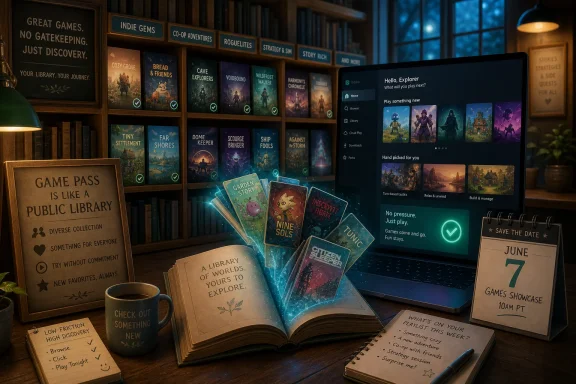 Game Pass Survives by Being Less Like Netflix Than a Public Library
The most generous way to understand PC Game Pass is not as a buffet of blockbusters, but as a library card with a GPU requirement. That distinction matters because Microsoft has spent years selling Game Pass with the language of abundance: day-one releases, big franchises, cloud access, EA Play, perks, and the comforting idea that one monthly fee can smooth out the modern games industry’s $70 sharp edges. But for many PC players, the service’s stickiness has always come from something smaller and more personal.A library does not work because every book on the shelf is a bestseller. It works because the cost of curiosity is close to zero. You walk in for one thing, come out with three you did not plan to read, and sometimes the accidental pickup becomes the one that changes your taste.
That is the case PCGamesN’s Ken Allsop makes in his reflection on why PC Game Pass still works for him. The service, in his telling, is not primarily a Microsoft showcase. It is the thing that made him try Blue Prince, Tunic, Sea of Stars, Monster Train, Pacific Drive, Roboquest, Wild Hearts, and a spread of co-op and indie games that might otherwise have lingered forever on a Steam wishlist.
That is the version of Game Pass Microsoft should be studying most closely. Not the version that asks whether a new Call of Duty makes the monthly price mathematically defensible, but the version that asks whether a player keeps stumbling into something worth loving.
The Price Hike Broke the Spell Because It Made Everyone Do the Math
The danger for Game Pass was never simply that Microsoft would raise the price. Subscription services raise prices; users complain; the spreadsheet people move on. The real danger was that price creep would force subscribers to stop behaving like explorers and start behaving like accountants.Once that happens, the service loses part of its magic. A player who is asking, “Did I get enough value this month?” is no longer wandering the stacks. They are auditing Microsoft.
That is why the recent pullback matters, even if the details of the new pricing structure still deserve scrutiny. Sharma’s reported acknowledgment that Game Pass had become too expensive landed because it conceded what users had already felt: Microsoft had pushed the service toward a tier of obligation rather than invitation. A subscription can be expensive and still feel valuable, but it cannot feel punitive.
PC Game Pass has always occupied a different emotional space than console Game Pass Ultimate. PC players already live in a world of Steam sales, Epic giveaways, Humble bundles, itch.io experiments, deep discounts, and sprawling backlogs. They do not need Microsoft to be the only store in town. They need Microsoft to justify why its library deserves a permanent place beside everything else.
That justification weakens the moment the monthly bill becomes loud. The user starts comparing against Steam wishlists, publisher sales, and the comforting permanence of ownership. Game Pass cannot win every one of those comparisons, so it has to avoid provoking them too often.
Microsoft’s First-Party Problem Is Really a Trust Problem
The irony is that Microsoft bought and built one of the largest first-party gaming machines in the world precisely to make Game Pass feel indispensable. Bethesda, Activision Blizzard, Obsidian, Ninja Theory, Playground Games, The Coalition, inXile, Double Fine, Mojang, and the rest of the Xbox constellation were supposed to create a pipeline no rival subscription could match. On paper, that still looks formidable.In practice, the first-party promise has been messier. Some of Microsoft’s best Game Pass arguments have come from its studios: Forza Horizon, Grounded, Pentiment, Hi-Fi Rush, Gears Tactics, Flight Simulator, and Obsidian’s output all gave the service moments of clarity. But those successes sit alongside delays, uneven releases, platform strategy confusion, and a growing sense that Xbox’s identity is being renegotiated in public.
For PC users, the issue is not whether Microsoft has good games. It plainly does. The issue is whether Microsoft’s own release calendar can carry the emotional weight the company keeps placing on it.
This is where Allsop’s argument cuts deeper than a simple “Game Pass is good” endorsement. The games he credits with sustaining his subscription are often not Microsoft’s tentpoles. They are indies, smaller third-party releases, older curiosities, co-op experiments, and genre pieces that benefit from reduced friction. Game Pass works for him because it widens the funnel of play, not because it guarantees every first-party mega-release will be worth the price of admission.
That should worry Microsoft a little. The most beloved use case for its gaming subscription may be one it does not fully control.
The PC Audience Was Never Waiting for a Console Rental Plan
PC Game Pass has always had to make a different pitch than its Xbox sibling. Console subscriptions can lean on ecosystem lock-in: the box under the television, the controller in the hand, the friends list, the store, the save files, the family account. PC gaming is more fluid and more hostile to single-vendor capture.A Windows player can buy from Steam, GOG, Epic, Microsoft, Ubisoft, EA, Battle.net, itch.io, and storefronts most people have already forgotten they installed. They can mod, sideload, emulate, stream, dual-boot, and wait for a bundle. They can build a library across decades and then complain, accurately, that no launcher is quite good enough.
That makes PC Game Pass less of a platform fortress and more of a behavioral nudge. The Xbox app is not Steam, and Microsoft should stop pretending it can become Steam by force of branding. What it can be is a useful front door into games that benefit from being tried rather than purchased.
That is especially true for genres where uncertainty is high. A Metroidvania can sound derivative until its movement clicks. A deckbuilder can look like homework until its rules produce a little lightning storm in the brain. A co-op shooter can seem disposable until three friends accidentally turn it into their Thursday night ritual. A survival game, roguelite, tactics release, or strange narrative puzzle box often needs an hour of grace that a store page cannot provide.
PC Game Pass is at its best when it buys that hour.
The Hidden Killer App Is Permission to Bounce Off
The least glamorous advantage of Game Pass is that it makes quitting easier. That sounds like a backhanded compliment, but it may be the service’s most important psychological trick.Buying a game creates a small moral debt. If you spend $30, $50, or $70 on something, you want it to justify the purchase. You tolerate a slow opening, fight with a bad tutorial, promise yourself it gets better, and sometimes confuse persistence with enjoyment.
A subscription changes that. If a game does not work, you leave. No refund timer, no buyer’s remorse, no need to write a courtroom brief in your head explaining why you are done. That freedom makes experimentation feel safe.
Paradoxically, the ability to quit can make players more patient. Allsop’s account of MIO: Memories in Orbit is a useful example: the game apparently did not grab him immediately, but because there was no price anxiety attached, he kept going until it unfolded into something special. Game Pass did not merely make it easier to sample the game. It made it easier to meet the game on its own terms.
This is where Microsoft’s subscription still has a distinctive advantage over traditional storefronts. Steam’s refund window is consumer-friendly, but it is still a window. Game Pass has no equivalent countdown. The pressure is not “decide quickly whether this was worth buying.” The pressure is closer to “see what happens.”
The Co-Op Case Shows Why Catalogs Beat Campaigns
Co-op gaming exposes one of the most practical strengths of Game Pass: group decision-making. Getting three or four adults to buy the same game is a minor miracle of scheduling, taste, budget, and trust. Getting them to install something already included in a subscription is much easier.That difference can rescue games from the purgatory of “looks fun, but not enough of us will buy it.” Aliens: Fireteam Elite, Remnant: From the Ashes, Roboquest, Grounded, and similar titles all benefit from the same dynamic. The subscription reduces the social risk of proposing a game to friends.
This is not just a consumer perk. It changes the commercial life of games. A title that might struggle to convert a whole group at retail can find an audience through frictionless access, then make money through DLC, expansions, sequels, or simple word of mouth. A player who would never have bought the base game may gladly pay for more once the group is invested.
That is the healthier version of subscription economics: discovery first, monetization later. It is also the version Microsoft should emphasize if it wants developers to believe Game Pass is more than a lump-sum visibility trade-off.
The risk, of course, is that subscriptions can train users not to buy. But the co-op pattern suggests something more nuanced. Game Pass can suppress some purchases while creating others that would never have existed. The problem is that Microsoft has not always been transparent enough for developers, players, or analysts to understand which side of that ledger dominates.
The Showcase Will Sell Blockbusters, but the Service Needs Texture
The June 7 Xbox Games Showcase will inevitably be judged by the usual metrics: trailers, release dates, gameplay demos, surprise reveals, and whether Microsoft can make its enormous studio portfolio look coherent. Gears of War: E-Day has its dedicated follow-up slot, and Microsoft will want the event to feel like a reset after years of mixed messaging. This is the annual moment when Xbox tries to turn a content pipeline into a narrative.But Game Pass does not live by tentpoles alone. It needs texture.
A healthy Game Pass month is not merely one enormous release sitting atop filler. It is a blend of recognizable names, eccentric indies, genre specialists, older games worth revisiting, and day-one oddities that feel too risky for an impulse purchase but perfect for a download. That mix is what makes the library feel alive.
Microsoft’s challenge is that showcases naturally overrepresent scale. The big trailers get the time. The first-party logos get the applause. The corporate strategy gets wrapped in orchestral swells and cinematic cuts. Yet the lived experience of PC Game Pass often happens in the quieter rows of the catalog.
That mismatch is not fatal, but it is important. If Microsoft treats Game Pass only as a delivery vehicle for its biggest bets, it will misunderstand why many PC users still keep paying. The service’s soul is not just in the headliners. It is in the games users almost did not notice.
Removing Call of Duty From the Center May Be a Blessing
If the revised economics mean this year’s Call of Duty is no longer part of the standard Game Pass value proposition, Microsoft will take heat for it. That is understandable. The company spent years training users to see day-one access as the defining promise, and Activision’s flagship shooter was the most obvious test of that promise.Yet there is a credible argument that Game Pass is healthier when Call of Duty is not allowed to distort the entire conversation. A franchise that large changes the perceived cost structure of the service. It pushes Microsoft toward higher prices, pushes users toward annualized value calculations, and turns every subscription debate into a referendum on a single shooter.
For players who live inside Call of Duty, that may be exactly what they want. For everyone else, it can make the service worse.
The Game Pass that PC players like Allsop describe is not a Call of Duty subsidy. It is a discovery layer. It works because a user can bounce from Blue Prince to Sea of Stars to Pacific Drive to Monster Train to Final Fantasy classics without treating any one game as the reason the whole machine exists.
Microsoft does not have to abandon blockbusters. It does need to stop letting blockbusters define value so completely that the rest of the catalog becomes invisible.
The Xbox App Remains the Weak Link in a Good Idea
No honest discussion of PC Game Pass can avoid the Xbox app. Microsoft has improved it over the years, but the bar on PC is brutal because Steam exists. Valve’s client is far from perfect, but it is culturally embedded, feature-rich, and trusted in a way Microsoft’s gaming software has never quite managed.For WindowsForum readers, this is not a cosmetic complaint. Launcher quality affects backups, modding, file access, patching, download reliability, storage management, controller behavior, cloud saves, and the simple confidence that a game will launch when clicked. PC gamers will forgive a lot, but they do not easily forgive a platform that feels like it is fighting the operating system it supposedly belongs to.
Microsoft has made progress on installation folders, app performance, and integration, yet Game Pass on PC still carries a faint residue of Games for Windows Live trauma. That history matters. When Microsoft asks PC players to trust another gaming layer, it is asking them to forget several earlier attempts that ranged from awkward to catastrophic.
The opportunity is obvious because Windows is Microsoft’s home turf. PC Game Pass should feel native, fast, transparent, and technically boring in the best possible way. The fact that the catalog can still shine through the app’s lingering reputation is a testament to the strength of the model, but it is also an indictment of how long Microsoft has taken to make PC gaming on Windows feel like a first-class Microsoft product.
The Third-Party Catalog Is Not a Side Dish
The core mistake Microsoft must avoid is treating third-party and indie Game Pass entries as filler between first-party drops. For many users, those games are the service.That does not mean every small game becomes a breakout. Most will not. But the aggregate effect matters. A library that regularly delivers intriguing mid-sized and independent games creates a habit of checking in. It turns the Xbox app from a place users open when a Microsoft release lands into a place they browse when they are bored.
That habit is valuable. It is also fragile.
If Microsoft cuts too deeply into third-party deals to protect margins, PC Game Pass risks becoming a narrower service with better-known brands and less discovery. That might look cleaner in a boardroom, but it would weaken the very behavior that keeps many subscribers around between major releases. The danger is not that users will revolt all at once. It is that they will open the app less often, install fewer experiments, and eventually realize they do not miss it.
The library card metaphor has a business edge. A library with only famous books is not much of a library. The serendipity comes from the shelves you did not know you wanted.
Final Fantasy Shows the Power of Removing Duplicate-Purchase Guilt
The reported addition of early Final Fantasy games is a perfect example of the quiet value PC Game Pass can provide. Many veteran players already own classics across multiple platforms, formats, remasters, and neglected digital libraries. The barrier is not always price in the strictest sense. It is the irritation of buying something again.Game Pass lowers that irritation. It gives players permission to revisit older games without turning nostalgia into another transaction. That matters more as the industry grows older and back catalogs become a larger part of gaming culture.
For Microsoft, older catalog titles also help solve a pacing problem. New games are unpredictable, expensive, and prone to delay. Classics are known quantities, but in a subscription context they can feel newly accessible. They fill gaps without necessarily feeling like padding.
This is especially important on PC, where preservation, compatibility, and library fragmentation are constant background issues. A well-curated subscription can make old games feel present without pretending they are new. That is a different kind of value from a day-one release, but it is real value.
Sharma’s Reset Only Works If Microsoft Stops Whiplashing the Audience
Asha Sharma’s early tenure at Xbox is being framed around correction: recognizing that pricing had gone too far, trying to repair the value equation, and preparing to tell a cleaner story at the showcase. That is the right instinct, but a reset is not the same as a strategy. Microsoft has to prove it can stop lurching.Xbox’s biggest recent problem has not been a lack of assets. It has been inconsistency. One month the message is exclusive ecosystem value; the next it is multiplatform reach. One year Game Pass is the future of all gaming; the next the pricing suggests the future has become expensive to maintain. One moment users are told day-one access is sacred; the next they are asked to understand why certain giants may sit outside the bundle.
Some of those changes are rational. The console market is not growing quickly enough, development costs are brutal, and Microsoft did not spend tens of billions on Activision Blizzard to win forum arguments about purity. But rational strategy can still feel chaotic when communicated poorly.
PC users are more tolerant of platform fluidity than console loyalists, but they are not indifferent to confusion. They want to know what they are paying for. If the answer changes every few months, they will default back to Steam and selective purchases.
The Windows Angle Is Bigger Than Xbox Branding
For this audience, the most interesting question is not whether Xbox wins the console war. That framing grows less useful every year. The more relevant question is whether Microsoft can make Windows the best place to subscribe, discover, and play across a messy multi-store PC landscape.That should be an advantage. Microsoft owns Windows, DirectX, the Xbox network, the Store infrastructure, cloud services, and a giant gaming portfolio. It has relationships across publishers and developers. It has the technical reach to make PC Game Pass feel deeply integrated rather than bolted on.
And yet, for much of its life, PC Game Pass has felt like a console strategy translated into Windows rather than a Windows-native gaming strategy. The catalog was the star; the surrounding experience lagged behind. Microsoft’s opportunity now is to reverse that hierarchy.
Imagine PC Game Pass as a genuinely polished Windows gaming layer: clean installs, excellent performance visibility, easy mod support where permitted, cloud saves that never require faith, reliable handheld PC behavior, strong family controls, and transparent game departure notices. None of that is as exciting as a showcase trailer. All of it matters more after the trailer fades.
The Real Competition Is the Player’s Backlog
Game Pass is usually compared with PlayStation Plus, Steam, or other subscription services. Those comparisons are useful but incomplete. The real competitor is the player’s existing backlog.Every PC gamer has one. It lives across Steam libraries, Epic freebies, GOG classics, Humble keys, itch.io downloads, abandoned MMOs, early-access promises, and games purchased during sales because the discount felt like destiny. The backlog is both abundance and guilt.
PC Game Pass must therefore do more than offer games. It must overcome inertia. It has to be interesting enough that a player chooses a temporary subscription title over something they already own permanently. That is a high bar, and it explains why discovery is so central to the service’s appeal.
A blockbuster can clear that bar through hype. A smaller game clears it through proximity. It is right there, installed with one click, free from purchase anxiety, ready to surprise you before the backlog can object.
This is why Microsoft should be careful with any move that makes the catalog feel less fresh. Once Game Pass becomes just another backlog, it loses. Its advantage is motion.
Developers Need More Than Exposure, and Players Need More Than Cheap Access
There is a romantic version of Game Pass where everyone wins: players discover more games, developers find audiences, Microsoft gains subscribers, and the industry becomes less dependent on launch-week sales. There is also a cynical version where subscriptions commoditize creative work, flatten perceived value, and hand too much leverage to platform holders.Both versions contain truth.
For smaller studios, a Game Pass deal can provide guaranteed money and visibility in a crowded market. It can also complicate long-term sales expectations, train audiences to wait, and make success dependent on opaque platform negotiations. For players, the service can enable curiosity, but it can also detach play from ownership and make access contingent on licensing churn.
Microsoft’s job is not to pretend those tensions do not exist. It is to manage them well enough that the bargain remains credible.
That means communicating clearly when games enter and leave. It means giving developers reasons to see Game Pass as additive rather than extractive. It means resisting the temptation to solve every margin problem with another price hike. Most of all, it means remembering that the user experience is not just the catalog size; it is the feeling that the subscription is on the player’s side.
The Part of Game Pass Worth Defending Is the Part Microsoft Can Still Ruin
The durable case for PC Game Pass is not that it saves every subscriber money every month. It will not. Some months a player will use it heavily; other months it will sit there like a gym membership with better art direction. The case is that, over time, it changes what players are willing to try.That is valuable in an industry increasingly dominated by safe bets, sequels, remakes, live-service gravity wells, and marketing budgets large enough to bend attention around them. A subscription library can either worsen that problem by privileging giants, or soften it by giving smaller and stranger games a route into ordinary play.
The best version of Game Pass does the latter. It lets a tactics skeptic try Gears Tactics. It lets a co-op group risk a weekend on Remnant. It lets someone open Roboquest on a whim. It lets an older RPG, a new Metroidvania, a roguelite deckbuilder, or a stylish indie puzzle game jump the queue.
That is the spark Allsop is describing. It is not loyalty to Microsoft. It is loyalty to surprise.
The Bargain Microsoft Must Not Forget
The lesson heading into the Xbox Games Showcase is not that Microsoft should stop funding first-party games or stop chasing major releases. It is that the company should understand which parts of Game Pass create affection and which parts merely create headlines. The service survives when it feels like permission to explore, not a payment plan for corporate scale.- PC Game Pass is strongest when it reduces the cost of curiosity rather than when it tries to justify itself around a single blockbuster franchise.
- Microsoft’s price reversal matters because it moves the service away from monthly value audits and back toward low-friction discovery.
- Third-party, indie, and older catalog games are central to the PC Game Pass experience, not decorative filler between Xbox first-party releases.
- The Xbox app remains a strategic weakness because PC players judge gaming platforms by reliability, transparency, file control, and trust.
- The June 7 showcase can help Microsoft’s narrative, but the day-to-day health of Game Pass depends on library texture, pricing discipline, and a better Windows-native experience.
References
- Primary source: PCGamesN
Published: 2026-06-06T15:50:13.869101
Xbox Game Pass still has the spark on PC, but it's not because of Microsoft - PCGamesN
As new Xbox CEO Asha Sharma attempts to find the brand's place in modern gaming, PC Game Pass still works as an avenue for experimentation.www.pcgamesn.com - Related coverage: windowscentral.com
Persona 5: Royal returns to Xbox Game Pass, and it's bringing with it some cosy and survival titles for Xbox Game Pass's first June 2026 batch of games | Windows Central
One of Atlus' most popular JRPGs, Persona 5: Royal, is coming back to Xbox Game Pass, and it's bringing with it a plethora of lesser-known titles like Herdling, Starseeker: Astroneer Expeditions, and more to Xbox Game Pass.www.windowscentral.com - Related coverage: gamesradar.com
The best Xbox Game Pass deals in July 2026 | GamesRadar+
We're rounding up all the latest Xbox Game Pass Ultimate prices and deals for big savings on your membership.www.gamesradar.com - Related coverage: notebookcheck.org
Xbox Games Showcase 2026 tiene fecha oficial - NotebookCheck.org News
Microsoft ha fijado el 7 de junio para el Xbox Games Showcase 2026, con un Gears of War: E-Day Direct dedicado programado inmediatamente después de la presentación principal. www.notebookcheck.org
- Related coverage: pcworld.com
Xbox's own CEO says Game Pass has gotten too expensive | PCWorld
In a leaked memo, Xbox CEO Asha Sharma says Game Pass is too expensive and promises a better value equation and flexibility.www.pcworld.com - Related coverage: notebookcheck.net
Xbox Games Showcase 2026 gets an official date - Notebookcheck News
Microsoft has locked in June 7 for Xbox Games Showcase 2026, with a dedicated Gears of War: E-Day Direct scheduled immediately after the main presentation. www.notebookcheck.net
- Related coverage: gematsu.com
Xbox Games Showcase 2026 followed by Gears of War: E-Day Direct set for June 7 - Gematsu
Xbox Games Showcase 2026 will air on June 7 at 10:00 a.m. PT / 1:00 p.m. ET / 6:00 p.m. BST, Microsoft announced. It will be immediately followed by a special…www.gematsu.com - Related coverage: purexbox.com
- Related coverage: geekwire.com
Microsoft's new Xbox chief makes first major change, cutting Game Pass price, but with a catch – GeekWire
Microsoft is dropping Xbox Game Pass Ultimate from $29.99 to $22.99 a month, but future Call of Duty games will no longer be available at launch. It's the first significant move by new gaming CEO Asha Sharma.www.geekwire.com - Related coverage: dotesports.com
Xbox Game Pass price drop possible based on Microsoft Gaming CEO memo
New Microsoft Gaming CEO Asha Sharma acknowledges the Xbox Game Pass costs too much, and a change in price could be coming soon.dotesports.com - Related coverage: summergamefest.com
XBOX Games Showcase 2026 | Summer Game Fest
XBOX reveals new games + Gears of War: E-Daywww.summergamefest.com - Related coverage: videogameschronicle.com
Xbox CEO claims Game Pass price cuts are working: ‘A good first step’ | VGC
Asha Sharma also attempted to explain the rebrand to all-caps ‘XBOX’…www.videogameschronicle.com - Related coverage: techradar.com
The Xbox Games Showcase 2026 airs in June and will be followed by a 'deep dive' into the Gears of War franchise with the E-Day Direct — here's when you can tune in and what to expect | TechRadar
Microsoft has announced plans for its annual Xbox Games Showcase this summer, along with a Gears of War: E-Day Direct.www.techradar.com - Related coverage: ashgabattimes.com
