

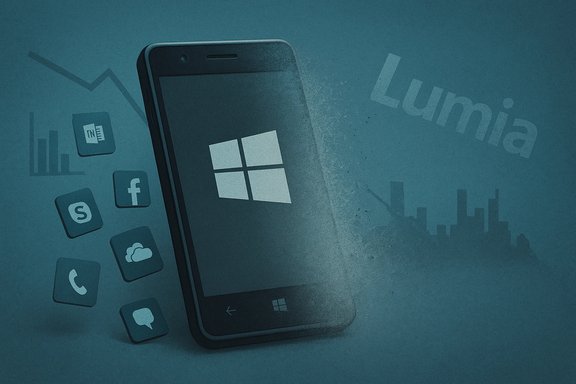
When a veteran tech commentator wrote that “Windows Phone was never alive,” the line landed less as provocation than as a shorthand for a longer, deeper collapse that had been visible to anyone watching the numbers, product cadence, and ecosystem for years. The immediate spark for the renewed obituaries was Microsoft’s poor mobile quarter — Windows phone revenue plunged and Lumia unit sales dropped to roughly 4.5 million — but the more interesting story is how a platform that once promised to be the third ecosystem never managed to build the engines that matter: developer momentum, OEM breadth, and a clear, consistent corporate strategy. The argument that Windows Phone was, in effect, never truly alive is blunt, but the hard facts behind it are straightforward and revealing.
That conclusion is unromantic but accurate: platform viability in consumer mobile is a function of scale, not just product quality. Microsoft’s attempt to deliver a third ecosystem was an ambitious failure, not a sudden death. The decline was long in the making, driven by a predictable set of strategic, partner, and developer dynamics that were visible to careful observers long before the headlines finally labeled the platform “dead.” The industry moved on accordingly.
But the company also lost the option value of owning its own phone platform: the ability to deliver a fully integrated stack from silicon to services, a model Apple continues to exploit. That trade-off is now part of Microsoft’s strategic legacy: it chose software and cloud reach over boutique device ownership.
For Windows enthusiasts and enterprise planners, the final lesson is practical. Platforms rise and fall on networks: developers, partners, and scale. Where one attempt to capture that stack failed, Microsoft’s more successful play has been to win hearts and minds through services that run anywhere. That may be the most durable, if least glamorous, chapter in the Windows mobile story.
Source: BetaNews Sorry 'pundits', but Windows Phone was never alive
 Background
From Windows Mobile to Windows Phone: a brief timeline
Microsoft’s mobile journey spans several distinct eras. The company’s early mobile OS work under the “Windows Mobile” name was overtaken by the smartphone revolution after the iPhone launch. Microsoft rebuilt its mobile approach and launched Windows Phone (the Metro/Live Tile era) as a platform designed to challenge iOS and Android on experience and UI clarity rather than incumbency. Microsoft then acquired Nokia’s Devices & Services business to accelerate hardware and carrier support, a major strategic bet intended to give Microsoft a vertically integrated alternative to the Android model. That acquisition closed in 2013 and brought Lumia hardware and Nokia engineering into Microsoft’s orbit. Windows Phone’s adoption never approached the volumes needed to be a sustainable third ecosystem. By late 2015 and early 2016 the metrics were unmistakable: Microsoft’s consumer-facing phone business posted steep declines in revenue, and Lumia shipments dropped into the low millions per quarter. Those results — and the industry context of nearly 400 million smartphones shipped in Q4 2015 — framed the argument that Windows Phone had been a marginal, niche platform long before reporters finally wrote that it was “dead.”What happened in the quarter that triggered the headlines
- Microsoft’s consumer phone revenue fell sharply year-over-year, with public reporting indicating about a 49% decline in Windows phone revenue for the quarter in question. Major tech outlets summarized the earnings by noting both the revenue fall and Lumia unit volumes.
- Lumia devices accounted for the overwhelming majority of Microsoft-branded phone shipments; in the referenced quarter Microsoft sold about 4.5 million Lumia units, versus roughly 10.5 million in the comparable quarter a year earlier — a dramatic year-over-year decline in unit volumes reported by multiple outlets.
- The industry backdrop made recovery harder: IDC reported roughly 399.5 million smartphone shipments in Q4 2015. When a platform ships only a few million handsets in a single quarter against a global market measured in the hundreds of millions, its relative presence is effectively negligible. That scale mismatch — not just year-over-year decline — is central to why pundits concluded the platform had no realistic path to parity.
Why Windows Phone never achieved escape velocity
1. App ecosystem: the death spiral
An operating system’s attractiveness today is defined more by apps than by the core OS. Windows Phone consistently struggled to attract the apps that consumers and enterprises expect.- Developers are rational actors; they follow users. With a small and shrinking install base, many developers deprioritized Windows Phone or never committed to it, creating a feedback loop where consumers saw fewer apps, which in turn made the platform even less attractive.
- Microsoft tried multiple approaches — from incentivizing developers with tools to attempting to bring universal Windows apps to life — but never reached the developer density needed to break the loop.
- The absence of flagship third-party apps and timely updates from major developers was repeatedly cited as a top reason consumers didn’t choose Lumia devices, especially in premium segments.
2. OEM and carrier support: a thin funnel
Outside of Nokia (and later Microsoft’s own devices), third-party OEM enthusiasm for Windows Phone remained limited.- Major Android OEMs had scale, distribution relationships, and breadth of SKUs across price points. Microsoft never matched that depth of vendor partnerships.
- Carriers, who influence which devices are subsidized and promoted widely, were cautious. Limited carrier push reduced the visibility of Windows Phone handsets in key markets.
- Because OEM investment in Windows Phone was marginal, hardware innovation (and frequent refresh cycles) lagged behind Android flagships and Apple’s iterative improvements.
3. Hardware strategy and flagships that missed the mark
Microsoft’s hardware journey — first supporting partners, then acquiring Nokia’s device business, then trying to relaunch under Microsoft’s own brand — produced inconsistent results.- Flagship devices generated interest but were often critiqued for productization that didn’t match the best of Android or iPhone hardware in camera performance, app ecosystems, or integrated services.
- Release cadence and channel availability were inconsistent. Long gaps between meaningful new models and failed exclusive deals hampered momentum.
- The lack of compelling, globally available, high-margin flagship choices made it difficult to change the perception that Windows Phone was suited mostly to low-cost, entry-level segments.
4. Strategy whiplash: messaging and corporate focus
Microsoft’s corporate posture toward mobile changed substantially under new leadership, creating strategic drift.- The company oscillated between treating mobile as a first-class product line and prioritizing cloud and services that were device-agnostic.
- An acquisition designed to create a vertically integrated phone business (Nokia) ended up entangling Microsoft in manufacturing and carrier logistics — areas where the company lacked experience at scale.
- When leadership choices shifted and priorities changed (including reported long-term leaves for senior product leads and public ambiguity about mobile’s future), the market read those moves as reduced commitment to the platform.
What Windows Phone did well — strengths that mattered to users
Windows Phone was not without virtues. Its failure was not from lack of product quality or clever engineering, but from systemic ecosystem and strategy problems.- User interface: The Live Tiles approach offered a distinct, glanceable UI that many users appreciated for clarity and information density. The design language influenced other platforms and remains praised by enthusiasts.
- Integration with Windows: When it worked, Windows Phone delivered a compelling continuity with Windows PCs — notifications, Office integration, and in some iterations features like Continuum (desktop-like experiences on larger displays) were visionary.
- Camera and hardware experiments: Lumia devices, particularly in the mid-2010s, were praised for camera quality and imaging innovation. Those devices demonstrated hardware excellence that influencers and photographers noticed.
- Value propositions in emerging markets: Windows Phone devices often provided excellent hardware at lower price points, making them attractive options for first-time smartphone buyers.
Windows 10 Mobile: a last hope that didn’t relaunch the story
Microsoft attempted a reset with Windows 10 Mobile, positioning it as the final unifying push to get developers and users into one Windows across device types. The operating system included modern APIs, Continuum, and a clear promise of parity with desktop Windows in terms of productivity and services.- In practice, Windows 10 Mobile never reached a launch moment with the momentum required to shift the platform’s trajectory. Upgrades were slow, and device compatibility and carrier availability created friction.
- Microsoft’s approach relied in part on upgrades to existing Windows Phone users; however, the installed base was already limited and hardware fragmentation meant many devices were stuck on older builds.
- Public-facing leadership changes and operational signals suggested that Microsoft was deprioritizing native phone OS investment in favor of cross-platform services — a rational business choice, but one that sealed Windows 10 Mobile’s fate as a niche, not mainstream, OS.
The business reality: numbers tell the story
Numbers from both Microsoft’s reporting periods and industry trackers make the platform’s relative position visible.- Microsoft reported a steep year-over-year decline in phone revenue during the quarter that pushed commentators to call the platform dead; multiple outlets summarized the company’s earnings and the Lumia shipment figures that drove that perception.
- IDC’s market tracking showed nearly 400 million smartphones shipped in Q4 2015 alone, and more than 1.4 billion for the year — scale that dwarfed the single-digit million quarterly shipments Microsoft was reporting for Lumia devices. When a vendor ships only a few million phones against a market of hundreds of millions in a quarter, the ability to shape the platform agenda is effectively nullified.
- Microsoft’s own annual documents later showed the phone business had been scaled down dramatically, and the company disclosed changing strategies and headcount allocations for devices and services that reflected this reality.
Key lessons for platform makers and enterprise buyers
- Ecosystem beats excellence: A technically competent OS with solid devices can still fail if the third-party ecosystem — developers, OEMs, carriers — doesn’t scale. The greatest risk for any new platform is failing to reach the network effects that tie users to developers and partners.
- Clear, sustained strategy is essential: Corporate consistency is not glamourous, but it matters. Repeated shifts in corporate posture or public signals of deprioritization drive partner and developer exodus.
- Acquisitions are not a shortcut: Buying a hardware supplier or a brand gives control, but it docreate distribution or developer pull. Microsoft’s Nokia acquisition bought hardware expertise but also bought complexity and integration risk.
- Service-first strategies can be more practical: When platform ownership becomes unsustainable, focusing on cross-platform services (email, productivity, cloud integration) preserves user relevance across ecosystems more cost-effectively than competing in hardware and OS markets.
What was overstated or unverifiable
Some claims made in commentary around the time — for example, that particular Microsoft leaders were on year-long vacations or that Windows 10 Mobile had no chance under any circumstance — blend fact with interpretation. Executive leaves and internal personnel moves are real events that affect morale and decision-making, but their direct causal impact on the ecosystem’s viability is harder to quantify without internal documents. Such claims should be treated cautiously unless corroborated by primary sources or company statements. Where public filing numbers and IDC shipment data exist, they provide a firmer base for analysis than anecdotal assertions.The final tally: was Windows Phone ever “alive”?
If “alive” means a platform with the scale to shape developer investment, carrier promotion, and global OEM supply chains, then Windows Phone never reached that critical mass. It had moments of product excellence, admired design, and loyal fans — but not the sustained, market-wide traction required to be counted with iOS and Android.That conclusion is unromantic but accurate: platform viability in consumer mobile is a function of scale, not just product quality. Microsoft’s attempt to deliver a third ecosystem was an ambitious failure, not a sudden death. The decline was long in the making, driven by a predictable set of strategic, partner, and developer dynamics that were visible to careful observers long before the headlines finally labeled the platform “dead.” The industry moved on accordingly.
Closing analysis: what Microsoft gained, and what it lost
Microsoft’s retreat from a proprietary phone OS freed resources and attention that the company redeployed into cloud, productivity services, Surface hardware, and later initiatives that leverage cross-platform distribution. This repositioning has paid dividends in enterprise cloud adoption and in the ubiquity of Microsoft services across iOS and Android.But the company also lost the option value of owning its own phone platform: the ability to deliver a fully integrated stack from silicon to services, a model Apple continues to exploit. That trade-off is now part of Microsoft’s strategic legacy: it chose software and cloud reach over boutique device ownership.
For Windows enthusiasts and enterprise planners, the final lesson is practical. Platforms rise and fall on networks: developers, partners, and scale. Where one attempt to capture that stack failed, Microsoft’s more successful play has been to win hearts and minds through services that run anywhere. That may be the most durable, if least glamorous, chapter in the Windows mobile story.
Source: BetaNews Sorry 'pundits', but Windows Phone was never alive
