

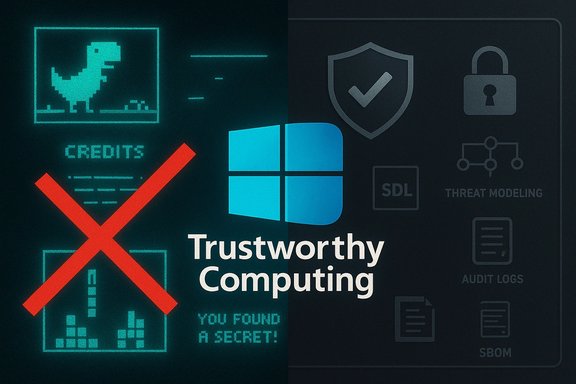
Microsoft stopped hiding Easter eggs in Windows because the costs — to security, compliance, and customer trust — began to outweigh the nostalgia and developer whimsy that produced those secrets.
Background
For more than two decades, Easter eggs were a quirky part of software culture: tiny credits pages, hidden minigames, or humorous messages tucked away behind obscure keystrokes. Microsoft shipped some of the most famous examples — the Doom-like "Hall of Tortured Souls" in Excel 95, the Flight-to-Credits Easter egg in Excel 97, and pinball hidden inside Word — artifacts of an era when development teams celebrated one another in code. That era changed dramatically after a corporate pivot toward Trustworthy Computing in the early 2000s. In a widely circulated January 15, 2002 memo, Bill Gates told every Microsoft employee that security, privacy, reliability, and system integrity must become the company's highest priorities. The memo reframed product decisions: when faced with choice, security should win over feature novelty. That shift laid the groundwork for sweeping internal changes — including policies that removed undocumented or hidden functionality from enterprise-facing products.What changed at Microsoft: policy, process, and engineering discipline
Trustworthy Computing and the end of "undocumented code"
The Trustworthy Computing initiative did more than change messaging; it altered engineering doctrine. Hidden code — by definition undocumented and rarely tested in the same way as production functionality — became an unacceptable risk in software destined for enterprise and government use. The new posture demanded that everything shipped be deliberate, reviewed, and traceable. That thinking explicitly put Easter eggs in the crosshairs: even harmless fun could undermine customer trust if it was present without disclosure.Security Development Lifecycle (SDL): enforcing discipline
Trustworthy Computing produced practical processes. Microsoft formalized the Security Development Lifecycle (SDL) in the mid-2000s — a mandatory, organization-wide framework that embeds threat modeling, design review, code analysis, and testing into product development. The SDL's requirements for traceability, threat modeling, and minimal attack surface directly conflict with the notion of secret features that are not included in formal design documents or threat models. It’s not merely a cultural preference; it’s an engineering rule: undocumented code increases risk and makes assurance harder.Compliance and certification pressures
Enterprise and government contracts often require vendor attestation and formal evaluation. Common Criteria and NIAP-certified products undergo rigorous auditing that expects no secret functionality. Certifications and compliance regimes impose legal and contractual consequences for undisclosed code paths. For vendors supplying software to sensitive customers — defense, finance, health, or government — the presence of any undocumented behavior can be fatal to procurement. Microsoft’s push to obtain Common Criteria certifications and meet the needs of large accounts reinforced the rationale to purge Easter eggs.The practical arguments Microsoft engineers made
Trust is binary
Larry Osterman, a longtime Microsoft engineer, wrote candidly about the issue: Easter eggs are not just small bits of fun; they are, in an enterprise context, a trust problem. Even rigorously implemented secrets can look sloppy or irresponsible to a customer who expects visibility into what runs on their systems. If engineers can hide nonessential code, customers may reasonably fear other, more dangerous undocumented paths. Osterman’s conclusion: the presence of secret code erodes professional credibility and customer trust — a risk that no large platform vendor should accept.Testing and maintenance burdens
Undocumented features complicate the test matrix. Because Easter eggs are often triggered only by obscure sequences, they may not appear in automated suites or be covered by QA scenarios. They can survive code churn and become latent liabilities — especially when code is refactored, dependencies change, or updates touch adjacent logic. For a company that decided to measure quality by the absence of security incidents and customer-impacting bugs, reducing such hidden surface area became a practical maintenance strategy.The logic-bomb and supply-chain anxiety
Security researchers and auditors have pointed out that an undocumented code path can be indistinguishable from a logic bomb or backdoor until someone reverse-engineers it. The same techniques that hide a harmless credit roll can be misused to conceal functionality that exfiltrates data or opens privileged channels. That indistinguishability matters for high-stakes customers and for the security assumptions that underpin certification processes. RFC-level definitions and security literature highlight exactly this worry: hidden functionality undermines trust in the trusted computing base.What was lost — and what remains
Lost practices and cultural nostalgia
The removal of Easter eggs ended a playful tradition that reinforced team identity and rewarded developer creativity. Long-time users recall the joy of discovering hidden games or credits — those discoveries felt like personal rewards, insider jokes, or proofs that the people behind complex software were human. In consumer-facing spaces, those artifacts also functioned as viral marketing: find a hidden gem, share it, and you generate buzz.Not everything “hidden” is gone
It’s important to separate malicious or undocumented code from legitimate, low-profile features. Modern products still include discoverable or disabled-by-default functionality, administrative shortcuts (so-called "God Mode" control panels), Easter-egg-like visual jokes in marketing, and playful behavior in games. The difference is transparency: these features are either documented, disabled for enterprise SKUs, or confined to non-essential components such as entertainment apps, developer channels, or Insider builds. Microsoft has demonstrated that fun is permitted so long as it does not compromise traceability, testing, and customer expectations.The trade-offs: why the policy makes sense for an OS vendor
1) Security over delight
Operating systems are foundational software. They manage privileges, memory, process isolation, and I/O — all areas attackers target. Even a minor, undocumented routine could become an exploit vector. For a vendor shipping billions of devices, the probability of a corner-case hiding a vulnerability that impacts many customers is too high to ignore. The engineering answer is simple: reduce unexplained surface area.2) Procurement and market segmentation
Large commercial and public-sector customers demand predictable, auditable products with clear update and patch behavior. Microsoft shifted heavier toward enterprise trust as a revenue and strategy imperative. That market reality means the company must avoid any practice that complicates audits, certifications, or legal compliance. Easter eggs are a tiny cost on a hobby project but a major risk when your software is an infrastructure dependency.3) Reproducibility and supportability
When undocumented features exist, support engineers must consider more scenarios; engineers must explain why something works. For a support organization operating at scale, undocumented behavior increases mean-time-to-resolution and can create inconsistencies across SKU and update lines. Removing Easter eggs simplifies troubleshooting and reduces the cost of long-tail anomalies.Counterpoints: what advocates for Easter eggs say
Morale, pride, and intrinsic motivation
Proponents argue Easter eggs serve a legitimate management purpose: they are morale boosters. Small creative projects can keep developers engaged and signal ownership, craftsmanship, and pride in work. Some academic work suggests that Easter eggs can signal quality to users because they indicate passionate teams. But companies have to balance that intangible benefit against measurable risk.The argument about negligible cost
Many veteran developers assert that well-implemented Easter eggs impose negligible runtime overhead and can be engineered to be safe and testable. They see the Trustworthy Computing ban as an overreaction that removes a harmless creative outlet. The counter to this view is organizational: trust is not just about a single module's safety, it's about the policy signal sent to customers. Even a benign secret can call that signal into question.Modern alternatives: how to preserve fun without risking trust
Microsoft and other vendors have adopted several approaches that retain developer expression while keeping systems auditable:- Documented "Easter features": Publish playful features in release notes or hidden settings that are discoverable and supported.
- Feature flags and channels: Keep novelty inside Insiders or alpha channels, where customers explicitly accept experimental behavior.
- Non-critical sandboxes: Put playful code into non-essential apps (e.g., games, bundled entertainment apps) rather than core platform components.
- Internal celebration mechanisms: Use internal wikis, team pages, or contributor screens in documentation rather than secret in-product content.
- Transparent test coverage: If a novelty is included, ensure it is part of test suites, threat models, and the SDL evidence chain.
Risks and edge cases Microsoft still faces
Supply-chain complexity and third-party components
Even with strict controls on first-party code, the modern OS integrates vast third-party code and open-source libraries. Secret functionality can re-enter the stack through dependencies or third-party drivers. The Security Development Lifecycle and supply-chain controls aim to mitigate that, but the complexity of modern ecosystems means risk is evolving rather than eliminated. Continuous SDL and SBOM (Software Bill of Materials) requirements are practical responses, but they are not a silver bullet.Feature creep and hidden configuration paths
Some features are intentionally latent — gated behind flags or hidden registries. Those mechanisms are useful for staged rollouts but can be misused. If such toggles are undocumented in release materials and lack adequate change control, they can become de facto Easter eggs. Good governance demands every flag have an owner, documentation, a threat model, and telemetry.Public perception and brand trade-offs
Removing Easter eggs changes public perception. Long-time enthusiasts sometimes interpret the absence as a loss of soul or an overbureaucratization of the engineering craft. Microsoft has attempted to balance this by keeping some playfulness in consumer experiences and by offering channels (Insider builds, Xbox, Minecraft) where experimentation is expected. But in the enterprise tier, the balance strongly favors predictability and traceability.A short timeline: how the policy evolved
- Pre-2000s — Easter eggs proliferate across Microsoft products; developer credits and small games are common.
- 2000 — Concerns arise as enterprise customers and beta testers criticize undisclosed code; Windows 2000 saw known Easter eggs removed ahead of RTM.
- 2002 — Bill Gates issues the Trustworthy Computing memo; the company pivots to security-first engineering.
- 2004–2005 — Security Development Lifecycle (SDL) formalized and applied broadly; Common Criteria/EAL certifications pursued.
- Mid-2000s onward — Microsoft institutes a "no Easter eggs" culture for core OS and enterprise products; select playful items surface only in non-critical or documented contexts.
Final analysis: why the change was necessary — and what it cost
The decision to stop hiding Easter eggs in Windows was not about killing joy for its own sake. It reflected a recalibration of priorities: a global platform vendor must protect customers, meet compliance obligations, and reduce unexplained behavior. In the calculus of risk management, the weight of potential security, legal, and commercial consequences tipped the scales.That said, the cost is cultural. Hidden credits and secret games fostered camaraderie, created viral moments, and humanized complex software. Removing them means one fewer channel for teams to publicly celebrate craftsmanship. The compromise the industry has reached — transparent, auditable fun in non-critical contexts — preserves some of that humanity while reducing systemic risk.
Microsoft’s move also teaches a larger lesson about scale and responsibility: what’s charming in a hobby project becomes a liability in infrastructure-grade software. For modern OS vendors and platform owners, the guiding principle is clear: if a feature cannot be fully modeled, tested, and explained to a skeptical auditor, it should not be shipped as a secret.
Practical takeaways for Windows users and developers
- If you miss Easter eggs, check the Insider channels and entertainment apps rather than expecting them in the OS or enterprise builds. Microsoft still experiments in those spaces.
- For developers, keep novelty transparent: add credits and easter-style features to release notes, internal documentation, or as opt-in features that are covered by tests and threat models.
- For IT buyers, the absence of hidden functionality in modern enterprise OS builds is a feature, not a bug: it reduces risk and eases certification and procurement.
Microsoft’s decision to remove Easter eggs from Windows was a pragmatic response to a changing threat landscape and changing customer expectations. The result is a trade-off: fewer delightfully secret moments built into core systems, but a more predictable, traceable, and secure platform for the billions of devices that depend on it.
Source: Neowin https://www.neowin.net/news/here-is-why-microsoft-does-not-hide-easter-eggs-in-windows-anymore/
