

Microsoft’s strategy to move the world onto Windows 10 created two distinct narratives: a rapid and measurable uptick in enterprise adoption, and at the same time a public relations fiasco over how that push was executed. New and contemporaneous industry research shows businesses embraced Windows 10 faster than its predecessor, while Microsoft’s own executives later admitted the company crossed a line during the aggressive free-upgrade campaign — a mix that changed how enterprises, IT teams, and Microsoft itself think about OS migration and update governance.
Windows 10 was launched as a free upgrade for qualifying Windows 7 and 8.1 systems, and Microsoft coupled that offer with an assertive notification and download campaign. The company’s objective was straightforward: reduce OS fragmentation, accelerate the shift to a more secure and modern platform, and position Windows as a continuously updated service rather than a static product. Microsoft publicly tied those goals to security, ecosystem compatibility, and a vision of a unified Windows across devices — messaging it repeated throughout 2015 and 2016 as the upgrade program rolled out. At the same time, Microsoft tracked and announced device-installation milestones as proof that the strategy was working: Windows 10 was reported to be running on more than 350 million devices mid‑2016, and Microsoft updated that figure to roughly 400 million devices months later as adoption continued. Those headline numbers helped explain why Microsoft pushed hard — but they also raised expectations and scrutiny about tactics used to hit them.
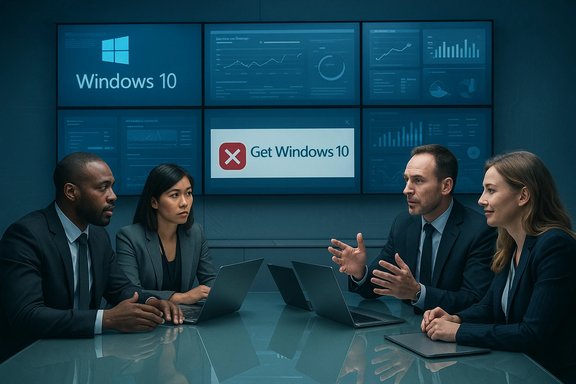
The most visible incident was a change to the behavior of the “X” (close) control in the GWX (Get Windows 10) dialog. Rather than dismissing the offer, closing the dialog sometimes queued or scheduled the upgrade, which many users felt was deceptive. Microsoft later patched that behavior, but not before the episode became a public relations problem and even produced litigation in some jurisdictions. Microsoft’s Chief Marketing Officer Chris Capossela later said the company “went too far” with that UI change and called the two‑week period between the problem becoming public and the fixed rollout “very painful” — language Microsoft and multiple tech outlets quoted as a corporate acknowledgement.
However, the apology was narrow in scope: Microsoft framed the issue around specific UI behavior (the “red X” incident) and the company emphasized that the overall aim of moving customers to a more secure platform remained valid. Many critics pointed out that the remediation did not fully address the perception of heavy‑handedness, and that multiple aggressive tactics had been used over an extended period. In short, the apology acknowledged a high‑profile mistake while defending the underlying policy goal.
The net outcome for organizations was constructive: a roadmap for faster adoption tempered by new governance practices and a greater emphasis on transparency and staged deployments. Microsoft’s admission of a “lowlight” in the rollout was an acknowledgment that hitting metrics is not the same as maintaining trust — a lesson now baked into enterprise procurement, update governance, and the broader conversation about how to safely and ethically drive platform migration at scale.
Source: BetaNews https://betanews.com/article/busine...soft-aggressive-windows-10-push-a-low-point/]
 Background
Windows 10 was launched as a free upgrade for qualifying Windows 7 and 8.1 systems, and Microsoft coupled that offer with an assertive notification and download campaign. The company’s objective was straightforward: reduce OS fragmentation, accelerate the shift to a more secure and modern platform, and position Windows as a continuously updated service rather than a static product. Microsoft publicly tied those goals to security, ecosystem compatibility, and a vision of a unified Windows across devices — messaging it repeated throughout 2015 and 2016 as the upgrade program rolled out. At the same time, Microsoft tracked and announced device-installation milestones as proof that the strategy was working: Windows 10 was reported to be running on more than 350 million devices mid‑2016, and Microsoft updated that figure to roughly 400 million devices months later as adoption continued. Those headline numbers helped explain why Microsoft pushed hard — but they also raised expectations and scrutiny about tactics used to hit them. What the data says: enterprise adoption vs. Windows 8
Early independent surveys and research showed surprisingly fast uptake in business environments.- Spiceworks’ industry survey and subsequent reporting captured the adoption picture in mid‑2016: within months of Windows 10’s launch, a measurable proportion of organizations had already deployed the OS in production and pilot environments. Spiceworks’ “Windows 10 Adoption: Sprinting out of the Gate” findings were reported widely — the study placed early adoption in the double digits for many markets and said the platform was being implemented across desktops, laptops and, selectively, tablets.
- BetaNews summarised those Spiceworks figures and compared Windows 10’s initial business penetration against Windows 8’s comparable early performance, concluding that Windows 10 was showing faster movement into corporate environments than Windows 8 did at the same point in its lifecycle. BetaNews reported an early three‑month penetration for Windows 10 of roughly 11 percent in businesses — a rate the writer described as about 20 percent higher than the comparable Windows 8 launch window. That relative comparison, while coarse, reflected multiple IT pros’ willingness to upgrade because of security, feature parity with Windows 7 (the return of the Start menu), and the free upgrade incentive.
Why businesses moved faster to Windows 10
Several practical drivers accelerated enterprise migration:- Free upgrade window: The time‑limited offer reduced procurement friction and allowed IT to standardize at no license cost for many desktops.
- Security improvements: Windows 10 introduced features like Windows Defender improvements, Windows Hello and enterprise‑grade protections that aligned with IT security programs.
- Restored familiarity: For many organizations, the return of the Start menu and a more familiar desktop experience compared to Windows 8 reduced the usability objections that stalled earlier migrations.
The controversy: Microsoft’s aggressive push and the “red X” moment
The popularity of Windows 10 in enterprise circles did not insulate Microsoft from consumer and SMB backlash. Multiple tactics used during the free upgrade year provoked complaints across forums, social channels and the press: background downloads of multi‑gigabyte Windows 10 installation files, persistent “upgrade offer” dialogs, and UI choices that critics called dark patterns because they made the easy path appear to accept the upgrade.The most visible incident was a change to the behavior of the “X” (close) control in the GWX (Get Windows 10) dialog. Rather than dismissing the offer, closing the dialog sometimes queued or scheduled the upgrade, which many users felt was deceptive. Microsoft later patched that behavior, but not before the episode became a public relations problem and even produced litigation in some jurisdictions. Microsoft’s Chief Marketing Officer Chris Capossela later said the company “went too far” with that UI change and called the two‑week period between the problem becoming public and the fixed rollout “very painful” — language Microsoft and multiple tech outlets quoted as a corporate acknowledgement.
What Microsoft said and how it framed the push
Microsoft defended the push internally and publicly as a security and ecosystem imperative: moving users off unsupported older OS versions reduced exposure to vulnerability and fragmentation, and enabled partners (OEMs and ISVs) to target a single, modern platform. That stated intent — “getting people to a safer place” — was repeated by Microsoft executives and formed the company’s primary justification for its urging. Yet even Microsoft’s spokespeople conceded that some of the tactics went beyond acceptable bounds and warranted correction.How the press and community responded
- Tech press, privacy advocates and many individual users characterized the behavior as intrusive and likened certain techniques to adware or even malware because of the background downloads and the difficulty of opt‑out.
- Regulators in some markets asked questions about consent and data collection; the backlash spurred detailed technical analysis and the release of tools designed to block the upgrade prompts.
- Legal action followed in narrow cases where users alleged damage from forced upgrades. Those incidents were low in number relative to the installed base but high in visibility.
Analysis: strengths, wins, and why enterprises chose Windows 10
Windows 10’s adoption story is notable for how it combined product, policy and market incentives to create momentum. The following summarizes the core strengths that drove enterprise migration.- Product maturity and alignment with enterprise needs: Windows 10 restored many desktop expectations while adding management and security features designed for businesses: improved Windows Update for Business, Windows Defender enhancements, and enterprise mobility management hooks. These technical features addressed tangible IT concerns.
- Cost and timing: The free upgrade offer was a decisive nudge. For budgets constrained by hardware refresh cycles, a no‑cost migration option removed a key barrier to standardization.
- Channel and partner alignment: OEMs and ISVs generally supported Windows 10, making the compatibility story easier for larger organizations and easing procurement conversations. The ecosystem’s alignment accelerated the decision calculus for many IT departments.
- Early positive feedback loops: Satisfaction surveys among early adopters in IT communities — particularly larger companies — were favorable. When IT leaders reported fewer headaches than expected during pilots, that encouraged others to proceed.
Risks and costs: what enterprises had to weigh
The aggressive push and the unprecedented update cadence also brought drawbacks and operational risks that IT teams had to manage carefully.- Update management complexity: Windows 10’s model of frequent cumulative updates and feature updates changed maintenance windows and patching strategies. Enterprises needed to develop formal staged rollout processes to avoid disruption.
- Compatibility and hardware constraints: Despite broad vendor support, some legacy applications and older hardware required remediation or replacement — a cost not always foreseen by budgeting cycles. Spiceworks and other surveys recorded compatibility hurdles as a top challenge for early adopters.
- Perception and trust erosion: The UI and messaging tactics used during the free‑upgrade campaign damaged user trust for some customers. Even when intentions were justified on security grounds, the method of persuasion mattered. Capossela’s admission of a “lowlight” implicitly acknowledged reputational costs.
- Legal and regulatory scrutiny: While most enterprises were not the direct target of consumer‑facing UX issues, the broader regulatory attention forced IT leaders to consider compliance questions about privacy, telemetry, and consent — areas that would later become central to enterprise procurement checklists.
What IT leaders learned: practical migration and governance takeaways
The Windows 10 episode offers a set of practical lessons for enterprises, service providers and platform vendors.- Create a repeatable, staged deployment model: pilot → limited production → broad rollout. Treat feature updates as major projects, not trivial patches.
- Layer telemetry and testing: monitor key stability, performance and compatibility indicators in pilot groups before wider deployment.
- Prioritize user communications and opt‑out clarity: when changes affect end users, transparency reduces backlash and help‑desk volume.
- Budget for exception handling: legacy hardware and line‑of‑business apps often require remediation; assign a contingency for replacements or virtualization.
- Reassess update windows and maintenance SLA commitments: frequent cumulative updates necessitate new scheduling discipline across remote and branch environments.
The corporate apology and its meaning
Microsoft’s acknowledgement — that at least one specific change “went too far” — was uncommonly candid for the company and had immediate practical effects. Internally, it prompted sorting and fixes; externally, it signaled to enterprises and partners that Microsoft heard the market and was willing to course‑correct.However, the apology was narrow in scope: Microsoft framed the issue around specific UI behavior (the “red X” incident) and the company emphasized that the overall aim of moving customers to a more secure platform remained valid. Many critics pointed out that the remediation did not fully address the perception of heavy‑handedness, and that multiple aggressive tactics had been used over an extended period. In short, the apology acknowledged a high‑profile mistake while defending the underlying policy goal.
Looking back: did the ends justify the means?
From a metrics perspective, the push succeeded: Windows 10 became the fastest adopted version of Windows to date in several enterprise snapshots and Microsoft achieved hundreds of millions of device installs within a year. From a governance and trust perspective, the approach was a wake‑up call: aggressive persuasion can deliver short‑term adoption but risks long‑term brand and regulatory costs if user autonomy and transparency are compromised. The balance between security imperatives and user consent emerged as the central tension. Enterprises that weighed those tradeoffs early — and implemented formal pilot, rollback and testing protocols — generally emerged in better operational shape than organizations that attempted mass migrations without rigorous controls. The incident broadened the industry conversation about update governance, the ethics of UX design in OS prompts, and how platform vendors should measure consent and friction when nudging users.Implications for future Windows migrations and platform governance
The Windows 10 experience reshaped expectations for both vendors and enterprise IT:- Platform vendors must balance security urgency with clear opt‑in mechanisms and robust communications. Abrupt or opaque behavior undermines trust even if the technical goals are sound.
- Enterprises should demand clearer SLAs, telemetry transparency and better testing channels from OS vendors to ensure that large‑scale changes can be evaluated before broad rollouts. Vendor programs for enterprise pilots and early‑access rings should be funded and formalized.
- Service providers and MSPs should build migration offerings that absorb compatibility risks and offer staged migration paths, including application virtualization and endpoint replacement financing options.
Practical checklist for organizations planning Windows migrations now
- Inventory: complete a detailed application and hardware compatibility matrix.
- Pilot: deploy to representative users and measure business‑critical workflows.
- Rollout plan: define a multi‑phase schedule with rollback triggers and communication templates.
- Backup and rollback: ensure full image backups or snapshot capabilities before feature updates.
- Security posture: align Windows update schedules with vulnerability windows and risk tolerance.
- User training: provide clear, user‑facing explanations for any changes and how to get help.
Conclusion
Windows 10 delivered tangible technical improvements and a faster enterprise uptake than Windows 8, driven by improved product-market fit and a time‑limited free upgrade program. At the same time, Microsoft’s aggressive upgrade campaign — including UI choices that confused or misled users — created reputational and regulatory headaches and forced a reassessment of how platform companies should persuade large, diverse user bases to migrate.The net outcome for organizations was constructive: a roadmap for faster adoption tempered by new governance practices and a greater emphasis on transparency and staged deployments. Microsoft’s admission of a “lowlight” in the rollout was an acknowledgment that hitting metrics is not the same as maintaining trust — a lesson now baked into enterprise procurement, update governance, and the broader conversation about how to safely and ethically drive platform migration at scale.
Source: BetaNews https://betanews.com/article/busine...soft-aggressive-windows-10-push-a-low-point/]
