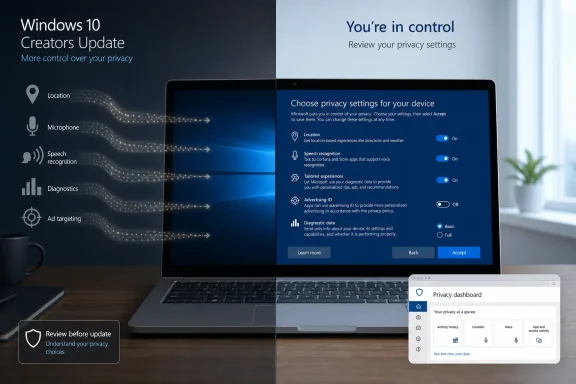
Microsoft used the Windows 10 Creators Update, made available for manual installation on April 5, 2017 and scheduled for broader rollout on April 11, to introduce clearer privacy setup screens, simplified diagnostic-data choices, and fuller explanations of what its telemetry settings collect. The change did not end Windows 10’s always-on consumer telemetry debate. It reframed it.
For two years, Microsoft had argued that Windows 10 needed diagnostic data to keep the operating system secure, reliable, and responsive to real-world use. Critics heard something different: the world’s dominant desktop OS had moved from a product you installed to a service that continuously reported back. The Creators Update privacy redesign was Microsoft’s attempt to prove that “Windows as a service” could coexist with meaningful user consent.
Windows 10’s privacy controversy was never just about one switch buried in Settings. It was about timing. Microsoft launched Windows 10 in 2015 with a sweeping telemetry model, then spent the next two years explaining why users should trust it.
That order mattered. By the time the Creators Update arrived, many users had already decided that Windows 10 treated privacy as an implementation detail rather than a design principle. The new privacy experience therefore landed less like a breakthrough and more like a correction.
The most visible change was simple: users upgrading to the Creators Update had to review privacy settings before proceeding. Fresh installations showed the same kind of setup flow during the out-of-box experience. Instead of scattering privacy controls across obscure menus and policy documents, Microsoft put several major choices in front of users at the moment Windows was being installed or upgraded.
That was a meaningful improvement. It also exposed the central compromise. Windows 10 Home and Pro users still could not fully disable diagnostic data through normal consumer controls; they could choose the lower “Basic” level or the broader “Full” level. Microsoft was not asking whether telemetry should exist. It was asking how much users were willing to send.
That simplification had two effects. It made the choice easier to understand, but it also sharpened the philosophical dispute. If Basic is mandatory, then the privacy argument shifts from “Can I opt out?” to “Do I accept Microsoft’s definition of necessary?”
Microsoft’s answer was predictable and not entirely unreasonable. Windows 10 was no longer a boxed operating system refreshed every few years; it was a continuously updated platform running across an enormous range of hardware, drivers, peripherals, and applications. To keep that platform from collapsing under the weight of its own compatibility obligations, Microsoft needed telemetry.
Administrators understand that argument better than most. Crash reports, driver failures, update rollbacks, app compatibility signals, and configuration data can reveal systemic problems that no lab can reproduce at Windows scale. The uncomfortable truth is that modern operating systems are safer and more stable when vendors can see how they fail.
But a technically sound argument is not the same thing as informed consent. Microsoft’s earlier messaging leaned heavily on the benefits of telemetry while leaving ordinary users unclear about the boundaries. The Creators Update tried to repair that imbalance by putting descriptions next to the controls and publishing more detail about the data collected at different levels.
That distinction is important. Most users understand that cloud-connected software sends data somewhere. What caused friction with Windows 10 was the sense that the PC itself — historically the most personal, locally controlled computing device in the household or office — had been quietly folded into the behavioral-data logic of the web.
Microsoft’s privacy dashboard, revised setup flow, and fuller diagnostic-data disclosures were all attempts to move the company from “trust us” to “here is what we collect and why.” The Creators Update made that shift visible inside Windows itself, where it mattered most.
Still, the company’s posture remained defensive. Microsoft was not retreating from telemetry; it was legitimizing it. The new privacy screens were an admission that the original experience had been too opaque, but they were also a declaration that diagnostic data was now part of the Windows bargain.
Microsoft said it reduced the amount of data collected at the Basic level for the Creators Update and published more information about what that level contained. That move mattered because Basic was effectively the floor for consumer editions. If users could not go lower, the floor had to be defensible.
The company’s framing was that Basic contained device, configuration, quality, compatibility, and security-related signals necessary to maintain Windows. In plain English, Microsoft wanted to know enough about your PC to understand whether Windows Update, drivers, apps, and core services were working. That is not the same as collecting documents or deliberately watching a user work, but it is still a persistent reporting relationship between the PC and Microsoft.
The privacy-sensitive user sees the problem immediately. Even when individual diagnostic events appear mundane, metadata at scale can be revealing. Device characteristics, app usage patterns, reliability events, and update histories can say a great deal about how a machine is used.
That is why Microsoft’s disclosure effort was necessary but not sufficient. Transparency helps users evaluate the bargain. It does not automatically make the bargain acceptable.
That shift brought real advantages. Feature updates could arrive faster. Security improvements could be deployed broadly. Microsoft could detect failures in the field and respond without waiting years for a new release cycle. For sysadmins managing heterogeneous fleets, telemetry-backed servicing could reduce some of the guesswork around reliability and compatibility.
But services require measurement. Measurement requires collection. Collection requires rules. Windows 10’s early privacy controversy came from the perception that Microsoft had changed the first two parts of that equation faster than it had explained the third.
The Creators Update was therefore less about a few toggles than about restoring legitimacy to Microsoft’s servicing model. If Windows was going to keep changing after installation, users needed a clearer view of what information flowed back to Redmond. If Microsoft wanted to treat telemetry as operational infrastructure, it had to stop presenting it as an afterthought.
This matters because defaults carry enormous power. Most users do not deeply customize operating-system privacy settings. They accept what is presented, especially during setup, when the priority is getting to the desktop.
Microsoft knew this. So did its critics. A privacy screen is not neutral merely because it contains switches. Its wording, layout, defaults, and timing shape user behavior.
The Creators Update’s more explicit setup flow was a better design than the original Windows 10 experience. But it also underscored the asymmetry between vendor and user. Microsoft writes the labels, defines the categories, and decides which choices are available. Users choose within that frame.
That is where Microsoft’s fuller documentation mattered. IT departments need to explain Windows behavior to legal teams, procurement officers, security reviewers, and sometimes national regulators. Vague assurances do not survive that process.
Enterprise editions of Windows have historically offered more policy control than consumer editions, including stricter diagnostic-data configurations in managed environments. But Windows 10’s broader servicing model still forced organizations to confront a new reality: the operating system was now a participant in ongoing data flows that had to be governed like any other cloud-connected system.
The Creators Update helped by making Microsoft’s position easier to evaluate. It did not eliminate the governance burden. If anything, it made that burden more explicit.
This is the modern Microsoft ecosystem in miniature. A Windows PC may be local hardware, but the user experience increasingly intersects with a Microsoft account, OneDrive, Edge, Bing, Cortana-era speech services, Store apps, advertising IDs, and diagnostic pipelines. Privacy therefore becomes distributed across the device and the web.
The dashboard made some of that more visible. It also revealed why many users found Windows 10 privacy hard to reason about. There was no single “privacy” switch because there was no single data system. Windows had become a mesh of local features, cloud services, personalization systems, and reliability telemetry.
That complexity is not unique to Microsoft. Apple, Google, and every major platform vendor face similar tensions. But Windows occupies a special place because of its enterprise footprint, legacy expectations, and role as the default desktop environment for hundreds of millions of people.
Telemetry can make software better. It can reveal crashes no tester saw, drivers that fail only on obscure hardware combinations, updates that break specific configurations, and features nobody uses. In an ecosystem as sprawling as Windows, flying blind would be irresponsible.
But privacy is not merely the absence of malicious intent. It is the presence of boundaries, explanations, and enforceable choices. A company can collect data for legitimate reasons and still lose trust if users cannot understand or limit that collection.
The Creators Update was Microsoft acknowledging that trust deficit. It did not concede that Windows 10 telemetry was wrong. It conceded that the company had not made the bargain clear enough.
That says something about Windows 10’s first two years. Microsoft had intended Windows 10 to be remembered as the start of a more agile Windows era. Instead, many enthusiasts remembered forced upgrades, aggressive update policies, advertising-like prompts, and privacy confusion.
By 2017, Microsoft needed to cool the temperature. The new privacy model was part of that effort. It gave the company a cleaner answer when challenged by regulators and a clearer story when challenged by users.
Still, the pivot did not erase the original sin in the eyes of skeptics. Once a platform vendor normalizes mandatory diagnostic collection, later improvements tend to be judged against the standard of full opt-out. Microsoft was offering clarity and reduction. Some users wanted refusal.
Windows 11 has inherited the same basic tension. Microsoft wants a smarter, safer, more adaptive platform. Users and administrators want predictability, restraint, and control. Those goals are not mutually exclusive, but they are constantly in negotiation.
The Creators Update showed the minimum Microsoft must do when it changes that bargain. It must explain what is collected. It must present choices clearly. It must reduce collection where possible. It must give administrators documentation precise enough to defend.
But it also showed the limit of interface fixes. Better labels cannot resolve a disagreement over who ultimately controls the PC. They can only make the disagreement more honest.
That point remains relevant because privacy controls often become theater. Vendors add dashboards, sliders, and explanatory text, then declare the problem solved. But the real test is whether users can predict the consequences of their choices.
Microsoft improved that predictability in the Creators Update. It made diagnostic levels clearer, surfaced privacy decisions during setup, and published more information about collected data. Those are real gains.
Yet the company also preserved the basic architecture of mandatory consumer telemetry. That architecture may be defensible. It may even be necessary for a modern operating system. But it is not the same thing as user sovereignty.
That standard is tougher than it sounds. It requires product teams to explain themselves before regulators, enterprises, journalists, and ordinary users force the issue.
For two years, Microsoft had argued that Windows 10 needed diagnostic data to keep the operating system secure, reliable, and responsive to real-world use. Critics heard something different: the world’s dominant desktop OS had moved from a product you installed to a service that continuously reported back. The Creators Update privacy redesign was Microsoft’s attempt to prove that “Windows as a service” could coexist with meaningful user consent.
 Microsoft Finally Explains the Machine It Had Already Built
Windows 10’s privacy controversy was never just about one switch buried in Settings. It was about timing. Microsoft launched Windows 10 in 2015 with a sweeping telemetry model, then spent the next two years explaining why users should trust it.That order mattered. By the time the Creators Update arrived, many users had already decided that Windows 10 treated privacy as an implementation detail rather than a design principle. The new privacy experience therefore landed less like a breakthrough and more like a correction.
The most visible change was simple: users upgrading to the Creators Update had to review privacy settings before proceeding. Fresh installations showed the same kind of setup flow during the out-of-box experience. Instead of scattering privacy controls across obscure menus and policy documents, Microsoft put several major choices in front of users at the moment Windows was being installed or upgraded.
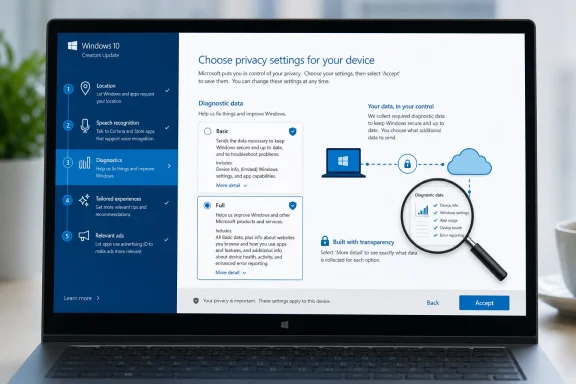
That was a meaningful improvement. It also exposed the central compromise. Windows 10 Home and Pro users still could not fully disable diagnostic data through normal consumer controls; they could choose the lower “Basic” level or the broader “Full” level. Microsoft was not asking whether telemetry should exist. It was asking how much users were willing to send.
The New Controls Made Consent More Visible, Not Absolute
The Creators Update simplified Windows 10’s diagnostic-data options by removing the previous “Enhanced” tier and leaving most consumer users with Basic and Full. Basic was described as the minimum information Microsoft believed it needed to keep Windows secure and up to date. Full added richer diagnostic information intended to help Microsoft improve products and fix problems.That simplification had two effects. It made the choice easier to understand, but it also sharpened the philosophical dispute. If Basic is mandatory, then the privacy argument shifts from “Can I opt out?” to “Do I accept Microsoft’s definition of necessary?”
Microsoft’s answer was predictable and not entirely unreasonable. Windows 10 was no longer a boxed operating system refreshed every few years; it was a continuously updated platform running across an enormous range of hardware, drivers, peripherals, and applications. To keep that platform from collapsing under the weight of its own compatibility obligations, Microsoft needed telemetry.
Administrators understand that argument better than most. Crash reports, driver failures, update rollbacks, app compatibility signals, and configuration data can reveal systemic problems that no lab can reproduce at Windows scale. The uncomfortable truth is that modern operating systems are safer and more stable when vendors can see how they fail.
But a technically sound argument is not the same thing as informed consent. Microsoft’s earlier messaging leaned heavily on the benefits of telemetry while leaving ordinary users unclear about the boundaries. The Creators Update tried to repair that imbalance by putting descriptions next to the controls and publishing more detail about the data collected at different levels.
Transparency Arrived Under Pressure
Microsoft did not make these changes in a vacuum. Privacy advocates, journalists, enterprise customers, and European regulators had been pressing the company since Windows 10’s launch. The complaint was not merely that Windows collected data, but that Microsoft had not explained the collection clearly enough for users to make informed choices.That distinction is important. Most users understand that cloud-connected software sends data somewhere. What caused friction with Windows 10 was the sense that the PC itself — historically the most personal, locally controlled computing device in the household or office — had been quietly folded into the behavioral-data logic of the web.
Microsoft’s privacy dashboard, revised setup flow, and fuller diagnostic-data disclosures were all attempts to move the company from “trust us” to “here is what we collect and why.” The Creators Update made that shift visible inside Windows itself, where it mattered most.
Still, the company’s posture remained defensive. Microsoft was not retreating from telemetry; it was legitimizing it. The new privacy screens were an admission that the original experience had been too opaque, but they were also a declaration that diagnostic data was now part of the Windows bargain.
The Basic Setting Became the Real Battleground
For power users, the most important privacy setting was never Full. Anyone choosing Full was accepting a broad exchange: more data for more personalization, diagnostics, and product improvement. The harder question was what remained in Basic.Microsoft said it reduced the amount of data collected at the Basic level for the Creators Update and published more information about what that level contained. That move mattered because Basic was effectively the floor for consumer editions. If users could not go lower, the floor had to be defensible.
The company’s framing was that Basic contained device, configuration, quality, compatibility, and security-related signals necessary to maintain Windows. In plain English, Microsoft wanted to know enough about your PC to understand whether Windows Update, drivers, apps, and core services were working. That is not the same as collecting documents or deliberately watching a user work, but it is still a persistent reporting relationship between the PC and Microsoft.
The privacy-sensitive user sees the problem immediately. Even when individual diagnostic events appear mundane, metadata at scale can be revealing. Device characteristics, app usage patterns, reliability events, and update histories can say a great deal about how a machine is used.
That is why Microsoft’s disclosure effort was necessary but not sufficient. Transparency helps users evaluate the bargain. It does not automatically make the bargain acceptable.
Windows as a Service Changed the Social Contract
The Creators Update privacy redesign is best understood as part of a broader transformation in Windows. Microsoft had spent decades selling Windows as a versioned product. Windows 10 turned it into an evolving service.That shift brought real advantages. Feature updates could arrive faster. Security improvements could be deployed broadly. Microsoft could detect failures in the field and respond without waiting years for a new release cycle. For sysadmins managing heterogeneous fleets, telemetry-backed servicing could reduce some of the guesswork around reliability and compatibility.
But services require measurement. Measurement requires collection. Collection requires rules. Windows 10’s early privacy controversy came from the perception that Microsoft had changed the first two parts of that equation faster than it had explained the third.
The Creators Update was therefore less about a few toggles than about restoring legitimacy to Microsoft’s servicing model. If Windows was going to keep changing after installation, users needed a clearer view of what information flowed back to Redmond. If Microsoft wanted to treat telemetry as operational infrastructure, it had to stop presenting it as an afterthought.
The Setup Screen Became a Trust Exercise
For ordinary users, the redesigned privacy setup experience was probably the most consequential change. It put controls for areas such as location, speech recognition, diagnostics, tailored experiences, and relevant ads into a clearer sequence. The point was not that every user would study each option closely. The point was that Windows could no longer claim users had consented through obscurity.This matters because defaults carry enormous power. Most users do not deeply customize operating-system privacy settings. They accept what is presented, especially during setup, when the priority is getting to the desktop.
Microsoft knew this. So did its critics. A privacy screen is not neutral merely because it contains switches. Its wording, layout, defaults, and timing shape user behavior.
The Creators Update’s more explicit setup flow was a better design than the original Windows 10 experience. But it also underscored the asymmetry between vendor and user. Microsoft writes the labels, defines the categories, and decides which choices are available. Users choose within that frame.
Enterprises Had a Different Problem
For business customers, the Windows 10 telemetry debate was less emotional and more procedural. Enterprises care about privacy, but they also care about auditability, compliance, supportability, and control. A home user may ask, “Why is my PC sending data?” An enterprise asks, “Can I document exactly what is sent, restrict it by policy, and satisfy regulators?”That is where Microsoft’s fuller documentation mattered. IT departments need to explain Windows behavior to legal teams, procurement officers, security reviewers, and sometimes national regulators. Vague assurances do not survive that process.
Enterprise editions of Windows have historically offered more policy control than consumer editions, including stricter diagnostic-data configurations in managed environments. But Windows 10’s broader servicing model still forced organizations to confront a new reality: the operating system was now a participant in ongoing data flows that had to be governed like any other cloud-connected system.
The Creators Update helped by making Microsoft’s position easier to evaluate. It did not eliminate the governance burden. If anything, it made that burden more explicit.
The Privacy Dashboard Was Microsoft’s Web-Era Concession
Alongside Windows-level changes, Microsoft promoted its privacy dashboard as a place for users to review and manage data tied to Microsoft services. That was a notable concession to the reality that Windows privacy could no longer be separated from account privacy, search privacy, advertising privacy, and cloud-service privacy.This is the modern Microsoft ecosystem in miniature. A Windows PC may be local hardware, but the user experience increasingly intersects with a Microsoft account, OneDrive, Edge, Bing, Cortana-era speech services, Store apps, advertising IDs, and diagnostic pipelines. Privacy therefore becomes distributed across the device and the web.
The dashboard made some of that more visible. It also revealed why many users found Windows 10 privacy hard to reason about. There was no single “privacy” switch because there was no single data system. Windows had become a mesh of local features, cloud services, personalization systems, and reliability telemetry.
That complexity is not unique to Microsoft. Apple, Google, and every major platform vendor face similar tensions. But Windows occupies a special place because of its enterprise footprint, legacy expectations, and role as the default desktop environment for hundreds of millions of people.
The Critics Were Right About Opacity, Even If Telemetry Was Inevitable
It is tempting to split this debate into two camps: privacy absolutists who oppose telemetry and engineers who understand why it is necessary. That framing is too convenient. The more accurate reading is that Microsoft was right about the operational value of telemetry, while critics were right that Windows 10 initially did a poor job explaining it.Telemetry can make software better. It can reveal crashes no tester saw, drivers that fail only on obscure hardware combinations, updates that break specific configurations, and features nobody uses. In an ecosystem as sprawling as Windows, flying blind would be irresponsible.
But privacy is not merely the absence of malicious intent. It is the presence of boundaries, explanations, and enforceable choices. A company can collect data for legitimate reasons and still lose trust if users cannot understand or limit that collection.
The Creators Update was Microsoft acknowledging that trust deficit. It did not concede that Windows 10 telemetry was wrong. It conceded that the company had not made the bargain clear enough.
The Creators Update Marked a Pivot, Not a Finish Line
The timing of the privacy changes also mattered. The Creators Update was marketed around creativity, gaming, mixed reality ambitions, and user-facing refinements. Yet one of its most important changes was administrative and legalistic: a better privacy-consent experience.That says something about Windows 10’s first two years. Microsoft had intended Windows 10 to be remembered as the start of a more agile Windows era. Instead, many enthusiasts remembered forced upgrades, aggressive update policies, advertising-like prompts, and privacy confusion.
By 2017, Microsoft needed to cool the temperature. The new privacy model was part of that effort. It gave the company a cleaner answer when challenged by regulators and a clearer story when challenged by users.
Still, the pivot did not erase the original sin in the eyes of skeptics. Once a platform vendor normalizes mandatory diagnostic collection, later improvements tend to be judged against the standard of full opt-out. Microsoft was offering clarity and reduction. Some users wanted refusal.
The Lesson for Windows 11 Was Already Visible
Looking back, the Creators Update privacy changes foreshadowed debates that would continue into Windows 11. Microsoft’s modern Windows strategy relies on telemetry, cloud integration, account-linked services, recommendation systems, and continuous experimentation. The privacy questions did not disappear; they became part of the operating system’s permanent politics.Windows 11 has inherited the same basic tension. Microsoft wants a smarter, safer, more adaptive platform. Users and administrators want predictability, restraint, and control. Those goals are not mutually exclusive, but they are constantly in negotiation.
The Creators Update showed the minimum Microsoft must do when it changes that bargain. It must explain what is collected. It must present choices clearly. It must reduce collection where possible. It must give administrators documentation precise enough to defend.
But it also showed the limit of interface fixes. Better labels cannot resolve a disagreement over who ultimately controls the PC. They can only make the disagreement more honest.
The Toggle Was Never the Whole Story
The most important part of Microsoft’s 2017 privacy update was not any single switch. It was the admission that privacy is a product experience, not just a policy document. If users need a lawyer’s patience to understand what an operating system collects, the design has already failed.That point remains relevant because privacy controls often become theater. Vendors add dashboards, sliders, and explanatory text, then declare the problem solved. But the real test is whether users can predict the consequences of their choices.
Microsoft improved that predictability in the Creators Update. It made diagnostic levels clearer, surfaced privacy decisions during setup, and published more information about collected data. Those are real gains.
Yet the company also preserved the basic architecture of mandatory consumer telemetry. That architecture may be defensible. It may even be necessary for a modern operating system. But it is not the same thing as user sovereignty.
Redmond’s Privacy Reset Left a Permanent Checklist
The Creators Update did not end the Windows privacy argument, but it did leave users and administrators with a more practical way to judge Microsoft’s promises. The useful question became less “Does Windows collect data?” and more “Can Microsoft justify each collection path in plain language?”That standard is tougher than it sounds. It requires product teams to explain themselves before regulators, enterprises, journalists, and ordinary users force the issue.
- Windows 10 Creators Update made privacy review part of the upgrade and setup flow rather than leaving users to find every setting later.
- Microsoft simplified consumer diagnostic-data choices to Basic and Full, removing the intermediate Enhanced level.
- Basic telemetry remained the minimum available level for normal consumer editions, keeping the opt-out debate alive.
- Microsoft published more detail about diagnostic data collection, a move shaped by sustained criticism and regulatory pressure.
- The update improved transparency but did not change the underlying reality that Windows 10 functioned as a continuously measured service.
References
- Primary source: Digital Journal
Published: 2026-06-03T17:20:36.296067
Microsoft explains new privacy settings in Windows 10 update
Windows 10's consumer versions come with always-on telemetry that cannot be fully disabled. It's used so the company can monitor how and when features arewww.digitaljournal.com - Related coverage: techradar.com
Microsoft clarifies exactly what personal data is collected in Windows 10 | TechRadar
Publishes full breakdown of ‘basic’ level diagnostic datawww.techradar.com - Official source: blogs.windows.com
Windows 10 privacy journey continues: more transparency and controls for you
Introducing three new things that will empower customers to be more informed about their privacy in Windows 10.blogs.windows.com - Related coverage: windowscentral.com
71 percent of Windows 10 Creators Update users share 'full' diagnostics, Microsoft says | Windows Central
Windows 10 gives users many different settings that help manage and control potentially sensitive information and maximize privacy. However, the majority of users still choose to share ...www.windowscentral.com - Related coverage: howtogeek.com
What Do Windows 10's Basic and Full Telemetry Settings Actually Do?
Windows 10 includes a telemetry service that automatically sends diagnostic and usage data about your computer to Microsoft. www.howtogeek.com
- Related coverage: techcrunch.com
Microsoft details new privacy settings in Windows 10 Creators Update | TechCrunch
As Microsoft announced last week, the Windows 10 Creators Update will start rolling out to users on April 11. As part of this update, the company is alsotechcrunch.com
- Related coverage: notebookcheck.net
71 percent of Windows 10 Creators Update users send Microsoft their full telemetry data - Notebookcheck News
Microsoft has reduced the amount of telemetry data collected under the 'basic' diagnostic option to be compliant with privacy laws and customer desires. However, 71 percent of Creators Update users still opt to send full diagnostic data to Microsoft including browsing and typing data. www.notebookcheck.net
- Related coverage: techspot.com
Microsoft says 71% of Windows 10 users allow their data to be collected | TechSpot
While Windows 10 is a great operating system, it's long been criticized for its approach to users' privacy. But Microsoft has revealed the changes it rolled out...www.techspot.com - Official source: news.microsoft.com
Microsoft unveils new privacy dashboard and set-up experience
Microsoft has revealed two new features heading to Windows 10 which will provide users with even more control over their privacy.news.microsoft.com - Related coverage: arstechnica.com
Microsoft opens up on Windows telemetry, tells us most of what data it collects - Ars Technica
Windows telemetry is getting a lot more transparent.arstechnica.com - Related coverage: axios.com
Windows 10 changes don't calm European privacy concerns
Advocates worry about the amount of user data collected.www.axios.com
- Related coverage: makeuseof.com