
Microsoft’s decision to end free support for Windows 10 has set off a ripple of practical, environmental and economic effects — and experts warn the most visible of those is a likely surge in electronic waste that could be worth billions in recoverable metals even as it threatens pollution and worker health if handled badly.
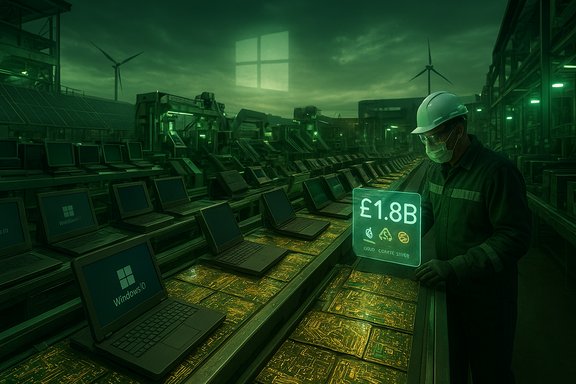
Microsoft formally ended mainstream, free support for Windows 10 on October 14, 2025, a move that removes routine security patches, feature updates and standard technical assistance for the consumer editions of the OS. This milestone was widely anticipated and rolled out with stepped options — most notably a one‑year Consumer Extended Security Updates (ESU) window and paid ESU offerings — but it also crystallised a dilemma: millions of still‑serviceable PCs are locked out of Windows 11 by hardware rules, and the lifeline Microsoft offers cannot, by itself, indefinitely forestall mass turnover. That decision is already being discussed not just as a platform change but as a waste event: analysts and recyclers estimate that a substantial fraction of Windows 10 devices either will be upgraded to new hardware or will be retired and enter recycling streams — creating both an environmental hazard and an economic opportunity in recovered materials. One high‑profile calculation, quoted by The Register and based on figures from Businesswaste.co.uk, pegs the value of recoverable precious metals from devices rendered obsolete by the end‑of‑support scenario in the United Kingdom at nearly £1.8 billion — primarily driven by an eye‑watering £1.6 billion estimate for gold content alone. That projection rests on a chain of assumptions (market share, number of devices unable to run Windows 11, device weight breakdowns and recoverable metal per ton) and should be treated as an informed estimate rather than a certified inventory.
Source: The Cool Down Experts issue warning on harmful side effect of Windows shutdown — here's what's happening
 Background
Microsoft formally ended mainstream, free support for Windows 10 on October 14, 2025, a move that removes routine security patches, feature updates and standard technical assistance for the consumer editions of the OS. This milestone was widely anticipated and rolled out with stepped options — most notably a one‑year Consumer Extended Security Updates (ESU) window and paid ESU offerings — but it also crystallised a dilemma: millions of still‑serviceable PCs are locked out of Windows 11 by hardware rules, and the lifeline Microsoft offers cannot, by itself, indefinitely forestall mass turnover. That decision is already being discussed not just as a platform change but as a waste event: analysts and recyclers estimate that a substantial fraction of Windows 10 devices either will be upgraded to new hardware or will be retired and enter recycling streams — creating both an environmental hazard and an economic opportunity in recovered materials. One high‑profile calculation, quoted by The Register and based on figures from Businesswaste.co.uk, pegs the value of recoverable precious metals from devices rendered obsolete by the end‑of‑support scenario in the United Kingdom at nearly £1.8 billion — primarily driven by an eye‑watering £1.6 billion estimate for gold content alone. That projection rests on a chain of assumptions (market share, number of devices unable to run Windows 11, device weight breakdowns and recoverable metal per ton) and should be treated as an informed estimate rather than a certified inventory. Why this matters: the triple problem of security, economics and the environment
Short, practical framing:- Security: Without free monthly security updates, devices become increasingly attractive targets for attackers. Microsoft’s ESU program is a stopgap but not a permanent fix for devices that cannot upgrade.
- Economic value: Printed circuit boards and connectors contain small but collectively significant quantities of copper, gold and silver — materials that reach meaningful market value when aggregated. The Businesswaste estimate shows why recyclers are paying attention.
- Environmental risk: E‑waste contains toxic materials (lead, mercury, brominated flame retardants) and, when processed improperly, contaminates soil and water and creates worker health hazards. Global monitoring shows e‑waste volumes are already soaring, and formal recycling rates lag far behind generation.
The numbers: what analysts are counting — and why they vary
How the headline figures were derived
The high‑profile UK number circulating in tech press used the following logic chain:- Estimate a base population of global Windows 10 devices (industry estimates vary; many outlets cited an approximate 400 million devices that cannot be upgraded, though this is a rough figure).
- Allocate the UK’s share of that population based on market share assumptions to arrive at ~14.4 million UK devices rendered effectively obsolete.
- Apply device type mix assumptions (for example, 70% laptops, 30% desktops) and average weight per device.
- Use published recovery rates of precious metals per ton of e‑waste (E‑Parisara and similar datasets provide copper, gold and silver yields per metric ton).
- Multiply by current commodity prices to reach the headline values.
Why these are estimates (and how to read them)
Every step above contains uncertainty:- The underlying count of impacted devices is an approximation. Reports quoting “around 400 million” are basing their figures on broad market‑share snapshots and manufacturer telemetry; the real number fluctuates by region and by the date the snapshot was taken. Treat the device count as an order‑of‑magnitude figure, not a precise census.
- Recoverable metal per ton depends heavily on the makeup of the device pool (older devices have different plating and connector quantities than newer ones) and on the efficiency of the recycler’s process.
- Commodity pricing is volatile; all valuations change with gold, copper and silver markets.
Environmental and human‑health risks if turnover is mishandled
Global e‑waste statistics show the context: in 2022 the world generated roughly 62 million tonnes of e‑waste, of which only ~22% was documented as properly collected and recycled. Most of the remainder is handled informally or ends up in landfills, with serious consequences for local environments and workers’ health. A surge of device turnover concentrated in short windows (e.g., at end‑of‑support dates) strains collection and proper recycling capacity. Key risks if many Windows 10 PCs are retired rapidly:- Illegal exports and informal processing: high‑value boards are exported to informal recycling hubs where open‑burning and acid baths are used to recover metals, releasing toxic fumes and contaminating local food chains.
- Data security: retired machines often contain sensitive, un‑wiped data — a cybersecurity and privacy risk if devices are not handled by certified IT asset disposal (ITAD) vendors.
- Bottlenecks and landfill leakage: municipal recycling systems are not uniformly equipped to process surges; overflow leads to landfill disposal or improper storage.
- Worker safety: informal recycling exposes workers (and children in some regions) to carcinogens and heavy metals without proper PPE or environmental controls.
What Microsoft is doing (and what it isn’t)
Microsoft’s public position on Windows 10’s end of support has several elements:- Encouragement to upgrade: Microsoft has promoted Windows 11 to eligible devices, with guidance and tools for checking compatibility.
- Extended Security Updates (ESU): Microsoft offered an ESU program providing critical security patches for a limited period after October 14, 2025. For consumers the ESU option was positioned as a one‑year bridge (with varying terms for enterprises) and has notable caveats — including changes in eligibility and account requirements in some regions. This makes ESU a short‑term mitigation, not a permanent lifecycle solution.
- Trade‑in and recycling programs: Microsoft and many OEM partners provide trade‑in credit and recycling services; these programs help route old hardware to proper channels but are uneven in scale and regional availability.
Alternatives and practical options: stretching device life and reducing waste
For individuals and small organisations facing a device that cannot run Windows 11, there are practical, lower‑risk alternatives to buying new hardware and to immediate scrappage:- Enroll in ESU (if available and acceptable) — ESU buys time for careful planning and avoids rushed disposal. Note ESU is a stopgap and often requires device registration and, in some cases, a Microsoft account.
- Install a modern Linux distribution — Desktop Linux (Ubuntu, Linux Mint, Zorin OS, Fedora, etc. can extend a device’s useful life for typical productivity tasks, web browsing and media consumption. These distributions are free, actively maintained and become attractive for devices whose hardware is supported by the kernel. Linux also reduces exposure to Windows‑specific malware while giving users security updates for OS components.
- ChromeOS Flex — Google’s ChromeOS Flex provides a lightweight, cloud‑centric OS for older PCs, targeted at organisations and schools that can operate primarily with browser apps.
- Refurbish and donate — Local charities, schools and non‑profits often accept refurbished devices (with data properly wiped) and can put them to productive reuse.
- Certified recycling / ITAD — When disposal is inevitable, use certified IT asset disposal services that provide secure data destruction and environmentally sound material recovery.
For IT managers and organisations: a checklist to manage the window of turnover
- Inventory and classify devices by upgrade eligibility and business criticality.
- Prioritise upgrade paths for devices required to run Windows‑only applications; plan migration schedules.
- Budget ESU or equivalent only for systems that require additional time for controlled replacement.
- Engage certified ITAD vendors for device retirement and insist on chain‑of‑custody and data‑destruction certificates.
- Where feasible, adopt refurbishment programs to keep devices in productive reuse.
- Communicate with end users: provide clear guidance on recycling, donation and in‑house return programs.
Who benefits — and who bears the cost?
- Recyclers: properly run recyclers with high‑quality processes will see increased feedstock and potential revenues from recovered materials — but they also face scaling costs for collection and safe processing. The raw economic case reported by Businesswaste is attractive only if collection and processing are efficient and compliant.
- OEMs and retailers: trade‑in programs drive new device sales and can capture used assets for refurbishment; however, the economics often favour manufacturers in mobility sectors rather than downstream recyclers.
- Low‑income populations and regions: historically, the burden of informal recycling and unmanaged disposal falls on the poorest communities, both domestically and internationally. Without coordinated policy and enforcement, these groups bear the environmental and health costs.
Policy and industry responses that should be considered
- Scale up formal collection systems: municipal and national e‑waste programs must be strengthened and funded to avoid overflow into informal channels.
- Producer responsibility: extended producer responsibility (EPR) laws that require OEMs to accept and process end‑of‑life electronics reduce leakage and create predictable collection streams.
- Data‑sanitisation mandates: legal and marketplace requirements for secure data wiping prior to resale or recycling should be scaled so that data security is not compromised during disposal.
- Repairability and modular design incentives: policy incentives for longer‑lived, repairable products reduce the frequency of wholesale replacement when platform support changes.
A cautionary note about the numbers and narratives
The dramatic valuation figures (for example, the near‑£1.8 billion estimate for recoverable metals in the UK) rightly draw attention — but they are not a licence for reckless disposal. The valuation depends on assumptions about device counts, mix, recovery efficiency and metal prices. Those assumptions vary across analyses, and the true recoverable profit after logistics, labour and compliance costs will be materially lower. The headline figures should be used to prompt better systems and investment in safe recycling, not as a justification for accelerated, unmanaged dumping.A historic pattern: updates that break more than they fix
The wider Windows ecosystem has repeatedly shown that major OS transitions and feature updates can produce compatibility surprises — ranging from shutdown or hibernation regressions on certain hardware to driver and encryption conflicts that block normal power states. Community reporting and vendor advisories have documented incidents where specific feature updates conflicted with OEM security software, producing operational headaches for end users and administrators. Those episodes matter here because they reinforce the need for cautious, staged rollouts and for IT teams to validate compatibility before mass deployments or retirements.Practical guidance for Windows users today
- If your PC is eligible for Windows 11 and you need continued official support, plan a controlled upgrade. Back up data and validate key apps in a pilot group first.
- If your PC is not eligible for Windows 11, consider ESU only as a bridge while you evaluate alternatives (Linux, ChromeOS Flex, refurbishment). ESU is a temporary safety net, not a long‑term lifecycle plan.
- Explore certified trade‑in and recycling options offered by OEMs and retailers — but verify that the recycler is audited and provides secure data‑wiping proof.
- For individuals: installing a supported Linux distribution is an eco‑friendly, low‑cost way to keep older hardware useful for web, office and media tasks.
Conclusion
Microsoft’s end of free support for Windows 10 is more than a software milestone — it’s a lifecycle inflection point for a large installed base of devices. The choice each owner makes — upgrade, enrol in ESU, repurpose, donate, refurbish or recycle — has ripple effects for cybersecurity, household and enterprise budgets, public health, and the global resource cycle. The headline valuations of recoverable metals underscore the economic potential trapped inside old devices, but they also remind us that value extraction should not come at the cost of human and environmental harm. The right response is coordinated: clearer consumer guidance, better collection infrastructure, stronger reuse and refurbishment channels, and policy drivers that reward durability and safe recycling. If the industry meets this moment with planning rather than panic, the hardware transition caused by Windows 10’s end of support can be managed in a way that captures value and limits harm — otherwise, the “gold mine” could become another toxic dump.Source: The Cool Down Experts issue warning on harmful side effect of Windows shutdown — here's what's happening
