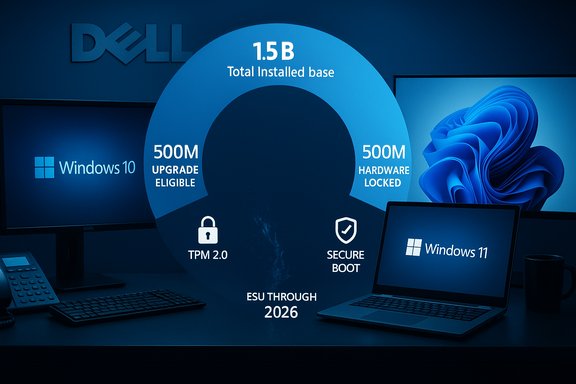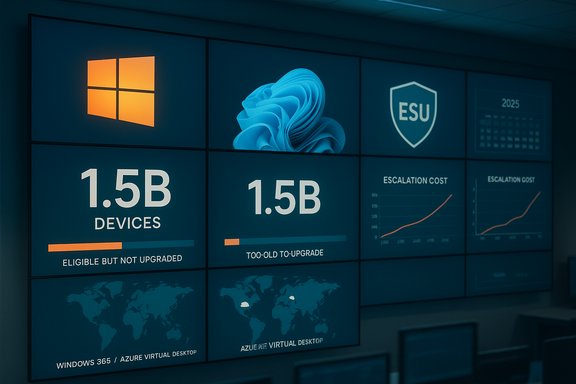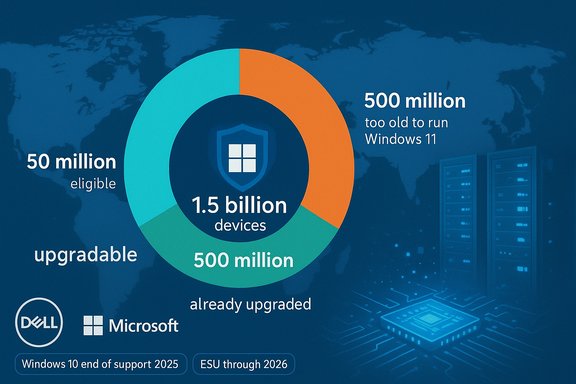
Dell’s blunt admission on its latest earnings call — that the Windows 11 migration “has not completed” — is a concise way of saying the modern Windows upgrade cycle is slower, messier, and more commercially complicated than many expected. The company’s COO, Jeffrey Clarke, told investors that Dell sees an installed base of roughly 1.5 billion Windows PCs, of which about 500 million are capable of running Windows 11 but remain on Windows 10, and another ~500 million are effectively too old to run Windows 11 without hardware replacement. Those figures framed Dell’s guidance that PC growth will be roughly flat year‑over‑year even as demand for AI server gear surges.
Background / Overview
Windows 11 launched in October 2021 with a sharper hardware baseline than its predecessors: Secure Boot, UEFI, and TPM 2.0 plus minimum CPU family requirements. Microsoft positioned the OS as a platform for security and future capabilities — notably on‑device AI — but those hardware gates created a compatibility cliff for many existing PCs.Microsoft formally ended mainstream support for Windows 10 on October 14, 2025; the company offered consumer Extended Security Updates (ESU) through October 13, 2026 as a temporary bridge for devices that can’t or won’t upgrade. That calendar forced a public deadline into the market, but it did not automatically translate into a blitz of hardware refreshes. At the same time, public telemetry painted two different but complementary pictures: web-traffic trackers (StatCounter) showed Windows 11 reaching parity and briefly overtaking Windows 10 in mid‑2025, while more specialist samples — notably Steam’s Hardware & Software Survey — showed gamers moving to Windows 11 even earlier and in greater numbers. The net result is genuine migration momentum, but significant inertia remains.
What Dell Actually Said — The Numbers and the Tone
The quote that made headlines
Jeffrey Clarke put the assessment plainly during Dell’s Q3 investor call: “We have not completed the Windows 11 transition.” He added that the company is roughly 10–12 percentage points behind the comparable point in the Windows 10 migration curve, and repeated the installed‑base breakdown: about 1.5 billion Windows devices in the field, ~500 million eligible but unupgraded, and ~500 million too old to run Windows 11 without hardware changes. That was presented not as a complaint but as a market map: a conservative short‑term view of PC demand paired with a multi‑year opportunity for refreshes.Dell’s guidance alongside the numbers
Dell signalled a two‑track reality: servers and AI infrastructure are booming, while client PC demand looks steady but not explosive. Infrastructure revenue tied to AI servers and networking grew sharply in the quarter (server and networking revenue reported at roughly $10.1 billion, up about 37% year‑over‑year), which is the engine of Dell’s near‑term optimism. Consumer and business PC sales, by contrast, are being shaped by replacement cycles, component inflation, and buyer hesitation around Windows 11 eligibility.Data Check — Putting Dell’s Claims in Context
Is Dell’s “1.5 billion / 500M / 500M” split plausible?
Dell’s figures are a vendor‑level view — not an audited census — but they are directionally consistent with multiple independent signals. Microsoft and large telemetry vendors measure different populations (monthly active devices, web pageview share, installed endpoint inventories), so exact counts vary. Dell’s number is best read as channel telemetry that maps to replacement opportunity rather than a precise device registry. Treat the 500M/500M framing as directional and meaningful for OEM planning, but as an estimate rather than an ironclad device inventory.What the public trackers show
- StatCounter’s public charts showed Windows 11 crossing the 50% mark in a mid‑2025 snapshot and overtaking Windows 10 on desktop pageview share in July 2025. Those monthly snapshots were heavily discussed across the press, but StatCounter’s pageview methodology means the numbers can swing with browsing patterns. Use StatCounter as a directional indicator, not a census.
- Valve’s Steam Hardware & Software Survey — a large, self‑selecting sample of gamers — reported Windows 11 64‑bit at roughly 60% of participating systems in the late‑summer 2025 snapshots, underlining that gaming rigs skew newer and were more likely to meet Windows 11 hardware requirements. Steam’s data is useful for the gaming vertical but not representative of low‑spec office PCs.
Why Adoption Has Been Slower Than Past OS Shifts
1) Hardware gates changed the calculus
Windows 11 deliberately raised the minimum platform baseline (TPM 2.0, Secure Boot, supported CPU families). That was rational from a long‑term security and stability perspective, but it created a population of devices that cannot upgrade without firmware/hardware intervention or full system replacement.- Many thin laptops, OEM all‑in‑ones, and older corporate devices lack upgradable TPMs or supported CPUs.
- For users with otherwise serviceable machines, the cost and hassle of hardware replacement isn’t compelling without a clear, immediate benefit.
2) Enterprise caution and long refresh cycles
Large organizations do not switch OSes en masse. They run pilot programs, certify line‑of‑business applications, validate drivers, and stagger deployments with hardware refresh budgets. The Windows 10→11 transition added friction because of strict baseline checks and the need to certify legacy applications and drivers. As a result, enterprises stretched their migration windows and used ESU or cloud PC alternatives where appropriate.3) The ESU safety valve reduced urgency
Microsoft’s consumer ESU program — designed as a one‑year bridge through October 13, 2026 — lowered the immediate pressure on consumers and some SMBs to buy new hardware. ESU provided a path to keep receiving security updates for Windows 10 while planning a more measured upgrade. The availability of ESU blunted the immediate spike in replacement demand OEMs anticipated around Windows 10’s end‑of‑support date.4) Perception, performance, and UX tradeoffs
For many users, Windows 11’s changes were incremental rather than transformative. A centered taskbar, UI tweaks, and new multitasking controls do not deliver a direct ROI for business desktops. Early perceptions of performance regressions on certain systems also created hesitancy among power users and gamers — impressions that are slow to reverse even after patches.5) Component price inflation and supply pressures
In 2025 the industry saw upward pressure on DRAM and NAND pricing driven by AI infrastructure demand. Higher BOM costs reduce the ability of OEMs to discount aggressively and raise the effective consumer cost of new devices. That dynamic extended buy cycles for budget‑sensitive buyers and small businesses.The Practical Consequences for the PC Market
For OEMs
- Short term: dampened replacement demand — fewer forced upgrades than a classic EOL spike would produce.
- Medium term: a long runway — the “upgradeable but unupgraded” cohort represents an addressable market for trade‑ins, financing, and bundled AI‑capable devices.
- Strategic pivot: invest more in AI server and infrastructure sales (where Dell is seeing double‑digit growth) while maintaining disciplined PC channel strategies and promotions. Dell’s Infrastructure Solutions Group reported strong momentum (server & networking revenue ~$10.1B, up ~37% YoY), which explains why the company emphasized servers and AI hardware in its guidance.
For Microsoft
- Messaging challenge: balancing urgency with empathy. Heavy‑handed nudges risk alienating consumers who face genuine hardware barriers.
- Product strategy: broadening approaches (cloud PC, hybrid features, and gradual on‑device AI rollouts) will help Microsoft deliver value to users who can’t upgrade hardware immediately.
- Security tradeoffs: ESU mitigates immediate threats but leaves a larger long‑tail of potentially vulnerable machines as ESU windows close.
For Enterprises and IT Pros
- Inventory first: comprehensive hardware and application audits are now non‑negotiable. Tag devices as “Windows 11‑ready,” “upgradeable after firmware change,” or “replacement required.”
- Prioritize business‑critical apps and user groups for staged rollouts.
- Budget for mixed‑mode support: expect a prolonged period where Windows 10 and Windows 11 coexist in fleets.
AI PCs, NPU Hype, and the Upsell Play
Dell framed the migration gap as a commercial opportunity for the next generation of client devices: AI PCs — machines with integrated NPUs (neural processing units) or MPUs for on‑device inference, coupled with Microsoft’s Copilot experiences — are a natural upsell to customers that are already thinking about modern productivity and security.That pitch has real leverage:
- On‑device AI can deliver concrete benefits (faster, private inference for local tasks) that may tip purchase decisions.
- OEMs can create differentiated bundles — Copilot+ services, longer support windows, and dedicated driver testing — that add real value to corporate refresh cycles.
Risks and Weaknesses in the Current Landscape
- Security exposure: large numbers of Windows 10 devices outside the ESU window could become prime targets for exploitation. The risk is systemic because many enterprise ecosystems include legacy components that are harder to update.
- Environmental and equity costs: pushing hardware replacement for compatibility reasons can accelerate e‑waste and create access gaps for budget‑constrained users and regions.
- Market concentration: strong demand for AI infrastructure concentrates BOM pressure on DRAM/NAND, pushing up component prices and squeezing OEM margins — limiting price incentives for mass consumer refresh programs.
- Messaging and trust: inconsistent or heavy upgrade nudges (forced account sign‑ins, confusing enrollment flows for ESU) can damage user trust and slow adoption even further.
Strengths and Opportunities
- The hardware baseline (TPM, Secure Boot, UEFI) raises the long‑term security posture for Windows devices and simplifies driver and OS testing for vendors.
- A multi‑year replacement runway allows OEMs to design more thoughtful refresh programs, focusing on trade‑ins, financing, and support packages that favor sustainability and total cost of ownership.
- AI server demand is a genuine and immediate growth engine for OEMs like Dell, enabling them to fund R&D and cross‑subsidize client initiatives if needed.
- For IT teams, the stretched timeline provides breathing room to plan migrations responsibly — focusing on app compatibility, staged pilots, and user training.
Practical Guidance — What IT Leaders and Consumers Should Do Now
- Inventory and classify devices immediately.
- Run hardware checks and flag devices by upgrade path: native Windows 11 eligible, eligible with firmware updates, or replacement required.
- Prioritize based on business impact.
- Protect and upgrade mission‑critical systems first; schedule noncritical endpoints in later refresh windows.
- Consider ESU strategically, not permanently.
- Use ESU to buy planning time, not to avoid modernization entirely.
- Build upgrade bundles that reduce friction.
- Offer device image standardization, driver validation, and user training with every refresh to minimize churn and support costs.
- Watch component pricing and timing.
- Negotiate with OEMs and distributors early; consider multi‑year contracts or financing if AI PC demand drives BOM inflation.
- Where appropriate, leverage cloud PC options.
- Windows 365 and similar hosted Windows options can provide a Windows 11 experience without immediate hardware replacements.
A Final Assessment — Slow, But Not Stalled
Dell’s public framing is blunt and commercially self‑interested, but it aligns with independent telemetry: Windows 11 gained ground steadily in 2024–2025 and passed Windows 10 on several public trackers in mid‑2025, yet a substantial installed base — often older, budget, or enterprise‑locked devices — remained unconverted when Microsoft’s Windows 10 support clock ran down. The result is a market that looks less like a single, sharp tidal wave of upgrades and more like a long, multi‑year refresh cycle shaped by hardware gates, ESU choices, enterprise prudence, and the new allure of on‑device and cloud AI.That slowdown is both an immediate constraint and a strategic opportunity. For OEMs, the trick is to convert Dell’s “ample opportunity” into offers that reduce friction: trade‑ins, low‑cost financing, sustainability programs, and clear business cases for AI‑capable hardware. For Microsoft, the task is to balance product nudges with practical upgrade paths and to continue to broaden Windows 11’s value proposition beyond UI changes to tangible security and productivity gains.
Dell’s earnings call simply crystallized what the market had already begun to feel: modernization is not just a push of code; it’s a coordinated choreography of hardware, software, budget cycles, and human choice. The migration is happening — but on terms set by buyers as much as by vendors.
Conclusion
The headline — “people aren’t in a hurry to switch to Windows 11” — is an oversimplification. Adoption happened and continues, but it is uneven and segmented. Dell’s investor‑level perspective is valuable because it converts that unevenness into tangible business signals: a slower front‑loaded refresh, a prolonged tail of upgradeable devices, and a clear commercial pivot toward AI infrastructure where growth is strongest. For IT leaders and consumers, the sensible path is pragmatic: inventory, prioritize, and use the breathing room to modernize deliberately rather than reactively — and to insist that upgrades deliver measurable security and productivity value, not just a fresh coat of UI paint.Source: PC Gamer What a shock—lots of people still haven't upgraded to Windows 11, says Dell