

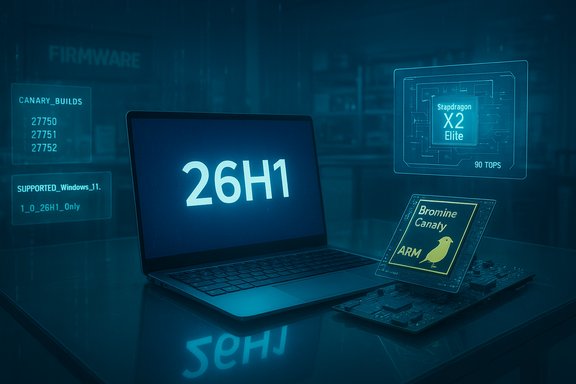
Microsoft’s servicing machinery has quietly exposed an internal reference to a previously unreported Windows 11 branch — “version 26H1” — and the trace was found not in a marketing blog but inside a Known Issue Rollback (KIR) tied to the October 2025 Windows 10 cumulative update (KB5066791). That breadcrumb, coupled with Canary-channel metadata that uses the internal codename Bromine and community-tracked 27xxx build numbers, gives the most credible signal yet that Microsoft is preparing a device-targeted interim release of Windows 11 intended to support the new Qualcomm Snapdragon X2 Elite family of Arm laptops.
Microsoft changed Windows 11’s delivery model after its initial years: the company now publishes a single major annual feature update in the H2 window and uses continuous servicing and enablement packages (eKBs) to flip dormant functionality that already lives in servicing binaries. That approach minimizes disruptive, large-scale upgrades and enables Microsoft to stage features selectively — by account, telemetry, or hardware entitlement — without shipping separate full installers for every minor milestone. The company documented this pattern when rolling out 25H2 as an enablement package on top of the 24H2 servicing branch. This engineering model also allows Microsoft to do something more surgical: ship a validated OS image that’s targeted only at a narrow set of hardware (a device-targeted release), then push the same user-facing features more broadly later in the usual H2 release. The impetus for such a strategy is simple — when a new silicon generation introduces novel NPUs, driver stacks, and firmware requirements, the safest path is often to validate the complete stack on certified hardware first and keep the broader fleet on the regular cadence until the ecosystem stabilizes. Community trackers and insider flight manifests now suggest Microsoft is doing precisely that with a Bromine (br_release) branch that lives in the Canary channel under 27xxx build numbers.
If Microsoft proceeds with this device-first approach, the short-term result should be better out-of-box AI experiences for early X2 adopters and a lower risk of systemic regressions on the wider Windows population. The long-term risk is perceived fragmentation and messaging confusion; Microsoft and OEM partners will need to communicate precisely who gets what and when. For the Windows ecosystem — OEMs, ISVs, IT admins, and consumers — the sensible posture is cautious readiness: prepare for Arm-first capabilities if your roadmap or procurement involves X2 devices, but avoid panic or rush upgrades if you value compatibility and manageability.
The discovery of a 26H1 marker inside Microsoft’s servicing artifacts has moved the Windows community from rumor to plausible engineering reality, but the final shape of any public release — its name, distribution method, and precise feature set — remains in Microsoft’s hands. Until the company issues a consumer-facing roadmap, treat the 26H1/Bromine signals as operationally significant but not yet definitive.
Source: BetaNews Microsoft makes its first references to Windows 11 26H1
 Background / Overview
Microsoft changed Windows 11’s delivery model after its initial years: the company now publishes a single major annual feature update in the H2 window and uses continuous servicing and enablement packages (eKBs) to flip dormant functionality that already lives in servicing binaries. That approach minimizes disruptive, large-scale upgrades and enables Microsoft to stage features selectively — by account, telemetry, or hardware entitlement — without shipping separate full installers for every minor milestone. The company documented this pattern when rolling out 25H2 as an enablement package on top of the 24H2 servicing branch. This engineering model also allows Microsoft to do something more surgical: ship a validated OS image that’s targeted only at a narrow set of hardware (a device-targeted release), then push the same user-facing features more broadly later in the usual H2 release. The impetus for such a strategy is simple — when a new silicon generation introduces novel NPUs, driver stacks, and firmware requirements, the safest path is often to validate the complete stack on certified hardware first and keep the broader fleet on the regular cadence until the ecosystem stabilizes. Community trackers and insider flight manifests now suggest Microsoft is doing precisely that with a Bromine (br_release) branch that lives in the Canary channel under 27xxx build numbers. How the 26H1 trace was discovered
The most concrete operational clue arrived in Microsoft’s handling of an unrelated Windows 10 UI problem. After Microsoft shipped KB5066791 on October 14, 2025 (the final public cumulative update aligned with Windows 10 end-of-support messaging), some devices displayed an incorrect “Your version of Windows has reached the end of support” banner in Settings. Microsoft documented the bug and issued a Known Issue Rollback (KIR) artifact to remediate the UI regression on affected systems. Analysts and community investigators examining that KIR found a machine-readable targeting token that appears to reference a Windows 11 branch labeled “26H1” (reported strings include the form SUPPORTED_Windows_11_0_26H1_Only). That internal tag is what first prompted widespread speculation that a 26H1 servicing branch exists inside Microsoft’s engineering pipelines. Important caveat: an internal tag inside update machinery is an engineering-level artifact, not an official marketing announcement. Microsoft regularly adds test branches, temporary labels, and device-targeted tags for servicing and rollout control. The presence of a 26H1 token is a strong operational signal — it indicates Microsoft is working in a branch that maps to a 26H1 engineering milestone — but it does not by itself confirm public naming, consumer availability, or distribution mechanics. Treat the string as credible operational evidence that requires corporate confirmation.What “26H1” likely is — technical expectations
If Microsoft is preparing a Windows 11 26H1 that will be delivered only to certain ARM devices, the most likely intent is platform enablement rather than a broad feature refresh. The technical work Microsoft and OEMs must coordinate makes that the reasonable path:- Validated driver stacks and DCH packages for GPU, NPU, connectivity (Wi‑Fi 7 / FastConnect), storage controllers, and camera/ISP firmware tuned to Snapdragon X2 thermal and power envelopes.
- Hexagon NPU runtimes, secure model manifests, and attestation hooks that allow on-device model execution for Copilot+ experiences, with safeguards to ensure private data stays local when intended.
- Compatibility and emulation improvements for Windows on Arm, including translation-path tweaks for x64/x86 code and anticheat/AV kernel hooks that historically cause launch-time friction on Arm devices.
- Servicing metadata and targeted eKB/KIR packaging so Microsoft or OEMs can flip features for qualifying SKUs without touching the broad servicing branch.
Why Microsoft would build an interim, device‑targeted release
- Controlled validation reduces out-of-box regressions: shipping a vendor-validated image with certified drivers and firmware reduces customer support incidents and accelerates retailer readiness.
- Privacy-first on-device AI testing: hardware-gated NPUs allow Microsoft to guarantee that some Copilot+ tasks execute locally (on-device) rather than in the cloud — but that guarantee must be validated against firmware, attestation flows, and runtime behavior. A device-limited branch is the safest way to do that.
- Seamless OEM go-to-market timing: aligning an OS image with retail launch schedules simplifies OEM logistics and ensures features that require tuned drivers arrive with the device rather than as a patchwork of updates.
The Snapdragon X2 connection: why it matters
Qualcomm’s Snapdragon X2 Elite and X2 Elite Extreme were announced as a step-change for Windows on Arm: chips built on advanced nodes, new Oryon CPU cores, higher memory bandwidth and, crucially, a much larger Hexagon NPU marketed at up to 80 TOPS for INT8 workloads. Qualcomm and major coverage place first X2‑based devices in the first half of 2026. Those silicon changes are not purely incremental — they introduce new driver and runtime dependencies, firmware blobs for ISP and secure model manifests, and novel power/thermal profiles that OEMs and Microsoft must validate together. Because certain on-device AI experiences (low-latency Copilot tasks, local model inference for Recall-like indexing, or other NPU-accelerated features) rely on both hardware capabilities and coordinated runtime attestation, Microsoft has a pragmatic reason to gate those experiences to X2 devices initially. A narrow 26H1 rollout reduces blast radius and keeps privacy and performance promises intact for early adopters.Build lab names, codenames and the Bromine signal
Community flight trackers, BetaWiki and Canary-channel manifests show that Microsoft has been switching certain Insider builds into a “br_release” lab — shorthand for Bromine in Microsoft’s internal naming pattern. Canary builds in the 27xxx range (27xxx.*) have been reported as belonging to the Bromine semester, reinforcing the interpretation that a new OS core is being exercised in preview channels ahead of any public naming. BetaWiki and multiple community outlets list concrete Canary builds in the 279xx series and associate them with br_release — a direct sign that Microsoft engineers are actively working in that branch. Caveat: internal codenames and lab tags are engineering shorthand, and Microsoft sometimes reassigns or retires lab names without issuing a public label. The existence of br_release/Bromine in Canary manifests is a strong signal but not final confirmation of the public product name “Windows 11 26H1.”What this means for consumers, IT admins and developers
For consumers and early adopters
- Buying an X2-powered Copilot+ laptop could deliver the earliest experience of advanced on-device AI features, and those features might be pre-enabled on the vendor image shipped with the device. Expect a faster feature time-to-value but also more frequent firmware and driver updates in the months after launch.
For IT administrators and enterprise teams
- Treat any 26H1-style release as a vendor-specific image rather than a fleet-wide update. Pilot X2 devices in a controlled validation ring, confirm that endpoint agents, MDM policies, VPNs and DR tools behave correctly, and coordinate with OEM partners on driver signing and delivery cadence. Windowed, device-targeted servicing complicates inventory and update reporting unless the device reports a distinct SKU.
For developers and ISVs
- Prioritize Arm64 native builds where practical and validate kernel-mode code, DRM, anticheat, and other low-level hooks on Arm hardware. Build graceful fallbacks so functionality can shift to CPU or cloud on non‑NPU devices. Expect to triage a higher volume of edge-case support issues during the first months of X2 device availability.
Strengths of Microsoft’s likely approach
- Controlled rollout and quality: a device-limited image minimizes the risk of wide-scale regressions and helps ensure that expensive AI features behave as advertised on the hardware that can support them.
- Faster time-to-value for capable hardware: consumers who buy premium X2 devices will get the performance and latency advantages of a local NPU for Copilot-like tasks sooner than if Microsoft waited to include everything in the annual H2 update.
- Better OEM coordination: shipping a validated image alongside hardware reduces post-sale support and helps OEMs tune drivers, firmware and power/thermal profiles before broader enablement.
Risks, trade-offs and potential for confusion
No engineering choice is risk‑free. The device-targeted 26H1 approach carries several important downsides.- Perception of fragmentation: public headlines that reference “Windows 26H1” can create confusion among consumers and IT departments who may assume universal availability. Microsoft must be explicit about the release’s scope to avoid support load spikes.
- Operational complexity for enterprises: device-targeted images complicate inventory, WSUS/Intune reporting, and update policies unless Microsoft and OEMs supply precise SKU and servicing metadata.
- Early-driver and firmware regressions: first-wave device images commonly surface corner-case failures (biometric sensors, docking station behaviors, third-party agent incompatibilities), which will place a burden on OEMs and early adopters.
- Privacy and feature parity nuance: features that run on an NPU on an X2 device may fall back to cloud processing or degraded local modes on older hardware, subtly changing the privacy and latency properties that marketing messages may imply. Enterprises with strict data locality requirements must audit feature delivery flows carefully.
What Microsoft must do to avoid a messaging disaster
- Provide clear, early communication that distinguishes an engineering/partner-only image from the mainstream H2 release and describe which exact devices or SKUs are targeted.
- Document update and servicing mechanics for IT: how will OEM images be identified in Intune/WSUS, how will eKB flips be logged, and how should admins treat a device-targeted KIR?
- Publish privacy and attestation guarantees for on-device AI so customers understand when models/processing are local versus cloud-based. This should include explicit test vectors and attestation logs IT teams can validate.
Verification status — what is confirmed and what is still unverified
Confirmed, cross-checked items:- Microsoft published KB5066791 (October 14, 2025) for Windows 10 and documented an associated UI regression; Microsoft provided a KIR mechanism to remediate affected systems.
- Community investigators and outlets identified an internal KIR artifact that contains a token referencing a 26H1 branch (e.g., SUPPORTED_Windows_11_0_26H1_Only). That KIR discovery was reported widely by community blogs and specialist outlets.
- Microsoft’s Canary channel manifests and BetaWiki trackers show a br_release (Bromine) lab with 27xxx builds, indicating active engineering work on a Bromine branch.
- Qualcomm publicly announced Snapdragon X2 Elite silicon with a much larger Hexagon NPU marketed around 80 TOPS and placed device availability in early 2026. Independent press coverage corroborates the X2 timeline and specs.
- Microsoft’s use of the public label “Windows 11 26H1” has not been confirmed in a consumer-facing announcement. The internal token is an operational breadcrumb but not an official product launch. This must be treated as a plausible engineering plan rather than a finalized public roadmap.
- The exact distribution mechanics (whether OEM images will ship with features pre-enabled; whether eKB flips or cataloged device-targeted updates will be used; the full content of 26H1) remain unconfirmed and may change as OEMs and Microsoft finalize validation.
Practical checklist — what to do now
For buyers:- If on a narrow timeline to get on-device Copilot experiences with the lowest latency and best privacy, verify with OEMs whether shipped X2 devices include pre-enabled Copilot+ features and ask about update cadence.
- If you value stability over bleeding-edge access, wait for the broader 26H2 rollout and let OEMs and Microsoft work out early regressions.
- Treat initial X2 devices as pilots. Create a validation ring in Intune/WSUS and test endpoint agents, VPNs, and management tooling on the vendor image.
- Coordinate with OEMs for driver packaging and signed images and ensure your inventory can report distinct OEM SKUs for device-targeted servicing.
- Prioritize Arm64 builds and test kernel-mode components on Arm hardware; validate DRM and anticheat for compatibility with new translation and runtime paths.
- Build fallback strategies so features degrade gracefully on devices without an NPU or with cloud-only processing.
Final analysis: a sensible engineering move, but treat rumors with discipline
The technical logic behind a device-targeted 26H1 branch is compelling: Qualcomm’s Snapdragon X2 family introduces a large NPU and other system-level changes that demand coordinated drivers, runtimes, and validation. The presence of an internal 26H1 token in a Microsoft KIR and the Bromine lab traces in Canary builds together form a credible, multi-signal case that Microsoft is preparing a platform-first delivery model to match X2 hardware. That said, the distinction between engineering artifacts and product announcements is important: the internal token is a signal that Microsoft engineers are actively working in such a branch, not a consumer pledge that every Windows 11 customer will see a “26H1” upgrade next spring.If Microsoft proceeds with this device-first approach, the short-term result should be better out-of-box AI experiences for early X2 adopters and a lower risk of systemic regressions on the wider Windows population. The long-term risk is perceived fragmentation and messaging confusion; Microsoft and OEM partners will need to communicate precisely who gets what and when. For the Windows ecosystem — OEMs, ISVs, IT admins, and consumers — the sensible posture is cautious readiness: prepare for Arm-first capabilities if your roadmap or procurement involves X2 devices, but avoid panic or rush upgrades if you value compatibility and manageability.
The discovery of a 26H1 marker inside Microsoft’s servicing artifacts has moved the Windows community from rumor to plausible engineering reality, but the final shape of any public release — its name, distribution method, and precise feature set — remains in Microsoft’s hands. Until the company issues a consumer-facing roadmap, treat the 26H1/Bromine signals as operationally significant but not yet definitive.
Source: BetaNews Microsoft makes its first references to Windows 11 26H1
