• Thread Author
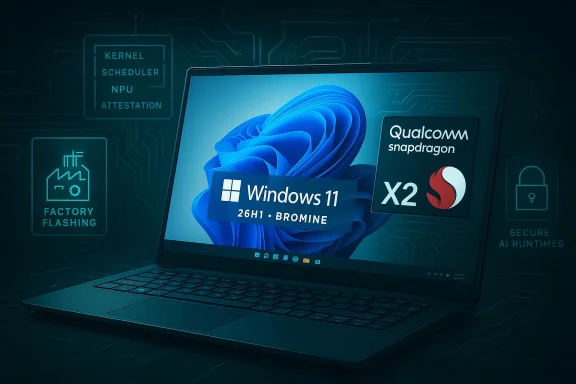
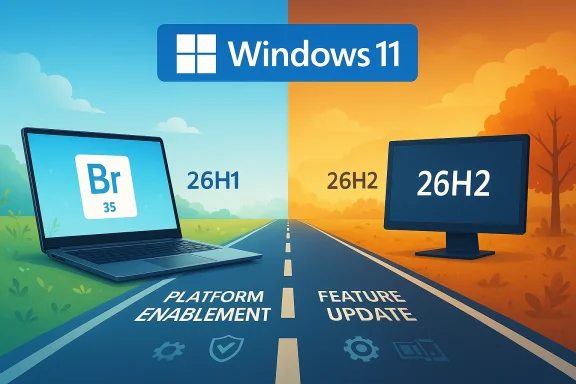
Microsoft’s latest move with Windows 11 has split the roadmap into two clearly different lanes: an early, device‑specific platform release — Windows 11 version 26H1 — that will appear only on new Arm‑based devices (starting with Qualcomm’s Snapdragon X2 series), and a broader, consumer‑facing feature update — Windows 11 version 26H2 — scheduled for the second half of 2026 and destined for the general PC population. This is not a small patch or a cosmetic rebrand; it is a deliberate engineering decision that trades immediate universality for safer, OEM‑friendly platform enablement.

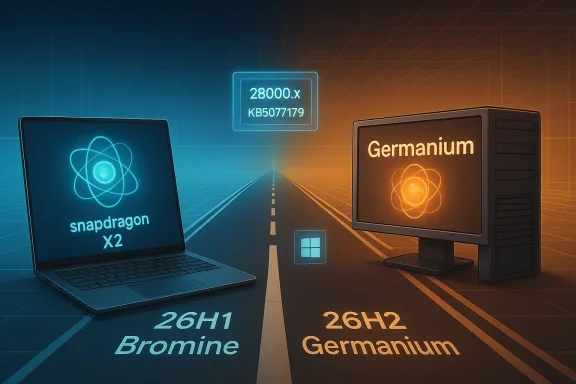
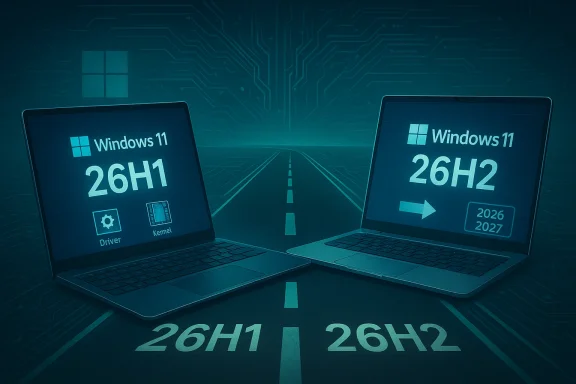
Windows 11 logo above a split road showing 26H1 vs 26H2 update paths for devices.Background / Overview​

Microsoft’s long‑standing cadence for Windows feature updates has been an annual H2 release that delivers visible UI and productivity changes to the entire installed base. In 2026 the company introduced a parallel track: a spring, platform release designed to support new silicon with deep under‑the‑hood changes, and an autumn, feature release that preserves the familiar consumer update experience.
  • The spring release is labeled Windows 11, version 26H1 and is based on a new platform baseline internally recognized by the community as Bromine. It was surfaced in Canary Insider builds with build numbers around the 28xxx family (notably build 28000).
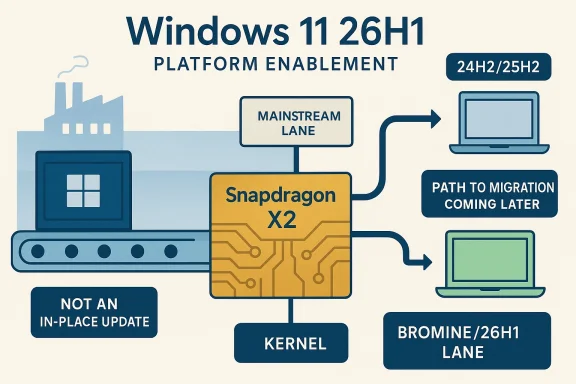
  • Microsoft’s published guidance makes the distinction explicit: 26H1 is intended for select new devices and will not be offered as an in‑place upgrade to existing Windows 11 systems. Devices running earlier Windows 11 releases will not receive 26H1 through Windows Update.
  • The usual mass‑market feature wave continues: Windows 11 26H2 will be the broad update for the wider installed base, scheduled for H2 2026 (with industry reporting pointing to an October window).
The net effect: Microsoft is running two concurrent servicing baselines for parts of 2026 — one narrow and device‑specific, the other broad and feature‑oriented.

What Windows 11 26H1 actually is — and what it is not​

A platform enablement release, not a consumer feature update​

Windows 11 26H1’s publicly stated mission is to enable next‑generation silicon and device innovations — specifically to support processors such as Qualcomm’s Snapdragon X2 series as they arrive in OEM laptops and Copilot+ devices in early 2026. The Microsoft support entry published on February 10, 2026, uses that wording directly and confirms the first devices will ship with Snapdragon X2 Series processors.
This means:
  • 26H1 contains kernel, scheduler, power‑management and runtime changes tuned to the architectural characteristics of new Arm SoCs, including tighter NPU integration and new power domains.
  • Visible, consumer‑facing features are minimal or unchanged versus 25H2; 26H1’s value is primarily stability, performance and battery optimizations on the targeted hardware.
  • Microsoft has stated that devices running 26H1 will continue to receive monthly quality and security updates, but they will follow the 26H1 servicing lane until Microsoft provides a migration path in a future release.

What 26H1 does not do​

  • It does not replace the broader annual feature cadence. Mainstream feature development remains focused on the H2 cycle and will be delivered to the wider installed base via 26H2.
  • It will not be offered through Windows Update as an in‑place upgrade to devices currently running 24H2 or 25H2. In short: if you have an existing Intel or AMD laptop, you will not be auto‑upgraded to 26H1.
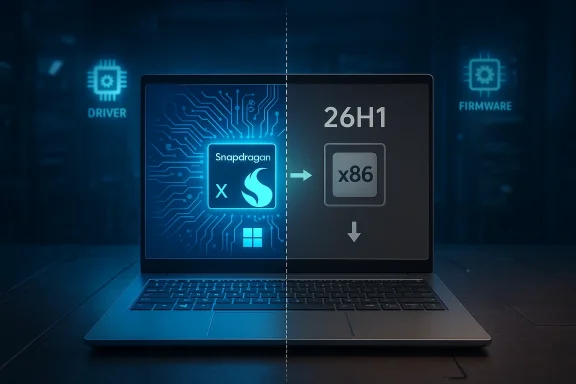
These technical and distribution choices are deliberate: platform changes that touch the kernel, firmware interaction, or underlying driver model carry higher regression risk if merged directly into the servicing baseline used by hundreds of millions of PCs. Shipping a validated, OEM‑flashed OS image avoids those risks for early silicon partners.

The hard facts: KB5077179, builds and dates​

On Patch Tuesday, February 10, 2026, Microsoft published cumulative update metadata tied to the new 26H1 baseline — for example, KB5077179 (OS Build 28000.1575) — which appears in Microsoft’s update history and security release notes for the new platform. That KB is the February 2026 cumulative for the 26H1 servicing lane and contains security fixes and quality improvements specific to build 28000.1575.
A few practical points to remember:
  • The build string 28000.x identifies the Bromine platform baseline used for 26H1.
  • KB5077179 is targeted at devices running 26H1; attempting to install it on standard Intel/AMD devices will fail because those devices are not in the supported device catalog for this platform lane. Microsoft’s support documentation and the KB pages are explicit about the device‑bound distribution model.

Which hardware gets 26H1 — Snapdragon X2, and maybe N1X​

Microsoft’s support document explicitly cites Qualcomm’s Snapdragon X2 Series as the first silicon family for which 26H1 will be available out of the box. That alignment was expected: Qualcomm and OEM partners targeted early 2026 shipments for X2‑based Copilot+ laptops, and Microsoft provided the validated Bromine/26H1 images OEMs need to factory‑flash those devices.
There’s also industry speculation — and a track record of reporting — suggesting 26H1 could be prepared to support additional Arm families, most notably NVIDIA’s long‑rumored N1X platform. Several outlets and leaks have suggested that N1X‑based laptops were intended to appear in 2026 and that Microsoft’s 26H1 test builds were written with the general idea of supporting next‑gen Arm silicon. However, N1X readiness and timing have been in flux: supply‑chain reports and leakers such as Moore’s Law Is Dead flagged software and compatibility issues that have delayed N1X availability and made broad OEM timelines uncertain. In short: Nvidia N1X support in 26H1 is plausible, but not confirmed, and subject to change. Treat N1X claims as speculative until Nvidia or Microsoft confirms device‑level support.

Why Microsoft took this route: engineering pragmatism vs. fragmentation risk​

The engineering case​

Modern Arm SoCs are increasingly complex: heterogeneous CPU configurations, large on‑device NPUs, new memory and I/O topologies, and firmware attestation primitives that require coordinated OS support. Waiting to fold those low‑level changes into the single annual feature baseline can delay OEM product launches; shipping unvalidated platforms can create a poor day‑one experience.
By delivering Bromine/26H1 as a factory‑installed image for qualifying devices, Microsoft gives OEMs and silicon partners:
  • A signed, tested OS image they can load at the factory.
  • A stable driver/firmware stack tailored to the target hardware.
  • Time to tune NPU runtimes, power governors and security hooks without risking regressions on the mass market.
From an engineering perspective, that’s a sensible, risk‑averse approach that prioritizes reliability for first‑wave devices.

The messaging and management problem​

But there’s a tradeoff: the move raises the risk of short‑term fragmentation and confusion.
  • Consumers and buyers may not understand the difference between a device that ships with 26H1 and one that will get 26H2 later. Without clear OEM labeling and point‑of‑sale disclosure, buyers could expect features or servicing parity that doesn’t exist yet.
  • IT administrators face procurement and lifecycle complexity: adding 26H1 devices to a fleet introduces a new servicing baseline with its own patch schedule and potential compatibility constraints for management agents, security tooling and line‑of‑business apps.
  • Driver and ISV certification programs must be re‑aligned: vendors may need to produce separate Arm64 builds for 26H1 and ensure graceful fallbacks for the broader Windows 26H2 stream.
If Microsoft, OEMs and ISVs do not communicate clearly, the benefit of safer launches will be offset by support overhead and user confusion. Community threads and early analysis in Windows‑oriented forums raised these exact concerns soon after the Canary builds appeared.

What this means for different audiences​

Consumers (existing PCs)​

  • If you own an Intel or AMD Windows 11 laptop today: nothing immediate to do. Your device will continue on the standard annual cadence and receive the general feature update in the H2 2026 release (26H2).
  • When shopping for a new Copilot+ Arm laptop: verify which Windows version arrives preinstalled and confirm OEM support, warranty terms and update commitments. If you buy an X2 device that ships with 26H1, be aware it may follow a separate servicing lane until Microsoft publishes an explicit migration path.

IT administrators / procurement teams​

  • Treat 26H1 devices as device‑specific images. Pilot them in a controlled ring before wide deployment.
  • Request OEM documentation and SLAs describing how firmware and driver updates will be handled, plus the timeline and mechanism for eventual migration to the broad 26H2 servicing baseline.
  • Validate management tooling and kernel‑mode agents on actual 26H1 hardware before scaling.

Developers and ISVs​

  • Prioritize Arm64 builds and test real hardware early. Emulate system behavior where possible, but verify NPU‑accelerated paths on retail devices.
  • Expect to maintain multiple release targets in the short term, and design graceful fallbacks for features tied to NPU or other silicon accelerators.

Practical checklist: how to approach 26H1 and 26H2​

  • If you’re an existing Windows user, stay on your current servicing lane and wait for 26H2 in H2 2026.
  • If you’re buying a new Snapdragon X2 laptop, confirm the image version at purchase and ask the OEM about update migration guarantees.
  • IT teams: pilot devices in a small ring, demand documentation, and add device filtering in your update policy so 26H1 images don’t accidentally get wide deployment.
  • Developers: test on real X2 hardware, validate NPU runtimes, and plan for server‑side fallbacks when local inference isn’t available.
  • Everyone: watch Microsoft’s official release health and update‑history documentation for official guidance on migration and known issues.

Risks, unknowns and claims you should treat cautiously​

  • Nvidia N1X support: there’s reasonable industry chatter that Microsoft’s plank for 26H1 could be extended to N1X or other Arm families, but N1X readiness has been reported as delayed by software/compatibility issues. That means N1X devices — if they ship with a 26H1 image at all — could arrive later than originally rumored. Treat NVIDIA N1X claims as speculative until either Nvidia or Microsoft issues explicit hardware support statements.
  • Update migration: Microsoft’s support page states that 26H1 devices will not be able to update to the second half feature update in 2026 because 26H1 is based on a different Windows core; Microsoft also promises a “path to update in a future Windows release.” However, the precise timing, mechanism and guarantees for that path remain unspecified and will be crucial for enterprise buyers. Flag this as an open question until Microsoft publishes a servicing matrix.
  • In‑place install behavior: community telemetry and KB metadata (Patch Tuesday entries) show that the 26H1 KB packages exist and that they are not applicable to non‑qualifying hardware. Nevertheless, community forums will likely surface edge cases and compatibility gotchas as devices ship — track those reports.

The strategic angle: Microsoft, OEMs and the ARM ecosystem​

Microsoft’s choice is part technical necessity and part strategic coordination.
  • For Microsoft, delivering Bromine/26H1 lets the company uphold product quality for partners while maintaining the broader annual cadence of visible features.
  • For Qualcomm and OEMs, a validated factory image reduces the risk of day‑one regressions on complicated new silicon and accelerates shipping schedules.
  • For the Windows on Arm ecosystem, the tradeoff is short‑term complexity in exchange for better long‑term hardware integration and the possibility of more compelling Arm‑based PCs in the market.
This is a predictable, engineering‑first response to the realities of modern silicon development: as SoCs gain NPUs and more varied microarchitectures, OS vendors must either delay launches to preserve a single update stream or accept parallel baselines that target early devices. Microsoft opted for the latter — rational and defensible technically, but sensitive from a messaging standpoint.

What to watch next (timeline and signals)​

  • February 2026: Microsoft published 26H1 support docs and KB metadata (KB5077179 / build 28000.1575), confirming the platform lane’s existence and the Snapdragon X2 alignment.
  • Spring 2026: OEMs planned to ship the first Snapdragon X2 laptops with 26H1 factory images; retailers and OEM announcements will be the first visible confirmation. Verify images at point of sale.
  • Mid‑to‑late 2026: Microsoft’s 26H2 feature update — the mainstream release for all existing PCs — is expected in H2 (community reporting points to an October timeframe), and will be the update that restores a single feature parity baseline across the majority of devices.
  • Any announcement from NVIDIA or Qualcomm about N1X/N2x support in 26H1 devices will radically shift expectations; treat such announcements as decisive confirmation or refutation of the speculation. Until then, N1X remains plausible but unproven.

Bottom line​

Windows 11 version 26H1 is real, technical and limited: it’s a factory‑installed, platform‑level release built to enable specific, next‑generation Arm silicon (starting with Snapdragon X2), not a broadly distributed feature update for existing Intel and AMD PCs. Microsoft published support guidance and a February 10, 2026 cumulative (KB5077179, build 28000.1575) that make the distribution model and constraints plain. For most users and organizations, the practical takeaway is simple: continue on the regular update path and expect the mainstream Windows 11 26H2 feature update in the second half of 2026; if you buy a new X2 device, verify vendor commitments and plan a careful pilot before deploying such hardware widely.

Microsoft’s approach is pragmatic engineering cloaked in careful language — it reduces technical risk for OEM launches and gives hardware partners the stable OS baseline they need, but it also raises short‑term operational questions for buyers and IT teams. Clear OEM labeling, documented migration paths, and timely communication from Microsoft will determine whether Bromine/26H1 is remembered as a smart enabler or as the start of a messy fragmentation chapter. Until then, the smart play for most Windows users is patience: 26H2 will bring the features to the broad installed base, and the Bromine lane will remain a targeted, partner‑driven route for those buying the very newest Arm silicon.

Source: Windows Latest Microsoft releases Windows 11 26H1, but it's not for existing PCs. Windows 11 26H2 is coming for all PCs
 

Microsoft has confirmed that Windows 11 version 26H1 — the early, hardware‑focused release shipping with the first Snapdragon X2 PCs this spring — will not be offered an in‑place update to the annual 26H2 feature update this fall, leaving devices that ship on the new 26H1 platform on a separate servicing lane until Microsoft publishes a later convergence release.

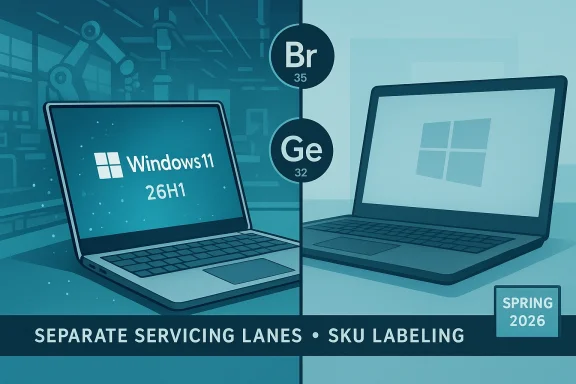
Snapdragon X2 laptop vs Germanium desktop in a futuristic tech showdown.Background​

Microsoft’s Windows release cadence has settled into an annual, H2 feature update rhythm for the broad installed base, with supplemental monthly cumulative updates for security and quality. Historically, every major platform refresh delivered in the second half of the year (the “H2” releases) has been the one that millions of existing Windows PCs receive through Windows Update. That model changed in late 2025 and early 2026 when Microsoft introduced a device‑first, platform‑specific release labelled Windows 11, version 26H1.
26H1 is not a conventional consumer feature update. It is a platform release — internally codenamed Bromine — produced to support next‑generation Arm silicon such as Qualcomm’s Snapdragon X2 family (and, in industry speculation, potentially other Arm designs). The Bromine core is materially different from the older Germanium core underpinning versions 24H2 and 25H2 (and the forthcoming 26H2). Because Bromine and Germanium are different platform branches, Microsoft’s support documentation makes a blunt statement: devices shipped with 26H1 will receive monthly updates but will not be able to update to the H2 feature update coming later in 2026 (26H2). Instead, those devices will have “a path to update in a future Windows release” — a convergence timeline Microsoft says will arrive at a later date.
This announcement was accompanied by concrete, verifiable signals: Canary Channel builds using the 28000-series build string (the Bromine baseline), and Patch Tuesday metadata that published cumulative packages tied specifically to the 26H1 lane (for example, KB5077179 / OS Build 28000.1575). Microsoft’s release notes for 26H1 explicitly state the device‑first distribution model and the non‑applicability of 26H1 as an in‑place update to existing 24H2/25H2 PCs.

What Microsoft actually said (the verified facts)​

The essentials, stated by Microsoft​

  • 26H1 is a hardware‑optimized release intended to enable specific new silicon families and will be available only on select new devices that ship preinstalled with it.
  • 26H1 is built on a different Windows core (Bromine) than the Germanium platform that underpins recent H2 releases. That difference is the technical reason for the split.
  • Devices running Windows 11, version 26H1 will not be able to update to the next annual feature update in H2 2026. Microsoft promises a future update path, but provides no precise timing or mechanism in the current support note.
  • 26H1 will receive monthly updates for security and quality similar to other Windows servicing lanes; Microsoft has already published cumulative update metadata tied to 26H1 builds.
  • 26H1 will not be delivered via Windows Update to existing devices running 24H2/25H2 and is not intended as an in‑place upgrade path for the installed base.

Concrete technical markers you can verify today​

  • Bromine builds use the 28000.x build series (for example, OS Build 28000.1575).
  • Patch Tuesday entries in February 2026 included KB packages targeted at the 26H1 servicing lane (KB5077179).
  • Microsoft’s “Windows 11, version 26H1” support page states the distribution model and the H2‑2026 upgrade limitation in plain language.
These are not unsubstantiated leaks; they are published Microsoft support and update‑history artifacts. That makes the platform split real, intentional, and documented.

Why Microsoft did this: the technical rationale​

At its core, this is engineering risk management applied to platform evolution.
  • Major platform shifts that change kernel behavior, low‑level driver interfaces, or firmware interaction carry a high potential for regressions. Microsoft’s choice to create a device‑first, OEM‑flashed image for new silicon minimizes the risk of breaking the broader installed base.
  • OEMs and silicon partners need a validated, factory image to tune firmware, drivers, and power management for new SoCs. Shipping a dedicated platform image is the most reliable way to ensure those devices meet battery life, performance, and compatibility targets.
  • By keeping the Bromine lane separate, Microsoft can push platform‑level innovations for Arm designs without forcing those changes onto hundreds of millions of existing Intel/AMD machines that rely on the Germanium servicing baseline.
In short: Bromine lets Microsoft and silicon partners iterate on a new platform without destabilizing the mainstream Windows Update pipeline.

What this means for different audiences​

Consumers (general buyers)​

If you buy a new Arm‑based laptop that ships with Windows 11 version 26H1 this spring, expect:
  • The device will receive monthly security/quality updates.
  • It will not receive the fall 26H2 in‑place feature update alongside mainstream PCs; a future, unspecified update will be used to converge the platform.
  • Functionality and user‑visible features may mirror 25H2 initially (Microsoft states 26H1 includes the same features as the 2025 Update), but underlying platform changes will be present.
If you own an existing Intel or AMD Windows 11 PC:
  • You will continue to receive updates on the Germanium servicing lane (24H2, 25H2 and then 26H2 in H2 2026).
  • You will not be offered 26H1 via Windows Update.

IT administrators and enterprise buyers​

Early‑adopter Arm devices present planning and risk assessment tasks:
  • Device lifecycle and patching policies must account for a separate servicing lane and an uncertain convergence timeline.
  • Imaging, management tools (MDM, SCCM), EDR agents, and vendor drivers will need validation on the Bromine image — do not assume parity with Germanium.
  • Procurement teams should demand OEM and ISV compatibility guarantees and a clear servicing statement for enterprise fleets.

OEMs and silicon partners​

This strategy is beneficial for OEMs and silicon vendors:
  • It allows them to ship certified, tuned images for new chips without waiting for the mainstream servicing baseline to incorporate platform changes.
  • It simplifies QA for device launch; however, vendors must manage support messaging carefully to avoid consumer confusion.

Strengths of Microsoft’s approach​

  • Safer rollouts for new silicon. Creating a platform‑specific lane reduces the chance of widespread regressions that could affect millions of devices.
  • Faster time to market for partners. OEMs and silicon vendors can ship devices with validated images timed to their SoC readiness.
  • Targeted fixes and servicing. Bromine devices get monthly updates tailored to the specific platform and hardware — fixes for Bromine won’t be needlessly gated by the Germanium servicing process.
  • Clear separation of concerns for development teams. Microsoft can evolve core platform capabilities for Arm faster without merging incomplete plumbing into the mainline servicing branch.

Real risks and downsides (what to watch closely)​

  • Fragmentation and update confusion. A split platform baseline with different version numbers (26H1 on Bromine vs 26H2 on Germanium) creates a natural source of confusion for consumers, retailers, and help desks. Expect questions: “Why is my new laptop on 26H1 while my friend’s machine shows 26H2 later in 2026?”
  • Unclear convergence timeline. Microsoft promises a “path to update in a future Windows release,” but offers no firm date or mechanism. For enterprises, the absence of a concrete servicing matrix complicates lifecycle planning.
  • Driver and tooling compatibility issues. Management agents, antivirus/EDR software, device drivers, and specialized peripherals often lag behind platform shifts. Enterprises must test these components on Bromine images before approving devices.
  • Third‑party application risk. Legacy applications that rely on specific on‑demand features (for example, .NET Framework 3.5) may be affected: patch notes tied to the new lane show changes such as .NET Framework 3.5 no longer being a “Windows Feature on Demand” on 26H1, requiring a standalone installer.
  • Support overhead for OEMs and retailers. Store teams and OEM customer support must be prepared to explain the servicing differences and the meaning of version strings to buyers.
  • Potential for consumer frustration. When a device advertises “Windows 11” but cannot receive the same named feature updates as other PCs on a timeline consumers expect, dissatisfaction may follow.

Unverified or speculative claims — exercise caution​

Several publications and community threads have speculated that 26H1 will also target other Arm chips (for example, Nvidia’s N1X family) or that Bromine will quickly replace Germanium for all devices. Those claims are plausible but remain speculative until Microsoft or the silicon vendors publish explicit lists of supported SKUs and a formal roadmap for convergence.
Treat the following as unverified unless and until Microsoft or the relevant silicon OEM confirms them:
  • That Nvidia N1X devices will ship with 26H1 at launch.
  • That Bromine features will be backported wholesale to Germanium in 26H2.
  • The precise timing and mechanism of the “path to update” Microsoft promises for 26H1 devices.

Practical advice: what to do now​

Whether you’re a consumer, IT pro, or OEM, here are concrete steps to take.
  • If you’re buying a new Arm laptop this spring:
  • Ask the retailer or OEM whether the device ships with Windows 11 version 26H1 and what that means for feature updates.
  • Confirm vendor support for enterprise features (BitLocker, TPM attestation, EDR compatibility).
  • If you rely on legacy components like .NET 3.5, verify how to install and support them on 26H1.
  • If you manage enterprise deployments:
  • Hold Bromine/26H1 devices to pilot status until vendors provide validated driver and management support.
  • Update procurement checklists to require a servicing and convergence commitment from OEMs.
  • Ensure imaging and OS deployment workflows account for a separate platform baseline and that rollback paths are tested.
  • If you’re an ISV or device driver author:
  • Acquire Bromine test images early and validate driver behavior, power management, and telemetry.
  • Test management agent installations under Bromine monthly updates to catch compatibility regressions early.
  • If you already own an Intel/AMD device:
  • Continue normal patching; expect to receive 26H2 when Microsoft releases the annual H2 feature update later in 2026.
  • No special action is needed unless you plan to replace the device with a 26H1‑shipped Arm machine.

How Microsoft could have reduced the friction​

There are things Microsoft (and partners) could do to smooth the transition and contain confusion:
  • Publish a precise servicing matrix that lists supported SKUs, the planned update path, and an expected date window for platform convergence.
  • Offer a clear, consumer‑facing explanation at point‑of‑sale and in the OEM support documentation about how 26H1 differs from regular feature updates.
  • Provide a tool or guidance for enterprises to map Bromine devices to existing lifecycle and patching models, including explicit EOL and upgrade windows.
  • Commit to a concrete migration path or compatibility guarantee for enterprises buying Bromine devices in volume, with timelines for when Bromine will be merged into the Germanium servicing baseline (or when Germanium will be replaced entirely).

Deeper technical considerations​

What “different Windows core” can imply​

When Microsoft says Bromine is a different Windows core, that can encompass multiple low‑level changes:
  • Kernel modifications to support new CPU architectures and power features.
  • Revised memory management or scheduler logic to optimize heterogeneous cores in modern SoCs.
  • New hypervisor or virtualization primitives tuned for on‑die AI accelerators or hardware partitioning.
  • Changes in the hardware abstraction layer (HAL) or driver models that require new driver signing or certification paths.
Each of these changes has non‑trivial downstream effects on drivers, firmware interfaces, and security tooling.

Servicing lanes and update logic​

Separating servicing lanes means Microsoft will maintain discrete update metadata, catalog rules, and compatibility filters that control which devices can receive each package. You’ll see this in practice as:
  • KB packages that only apply to the 28000.x family, and that the Microsoft Update Catalog marks as non‑applicable on non‑Bromine hardware.
  • Update cataloging and deployment tools (WSUS, SCCM/MECM) needing to recognize device platform lines to avoid attempting incompatible installs.

Scenarios to monitor​

  • If Microsoft schedules a fast convergence release (e.g., 27H2 or another H2 release where Bromine and Germanium are unified) with a clear migration tool, the disruption will be short‑lived.
  • If convergence slips into 2027 or later, enterprises will face longer complexity in their device fleets and may delay purchases of Bromine devices.
  • If OEMs push heavy marketing of Bromine devices without clear servicing guarantees, consumer confusion and return rates may increase.
  • If driver and ISV ecosystems are slow to support Bromine, early adopters may encounter real productivity or compatibility problems.

Final analysis — balancing risk and reward​

Microsoft’s platform split is a defensible engineering decision: it enables OEMs and silicon partners to ship tuned devices while preventing risky platform plumbing from destabilizing the vast Windows install base. For the ecosystem, the benefits are tangible — better battery life, closer firmware integration, and optimized drivers for Arm SoCs — but Microsoft’s current messaging leaves important operational questions unanswered.
For consumers, this is mostly a curiosity unless you plan to buy an Arm device that explicitly ships with 26H1. For enterprises and IT decision‑makers, the immediate impact is operational: treat Bromine devices as pilots, demand servicing clarity from OEMs, and validate your stack before deployment.
Ultimately, the success of this approach will hinge on three things:
  • How quickly Microsoft and partners converge the two platform lanes,
  • How clearly OEMs communicate the difference at point of sale, and
  • How fast ISVs and driver authors bring Bromine parity to the ecosystem.
If Microsoft executes confidently on those three fronts, Bromine can be a controlled pathway to modern Arm hardware on Windows without long‑term fragmentation. If not, the company risks a period of confusion and increased support overhead for both consumers and enterprises. The coming months — as Snapdragon X2 devices arrive and as Microsoft publishes more servicing details — will tell whether this split becomes a short engineering interlude or the start of a more permanent branching in the Windows platform.

Source: Windows Central Windows 11 version 26H1 won't be getting version 26H2 this fall
 

Microsoft’s decision to ship Windows 11 version 26H1 as a narrowly scoped, factory-installed platform image for new Arm-based laptops — led by Qualcomm’s Snapdragon X2 family — marks a deliberate engineering break from Microsoft’s usual annual feature cadence and raises immediate questions for consumers, enterprises, OEMs and developers about update pathways, device fragmentation, and the practical meaning of “Copilot+” hardware readiness.

Two scientists in lab coats study a Windows 11 laptop with a holographic UI in a high-tech lab.Background / Overview​

Microsoft published an Insider Canary build that surfaces the version string Windows 11, version 26H1 (build numbers in the 28xxx range). The company’s release notes are explicit: “26H1 is not a feature update for version 25H2 and only includes platform changes to support specific silicon.” That wording — short, technical and unusual — reframes 26H1 as a platform enablement release rather than a consumer-facing feature wave.
Industry reporting and OEM briefings tie the initial distribution of 26H1 to Qualcomm’s Snapdragon X2 family (variously marketed in Elite and Elite Extreme tiers). Qualcomm positioned X2-equipped laptops for H1 2026 availability, andlong with internal Microsoft messaging — indicate OEMs will ship specific Snapdragon X2 SKUs with 26H1 preinstalled while Intel/AMD variants of the same model lines will retain the mainstream 25H2 image. That split highlights Microsoft’s device-image approach in practice.
In short: 26H1 exists to give OEMs an RTM-quality OS image they can factory-flash on next-generation Arm silicon so devices deliver validated drivers, firmware and on-device AI experiences from day one — while mainstream Windows 11 feature development remains tied to the normal H2 26H2 release later in the year.

Why Microsoft created a device-specific platform release​

The engineering problem​

Modern SoCs are not incremental CPU bumps. They introduce:
  • heterogeneous CPU topologies (big.LITTLE-like Oryon configurations),
  • vastly larger NPUs (neural processing units) intended for on-device generative and inferencing workloads, and
  • new memory, I/O and firmwareruler and power management in ways that existing servicing channels were not designed to validate at scale.
Microsoft’s engineers concluded that trying to graft these low-level changes into the mainstream 25H2 servicing stream risks regressions and support incidents across billions of devices. A factory image for a targeted hardware set reduces the blast radius — OEMs receive a validated, signed image to flash at the factory, and Microsoft contains risky platform work to a known device set.

Operational benefits for OEMs and hardware launches​

A Bromine/26H1 factory image (Bromine being the internal platform codename associated with the new baseline) givesmage to flash at the point of manufacturing,
  • a driver stack and firmware pairing that minimize day-one issues, and
  • a controlled update path for early hardware that relies on vendor-specific runtime and attestation flows for NPUs.
This approach matters when laptop shipments advertise Copilot+ experiences and local AI acceleration — consumer marketing claims can blow up quickly if drivers or firmware cause crashes, battery drain, or thermal unpredictability at scale.

Snapdragon X2: the silicon pulling 26H1 forward​

What Qualcomm is promising​

Qualcomm’s Snapdragon X2 family is positioned as a pronounced step-up for Windows Arm PCs. Public vendor briefings and press coverage list headline specs for Elite and Elite Extreme SKUs that include:
  • CPU configurations scaling up to 18 cores (12 Prime + 6 Performance in flagship variants),
  • Hexagon NPU performance in the ~80 TOPS range (INT8 basis, used in vendor materials),
  • advanced Adreno X2 GPU parts and wider memory bandwidth (LPDDR5x) for NPU/CPU data movement, and
  • boost CPU frequencies that push the envelope for single- and multi-thread workloads in laptops.
Independent benchmark reporting on pre-production X2 units shows strong multi-thread performance in rendering and encode workloads — enough to draw comparisons to Apple’s M-series and Intel’s latest laptop silicon in some tests — but those results come from early hardware with tuning still in progress. Readers should treat early benchmarks as directional rather than final.

Why X2 matters for Windows’ on-device AI​

Snapdragon X2’s larger NPUs and increased throughput are central to the Copilot+ narrative: Microsoft and OEMs want on-device models, low-latency inference, and local data processing without constant cloud round-trips. Those features require deep integration:
  • secure NPU runtimes and attestation,
  • kernel s heterogeneous compute resources, and
  • power/thermal management tuned to AI-heavy workloads.
Windows must offer hooks to manage these flows; Bromine/26H1 contains those underlying plumbing changes. That is the technical justification for a platform-targeted release rather than a mass update.

Who gets 26H1 — and who does not​

Initial recipients​

  • New Arm-based Copilot+ laptops using Snapdragon X2 SKUs will be the primary devices shipping with Windows 11 26H1 preinstalled at factory. OEM briefings and reporting indicate that models like certain ASUS ZenBook SKUs with X2 options are slated to arrive with the Bromine image.

Not eligible​

  • Existing Intel- and AMD-based Windows 11 PCs will not be offered 26H1 as angh Windows Update. Those systems remain on the mainstream 25H2 servicing baseline and will receive the usual security/quality updates until their H2 feature release (26H2) is available for the broader installed base. Microsoft’s public messaging is blunt on this point: no forced migration.

Possible but unconfirmed extensions​

  • Industry chatter and community captures have suggested other Arm processors (NVIDIA’s rumored N1/N1X family, for example) might be candidates for Bromine/26H1 support, but that remains speculative until Microsoft or the silicon vendor confirms formal support. Treat such claims as rumor uncrosoft publishes specific compatibility statements.

Practical effects: what consumers, IT teams and developers must do​

Consumers and buyers​

  • If you own a current Intel/AMD laptop: no action is required. Your PC remains on 25H2 and will continue to receive security and quality updates in the normal fashion. Do not expect Windows Update to push 26H1 onto your machine. ([pcworld.com](It's official: Windows 11 26H1 isn't for you you plan to buy a new Copilot+ laptop: ask the retailer and OEM explicitly whether a given SKU ships with 26H1 (and what update path and driver servicing channels will be used). Some identically named model lines may have both Intel/AMD and X2 SKUs; the X2 SKU may carry 26H1 while the others do not. Have the vendor document how firmware and driver updates are handled after purchase.

IT teams and procurement​

  • Treat 26H1 devices as hardware-specific images with their own servicing expectations. Pilot thoroughly validate management agents, endpoint protection and MDM behavior on Bromine-based images before wide deployment.
  • Require OEM documentation and SLAs describing firmware and driver update channels. Some Bromine devices may rely more heavily on OEM update tooling than on Windows Update for device-specific drivers and attestations.

Developers and ISVs​

  • Prioritize Arm64 CI builds and test NPU-accelerated code paths where practical. A growing portion of on-device AI workloads will dependnd secure model attestation; apps should degrade gracefully when hardware acceleration is absent.
  • Validate native and emulation paths. While X2-class devices will promote native Arm64 binaries and accelerated runtimes, a large existing installed base still runs x64/x86 workloads under emulation; compatibility testing remains essential.

Risks, trade-offs and unanswered questions​

Fragmentation and servicing complexity​

Shipping a platform image naturally creates a short-term fragmentation risk. Enterprises and ISVs face a bifurcated testing matrix — Bromine/26H1 devices versus the mainstream 25H2/26H2 lineage — which complicates imaging, update planning, and driver certification. Microsoft will need clear guidance on rollout timelines and servicing windows to reduce operational friction.

Updateorting suggests 26H1 devices may follow a different cadence or update mechanism than mainstream devices, potentially affecting how and when those devices receive subsequent feature releases like 26H2. Microsoft’s public messaging has not published a fully unambiguous timeline for how and when Bromine-based devices will converge with the mainstream branch; buyers should demand clarity from OEMs and Microsoft support channels.​

Dependence on OEMs for driver/firmware updates​

A factory image reduces day-one brdependence on OEMs for long-term driver and firmware servicing. If OEM update tooling is inconsistent, enterprises could face a patchwork of support models across device fleets. Require written update policies and test the OEM’s update tooling in pilots.

Security and attestation implications​

On-device AI and secure model execution require attestation, protected runtimes and updated firmware chains. Those flows increase complexity for security teams, who must validate that NPU runtimes, model stores, and attestation endpoints meet corporate policies. Microsoft and OEMs will need to publish best practices for securely provisioning and updating Bromine devices. Until then, treat these devices as higher operational risk from an endpoint security perspective.

How credible are the technical claims about Snapdragon X2?​

Multiple independent outlets and the vendor’s own materials converge on a few consistent claims:
  • flagship X2 SKUs use up to 18 cores in split Prime/Performance arrangements,
  • NPUs in the Snapdragon X2 family are advertised around 80 TOPS (INT8 metric),
  • memory bandwidth and cache configurations scale significantly versus the prior generation.
These claims are present in Qualcomm briefings and reproduced across TechPowerUp, Yahoo/press summaries and multiple hardware outlets that observed pre-production benchmarks. Early benchmarks are promising for multi-threaded workloads, but they come from pre-production hardware (limited thermal tuning and firmware maturity), so vendors’ published figures should be treated as vendor-provided and early tests as provisional. Cross-referencing Qualcomm’s product materials with independent benchmark reports shows tecture and capability intent, while performance deltas in real-world laptop SKUs will depend on OEM thermal and power design.

Recommendation checklist (for immediate action)​

  • If you manage procurement for an organization:
  • Demand OEM documentation that clarifies whether a specific SKU ships with 26H1 and how driver/firmware updates will be delivered post-sale.
  • Require a pilot program with a minimum of 25–50 devices (depending on fleet size) to validate management software, endpoint protection, and update behavior under production policy.
  • Include Bromine/26H1 targets in your asset classification and patching playbook until OEM/Microsoft servicing models are formalized.
  • If you’re a consumer shopping for a Copilot+ laptop:
  • Ask point-of-sale whether the X2 SKU ships with Windows 11 26H1 factory image and confirm the OEM’s update policy.
  • Consider waiting for independent reviews of the final retail hardware that include battery life, thermals, and apty testing before committing if you value long-term predictability.
  • If you’re a developer:
  • Add Arm64 CI runners where possible, test fallbacks for NPU-absent devices, and instrument performance counters to detect behavioral differences between Bromine and mainstream images.
  • If you’re an OEM:
  • Publish an explicit post-sale update roadmap for 26H1 devices and build robust tooling for firmware, driver and attestation updates that integrates with enterprise management tools.

What to watch next (timeline and signals)​

  • OEM announcements at product launch: watch whether OEMs explicitly state “ships with Windows 11 26H1” on product pages and spec sheets; that language matters operationally. Early reporting indicated ASUS ZenBook X2 SKUs as an example of device-specific shipping choices.
  • Microsoft documentation and support articles: Microsoft has published Canary release notes and a blog clarification that 26H1 is platform-only; more detailed servicing guidance is the decisive signal enterprises need.
  • Independent retail reviews and teardown benches: look for final retail units tested for battery life, thermal envelopes and application compatibility to validate vendor claims and early bench results. Early pre-production benchmarks show strong multi-thread results but are not definitive.

Critical assessment — strengths and risks​

Strengths​

  • Engineering safety: Isolating deep platform changes to a factory image is a conservative engineering stance that reduces the likelihood of broad regressions across the billions of Windows devices Microsoft supports.
  • Enables on-device AI: Bromine/26H1 can accelerate the rollout of local AI experiences that depend on secure NPU runtimes and low-latency inference, delivering real user benefits on capable devices.
  • Faster time-to-market: OEMs can ship X2-equipped devices on schedule, with a validated OS image and certified driver stacks.

Risks​

  • Short-term fragmentation: Enterprises and ISVs must contend with multiple test targets (Bromine vs. mainstream) and potentially different servicing models for a subset of devices.
  • OEM servicing dependency: Reliance on vendor-specific update tooling and channels increases operational burden; inconsistent OEM tooling could create long-term support problems.
  • User and buyer confusion: Identically named model lines shipping with different Windows images (depending on silicon) can confuse buyers and complicate support for retailers and service desks.
  • Security complexity: New attestation and NPU runtime flows expand the attack surface and introduce new provisioning challenges for security teams until best practices are published and adopted.

Final verdict​

Windows 11 26H1 is not a typical feature update; it is a targeted, platform-only release created to enable new Arm silicon such as Qualcomm’s Snapdragon X2. That engineering-centered approach makes sense: it reduces day-one risk for OEMs and helps protect mainstream devices from risky low-level changes. However, the model introduces short-term operational friction — fragmentation, servicing complexity and increased reliance on OEMs — that enterprises, service providers and developers must actively manage.
If you’re buying a new Copilot+ laptop, ask for written update and servicing commitments. If you’re managing a fleet, plan a pilot, demand OEM SLAs, and treat Bromine devices as a separate classification until Microsoft and OEMs publish clear, long-term servicing guidance. And if you’re a developer, accelerate Arm64 testing and design for graceful fallback from hardware acceleration.
This is an engineering-first pivot by Microsoft that prioritizes silicon enablement and product reliability for a narrow set of new devices. The broader Windows ecosystem will still receive mainstream features on the H2 cadence (26H2), but expect a short window of complexity as the industry adapts to platform-specific images and on-device AI hardware.

Source: Windows Report https://windowsreport.com/windows-11-26h1-targets-snapdragon-x2-cpus-excludes-existing-pcs/
 

Microsoft’s announcement that Windows 11 version 26H1 exists — and that it will only appear on a narrow set of new ARM PCs — is less a consumer-facing update and more an engineering concession to the realities of modern silicon. The release is a factory‑flashed platform image, tied to next‑generation SoCs such as Qualcomm’s Snapdragon X2 family, designed to deliver the low‑level kernel, driver, power‑management and NPU plumbing those chips require out of the box rather than to push new UI features to today’s installed base.

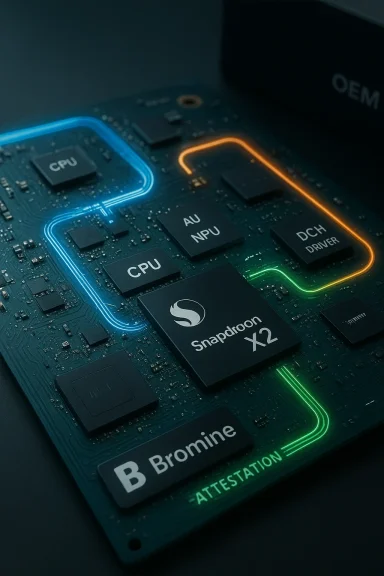
Close-up of a Snapdragon X2 chip on a motherboard, outlined by glowing blue, orange and green traces.Background / Overview​

Microsoft’s Windows 11 update cadence has historically relied on a broadly distributed H2 feature release with ongoing servicing patches. Version 26H1 breaks that pattern by acting as a device‑specific platform branch rather than a mass feature update. The build baseline that surfaced in Insider Canary previews is in the 28xxx range (notably Build 28000) and has been associated internally with a new platform codename often referred to as Bromine. That baorm‑level changes — not headline UI features — and will be shipped preinstalled by OEMs on qualifying ARM64 systems.
Why does Microsoft take this approach? Modern Arm SoCs are heterogeneous beasts: multi‑cluster CPU topologies, large on‑device NPUs, new GPU/ISP subsystems, and different power/thermal envelopes require OS‑level changes deep in the kernel and driver stacks. Pushing those changes into the broad servicing channel used by hundreds of an risk regressions. The pragmatic solution: build a validated platform image for OEMs to factory‑flash on specific hardware so day‑one functionality and stability are preserved for the new silicon.

What Windows 11 26H1 actually is​

A platform release, not a consumer feature pack​

  • Primary purpose: Enable and validate platform‑level changes for particular next‑gen ARM silicon (kernel/HAL adjustments, scheduler tuning, NPU runtimes and attestation hooks, DCH driver bundles, firmware/pre‑boot security interactions).
  • Distribution model: Preinstalled by OEMs on qualifying new devices. It is not intended to be pushed via Windowntel/AMD machines.
  • Visible impact: Minimal for users migrating from 25H2 — most improvements are under the wer, hardware offload).

Technical identifiers to remember​

  • OS label: Windows 11, version 26H1.
  • Build baseline: Build 28000 (Canary snapshots surfaced these build numbers).
  • Platform codename: Bromine (internal platform name tied to the new baseline).

Why Microsoft created 26H1 — engineering rationale​

The root causes are straightforward:
  • Chip vendors (notably Qualcomm) are shipping new Arm laptop SoCs with architectural changes that require kernel and runtime integration work.
  • OEM manufacturing cycles require stable, signed OS images for factory flashing and certification.
  • Changes deep in the OS (scheduling algorithms for heterogeneous CPU clusters, trusted attestation for NPUs, or new power governors) can’t safely be rolled out to the entire Windows install base without targeted validation.
This is an engineering‑first choice: ship an OEM image that guarantees hardware behaves correctly at launch while keepincing branch stable for the broader ecosystem. The tradeoff is temporary platform divergence between devices shipping on Bromine/26H1 and the majority of Windows installations that will remain on the mainstream branch until the usual H2 feature update.

What’s different under the hood​

Although end users will not see a list of shiny new features, 26H1 packages several important platform changes that can materially affect device behavior:
  • Scheduler and kernel adjustments: To fairly allocate work across big.LITTLE or heterogeneous core clusters and to avoid single‑threaded tasks being starved or overly favored.
  • Power and thermal governors: Tuned to new SoC power envelopes to improve battery consistency and sustained performance under load.
  • NPU runtime and attestation hooks: Secure on‑device AI execution requires runtimes, drivers, and attestation primitives that the OEM image can validate against specific NPUs.
  • DCH driver bundles: Validated driver collections for GPUs, ISPs, radios and other subsystems that are specific to the silicon and OEM board designs.
  • Firmware / pre‑boot interactions: Changes to WinRE, BitLocker attestation and pre‑boot security to align with new platfo.
These changes are precisely why Microsoft is restricting the release: what’s safe and tested for new Arm configurations may cause unexpected behavior on millions of existing PCs if broadly backported without careful validation.

What 26H1 does NOT do (important clarifications)​

  • It is not the replacement for the regular H2 feature update. The broader consumer‑facing feature wave (expected as 26H2) remains on the normal cadence and will carry the visible UI changes most users expect later in the year.
  • It will not be delivered via Windows Update to devicndows 11 24H2/25H2. Existing devices will continue to receive security and quality updates on their servicing branch.
  • It does not initially introduce exclusive consumer features; visible improvements are largely performance and hardware integration gains rather than new apps or UI flows.

Who should care and why​

Consumers and early adopters​

If you’re buying a next‑gen ARM laptop (Snapdragon X2 or similar) in early 2026, expect the device to ship with 26H1 preinstalled and validated for that model. That should deliver the best day‑one experience for those specific laptops, but it also means the OS image and update path may differ from Intel/AMD counterparts. Ask OEMs at purchase about the factory image, driver update channel, and long‑term upgrade plans.

Enterprises and IT pros​

26H1 creates an operational wrinkle for device fleets and procurement:
  • Pilot earls a distinct platform and pilot them in a controlled ring before broad deployment.
  • Demand clarity: require OEM documentation, driver update SLAs, and explicit guidance on management tooling compatibility (MDM, group policies, endpoint agents).
  • Verify tooling: kernel‑mode agents, device management agents, and custom telemetry hooks must be validated for compatibility with the Bromine platform.
Microsoft’s guidance is explicit: continue enterprise rollout plans on broadly released versions (24H2/25H2) and do not expect 26H1 to replace mainstream servicing.

Developers and ISVs​

If you build for Windows:
When evaluating Snapdragon X2 (or other 26H1‑based) systems, follow this checklist:
  • Pilot: Procure a small test fleet and run it under your standard management rings.
  • Ask OEMs: Get written statements for image maintenance, driver distribution channels, and recovery image policies.
  • Validate management: Confirm MDM, SCCM/Configuration Manager, BitLocker key flow, and telemetry work as expected on the Bromine image.
  • Test agents: Validate antivirus, EDR, VPN, kernel‑mode drivers and line‑of‑business software for Arm64 compatibility.
  • Prepare fallback strategies: Ensure you have WinRE and recovery media, and confirm how OEMs will support clean image re‑flashing or OS rollback if needed.

Enterprise risks and mitigation​

Risk: Platform divergence and update compatibility​

Because 26H1 runs on a different platform baseline, devices that ship with it may not follow the same update path as the enterprise majority. Windows Central reported Microsoft’s support note indicating 26H1 devices may not be eligible to receive the 26H2 platform upgrade later in the year, creating an extended period where two platform baselines coexist. This complicates patch testing and lifecycle planning. IT teams must therefore treat 26H1 machines as a divergent platform and maintain separate validation and deployment rings.
Mitigation:
  • Keep 26H1 systems in pilot rings until OEM and Microsoft release clear upgrade paths.
  • Require OEM support SLAs that include platform‑level updates and hotfix delivery guarantees.

Risk: Driver and agent incompatibility​

New DCH driver stacks or kernel changes can break endpoint agents, third‑party drivers, or specialized enterprise software.
Mitigation:
  • Request test images or device loaner programs from OEMs for early compatibility testing.
  • Prioritize Arm64 versions of critical software and ensure vendors support Bromine baseline.

Risk: Security and pre‑boot attestation​

New attestation primitives or firmware interactions could change BitLocker, Secure Boot and recovery behaviors. Additionally, Microsoft’s update history notes other platform issues (e.g., Secure Boot certificate expirations are scheduled in 2026), which have lifecycle implications for enterprise deployments. Review secure boot certificate guidance as part of rollouts.
Mitigation:
  • Validate BitLocker encryption and recovery workflows on sample devices before deployment.
  • Confirm OEM firmware update processes and support for secure boot certificate updates.

Developer considerations: testing for Arm and NPU​

The arrival of Bromine/26H1 reinforces a recurring message for developers: if you want to support Winly, you must test on real arms hardware, not just emulation.
  • Build native Arm64 binaries and provide fallbacks.
  • Test NPU offload and verify model quantization, runtime errors, and attestation flows.
  • Expect variant behavior in instruction sets: emulation layers (e.g., AVX2 emulation) are improving but are not a perfect substitute for native execution; performance and numerical behavior may differ. Qualcomm and partners have signaled AVX2 emulation rollouts and game‑centric driver updates for Snapdragon X2, but thorough per‑title testing is still required.

Consumer impact and messaging​

For most mainstream Windows 11 users on Intel and AMD machines: nothing changes today. Continue using the mainstream servicing branch — your devices will keep receiving security and quality updates. Microsoft and OEMs are explicitly saying there is “no action required” for typical customers; the targeted nature of 26H1 means dayhip remains unchanged for the majority.
For people who plan to buy a next‑gen Snapdragon X2 laptop: expect a device grounded in 26H1 and optimized for the new silicon’s power and AI capabilities. That may deliver superior battery life, better NPU‑accelerated local AI inference, and hardware‑specific optimizations — but also introduces the need to confirm update and support policies with the vendor at point of sale.

The strategic picture: why this matters for Windows on Arm​

26H1 is a strategic signal more than a single product update. It demonstrates Microsoft’s willingness to decouple platform plumbing from consumer feature cadence when silicon evolution demands it. That flexibility helps OEMs and silicon partners ship innovative hardware on schedule while preserving the stability of the large Windows installed base.
At the same time, this approach increases short‑term complexity: device diversity rises, and enterprises, ISVs and developers must track platform baselines more closely. In the longer term, however, the Bromine/26H1 experiment — if managed well — should produce more polished, performant ARM devices that bring Windows on Arm closer to mainstream parity.

Testing checklist for IT and ISVs (concise)​

  • Confirm device model ships with 26H1 and get the exact build number.
  • Create separate test rings for Bromine devices.
  • Validate: BitLocker, BitLocker recovery, WinRE, Secure Boot, firmware update path.
  • Test critical LOB applications and security agents on Arm64 hardware.
  • Validate AVX2 emulation behaviors for compute‑heavy workloads and gaming anti‑cheat compatibility where applicable.

What happens next — and what to watch​

  • Expect early Snapdragon X2 laptops to begin shipping in the spring window and carry 26H1 factory images; OEM timing suggests devices will appear in Q1–Q2 2026. Watch OEM announcements and review their support commitments closely.
  • Microsoft intends to continue mainstream feature development on the 25H2/26H2 cadence; a broad consumer‑facing 26H2 wave is expected later in 2026 with the features most users will notice.
  • Monitor Microsoft and OEM guidance about whether Bromine/26H1 devices will receive a direct upgrade path to 26H2. Early support notes indicate some 26H1 devices may not be eligible for 26H2 in the fall due to platform baseline differences — IT teams should factor this into
  • Keep an eye on platform security notices (e.g., Secure Boot certificate expiration guidance) that could intersect with device rollouts and firmware update scheduling.

Strengths, risks, and final assessment​

Strengths​

  • Day‑one hardware compatibility: OEMs can ship validated images, reducing launch‑week regressions for new silicon.
  • Optimized platform behavior: Scheduler, power governors and NPU runtimes tuned to SoC specifics should yield tangible battery and performance improvements on supported devices.
  • Enables advanced capabilities: Secure on‑device AI offload and attestation hooks are necessary for next‑gen features and local inference scenarios.

Risks​

  • Platform fragmentation: Divergent platform baselines complicate enterprise management and testing.
  • Update and upgrade ambiguity: Early support notes suggest 26H1 devices may not automatically receive the later 26H2 platform upgrade, requiring explicit OEM/Microsoft guidance and SLAs.
  • Compatibility gaps: Third‑party drivers, kernel‑mode agents and legacy apps may behave differently on Bromine; testing overhead rises.

Final assessment​

Windows 11 26H1 is an engineering‑driven, pragmatic response to silicon innovation. It is not a consumer feature update — it is a factory image meant to protect OEM launch timelines and to deliver the right low‑level changes for new Arm SoCs. For typical users, the headline is simple: nothing to do. For purchasers, enterprises and developers, the headline is clear: plan, pilot, and validate. Treat 26H1 devices as a distinct platform purchase and demand the documentation and update guarantees necessary to manage them at scale.

If you manage hardware procurement or deploy at scale, adopt a conservative pilot strategy, require OEM transparency about image and driver maintenance, and prioritize testing on Arm64 hardware. The Bromine/26H1 approach should make next‑gen ARM Windows PCs better behaved out of the box — provided the ecosystem (OEMs, Microsoft, ISVs) coordinates on clear upgrade and support paths during this period of platform divergence.

Source: gHacks Technology News Windows 11 26H1 Arrives (But Only for Next-Gen ARM PCs) - gHacks Tech News
 

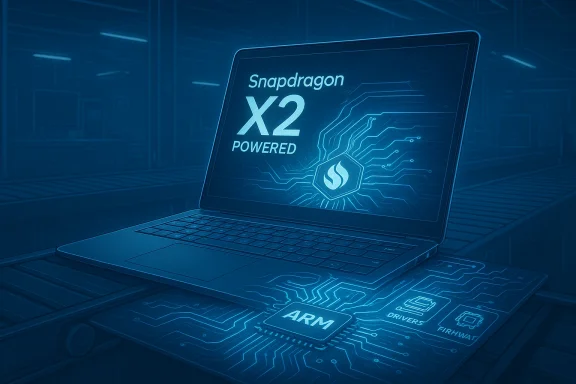
A laptop on a glowing circuit-board platform displays Snapdragon X2 powered with an ARM chip.
Microsoft’s move to ship Windows 11 version 26H1 as a device‑specific, platform‑only release represents a deliberate engineering pivot: Microsoft will factory‑flash this release on a narrow set of next‑generation Arm machines (chiefly Qualcomm’s Snapdragon X2 line) rather than deliver it as a broad feature update for the existing PC installed base. This is not a cosmetic version bump — it’s a new platform baseline (internally codenamed Bromine) meant to enable deep kernel, scheduler, power-management and NPU/runtime changes that modern Arm silicon requires.

Background / Overview​

Microsoft historically ships one major consumer feature update per year (the H2 release). Version numbers that look like “26H1” suggest an H1 release, but Microsoft has been explicit: 26H1 is not a feature update for version 25H2; it only includes platform changes to support specific silicon. That means ordinary Intel and AMD PCs — and even prior Arm systems — will remain on the mainstream servicing path and will not be automatically upgraded to 26H1. The primary goal of 26H1 is to provide an RTM‑quality OS image OEMs can factory‑flash on qualifying hardware.
Why now? The architecture and capabilities of recent Arm SoCs (bigger NPUs, heterogeneous core topologies, new firmware and memory subsystem behaviors) are pushing changes deep into the OS stack. Those low‑level changes are safer and more supportable if isolated to a small, validated hardware set during launch. Microsoft’s Canary builds for 26H1 begin with a jump to the 28xxx build numbering (notably around Build 28000), reflecting the new baseline and confirming that this is platform plumbing rather than a consumer feature wave.

What 26H1 actually is — the technical snapshot​

Bromine: a platform baseline, not a UI release​

  • Bromine is the internal platform codename tied to the 26H1 Canary builds. It packages kernel, HAL and scheduler adjustments plus updated runtime stacks for NPUs and device attestation that newer Arm SoCs expect. Visible UI changes are intentionally minimal; the work is under‑the‑hood.
  • The distribution model is changed: OEMs receive an RTM‑quality image for factory flashing, and Microsoft treats 26H1 as a device‑scoped baseline for support and servicing rather than a general servicing branch. That reduces the risk of regressions for the wider Windows population while enabling day‑one experiences on new silicon.

Key technical focuses in 26H1​

  • Kernel and scheduler tuning for heterogeneous core arrangements and new Oryon‑style CPU behavior.
  • Power‑state and thermal policy adjustments to deliver realistic battery life across novel power envelopes.
  • Bundled DCH driver stacks and signed firmware packages tailored to new SoC I/O, ISP, and connectivity subsystems.
  • NPU runtime and secure model manifests to support on‑device AI pipelines and attestation for privacy/security.
  • Device catalog and servicing metadata engineered so Microsoft and OEMs can target updates, rollbacks and mitigations safely to qualifying hardware without touching the broader servicing baseline.

The hardware side: Snapdragon X2 (and the Nvidia angle)​

Snapdragon X2 — what Qualcomm promises​

Qualcomm positions the Snapdragon X2 family as a major generational step in Windows‑on‑Arm silicon: more CPU cores (Oryon‑branded designs), higher frequencies (advertised 5 GHz variants in flagship SKUs), significantly beefed‑up NPUs for local AI, and faster memory/I/O. OEMs such as ASUS have indicated ZenBook X2 machines will ship with the 26H1 baseline at launch. These new chips are being sold as power‑efficient, AI‑capable alternatives for thin‑and‑light and even gaming‑class Arm laptops.
Claims to watch: vendor marketing highlights performance‑per‑watt and NPU TOPS figures, but early platform validation is the critical piece — the OS must be adapted to handle larger NPUs, model runtimes, and secure attestation hooks without destabilizing broader Windows servicing. Microsoft’s Bromine branch is that adaptation layer.

Nvidia N1 / N1x — a more complex picture​

Multiple outlets have linked Microsoft’s platform work to other Arm silicon ambitions — specifically Nvidia’s N1/N1x Arm CPU efforts. However, Nvidia’s roadmap has been noisy and there are reports of delays and engineering difficulties, with some coverage indicating N1x could slip later in 2026. That ambiguity means Microsoft is preparing for a future where multiple Arm vendors require platform‑level OS adaptations — but 26H1’s immediate practical anchor is Snapdragon X2 devices that are slated to ship first. Treat Nvidia‑related claims as conditional and check vendor timelines before planning a deployment that depends on N1 availability.

Why Microsoft split the platform — engineering rationale​

There are three tightly linked reasons behind the decision:
  1. Deep architectural differences. Modern Arm SoCs change behaviors that used to be confined to firmware or drivers and now require kernel and scheduler awareness — heterogeneous cores, different instruction microarchitectures, and NPU/ISP offload semantics are examples. These changes cannot be safely backported into the servicing baseline for tens of millions of existing devices without elevated regression risk.
  2. OEM and silicon timing mismatch. Silicon and OEM release schedules do not always align with Microsoft’s H2 feature calendar. Providing a factory image allows Microsoft and OEMs to ship on time without sliding the mainstream feature roadmap.
  3. Controlled blast radius. A device‑scoped platform release localizes potential regressions to a narrow hardware set. It simplifies testing and rollback logic across firmware, signed driver stacks and OS servicing metadata. That is pragmatic risk management when on‑device AI and large NPUs are involved.

How 26H1 changes the update and servicing model​

Two important servicing takeaways​

  • 26H1 will not follow the usual annual servicing cadence for general x86 machines. Devices on the Bromine/26H1 baseline will receive targeted updates (specialized, device‑scoped servicing) in the first half of the year where needed, while the mainstream Windows 11 feature stream remains H2‑centric (26H2 in the second half of 2026). This means that Arm devices on 26H1 are on a different servicing timeline than Intel/AMD devices.
  • No automatic upgrade for existing machines. If you own an Intel or AMD PC (or prior Arm machines), Microsoft’s messaging is explicit: there’s no consumer action required and 26H1 will not be pushed as a feature update to those devices. Enterprises should treat 26H1 images like specialized device images to be adopted only when hardware is purchased and validated.

What this means for cumulative updates and security fixes​

Microsoft’s approach isolates platform changes but does not absolve OEMs and Microsoft of security responsibilities. Expect security and quality servicing to be delivered via targeted channels for qualifying devices; enterprises should confirm update behavior, rollback mechanisms and SLA commitments with OEMs at purchase. The device catalog metadata Microsoft uses will be critical for selective update application and coordinated mitigations when necessary.

Consumer impact — what everyday PC buyers should know​

  • If you’re buying a Snapdragon X2 laptop that ships with 26H1, expect the vendor image to be tuned for the hardware with preinstalled drivers and NPU runtimes that enable day‑one on‑device AI experiences. That can mean better battery life and local AI features relative to earlier Arm devices — but these benefits are hardware‑specific and will not translate to older Intel/AMD machines.
  • If you own a current Intel or AMD laptop: you will not receive 26H1 as a general feature update. The mainstream consumer feature update for the year will arrive as 26H2 and continue to be the broad release where user‑facing features ship. No action is required for most consumers.
  • If you’re an enthusiast Insider who wants to experiment: Canary channel builds for 26H1 are available, but remember that Canary builds by design are experimental. Installing Canary images on a production machine — particularly on hardware they aren’t intended for — is not advised.

Enterprise and IT implications​

Deployment and imaging​

Enterprises must not treat 26H1 as a normal servicing ring. It is a hardware image baseline. Before purchasing or deploying X2 devices, IT teams should:
  1. Confirm which SKUs ship with Bromine/26H1 factories.
  2. Request OEM documentation for the factory image, driver support window, and rollback procedures.
  3. Validate management tooling (MDM, SCCM/Endpoint Manager) and kernel‑mode agents on real X2 hardware in a pilot ring before wider rollout.

Security and compliance​

  • Confirm how security patches are delivered to Bromine images and whether targeted patches arrive in lockstep with mainstream servicing windows or via a separate schedule.
  • Ensure that endpoint management solutions can inventory and target device‑scoped updates correctly (the device catalog Microsoft uses becomes more important when servicing is hardware‑specific).

App compatibility and ISV testing​

Developers and ISVs should prioritize Arm64 builds and validate NPU‑accelerated paths on real hardware. App compatibility may be affected by ABI differences, JIT behaviors, or NPU offload semantics — test with real X2 hardware early in development cycles. If your enterprise relies on legacy kernel drivers or third‑party security agents, verify manufacturer support on Bromine images prior to procurement.

Developer and OEM checklist (practical steps)​

  • OEMs:
    • Provide clear SKU labeling at point of sale indicating which units ship with 26H1/Bromine and which ship with 25H2.
    • Publish factory‑image details, driver lists and firmware signing commitments.
    • Offer update/rollback SLAs for enterprise buyers.
  • Developers:
    • Prioritize testing on Arm64 hardware with the X2 NPU runtime.
    • Ensure graceful fallbacks for CPU‑only paths if NPU accelerators or model runtimes are unavailable.
    • Verify performance and power profiles across the heterogeneous core and NPU workloads.
  • IT/Admins:
    • Pilot X2 devices in a closed ring, test patching and rollout behavior, and validate management tooling compatibility.
    • Demand documentation from OEMs about image maintenance and support lifetime.

Strengths of Microsoft’s approach​

  • Pragmatic risk control. By isolating deep platform changes to a hardware‑specific baseline, Microsoft reduces the chance that a change designed for a particular SoC will unintentionally destabilize millions of unrelated devices. That’s engineering first, and it’s defensible where OS internals must evolve for new silicon.
  • Faster, validated day‑one experiences. OEMs can factory‑flash systems with a certified image and ship devices with tested drivers, firmware and NPU runtimes — improving the first user experience and reducing support calls on launch day.
  • Enables on‑device AI. With NPUs growing in size and complexity, a coordinated OS+firmware+driver+runtime baseline is required to deliver privacy‑aware, performant on‑device AI features without constant cloud backends. Bromine/26H1 is built to enable that stack.

Risks and potential downsides​

  • Fragmentation risk. A proliferation of device‑scoped platform baselines could create confusion for consumers and IT teams if messaging is unclear. Enterprises need transparency about which devices receive which images and for how long. Microsoft and OEMs must provide unambiguous SKU labeling and servicing documentation to avoid procurement mistakes.
  • Support complexity for cross‑platform enterprises. Organizations that manage mixed fleets (Intel/AMD/Arm) must maintain separate validation, testing and update strategies for each baseline — that’s an operational cost.
  • Hardware‑specific benefits. Battery improvements, local AI acceleration, and other gains from 26H1 are tied to the underlying architecture. Owners of x86 devices will not see these improvements, which can create perception issues among consumers who expect software updates to produce universal gains. Microsoft’s messaging must be clear here.
  • Vendor timeline uncertainty (Nvidia). Some reporting indicates Nvidia’s N1x timeline may be delayed. Microsoft’s platform work is future‑ready, but adoption by additional silicon vendors depends on those vendors’ ability to deliver silicon on predictable timelines. Plan accordingly and treat any Nvidia‑related 26H1 linkage as contingent.

Buyer’s guide — should you purchase an X2 device at launch?​

  • Buy an X2 device at launch if:
    • You want early access to on‑device AI experiences and are comfortable accepting that they are hardware‑specific.
    • You need best‑effort battery and performance improvements tied to the new SoC and are prepared to validate enterprise tooling in pilot rings.
  • Wait or be cautious if:
    • Your environment depends on legacy kernel drivers, specialized security agents, or tightly controlled update rollouts — confirm OEM support first.
    • You need long, proven driver compatibility across a broad ecosystem — early hardware tends to smooth out edge‑case incompatibilities only after a few firmware and driver revisions.

Recommendations for Microsoft, OEMs and partners​

  • Microsoft should publish clear guidance and a simple SKU label that explicitly states whether a device ships with Bromine/26H1 or with the mainstream 25H2 baseline.
  • OEMs must commit to transparent factory‑image documentation and to support lifecycles and rollback procedures that enterprises can rely on.
  • ISVs and developers should prioritize Arm64 and NPU paths now; test on real X2 hardware to find and resolve platform‑specific regressions early.
  • Enterprises should demand deployment documentation and SLAs from their OEM reps and run a pilot before rolling X2 devices into production.

Final analysis — engineering pragmatism with a messaging challenge​

Windows 11 version 26H1 is a practical recognition that modern PC silicon, especially Arm SoCs with large NPUs, is reshaping the OS surface area. Microsoft’s decision to create Bromine as a device‑specific platform baseline is an engineering‑first move that helps OEMs ship validated day‑one experiences on Snapdragon X2 machines and reduces the risk of wide‑scale regressions across the broader Windows fleet. When executed properly, it enables credible on‑device AI and better battery/performance behavior on the hardware designed to support those capabilities.
The primary risk is messaging and operational complexity: if OEMs, Microsoft and retailers fail to make SKU differences obvious and fail to provide clear servicing commitments, enterprises and consumers may be confused about which devices receive what software and when. For IT teams and developers, Bromine/26H1 is a call to plan — don’t assume general availability parity, test on real hardware, and demand documentation. For consumers, the headline is simple: if your device uses Intel or AMD, 26H1 doesn’t matter for you; if you buy a Snapdragon X2 laptop, expect a tuned, Bromine‑based experience at launch.
Microsoft’s platform‑first approach is defensible in technical terms, but success depends on clear communication, robust OEM commitments, and predictable silicon roadmaps from partners. If those pieces align, 26H1 can be a useful bridge to a broader 26H2 world where mainstream feature parity and cross‑platform improvements return to the annual consumer cadence. If they don’t, the industry risks unnecessary fragmentation at a time when cohesive platform engineering is most needed.

Quick summary (for readers who skim)​

  • What happened: Microsoft has published Canary builds that show Windows 11, version 26H1 (Build ~28000), a platform baseline codenamed Bromine designed to support next‑generation Arm silicon.
  • Who gets it: Initially exclusive to new devices shipping with Qualcomm Snapdragon X2 (factory image). Existing Intel/AMD machines will remain on the mainstream update path.
  • Why it matters: It isolates deep OS changes needed for large NPUs and new power/firmware interfaces to a controlled hardware set, enabling day‑one on‑device AI and tuned power profiles.
  • What to do: If you’re an enterprise, test on real X2 hardware, demand OEM image details and SLAs. Consumers should check SKU labeling at purchase and expect the mainstream feature update to arrive in 26H2 later in the year.
This engineering‑first release signals a new era of synchronized work across Microsoft, silicon vendors and OEMs — promising meaningful hardware‑specific gains, but demanding clearer communication and disciplined rollout practices if it’s to avoid fracturing the Windows ecosystem.

Source: VOI.id Microsoft Will Release Windows 11 Version 26H1, Exclusive to the Latest Snapdragon PC
 

Microsoft's decision to ship Windows 11, version 26H1 as a narrowly scoped, device‑specific platform image — rather than a mass Windows Update for the installed base — is now official: the release exists primarily to enable next‑generation Arm‑based PCs (notably Qualcomm's Snapdragon X2 family) and will be factory‑flashed on qualifying new hardware while most existing Intel and AMD machines remain on Windows 11 25H2 until the later 26H2 rollout.

Laptop running Windows 11 on Qualcomm Snapdragon X2, highlighting AI and secure runtimes.Background / Overview​

The Windows release model has stabilized in recent years around an annual consumer feature update delivered in the second half of the year, with servicing and targeted fixes otherwise distributed through updates. The appearance of a new version label — Windows 11, version 26H1 — initially suggested a typical H1 feature wave. Microsoft and partner communications make clear that 26H1 is different: it is a platform baseline (internally codenamed Bromine in some partner briefings) intended to accommodate deep, low‑level changes required by modern Arm SoCs and their supporting firmware, NPUs, and device attestation flows.
Key points readers should understand from the outset:
  • 26H1 is a platform image, not a general feature update. It contains OS plumbing — kernel, scheduler, driver and runtime work — aimed at enabling specific silicon and OEM manufacturing timelines.
  • Existing Intel/AMD PCs will remain on 25H2. Those systems will continue to receive security and quality updates on their established servicing track and should expect the broader feature set to arrive with 26H2 later in the year.
  • Factory preinstallation is the primary distribution model. OEMs will receive validated 26H1 images to flash at the factory for qualifying Arm64 SKUs; consumers buying an X2‑based machine should verify which image their chosen SKU ships with.
This device‑first approach mirrors earlier scenarios where Microsoft shipped targeted images for particular hardware launches, but it formalizes the model into an explicit versioning decision — with practical consequences for buyers, IT teams, and developers.

What 26H1 actually is — and what it isn’t​

A targeted platform baseline​

At its core, Windows 11 26H1 is engineering work packaged as an RTM‑quality image for a small set of devices. The technical goals are clear:
  • Integrate and validate support for new SoC architectures and heterogeneous CPU topologies used in high‑end Arm laptop chips.
  • Provide tested, signed driver bundles and firmware pairings that OEM factories can flash to avoid day‑one regressions.
  • Expose secure NPU runtimes, attestation hooks, and power/thermal policies required for on‑device AI workloads marketed as Copilot+ experiences.
Microsoft’s public guidance to Insiders emphasized that the Canary channel build that surfaced the version label (a build in the 28xxx range) is platform‑focused, and explicitly noted that 26H1 “is not a feature update for version 25H2.”

Not a consumer feature roll‑out​

Users should not expect 26H1 to deliver a broad list of new UI features across the Windows ecosystem. Visible changes in public previews have been modest — polishing, bug fixes and small refinements that could have been part of 25H2 — while the heavier work targets low‑level platform behavior. The consumer‑facing feature list for the wider installed base remains the preserve of Windows 11 26H2 later in the year.

Why Microsoft chose this path​

There are three pragmatic reasons behind the split:
  • Hardware timelines. Chip vendors and OEMs often ship on cycles that don't line up with Microsoft’s H2 cadence; a platform image lets Microsoft hand OEMs a validated stack in time for factory flashing.
  • Risk containment. Deep kernel and driver changes can cause regressions if back‑ported into the broad servicing stream. Limiting those changes to a known device set reduces the blast radius.
  • Enabling on‑device AI. Secure NPU runtimes and attestation, heterogeneous scheduling, and new power/thermal governors are best validated on the actual hardware they will run on.

The silicon context: Snapdragon X2 and why it matters​

Qualcomm’s new high‑end laptop family — commonly referred to by partners as Snapdragon X2 (Elite / Elite Extreme SKUs) — is the primary silicon tied to early 26H1 devices. Vendor materials and OEM briefings position X2 as a significant step in on‑device AI and throughput, and Microsoft’s Bromine work is explicitly framed to support these chips.
What to know about the silicon claims (with caution):
  • Vendors have promoted large core counts and sizable NPUs in the X2 family. Those figures are vendor announcements and are useful directional indicators, but they should be treated as vendor claims until independently validated.
  • The architectural changes (heterogeneous cores, beefier NPUs, unified memory considerations) are exactly the sort of platform‑level differences that can demand kernel, scheduler and runtime adjustments inside Windows.
The practical upshot is straightforward: when an OEM ships a laptop with a Snapdragon X2 SKU, it may need a tuned Windows image to achieve expected battery behavior, stable drivers for on‑device accelerators, and secure attestation for local AI workloads. That is what 26H1 aims to provide.

Distribution, eligibility, and the factory image model​

Which devices will get 26H1?​

Initial recipients will be new Arm64 Copilot+ laptops using qualifying Snapdragon X2 SKUs. OEM briefings indicate some specific models — for example, Snapdragon X2 SKUs in certain ZenBook lines — will ship preinstalled with Windows 11 26H1. The same product line with Intel or AMD chips will ship with 25H2, illustrating the device‑image split in practice.

Which devices will not?​

  • Existing Intel‑ and AMD‑based Windows 11 PCs will not be offered 26H1 via Windows Update and will remain on the mainstream 25H2 servicing baseline.
  • Many prior Arm devices are also expected to remain on 25H2, unless a hardware vendor explicitly certifies support for 26H1.

Distribution channels and update mechanics​

  • Primary distribution is factory flashing by OEMs; Microsoft is publishing HLK (Hardware Lab Kit) guidance and compliance playlists tailored to the 26H1 baseline for partner certification.
  • Some Insider channel access will exist for testing, but Microsoft discourages treating 26H1 as a broad upgrade path for existing consumer PCs.
  • OEMs may rely on their own device update tooling for firmware and driver distribution on Bromine devices; buyers should confirm how drivers and firmware will be serviced post‑purchase.

Precise technical themes inside 26H1​

While Microsoft has been intentionally high‑level in public messaging, the engineering areas that justify a platform image are concrete:
  • Kernel and scheduler tuning for heterogeneous core topologies. New Arm SoCs often mix multiple core types and frequency/voltage domains; efficient scheduling and correct power management require OS changes.
  • Power and thermal governors tuned to unique SoC envelopes. Sustained performance, battery life and thermal behavior differ materially between new Arm silicon and existing laptop SoCs.
  • NPU runtime integration and secure attestation. On‑device AI capabilities rely on secure model manifests, attestation chains and vendor runtimes to deliver private, low‑latency inference. Those flows cross kernel/firmware boundaries and must be validated end‑to‑end.
  • Bundled DCH driver stacks and signed firmware packages. Factory images let OEMs ship a known‑good pairing of drivers and firmware, reducing early field failures due to mismatched software.
  • Platform pre‑boot and recovery changes. New attestation primitives or firmware behaviors can affect BitLocker, WinRE and pre‑boot interactions; those are safer to validate in a limited rollout.
These items are not cosmetic; they touch the deepest layers of the platform and explain why Microsoft treats 26H1 as a device‑scoped baseline.

Practical guidance for different audiences​

For consumers and buyers​

  • If you own a current Intel or AMD laptop: do nothing. Your PC remains on 25H2 and will receive security and quality updates as normal.
  • If you plan to buy a new Arm‑based Copilot+ laptop (Snapdragon X2): ask the vendor which Windows image ships on the specific SKU. Identical model names can have different images depending on the silicon inside.
  • When buying a device marketed for on‑device AI, require clarity on driver/firmware update channels and whether OEM tooling or Windows Update will deliver ongoing updates.

For IT teams and procurement​

Treat 26H1 devices as a distinct hardware SKU with their own servicing expectations. Recommended checklist:
  • Pilot early: validate MDM, endpoint protection, management agents, VPNs and backup tooling on Bromine images.
  • Require OEM documentation: get written SLAs describing firmware/driver update channels and support windows.
  • Map certification matrices: certify images and drivers against both Bromine (26H1) and your existing 25H2 gold images if you plan to include X2 devices in fleets.
  • Plan for mixed fleets: if you run image‑based deployment, expect a bifurcated testing matrix and update policies for Arm64 vs x86 devices.

For developers and ISVs​

  • Prioritize native Arm64 CI builds for apps that will run on X2 devices and validate emulation paths for x86/x64 under WoA emulation.
  • Test NPU‑accelerated code paths where applicable, but design graceful degradation when hardware acceleration is absent.
  • Watch for runtime and attestation requirements. Apps that assume particular driver or kernel behavior may need vendor‑specific accommodations on Bromine devices.

For OEMs and hardware partners​

  • Use the 26H1 HLK playlists to validate factory images and ensure driver/firmware pairings are signed and testable.
  • Clarify update channels to customers: some device‑specific updates may come from OEM tools rather than Windows Update; document expected cadence and support timelines.
  • Ensure supply chain QA at factory flashing and provide clear fallbacks for rollback or recovery should a shipped image face field issues.

Strengths: why this approach makes sense​

  • Day‑one device compatibility. Factory‑flashed, validated images reduce launch‑week regressions for complex new silicon.
  • Safer platform changes. Restricting deep kernel/driver changes to a known device set limits risk for the much larger installed base.
  • Enables on‑device AI. Secure NPU runtimes and attestation flows are foundational for Copilot+ experiences and other local inference scenarios.
  • Frees feature cadence. Microsoft can continue developing user‑facing features on the main 25H2 → 26H2 track while enabling reasonable OEM launch windows.
These are practical operational benefits for an ecosystem juggling diverse silicon roadmaps.

Risks and trade‑offs you need to know​

  • Short‑term fragmentation. Multiple platform baselines (25H2 mainstream, 26H1 Bromine for X2 devices, then 26H2) increase the complexity footprint for enterprises and ISVs.
  • Update path ambiguity. Early partner notes suggest that some 26H1 devices may not receive a straightforward in‑place upgrade to 26H2; buyers should demand clarity.
  • Driver and compatibility gaps. Third‑party kernel‑mode agents, legacy drivers and some security tooling may behave differently on Bromine images; extra testing is required.
  • Potential for OEM‑centric servicing. If OEMs handle device drivers/firmware outside of Windows Update, organizations must incorporate vendor toolchains into support workflows.
  • User confusion. Identical product names with different images (Intel/AMD vs X2 SKUs) can confuse purchasers and complicate support desks.
Those trade‑offs are real and deserve careful management by purchasers and IT operators.

Upgrade paths and the future: 26H2 and convergence prospects​

Microsoft’s messaging reiterates that Windows feature development continues on the H2 cadence and that 26H2 will be the broader consumer update later in the year. Questions remain about how Bromine (26H1) devices will converge with the mainstream 26H2 branch:
  • Will 26H1 devices receive a direct, tested upgrade to 26H2, or will they follow a separate cadence requiring OEM‑mediated updates?
  • Will Microsoft and OEMs provide an explicit timeline and tooling for migrating Bromine devices into the mainstream feature track?
These are operational details Microsoft and partners must clarify. Until then, organizations should assume that 26H1 devices might follow a different servicing path and require explicit lifecycle planning.

A practical checklist for buyers, IT and developers​

  • Consumers:
  • Confirm which Windows image ships on the exact SKU you intend to buy.
  • Ask the retailer or OEM about driver and firmware update channels.
  • Expect the same consumer features to arrive broadly with 26H2 later in the year.
  • IT / Procurement:
  • Request OEM documentation and SLAs before purchase.
  • Acquire a test fleet of Bromine devices for pilot validation.
  • Validate endpoint protection stacks and management agents on Arm64.
  • Train support staff on the difference between Bromine images and mainstream 25H2 images.
  • Developers / ISVs:
  • Add Arm64 native CI builds where performance or reliability warrants.
  • Test both native and emulated codepaths; validate AVX/NEON behavior for critical workloads.
  • Prepare fallback paths when NPU acceleration or attestation is absent.

Final analysis — balancing pragmatism and complexity​

Microsoft’s 26H1 decision is an engineering‑first, practical move to protect both OEM launch schedules and the stability of the broader Windows population. By treating 26H1 as a platform image rather than a universal feature update, Microsoft reduces the risk of wide regression and gives silicon vendors the validated environment they need to deliver on day one.
That pragmatism comes at a cost. Short‑term fragmentation, update‑path ambiguity, and increased testing burden for enterprises and ISVs are unavoidable side effects. The net result is a period of elevated complexity that will require clear communication from OEMs and Microsoft, disciplined pilot programs from IT organizations, and careful SKU‑level scrutiny from buyers.
For typical consumers the headline is simple: nothing changes unless you're actively buying a new Snapdragon X2 Copilot+ laptop. For buyers and IT teams, the headline is actionable: insist on OEM transparency, pilot thoroughly, and treat 26H1 devices as distinct platform purchases with their own lifecycle rules.
Windows’ long‑term health depends on getting this coordination right. If Microsoft, OEMs and the broader software ecosystem align on clear update paths, documentation and support SLAs, Bromine/26H1 can be a pragmatic bridge to a new generation of on‑device AI. If coordination falters, however, enterprises and consumers alike may face avoidable friction during the transition. The responsibility now sits with vendors and IT teams to manage that transition carefully — and with Microsoft to publish unambiguous guidance about upgrade paths and servicing expectations as the year unfolds.

Conclusion
Windows 11 26H1 represents a pragmatic, targeted response to silicon innovation: a platform image shipped for specific Arm64 devices to ensure correct, performant day‑one behavior for new SoCs. It is not a broad consumer feature update, and most PCs remain on 25H2 until the scheduled 26H2 feature release. The model reduces risk for the mass installed base but creates a short‑term operational burden for purchasers, IT teams and developers. Plan accordingly: verify SKU images before purchase, pilot Bromine devices in controlled environments, demand OEM update guarantees, and prioritize Arm64 testing where it matters. With the right planning and vendor transparency, the transition to next‑gen Arm Windows devices can be managed safely — but it will require more coordination than a standard yearly feature update.

Source: TechPowerUp Windows 11 26H1 Limited to New Arm-based Processors, Other PCs Remain on 25H2
 

Microsoft has shipped a new, narrowly scoped Windows 11 release — Windows 11, version 26H1 — but the company has made it abundantly clear: for almost everyone running Windows today, this is academic until you buy specific new hardware.

Windows 11 26H1 Bromine box on a circuit board with a Snapdragon X2 chip.Background / Overview​

Microsoft announced Windows 11, version 26H1 as a platform-specific release intended to enable next‑generation silicon in early‑2026 devices. The release is built on a new engineering baseline (internal build strings in the 28000-series) and is being distributed exclusively as an OEM factory image for qualifying machines — most notably the first wave of devices using Qualcomm’s Snapdragon X2 family. Microsoft published the 26H1 update history and related release notes on February 10, 2026, and has stated plainly that devices running earlier Windows 11 releases will not be offered 26H1 via Windows Update and cannot receive it as an in‑place upgrade.
This is not a normal H2 feature update. Think of 26H1 as an enablement image: the OS plumbing — kernel/HAL adjustments, scheduler and power‑management tuning, validated DCH driver stacks and NPU/runtime hooks — has been moved forward to support particular Arm SoCs, and Microsoft is keeping that work isolated from the mainstream servicing lane reserved for the broadly distributed 24H2 → 25H2 → 26H2 cadence.

What changed in this release — the essentials​

  • Distribution model: 26H1 is available only preinstalled on select new devices. It will not be pushed to existing Intel or AMD PCs through Windows Update.
  • No in‑place upgrade: You cannot upgrade an existing Windows 11 device to 26H1 as an in‑place update.
  • Separate servicing lane: Devices shipped with 26H1 will receive monthly security and quality updates tied to the 26H1 servicing lane; those devices are not slated to automatically receive the general H2 feature update in the second half of 2026 because 26H1 is based on a different Windows core. Microsoft says a migration path will be provided in a future release, but specifics are not yet published.
  • Hotpatching: 26H1 devices do not participate in hotpatch servicing. That reduces the ability to apply certain zero‑reboot fixes used by some enterprise fleets.
  • Platform ID and build numbers: Insider Canary metadata and the published cumulative updates show builds in the 28000.x series for the Bromine/26H1 baseline; earlier Canary artifacts referencing Build 27965 flagged the change to treat .NET Framework 3.5 differently.
  • Not a feature wave: Visible user‑facing changes are minimal; most of the work is under the hood to support the new silicon and to validate firmware/driver interactions for OEMs.
These design choices are deliberate: Microsoft wants OEMs to ship validated images that match the hardware they test. Shifting platform plumbing into a targeted, OEM‑flashed image reduces the risk of large‑scale regressions on the vast installed base — but it introduces operational complexity for device procurement and lifecycle management.

The .NET 3.5 headline — what actually happened​

Perhaps the most concrete, immediately actionable change in the 26H1 release notes is one that will matter to application owners and ISVs: .NET Framework 3.5 is no longer provided as a Windows Feature on Demand optional component on Windows 11, version 26H1. If your organization still depends on .NET Framework 3.5 (the legacy 2.0/3.0/3.5 lineage), you will now need to obtain and deploy the standalone .NET Framework 3.5 installer for devices running 26H1.
Why this matters:
  • Installation friction: Previously, administrators could add .NET 3.5 via the Windows Features dialog, DISM with Features-on-Demand packages, or through standard enterprise deployment channels that pull the component from Windows Update or a local Features repository. On 26H1, that optional component is gone — the OS will not provide it from Features-on-Demand; the legacy runtime must be delivered as a standalone package.
  • Compatibility timelines: .NET Framework 3.5 SP1 has a published end‑of‑support date of January 9, 2029, which gives organizations a defined (but limited) runway to migrate legacy workloads to supported runtimes. Microsoft’s lifecycle guidance has long called for migration to modern .NET versions; the 26H1 change is an unmistakable signal to accelerate that work.
  • Operational effects on new hardware: For customers evaluating or buying Snapdragon X2 devices that ship with 26H1, installing older apps that expect the feature to be present by default may require additional packaging, imaging steps, or sourcing the standalone installer into the corporate software repository.
This is not merely a cosmetic housekeeping change — it changes the default installation story for legacy .NET apps on a new platform baseline. For organizations that still have line‑of‑business apps tied to .NET 3.5, it is now an operational item to address during procurement and testing.

Why Microsoft did this — the technical and business logic​

On the surface Microsoft cites improved performance and battery life as benefits of the changes in 26H1 for Arm silicon. Those are reasonable goals: migrating scheduler behavior, power governors, and driver interfaces to match a new SoC can materially affect user‑facing metrics. But the deeper motivation is timing and risk management.
Chip vendors ship silicon on their own timelines. When a new SoC introduces low‑level differences that the current Windows platform cannot safely accommodate, Microsoft faces three choices:
  • Delay OS changes and force OEMs to wait for the next broad feature update.
  • Merge platform‑level changes into the mainstream servicing baseline and accept a higher risk of broad regressions.
  • Create a targeted, OEM‑flashed platform image that enables the new hardware while preserving the mainstream servicing channel for the installed base.
Microsoft chose option 3. It isolates the work into a Bromine/26H1 image so OEMs can ship devices on their schedule without destabilizing updates for hundreds of millions of existing PCs. That is pragmatic, but it does open a new coordination surface — manufacturers, silicon vendors, Microsoft, and enterprise customers must now negotiate how updates, firmware, and hotfixes are delivered and supported across diverging platform baselines.

What this means for IT — practical guidance and risk mitigation​

If you manage devices or plan procurement, treat 26H1 as a special SKU and operate by checklist. Below are concrete steps and priorities.

Immediate triage (what to do this week)​

  • Inventory: Identify any applications that require .NET Framework 3.5 or older .NET runtimes. Classify them by business criticality, vendor dependency, and test coverage.
  • Procurement hold/no‑hold decision: If you are not explicitly buying Snapdragon X2 devices, continue with your existing 24H2/25H2 procurement plans. Microsoft’s guidance for IT administrators is explicit: Windows 11 versions 24H2 and 25H2 remain the recommended releases for enterprise deployment. There is no general operational benefit to delaying purchases for 26H1 unless you are specifically targeting that hardware.
  • Lab testing: If you plan to evaluate 26H1 devices, procure a small sample and validate your management agents, EDR/AV, MDM agents (Intune), and critical LOB apps before mass procurement. Treat these devices as a different platform image, not as identical Intel/AMD SKUs.

Pre‑procurement checklist (questions to get in writing from OEMs)​

  • Which Windows image is factory‑installed on the SKU? (26H1 Bromine baseline or standard 25H2/24H2 image?)
  • How will the OEM deliver driver and firmware updates post‑sale? Will they deliver monthly driver packages or rely on Microsoft Update Catalog?
  • What is the OEM’s rollback plan if a Bromine update bricks or destabilizes a corporate device?
  • Will the device receive the same security servicing cadence and telemetry support as Intel/AMD SKUs?
  • Are there any limitations on features (for example, hotpatching) that will affect operations?
Demand written answers before signing purchase orders for large fleets. These details matter for warranty claims, support SLAs, and long‑term maintenance costs.

Application migration and compatibility (for .NET 3.5 apps)​

  • Plan migration: Begin migration of .NET 3.5 applications to supported runtimes (for example, move to .NET Framework 4.8.x or newer supported alternatives, or port to .NET 7/8/10 where feasible). Use the official migration guides and compatibility analyzers.
  • Short term: If migration is not immediately possible, package the .NET Framework 3.5 standalone installer into your imaging/patching infrastructure and include it in the device provisioning flow for any 26H1 devices. Test installers and update sequences thoroughly.
  • Workarounds: Consider virtualization, application containers, or remote app hosting for legacy applications that cannot run on the device natively. These patterns preserve security posture while you work on migration.

Servicing and patching considerations​

  • Hotpatch absence: Since 26H1 devices currently do not support hotpatch updates, expect a higher number of reboots for some urgent updates. Put this into your change management calendar if you plan on deploying Bromine devices at scale.
  • Update channels: Confirm with OEMs and Microsoft which update catalog packages and KBs apply to 26H1 images. Some KB packages are specific to the 28000.x servicing lane and will fail on other devices.
  • Lifecycle planning: 26H1 uses standard Windows servicing timelines (Microsoft documented that 26H1 was released on February 10, 2026). For planning purposes, review the exact servicing durations for Pro and Enterprise SKUs (e.g., standard Pro servicing vs. extended Enterprise servicing windows) and map them to your refresh cadence.

Risks and trade‑offs — a balanced assessment​

No change is without trade‑offs. The 26H1 approach reduces one risk and raises others.

Notable strengths​

  • Faster time‑to‑market for new silicon: OEMs and silicon partners can ship devices when they need to ship, with an OS baseline validated for that hardware.
  • Reduced regression blast radius: By isolating low‑level changes to a specific image, Microsoft avoids destabilizing the mainstream servicing baseline used by the majority of Windows devices.
  • Clear signal for modernization: Removing .NET Framework 3.5 from Features on Demand on the new baseline provides a firm, actionable nudge to vendors and IT teams to modernize legacy apps.

Potential risks​

  • Servicing fragmentation: Multiple platform baselines in the wild complicate patch management, driver distribution, and emergency mitigation strategies. IT teams must track and reconcile different KBs and SSU/LCU pairings for each baseline.
  • Procurement complexity: IT buyers must now add OS‑image questions to RFPs and insist on OEM servicing commitments. Failing to do so invites surprises post‑sale.
  • Compatibility friction: Legacy apps that implicitly rely on Windows Features being present by default may break on 26H1 without additional deployment steps. That increases initial support burden for frontline technicians.
  • Hotpatch regression: The absence of hotpatch support removes one avenue for low‑impact emergency patches; organizations that rely on hotpatch to reduce downtime will need alternate mitigation strategies.
  • Consumer confusion: Consumers and smaller businesses may misinterpret 26H1 as the “new Windows” and delay purchases or attempt to upgrade incorrectly. Clear communication from vendors and partners is required.

Migration playbook for .NET 3.5 applications (step‑by‑step)​

  • Inventory phase: Run an application discovery pass across your estate to enumerate binaries that depend on .NET 2.0/3.0/3.5. Prioritize by usage and criticality.
  • Compatibility testing: For each app, attempt to run on the highest compatible .NET Framework version (for example, 4.8.x) in an isolated lab. Use static analyzers and the .NET Portability Analyzer where applicable.
  • Short‑term containment: If migration is not immediately possible, bundle the official standalone .NET Framework 3.5 installer into your provisioning flows and test full imaging scenarios on 26H1 hardware. Ensure installers are sourced from the vendor and validated with your security processes.
  • Long‑term modernization: Where possible, convert server‑side or client apps to supported, cross‑platform .NET versions (e.g., .NET 7/8/10) or move legacy functionality into containerized or server‑hosted services.
  • Vendor engagement: Contact ISVs to request updated builds and clarify their support timelines in light of .NET 3.5’s end‑of‑support date of January 9, 2029. Lock in SLAs for patched builds and compatibility notes for new devices.
  • Decommission plan: Create a schedule to retire the use of legacy runtimes from endpoints, factoring in testing time, vendor timelines, and any regulatory or compliance constraints.

FAQ — quick answers to the likely questions​

  • Will my existing Windows 11 PC be forcibly upgraded to 26H1?
    No. Microsoft has explicitly said existing devices will not be offered 26H1 via Windows Update; the version will be available only on qualifying new devices. Continue to follow the mainstream H2 feature cadence if you already manage 24H2/25H2.
  • Does 26H1 change the Windows lifecycle?
    No — 26H1 devices follow Windows servicing timelines, but they sit on a different servicing lane. Microsoft published the 26H1 release on February 10, 2026, and applied standard servicing durations for the editions involved.
  • What about hotpatches and rebootless fixes?
    26H1 devices currently do not support hotpatch updates; plan for standard security update behavior that may require restarts.
  • Is .NET Framework 3.5 unsupported immediately?
    No. .NET Framework 3.5 SP1 remains supported through its published end‑of‑support date, January 9, 2029, but Microsoft removed it as a Features‑on‑Demand component on the 26H1 image. That creates additional installation work on affected devices.

A balanced verdict: engineering pragmatism, new operational responsibilities​

Windows 11, version 26H1 is Microsoft's pragmatic solution to a real engineering challenge: enabling new silicon while protecting the stability of a massive installed base. The approach is defensible from an engineering and OEM coordination perspective. But it is operationally noisier.
For most organizations the correct choice is to continue running and deploying Windows 11 versions 24H2 or 25H2 for broad enterprise fleets. Only adopt 26H1‑shipped devices selectively and after thorough validation. Treat 26H1 devices as a distinct SKU, not as direct substitutes for existing Intel/AMD images.
The concrete removal of .NET Framework 3.5 from Features on Demand on the 26H1 baseline amplifies the message: the future is modern .NET, and organizations should accelerate work to retire legacy runtimes. If you cannot migrate immediately, plan for operational mitigations: package the standalone .NET 3.5 installer in your images, test vigorously on 26H1 hardware, and require explicit OEM servicing commitments before signing large purchase orders.

Final recommendations — what to do now​

  • If you manage enterprise fleets: Continue with 24H2/25H2 for rollouts; do not postpone purchases because of 26H1 unless you intentionally need the new hardware and are prepared to treat it as a special image.
  • If you are evaluating Snapdragon X2 devices: Buy a small validation lot first. Validate drivers, firmware updates, management agents, and any legacy LOB applications front to back. Get written OEM commitments on post‑sale driver and firmware support.
  • If you have .NET 3.5 dependencies: Start or accelerate migration projects; in parallel, prepare the standalone .NET Framework 3.5 installer in your provisioning pipeline and test on 26H1 machines.
  • If you rely on hotpatching to minimize reboots: Assume 26H1 hardware will not support hotpatch; plan maintenance windows accordingly.
  • Update procurement templates and RFPs: Add OS‑image and servicing questions, and insist on clear documentation covering update mechanics, rollback procedures, and support SLAs.
Microsoft’s 26H1 move is a signal: hardware innovation will continue to push Windows into new engineering territories, and IT organizations will need to keep negotiating the balance between early hardware adoption and predictable, manageable operations. The change to .NET Framework 3.5 distribution is a reminder that every new platform baseline is an opportunity to accelerate modernization — and also a reason to double down on testing, procurement discipline, and software lifecycle planning.

Source: theregister.com Microsoft rolls out Windows 11 26H1, but you can't have it
 

Microsoft's terse Message Center notice on February 10, 2026 — saying only that Windows 11 26H1 would be available for “select new devices only and is not offered as an in‑place update” — did exactly what short, context-free bureaucratic bullet points always do: it created more anxiety than clarity for IT teams and power users already navigating a compressed Windows lifecycle. The follow‑up documentation and reporting make the technical truth clear: 26H1 is a device‑targeted, platform‑level release built to enable next‑generation Arm silicon (the first devices will ship with Qualcomm’s Snapdragon X2 Series), not a conventional H1 consumer feature update for the installed Intel/AMD base. That clarification, however, came after a predictable wave of questions about upgrade paths, support windows, and whether Microsoft had quietly initiated another compatibility purge — anxieties that were entirely avoidable with better initial communication.

Windows 11 26H1 platform enablement with Snapdragon X2 guiding kernel and migration lanes.Background / Overview​

Microsoft quietly surfaced Windows 11, version 26H1 in the Windows Insider Canary Channel as Build 28000, and followed up with an official support/update‑history page that spelled out the essential mechanics: 26H1 “enables the next generation of silicon,” will be available only on select new devices beginning in early 2026, and is not offered as an in‑place update for existing devices running Windows 11 24H2 or 25H2. Microsoft also confirmed that the first devices launching with 26H1 will use Qualcomm Snapdragon® X2 Series processors.
That last line — that 26H1 is not an in‑place update — is the kernel of the confusion. Many administrators reacted as if Microsoft had announced a broad deprecation or new hardware gate that would strand current devices. The reality is more nuanced: Microsoft produced a parallel platform baseline, sometimes discussed in partner briefings under the internal codename (reported across industry coverage), to accommodate deep, low‑level changes required by new Arm‑centric SoCs. In practice, 26H1 is an OEM factory image intended to be preinstalled on qualifying hardware; it is not intended for distribution to the existing installed base via Windows Update.

What 26H1 is — and what it is not​

  • It is a platform enablement release: low‑level kernel, scheduler, driver and NPU/runtime plumbing to support new silicon architectures.
  • It is not a broad consumer feature wave for the installed Intel/AMD population; mainstream feature development will continue on the regular H2 cadence (26H2 expected later in 2026).

How Microsoft communicated — the problem​

Microsoft’s initial Message Center wording was factually correct but minimalistic. A single administrative bulletin stating that 26H1 “is not offered as an in‑place update” without immediate context or follow‑up left many readers to imagine worst‑case scenarios: immediate obsolescence, mass breakage, or shortened servicing windows for devices already deployed in the field. The result was the predictable social‑media cascade: posts, threads, and support tickets asking the same three questions — who is affected, when, and what must admins do — none of which were directly answered in the first bulletin.
This is a classic communications error: accurate facts presented without context or practical guidance. When you are talking to a global audience that includes enterprise sysadmins, OEM partners, and ordinary consumers, tone and framing matter as much as the technical details. A short, context‑devoid notice overwrites nuance with anxiety — and that is what happened here.

Why Microsoft did this: technical rationale​

To judge Microsoft fairly, you have to look under the hood. Modern Arm SoCs for PC‑class devices are architecturally different from the x86 world in ways that touch the operating system’s deepest layers. Qualcomm’s Snapdragon X2 family introduces updated CPU cores, expanded NPUs (neural processing units) with much larger TOPS figures, new GPU/ISP driver stacks, and fresh firmware and attestation flows for on‑device AI. Those changes require kernel and scheduler tuning, validated DCH driver bundles, power/thermal governors tuned to new envelopes, and secure NPU runtimes and attestation hooks — items that are not safely back‑portable into the servicing branch used by hundreds of millions of existing devices.
A factory image approach gives OEMs an RTM‑quality image they can test and validate with vendor firmware, and it reduces the blast radius of day‑one compatibility issues. Put simply: there are times engineering pragmatism demands that a new platform be instantiated as a discrete image rather than shoehorned into the mainstream servicing stream. That is what 26H1 represents: platform engineering without the risk of breaking the main servicing lane.

What Microsoft explicitly confirmed (and why it matters)​

Microsoft’s support page and release health notes make several concrete commitments that deserve to be pulled out and understood:
  • Availability: 26H1 will be available only on new devices with select new silicon beginning early 2026.
  • Distribution model: it will be preinstalled by OEMs on qualifying devices rather than pushed via Windows Update to the installed base.
  • Servicing: devices shipped with 26H1 will receive monthly security, quality, and feature‑level updates on their own servicing lane. They will not be automatically updated to 26H2 in the second half of 2026 because 26H1 is based on a different Windows core; Microsoft promises a path to update in a future release but has not enumerated the migration mechanics.
Those are the load‑bearing facts. The detail that devices running 26H1 won’t receive the normal 26H2 servicing upgrade later in the year is what will shape OEM SLAs, enterprise procurement decisions, and migration planning. It’s also the nuance Microsoft should have placed front and center when the Message Center alert went out.

The practical impact on audiences​

For consumers and home buyers​

If you own an Intel or AMD PC today, 26H1 has no immediate operational impact: your device will remain on the mainstream 24H2 → 25H2 → 26H2 cadence and will continue to receive security and quality updates in the regular servicing model. If you are buying a new Snapdragon X2 laptop, expect it to ship with 26H1 factory‑flashed and tuned for the device’s silicon. That experience may deliver improved battery life and AI features tuned to the SoC, but it also means the device follows a distinct servicing lane.

For IT administrators and enterprises​

The conversation becomes material for IT pros. Procurement must now consider:
  • Will new Arm‑based hardware be treated as a separate class in your estate?
  • Do you need to certify applications and management tooling (SCCM/MEM/Intune, bitlocker attestation, drivers) against the Bromine/26H1 baseline?
  • What SLAs will OEMs provide for migration to the mainstream H2 release, and how will that affect device lifecycle planning?
Enterprises should not assume 26H1 devices will be interchangeable with their existing images and update pipelines. Testing on real hardware, securing OEM image and driver documentation, and locking down migration plans will be essential. Microsoft’s statement that a future update path will be provided is helpful but not sufficient: enterprises need deterministic timelines and migration tooling.

For OEMs and developers​

OEMs gain the benefit of a validated factory image to ensure day‑one compatibility. Developers, meanwhile, must balance the need to support a new Arm lineage (including potential binary compatibility or emulation layers) against the reality that the installed base remains heavily x86‑centric for now. Developers of security‑sensitive code (e.g., drivers, anti‑cheat, kernel extensions) have to move quickly to validate their stacks on Bromine/26H1 hardware. Qualcomm and partners are rolling out emulation and anti‑cheat improvements specifically for Snapdragon X‑class platforms — improvements that reduce friction for gaming and other workloads on Arm.

Risk assessment: strengths and potential hazards​

Strengths (what this approach gets right)​

  • Engineering safety: isolating deep platform changes to OEM images reduces regression risk on the mainstream servicing lane.
  • Day‑one compatibility: OEMs can ship devices that work with validated drivers and firmware, minimizing returns and negative reviews.
  • Enables innovation: a platform image lets Microsoft, SoC vendors, and OEMs push forward new NPU‑centric features without waiting for multi‑year servicing changes.

Risks and downsides​

  • Perception of sudden obsolescence: brief, terse messaging can easily be misread as a broad deprecation event, causing unnecessary alarm among admins and buyers. The Message Center wording triggered exactly that reaction.
  • Fragmentation: having distinct servicing lanes (Bromine/26H1 vs. Germanium/25H2/26H2) increases the operational surface area for sysadmins, vendors, and developers.
  • Unclear migration mechanics: Microsoft’s promise of “a path to update in a future Windows release” is too vague; enterprises need specific migration tools and timelines to plan lifecycles.
  • Support overhead: help desks may face an uptick in tickets from purchasers who misread the initial bulletin and think their existing machines are suddenly off‑support.
  • Third‑party compatibility: AVX2‑dependent workloads, drivers with kernel hooks, and anti‑cheat systems can behave unpredictably on new Arm platforms; while Qualcomm and partners are adding AVX2 emulation and anti‑cheat support, compatibility is still a work in progress.

What administrators should do today — a checklist​

  • Inventory: Identify any pending purchases that may include Snapdragon X2 or other next‑gen Arm silicon. Ask OEMs to confirm which Windows version ships with each SKU (26H1 vs 25H2).
  • Test: Acquire evaluation hardware and run your standard application, driver, and management tooling tests against the Bromine/26H1 image. Do not rely on emulation or vendor claims alone.
  • Clarify SLAs: Request from OEMs a clear migration and servicing SLA for 26H1 devices, including timing and tooling for moving devices to the mainstream servicing lane if needed.
  • Update procurement docs: Include explicit language about OS lineage and update pathways in upcoming procurement/evaluation documents.
  • Communication plan: Update internal stakeholder messaging to explain that 26H1 is hardware‑specific and does not affect existing Intel/AMD devices. Provide a short FAQ to mitigate support churn.

Messaging failures and how Microsoft should fix them​

Good engineering decisions require equally good communication. Microsoft’s engineering justification for 26H1 is defensible; the communications execution is not.
Tactical recommendations Microsoft should adopt immediately when producing hardware‑specific platform images:
  • Lead with the audience and impact: start notices with who is affected and what action (if any) is required, then explain the technical rationale.
  • Provide deterministic migration timelines: "We will provide a migration tool in Q4 2026 and expect OEM images to migrate by Q1 2027" is better than "a future path will be provided."
  • Supply OEM‑specific guidance: publish a table mapping OEM SKUs to OS images, support timelines, and migration tooling.
  • Expand Message Center copy with micro‑FAQs and a single‑page admin playbook for procurement and support teams.
Those steps would have prevented the rush of alarm after a short Message Center alert and would make 26H1’s rollout far smoother for partners and IT professionals.

Comparison to past friction points — why readers worried​

Microsoft’s messaging misstep hit a nerve because the user base remembers the TPM 2.0 requirement and the earlier 24H2 ARM‑related teething troubles. Forced hardware gates have become a sensitive subject. This time, the gate is narrower — and the technical reasoning (deep platform plumbing for new NPU/SoC features) is sound — but the optics are bad when an administrative notice reads like a blunt instrument rather than a carefully framed technical advisory. Clear communication would have avoided the social‑media panic and the wave of procurement freeze requests that often follow such surprises.

Developer and ISV implications​

Independent software vendors (ISVs) and developer teams must consider the following:
  • Prioritize testing on real 26H1 hardware for any code paths that touch native performance, machine‑learning offload, or hardware‑accelerated media components.
  • Monitor Qualcomm and Microsoft guidance for AVX2 emulation maturity and anti‑cheat or kernel‑mode compatibility notes; several vendors already report targeted fixes and new emulation layers to bridge gaps.
  • Consider containerization or architecture‑agnostic reupporting both x86 and Arm devices is a requirement for your customers.

The OEM angle: why they wanted this​

From an OEM perspective, 26H1 is welcome. Shipping a validated factory image dramatically reduces day‑one compatibility issues and makes the marketing promise of “AI‑accelerated battery life and performance” more deliverable. OEMs who ship Bromine/26H1 images can provide richer documentation and controlled driver stacks at the time of sale — essential for hardware that deviates meaningfully from prior generations. That pragmatic benefit, however, depends on transparent migration and servicing commitments that Microsoft must publish.

Final analysis — balancing engineering prudence with communication discipline​

Windows 11 26H1 is an engineeringly sensible answer to a real problem: enabling powerful new Arm silicon that demands platform changes you cannot safely graft onto the servicing lane of billions of existing devices. Microsoft and its partners need the Bromine/26H1 vehicle to bring the hardware to market without risking a mass regression across the installed base. Technically, that was the right call.
But the rollout demonstrates a perennial truth: good technical choices are not enough. When the stakeholders that matter most — IT administrators, OEMs, enterprise procurement teams, and consumers — are not given clear, deterministic information at the outset, confusion fills the gap. Microsoft’s Message Center notice was accurate but incomplete; that combination is worse than inaccurate messaging because it invites worst‑case interpretations.
For future hardware‑gated platform releases, Microsoft must pair engineering announcements with immediate, practical guidance: explicit affected SKUs, migration timelines, OEM SLAs, and a clear admin playbook. In the absence of that, even well‑justified technical moves will be treated like another stealth obsolescence — and rightly so by anxious enterprise planners.
If you manage devices or plan purchases this quarter, treat 26H1 as what it is: a hardware‑specific OS lineage for a narrow set of next‑gen Arm platforms. Test early, get OEM commitments in writing, and demand a migration path with dates. The technology looks promising; the communications need to catch up.
Conclusion: Microsoft got the engineering call right, but bungled the first impression. That is a fixable problem — one that requires more words, fewer surprise bullet points, and the kind of practical guidance that IT teams can act on the day they read the Message Center.

Source: PC Perspective Microsoft's Abysmal Communication About The Windows 11 26H1 Release - PC Perspective
 

Microsoft has quietly split the Windows release pipeline into two separate development and servicing lanes — one optimized for the newest Arm silicon and another for the established x86 ecosystem — a move with technical logic but major practical implications for device makers, IT teams, and consumers shopping for a PC in 2026.

Split-screen laptop showing Snapdragon ARM-to-x86 emulation (26H1).Background​

In February 2026 Microsoft published a support entry for Windows 11, version 26H1 that makes two things plain: 26H1 is not a standard annual H2 feature update and it will be available only preinstalled on select new devices; and devices shipped with 26H1 will not be eligible to receive the usual H2 feature update later in 2026 because 26H1 is built on a different Windows core. The company explicitly states the first wave of qualifying devices will ship with Qualcomm’s Snapdragon X2 series processors, making 26H1 the factory-flashed platform image for the first wave of next‑generation Windows-on-Arm laptops.
Put simply: for 2026 Microsoft is running two parallel Windows tracks. One is the familiar H2 feature‑update rhythm (24H2, 25H2, upcoming 26H2) used for the broad Intel/AMD installed base. The other is a device‑first platform lane (26H1, internally tied to a new platform baseline) intended to enable deep platform changes required by new Arm silicon.
This is unusual. Historically Microsoft shipped one Windows platform baseline to the majority of devices and rolled feature work down a single servicing path. The new approach is, in engineering terms, a fork: two distinct cores and servicing lanes coexisting while Microsoft, OEMs, and silicon partners work out integration and migration.

What Microsoft actually announced (the facts)​

A factory-image platform for new silicon​

  • 26H1 will be available only on select new devices that come to market in early 2026 and is not offered as an in‑place upgrade from Windows 11 versions 24H2 or 25H2 on existing devices.
  • The release is explicitly described as enabling “next generation silicon” and the first devices are noted to launch with Qualcomm Snapdragon X2 Series processors.
  • Devices running 26H1 will continue to receive monthly security and quality updates, but will not be able to update to the next annual feature update in the second half of 2026 via the normal in‑place channel because 26H1 is based on a different Windows core.
  • Microsoft promises the 26H1‑shipped devices will have “a path to update in a future Windows release” but does not commit to a timeline or mechanism in the initial guidance.

Technical markers that make the split visible​

  • The 26H1 line is associated with a new build series (high 27xxx–28xxx family in Insider/Canary builds) that Microsoft and partner tooling tie to the platform baseline used for these devices.
  • Microsoft’s servicing metadata in February 2026 included cumulative updates targeted specifically at the 26H1 servicing lane, indicating it is a distinct servicing track rather than a temporary preview image.
Those are the public, verifiable points: 26H1 exists, it’s device‑gated, it targets new Arm silicon, it uses a different Windows core, and it will not receive the normal H2 2026 in‑place upgrade.

Why Microsoft did this: engineering reality, not theater​

Microsoft’s rationale — whether implicit or explicit — is rooted in a familiar problem: platform-level changes that reach down into kernel behavior, driver models, firmware integration, or NPU runtimes can create severe compatibility risk when merged into the baseline used by hundreds of millions of diverse PCs.
  • Next‑generation Arm SoCs (represented by Qualcomm’s Snapdragon X2 family) bring radically different architectures: heterogeneous core topologies, new power and thermal management domains, substantial on‑device NPU resources, and updated firmware/attestation models. Those changes frequently require kernel/HAL changes, driver bundles tuned to specific firmware, and revised power governors.
  • OEMs and silicon partners need a tightly curated, factory-flashed image to certify drivers, calibrate firmware, and tune power management to meet battery and performance promises. A bespoke image shipped from the factory reduces the blast radius for early hardware launches.
  • By separating the platform baseline for new silicon, Microsoft reduces the chance that a platform regression affecting the new processors will also break the massive existing installed base on Intel and AMD.
This is sound engineering from a risk-management point of view: isolate platform plumbing where it’s needed, validate it on defined hardware, and avoid destabilizing the broad servicing lane.

What “fork” means in practice: the technical and product consequences​

Two separate Windows cores​

The footnote that 26H1 is “based on a different Windows core” is the single most consequential sentence in Microsoft’s note. When an OS vendor speaks of a different core, it means more than cosmetic UI changes — it means differences in kernel-level assumptions, driver models, and platform interfaces.
This has concrete consequences:
  • Different servicing lanes: Each core follows its own monthly security/quality servicing, and feature work may diverge until convergence is engineered.
  • Patch targeting and packaging: Cumulative updates must be built and validated per servicing lane; some fixes for one lane may not apply cleanly to the other.
  • Driver catalogs: Device drivers and firmware that depend on core behavior need to be certified and packaged specifically for each lane.
  • Compatibility testing: Software that performs low-level operations, endpoint security agents, virtualization or hypervisor solutions, and specialized peripherals may behave differently across lanes and require distinct validation.

The OEM factory-image model​

By shipping 26H1 as a factory-flashed image, Microsoft and OEMs commit to delivering a validated stack to end users out of the box. That reduces day‑one mismatch between OS expectations and firmware/driver realities. However, it also means:
  • Consumers buying a device preloaded with 26H1 are effectively buying into a different servicing and upgrade narrative than customers who buy the same model with Intel/AMD and the mainstream Windows image.
  • Enterprises that purchase small fleets of early Arm devices must plan for a divergent lifecycle and create separate validation/patching processes.

The migration question — unanswered for now​

Microsoft’s wording says devices running 26H1 “will have a path to update in a future Windows release,” but it does not define when or how that path will appear. That leaves the update story incomplete:
  • Will Microsoft backport H2 feature parity to the Arm-based core? Will it merge cores later? Will a special converged upgrade be offered?
  • The lack of a concrete upgrade timeline means OEMs, IT administrators, and consumers cannot yet assume these devices will follow the same multi‑year roadmap as the wider installed base.

How this affects buyers and IT teams​

Consumers (and prosumers)​

  • If you want the latest Arm laptop (Snapdragon X2-based Copilot+ devices), you’ll get a machine with 26H1 preinstalled that’s tuned for that silicon. That can mean better battery life, improved NPU-enabled features, and potentially different on‑device AI experiences.
  • But those devices will follow a different upgrade path for at least the remainder of 2026, and you shouldn’t expect the standard H2 feature update to install in place.
  • For most buyers, the practical trade-off is: buy into early hardware-level innovation now (and assume an eventual migration path will be provided), or wait for the broader rollout of the mainstream H2 release that will reach the majority of PCs.

IT administrators and enterprise procurement​

  • Treat 26H1 devices as a distinct platform. Do not assume standard driver, management agent, or security tooling will behave identically.
  • Pilot early and require OEM/Microsoft commitments. If your organization accepts purchase of early Arm devices, insist on:
  • Clear upgrade and servicing SLAs from the OEM.
  • A device loan or test fleet to validate critical agent compatibility (VPN, EDR, MDM, corporate imaging).
  • Written commitments on long-term support, especially if you plan broad deployment.
  • Maintain separate update rings and testing matrices for Bromine/26H1-class devices (as distinct from Germanium/24H2–25H2/26H2 devices).

The immediate strengths of the approach​

  • Risk containment: Isolating platform-level work reduces the chance of system-wide regressions wiping out broad swathes of the Windows ecosystem.
  • Optimized user experience on qualifying hardware: Factory images let OEMs tune drivers, power, and firmware to hit battery life and performance claims without relying on post‑sale driver matching.
  • Faster enablement for new silicon capabilities: By creating a targeted platform, Microsoft can ship kernel‑level changes and NPU runtimes required by modern Arm processors faster and with greater fidelity.
  • Clearer path for silicon partners: Qualcomm and other partners get a stable baseline to certify hardware and differentiate devices.

The risks and downsides​

  • Fragmentation perception: Messaging that Microsoft “split Windows” feeds fears of fragmentation. Even if the fork is temporary or converges later, customers perceive complexity when two versions coexist.
  • Purchasing confusion: Consumers comparing laptop SKUs may face an extra decision about which core/servicing lane they want, complicating buying decisions for less technical shoppers.
  • Longer-term compatibility uncertainty: Without a specified upgrade path or timetable, businesses may hesitate to buy 26H1 devices for production if they cannot guarantee a clean migration later.
  • Support and tooling fragmentation: Security tooling, EDR solutions, container runtimes, virtualization layers, and other low-level system software may need separate builds or certifications across lanes.
  • Potential for staggered feature availability: If feature development stays primarily on the H2 baseline, early Arm devices might not see certain features until convergence, or they may see different features at different times — a confusing user experience.

Is this Windows 12 in disguise?​

When Microsoft spins up a new internal platform baseline, speculation naturally follows: is this an early Windows 12, or simply an engineering detour? The cautious answer is: neither is confirmed.
  • 26H1 is explicitly described as a platform-first release that includes the same user-facing features delivered in the Windows 11 2025 Update (25H2) but with deeper platform plumbing to support specific silicon.
  • The differentiation appears motivated by hardware enablement rather than a full product generational shift. However, a new core baseline does provide Microsoft and partners the technical runway to test architectural changes that could later form part of a bigger product release.
  • Whether 26H1 is best understood as a “commercialized, hardware-gated preview” or the start of a broader generational change depends entirely on how Microsoft handles convergence: if 26H1’s plumbing is gradually merged and everyone gets unified parity in an H2 release, this will read as prudent engineering. If convergence is delayed or incomplete, the ecosystem will experience friction reminiscent of platform fragmentation.

How OEMs and Qualcomm factor into this picture​

Qualcomm’s Snapdragon X2 family is the obvious anchor for this strategy. The X2 chips bring more performant NPUs, updated CPU microarchitectures, and new power management characteristics that require OS-level tuning.
  • OEMs shipping early X2 devices will likely flash factory images with 26H1 and ship validated driver and firmware stacks that match the OS baseline.
  • OEMs will need to make clear at point-of-sale which Windows image is shipped with a given SKU; the same model name could ship with different chips and different Windows images depending on the configuration (x86 variant with 25H2 vs Arm variant with 26H1), increasing the chance of buyer confusion.
  • Qualcomm and OEM messaging will be critical to present a coherent story about features, battery life, and update planning for customers who want to buy these new Arm devices.

Practical recommendations for buyers and admins​

  • If you are a consumer buying one laptop:
  • Decide whether you want early Arm silicon and its on-device AI features now, or prefer the mainstream stability and unified servicing of the H2 release later in 2026.
  • Check the device’s factory image before purchase. Confirm whether it ships with 26H1 and what the vendor’s upgrade and support promises are.
  • If you manage enterprise purchases:
  • Treat 26H1 devices as a separate platform with its own pilot and validation requirements.
  • Obtain concrete upgrade/servicing commitments from OEMs and Microsoft as part of procurement.
  • Keep a conservative deployment strategy: pilot first, require device-level testing of endpoint agents, and track Microsoft communications for the promised migration path.
  • For developers and ISVs:
  • Test critical code paths on both lanes if you expect clients to run on Arm 26H1 devices and on mainstream x86 devices.
  • Watch for updated SDKs, driver behavior, and NPU runtime APIs on Arm builds that may affect on-device AI workloads.

How Microsoft should manage the messaging and migration​

To avoid long-term fragmentation and confusion, Microsoft must do three things well:
  • Transparent migration plans: Provide a clear, dated migration roadmap for 26H1 devices to converge with the mainline feature cadence or define the conditions under which parity will occur.
  • OEM labeling and SKU clarity: Require OEMs to clearly label factory images at point-of-sale and in marketing material so consumers and IT buyers know which servicing lane they’re acquiring.
  • Tooling and partner support: Publish guidance, test images, and compatibility matrices for ISVs, EDR vendors, and enterprise tooling so organizations can validate critical software on both lanes.
If Microsoft communicates proactively and delivers a reasonable convergence timeline, the technical benefits of this split can be realized without a long-term fragmentation tax on customers.

Looking forward: scenarios to watch​

  • Scenario A — Smooth convergence: Microsoft delivers a converged migration path in a future release (perhaps 26H2.x or a later release) that brings 26H1 devices onto a unified baseline without data loss or incompatibility. Outcome: short-term complexity but long-term parity.
  • Scenario B — Prolonged dual servicing: The two cores continue to evolve separately for more than a year, forcing longer-term fragmentation in testing and tooling. Outcome: enterprise hesitation, consumer confusion, and fractured ecosystem support.
  • Scenario C — Feature divergence: Some Arm-optimized features ship only to 26H1 devices for an extended period, creating an uneven feature landscape. Outcome: selective advantage for early adopters, but uneven expectations and inconsistent user experiences.
Which scenario plays out depends on Microsoft’s engineering schedule, OEM cooperation, and the practical realities of aligning kernel-level work across architectures.

Conclusion​

Microsoft’s decision to ship Windows 11, version 26H1 as a hardware-gated platform image for Qualcomm Snapdragon X2 machines is an engineering-first move designed to enable new silicon without destabilizing the broader Windows ecosystem. It is technically prudent: deep platform changes are easier to validate and support when limited to factory-flashed images on defined hardware.
But engineering prudence brings product and business complexity. The creation of separate Windows cores and servicing lanes introduces buyer confusion, complicates enterprise lifecycle planning, and raises legitimate questions about upgrade paths and long-term compatibility. Until Microsoft publishes a concrete migration plan and OEMs make upgrade and support commitments explicit, organizations and consumers must approach 26H1 devices as a specialized platform: exciting for early adopters, but something to pilot and validate carefully before broad deployment.
For the average PC buyer, the simplest rule remains: if you value the absolute newest Arm silicon and its promise of on-device AI and battery improvements, buy with eyes open; if you prioritize an uninterrupted, well-understood update path and broad compatibility, waiting for the mainstream H2 release (and the devices that ship with it) is the safer play.
This is not the end of Windows, but it is a new chapter — one where the race to enable advanced silicon and on-device AI meets the practical realities of servicing, support, and clarity for tens of millions of users. The outcome will hinge on communication and convergence: Microsoft must show how the two tracks become one again, and fast.

Source: PCWorld Microsoft just forked Windows
 

Microsoft has confirmed that Windows 11 devices that ship with the new 26H1 build will not be able to move to the 26H2 feature update later in 2026, effectively placing Snapdragon X2–powered PCs on a separate servicing lane until Microsoft provides a migration path in a future Windows release.

Two Windows 11 laptops display 26H1 and 26H2 on a neon road.Background and overview​

Microsoft’s Windows release cadence historically follows a predictable H1/H2 naming convention that organises feature and platform updates across the calendar year. In 2026 Microsoft introduced an unusual divergence: Windows 11, version 26H1 is a hardware‑first platform release targeted at next‑generation Arm silicon — primarily Qualcomm’s Snapdragon X2 series — and is being distributed only on new devices that ship with that image preinstalled. Existing Intel and AMD devices (and earlier Arm devices) will not be offered 26H1 as an in‑place update via Windows Update.
That decision is not simply a distribution quirk. Microsoft states explicitly that 26H1 is built on a different Windows core than the mainline H2 releases, and the platform divergence is the technical reason these devices will not be updated to 26H2 in the second half of 2026. Microsoft confirms devices running 26H1 will continue to receive monthly security and quality updates on the 26H1 servicing lane, but the next annual cross‑platform feature update for these devices is deferred to a future Windows release.

Why this matters now​

For buyers, IT teams, and hardware partners, the split in platform baselines reshapes expectations about upgrade paths, driver compatibility, and vendor support. For OEMs shipping Snapdragon X2 laptops and Copilot+ devices in early 2026, factory‑flashing a bespoke 26H1 image reduces integration risk and lets those machines ship optimised for the silicon they use. For everyone else—enterprises running mixed Intel/AMD fleets, or consumers with current laptops—there is no immediate action: your systems remain on the mainstream servicing lane and will receive the usual H2 feature update (26H2) when it becomes available.

What Microsoft officially announced​

The public support entry: the facts​

Microsoft published a support article describing Windows 11, version 26H1 as an image “designed to enable the next generation of silicon” and clearly stated it is “not designed to be offered or installed on existing devices.” The entry names Qualcomm’s Snapdragon X2 series as the first supported silicon and notes the new servicing lane will continue to receive monthly updates for security, quality, and features. Crucially, Microsoft states that devices running 26H1 “will not be able to update to the next annual feature update in the second half of 2026” because they are built on a different Windows core.

Patch‑Tuesday evidence: build numbers and KBs​

Microsoft’s Patch Tuesday metadata makes the platform split concrete. The February 2026 cumulative for the 26H1 lane is published as KB5077179 (OS Build 28000.1575) — the 28000.x build series is the identifier for the new platform baseline (commonly referenced as the Bromine baseline inside Microsoft and the Windows ecosystem). That same month the general servicing lanes for 25H2 and 24H2 continued with the 26200.x and 26100.x build series. The existence of a separate LCU/SSU bundle for 26H1 confirms there are two distinct servicing baselines in play for 2026.

Technical rationale: why 26H1 can't trivially merge back into 26H2​

Platform divergence: Bromine vs Germanium (and what that means)​

Internally, Microsoft organises low‑level platform work under codenames (for 2024/25 cycles the Germanium baseline was used by H2 releases). The 26H1 image is built on a newer internal platform baseline often referred to in reporting as Bromine. Bromine introduces kernel, scheduler, runtime and firmware‑interaction changes specifically tuned to characteristics of modern Arm SoCs — for example, new NPU integration points, different power domains, and updated HAL/driver expectations.
Those platform‑level changes are not cosmetic UI features: they touch the kernel, driver model, and firmware interfaces. Attempting to merge Bromine’s baseline into the mainstream H2 release used by hundreds of millions of Intel and AMD systems would increase regression risk substantially. Microsoft’s approach — ship a validated factory image for qualifying hardware and keep the servicing lanes separate — reflects a conservative trade‑off: safer launches for new silicon, at the cost of a temporary fragmentation in update paths.

Regression risk and ecosystem testing​

Platform changes that alter kernel scheduling, power management, and driver frameworks can trigger subtle regressions across the installed base. History offers instructive examples: previous platform rollouts that touched fundamentals required extra compatibility blocks and emergency patches. By isolating the Bromine baseline to a limited hardware set at launch, Microsoft reduces the systemic risk of widespread regressions while OEMs and silicon partners validate drivers and firmware stacks under real‑world workloads. This containment strategy is pragmatic but introduces a short‑term complexity for update management.

Who is affected — and who is not​

Affected: Snapdragon X2 devices and early Arm adopters​

  • New Copilot+ and Arm‑first laptops shipping with Snapdragon X2 SKUs will be the first wave of 26H1 devices. OEM briefings and reporting have already tied certain X2 SKUs to Bromine/26H1 factory images. These devices will carry the 28000.x build numbering and receive targeted cumulative updates for that servicing lane.

Not affected: existing Intel/AMD machines and older Arm models​

  • Existing Intel and AMD Windows 11 PCs will not be offered 26H1 via Windows Update and cannot perform an in‑place upgrade from 24H2/25H2 to 26H1. Those systems will continue on the mainstream cycle and should expect the fall 26H2 feature update as previously scheduled. Similarly, earlier Arm devices that are not on the approved device catalog for 26H1 will remain on the mainstream servicing lane.

Partial or ambiguous cases: identically named SKUs and mixed‑silicon lines​

A practical complication arises when OEMs ship identically named product families that include both Intel/AMD SKUs and Arm SKUs. Buyers must verify the specific SKU hardware to know whether a device ships with 26H1. OEM spec sheets and vendor disclosures will be the authoritative source; consumers should confirm whether a given model is factory‑flashed with Bromine/26H1 or with the mainstream 25H2 image.

The servicing story: what updates will look like for 26H1 devices​

  • Devices on 26H1 will receive monthly cumulative updates (LCUs and SSUs) as Microsoft publishes fixes for the Bromine baseline. These updates are targeted to the 28000.x series and will not be interchangeable with the 25H2/24H2 servicing channels.
  • Microsoft’s support entry promises that devices running 26H1 “will have a path to update in a future Windows release,” but the company did not provide a precise timetable or mechanism in the current documentation. Some outlets infer a 2027 convergence (for example, a hypothetical 27H2 release) as the next likely opportunity for a cross‑platform migration, but that timing is an inference rather than a Microsoft‑stated commitment. Readers should interpret any calendar predictions with caution until Microsoft publishes an explicit migration plan.
  • From an enterprise perspective, IT administrators will need to treat 26H1 devices as a distinct device class for patching and lifecycle management. Existing tools (Windows Update for Business, WSUS, Configuration Manager) will continue to manage updates, but policies must account for the device‑bound servicing lane and any OEM driver/firmware update processes that differ from mainstream platforms.

Practical implications and recommended actions​

For consumers and prospective buyers​

  • If you own an Intel/AMD laptop: continue normal Windows Update hygiene. You will remain on the mainstream servicing lane and will receive the 26H2 feature update when Microsoft releases it to the broad installed base.
  • If you plan to buy a new Copilot+ or Snapdragon X2 laptop in early 2026: confirm whether the model ships with Windows 11, version 26H1 and ask the vendor to document the update path and driver servicing policy. Devices with 26H1 will be optimised for that silicon at launch, but they may follow a different servicing cadence than identically named Intel/AMD SKUs.

For IT administrators and enterprise teams​

  • Treat 26H1 devices as a separate device inventory class. Review deployment and compliance tooling to ensure 26H1 servicing lanes are handled correctly and that driver/firmware updates from OEMs are integrated into your patch cycles. If your organisation runs mixed fleets, quantify the number of Bromine devices and confirm with vendors the expected support and testing commitments.
  • Evaluate compatibility of enterprise tooling, remote management agents, and endpoint security solutions with Bromine builds; test on representative hardware early to surface potential integration issues before broad deployment. Work with your OEM and Microsoft support contacts for validated images and driver packages where possible.

For developers and ISVs​

  • If your software interfaces with low‑level OS services (drivers, virtualisation, hardware accelerators, or NPU offloads), validate compatibility on Bromine devices as early as possible. Platform changes that alter kernel behaviour or driver models can cause unexpected regressions; explicit testing on 26H1 hardware is essential to avoid post‑shipment issues.

Strengths of Microsoft’s approach​

  • Targeted stability for new silicon. By delivering a Bromine image factory‑flashed on qualifying hardware, Microsoft and partners reduce the risk of large‑scale regressions across the broader ecosystem. This is a conservative, safety‑first posture for platform‑level changes.
  • Better out‑of‑the‑box experience for early Arm adopters. OEMs and silicon vendors can ship validated images tuned to the Snapdragon X2 (and similar chips), which increases the probability of good battery life, NPU performance, and driver stability on day one.
  • Clear separation of servicing lanes. The split makes it easier to reason about which devices receive which fixes, avoiding accidental cross‑installation of incompatible updates. Build numbering and KB metadata already reflect the separation (for example, KB5077179 tied to OS Build 28000.1575).

Risks, trade‑offs and unanswered questions​

  • Fragmentation and user confusion. The immediate downside is complexity for buyers and IT teams. Identically named product lines with mixed silicon could confuse consumers and retail staff about update expectations. OEMs must communicate SKU‑level differences clearly.
  • Unclear migration timing. Microsoft’s support entry promises a migration path “in a future Windows release,” but provides no concrete date or mechanism. That lack of specificity introduces uncertainty for enterprises that want guaranteed timelines for feature parity or consolidation of servicing lanes. Predictions that convergence will happen in 2027 are reasonable but remain speculative until Microsoft confirms.
  • Third‑party driver/tooling compatibility. Independent ISVs and security vendors must ensure their packets, drivers, kernel‑mode components, and endpoint protections are validated against Bromine builds. Any mismatch could produce support incidents that are difficult to diagnose if vendor tooling presumes the mainstream platform baseline.
  • Supply chain and OEM support commitments. The long‑term quality of the 26H1 experience depends heavily on OEMs and silicon partners maintaining timely driver and firmware updates on the Bromine servicing lane. Enterprises should obtain explicit SLAs where support continuity is critical.

How to verify and stay informed​

  • Check the Windows 11 version support article and the Windows update history for authoritative statements about which builds and KBs apply to which devices. Microsoft’s KB pages and update history entries already list 26H1‑specific packages (for example, KB5077179 for OS Build 28000.1575). Those entries are the most authoritative source for servicing details.
  • Monitor vendor documentation and OEM product pages when shopping for new hardware. If you’re considering a Copilot+ or Snapdragon X2 laptop, insist on explicit SKU disclosures and written statements about the device’s initial OS image and update path.
  • For enterprises, engage your Microsoft account team and OEM partners early. Validate your management tooling against a Bromine device in a test lab before approving broad deployment. This reduces operational risk and gives your team time to update playbooks and support guidance.

Reading the roadmap: what likely happens next​

Microsoft’s approach for 2026 creates two plausible scenarios for how the Bromine and Germanium baselines will converge:
  • A future H2 release (commonly referenced as 27H2 in calendar terms) will adopt Bromine platform features and provide an in‑place migration path from 26H1 to the mainstream lane. In that case, Bromine’s platform work becomes the new baseline and the temporary split closes in a later year. This is the optimistic and industry‑friendly outcome many outlets have suggested as the likely convergence.
  • Microsoft maintains parallel servicing lanes for an extended period and provides a more involved migration tool or OEM‑mediated update that moves devices from Bromine to the mainstream baseline. This would be more complex operationally for admins and would require clear Microsoft/OEM documentation to avoid upgrade mistakes.
Microsoft’s public wording — promising a future path but giving no definite date — leaves both scenarios on the table. Until Microsoft supplies a migration timetable, organisations should plan conservatively and assume the Bromine servicing lane will remain distinct for at least the near term.

Bottom line: what readers should take away​

  • Windows 11 26H1 is a hardware‑first, platform‑level release that Microsoft has limited to new devices shipping with qualifying silicon (principally Qualcomm’s Snapdragon X2). It is not a general in‑place upgrade for existing PCs.
  • Devices running 26H1 will not be updated to 26H2 during 2026. They will receive monthly servicing on the 26H1/Bromine lane and will wait for a future Windows release to receive a migration path to the mainstream feature cadence. Microsoft confirmed this behaviour in its support documentation; third‑party outlets and Patch Tuesday metadata corroborate the split.
  • This split improves initial stability for new Arm silicon but increases short‑term complexity. Buyers, IT teams, and developers must be explicit about which SKUs they purchase, test Bromine devices before wide deployments, and seek written update commitments from OEMs where long‑term support is required.
  • Treat any calendar predictions (for example, a 2027 convergence) with caution. Microsoft has said only that there will be a future update path; it has not published a firm timetable. Organisations should ask Microsoft and OEMs for precise migration details if those timelines matter to procurement or compliance planning.

Closing advice for readers​

If you’re in the market for a new Copilot+ or Snapdragon X2 laptop in early 2026, prioritise clarity from the vendor: confirm the exact SKU, the OS image shipped, and the documented update path. If you manage devices at scale, add Bromine (26H1) to your device inventory classification and test critical applications and management tooling on a Bromine device before approving broad deployments. And finally, keep an eye on Microsoft’s support pages and vendor advisories for the formal migration plan — that single document will determine whether Bromine merges back with the mainstream lane in a single release or requires additional migration tooling and coordination.
In short: Microsoft’s 26H1 decision prioritises safe, optimised launches for new Arm silicon — a technically prudent move — but it comes with a clear trade‑off: a temporary servicing split that requires clarity, planning, and extra diligence from buyers, IT teams, and developers.

Source: WinBuzzer Windows 11 26H1 Won't Get 26H2 Update Until 2027
 

Two laptops—Windows 11 on the left and Windows logo on the right—advertising separate servicing lanes and SKU labeling.
Microsoft’s own words — and every major Windows outlet covering the story — confirm a sharp, deliberate break in the Windows release model: Windows 11 version 26H1 will ship only on a narrow set of new Arm-based PCs (first wave: Qualcomm’s Snapdragon X2 family), and it will not be offered as an in-place feature update to the bulk of existing Windows 11 PCs running 25H2 or earlier.

Background / Overview​

Microsoft historically delivered major consumer-focused Windows feature updates on an annual H2 cadence, with cumulative security and quality updates in between. That model kept millions of devices on a common platform baseline and made upgrades predictable for IT and arly 2026 Microsoft introduced a departure: a springtime, device-first release labeled 26H1 that is built on a different internal platform baseline (commonly referenced in reporting as the Bromine core) rather than the Germanium core that underpins recent H2 releases.
The practical result: OEMs can ship factory-flashed images tailored to new Arm silicon and its firmware/driver expectations, but most existing Intel- and AMD-based PCs — and even earlier Arm machines — will remain on the mainstream servicing lane and will not be pushed to 26H1 through Windows Update. That split is intentional: Microsoft says 26H1 “only includes platform changes to support specific silicon,” not a broad set of new consumer features.

What exactly is Windows 11 26H1?​

A platform enablement image, not a consumer feature pack​

At its core, 26H1 is a factory-age designed to match the low-level requirements of next-generation Arm SoCs — kernel and scheduler updates, power-management and thermal tuning, validated DCH driver bundles, and integration hooks for neural processing units (NPUs) and attestation flows. Consumer-facing UI changes are minimal; the value proposition is under the hood: make the hardware behave as intended from first boot.
Multiple outlets and Microsoft’s own support notes emphasize that 26H1 is not meant as an in-place update for the installed base; instead it is the OS image that will come preinstalled on qualifying devices during manufacturing. That distinction explains why build strings for 26H1 start in a different series (28000+) compared with the Germanium H2 lineage (26xxx series).

Why the name matters — Bromine vs Germanium​

Reporting has adopted simple chemistry-themed codenames to describe the dual-platform situation: Bromine for the 26H1/Bromine baseline and Germanium for the H2-focused platform line that serves the broader ecosystem. The technical split is more than branding: it reflects internal differences in kernel subsystems, driver validation expectations, and platform security attestation flows required by modern Arm SoCs.

Why ARM-only — the technical rationale​

Microsoft and partners point to three engineering drivers for the ARM-first rollout:
  • New silicon requires new OS plumbing. Modern Arm SoCs like Qualcomm’s Snapdragon X2 integrate large NPUs, complex power domains, and firmware attestation models that need kernel/scheduler-level hooks and validated driver stacks. Those changes are safer to ship as a factory image on vetted devices than as a universal over-the-air update across a massive, heterogeneous installed base.
  • On-device AI and performance-per-watt. The Snapdragon X2 family emphasizes local AI acceleration and improved efficiency; Microsoft’s 26H1 includes runtime hooks and optimizations intended to expose those capabilities directly and securely to the OS and AI subsystems. That tight hardware–software coupling benefits battery life and inference throughput but depends on specific silicon features. ([windowscentral.comcentral.com/microsoft/windows-11/windows-11-version-26h1-will-launch-exclusively-on-snapdragon-x2-devices-this-spring)
  • Risk management and OEM launch timelines. OEMs launching new SoC-based laptops need a validated OS image to flash in factories; delaying device launches for a consolidated H2 release would hurt partners’ market plans. A separate 26H1 image lets device makers ship on schedule while minimizing the risk of broad regressions across the existing Windows ecosystem.
These reasons are not hypothetical: vendors and reviewers have shown that when deep platform changes are applied across a wide variety of hardware without careful tailoring, the result can be performance regressions and unexpected compatibility issues. Microsoft’s approach mitigates those risks by narrowing the initial distribution.

Which PCs will miss 26H1 — and which will get it​

Who gets 26H1 at launch​

  • New Arm64 laptops and devices that ship factory-flashed with Qualcomm Snapdragon X2 Series processors (including X2 Plus, Elite, Extreme SKUs noted in early reporting).
  • OEM SKUs explicitly maill show 26H1 in winver and will receive monthly cumulative updates on their own servicing lane.

Who does not get 26H1​

  • Most existing Windows 11 PCs with Intel or AMD processors.
  • Earlier Arm devices that do not include the next-gen NPUs or firmware models targeted by Bromine.
  • Systems still on 24H2 or 25H2 will remain on the Germanium servicing lane and will receive mainstream feature updates later in the year (26H2) as part of the annual H2 cadence.
Microsoft’s support notes are blunt about distribution: 26H1 is not being offered broadly via Windows Update and is intended for qualifying new devices only. For the majority of users, that means no action required and a continuation of the usual servicing path.

Immediate implications for consumers and buyefusion at the point of sale​

Because OEM models often ship across multiple silicon families under the same commercial name, consumers must check the factory OS image and SKU details at purchase time. Two visually identical laptops could ship with different processors and different Windows images (26H1 on the X2 SKU, 25H2 on Intel/AMD SKUs). This raises the likelihood of buyer confusion unless OEMs and retailers clearly label devices.

Security and servicing lifecycle questions​

Windows Central’s reporting notes that Microsoft has defined support timelines for 26H1 devices (security updates until specified cutoff dates for Home/Pro vs Enterprise/Education), but because 26H1 is on a separate servicing lane there is lifecycle complexity that buyers should validate with OEMs before purchasing large fleets. Enterprises buying Bromine-based devices should insist on written update commitments from OEM partners.

Practical consumer guidance​

  • If you’re happy with your current Intel/AMD laptop, there’s no need to delay a purchase: mainstream 26H2 is expected to bring broader consumer features later in the year.
  • If you want the latest Arm-specific benefits (battery life, on-device AI), buy a device explicitly marketed with Snapdragon X2 and confirm it ships with 26H1.

Enterprise and IT impact — plan, pilot, and demand guarantees​

Enterprises face the heaviest operational burden from a split platform model. The main headaches will be:
  • Platform fragmentation: Different servicing branches mean separate update schedules, testing matrices, and imaging strategies. For organizations with mixed Arm/x86 deployments, patching and compliance workflows will be more complex.
  • Compatibility testing: Security agents, VPN clients, and third-party kernel-mode components often assume an x86 ABI and may require vendor-supplied Arm64 builds or special validation. Expect increased ISV testing overhead for Bromine/26H1 devices.
  • Unclear upgrade paths: Microsoft has stated that 26H1 devices will have “a path to update in a future Windows release,” but early documentation also indicates that 26H1 devices may not receive 26H2 in the fall because of the divergent platform baselines. That uncertainty requires contractual clarity when procuring hardware at scale.
Recommended enterprise actions:
  1. Inventory current hardware an4 devices may fit.
  2. Pilot Bromine/26H1 devices in a controlled environment to validate core workloads and security tooling.
  3. Require OEM commitments for driver and image updates, and demand clear, documented upgrade pathways to future unified releases.
  4. Coordinate with ISVs to secure Arm64-compatible builds of essential software before wide dep minimize surprises and reduce long-tail support costs if Bromine devices behave differently under management tooling or legacy agents.

OEMs and silicon partners — what this means for the supply chain​

OEMs gained a practical lever: a validated OS image to flash at factory that matches the firmware and driver matrix of new Arm hardware. That reduces the risk of regressions at first boot and can shorten time-to-market for new devices. Qualcomm and other chipmakers also benefit because the OS can expose NPU and attestatioom day one.
But there’s an operational price: OEMs must manage two update/servicing lanes for devices carrying the same chassis but different silicon. Retail and channel partners must adopt clearer SKU labeling to prevent consumer confusion. Failure to do so could hurt buyer confidence and increase return rates.

Strengths and potential risks — balanced analysis​

Notable strengths​

  • Reduced regression risk for new silicon: Validated factory images lower day-one issues tied to mismatched drivers and firmware.
  • Optimized on-device AI and battery behavior: Tight hardware–software integration improves performance-per-watt for supported Arm devices.
  • Faster OEM launches: Partners can ship devices on schedule without waiting for a consolidated H2 release.

Material risks​

  • Platform fragmentation: Divergent servicing lanes complicate enterprise management and ISV testing.
  • Upgrade ambiguity for purchasers: Early support notes indicate 26H1 devices may not be eligible for the fall 26H2 update, creating lifecycle uncertainty.
  • Potential consumer confusion: Identical model names across CPU variants may lead to mismatched expectations unless OEMs and retailers label SKUs precisely.
Where the balance tips depends on execution: if Microsoft, OEMs and ISVs coordinate documentation, labeling, and update guarantees, the Bromine lane can be a pragmatic bridge to better Arm devices. If messaging or SLAs are weak, the idable fragmentation headache for buyers and IT teams.

Technical deep dive — build strings, kernels and NPUs​

  • Build families: 26H1 reporting highlights a 28000-series build string for Bromine images versus the 26100/26200 and similar strings in the Germanium H2 line. Those build differences are not cosmetic — they track platform-level divergences in kernel subsystems and driver packaging.
  • Kernel and scheduler changes: Bromine includes scheduler and governor adjustments tailored to Arm’s heterogeneous cores and to the power/thermal profiles of modern SoCs. Those changes affect process scheduling latencies, power-state transitions, and governor aggressiveness erially alter battery and performance behavior.
  • NPU runtimes and attestation: On-device AI requires secure ways to load and attest NPU models and to control access to runtime hardware. 26H1 exposes runtime hooks and driver validation that OEMs can use to ensure secure local inference — a key reason Microsoft chose a targeted rollout.
These low-level differences justify caution in broad distribution: applying Bromine-level kernel and driver changes to a broad x86 fleet without specific firmware and NPU support would create real risk of regressions.

Timeline — what to expect next​

  • Spring 2026: First Snapdragon X2 devices begin shipping with 26H1 factory images. OEMs such as ASUS have announced X2 SKUs that will ship with 26H1 preinstalled.
  • Fall 2026: Microsoft’s usual H2 feature update (26H2) is expected to reach the broad installed base with consumer-facing features and the typical annual cadence, but 26H1 devices may not be eligible for 26H2 because of their different platform baseline. Microsoft says Bromine devices will have a path to update in a future Windows release, but the precise convergence timetable is unclear and will evolve as Microsoft aligns the codebases.
  • Future convergence: Industry coverage anticipates a later consolidation — possibly a 27H2-style release — that reunites the Bromine and Germanium branches on a single platform baseline. Enterprises should not assume automatic parity until Microsoft publishes a concrete convergence plan.

Practical recommendations — what readers should do now​

  1. Consumer buyers: If you want best-in-class Arm battery life and local AI, buy a device explicitly marketed with Snapdragon X2 and confirm it ships with 26H1. Otherwise, buy on your normal timetable; mainstream features will land on 26H2 for the wider installed base.
  2. IT decision-makers: Treat Bromine devices as separate SKUs. Pilot widely used apps and management agents on Arm64 hardware before procurement, and require OEM update and support guarantees in writing.
  3. OEMs and retailers: Improve point-of-sale labeling and SKU transparency. Make the factory image and servicing lane obvious in product specifications to reduce returns and buyer confusion.
  4. ISVs: Prioritize Arm64 builds for mission-critical tooling and be explicit about support timelines for Bromine-based devices. Compatibility gaps will cost customers time and trust.

Final assessment — pragmatic engineering, conditional on execution​

Microsoft’s ARM-first approach with Windows 11 26H1 is an engineering-first solution to a genuine problem: how to ship modern Arm silicon with the OS-level plumbing it requires without destabilizing hundreds of millions of existing PCs. The benefits — better hardware behaviour, secure NPU integration, and faster OEM launches — are real and meaningful for buyers who need them.
That said, the decision also introduces short-term complexity: platform fragmentation, lifecycle ambiguity, and buyer confusion. The ultimate success of the Bromine lane will depend on clear communication from Microsoft and OEMs, robust enterprise guidance, and timely Arm64 support from ISVs. If those pieces fall into place, 26H1 can be a tidy bridge to a more integrated Arm future for Windows. If not, it risks being remembered as a messy detour that added noise to the update story in 2026.
For most Windows users today the practical headline remains simple: do nothing different unless you intend to buy a Snapdragon X2 device — and if you do, verify the factory image, demand OEM support policies, and plan for a distinct servicing lane until Microsoft publishes a firm convergence schedule.

In short: Microsoft has chosen a cautious, partner-driven path to enable next-generation Arm silicon. It’s a technically defensible choice that prioritizes device correctness over universal immediacy — and its success will rest on discipline and transparency from every stakeholder in the Windows ecosystem.

Source: thewincentral.com Windows 11 26H1 Goes ARM-Only — Most PCs Miss the Update
 

Back
Top