

Microsoft used Build 2026 in San Francisco and the Computex hardware cycle in Taipei to recast Windows 11 as a local, agent-capable AI platform, anchored by Microsoft Execution Containers, OpenClaw support, and Nvidia’s new RTX Spark PC silicon. The message was not that Copilot is getting another sidebar. It was that Windows is being rebuilt as the place where autonomous software acts, observes, and is governed. That is a far more consequential shift than another chatbot demo, because it moves AI from a browser tab into the operating system’s trust boundary.
For most of the Windows 11 era, Microsoft’s AI strategy has looked like a layer of branded assistance bolted onto an old desktop bargain. Copilot sat in the taskbar, Recall became a privacy lightning rod, and “AI PC” mostly meant a neural processing unit waiting for software that justified its existence. Build 2026 sharpened the pitch: Windows is not merely an endpoint that runs AI apps, but the operating environment where agents are identified, contained, monitored, and allowed to act.
That distinction matters. A chatbot answers; an agent does. Once software can edit files, invoke tools, query private data, talk to other services, and chain actions together, the operating system has to decide whether the agent is closer to an application, a user, a process, a service account, or a potentially hostile insider.
Microsoft’s answer appears to be: all of the above. The company’s Microsoft Execution Containers, or MXC, are being positioned as OS-enforced sandboxes for agent workloads. In plain English, Microsoft is acknowledging that agents need more than polite permission prompts. They need walls.
The rhetoric around this is predictably warm. Microsoft talks about developers staying in control, enterprises gaining manageability, and Windows becoming a trusted platform for local AI. But the subtext is colder and more interesting: if agents are powerful enough to be useful, they are powerful enough to be dangerous.
That is not a cosmetic hardware refresh. For years, Windows on Arm has been an awkward story of compatibility, battery life, and software inertia. Qualcomm’s Snapdragon X systems improved the case, but they did not fully change the emotional center of the PC market. Nvidia is now entering with a different argument: the future Windows machine is not primarily a thin client or a gaming laptop, but a local AI workstation for agents.
The numbers are meant to make that argument feel inevitable. RTX Spark’s advertised configuration — high unified memory, Blackwell GPU cores, and local AI throughput — is designed for models and agents that would have been laughably impractical on a mainstream laptop a few years ago. The old PC upgrade pitch was faster boot times and better graphics. The new one is autonomy.
That shift also exposes why Microsoft needs agent governance baked into Windows rather than left to application vendors. If the next wave of PCs ships with enough local compute to run multi-step agents continuously, the OS cannot pretend those agents are just another window on the desktop. They will be persistent actors with access to local context, user data, and enterprise resources.
A conventional app has a relatively predictable shape. It has files, permissions, processes, network calls, and a user interface. An agent is messier. It may receive an instruction, interpret it, choose a tool, call another process, revise a document, query an inbox, execute a script, and then repeat the loop based on what it finds.
That makes the security model harder. A malicious app can be blocked by reputation, permissions, antivirus, code signing, or user caution. A legitimate agent can become harmful while doing exactly what it was designed to do: generalizing across tasks. The same flexibility that makes an agent useful also makes it an unusually gifted confused deputy.
MXC is Microsoft’s attempt to make that flexibility survivable. Rather than treating an agent as a magical assistant with ambient access to the user’s world, the OS can treat it as a contained identity with policy boundaries. That means the agent’s access can be limited, audited, and revoked in a way that resembles enterprise identity management more than consumer app permissions.
The industry has been here before, but never quite at this layer. Browsers got sandboxes because arbitrary web code was too risky to trust. Mobile operating systems got app permissions because pocket computers carried microphones, cameras, and location data. Agentic Windows needs containment because the software is no longer merely displaying information — it is acting on it.
But local does not automatically mean private. A system that continuously indexes, summarizes, watches, or interprets user activity still creates a new concentration of sensitive information. Whether that data leaves the machine is only one part of the risk. The other is what exists on the machine, who can query it, how long it persists, and what happens when an attacker compromises the account or the agent runtime.
This is why the ghost of Recall still hangs over Microsoft’s agentic ambitions. Recall’s original pitch — a searchable memory of PC activity — collided with a simple public fear: users do not want their machines keeping a richly indexed diary of everything they do unless the controls are obvious, trustworthy, and off by default where necessary. Microsoft later reworked Recall’s security and deployment posture, but the lesson remains.
Agentic computing intensifies that concern. An agent does not merely need memory; it needs context. It needs to know what the user is working on, what documents matter, what meetings are coming, which files are sensitive, which apps are relevant, and which actions are permissible. That is the raw material of usefulness. It is also the raw material of surveillance.
The key word here is not “AI.” It is observability. Windows agents require a more observable PC, and observability is always a governance problem before it is a feature.
Microsoft knows this audience well. The company’s strength is not merely that it owns Windows, Office, Azure, Entra, Defender, Intune, and Purview. It is that it can connect the story across all of them. An agent on Windows can be presented not as a random desktop assistant, but as a managed identity inside a broader Microsoft security and compliance estate.
That is the strategic genius of the move. Microsoft does not have to win the AI interface war solely by making the friendliest assistant. It can win by making the only agent platform a chief information security officer can plausibly approve at scale. If agents are inevitable, Microsoft wants Windows to be where they are governed.
This is also where the company’s incentives become complicated. The same integration that gives IT departments control also deepens Microsoft’s hold on the enterprise stack. Agent governance tied to Entra, Defender, Intune, and Purview will be attractive because it is familiar. It will also make non-Microsoft agent ecosystems feel riskier, even when they are technically capable.
That pattern is not new. Microsoft has spent decades converting platform anxiety into administrative comfort. The agentic era gives it another chance.
Agents soften that boundary. The user sets an intent, and the machine decides how to pursue it. That may sound liberating when the task is tedious — organize these receipts, prepare a briefing, reconcile these spreadsheets, summarize this folder, fix this codebase. It feels less liberating when the task touches private judgment, ambiguous authority, or irreversible action.
The next interface battle will therefore be less about windows and widgets than consent and reversibility. Can the user preview every action? Can the agent act only in a staged environment? Can it request elevation for specific steps? Can it explain why it chose a tool? Can it be forced to forget? Can it be prevented from inferring sensitive facts?
These are not philosophical niceties. They are product requirements. A Windows agent that saves ten minutes but occasionally edits the wrong file will be hated. An enterprise agent that increases productivity while creating unclear liability will be blocked. An assistant that cannot explain its authority will be distrusted, even if it is technically impressive.
That is why MXC and OS-enforced identity may prove more important than any demo of an agent completing a workflow. The magic trick is not the agent doing something. The magic trick is the agent doing it inside boundaries a human can understand.
But hype can still describe a real transition. The agentic label is useful because it identifies where the center of gravity is moving. The operating system is becoming less about launching applications and more about mediating action among users, agents, data stores, devices, and cloud services.
That does not mean the old desktop disappears overnight. Excel will still be Excel. File Explorer will still matter. Administrators will still image machines, push policies, chase drivers, and curse printers. But a new layer is forming above and around those familiar tasks.
The risk is that Microsoft and its partners will treat “agentic” as permission to make the PC noisier, more presumptive, and more opaque. Windows users have already endured years of nags, recommendations, ads, account prompts, cloud nudges, and default-app friction. An autonomous assistant that inherits that product culture would not feel like the future. It would feel like Clippy with root privileges.
The opportunity is that Microsoft could make Windows less brittle. If agents are carefully constrained, they could become the automation layer Windows power users have always wanted but never quite received. Imagine local agents that can triage logs, explain group policy conflicts, prepare driver rollback plans, test software in containers, or generate remediation scripts without uploading everything to a remote service.
That version of agentic Windows would be genuinely useful. The question is whether Microsoft can resist turning it into another engagement surface.
These are not edge cases in agentic systems. They are the normal weather. Agents consume untrusted content and then decide what to do next. That means the boundary between data and instruction becomes dangerously porous. A malicious calendar invite, README file, PDF, spreadsheet, or web page may become part of the agent’s reasoning context.
Traditional security products are not useless here, but they are incomplete. Antivirus can scan a file. EDR can observe behavior. Identity systems can enforce access. But an agent can fail in a way that looks semantically wrong rather than technically malicious. It may have permission to perform an action, and the action may be executed through legitimate tools, yet the result may still be harmful.
That is why Microsoft’s emphasis on containment is the right starting point, not the finish line. Containers can limit blast radius. Identity can narrow access. Audit logs can reconstruct decisions. Policy can prevent certain actions. None of that eliminates the need for human oversight, especially in workflows involving money, legal commitments, customer data, source code, or system configuration.
The secure agentic PC will not be the one where the assistant never makes a mistake. It will be the one where mistakes are bounded, visible, and recoverable.
That is partly about cost. Local AI can reduce cloud inference bills, especially for repetitive workflows and developer tooling. It is partly about latency. Some experiences feel magical only when they respond immediately. It is partly about privacy and regulation. Certain data should not leave the device or tenant environment.
But it is also about platform gravity. If developers build agents that assume Windows identity, Windows containment, Windows local models, Windows developer tooling, and Microsoft cloud governance, then Windows becomes more than a supported endpoint. It becomes the default execution environment for a new class of software.
That is the real significance of Microsoft pairing Windows developer improvements with agent infrastructure. The company is not just saying “our OS can run AI.” It is saying “our OS can be the safest place to build and govern agents.” For a developer ecosystem that has spent years drifting toward web apps, containers, Linux tooling, and cloud-native workflows, that is a direct attempt to make Windows technically central again.
Whether developers believe it will depend on the quality of the implementation. Windows has made real progress as a developer machine, especially with WSL, Dev Home-style efforts, package management improvements, and better Arm support. But agent development will be unforgiving. If the tooling is slow, locked down, poorly documented, or too dependent on Microsoft services, developers will route around it.
Kenya’s technology sector is a useful example because Nairobi’s “Silicon Savannah” is not a metaphor for passive adoption. It is a real ecosystem of fintech, logistics, government services, mobile infrastructure, and startup experimentation. If agent-capable Windows machines become mainstream, Kenyan businesses and public institutions will face the same operational questions as a bank in London or a hospital in Seattle, but often with thinner compliance teams and tighter budgets.
This is not an argument that emerging markets should avoid agentic computing. Quite the opposite. Local AI could be extraordinarily useful where connectivity is expensive, cloud costs are restrictive, and small teams need leverage. A secure local agent that helps a clinic process records, a school manage administration, or a startup automate support could have immediate value.
The problem is asymmetric risk. The same automation that helps small organizations scale can also amplify mistakes, expose sensitive data, and create new attack surfaces. If the guardrails require sophisticated licensing, enterprise identity maturity, or specialized security staff, then the safest version of agentic Windows may be available mainly to the customers who already have the most resources.
Microsoft will need to prove that agent containment and privacy controls are not merely enterprise add-ons. If agentic Windows is to become the default Windows, its safety model has to work for small businesses, schools, nonprofits, local governments, and consumers who will never read an admin guide.
Agentic Windows will make the off-switch debate more complicated. There may not be a single thing called “AI” to disable. There may be local models, cloud agents, app-specific assistants, developer tools, indexing services, enterprise-managed agents, third-party frameworks, and hardware acceleration paths. Turning off one assistant does not necessarily turn off the agentic substrate.
That is why transparency will matter more than branding. Users and administrators need to know which agents exist, which identities they run under, what data they can access, what actions they can take, and where their logs live. A settings page full of cheerful toggles will not be enough.
For managed environments, this becomes a policy architecture problem. IT departments will want defaults for agent installation, model usage, network access, file-system scope, clipboard access, email actions, code execution, data retention, and administrative elevation. They will also want reporting that distinguishes between a human user, an application, and an agent acting on behalf of the user.
For consumers, the need is simpler but no less important: the machine should not feel haunted. If Windows starts acting proactively, users must be able to see why. If an assistant suggests, edits, moves, summarizes, or schedules something, the chain of authority should be visible. Trust is not created by intelligence. It is created by intelligibility.
That is why Nvidia, Microsoft, Qualcomm, and OEMs are converging on similar language. They need buyers to believe that the next PC is not merely faster, but categorically different. The mouse-and-keyboard metaphor is not being discarded, but it is being demoted from the only interface to one interface among several.
The difficulty is that users do not buy narratives forever. They buy outcomes. If agentic PCs mainly produce demos, pop-ups, subscriptions, and compatibility headaches, the backlash will be brutal. The Windows audience is already skeptical because it has seen Microsoft overreach before.
But if the hardware enables local workflows that are fast, private, and meaningfully useful, the shift could stick. Developers running local coding agents, analysts processing sensitive documents on-device, administrators testing remediations in contained environments, and creators using local generative tools all have practical reasons to want more AI compute on the desk.
The agentic PC will succeed first where the value is concrete. The consumer dream of a universal digital butler may take longer. The professional dream of a contained local helper for ugly workflows is much closer.
That does not mean the execution will be smooth. Windows remains a sprawling compatibility machine, and every new subsystem must coexist with decades of software assumptions. Agentic features also raise the stakes for bugs. A broken widget is annoying. A broken agent with write access is a governance incident.
Still, Microsoft has chosen a more credible path than pretending AI can be safely sprinkled across the desktop as a feature. By talking about execution containers, identity, manageability, and local acceleration, the company is at least engaging with the hard parts. That is progress, even if it is not reassurance.
The most honest reading is that Microsoft is trying to make Windows both more autonomous and more governable. Those goals are in tension. Autonomy wants freedom; governance wants constraint. The future of Windows will be shaped by how well Microsoft can hold that tension without collapsing into either chaos or lock-in.
That gives Windows users and administrators a different checklist than the AI hype cycle usually provides:
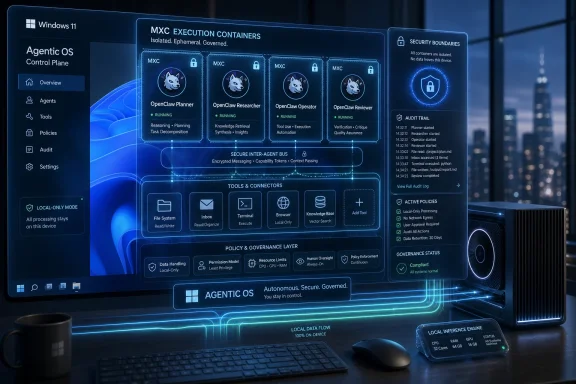 Windows Is No Longer Just Hosting AI — It Is Becoming the Control Plane
For most of the Windows 11 era, Microsoft’s AI strategy has looked like a layer of branded assistance bolted onto an old desktop bargain. Copilot sat in the taskbar, Recall became a privacy lightning rod, and “AI PC” mostly meant a neural processing unit waiting for software that justified its existence. Build 2026 sharpened the pitch: Windows is not merely an endpoint that runs AI apps, but the operating environment where agents are identified, contained, monitored, and allowed to act.That distinction matters. A chatbot answers; an agent does. Once software can edit files, invoke tools, query private data, talk to other services, and chain actions together, the operating system has to decide whether the agent is closer to an application, a user, a process, a service account, or a potentially hostile insider.
Microsoft’s answer appears to be: all of the above. The company’s Microsoft Execution Containers, or MXC, are being positioned as OS-enforced sandboxes for agent workloads. In plain English, Microsoft is acknowledging that agents need more than polite permission prompts. They need walls.
The rhetoric around this is predictably warm. Microsoft talks about developers staying in control, enterprises gaining manageability, and Windows becoming a trusted platform for local AI. But the subtext is colder and more interesting: if agents are powerful enough to be useful, they are powerful enough to be dangerous.
Computex Supplied the Silicon for Microsoft’s Software Ambition
The Build message landed in the same week Nvidia used Computex to push RTX Spark, a Windows-on-Arm platform built around a Blackwell-class GPU, a Grace CPU, and a very direct promise: local machines will run personal agents rather than simply call cloud models. Nvidia and Microsoft framed the PC as a machine that does the work after being asked, not just a device that waits for clicks.That is not a cosmetic hardware refresh. For years, Windows on Arm has been an awkward story of compatibility, battery life, and software inertia. Qualcomm’s Snapdragon X systems improved the case, but they did not fully change the emotional center of the PC market. Nvidia is now entering with a different argument: the future Windows machine is not primarily a thin client or a gaming laptop, but a local AI workstation for agents.
The numbers are meant to make that argument feel inevitable. RTX Spark’s advertised configuration — high unified memory, Blackwell GPU cores, and local AI throughput — is designed for models and agents that would have been laughably impractical on a mainstream laptop a few years ago. The old PC upgrade pitch was faster boot times and better graphics. The new one is autonomy.
That shift also exposes why Microsoft needs agent governance baked into Windows rather than left to application vendors. If the next wave of PCs ships with enough local compute to run multi-step agents continuously, the OS cannot pretend those agents are just another window on the desktop. They will be persistent actors with access to local context, user data, and enterprise resources.
The OpenClaw Story Is Really a Security Story
The most revealing part of Microsoft’s Build messaging was not the mere appearance of OpenClaw on Windows. It was the surrounding architecture. OpenClaw, an agent framework now being shown running with Windows integration, becomes interesting because it gives Microsoft a live example of why containment has to be an operating-system feature.A conventional app has a relatively predictable shape. It has files, permissions, processes, network calls, and a user interface. An agent is messier. It may receive an instruction, interpret it, choose a tool, call another process, revise a document, query an inbox, execute a script, and then repeat the loop based on what it finds.
That makes the security model harder. A malicious app can be blocked by reputation, permissions, antivirus, code signing, or user caution. A legitimate agent can become harmful while doing exactly what it was designed to do: generalizing across tasks. The same flexibility that makes an agent useful also makes it an unusually gifted confused deputy.
MXC is Microsoft’s attempt to make that flexibility survivable. Rather than treating an agent as a magical assistant with ambient access to the user’s world, the OS can treat it as a contained identity with policy boundaries. That means the agent’s access can be limited, audited, and revoked in a way that resembles enterprise identity management more than consumer app permissions.
The industry has been here before, but never quite at this layer. Browsers got sandboxes because arbitrary web code was too risky to trust. Mobile operating systems got app permissions because pocket computers carried microphones, cameras, and location data. Agentic Windows needs containment because the software is no longer merely displaying information — it is acting on it.
The Privacy Fight Did Not End With Recall
Microsoft will insist, as it has throughout the AI PC cycle, that local processing is a privacy win. In one sense, that is true. Running models and agents on-device can reduce the amount of personal or corporate data sent to remote servers. For regulated industries and latency-sensitive workflows, local inference is not just convenient; it may be a requirement.But local does not automatically mean private. A system that continuously indexes, summarizes, watches, or interprets user activity still creates a new concentration of sensitive information. Whether that data leaves the machine is only one part of the risk. The other is what exists on the machine, who can query it, how long it persists, and what happens when an attacker compromises the account or the agent runtime.
This is why the ghost of Recall still hangs over Microsoft’s agentic ambitions. Recall’s original pitch — a searchable memory of PC activity — collided with a simple public fear: users do not want their machines keeping a richly indexed diary of everything they do unless the controls are obvious, trustworthy, and off by default where necessary. Microsoft later reworked Recall’s security and deployment posture, but the lesson remains.
Agentic computing intensifies that concern. An agent does not merely need memory; it needs context. It needs to know what the user is working on, what documents matter, what meetings are coming, which files are sensitive, which apps are relevant, and which actions are permissible. That is the raw material of usefulness. It is also the raw material of surveillance.
The key word here is not “AI.” It is observability. Windows agents require a more observable PC, and observability is always a governance problem before it is a feature.
Microsoft Is Trying to Pre-Solve the Enterprise Objection
For consumers, the agentic Windows pitch will arrive as convenience. For enterprise IT, it arrives as an audit question. Who authorized this agent? What data can it read? Can it write to SharePoint? Can it send email? Can it run code? Can it exfiltrate sensitive information through a sanctioned app? Can it be disabled by policy?Microsoft knows this audience well. The company’s strength is not merely that it owns Windows, Office, Azure, Entra, Defender, Intune, and Purview. It is that it can connect the story across all of them. An agent on Windows can be presented not as a random desktop assistant, but as a managed identity inside a broader Microsoft security and compliance estate.
That is the strategic genius of the move. Microsoft does not have to win the AI interface war solely by making the friendliest assistant. It can win by making the only agent platform a chief information security officer can plausibly approve at scale. If agents are inevitable, Microsoft wants Windows to be where they are governed.
This is also where the company’s incentives become complicated. The same integration that gives IT departments control also deepens Microsoft’s hold on the enterprise stack. Agent governance tied to Entra, Defender, Intune, and Purview will be attractive because it is familiar. It will also make non-Microsoft agent ecosystems feel riskier, even when they are technically capable.
That pattern is not new. Microsoft has spent decades converting platform anxiety into administrative comfort. The agentic era gives it another chance.
The User Is Being Moved From Operator to Supervisor
The desktop metaphor was built around direct manipulation. You opened a file, clicked a menu, dragged an icon, launched a program, saved a document, and shut the machine down. Even when Windows was frustrating, the implied relationship was clear: the user acted, and the computer responded.Agents soften that boundary. The user sets an intent, and the machine decides how to pursue it. That may sound liberating when the task is tedious — organize these receipts, prepare a briefing, reconcile these spreadsheets, summarize this folder, fix this codebase. It feels less liberating when the task touches private judgment, ambiguous authority, or irreversible action.
The next interface battle will therefore be less about windows and widgets than consent and reversibility. Can the user preview every action? Can the agent act only in a staged environment? Can it request elevation for specific steps? Can it explain why it chose a tool? Can it be forced to forget? Can it be prevented from inferring sensitive facts?
These are not philosophical niceties. They are product requirements. A Windows agent that saves ten minutes but occasionally edits the wrong file will be hated. An enterprise agent that increases productivity while creating unclear liability will be blocked. An assistant that cannot explain its authority will be distrusted, even if it is technically impressive.
That is why MXC and OS-enforced identity may prove more important than any demo of an agent completing a workflow. The magic trick is not the agent doing something. The magic trick is the agent doing it inside boundaries a human can understand.
The “Agentic OS” Label Is Both Hype and Warning
There is a temptation to dismiss the phrase “agentic operating system” as trade-show inflation. The PC industry loves epochal language, especially when it needs to sell new hardware. We have had multimedia PCs, Internet PCs, cloud PCs, creator PCs, Copilot+ PCs, and now agentic PCs.But hype can still describe a real transition. The agentic label is useful because it identifies where the center of gravity is moving. The operating system is becoming less about launching applications and more about mediating action among users, agents, data stores, devices, and cloud services.
That does not mean the old desktop disappears overnight. Excel will still be Excel. File Explorer will still matter. Administrators will still image machines, push policies, chase drivers, and curse printers. But a new layer is forming above and around those familiar tasks.
The risk is that Microsoft and its partners will treat “agentic” as permission to make the PC noisier, more presumptive, and more opaque. Windows users have already endured years of nags, recommendations, ads, account prompts, cloud nudges, and default-app friction. An autonomous assistant that inherits that product culture would not feel like the future. It would feel like Clippy with root privileges.
The opportunity is that Microsoft could make Windows less brittle. If agents are carefully constrained, they could become the automation layer Windows power users have always wanted but never quite received. Imagine local agents that can triage logs, explain group policy conflicts, prepare driver rollback plans, test software in containers, or generate remediation scripts without uploading everything to a remote service.
That version of agentic Windows would be genuinely useful. The question is whether Microsoft can resist turning it into another engagement surface.
Security Teams Will Judge the Platform by Failure Modes
The industry tends to demo success. Security teams buy based on failure. What happens when a prompt injection slips into a document? What happens when an agent reads a poisoned email? What happens when a local model misclassifies a destructive action as routine? What happens when a user grants broad permissions because the prompt is annoying?These are not edge cases in agentic systems. They are the normal weather. Agents consume untrusted content and then decide what to do next. That means the boundary between data and instruction becomes dangerously porous. A malicious calendar invite, README file, PDF, spreadsheet, or web page may become part of the agent’s reasoning context.
Traditional security products are not useless here, but they are incomplete. Antivirus can scan a file. EDR can observe behavior. Identity systems can enforce access. But an agent can fail in a way that looks semantically wrong rather than technically malicious. It may have permission to perform an action, and the action may be executed through legitimate tools, yet the result may still be harmful.
That is why Microsoft’s emphasis on containment is the right starting point, not the finish line. Containers can limit blast radius. Identity can narrow access. Audit logs can reconstruct decisions. Policy can prevent certain actions. None of that eliminates the need for human oversight, especially in workflows involving money, legal commitments, customer data, source code, or system configuration.
The secure agentic PC will not be the one where the assistant never makes a mistake. It will be the one where mistakes are bounded, visible, and recoverable.
Developers Are Being Recruited Into a New Windows Stack
Build is, first and last, a developer conference. Microsoft’s agentic Windows push is therefore also a recruitment drive. The company wants developers building, testing, and deploying agent workloads on Windows rather than treating the PC as an inconvenient front end to cloud-hosted AI.That is partly about cost. Local AI can reduce cloud inference bills, especially for repetitive workflows and developer tooling. It is partly about latency. Some experiences feel magical only when they respond immediately. It is partly about privacy and regulation. Certain data should not leave the device or tenant environment.
But it is also about platform gravity. If developers build agents that assume Windows identity, Windows containment, Windows local models, Windows developer tooling, and Microsoft cloud governance, then Windows becomes more than a supported endpoint. It becomes the default execution environment for a new class of software.
That is the real significance of Microsoft pairing Windows developer improvements with agent infrastructure. The company is not just saying “our OS can run AI.” It is saying “our OS can be the safest place to build and govern agents.” For a developer ecosystem that has spent years drifting toward web apps, containers, Linux tooling, and cloud-native workflows, that is a direct attempt to make Windows technically central again.
Whether developers believe it will depend on the quality of the implementation. Windows has made real progress as a developer machine, especially with WSL, Dev Home-style efforts, package management improvements, and better Arm support. But agent development will be unforgiving. If the tooling is slow, locked down, poorly documented, or too dependent on Microsoft services, developers will route around it.
The Global South Will Get the Same Agents With Fewer Guardrails
The agentic Windows story is often told from Redmond, San Francisco, Taipei, and the enterprise campuses of North America and Europe. But Windows remains a global platform, and its defaults travel faster than regulatory maturity. That matters in places where data protection law, procurement oversight, cyber insurance, and incident response capacity are still uneven.Kenya’s technology sector is a useful example because Nairobi’s “Silicon Savannah” is not a metaphor for passive adoption. It is a real ecosystem of fintech, logistics, government services, mobile infrastructure, and startup experimentation. If agent-capable Windows machines become mainstream, Kenyan businesses and public institutions will face the same operational questions as a bank in London or a hospital in Seattle, but often with thinner compliance teams and tighter budgets.
This is not an argument that emerging markets should avoid agentic computing. Quite the opposite. Local AI could be extraordinarily useful where connectivity is expensive, cloud costs are restrictive, and small teams need leverage. A secure local agent that helps a clinic process records, a school manage administration, or a startup automate support could have immediate value.
The problem is asymmetric risk. The same automation that helps small organizations scale can also amplify mistakes, expose sensitive data, and create new attack surfaces. If the guardrails require sophisticated licensing, enterprise identity maturity, or specialized security staff, then the safest version of agentic Windows may be available mainly to the customers who already have the most resources.
Microsoft will need to prove that agent containment and privacy controls are not merely enterprise add-ons. If agentic Windows is to become the default Windows, its safety model has to work for small businesses, schools, nonprofits, local governments, and consumers who will never read an admin guide.
The Old Off Switch Is Becoming a Policy Surface
One of the more naïve hopes in every controversial Windows feature cycle is that users can simply turn it off. Sometimes they can. Sometimes the toggle moves. Sometimes it applies to one component but not the broader platform behavior. Sometimes enterprise policy exists while consumer control remains ambiguous.Agentic Windows will make the off-switch debate more complicated. There may not be a single thing called “AI” to disable. There may be local models, cloud agents, app-specific assistants, developer tools, indexing services, enterprise-managed agents, third-party frameworks, and hardware acceleration paths. Turning off one assistant does not necessarily turn off the agentic substrate.
That is why transparency will matter more than branding. Users and administrators need to know which agents exist, which identities they run under, what data they can access, what actions they can take, and where their logs live. A settings page full of cheerful toggles will not be enough.
For managed environments, this becomes a policy architecture problem. IT departments will want defaults for agent installation, model usage, network access, file-system scope, clipboard access, email actions, code execution, data retention, and administrative elevation. They will also want reporting that distinguishes between a human user, an application, and an agent acting on behalf of the user.
For consumers, the need is simpler but no less important: the machine should not feel haunted. If Windows starts acting proactively, users must be able to see why. If an assistant suggests, edits, moves, summarizes, or schedules something, the chain of authority should be visible. Trust is not created by intelligence. It is created by intelligibility.
The PC Industry Has Found Its Post-Smartphone Narrative
The PC has spent much of the last decade as a mature platform searching for a growth story. Gaming pushed GPUs. Remote work pushed webcams and battery life. Creator workflows pushed displays and media engines. Copilot+ PCs tried to make NPUs matter. Agentic AI now offers the industry a more ambitious narrative: the PC becomes the personal work engine again.That is why Nvidia, Microsoft, Qualcomm, and OEMs are converging on similar language. They need buyers to believe that the next PC is not merely faster, but categorically different. The mouse-and-keyboard metaphor is not being discarded, but it is being demoted from the only interface to one interface among several.
The difficulty is that users do not buy narratives forever. They buy outcomes. If agentic PCs mainly produce demos, pop-ups, subscriptions, and compatibility headaches, the backlash will be brutal. The Windows audience is already skeptical because it has seen Microsoft overreach before.
But if the hardware enables local workflows that are fast, private, and meaningfully useful, the shift could stick. Developers running local coding agents, analysts processing sensitive documents on-device, administrators testing remediations in contained environments, and creators using local generative tools all have practical reasons to want more AI compute on the desk.
The agentic PC will succeed first where the value is concrete. The consumer dream of a universal digital butler may take longer. The professional dream of a contained local helper for ugly workflows is much closer.
The Windows 11 Bet Now Has a Clearer Shape
Microsoft’s Windows 11 strategy has often looked fragmented: stricter hardware requirements, Copilot branding, Arm experimentation, security baselines, Store reform, developer tooling, Recall controversy, and AI PC marketing all pulling in different directions. Build 2026 makes the pieces fit together more clearly. The destination is a Windows platform where AI agents are local, managed, hardware-accelerated, and tied into Microsoft’s identity and security stack.That does not mean the execution will be smooth. Windows remains a sprawling compatibility machine, and every new subsystem must coexist with decades of software assumptions. Agentic features also raise the stakes for bugs. A broken widget is annoying. A broken agent with write access is a governance incident.
Still, Microsoft has chosen a more credible path than pretending AI can be safely sprinkled across the desktop as a feature. By talking about execution containers, identity, manageability, and local acceleration, the company is at least engaging with the hard parts. That is progress, even if it is not reassurance.
The most honest reading is that Microsoft is trying to make Windows both more autonomous and more governable. Those goals are in tension. Autonomy wants freedom; governance wants constraint. The future of Windows will be shaped by how well Microsoft can hold that tension without collapsing into either chaos or lock-in.
The New Windows Bargain Is Written in Permissions, Not Prompts
The immediate story from Build and Computex is not that Windows 11 suddenly became sentient or that every PC user is about to be watched by a rogue assistant. The real story is more structural. Microsoft and its partners are building the hardware and software layers that make autonomous local agents normal.That gives Windows users and administrators a different checklist than the AI hype cycle usually provides:
- Microsoft is positioning Windows as an agent execution platform, not merely a host for Copilot-branded experiences.
- Nvidia’s RTX Spark push gives the agentic PC story a serious local-compute foundation, especially for high-memory, GPU-heavy workloads.
- Microsoft Execution Containers are an implicit admission that useful agents must be treated as security risks from the start.
- Local AI improves some privacy problems but creates new ones by concentrating sensitive context on the device.
- Enterprise adoption will depend less on demos than on identity, auditability, policy control, and recoverable failure modes.
- Consumers and smaller organizations will need simple, enforceable controls if agentic Windows is not to become another trust-eroding feature wave.
References
- Primary source: streamlinefeed.co.ke
Published: 2026-06-08T09:10:16.992650
Microsoft Transforms Windows 11 Into an Agentic AI Platform | Streamline
Microsoft has officially transformed Windows 11 into an agentic platform, sparking fierce industry debates over privacy, autonomous AI, and user data control.streamlinefeed.co.ke - Related coverage: windowscentral.com
Microsoft outlines its vision for “the next computer” with Project Solara, an agentic platform that exists liminally in your pocket and on your desk | Windows Central
After Windows Phone, Microsoft is eager to get ahead of the next paradigm shift in computing, and it's betting big on an agentic hardware and software future.www.windowscentral.com - Related coverage: tomshardware.com
Nvidia unveils RTX Spark Superchip for laptops and desktop PCs at Computex 2026 – new platform promises to turn Windows into an agentic AI OS with Arm CPU, Blackwell GPU, and 128GB unified memory | Tom's Hardware
Over 30 laptops and 10 desktops coming this fall with "the most efficent platform ever built"www.tomshardware.com - Official source: blogs.microsoft.com
Microsoft Build 2026: Be yourself at work - The Official Microsoft Blog
Platforms shift when developers build. We explore, choose tools, dream, create. This platform shift comes with more information than ever, ready at your fingertips. This shift, it’s about building fast AND THEN: it’s about building, operating, optimizing and observing. Securing your...blogs.microsoft.com - Official source: blogs.windows.com
Build 2026: Furthering Windows as the trusted platform for development
Build is one of our favorite moments each year - a chance to connect with the global developer community and share what we’ve been building. Over the past year, we have connected with many developers pushing the boundaries of what’s possible onblogs.windows.com - Related coverage: investor.nvidia.com
NVIDIA Corporation - NVIDIA and Microsoft Reinvent Windows PCs for the Age of Personal AI
RTX Spark — a 1-Petaflop Superchip, the Full CUDA and RTX Ecosystem, and Windows-Native Agents — a New Beginning for Personal Computers News Summary: NVIDIA RTX Spark powers the world’s first Windows PCs purpose-built for personal agents, featuring 1 petaflop of AI performance, industry-leading...investor.nvidia.com
- Related coverage: windowslatest.com
Microsoft pledges to make Windows 11 the OS for building AI, after years of Copilot backlash
Microsoft is turning Windows 11 into agent-native at Build 2026, adding local AI models and OS-level security to fix its developer platform. www.windowslatest.com
- Official source: news.microsoft.com
- Related coverage: theguardian.com
Nvidia launches ‘superchip’ putting AI power into laptops and PCs | Nvidia | The Guardian
Firm says its RTX Spark PC chip for Microsoft Windows will let AI agents replace the mouse and keyboardwww.theguardian.com - Related coverage: axios.com
Microsoft debuts Nvidia-powered Microsoft Surface Ultra laptop
Microsoft is trying again to redefine the PC for the AI era.www.axios.com
- Related coverage: techxplore.com

