

Mozilla’s new Over the Edge 2.0 report alleges that Windows 10 and Windows 11 still interfere with users who install, set, and try to keep a non-Edge browser as their default—and it says Microsoft’s own Copilot experiences can bypass that choice by opening links in Edge. The report, published July 14 and commissioned by Mozilla, lands six weeks after the Browser Choice Alliance sent Microsoft CEO Satya Nadella an open letter demanding an end to what it calls browser-choice “dark patterns.”
For Windows users, the immediate issue is not whether Edge is a capable Chromium-based browser. It is whether selecting Chrome, Firefox, Opera, Vivaldi, or another browser as the system default reliably controls every meaningful Windows entry point: search, widgets, Teams and Outlook links, setup flows, Copilot, and migration to a new PC. Mozilla’s researchers say it does not.
The Browser Choice Alliance’s June 3 letter goes further, accusing Microsoft of using Windows’ position on the PC desktop, along with commercial terms for OEMs and exclusive promotional surfaces, to restrict or distort browser competition. Its members include Google, Opera, Vivaldi, Wavebox, BrowserWorks, and Midori. These are allegations from Microsoft’s browser rivals, not findings by a regulator or court—but the accompanying research makes a more concrete claim: Microsoft has already shown it can offer a less intrusive experience in Europe.
The central finding of Over the Edge 2.0 is that choosing another default browser does not consistently stop Windows from steering a user back to Edge. Independent researchers Harry Brignull and Cennydd Bowles tested browser-choice journeys on Windows 10 and Windows 11 in the United States, United Kingdom, India, and Germany.
They documented design patterns ranging from trick wording and visual interference to preselected choices, nagging, obstruction, and forced actions. The report argues that those techniques appear at multiple points: downloading a rival browser through Bing, visiting a Chrome download page in Edge, setting a default, and continuing to use that alternative after an update or device transition.
Some of these complaints will be familiar to experienced Windows users. A default browser setting has historically not covered every Microsoft-controlled URI handler or shell integration. Windows Search, Widgets, and certain Microsoft 365 touchpoints have been recurring examples where Edge could be invoked even after a user selected Firefox or Chrome for ordinary HTTP and HTTPS links.
The Browser Choice Alliance says this fragmentation is the point. Its letter demands that all web links respect the selected system browser, that Microsoft restore a clear one-click default switch across relevant file types and apps, and that it stop using updates or Microsoft-owned banners to re-promote Edge. The group also calls for browser makers to be able to compete for OEM preinstallation and default placements.
Microsoft’s position is not included in Mozilla’s report or the alliance’s open letter. That distinction matters: the report describes observed user-interface behavior and interprets it through established definitions of harmful or deceptive design; it does not establish an antitrust violation on its own.
That is more consequential than another browser prompt. Copilot is increasingly positioned across Windows, Edge, Microsoft 365, and search-adjacent experiences. Each place where it can decide which browser opens a result becomes another point where a default-browser preference can be made conditional.
Mozilla’s researchers also describe what they call a possible “pipeline” of consent prompts across Windows and Edge. Their concern is that separately presented data-sharing choices may, in combination, route more browsing-related information into Microsoft personalization and advertising systems—including activity originating in a rival browser. The report frames that as a potential outcome, not proof that Microsoft is collecting every competitor-browser activity stream in the manner alleged.
This is where the discussion becomes more than an old Edge-versus-Chrome argument. A browser is the gateway to search, cloud applications, AI assistants, identity, synchronization, and advertising. The company that controls the default browser—or repeatedly gets a second chance to replace it—can influence where search queries go, which account is used, what telemetry is available, and which AI service becomes the user’s habit.
If that behavior is reproducible across standard consumer migrations, it is a practical concern for IT teams as well as home users. Windows 10 reached end of support in October 2025, so organizations and consumers are still moving devices, replacing hardware, or refreshing images around Windows 11. Browser configuration is often tied to extension policy, password-manager deployment, SSO behavior, web-app compatibility, and security tooling.
A restored machine that silently returns to Edge will not necessarily break an environment. But it can create hard-to-diagnose changes: a web app opens under a different profile, a required extension is absent, an employee signs into a different account, or a conditional-access workflow behaves differently. In managed environments, the correct response is not to rely on the consumer-facing default-browser setting alone.
Administrators should validate browser behavior after feature upgrades, device replacement, Windows Backup restores, and major Microsoft 365 changes. That includes testing search links, Widgets, Teams and Outlook links, Copilot results, PDFs, HTTP/HTTPS associations, and first-run experiences. If a browser standard is operationally important, enforce it through supported policy and configuration management, then verify the actual launch behavior rather than assuming the Settings app is the final authority.
According to Mozilla, Microsoft removed the Bing panel that tells users “All you need is right here” in the EEA, along with the Windows 10 “You’re almost done setting up your PC” journey used to encourage Edge adoption. The researchers also report that Copilot data toggles default to Off in the EEA and UK, while defaulting to On in the United States and India.
The European Commission has previously said that Microsoft made Edge and Bing uninstallable on Windows in the EEA and ended recommendations to set Edge as the default in various Windows experiences there, while keeping the company’s compliance plan under review. Mozilla’s interpretation is blunt: the regional split demonstrates that these are product-design choices, not unavoidable technical constraints.
That does not mean the EEA experience is free of steering. The report says some harmful patterns persist there too. But it makes a damaging argument for Microsoft’s global approach: if Windows can treat browser preference more consistently where regulatory obligations are strongest, users outside Europe have reason to ask why that respect does not travel with the same Windows codebase.
For users, the near-term lesson is straightforward: a default setting is worth checking after a Windows upgrade, a PC migration, or a major Copilot and Microsoft 365 update. For administrators, it is another reason to treat browser selection as a managed configuration with post-update validation.
For Microsoft, the harder question is whether Edge will compete primarily on its feature set—or whether Windows will continue to supply the browser with privileged routes around a user’s stated choice.
For Windows users, the immediate issue is not whether Edge is a capable Chromium-based browser. It is whether selecting Chrome, Firefox, Opera, Vivaldi, or another browser as the system default reliably controls every meaningful Windows entry point: search, widgets, Teams and Outlook links, setup flows, Copilot, and migration to a new PC. Mozilla’s researchers say it does not.
The Browser Choice Alliance’s June 3 letter goes further, accusing Microsoft of using Windows’ position on the PC desktop, along with commercial terms for OEMs and exclusive promotional surfaces, to restrict or distort browser competition. Its members include Google, Opera, Vivaldi, Wavebox, BrowserWorks, and Midori. These are allegations from Microsoft’s browser rivals, not findings by a regulator or court—but the accompanying research makes a more concrete claim: Microsoft has already shown it can offer a less intrusive experience in Europe.
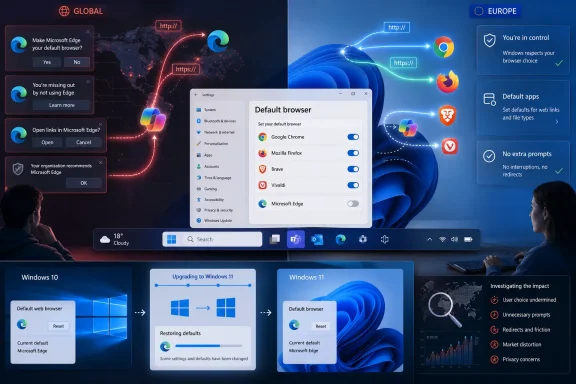 The default browser remains less than system-wide
The central finding of Over the Edge 2.0 is that choosing another default browser does not consistently stop Windows from steering a user back to Edge. Independent researchers Harry Brignull and Cennydd Bowles tested browser-choice journeys on Windows 10 and Windows 11 in the United States, United Kingdom, India, and Germany.They documented design patterns ranging from trick wording and visual interference to preselected choices, nagging, obstruction, and forced actions. The report argues that those techniques appear at multiple points: downloading a rival browser through Bing, visiting a Chrome download page in Edge, setting a default, and continuing to use that alternative after an update or device transition.
Some of these complaints will be familiar to experienced Windows users. A default browser setting has historically not covered every Microsoft-controlled URI handler or shell integration. Windows Search, Widgets, and certain Microsoft 365 touchpoints have been recurring examples where Edge could be invoked even after a user selected Firefox or Chrome for ordinary HTTP and HTTPS links.
The Browser Choice Alliance says this fragmentation is the point. Its letter demands that all web links respect the selected system browser, that Microsoft restore a clear one-click default switch across relevant file types and apps, and that it stop using updates or Microsoft-owned banners to re-promote Edge. The group also calls for browser makers to be able to compete for OEM preinstallation and default placements.
Microsoft’s position is not included in Mozilla’s report or the alliance’s open letter. That distinction matters: the report describes observed user-interface behavior and interprets it through established definitions of harmful or deceptive design; it does not establish an antitrust violation on its own.
Copilot expands the number of ways Windows can override preference
The new wrinkle is Copilot. Mozilla says the report found that links opened through Microsoft’s AI assistant can launch in Edge rather than in the user’s chosen default browser. If borne out broadly, that turns the AI assistant into another privileged routing layer in Windows rather than a neutral client of the user’s existing settings.That is more consequential than another browser prompt. Copilot is increasingly positioned across Windows, Edge, Microsoft 365, and search-adjacent experiences. Each place where it can decide which browser opens a result becomes another point where a default-browser preference can be made conditional.
Mozilla’s researchers also describe what they call a possible “pipeline” of consent prompts across Windows and Edge. Their concern is that separately presented data-sharing choices may, in combination, route more browsing-related information into Microsoft personalization and advertising systems—including activity originating in a rival browser. The report frames that as a potential outcome, not proof that Microsoft is collecting every competitor-browser activity stream in the manner alleged.
This is where the discussion becomes more than an old Edge-versus-Chrome argument. A browser is the gateway to search, cloud applications, AI assistants, identity, synchronization, and advertising. The company that controls the default browser—or repeatedly gets a second chance to replace it—can influence where search queries go, which account is used, what telemetry is available, and which AI service becomes the user’s habit.
A Windows 10-to-11 move can quietly reset the choice
One of the report’s sharpest allegations concerns Windows Backup during migration from Windows 10 to Windows 11. The researchers say that when they backed up a Windows 10 machine where an alternative browser was installed and set as default, then restored it to a new Windows 11 PC, the rival browser was not transferred and Edge became the default without an explicit choice.If that behavior is reproducible across standard consumer migrations, it is a practical concern for IT teams as well as home users. Windows 10 reached end of support in October 2025, so organizations and consumers are still moving devices, replacing hardware, or refreshing images around Windows 11. Browser configuration is often tied to extension policy, password-manager deployment, SSO behavior, web-app compatibility, and security tooling.
A restored machine that silently returns to Edge will not necessarily break an environment. But it can create hard-to-diagnose changes: a web app opens under a different profile, a required extension is absent, an employee signs into a different account, or a conditional-access workflow behaves differently. In managed environments, the correct response is not to rely on the consumer-facing default-browser setting alone.
Administrators should validate browser behavior after feature upgrades, device replacement, Windows Backup restores, and major Microsoft 365 changes. That includes testing search links, Widgets, Teams and Outlook links, Copilot results, PDFs, HTTP/HTTPS associations, and first-run experiences. If a browser standard is operationally important, enforce it through supported policy and configuration management, then verify the actual launch behavior rather than assuming the Settings app is the final authority.
Europe shows that a different design is possible
Mozilla’s strongest evidence is comparative. The researchers found fewer harmful patterns when Windows was configured for Germany, representing the European Economic Area, than when it was configured for the United States, United Kingdom, or India.According to Mozilla, Microsoft removed the Bing panel that tells users “All you need is right here” in the EEA, along with the Windows 10 “You’re almost done setting up your PC” journey used to encourage Edge adoption. The researchers also report that Copilot data toggles default to Off in the EEA and UK, while defaulting to On in the United States and India.
The European Commission has previously said that Microsoft made Edge and Bing uninstallable on Windows in the EEA and ended recommendations to set Edge as the default in various Windows experiences there, while keeping the company’s compliance plan under review. Mozilla’s interpretation is blunt: the regional split demonstrates that these are product-design choices, not unavoidable technical constraints.
That does not mean the EEA experience is free of steering. The report says some harmful patterns persist there too. But it makes a damaging argument for Microsoft’s global approach: if Windows can treat browser preference more consistently where regulatory obligations are strongest, users outside Europe have reason to ask why that respect does not travel with the same Windows codebase.
The next test is whether Microsoft changes behavior globally
The Browser Choice Alliance is asking Microsoft to make browser choice simple, transparent, and worldwide—not merely a compliance feature for specific markets. Its demands include ending promotional interference during rival-browser downloads, respecting the system default across Windows links, stopping default resets after updates, and removing restrictions that prevent third-party browsers on existing Windows S mode devices.For users, the near-term lesson is straightforward: a default setting is worth checking after a Windows upgrade, a PC migration, or a major Copilot and Microsoft 365 update. For administrators, it is another reason to treat browser selection as a managed configuration with post-update validation.
For Microsoft, the harder question is whether Edge will compete primarily on its feature set—or whether Windows will continue to supply the browser with privileged routes around a user’s stated choice.
References
- Primary source: MediaPost
Published: 2026-07-15T16:20:09.317728
Microsoft Accused Of Browser Abuse 07/15/2026
Microsoft Accused Of Browser Abuse - 07/15/2026www.mediapost.com - Related coverage: elevenforum.com
Browser Choice Alliance Open Letter to Microsoft - Enough is Enough | Windows 11 Forum
Browser Choice Alliance: Dear Satya Nadella, Microsoft CEO, Our global coalition of innovative developers promotes genuine competition and users’ freedom...www.elevenforum.com - Related coverage: mlex.com
Microsoft's Windows operating system favors Edge, Browser Choice Alliance says | MLex | Specialist news and analysis on legal risk and regulation
MLex Summary: The Browser Choice Alliance, a coalition of web browser providers including Chrome, Vivaldi and Opera, said that Microsoft "restrict, distort and subvert user choice" of browser by promoting Edge through its Windows operating system. In a letter sent on Wednesday...www.mlex.com