

Mozilla’s Over The Edge 2.0 report says Windows 10, Windows 11, Microsoft Edge, Bing, and Copilot still interfere with attempts to install and retain a competing default browser. The researchers found a crucial regional split, however: several of the tactics disappear or become less aggressive on PCs configured for the European Economic Area, showing that Microsoft already has the technical ability to offer a less coercive experience.
Published July 14, the investigation was conducted by deceptive-design specialists Dr. Harry Brignull and Cennydd Bowles, who also produced the original Over The Edge report two years ago. Mozilla commissioned both studies but says the researchers controlled the methodology and conclusions; screenshots and recorded user journeys have also been placed in a public database for examination.
The new report tests browser-related journeys in the United States, India, the United Kingdom, and Germany, using Germany as its representative EEA market. Its conclusion is not that Windows prevents another browser from running, but that Microsoft surrounds browser choice with what the researchers classify as harmful design patterns: trick wording, obstruction, visual interference, preselection, nagging, and forced action.
That distinction matters. Microsoft can correctly say that Windows users are permitted to download Firefox, Chrome, or another browser and make it their default. The researchers’ argument is that nominal permission does not amount to a free choice when the operating system, search engine, browser, and AI assistant repeatedly favor Edge before, during, and after that decision.
The report examines three practical tasks: downloading an alternative browser, setting it as the default, and continuing to use it without subsequent interference. That broader framing captures behavior that a simple inspection of Settings > Apps > Default apps would miss.
A user may begin in Edge because it ships with Windows, search Bing for a rival browser, dismiss messages promoting Edge, complete a download, respond to another recommendation during installation, and then navigate Windows’ default-app controls. Later prompts, setup screens, system links, migrations, and Microsoft services can create additional opportunities to reopen Edge or restore Microsoft-recommended settings.
According to Mozilla’s summary, Brignull and Bowles continued to find harmful patterns at nearly every stage across all four regions. One example removed in the EEA is Bing’s “All you need is right here” panel, which attempts to discourage users searching for another browser. The researchers also found that the Windows 10 “You’re almost done setting up your PC” flow was absent as a browser-choice pressure point in the European configuration they tested.
The report’s most consequential Windows finding concerns migration. The researchers backed up a Windows 10 PC configured with an alternative default browser and restored that backup to a Windows 11 device. They report that the competing browser did not transfer and that Microsoft Edge silently became the default on the new installation.
Some reset is understandable when an application is not installed on the destination machine; Windows cannot assign web protocols to software that is not present. The harder question is whether Windows Backup communicates that limitation clearly and helps restore the user’s previous browser, rather than quietly treating Edge as a fresh expression of preference.
This is increasingly relevant after standard support for Windows 10 ended on October 14, 2025. Organizations can use Extended Security Updates and other supported arrangements, but migrations to Windows 11 remain a major operational project. For administrators, any setting that Windows Backup does not preserve should be treated as part of application deployment and post-migration validation rather than assumed to follow the user.
That behavior turns the browser-choice debate into an AI-integration issue. As Copilot becomes an entry point for research, recommendations, documents, and web results, its link handling can determine which browser receives a growing share of ordinary browsing activity. A default that is respected in an email client but bypassed in an AI assistant is not a system-wide default in the way most users understand the term.
The researchers also raise concerns about a potential data “pipeline” built from consent prompts distributed across Windows and Edge. Their theory is that several individually presented settings may collectively allow browsing-related information, potentially including activity originating outside Edge, to feed Microsoft’s personalization and advertising systems.
That part of the report warrants careful reading rather than an assumption that every possible data flow has been proven. Mozilla’s research page describes it as a pipeline the researchers suggest may exist, not a fully demonstrated transfer of every rival browser’s history into Microsoft advertising. Even so, the regional defaults provide a concrete comparison: Mozilla says relevant Copilot data toggles were switched on by default in the US and India but off by default in the UK and EEA.
For enterprise administrators, policy remains more important than the consumer default. Organizations managing Copilot, Edge, diagnostic data, connected experiences, and default application associations through Microsoft Intune or Group Policy should continue to define those settings explicitly. The report’s value for IT teams is less about proving that every managed tenant is affected and more about identifying assumptions that should be tested against an organization’s actual Windows build, Edge version, licensing, geography, and policy configuration.
Microsoft has publicly documented a series of EEA-specific changes made for compliance with the European Union’s Digital Markets Act. On Windows 10 and Windows 11 in that region, the expanded “Set default” operation can associate additional web link and file types with the chosen browser, including formats such as XHTML, SVG, and XML. A registered browser can also be selected for PDF files and pinned during the same process.
Microsoft’s Windows Insider blog further states that EEA versions allow Windows Search and Start experiences to open web content in the chosen default browser. Since Edge 137.0.3296.52, released May 29, 2025, Edge is also supposed to avoid prompting EEA users to make it the default unless they deliberately open Edge itself. Microsoft additionally permits Edge to be uninstalled in the EEA and says other Microsoft applications should not pressure users to reinstall it, subject to limited exceptions involving Edge-based web applications.
Outside the EEA, Microsoft’s own support documentation still describes Edge as a core Windows component that cannot be uninstalled. The company says users nevertheless remain free to install other browsers and change their defaults at any time.
Those two positions expose the center of the dispute. Microsoft treats bundling Edge and recommending its own services as part of delivering an integrated Windows product. Mozilla and the independent researchers argue that the integration becomes manipulative when Microsoft controls the operating system surfaces through which users discover, install, select, and repeatedly return to a browser.
The UK result adds nuance. It is outside the EEA and therefore does not receive the entire DMA-oriented Windows experience, but the researchers found some UK Copilot data settings defaulted to off, matching the EEA rather than the US and India. Regulation and privacy requirements can therefore affect individual controls without producing one uniform “European” edition of Windows.
Mozilla has an obvious commercial and strategic interest: Firefox competes with Edge, and browser defaults influence market share. That interest does not invalidate the documented journeys, but it makes the report’s transparency important. Readers can inspect the methodology and screenshots rather than treating Mozilla’s characterization as neutral vendor guidance.
The practical takeaway is that Microsoft’s regional differences are product decisions, not technical necessities. Windows already contains mechanisms that more consistently honor another default browser, reduce Edge prompts, and expose less aggressive data defaults. The unresolved issue is whether Microsoft will extend those choices beyond jurisdictions that compel it—or continue shipping materially different definitions of user choice according to where a Windows PC is activated.
Published July 14, the investigation was conducted by deceptive-design specialists Dr. Harry Brignull and Cennydd Bowles, who also produced the original Over The Edge report two years ago. Mozilla commissioned both studies but says the researchers controlled the methodology and conclusions; screenshots and recorded user journeys have also been placed in a public database for examination.
The new report tests browser-related journeys in the United States, India, the United Kingdom, and Germany, using Germany as its representative EEA market. Its conclusion is not that Windows prevents another browser from running, but that Microsoft surrounds browser choice with what the researchers classify as harmful design patterns: trick wording, obstruction, visual interference, preselection, nagging, and forced action.
That distinction matters. Microsoft can correctly say that Windows users are permitted to download Firefox, Chrome, or another browser and make it their default. The researchers’ argument is that nominal permission does not amount to a free choice when the operating system, search engine, browser, and AI assistant repeatedly favor Edge before, during, and after that decision.
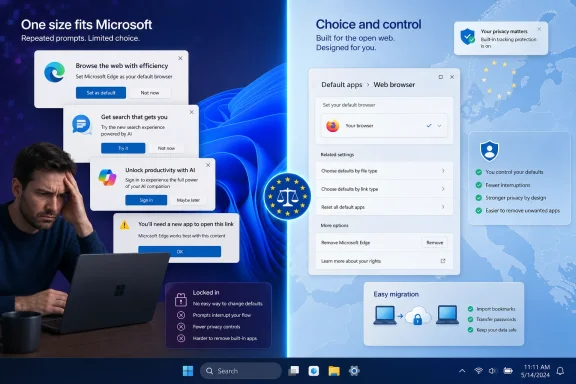 Browser Choice Is a Journey, Not One Default Button
The report examines three practical tasks: downloading an alternative browser, setting it as the default, and continuing to use it without subsequent interference. That broader framing captures behavior that a simple inspection of Settings > Apps > Default apps would miss.A user may begin in Edge because it ships with Windows, search Bing for a rival browser, dismiss messages promoting Edge, complete a download, respond to another recommendation during installation, and then navigate Windows’ default-app controls. Later prompts, setup screens, system links, migrations, and Microsoft services can create additional opportunities to reopen Edge or restore Microsoft-recommended settings.
According to Mozilla’s summary, Brignull and Bowles continued to find harmful patterns at nearly every stage across all four regions. One example removed in the EEA is Bing’s “All you need is right here” panel, which attempts to discourage users searching for another browser. The researchers also found that the Windows 10 “You’re almost done setting up your PC” flow was absent as a browser-choice pressure point in the European configuration they tested.
The report’s most consequential Windows finding concerns migration. The researchers backed up a Windows 10 PC configured with an alternative default browser and restored that backup to a Windows 11 device. They report that the competing browser did not transfer and that Microsoft Edge silently became the default on the new installation.
Some reset is understandable when an application is not installed on the destination machine; Windows cannot assign web protocols to software that is not present. The harder question is whether Windows Backup communicates that limitation clearly and helps restore the user’s previous browser, rather than quietly treating Edge as a fresh expression of preference.
This is increasingly relevant after standard support for Windows 10 ended on October 14, 2025. Organizations can use Extended Security Updates and other supported arrangements, but migrations to Windows 11 remain a major operational project. For administrators, any setting that Windows Backup does not preserve should be treated as part of application deployment and post-migration validation rather than assumed to follow the user.
Copilot Creates Another Route Into Edge
Over The Edge 2.0 expands its scope beyond the conventional browser and default-app interfaces to Microsoft Copilot. The researchers found that links opened through Copilot could be displayed through Edge rather than the browser selected as the Windows default.That behavior turns the browser-choice debate into an AI-integration issue. As Copilot becomes an entry point for research, recommendations, documents, and web results, its link handling can determine which browser receives a growing share of ordinary browsing activity. A default that is respected in an email client but bypassed in an AI assistant is not a system-wide default in the way most users understand the term.
The researchers also raise concerns about a potential data “pipeline” built from consent prompts distributed across Windows and Edge. Their theory is that several individually presented settings may collectively allow browsing-related information, potentially including activity originating outside Edge, to feed Microsoft’s personalization and advertising systems.
That part of the report warrants careful reading rather than an assumption that every possible data flow has been proven. Mozilla’s research page describes it as a pipeline the researchers suggest may exist, not a fully demonstrated transfer of every rival browser’s history into Microsoft advertising. Even so, the regional defaults provide a concrete comparison: Mozilla says relevant Copilot data toggles were switched on by default in the US and India but off by default in the UK and EEA.
For enterprise administrators, policy remains more important than the consumer default. Organizations managing Copilot, Edge, diagnostic data, connected experiences, and default application associations through Microsoft Intune or Group Policy should continue to define those settings explicitly. The report’s value for IT teams is less about proving that every managed tenant is affected and more about identifying assumptions that should be tested against an organization’s actual Windows build, Edge version, licensing, geography, and policy configuration.
Europe Shows Microsoft Can Build a Different Windows
The strongest evidence in the report is not any single prompt. It is the fact that Windows behaves differently by jurisdiction.Microsoft has publicly documented a series of EEA-specific changes made for compliance with the European Union’s Digital Markets Act. On Windows 10 and Windows 11 in that region, the expanded “Set default” operation can associate additional web link and file types with the chosen browser, including formats such as XHTML, SVG, and XML. A registered browser can also be selected for PDF files and pinned during the same process.
Microsoft’s Windows Insider blog further states that EEA versions allow Windows Search and Start experiences to open web content in the chosen default browser. Since Edge 137.0.3296.52, released May 29, 2025, Edge is also supposed to avoid prompting EEA users to make it the default unless they deliberately open Edge itself. Microsoft additionally permits Edge to be uninstalled in the EEA and says other Microsoft applications should not pressure users to reinstall it, subject to limited exceptions involving Edge-based web applications.
Outside the EEA, Microsoft’s own support documentation still describes Edge as a core Windows component that cannot be uninstalled. The company says users nevertheless remain free to install other browsers and change their defaults at any time.
Those two positions expose the center of the dispute. Microsoft treats bundling Edge and recommending its own services as part of delivering an integrated Windows product. Mozilla and the independent researchers argue that the integration becomes manipulative when Microsoft controls the operating system surfaces through which users discover, install, select, and repeatedly return to a browser.
The UK result adds nuance. It is outside the EEA and therefore does not receive the entire DMA-oriented Windows experience, but the researchers found some UK Copilot data settings defaulted to off, matching the EEA rather than the US and India. Regulation and privacy requirements can therefore affect individual controls without producing one uniform “European” edition of Windows.
Mozilla has an obvious commercial and strategic interest: Firefox competes with Edge, and browser defaults influence market share. That interest does not invalidate the documented journeys, but it makes the report’s transparency important. Readers can inspect the methodology and screenshots rather than treating Mozilla’s characterization as neutral vendor guidance.
The practical takeaway is that Microsoft’s regional differences are product decisions, not technical necessities. Windows already contains mechanisms that more consistently honor another default browser, reduce Edge prompts, and expose less aggressive data defaults. The unresolved issue is whether Microsoft will extend those choices beyond jurisdictions that compel it—or continue shipping materially different definitions of user choice according to where a Windows PC is activated.
References
- Primary source: The Mozilla Blog
Published: Tue, 14 Jul 2026 12:30:37 GMT
Over The Edge 2.0: what independent researchers found about browser choice on Windows
Two years after their first report about browser choice on Windows, two independent researchers publish Over The Edge 2.0.blog.mozilla.org - Official source: learn.microsoft.com
Set Microsoft Edge as the default browser on Windows and macOS | Microsoft Learn
Learn how to set Microsoft Edge as the default browserlearn.microsoft.com - Related coverage: arstechnica.com
No Bing, no Edge, no upselling: De-crufted Windows 11 coming to Europe soon - Ars Technica
Some changes will arrive for non-EU users, too, but not the easy removals.arstechnica.com - Related coverage: theregister.com
Microsoft will stop pestering Windows users about Edge in EU
: Plus, Europeans will find it easier to sideline Bing and uninstall the Windows Storewww.theregister.com - Related coverage: techzine.eu
- Official source: blogs.windows.com
